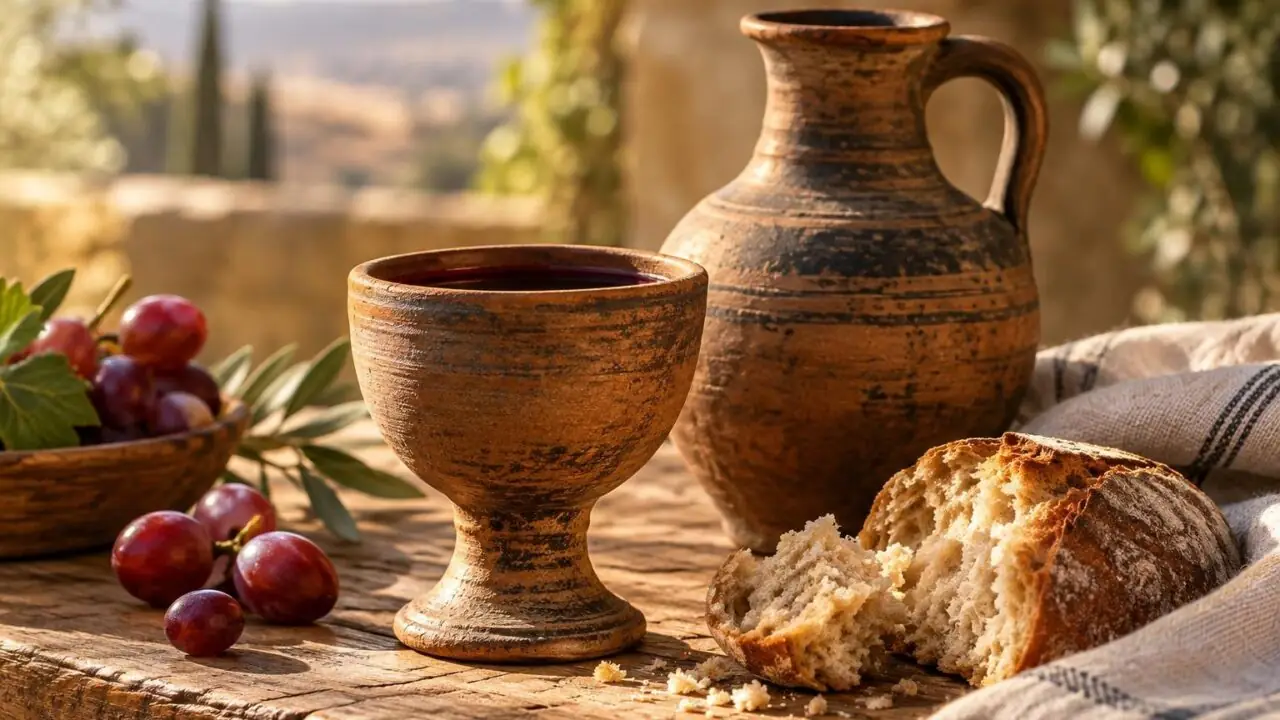
did jesus drink alcohol is answered yes: the Gospels place Jesus at meals, Passover, and a wedding where wine was served, and his critics accused him of being “a glutton and a drunkard.”.
The stronger question is what kind of drinking the texts describe. First-century Jewish wine was a normal table drink, tied to feasts, hospitality, and ritual, not presented as a license for drunkenness.
This article separates biblical evidence, historical drinking customs, and later Christian interpretation so the answer stays grounded in context rather than modern alcohol debates.
Wine in First Century Jewish Meals
Wine was not optional at formal Jewish meals in the first century—it was liturgically required.
Rabbinic literature prescribes specific quantities for ritual observance, making wine consumption a religious obligation rather than a personal choice.
The Passover Seder Requirement
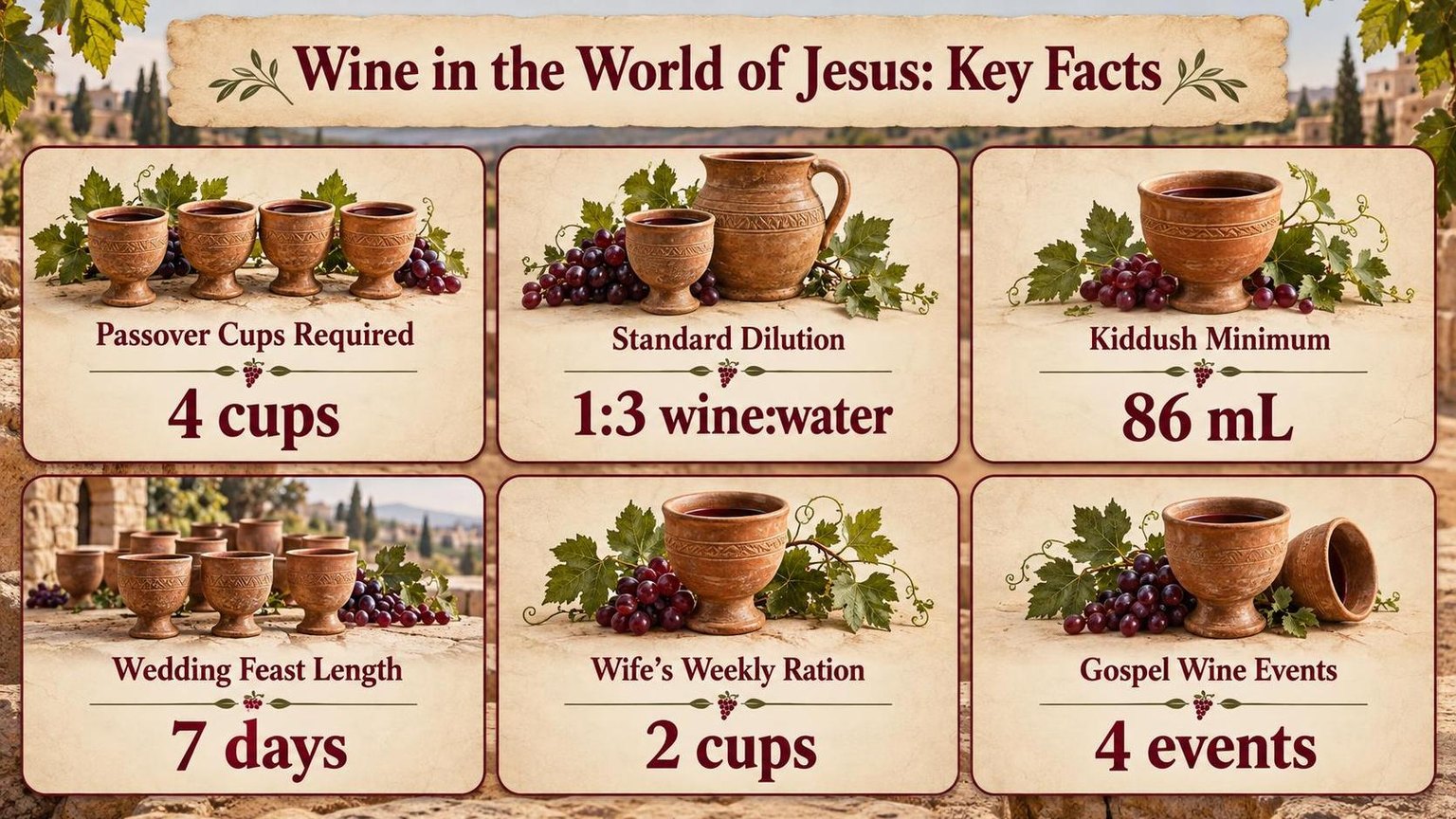
The Mishnah (Pesachim 10:1) mandates exactly four cups of wine during the Passover meal. This applied to every participant, including the poorest members of the community.
Pesachim 10:1 states that even a person sustained by the communal charity fund must be provided no fewer than four cups. The obligation was absolute, not discretionary.
Wine-to-Water Dilution Ratios
First-century Jews followed Greco-Roman convention by diluting wine with water. The Talmud (Shabbat 77a) identifies specific mixture ratios considered standard practice.
| Mixture Type | Wine | Water | Context |
| Standard table wine | 1 part | 3 parts | Common daily meals |
| Stronger mix | 1 part | 2 parts | Festive occasions |
| Kiddush minimum | 1 part | 3 parts | Sabbath blessing |
| Undiluted wine | Full strength | None | Considered uncouth |
Drinking undiluted wine was associated with barbarian customs. Rabbi Eliezer (circa 80–120 CE) ruled that wine lacking sufficient dilution could not receive the proper blessing.
Daily and Sabbath Consumption
Archaeological evidence from first-century Judean households confirms widespread wine storage. Excavations at Gamla in the Golan Heights uncovered large-capacity wine presses serving a population of roughly 5,000.
- Kiddush on Friday evening required a minimum cup of undiluted wine measuring approximately 86 milliliters (a revi’it), then diluted before drinking
- Havdalah at Sabbath’s close required a second full cup
- Wedding feasts typically lasted seven days, with wine served throughout
- The Mishnah (Ketubot 5:8) specifies a weekly wine allotment of two cups for a wife as a marital obligation
Wine at Jewish meals functioned as a sacred element tied to blessing, covenant, and community. Abstaining without a vow—such as a Nazirite vow—would have been culturally conspicuous in first-century Judea.
What the Gospels Say Jesus Drank
The four canonical Gospels reference Jesus drinking wine in multiple passages. These references use the Greek word oinos, which consistently denoted fermented grape juice throughout ancient Greek literature.
The Gospel accounts provide direct and indirect evidence of Jesus consuming alcoholic wine at specific events.
| Event | Gospel Reference | Key Detail |
| Wedding at Cana | John 2:1–11 | Jesus turned water into wine (oinos); the master of the banquet called it superior to earlier wine |
| The Last Supper | Matthew 26:27–29, Mark 14:23–25, Luke 22:17–20 | Jesus shared “the fruit of the vine” (gennēma tēs ampelou) with the Twelve |
| Accusation of drinking | Matthew 11:19, Luke 7:34 | Critics called Jesus “a glutton and a drunkard” (oinopotēs), implying visible wine consumption |
| The Cross | Mark 15:23, Matthew 27:34, John 19:29 | Offered wine mixed with myrrh (refused) and later sour wine (oxos, a vinegar-based soldier’s drink) |
Three of these four events involve Jesus willingly drinking wine. Only the myrrh-laced offering at the crucifixion was refused.
The “Fruit of the Vine” Phrase
Some scholars argue “fruit of the vine” could mean unfermented grape juice. This interpretation faces a significant problem: fresh grape juice was nearly impossible to preserve in first-century Palestine without fermentation.
Natural yeast on grape skins triggers fermentation within hours in warm climates. Pasteurization, the primary method for halting fermentation, was not developed until 1864 by Louis Pasteur.
Jesus Contrasted With John the Baptist
Luke 7:33–34 draws a deliberate contrast.
John the Baptist “came neither eating bread nor drinking wine.” Jesus “came eating and drinking.” The parallel structure confirms Jesus did drink oinos—the same word Luke uses for fermented wine throughout Acts and his Gospel.
- John the Baptist took a Nazirite-style vow avoiding wine (Luke 1:15).
- Jesus took no such vow and was publicly known to drink at meals and celebrations.
- The Pharisees’ accusation of oinopotēs (wine-drinker) only works if Jesus actually drank alcoholic wine.
The textual evidence across all four Gospels is consistent: Jesus drank fermented wine and never condemned its moderate consumption.
The Cana Miracle and Real Wine
At the wedding in Cana (John 2:1–11), Jesus transformed approximately 120–180 gallons of water into wine.
The steward’s reaction confirms this was fermented wine, not grape juice—a distinction carrying significant theological and historical weight.
Six stone water jars held 2–3 metretes each. One Greek metretes equals roughly 10 gallons, placing the total volume between 120 and 180 gallons.
| Detail | Specification |
| Number of jars | 6 stone vessels |
| Capacity per jar | 2–3 metretes (20–30 gallons) |
| Total volume produced | 120–180 gallons |
| Greek word used | οἶνος (oinos) |
| Gospel source | John 2:1–11 |
The steward told the bridegroom: “Everyone serves the good wine first, and when people have drunk freely, then the poor wine. But you have kept the good wine until now” (John 2:10, ESV).
This statement only makes sense with alcoholic wine. The verb μεθυσθῶσιν (methysthōsin) derives from methyō, meaning “to become intoxicated.” The steward referenced guests who had already consumed enough alcohol to dull their palates.
Why Grape Juice Is Historically Impossible
- Pasteurization was invented by Louis Pasteur in 1864—unpreserved grape juice ferments within 24–72 hours in warm climates like 1st-century Galilee.
- Thomas Bramwell Welch produced the first commercial unfermented grape juice in 1869, specifically to offer a communion alternative.
- Ancient Jewish sources including the Mishnah (Berakhot 6:1) classify wine as fermented, requiring the blessing “borei pri hagafen.”
- Archaeological evidence from Galilean wine presses at sites like Khirbet Qana confirms active wine production in Jesus’s region.
The Greek word oinos appears 33 times in the New Testament. Classical Greek lexicons—including Thayer’s and BDAG—define it as fermented grape wine without exception.
Jesus chose a wedding celebration to perform his first recorded miracle. He produced high-quality fermented wine in extraordinary quantity, signaling abundance rather than abstinence as the character of his ministry’s inauguration.
Last Supper Wine in Context
The Last Supper, described in all three Synoptic Gospels (Matthew 26:27–29, Mark 14:23–25, Luke 22:17–20), explicitly depicts Jesus sharing a cup of wine with his twelve disciples.
This event occurred during Passover, which carried specific wine-drinking requirements.
Passover Wine Requirements in the 1st Century
The Mishnah (Pesachim 10:1), compiled around 200 CE but reflecting earlier oral traditions, prescribed exactly four cups of wine during the Passover Seder. Even the poorest Israelite was obligated to drink all four.
| Cup | Hebrew Name | Significance |
| 1st Cup | Kos Kiddush | Sanctification — blessing over the festival |
| 2nd Cup | Kos Makkot | Plagues — recounting the Exodus narrative |
| 3rd Cup | Kos Brachah | Blessing — after the meal grace |
| 4th Cup | Kos Hallel | Praise — completion of Hallel psalms (113–118) |
Luke 22:17–20 references at least two distinct cups, aligning with this Seder structure. Most scholars identify the “cup after supper” (Luke 22:20) as the third cup, Kos Brachah.
The Greek Term Used
The Gospels use the Greek word γένημα τῆς ἀμπέλου (genēma tēs ampelou), meaning “fruit of the vine.” This phrase mirrors the traditional Hebrew blessing borei p’ri hagafen, recited specifically over fermented wine — not grape juice.
Jesus stated in Matthew 26:29 that he would “not drink of this fruit of the vine” again until the Kingdom. The declaration presupposes he was drinking actual wine at that moment.
Alcohol Content of Ancient Passover Wine
First-century Palestinian wine typically contained 8–14% alcohol by volume before dilution. Standard Greco-Roman practice mixed wine with water at ratios between 2:1 and 3:1, yielding a serving strength of roughly 3–7% ABV.
- The Mishnah (Pesachim 7:13) discusses wine dilution ratios for Passover
- Rabbi Yehuda specified a minimum mixture of one part wine to three parts water
- Undiluted wine was considered barbaric in both Jewish and Greek custom
The Last Supper accounts leave no textual ambiguity: Jesus drank fermented wine as part of a ritually prescribed Passover meal, following established Jewish practice documented across multiple independent sources.
Was Biblical Wine Alcoholic
The Hebrew word yayin and the Greek word oinos both refer to fermented grape juice. Ancient winemaking methods produced beverages with measurable alcohol content, confirmed by archaeological and textual evidence spanning millennia.
Ancient Wine Alcohol Content
Biblical-era wines typically contained 7–10% alcohol by volume (ABV) before dilution. Roman writer Pliny the Elder documented wines reaching 14–16% ABV in his Natural History (77 AD), though these were considered exceptionally strong.
| Wine Type | Estimated ABV | Source/Evidence |
| Common Palestinian wine (undiluted) | 7–10% | Archaeological residue analysis |
| Roman Falernian wine | 14–16% | Pliny the Elder, Natural History |
| Greek-Roman diluted wine (standard) | 2.5–4% | Typical 3:1 or 2:1 water-to-wine ratio |
| Fresh grape juice (unfermented) | 0% | Called tirosh in Hebrew |
Dilution Was Standard Practice
Greeks and Romans routinely mixed wine with water at ratios of 2:1 to 4:1. The Talmud (Shabbat 77a) prescribed diluting wine with three parts water. Drinking undiluted wine was considered barbaric by Greco-Roman standards.
Even diluted, the resulting beverage contained 2.5–4% ABV — comparable to modern light beer. This was not a non-alcoholic drink by any definition.
The Tirosh Distinction
Some argue that tirosh (Hebrew for “new wine” or fresh grape juice) proves biblical figures drank only unfermented juice. This claim fails on multiple grounds.
- Tirosh appears 38 times in the Old Testament, often alongside grain and oil as agricultural blessings — not as a beverage served at meals.
- Yayin appears 141 times and is the word used in narratives involving actual drinking, including Noah’s drunkenness (Genesis 9:21).
- In Hosea 4:11, tirosh itself is said to “take away understanding,” indicating even new wine carried intoxicating properties as fermentation began rapidly in warm climates.
- Without refrigeration or pasteurization, grape juice in ancient Palestine’s 30°C+ summers began fermenting within hours of pressing.
Natural yeasts on grape skins trigger fermentation immediately upon crushing. Ancient peoples had no sterile containers, sulfite preservatives, or cold storage. Keeping juice unfermented for more than 1–3 days was practically impossible.
The archaeological record confirms this.
Residue analysis from 6,000-year-old jars at Hajji Firuz Tepe in Iran — the oldest known winemaking site — revealed tartaric acid and terebinth resin, both markers of deliberate fermented wine production.
Jesus Compared With John the Baptist
The Gospels deliberately contrast Jesus and John the Baptist in their eating and drinking habits. Luke 7:33–34 records Jesus himself acknowledging this difference, using it to illustrate how critics rejected both men for opposite reasons.
| Attribute | John the Baptist | Jesus of Nazareth |
| Diet described in Scripture | Locusts and wild honey (Matthew 3:4) | Ate bread, fish, and various meals with others (Luke 7:34, John 21:13) |
| Drinking practice | Drank no wine or strong drink (Luke 1:15) | Called “a drunkard” by critics — implying regular wine consumption (Luke 7:34) |
| Social setting | Wilderness ascetic (Mark 1:4) | Frequent guest at banquets, weddings, and dinners (Luke 5:29, John 2:1–2) |
| Accusation from critics | “He has a demon” (Luke 7:33) | “A glutton and a drunkard, a friend of tax collectors and sinners” (Luke 7:34) |
| Nazirite-type vow | Angel Gabriel commanded abstinence before birth (Luke 1:15) | No such vow recorded in any Gospel |
The angel Gabriel told Zechariah that John “must never drink wine or strong drink” (Luke 1:15). This echoes the Nazirite restrictions outlined in Numbers 6:1–4.
Jesus received no comparable prohibition. The Gospels record him attending at least 6 distinct meals or feasts, including Matthew’s banquet (Luke 5:29), Simon the Pharisee’s dinner (Luke 7:36), and the wedding at Cana (John 2:1–11).
Why the Contrast Matters Theologically
Jesus used this pairing to expose the inconsistency of his critics. They called John demon-possessed for abstaining, then called Jesus a drunkard for participating. Neither lifestyle satisfied them.
- John’s abstinence signaled prophetic separation and repentance — a call to prepare for the coming kingdom.
- Jesus’s table fellowship signaled the kingdom’s arrival — celebration, inclusion, and the messianic banquet foreshadowed in Isaiah 25:6.
- The fact that Jesus did not defend himself against the drinking accusation by claiming abstinence strongly implies he did consume wine.
Scholar Craig Keener notes in The IVP Bible Background Commentary that Jesus’s willingness to feast with sinners was a deliberate prophetic sign, not casual socializing. The contrast with John was intentional and theological.
Modern Claims About Grape Juice
The argument that Biblical wine was actually unfermented grape juice originated in the 19th-century American temperance movement.
Thomas Bramwell Welch, a Methodist dentist, invented pasteurized grape juice in 1869 specifically to provide a non-alcoholic communion substitute.
Welch applied Louis Pasteur’s recently published pasteurization techniques to Concord grape juice, halting fermentation. Before this technology existed, preserving unfermented grape juice was essentially impossible in the ancient Near East.
Why Unfermented Juice Was Impractical in Antiquity
Natural yeasts on grape skins initiate fermentation within hours of crushing. Ancient Palestine lacked refrigeration and pasteurization—the two methods that prevent this process.
| Preservation Method | Invention Date | Available in 1st Century? |
| Pasteurization | 1864 (Pasteur) | No |
| Refrigeration | 1834 (Perkins) | No |
| Hermetic glass bottling | 17th century | No |
| Sulfite preservation | Limited ancient use (Roman era) | Partial — produced low-alcohol wine, not juice |
Grape harvest in ancient Judea occurred in August–September. Fresh juice would begin fermenting within 6–12 hours at ambient temperatures of 80–95°F typical of that season.
The Temperance Movement’s Influence
- In 1835, the American Temperance Society began promoting the “two-wine theory”—claiming Biblical Hebrew and Greek used the same words for both alcoholic and non-alcoholic beverages.
- Presbyterian minister William Patton published Bible Wines in 1871, arguing “yayin” could mean unfermented juice.
- Welch’s company began supplying churches with pasteurized juice in the 1870s, marketing it as “Dr. Welch’s Unfermented Wine.”
- By 1913, Welch’s son Charles had transformed the communion product into a mainstream commercial beverage.
Hebrew lexicons do not support the two-wine theory. The word yayin appears 141 times in the Old Testament. In every context where its effects are described, intoxication is clearly possible.
The grape juice claim reflects 19th-century American cultural concerns projected backward onto ancient texts rather than evidence from archaeology, linguistics, or historical fermentation science.
Frequently Asked Questions
Did Jesus drink wine according to the Bible?
Yes. The Gospels record Jesus drinking wine at multiple occasions, most explicitly at the Last Supper (Matthew 26:29, Mark 14:25, Luke 22:18) where he shared a cup with his disciples.
He also produced wine at the Wedding at Cana (John 2:1–11), an act that would be contradictory if he viewed wine consumption as inherently sinful.
Was the wine in biblical times actually alcoholic?
It was. The Greek word used throughout the New Testament is oinos, which consistently refers to fermented grape juice.
Ancient winemaking naturally produced alcohol content estimated between 5–15% ABV, and passages like Ephesians 5:18 (“do not get drunk on wine”) confirm the beverage was intoxicating.
Why did some people call Jesus “a drunkard” during his ministry?
In Matthew 11:19 and Luke 7:34, Jesus acknowledged that critics labeled him “a glutton and a drunkard, a friend of tax collectors and sinners.” This accusation, while meant as slander.
Confirms that Jesus openly ate and drank wine in social settings — a stark contrast to John the Baptist’s ascetic lifestyle of abstaining from wine (Luke 7:33).
Did Jesus drink the sour wine offered to him on the cross?
According to John 19:29–30, Jesus accepted the sour wine (Greek: oxos, a cheap vinegar-wine called posca commonly consumed by Roman soldiers) on a sponge moments before his death.
However, Mark 15:23 records that he earlier refused a separate offering of wine mixed with myrrh, likely a pain-dulling mixture, indicating a deliberate distinction between the two drinks.
Does the Bible condemn all alcohol consumption or only drunkenness?
Scripture consistently condemns drunkenness — not moderate drinking.
Proverbs 20:1 warns that wine “is a mocker,” while Psalm 104:14–15 praises God for giving “wine that gladdens human hearts.” Paul instructed Timothy to “use a little wine” for his stomach (1 Timothy 5:23).
The biblical position draws a clear line between enjoyment and excess.
What was the wine Jesus served at the Last Supper and how does it connect to Passover tradition?
The Last Supper was a Passover Seder meal, which by Jewish tradition required four cups of fermented wine — not grape juice.
The Mishnah (Pesachim 10:1) specifies that even the poorest Israelite must drink four cups of wine during Passover.
Jesus used this existing ritual cup to institute the Eucharist, stating “this cup is the new covenant in my blood” (Luke 22:20), directly linking fermented wine to one of Christianity’s central sacraments.
Related Reading
- 11 Essential Facts About How Much Is 12 Ounce (2026 Complete Conversion, Daily Use, Food & Beverage Guide)
- Popular Beers of the 70s That Defined a Decade
- How Much Ounces In A Gallon?
- How Many Calories In A 750ml Bottle Of Wine?
- How Many Litres Is 20 Gallons?
- How Many Ounces In 1 4 Pound?
- How Many Cc In A Teaspoon?
- How Much Is 200 Ml In Oz?
- What Does Bruising Mean in Bartending? 17 Things Every Bartender Should Know (2026 Guide)
- All Blog Guides
- Biblical Archaeology Society** (2023)
- National Institute on Alcohol Abuse and Alcoholism (NIAAA/NIH)** (2024)
- University of Pennsylvania Museum – Biomolecular Archaeology Project** (2023)
- PubMed – "The earliest wine of Georgia in the South Caucasus"** (2017)
- Harvard Divinity School – Religious Literacy Project** (2024)
- The Metropolitan Museum of Art – Wine in Ancient Egypt and the Near East** (2023)
- USDA FoodData Central – Wine, table, red** (2024)
- PubMed – "Alcohol consumption in the ancient world: a brief review"** (2019)
- Yale Divinity School Library – New Testament Studies Resources** (2024)