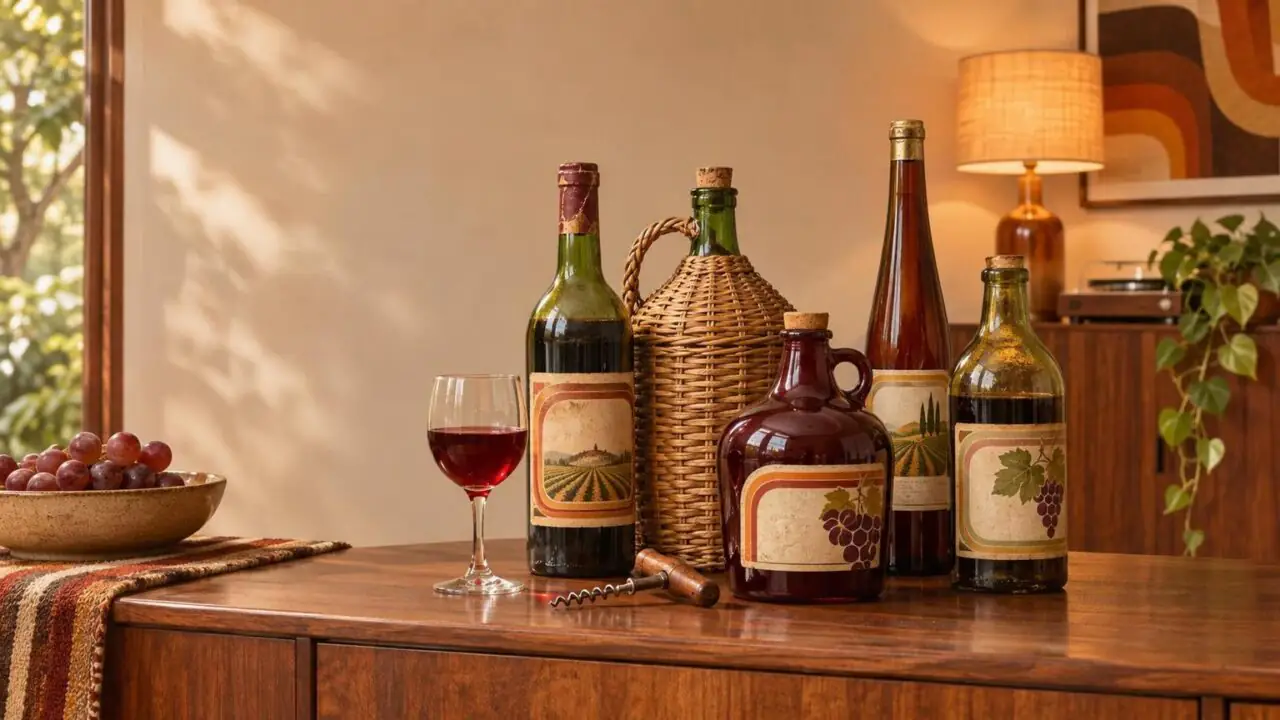
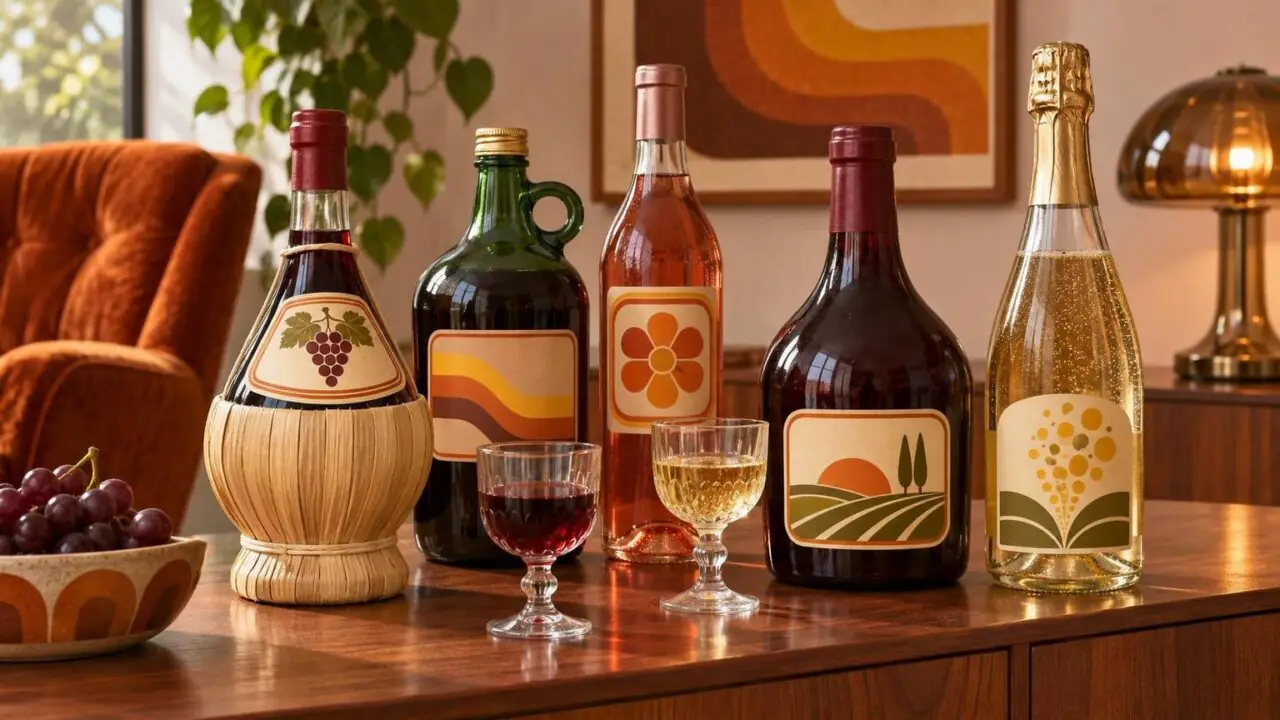
cheap wines of the 70s are inexpensive wines such as Boone’s Farm, Ripple, and Mateus Rosé, remembered for sweet flavors, recognizable bottles, and mass-market appeal.
In the United States, these labels helped make wine approachable for shoppers who wanted an affordable drink rather than a collectible vintage.
The decade’s budget selections ranged from fruit-flavored wines to large jugs of California table wine. Not every bottle was sweet, and “cheap” covered several styles.
This guide revisits the familiar brands, explains their differences, and separates documented history from nostalgic claims about what Americans drank and paid.
Why Cheap Wines Boomed in the 1970s
Cheap wines benefited from a broader American turn toward wine during the 1970s.
Large producers made bottles affordable and widely available, while sweet, fruity styles gave inexperienced drinkers an alternative to dry wines that demanded more familiarity.
A Growing Market Favored Accessible Bottles
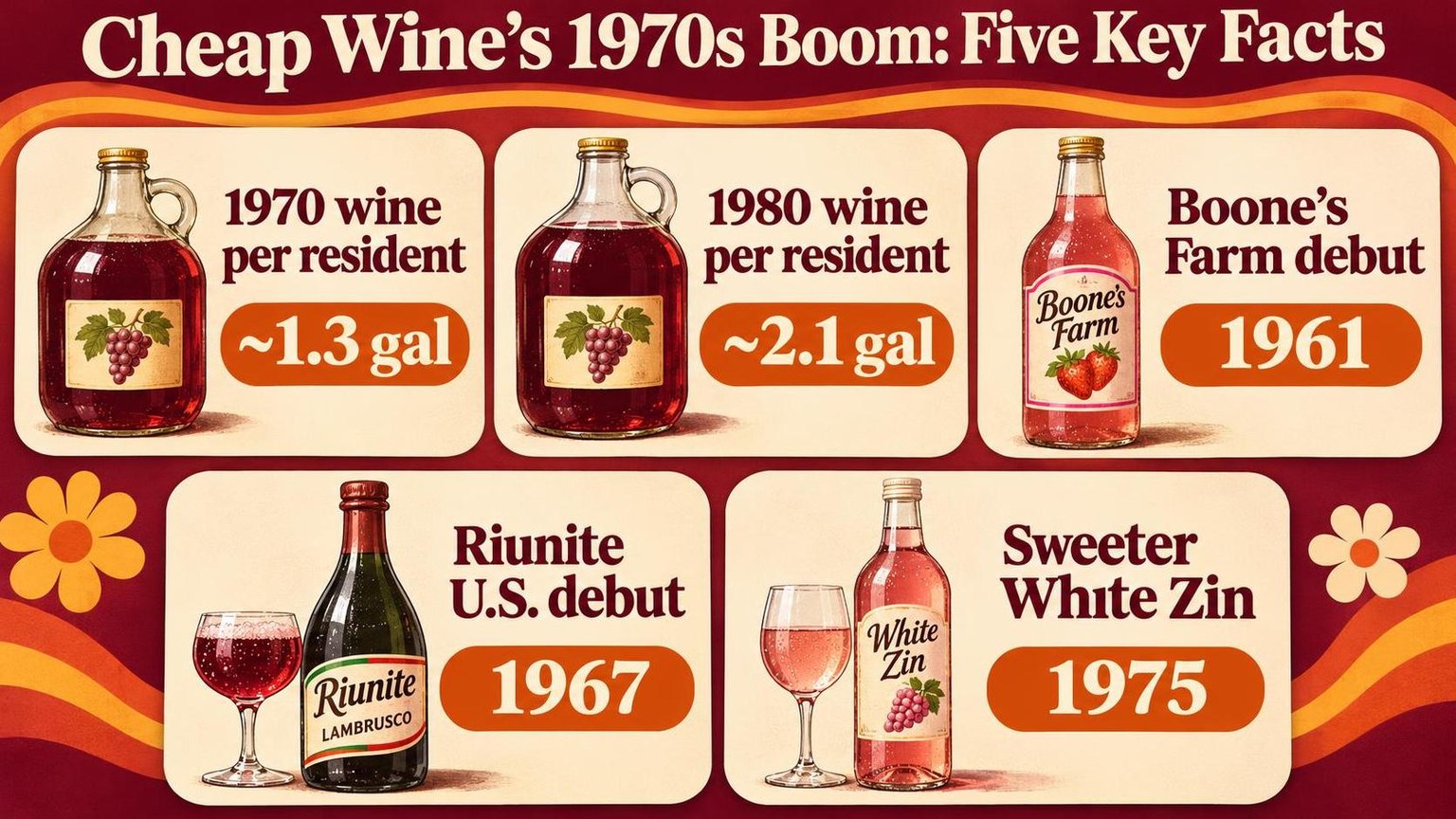
Wine Institute’s historical consumption figures show the market’s expansion. These totals cover all wine, not specifically inexpensive brands, but they establish the growing demand that budget producers could serve.
| Year | U.S. wine consumption per resident, approximately |
| 1970 | 1.3 gallons |
| 1980 | 2.1 gallons |
The per-resident measure includes the entire population, not only wine drinkers. Source: Wine Institute, “Wine Consumption in the U.S.” It should not be interpreted as the average amount consumed by an individual customer.
Sweetness and Branding Lowered the Entry Barrier
Consumers did not need to understand appellations or vintages to order Boone’s Farm, Riunite, or Blue Nun. Recognizable names and relatively consistent styles simplified shopping.
These products occupied different categories, but each offered an approachable route into wine.
- Fruit-forward flavors: Sweetness made many inexpensive wines immediately appealing to customers accustomed to soda and other sweet drinks.
- Simple serving: Chilled Lambrusco, rosé, and white wines worked without elaborate preparation or aging.
- Repeatable purchases: Brand identity helped shoppers buy a familiar taste rather than navigate unfamiliar regional labels.
Riunite entered the U.S. market in 1967, according to its importer’s brand history. Its lightly sparkling Lambrusco illustrates the appeal of wine sold around refreshment and accessibility rather than connoisseurship.
Large-Scale Production Supported Low Prices
California’s large wineries could spread production, bottling, and distribution costs across substantial volumes.
Blending helped maintain a recognizable house style, while large-format jug wines offered economical quantities for everyday meals and gatherings.
Product experimentation also mattered. Sutter Home dates its sweeter White Zinfandel breakthrough to a stuck fermentation in 1975: fermentation stopped before all the sugar became alcohol.
Its winery history documents the accident, although the style’s largest commercial expansion came later.
The boom therefore reflected more than bargain pricing. Affordable supply, recognizable branding, approachable flavors, and expanding wine consumption reinforced one another.
Boones Farm and Annie Green Springs
Boone’s Farm and Annie Green Springs belonged to the sweet, inexpensive end of the 1970s wine market.
Their appeal centered on recognizable fruit flavors and approachable branding, not grape varieties, vineyard pedigrees, or the rituals associated with fine wine.
Boone’s Farm: Apple Wine Before the Nostalgia
GALLO’s company history dates Boone’s Farm to 1961. Its early identity centered on apple wine, an important distinction: calling every bottle “cheap grape wine” misrepresents what shoppers were buying.
Strawberry Hill became another familiar Boone’s Farm name. These products offered sweetness and prominent fruit character rather than the dryness and tannin consumers might encounter in conventional table wines.
They also fit casual drinking occasions where price and familiarity mattered more than appellation.
Annie Green Springs: Fruit-Forward Competition
Annie Green Springs occupied similar territory, using pastoral branding and flavor names such as Peach Creek. Vintage Peach Creek labels identify peach wine, making the fruit association more than a decorative suggestion.
The brands are often remembered together, but they were not interchangeable products. Fruit wine, flavored wine,.
and malt-based beverages are distinct categories. Modern Boone’s Farm formulations should not be used to reconstruct the ingredients or alcohol strength of bottles sold during the decade.
Read the Bottle Size Before Comparing Prices
Period wine bottles often carried a four-fifths-quart designation. That quantity is close to, but not exactly, the familiar metric wine bottle. The conversions below use the U.S. liquid quart, not the larger imperial quart.
| Label designation | Volume in milliliters |
| Four-fifths U.S. quart | Approximately 757 mL |
| Standard metric wine bottle | 750 mL |
Neither brand had one nationwide price throughout the 1970s. Local taxes, retailer promotions, bottle sizes, and the advertisement’s date all affect a defensible comparison.
A remembered bargain price is useful nostalgia, but it is not a decade-wide retail benchmark.
For historical identification, prioritize the original label’s product description, stated alcohol content, and bottler. Those details establish more than a familiar brand name alone.
Sources: GALLO company history for Boone’s Farm’s introduction; period Annie Green Springs Peach Creek labels for product identity; NIST Special Publication 811, Appendix B, for volume conversions.
Ripple and Thunderbird on Seventies Shelves
Ripple and Thunderbird represented two distinct styles of inexpensive wine available in the 1970s. Both came from E. & J.
Gallo, but Ripple offered a sweet, lightly carbonated drink, while Thunderbird belonged to the stronger, fortified-white-wine category.
Different Bottles, Different Appeals
| Brand | Introduction | Style |
| Ripple | 1960 | Sweet, flavored, lightly carbonated wine. |
| Thunderbird | 1957 | Inexpensive, citrus-flavored fortified white wine. |
These were branded products rather than wines sold primarily through grape variety, vineyard, or vintage. Their memorable names helped buyers recognize the bottle without knowing wine terminology.
For a history of Gallo’s mass-market business, see The Oxford Companion to Wine, fourth edition, entry “Gallo.”.
Ripple’s sweetness and carbonation distinguished it from conventional table wine.
Calling it a “wine cooler,” however, risks importing the identity of the later packaged-cooler boom into an earlier product. “Flavored, lightly carbonated wine” describes it more precisely.
Thunderbird’s fortification mattered: added distilled alcohol made it a different proposition from ordinary table wine.
Historical accounts identify it with Gallo’s expansion into inexpensive wines; Encyclopaedia Britannica’s biography of Ernest and Julio Gallo discusses Thunderbird’s role in the brothers’ business.
Why Ripple Became a Seventies Reference
Ripple acquired an unusually durable television association through Sanford and Son, which originally aired on NBC from 1972 to 1977.
Fred Sanford’s enthusiasm for Ripple, including jokes about mixing it with other drinks, made the brand recognizable beyond its actual customers. The series itself is the primary source.
That association documents popular culture, not market share. A sitcom joke cannot establish that Ripple outsold Thunderbird, dominated a particular neighborhood, or cost the same amount across the country.
Read Historical Prices Carefully
Thunderbird’s famous advertising rhyme paired “What’s the word?” with the brand name and “What’s the price?” with “Thirty twice.” That remembered slogan should not be presented as a.
Nationwide seventies shelf price.
- Use a dated local advertisement to establish an actual retail price.
- Record bottle capacity before comparing prices between brands.
- Check the historical label for alcohol content; later bottles do not establish every seventies formulation.
MD 20 20 and Fortified Wine
MD 20/20 belonged to the stronger end of the inexpensive wines associated with the 1970s. Introduced in 1968, it combined fruit flavor, sweetness, and an unusually potent original formula—a different proposition from ordinary dinner wine.
What the Name Actually Meant
MD stood for Mogen David, not “Mad Dog.” The nickname became more recognizable than the initials’ meaning, but the numbers originally described the product itself.
They were not a vintage, rating, or promise that every later bottle would retain the original specifications.
| Original name element | Meaning |
| MD | Mogen David, the originating wine brand |
| First 20 | 20 US fluid ounces of wine |
| Second 20 | 20% alcohol by volume |
The brand’s official history explains this naming convention. For historical identification, distinguish MD 20/20 from Mogen David’s traditional sweet wines: sharing a brand lineage does not make the products interchangeable.
Source: MD 20/20’s official website, https://www.md2020wine.com/.
Why Fortification Mattered
Fortification means adding distilled alcohol to wine. In inexpensive fortified products, that process delivered additional alcoholic strength, while sweetness and flavoring helped shape the finished taste.
Sweetness alone, however, does not establish that a wine was fortified.
That distinction matters when discussing cheap wines of the decade. “Cheap,” “sweet,” and “fortified” are not synonyms. A low-priced table wine could taste sweet without containing added spirits;
A fortified wine could be dry.
Federal wine standards distinguish these categories rather than treating them as one style.
Source: Alcohol and Tobacco Tax and Trade Bureau wine standards of identity, 27 CFR § 4.21, https://www.ecfr.gov/current/title-27/section-4.21.
Reading the Seventies Reputation Accurately
- Separate original specifications from later bottles. The name survived changes in packaging and alcoholic strength.
- Do not backdate today’s flavor lineup. A current bottle does not establish what a store stocked during the 1970s.
- Treat remembered prices cautiously. Store, state, bottle size, and year affect whether a quoted bargain is meaningful.
MD 20/20’s place in this history rests on inexpensive, sweet, strong wine—not on a single nationwide shelf price.
Dated advertisements and period labels provide better evidence for specific purchases than nostalgic claims about what every bottle supposedly cost.
Carlo Rossi and the Jug Wine Era
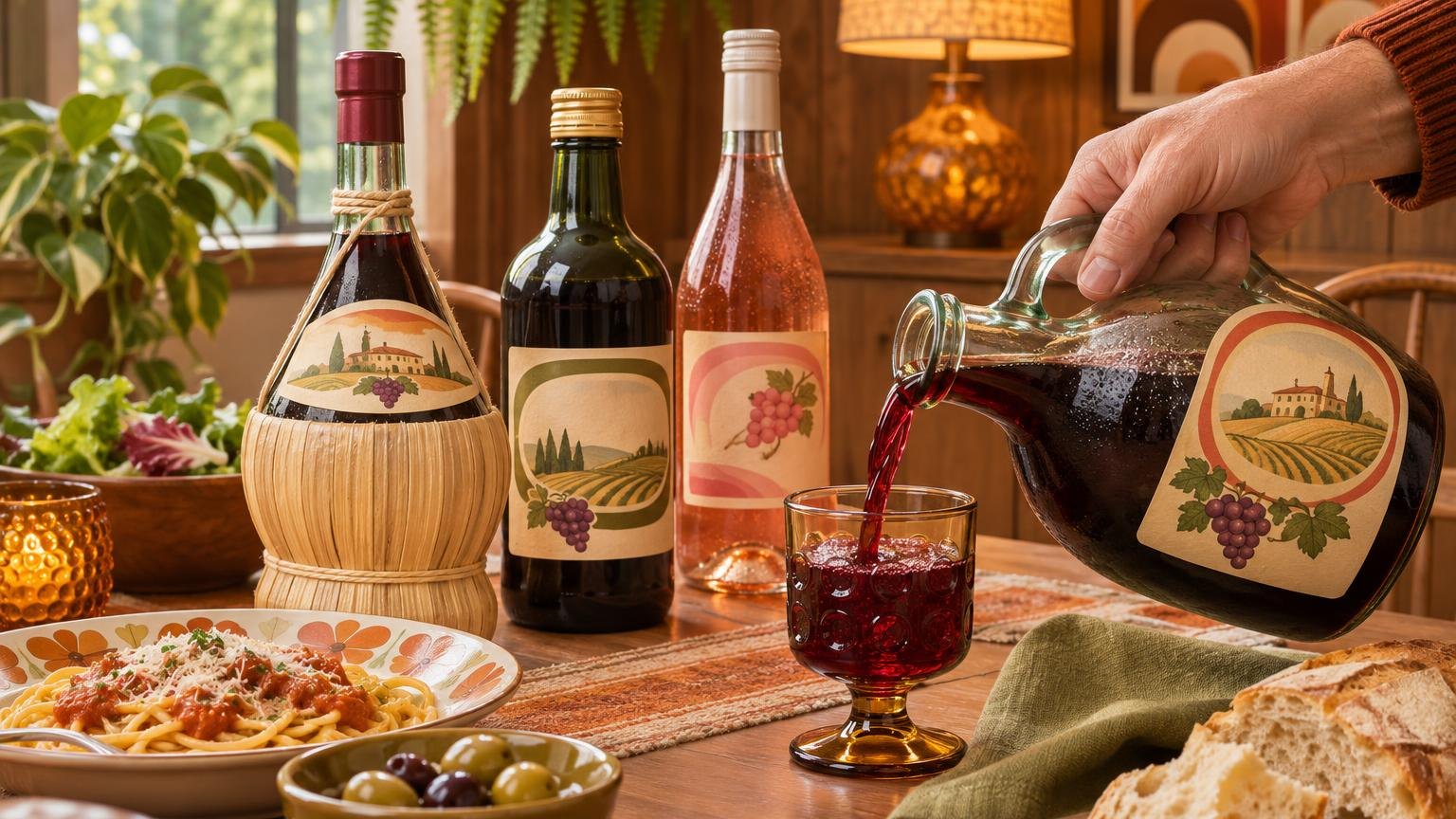
Carlo Rossi represents a defining feature of cheap wines of the 70s: California wine sold in large, reusable glass jugs for everyday drinking.
The appeal was straightforward—an affordable table wine, a screw cap, and enough to serve several people without opening multiple bottles.
From Red Mountain to National Distribution
Produced by E. & J. Gallo, Carlo Rossi grew from a regional offering into a nationally distributed brand.
Its advertising featured its namesake spokesman, whose conversational delivery reinforced the idea that wine did not require specialist knowledge.
| Year | Brand milestone |
| 1962 | Carlo Rossi Red Mountain wines entered the market. |
| 1975 | Carlo Rossi became a national brand, with Carlo himself appearing in its advertising. |
Source: Carlo Rossi’s official brand history, https://www.carlorossi.com/. This manufacturer account supports the brand chronology; it does not establish a nationwide retail price for any particular vintage or package.
What the Jug Offered
The package mattered as much as the label. A handled glass jug was practical for carrying and pouring, while its resealable closure suited informal meals.
Large-format packaging positioned wine as a household beverage rather than a special-occasion purchase.
- Familiar style names: Labels such as Burgundy and Chablis identified broad wine styles for American shoppers, not French vineyard origins. Carlo Rossi’s wines came from California.
- Blends over vineyard identity: The selling proposition emphasized an accessible, consistent style rather than a named estate, individual vineyard, or collectible vintage.
- Table wine, not necessarily dessert wine: Cheap jug wine was not a single sweetness category. Do not treat every red or white jug as equivalent to sweet, fortified bargain wines.
Keep Historical Prices in Context
A defensible 1970s price needs a dated advertisement, a location, and the container size. A sale price from one supermarket cannot establish what Americans universally paid, and today’s Carlo Rossi prices cannot reconstruct that history.
For this era, the important distinction is the format and positioning: Carlo Rossi helped make inexpensive California table wine a familiar national product, sold for ordinary consumption rather than prestige.
Blue Nun and Budget German Wine
Blue Nun made German white wine approachable for American shoppers in the 1970s.
Its recognizable label, gentle sweetness, and easy-to-remember name helped sell Liebfraumilch to drinkers who found German vineyard names and classifications intimidating.
What Was in the Bottle?
H. Sichel Söhne introduced Blue Nun in 1921. During its 1970s heyday, the brand sold Liebfraumilch: a blended German white wine, not a grape variety and not necessarily Riesling.
Liebfraumilch belongs to Germany’s Qualitätswein category. Its permitted origins are Rheinhessen, Pfalz, Nahe, and Rheingau.
The German Wine Institute identifies these requirements for the style; they explain its character, rather than document a particular vintage’s blend.
| Requirement | Liebfraumilch specification |
| Grape composition | At least 70% Riesling, Silvaner, Müller-Thurgau, or Kerner, individually or combined. |
| Residual sugar | At least 18 grams per liter. |
| Flavor profile | The wine must have a sweet character. |
That distinction matters when remembering “cheap Riesling.” A bottle could contain substantial Müller-Thurgau or other permitted grapes.
Blue Nun’s brand name offered consistency without requiring buyers to understand the blend, village, or vineyard.
Why It Fit the Decade
Blue Nun’s advertising presented wine as an uncomplicated companion to food, rather than something demanding separate red-and-white pairing rules.
Its American campaigns included comedy performers Jerry Stiller and Anne Meara, whose conversational advertisements made the product sound familiar rather than prestigious.
- Recognizable branding: The nun illustration stood out among labels dominated by unfamiliar German terms.
- Accessible taste: Noticeable sweetness softened the impression of acidity and appealed to newcomers.
- Simple purchasing: A named brand reduced the need to choose by producer, vineyard, or German wine terminology.
Keep the Budget Claim in Perspective
Blue Nun was a mass-market imported wine, not automatically the cheapest bottle on an American shelf. Domestic jug wines could cost less per serving.
Without a dated retailer advertisement, assigning it one nationwide 1970s price would create false precision.
Its historical importance lies in accessibility: Blue Nun helped make German wine recognizable while encouraging Americans to associate it with sweetness.
Sources: Blue Nun’s official brand history; the German Wine Institute’s Liebfraumilch guidance; The Oxford Companion to Wine, fourth edition, entries on Blue Nun and Liebfraumilch.
Mateus and Lancers Made Rosé Fashionable
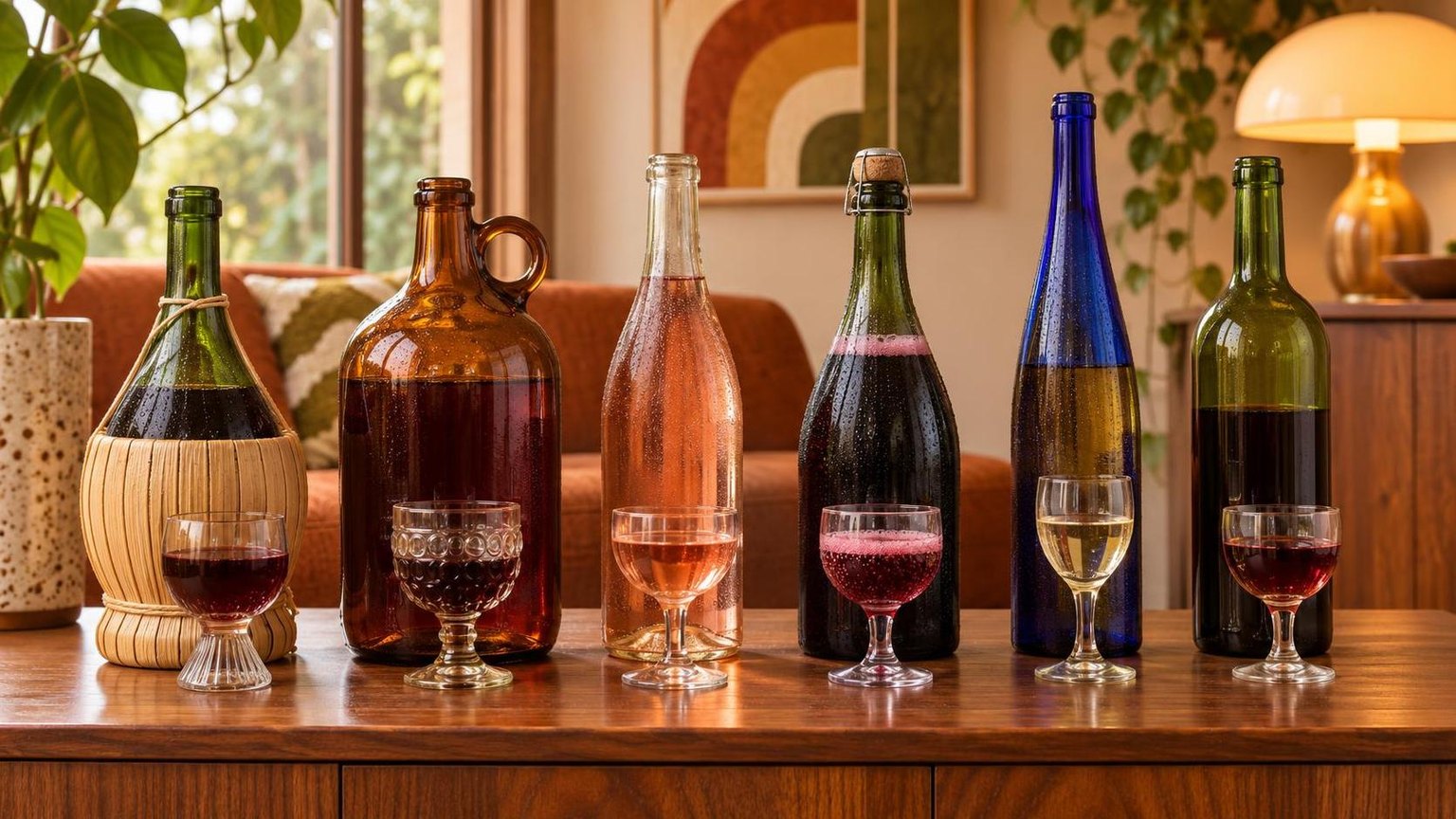
Mateus and Lancers helped make Portuguese rosé a familiar, approachable choice for American wine drinkers in the 1970s.
Their lightly sweet, gently fizzy styles offered an alternative to dry table wine, while distinctive bottles made both brands easy to recognize on store shelves and restaurant tables.
Two Portuguese Brands Built for Export
Neither brand originated during the decade. Both emerged during World War II, giving them decades to develop international distribution before the American wine boom of the seventies.
| Brand | Launched | Origins | Recognizable packaging |
| Mateus Rosé | 1942 | Created by Fernando van Zeller Guedes, founder of Sogrape. | A broad, flattened, flask-shaped bottle. |
| Lancers | 1944 | Developed by José Maria da Fonseca in collaboration with American importer Henry Behar. | A distinctive terracotta-colored bottle. |
These launch dates and founding histories come from the producers’ historical accounts: Sogrape’s Mateus materials at https://www.mateusrose.com/ and José Maria da Fonseca’s brand history at https://www.jmf.pt/.
Why Their Style Worked
The appeal was accessibility, not complexity. Both rosés combined fruity flavors, some sweetness, and a light prickle of carbonation. Served chilled, they required no knowledge of vineyard classifications or vintage charts.
Customers could remember a brand and bottle shape rather than navigate an unfamiliar appellation.
These were branded Portuguese rosés, not California white Zinfandel. Their success helped establish a market for approachable pink wine before white Zinfandel became a major American category.
They also differed from the predominantly dry rosés many shoppers associate with Provence today.
Packaging reinforced that accessibility. Mateus looked unlike a conventional straight-sided wine bottle; Lancers presented an equally recognizable alternative.
The containers became part of the brands’ identities, helping consumers identify a familiar purchase without closely reading the label.
What “Cheap” Means Here
In a history of cheap wines, Mateus and Lancers belong among widely marketed, accessible imports—not automatically the lowest-priced wines available.
American shelf prices varied by year, retailer, location, and bottle size; a single unsourced “1970s price” would misrepresent that variation.
Their importance was cultural as much as economic: they made rosé recognizable, repeatable, and easy to order. For drinkers exploring wine beyond domestic jug brands, both offered an imported label without demanding specialist knowledge.
Frequently Asked Questions
What was Boone’s Farm in the 1970s?
Boone’s Farm began as an apple-wine brand in 1961, according to Gallo’s brand history, and became associated with inexpensive, sweet drinks such as Strawberry Hill.
Historical bottles should not be confused with today’s products: some later Boone’s Farm beverages use a malt base rather than wine.
Why was Ripple associated with cheap 1970s wine?
Ripple was Gallo’s inexpensive, sweet wine, marketed to consumers who wanted an easy-drinking alternative to conventional table wine.
Its frequent mentions on the sitcom Sanford and Son, which aired from 1972 to 1977, helped cement its place in American budget-wine culture.
Was Thunderbird a table wine or a fortified wine?
Thunderbird was a fortified, citrus-flavored wine rather than an ordinary table wine; Gallo’s company history dates its introduction to 1957.
It remained associated with low-cost drinking in the 1970s, but its higher-strength formulation distinguished it from inexpensive rosé and sparkling red wines.
Why do people remember Mateus Rosé from the 1970s?
Mateus combined a distinctive flask-shaped bottle with a lightly sparkling Portuguese rosé that reached a broad international audience.
Producer Sogrape dates its launch to 1942; by the 1970s, it was a familiar accessible import rather than an American fortified bargain wine.
Was the Blue Nun sold in the 1970s a Riesling?
The classic Blue Nun of that era was marketed as Liebfraumilch, a German white-wine category, not as a single-variety Riesling.
The brand’s history dates its creation to 1921, and its approachable sweetness helped make German wine accessible to American buyers unfamiliar with regional labels.
What made Riunite Lambrusco different from other inexpensive 1970s wines?
Riunite offered sweet, lightly sparkling Italian red wine commonly served chilled, unlike still white wines or stronger fortified products.
Banfi’s company history dates its introduction to the United States to 1967, placing it on American shelves before its rise during the 1970s.
Related Reading
- How Often Should Ice Machines Be Cleaned?
- How Much Is 10 Lb?
- How Many Cups Is Four Ounces?
- What Is Fat Washing Whiskey?
- How Many Grams In A Pound Of Gold? A Real-World Guide for Buyers, Investors, and Collectors
- How Many Grams Is 4 Oz? 4 Ounces To Grams
- How Many Water Bottles Equal A Gallon?
- All Blog Guides
- National Institute on Alcohol Abuse and Alcoholism, Surveillance Report #120: Alcohol Consumption Trends, 1977–2021 (2023)
- Alcohol and Tobacco Tax and Trade Bureau, Wine Statistics (n.d.)
- University of California, Davis, Department of Viticulture and Enology (n.d.)
- The Oxford Companion to Wine, Fourth Edition (2015)
- Wine Institute, U.S. Wine Consumption (n.d.)
- Boone’s Farm, Official Brand Website (n.d.)
- Carlo Rossi, Official Brand Website (n.d.)
- Franzia, Official Brand Website (n.d.)
- Riunite, Official Brand Website (n.d.)