black owned wineries near me are Black-owned wine producers and tasting rooms you can find through resources such as the Association of African American Vintners’ member directory.
Nearby options depend on your location, travel radius, and preference for a vineyard visit or an urban tasting room.
California examples include Brown Estate, which operates a downtown Napa tasting room, and Theopolis Vineyards in the Yorkville Highlands.
This guide explains how to find local options, distinguish wineries from wine shops, and check tasting locations, reservation requirements, and current hours before planning your visit.
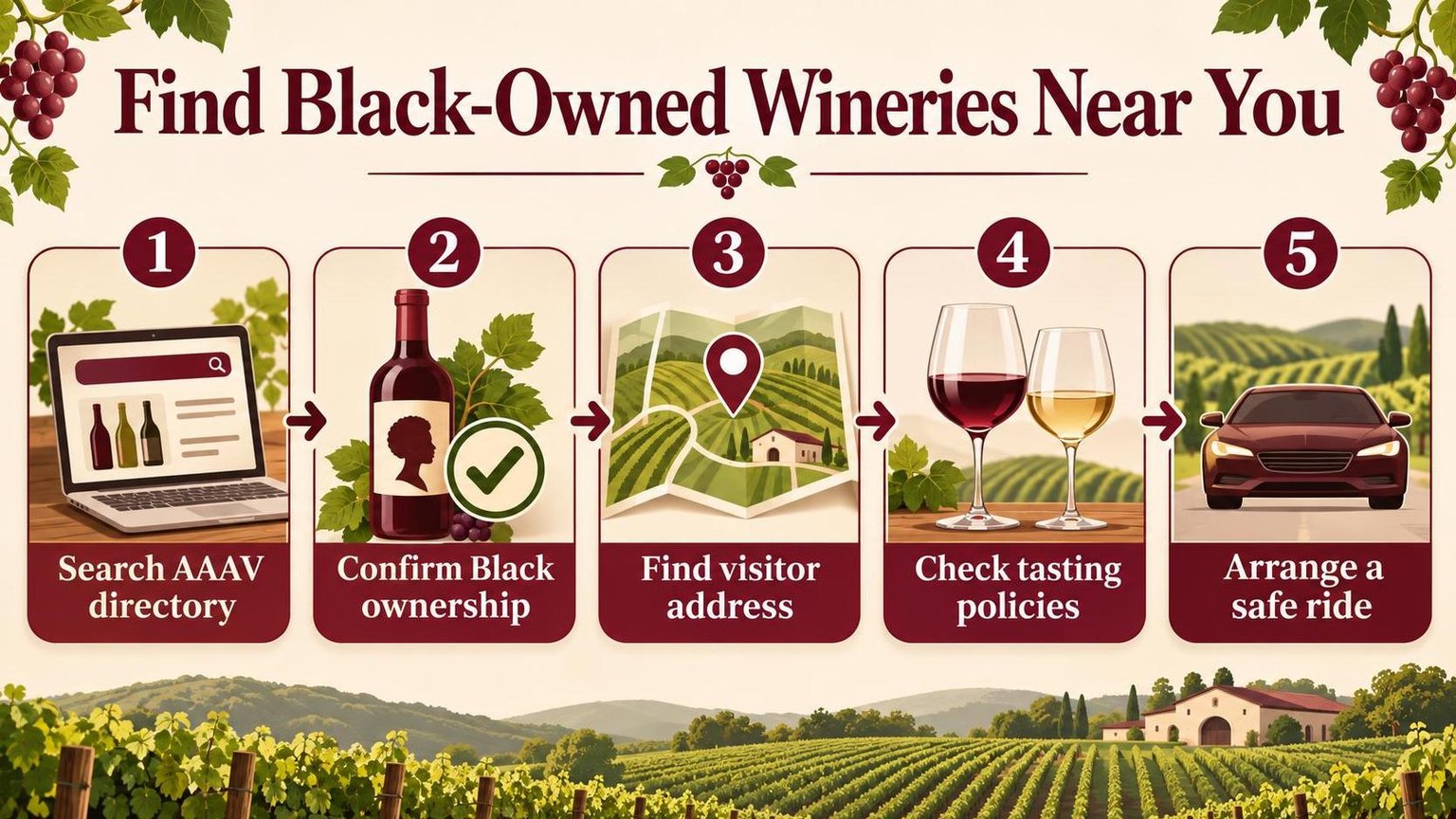
How to Find Black Owned Wineries Nearby
Start with a Black wine-industry directory, then confirm each business’s location and visitor policy on its own website.
A search for “black owned wineries near me” can return vineyards, urban tasting rooms, and wine brands without public premises, so a nearby map pin does not guarantee a visit.
Start With a Specialist Directory
The Association of African American Vintners maintains a directory of member wineries and wine businesses at https://www.aaavintners.org/.
Use it to identify producers, then check their websites for current ownership information and tasting locations. Membership is a starting point, not a complete census of Black-owned wineries.
- Search your city, county, and nearby wine region alongside “Black-owned winery” or “Black-owned tasting room.”
- Use Google Maps or Apple Maps to check driving routes, but confirm hours through the business’s booking page.
- Read the producer’s About page. A Black winemaker, distributor, or event host does not automatically establish Black ownership.
Distinguish the Winery From the Visiting Address
Brown Estate illustrates why this matters.
The family established its Napa Valley wine label in 1996, but visitors should look for Brown Downtown, its tasting location at 1005 Coombs Street in Napa, rather than assume the estate vineyard welcomes drop-ins.
Source: https://www.brownestate.com/.
Theopolis Vineyards, founded by Theodora R. Lee, is in California’s Yorkville Highlands. Its official website provides tasting and event information at https://www.theopolisvineyards.com/.
Check the current visit arrangements before driving; a vineyard location is not necessarily a daily, walk-in tasting room.
These examples are location checks, not recommendations based on your proximity. Without your city or ZIP code, “nearby” cannot be determined accurately.
Search from your actual starting point and evaluate the driving route rather than straight-line distance.
Confirm the Visit Before You Leave
- Check whether tastings require reservations and whether your preferred date has availability.
- Confirm the tasting fee, cancellation policy, and any purchase requirement for waiving fees.
- Ask about step-free access, seating, children, dogs, food, and group-size restrictions when relevant.
- Verify that the listed address is a visitor entrance, not an office, shipping warehouse, or private residence.
- Arrange a designated driver or transportation before booking a tasting.
If no local winery fits, look for a tasting hosted by a Black-owned producer at a nearby wine shop or restaurant. Confirm the producer’s participation directly; stocking its bottles does not make the venue Black-owned.
Black Owned Wineries by US Region
Black-owned wineries include estate vineyards, urban production facilities, and tasting rooms far from the grapes’ growing region.
For a useful “near me” search, identify the visitor location first: a winery’s mailing address, vineyard, and public tasting room may be different places.
| Region | Winery | Location to research |
| California | Brown Estate | Downtown Napa tasting room |
| California | Longevity Wines | Livermore Valley |
| California | Theopolis Vineyards | Yorkville Highlands, Mendocino County |
| Pacific Northwest | Abbey Creek Vineyard | North Plains, Oregon |
| Southeast | Seven Springs Farm and Vineyard | Norlina, North Carolina |
| Mid-Atlantic | Philosophy Winery & Vineyard | Maryland; confirm current tasting arrangements |
California: Napa, Livermore, and Mendocino
Brown Estate, established in 1996, identifies itself as Napa Valley’s first Black-owned estate winery. Its downtown Napa tasting room is the visitor destination; do not assume the estate vineyard welcomes walk-ins.
Source: https://www.brownestate.com/.
- Longevity Wines was founded by Phil and Debra Long. Its Livermore location makes it a geographically distinct alternative to Napa, especially for East Bay visitors.
- Theodora Lee founded Theopolis Vineyards in 2003. The Yorkville Highlands producer is particularly associated with Petite Sirah. Confirm tasting availability before planning a Mendocino detour.
Check tasting schedules and reservation requirements directly: https://www.longevitywines.com/ and https://www.theopolisvineyards.com/.
Pacific Northwest: Oregon
Abbey Creek Vineyard founder Bertony Faustin is recognized as Oregon’s first recorded Black winemaker. North Plains, west of Portland, is the location to investigate for its Crick tasting experience.
Check the booking calendar rather than assuming conventional vineyard-tour service. Source: https://www.abbeycreekvineyard.com/.
Southeast: North Carolina
Seven Springs Farm and Vineyard is a family-owned destination in Norlina, near the Virginia border. Founders Preston and Mary Cheek built a business that combines wine with an events-focused setting.
Check whether your intended date offers regular tastings or requires event admission. Source: https://www.sevenspringsfarmandvineyard.com/.
Mid-Atlantic: Maryland
Kimberly Johnson and Denise Matthews founded Philosophy Winery & Vineyard in 2018. The Maryland business identifies itself as the state’s first Black women-owned winery.
Verify current public events and tasting arrangements before treating it as a drop-in vineyard destination. Source: https://www.philosophywinery.com/.
Midwest and Northeast: Broaden the Search Carefully
Use the Association of African American Vintners directory to identify additional producers, then verify visitor access directly. A nearby retailer carrying a Black-owned label is not necessarily a Black-owned winery.
Search the producer’s events page for local tastings when an onsite visit is unavailable. Source: https://www.aaavintners.org/.
Black Owned Vineyards Versus Wine Brands
A Black-owned wine label does not automatically lead to a vineyard you can visit. For a “black owned wineries near me” search, distinguish the vineyard, the production winery, and the tasting room before choosing a destination.
What Each Business Actually Operates
- Vineyard: Land planted with grapevines. Its owner may sell grapes, make wine elsewhere, or operate an on-site winery. Vineyard ownership alone does not establish public access.
- Winery: A wine-production business or facility. It can use estate-grown grapes, purchased fruit, or both; its tasting room may occupy a separate address.
- Wine brand: The business behind a label. Owners may direct sourcing, blending, and marketing while another facility produces the wine. That arrangement does not, by itself, indicate lower quality.
Real Examples to Guide Your Search
Brown Estate, Napa Valley: This Black-owned estate has vineyard property in Napa Valley, but its downtown Napa tasting room is a separate destination. Do not assume a downtown reservation includes vineyard access.
Check the current location and reservation instructions at brownestate.com.
Theopolis Vineyards, Mendocino County: Founded by Theodora Lee, this estate identifies its vineyard as five acres in the Yorkville Highlands appellation. It is a concrete example of Black ownership connected to planted vineyard land.
Confirm available tastings and events directly at theopolisvineyards.com.
Maison Noir Wines, Oregon: Founded by sommelier André Hueston Mack, Maison Noir describes its wines as sourced from Oregon vineyards.
Treat it as a wine-brand search rather than assuming the label identifies an owner-operated vineyard attraction. Check current purchasing and contact information at maisonnoirwines.com.
What “Estate Bottled” Tells You
Under federal labeling rules, “estate bottled” requires 100% of the grapes to come from land the winery owns or controls within the stated viticultural area. The winery must also be located in that area.
Crushing, fermentation, finishing, aging, and bottling must occur in a continuous process on its premises. The term does not establish Black ownership or visitor access.
Source: Alcohol and Tobacco Tax and Trade Bureau regulations, 27 CFR § 4.26, https://www.ecfr.gov/current/title-27/section-4.26.
Confirm the Visit Before Traveling
Ask whether the listed address is a vineyard, production facility, tasting room, or office. Then confirm public access, reservations, tasting fees, and accessibility.
Verify current ownership through the business’s own account; a retailer stocking Black-owned wines is not necessarily Black-owned itself.
Checking Winery Ownership and Tasting Room Locations
A search for “black owned wineries near me” can return vineyards, wine brands, tasting rooms, and retailers.
Verify ownership separately from the visitor address: a winery’s production site, mailing address, and public tasting room may be different places.
Verify Ownership Beyond a Directory Listing
Start with the producer’s official ownership or “Our Story” page.
Look for named owners and their roles, then cross-check an industry directory such as the Association of African American Vintners at https://www.aaavintners.org/.
Treat directories as discovery tools, not substitutes for current business information.
- Distinguish ownership from employment. A Black winemaker, tasting-room manager, or brand ambassador does not automatically make the business Black-owned.
- Separate founding history from current ownership. “Black-founded” describes an origin; it does not establish who owns the company today.
- Check the specific business. A retailer carrying Black-owned labels is not necessarily Black-owned, and a wine brand does not necessarily operate a winery visitors can enter.
Match the Brand to the Visitor Location
These examples show why the location check matters.
Use the official websites to confirm the current booking address and access rules before traveling; neither a vineyard map pin nor a bottle’s regional designation guarantees a public tasting room.
| Producer | Ownership reference | Location distinction |
| Brown Estate | Its official history identifies the Brown family behind the estate. Source: https://www.brownestate.com/ | The downtown tasting room is at 1005 Coombs Street, Napa, California. Do not confuse that visitor location with the estate vineyard property. |
| Theopolis Vineyards | Attorney Theodora Lee established the producer in 2003. Source: https://www.theopolisvineyards.com/ | The vineyard is in California’s Yorkville Highlands appellation, not downtown Napa. Check directly for available visits and arrival instructions. |
Confirm Access Before Making the Drive
Open the producer’s reservation page rather than relying solely on a map listing. A business can sell wine online, host occasional events, or pour at a shared venue without maintaining daily walk-in hours.
- Confirm the entrance. Ask whether the reservation is at an estate, urban tasting room, or temporary event space.
- Confirm the appointment. Check availability, tasting fees, cancellation terms, and whether your entire group needs reservations.
- Confirm practical access. Ask about step-free entry, parking, children, and pets when relevant.
If ownership remains unclear, ask directly: “Is the business currently Black-owned, and where can guests book a tasting?” Record the answer’s date; ownership and visitor arrangements can change independently.
Booking Tastings at Black Owned Wineries
Book through the winery’s official website, and confirm the tasting address before arranging transportation.
A Black-owned wine brand may welcome visitors at an urban tasting room, offer vineyard visits by appointment, or sell bottles without operating a public tasting space.
Match the Reservation to the Location
These California producers illustrate why the winery name alone is not enough to plan a visit. Their official websites provide background and booking information; check current availability rather than treating a map listing as confirmation.
| Producer | Established fact | Booking consideration | Official source |
| Brown Estate | The family produced its first vintage in 1996. | Distinguish the downtown Napa tasting room from the estate vineyard property in Chiles Valley. | https://www.brownestate.com/ |
| Theopolis Vineyards | Theodora Lee founded the winery in 2003 in California’s Yorkville Highlands. | Check the available tasting experiences and appointment requirements before traveling to the vineyard. | https://www.theopolisvineyards.com/ |
Confirm the Full Cost and House Rules
Before paying, read the terms attached to the specific experience. A tasting fee does not automatically include food, a vineyard tour, or a credit toward bottles. Policies can differ between experiences at the same winery.
- Price: Confirm the per-person charge, taxes, service charges, and whether any purchase waives the tasting fee.
- Cancellation: Find the refund deadline, late-arrival rules, and no-show charge. Save the confirmation email.
- Group size: Ask whether your party requires a private booking, deposit, or different menu.
- Access: Confirm step-free entry, accessible restrooms, seating, parking, and the distance from the vehicle drop-off.
- Guests: Ask about children, non-drinkers, and pets. In the United States, the minimum legal drinking age is 21; bring government-issued photo identification.
Build a Practical Tasting Schedule
As a planning buffer—not a universal winery requirement—look for appointments 2–3 weeks ahead for weekends. For a birthday, holiday, or larger party, contact the venue earlier.
If the calendar shows no openings, ask about cancellations rather than arriving without a reservation.
Use the appointment’s stated duration to plan your day, then add driving and parking time. Check whether rideshare pickup is dependable at rural properties.
Arrange a designated driver or transportation service before drinking, and ask whether spitting cups or dump buckets are available.
Finally, reconfirm the address and arrival instructions in your booking email.
If supporting Black ownership is central to your search, consult the producer’s own ownership story rather than assuming every retailer or event featuring its wines is Black-owned.
Buying Local Black Owned Wines Without Visiting
You can support Black-owned wineries through local wine shops, retailer delivery, and direct shipping without visiting a tasting room.
First decide whether “local” means wine grown nearby, a winery headquartered nearby, or a bottle purchased from a neighborhood business; those are different claims.
Find Bottles Already Sold Nearby
Start with a producer’s official retailer locator, then confirm stock with the store. McBride Sisters Collection offers a wine finder at https://www.mcbridesisters.com/.
Search your ZIP code rather than assuming a nearby store carries every wine in the collection.
- Ask for the producer, wine name, and vintage. A shop may carry one bottling but not the specific wine you want.
- Request a special order if the bottle is unavailable. Retailers can check their licensed distributors, although state distribution and ordering requirements may limit access.
- Ask whether pickup or delivery comes from that shop’s inventory. Marketplace listings do not necessarily reflect bottles physically stocked nearby.
Buying through an independently owned neighborhood retailer supports a local business, even when the grapes come from elsewhere.
If you want locally grown wine specifically, check the label’s appellation and the producer’s vineyard information rather than relying on the company’s mailing address.
Order Directly When Shipping Is Available
Two producers to investigate are Brown Estate, a Black-owned Napa Valley winery, and Theopolis Vineyards, founded by Theodora Lee in Mendocino County’s Yorkville Highlands.
Their official websites provide wine selections and purchasing information: https://www.brownestate.com/ and https://www.theopolisvineyards.com/.
Enter your delivery state before building a large cart. Direct-to-consumer wine shipping depends on destination-state law, the seller’s licenses, and sometimes local restrictions.
A winery that ships to one state may not legally ship to another.
- Check shipping charges, weather holds, and the winery’s policy for heat-damaged bottles before paying.
- Choose an address where an adult aged 21 or older can present identification and sign. Do not assume the carrier can leave wine unattended.
- Review club terms separately. Recurring shipments, cancellation deadlines, and allocation commitments differ from a single-bottle purchase.
Verify the Seller and Delivery Rules
Use the winery’s official shop or a licensed retailer, and confirm current Black ownership through producer biographies or ownership statements. A founder’s historical connection alone does not establish present ownership.
USPS prohibits mailing intoxicating liquor; wine is not an ordinary parcel. For the federal postal rule, consult USPS Publication 52, section 422: https://pe.usps.com/text/pub52/pub52c4_019.htm.
Check your state alcohol regulator for destination-specific purchasing and shipping rules.
Common Questions
How can I find Black-owned wineries near me?
Start with the Association of African American Vintners’ member directory at https://www.aaavintners.org/, then search the listed businesses by city or state.
Confirm ownership, visitor access, and the tasting-room address on each winery’s official website before traveling.
Does a Black-owned wine brand always have a winery I can visit?
No. A wine brand may produce through a partner facility and sell online without operating a public tasting room. Look for a published visitor address and tasting reservations rather than assuming a business listing identifies a walk-in winery.
Which Black-owned winery can I visit in Napa Valley?
Brown Estate, established in 1996, is a Black-owned family winery with a tasting room in downtown Napa.
Use https://www.brownestate.com/ to check tasting availability, and distinguish the downtown visitor location from its vineyard estate when planning your route.
Is there a Black-owned winery near Portland, Oregon?
Abbey Creek Vineyard, founded by winemaker Bertony Faustin, operates The Crick tasting destination in North Plains, west of Portland.
Check https://www.abbeycreekvineyard.com/ for the current tasting schedule and booking requirements before making the trip.
Do Black-owned wineries require tasting reservations?
Reservation policies vary by winery; ownership does not determine whether walk-ins are accepted. Check the official booking page for your date, party size, tasting fee, cancellation deadline, and any food or age restrictions.
Can I order from a Black-owned winery if none are nearby?
Many Black-owned producers sell online, but direct-to-consumer shipping availability depends on your destination state and the producer’s permits.
Enter your delivery ZIP code on the winery’s website before ordering; wine deliveries require an adult age 21 or older to sign.
- Cava Vs Prosecco: What Is The Difference Between Them?
- How To Open A Wine Bottle Without A Corkscrew? – 11 Proven, Real-Life Methods That Actually Work
- What Type Of Wine To Use For Sangria?
- Beers from the 80's People Still Remember
- What Is A Good Bourbon Whiskey?
- How Many Truly Hard Seltzers To Get Drunk?
- All Blog Guides