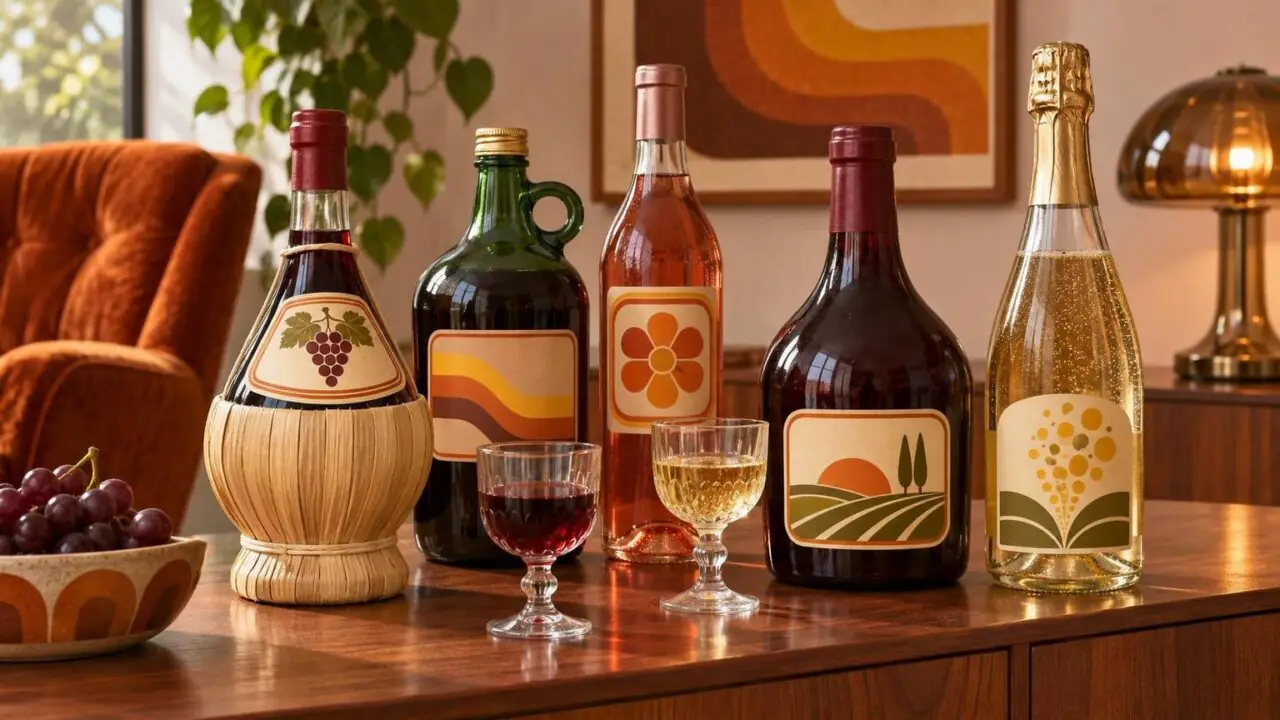
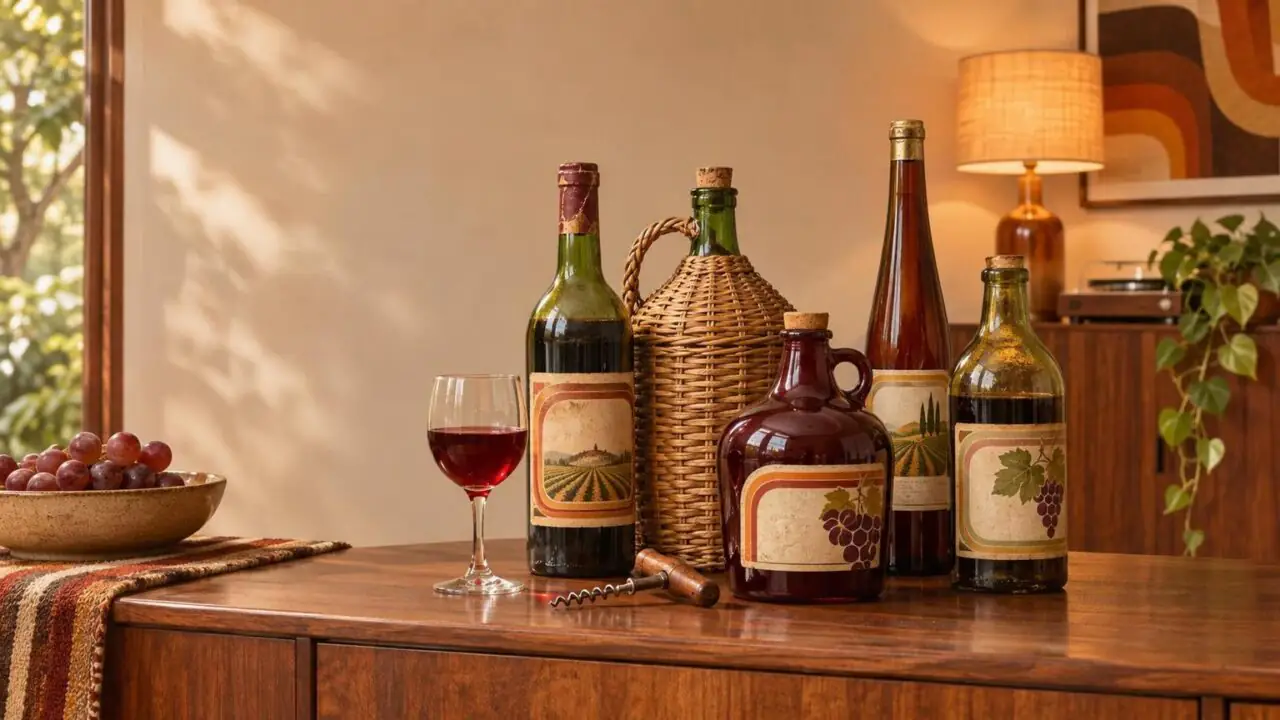
cheap wines from the 70s are inexpensive, approachable wines remembered through brands such as Boone’s Farm, Annie Green Springs, and Mateus.
Sweet fruit flavors, gentle fizz, and distinctive bottles helped these labels find places at American parties and dinner tables, far from the formality associated with fine wine.
These wines were not interchangeable: fruit wines, Portuguese rosés, and California jug wines offered different styles of affordable drinking.
This guide explores the names Americans remember, what those bottles contained, and how their reputations developed. It also distinguishes original wine products from later beverages sold under familiar brand names.
Why Cheap Wines Boomed in the 1970s
Cheap wines benefited from a growing American wine market, mass distribution, and products that required little knowledge to enjoy.
Large California producers made wine accessible through grocery-store placement, familiar branding, and inexpensive packaging rather than vineyard prestige.
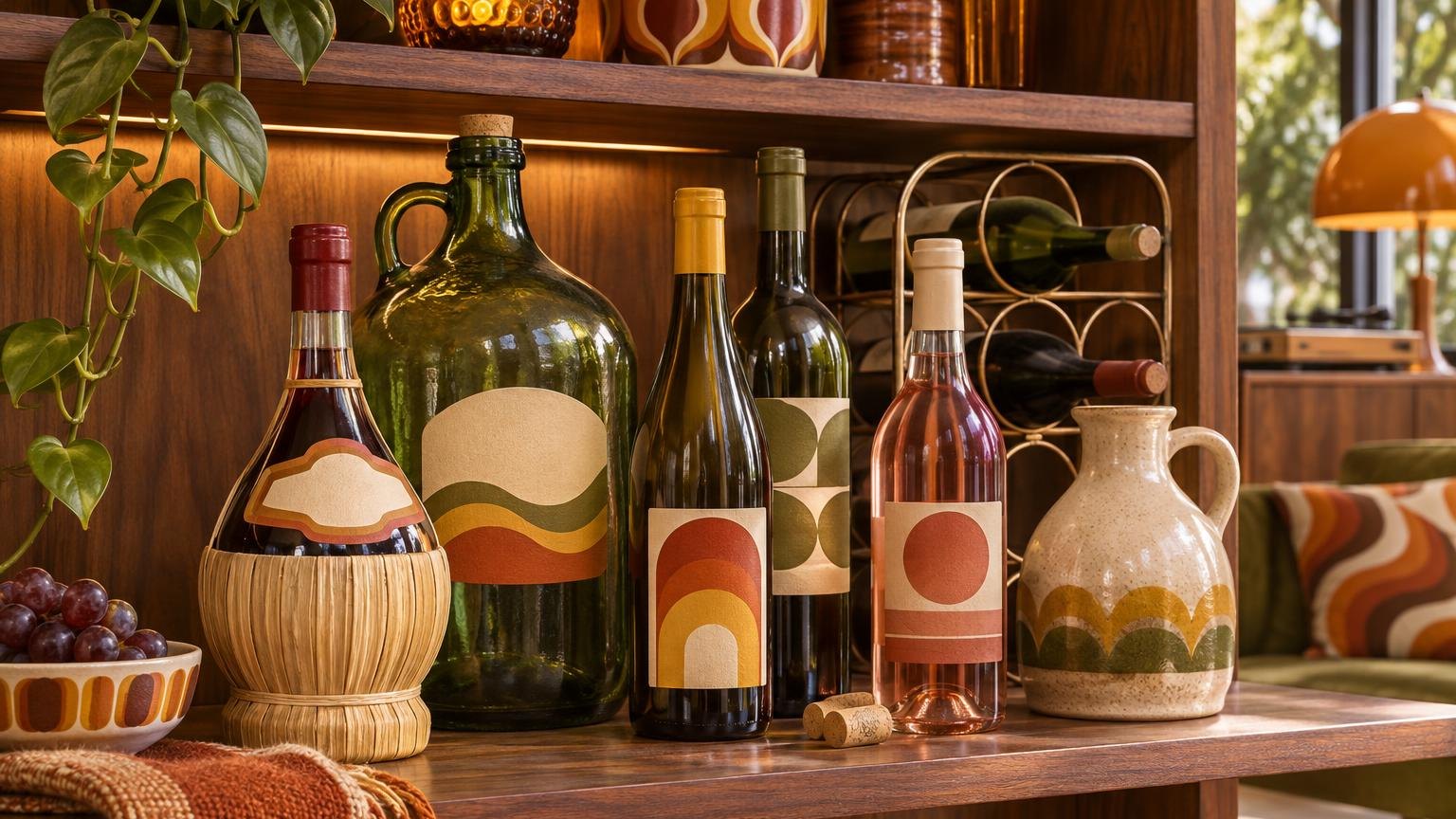
A Growing Market Made Room for Everyday Wine
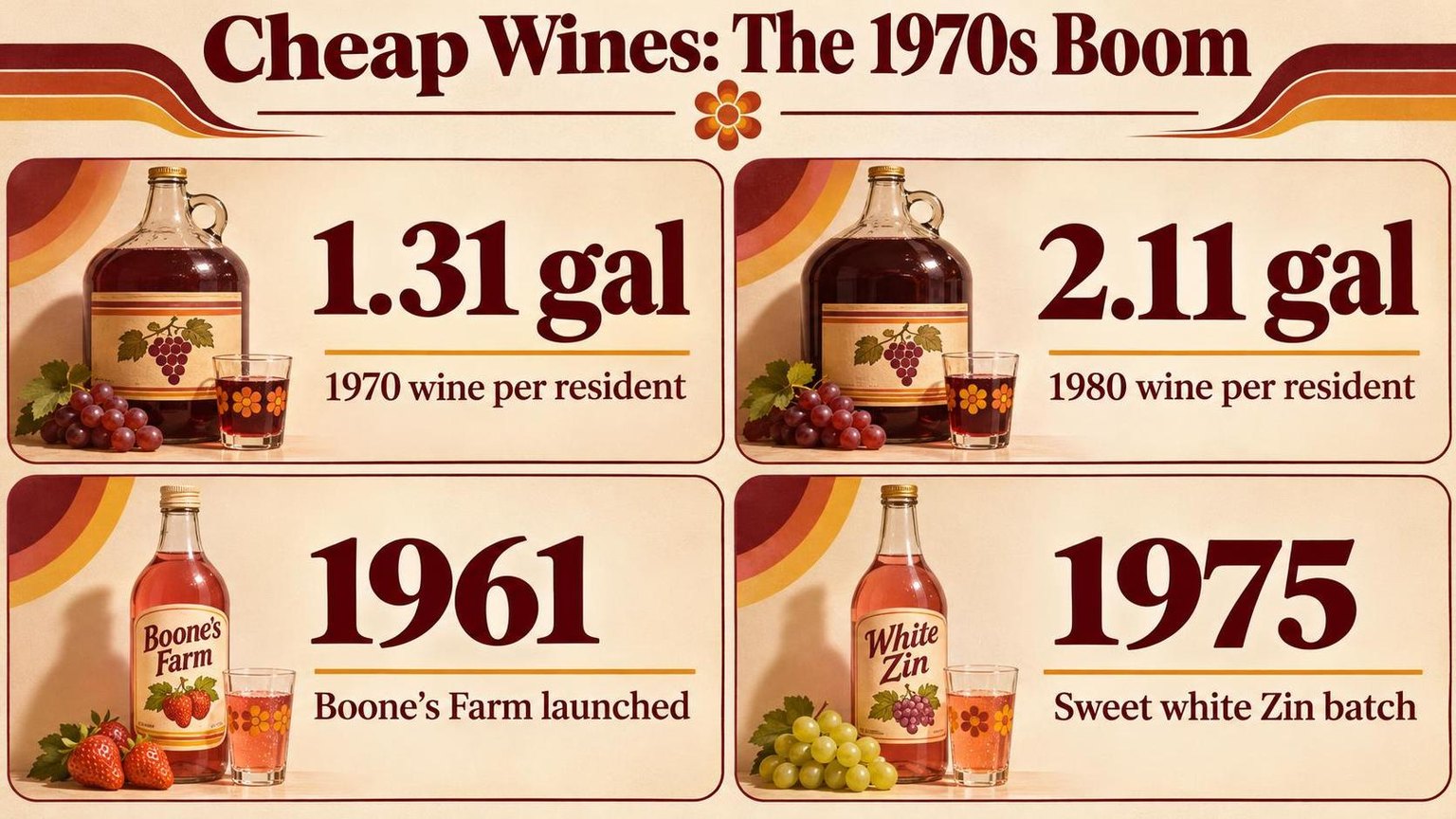
Wine Institute’s historical consumption estimates show the broader shift. These figures cover all wine, not specifically budget brands, but establish the expanding market in which inexpensive wines competed.
| Year | U.S. wine consumption per resident |
| 1970 | 1.31 gallons |
| 1980 | 2.11 gallons |
Source: Wine Institute, “U.S. Wine Consumption,” https://wineinstitute.org/our-industry/statistics/us-wine-consumption/. The per-resident measure includes the entire population; it does not represent consumption per wine drinker.
Scale and Simple Packaging Kept Prices Accessible
Producers such as E. & J. Gallo competed through large-scale production and broad distribution. Blending wine from multiple sources helped maintain a recognizable house style without depending on a single vineyard’s limited harvest.
- Jug packaging: Large bottles spread packaging costs across more wine, supporting economical purchases for regular household use.
- Broad labels: Names such as “Burgundy” and “Chablis” commonly identified American wine styles rather than French origins. Shoppers could reorder a familiar product without learning grape varieties.
- Retail availability: Where state law permitted grocery wine sales, inexpensive bottles could become part of an ordinary food-shopping trip.
Sweetness Lowered the Taste Barrier
The budget category included conventional table wines, sweet fruit-flavored products, and fortified wines. Their appeal differed, but sweeter offerings gave consumers an alternative to dry wines whose acidity or tannins could seem unfamiliar.
Sutter Home’s white Zinfandel illustrates that opportunity. According to the winery’s history, a stuck fermentation in 1975 left residual sugar in a batch.
The resulting sweeter pink wine became commercially successful, helping establish an approachable style during the decade’s later years.
Brand Recognition Reduced Buying Anxiety
Memorable names and repeatable flavors simplified purchasing. Cheap wine’s advantage was not sophistication: it offered an affordable, recognizable drink without requiring knowledge of vintages, appellations, or formal wine service.
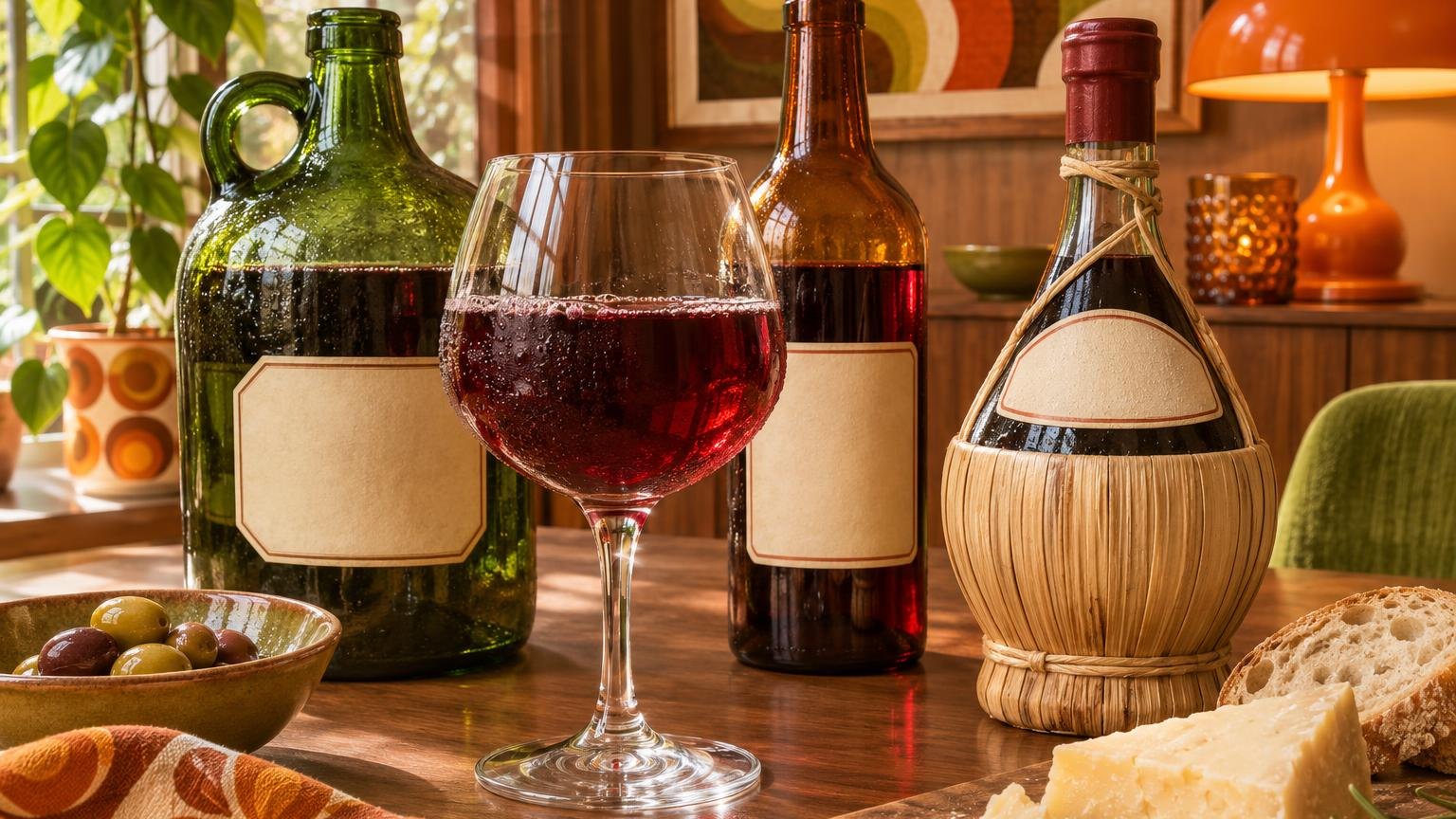
Boones Farm and the Fruit Wine Craze
Boone’s Farm turned inexpensive, sweet fruit wine into a recognizable part of American drinking culture in the 1970s. Introduced in 1961 by E. & J.
Gallo, the brand sold an approachable alternative to dry table wine: fruity flavors, straightforward names, and little need for wine knowledge.
Apple Wine, Not a Vineyard Story
Boone’s Farm began as an apple wine.
That distinction matters: wine can be fermented from fruit other than grapes, and the brand’s early identity belonged to that broader category rather than to varietal wines such as Chardonnay or Cabernet Sauvignon.
Gallo, founded in Modesto, California, in 1933, brought large-scale production and distribution to the product.
Boone’s Farm competed through affordability and recognizable flavor, not vineyard prestige, vintage reputation, or aging potential. Its appeal made sense for drinkers who wanted sweetness without the ceremony associated with wine.
Why the Flavors Worked
- Familiar names: Strawberry Hill became a signature expression. Fruit-led branding told shoppers what kind of flavor experience to expect without requiring knowledge of grape varieties or European wine regions.
- Sweetness first: These drinks emphasized easy-drinking fruit character rather than the dryness and tannin associated with many conventional table wines.
- Casual occasions: The brand became associated with young adult drinkers, parties, and budget purchases. That cultural identity helps explain its lasting place in recollections of cheap seventies wine.
Keep the Historical Bottle Separate
Do not use a present-day Boone’s Farm bottle as an exact specification for its 1970s predecessor. Products sold under the name have included malt-based beverages as well as wine-based formulations.
A familiar flavor name does not establish an unchanged recipe or alcohol content.
Likewise, a remembered bargain price is not a nationwide historical price. Establishing an exact cost requires a dated advertisement with a location and bottle size.
Without that evidence, calling Boone’s Farm inexpensive is more defensible than assigning every seventies bottle the same price.
Sources: Wine-Searcher’s Boone’s Farm producer profile documents its origins and product evolution. Gallo’s corporate history establishes the company’s founding.
Alcohol and Tobacco Tax and Trade Bureau labeling guidance explains the distinction between wine and malt beverages.
Ripple and Thunderbird on Budget Wine Shelves
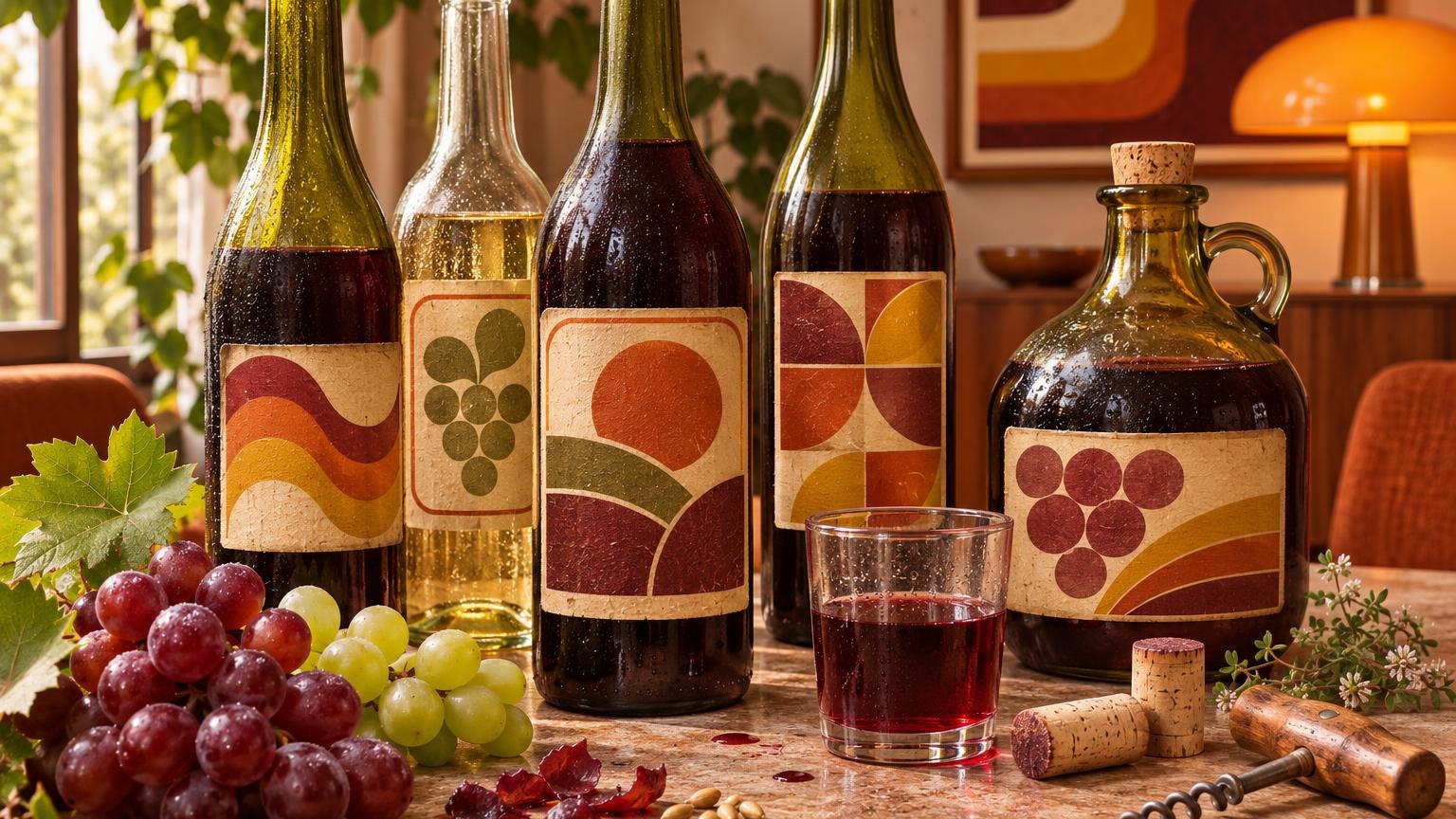
Ripple and Thunderbird were inexpensive Gallo brands familiar to American drinkers during the 1970s, but they offered different experiences.
Ripple was sweet and lightly carbonated; Thunderbird was a stronger, fortified white wine with citrus flavoring.
Two Different Routes to Cheap Wine
Both brands predated the decade. Their identities depended less on grape varieties, vineyard origins, or vintage years than on recognizable names, accessible flavors, and low prices.
| Brand | Introduction | Defining style |
| Ripple | 1960 | Sweet, lightly carbonated flavored wine |
| Thunderbird | 1957 | Citrus-flavored fortified white wine |
These dates and descriptions appear in the brand histories “Ripple (wine)” and “Thunderbird (wine).” They establish an important distinction.
Neither product originated with the wave of wine coolers that became prominent during the following decade.
Ripple: Sweetness and Television Recognition
Ripple’s sweetness and carbonation offered an alternative to dry table wine. Its name also became a recurring joke on “Sanford and Son,” whose character Fred Sanford enthusiastically discussed Ripple and invented mixtures using it.
That television association helps explain why Ripple remains recognizable even to people who never tasted it. The jokes document its place in popular culture, however, not its retail price, sales volume, or quality.
Ripple was discontinued in 1984. Treat bottles offered today as collectibles rather than straightforward opportunities to experience the original drink: storage conditions, closures, and decades of aging can substantially alter what remains inside.
Thunderbird: Fortification, Not Fine-Wine Positioning
Thunderbird belonged to the inexpensive fortified-wine market. Fortification means adding distilled spirits to wine; it does not mean carbonation.
Consequently, grouping Thunderbird and Ripple together as interchangeable “cheap wines” obscures a meaningful production difference.
For historical price claims, use a dated advertisement showing the retailer, bottle size, and location. A remembered advertising jingle or an undated bottle photograph cannot establish what shoppers paid throughout the decade.
The practical distinction is straightforward: Ripple represents sweet, fizzy budget wine and television nostalgia; Thunderbird represents inexpensive fortified wine.
Neither should stand in for every affordable table wine Americans bought during the period.
Sources: Brand-history references: https://en.wikipedia.org/wiki/Ripple_(wine) and https://en.wikipedia.org/wiki/Thunderbird_(wine). These are secondary summaries, not evidence of nationwide shelf prices.
Annie Green Springs Enters the Wine Market
By 1972, Annie Green Springs was advertising sweet, fruit-flavored wines to Americans who wanted an inexpensive, approachable drink.
Its appeal rested on recognizable flavors and informal branding rather than grape varieties, vineyard pedigrees, or cellar aging.
Fruit Flavors Replaced Wine Vocabulary
Names such as Peach Creek and Berry Frost made the proposition easy to understand. Shoppers did not need to know the difference between Burgundy and Bordeaux to choose a bottle.
The branding emphasized the expected drinking experience, not a lesson in European wine regions.
That approach placed Annie Green Springs in the same broad commercial category as Boone’s Farm: inexpensive, sweet wines marketed for casual drinking. They were competing brands, not interchangeable names for the same product.
- Flavor-led names gave buyers an immediate cue about what to expect.
- Informal advertising presented wine as an everyday social drink rather than a ceremonial purchase.
- Sweetness and fruit character offered an alternative to the dryness and tannins that could discourage inexperienced wine drinkers.
What “Cheap Wine” Actually Meant
Annie Green Springs belongs in a history of accessible, mass-market wine, but a single nationwide bottle price would be misleading. Advertised prices depended on the retailer, location, bottle size, and promotion.
A dated local advertisement supports a specific price; nostalgia alone does not.
The same caution applies to alcohol content. Do not assign every flavor and production year one percentage without a corresponding label.
Nor should these wines automatically be described as fortified: sweetness, added flavor, and fortification are separate characteristics.
Federal wine rules distinguish fruit wine from products made by adding flavoring to grape wine. 27 CFR § 4.21 provides the classification framework; a flavor name alone cannot establish a historical bottle’s ingredients or legal designation.
Reading the Historical Evidence
Contemporary Annie Green Springs advertisements and original bottle labels are the strongest evidence for its marketing and individual products.
They establish its place in the early-1970s flavored-wine market more reliably than later accounts that group every inexpensive sweet wine together.
Regulatory reference: https://www.ecfr.gov/current/title-27/chapter-I/subchapter-A/part-4/section-4.21.
Carlo Rossi and the Jug Wine Boom
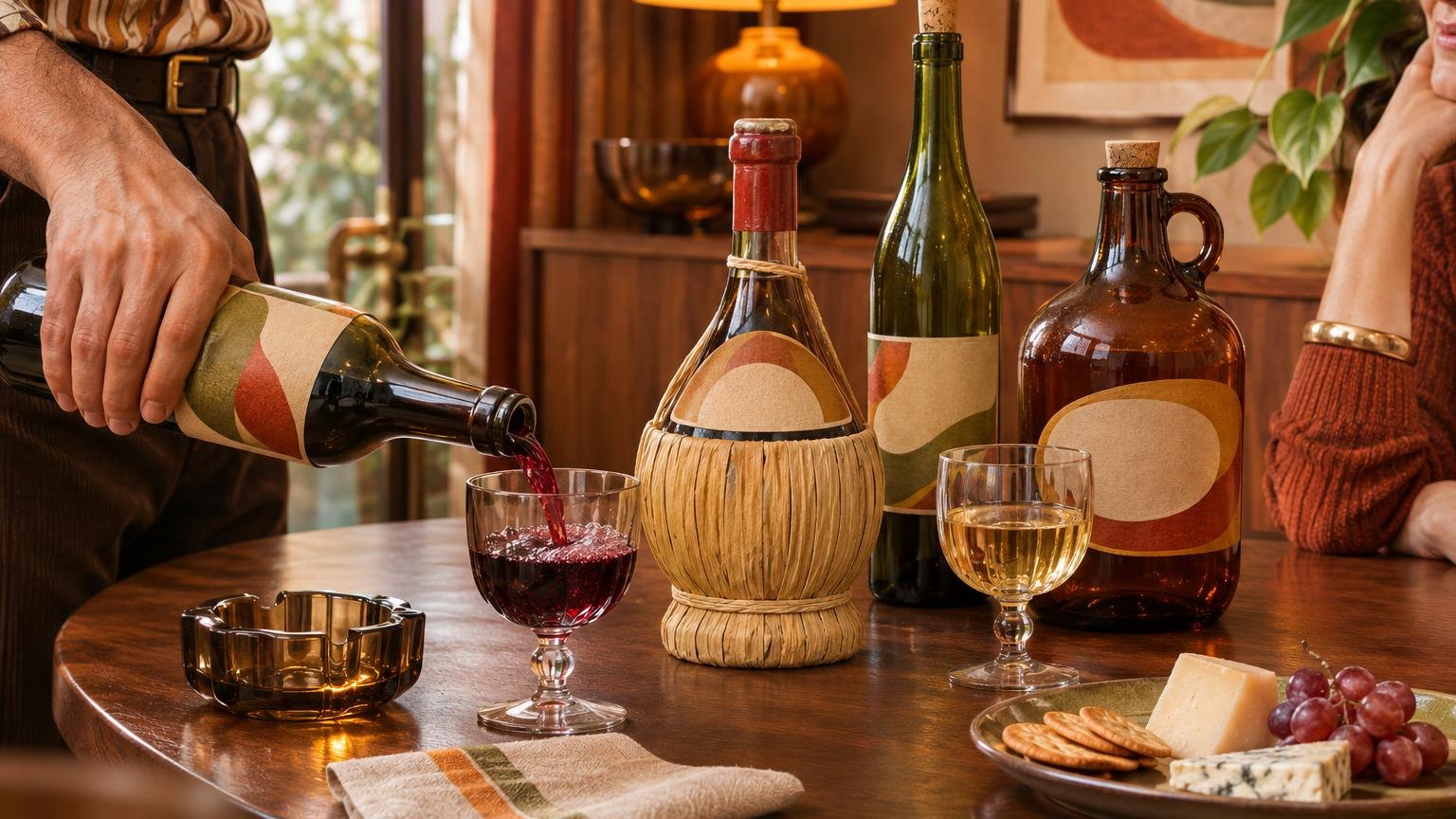
Carlo Rossi helped make inexpensive California wine a familiar fixture on American dinner tables during the 1970s.
Its appeal centered on generous containers, approachable blends, and everyday drinking rather than vineyard prestige or collectible vintages.
According to the brand’s official history, Carlo Rossi Red Mountain wines debuted in 1962. The brand belonged to E. & J. Gallo, the California producer founded in 1933.
Its growth reflected an established market for affordable table wine, not the invention of jug wine itself.
A Spokesman Instead of Wine Snobbery
Carlo Rossi was a real salesman and advertising spokesman, not simply an invented label character. His television and radio appearances helped personalize the brand during the 1970s.
The line “I like talking about wine, but I’d rather drink it” captured its deliberately unpretentious positioning.
The broader jug-wine category offered an alternative to buying wine for a special occasion. Large bottles with handles and screw caps suited shared meals and repeat pours.
The packaging emphasized quantity and convenience, while familiar product names made ordering less intimidating.
What the Jug Actually Offered
Carlo Rossi still sells large-format wines, but today’s package sizes should not automatically be assigned to a 1970s bottle. This comparison explains the capacity of a current jug, not a documented historical package or price.
| Container | Volume | Equivalent standard bottles |
| Standard wine bottle | 750 mL | 1 |
| Carlo Rossi jug | 4 L | Approximately 5.33 |
Names such as Burgundy and Chablis also require historical context. On California jug wines, these names identified American-market wine styles; they did not establish French origin.
Nor should readers interpret them as reliable statements that the wine contained Pinot Noir or Chardonnay.
The price caveat: a precise 1970s shelf price needs a dated advertisement showing the retailer, location, and container size.
Without that evidence, calling Carlo Rossi an inexpensive, volume-oriented table wine is more defensible than assigning it a supposedly typical dollar figure.
Sources: Carlo Rossi’s official brand history and current product listings, https://www.carlorossi.com/; Gallo’s company history, https://www.gallo.com/; federal rules governing semi-generic wine names, 27 CFR § 4.24.
Mateus and Lancers Bring Affordable Portuguese Rosé
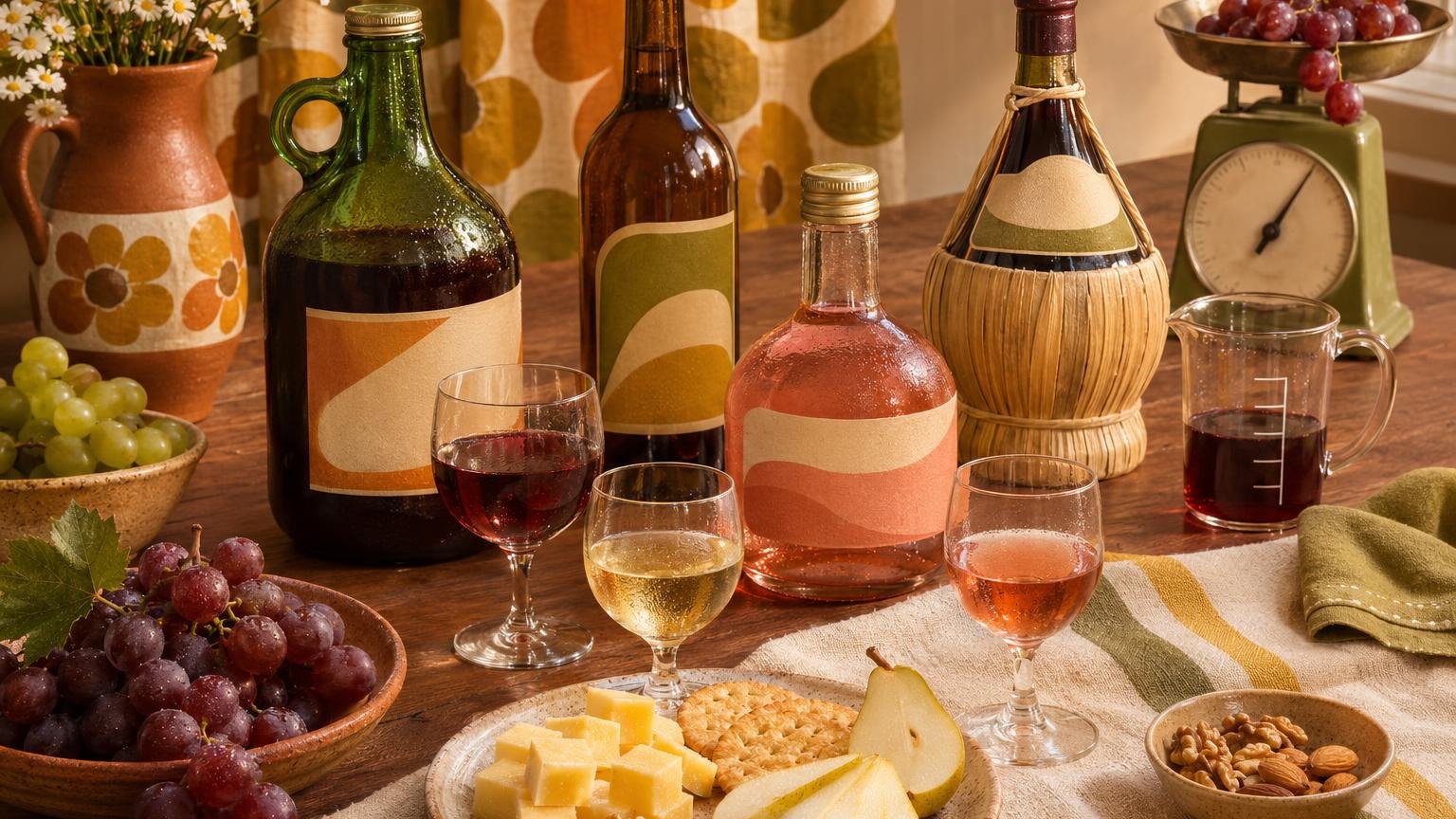
Mateus and Lancers helped make Portuguese rosé familiar to American wine buyers during the 1970s.
Their approachable sweetness, gentle fizz, and distinctive bottles offered an alternative to dry table wine without requiring knowledge of grape varieties or European appellations.
Two Brands Built for Export
Neither wine originated in the disco era. Both reached international markets decades earlier, giving their producers time to establish the distribution and recognizable packaging that supported their visibility in the 1970s.
| Brand | Launch year | Producer and background |
| Mateus | 1942 | Created by Fernando van Zeller Guedes, a founder of Sogrape, as a Portuguese rosé aimed at international consumers. |
| Lancers | 1944 | Launched by José Maria da Fonseca following American wine merchant Henry Behar’s involvement in developing a wine for the US market. |
Source: the producers’ brand histories at https://www.mateusrose.com/ and https://www.jmf.pt/. These establish the wines’ origins; they do not establish a single nationwide American retail price for the 1970s.
What Buyers Were Getting
- Mateus: A pink, slightly sparkling wine associated with a broad, flattened bottle. Its label depicts the Mateus Palace, but the pictured estate should not be mistaken for the wine’s production site.
- Lancers: A competing Portuguese rosé identified with a squat, opaque, pottery-style bottle. Its packaging distinguished it from conventional clear-glass wine bottles on American shelves.
- Shared appeal: Fruit-forward flavor, some sweetness, and light effervescence made these wines approachable when chilled. Neither depended on the prestige of a declared vintage or a famous vineyard.
Affordable Then Does Not Mean Collectible Now
For an article about cheap 1970s wines, these belong in the accessible imported-wine category, not automatically the absolute lowest-price tier.
An exact historical dollar figure needs a dated advertisement or retailer listing identifying the market, bottle size, and any promotional discount.
The bottles can also create confusion today: an attractive surviving container is not evidence that its contents have improved. These were youthful-drinking rosés, not wines designed for decades of cellaring.
Buy a current bottle to explore the style; treat an old unopened example primarily as memorabilia.
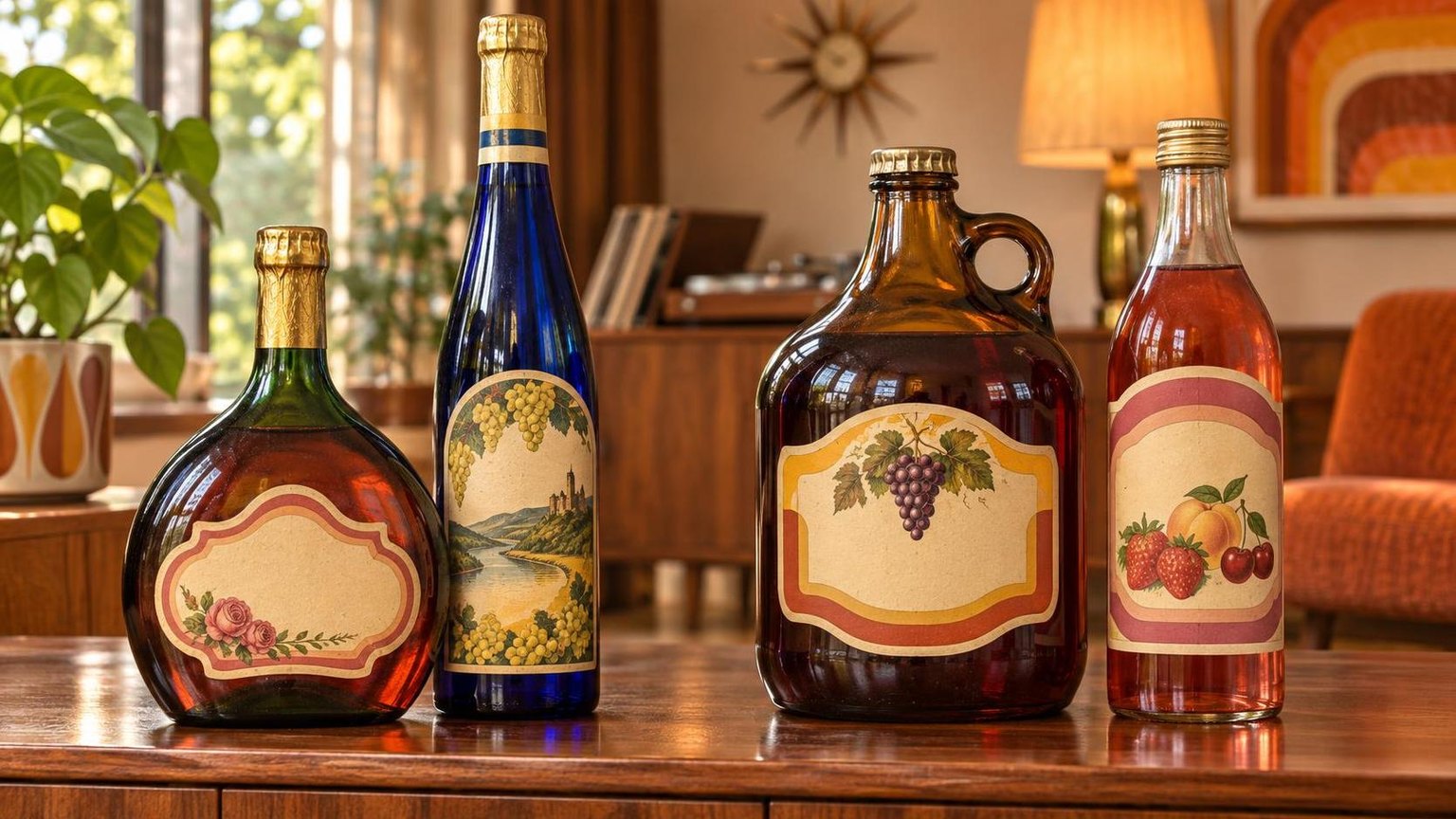
What Budget Wines Cost in the 1970s
Budget wine in the 1970s centered on supermarket table wines, larger jugs, and inexpensive sweet or flavored wines. A reliable price needs a year, location, and container size: there was no single national price for “cheap wine.”.
What a Low Shelf Price Meant
The following prices are illustrative shopping examples, not verified advertisements for particular brands. They show how inexpensive wine purchases compared with the federal minimum wage at the beginning and end of the decade.
| Illustrative wine price | Work time at 1970 federal minimum wage | Work time at 1979 federal minimum wage |
| $1 | 37.5 minutes | 20.7 minutes |
| $2 | 75 minutes | 41.4 minutes |
| $3 | 112.5 minutes | 62.1 minutes |
| Hourly wage used | $1.60 | $2.90 |
These calculations use gross pay, before taxes. The earlier wage applies to workers covered under the original federal law; some newly covered workers had a different minimum. Source: U.S.
Department of Labor, “History of Federal Minimum Wage Rates Under the Fair Labor Standards Act.”.
Inflation Changed the Meaning of Cheap
A price remembered from the beginning of the decade should not be treated as equivalent to the same sticker price near its end. General consumer prices rose sharply, although that does not establish how much any individual wine increased.
| Inflation measure | Amount |
| 1970 annual-average CPI-U | 38.8 |
| 1979 annual-average CPI-U | 72.6 |
| Overall consumer-price increase | 87.1% |
| 1979 purchasing-power equivalent of $2 in 1970 | Approximately $3.74 |
Source: U.S. Bureau of Labor Statistics, annual-average Consumer Price Index for All Urban Consumers, all items, U.S. city average. This measures overall inflation, not a wine-specific price index.
Read Vintage Wine Prices Carefully
- Check the container. A jug and a standard bottle cannot be compared meaningfully by sticker price alone.
- Identify the product. Boone’s Farm, inexpensive sparkling wine, and generic jug Burgundy occupied different categories.
- Check the offer. Newspaper specials could require a case purchase or apply only during a short promotion.
For a defensible brand-specific cost, cite a dated retailer advertisement and preserve its package size and sale conditions. Unsourced nostalgic prices can suggest affordability, but they cannot establish what Americans generally paid.
Questions People Ask Most
What cheap wines were popular in the 1970s?
Budget-friendly names associated with the decade include Boone’s Farm, Ripple, Annie Green Springs, and Thunderbird.
Imported labels such as Riunite, Mateus Rosé, and Blue Nun also reached American mass-market drinkers, although their prices and styles differed from domestic bargain wines.
Was Boone’s Farm actually wine in the 1970s?
Boone’s Farm began in 1961 as an apple-wine product, according to GALLO’s brand history.
Its fruit-based identity distinguished it from conventional grape wines; do not assume a bottle sold under the name today has the same formulation or alcohol content as a 1970s version.
Were Ripple and Thunderbird the same kind of cheap wine?
No: Ripple was a sweet, lightly carbonated wine, while Thunderbird belonged to the higher-alcohol fortified-wine category.
Both became associated with inexpensive drinking, but treating them as interchangeable misses important differences in strength and carbonation.
Which inexpensive imported wines were associated with the 1970s?
Riunite Lambrusco offered sweet, lightly sparkling red wine; Mateus Rosé offered lightly sparkling Portuguese rosé; and Blue Nun became associated with German Liebfraumilch.
Their producers’ histories date Riunite’s U.S. introduction to 1967, Mateus’s creation to 1942, and Blue Nun’s origins to the 1921 vintage, so none was invented during the 1970s.
What would a cheap 1970s wine cost in today’s money?
Using the U.S. Bureau of Labor Statistics’ annual-average CPI-U, $2 in 1975 had approximately the purchasing power of $11.66 in 2024.
That is an inflation example, not a documented bottle price: historical comparisons require a dated advertisement showing the brand, bottle size, and retailer.
Is an unopened bottle of cheap wine from the 1970s still good to drink?
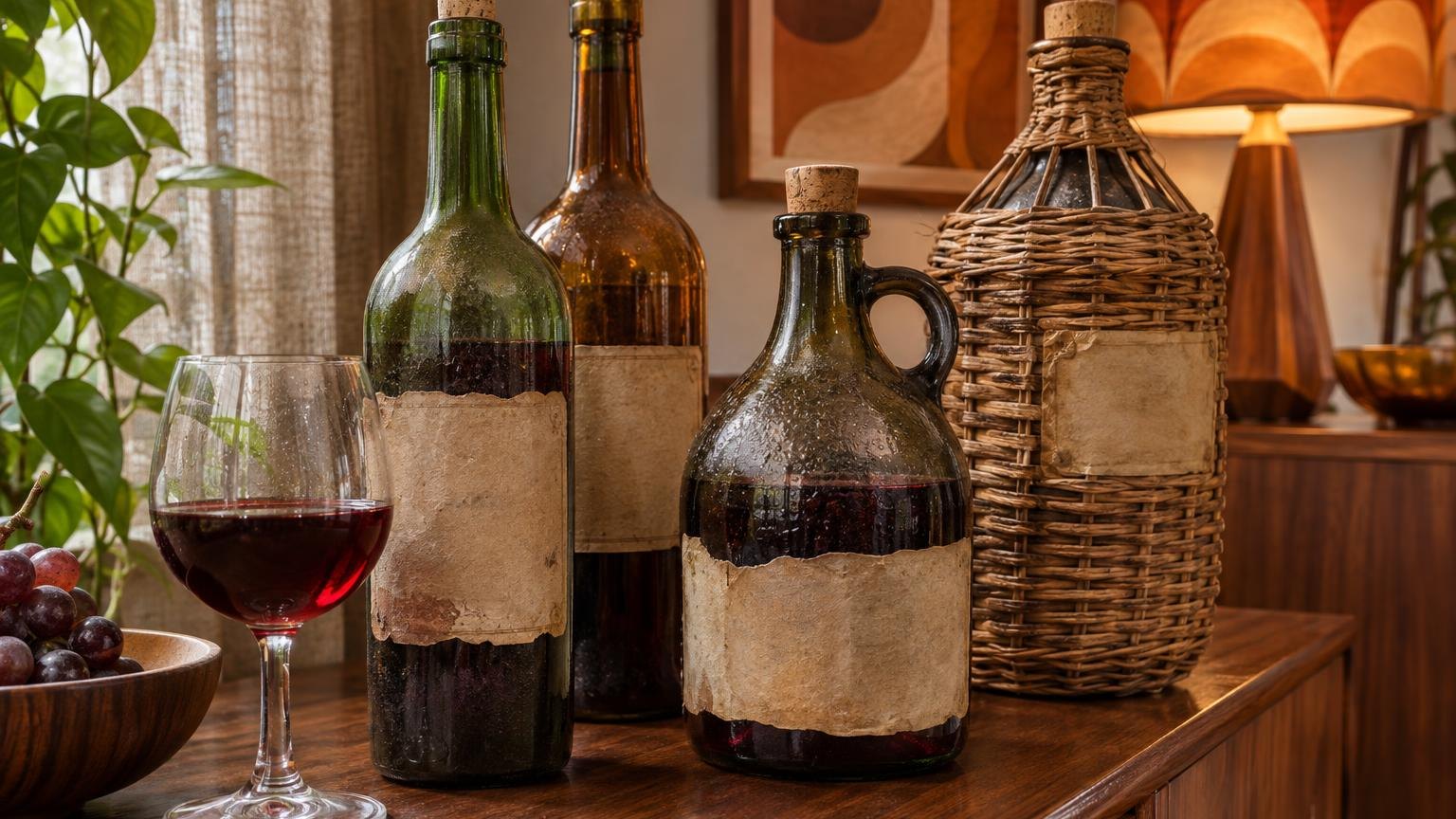
Most inexpensive fruit wines, sweet table wines, and lightly sparkling wines were intended for early consumption, not roughly 50 years of aging.
An intact bottle may still contain drinkable wine, but storage conditions and closure integrity matter more than the label’s nostalgia; leakage, a compromised seal, or uncertain contents are reasons not to taste it.
What should I buy to recreate the taste of cheap 1970s wine?
For the sweet, fizzy imported style, look for Riunite Lambrusco or a Lambrusco labeled “dolce”; for the Portuguese rosé style, look for Mateus.
For nostalgic fruit flavors, check current Boone’s Farm labels carefully, because a surviving brand name does not guarantee the original recipe.
Related Reading
- How Many Pounds Is 13 Stone?
- How Many Ounces Is 6 Liters?
- Why Do Wine Glasses Have Stems? Get Answer Now
- How Much Is 5 Oz?
- How To Take A Shot Without Tasting It?
- How Many Pounds Is 10 Stone?
- How Many Tablespoons Is 15 ML? 15 Milliliters to Tablespoons
- How To Get A Cork Out?
- All Blog Guides
- Thomas Pinney, A History of Wine in America, Volume 2, University of California Press (2007)
- National Institute on Alcohol Abuse and Alcoholism, Apparent Per Capita Alcohol Consumption: National, State, and Regional Trends, 1977–2021 (2023)
- U.S. Census Bureau, Historical Statistics of the United States, Colonial Times to 1970 (1975)
- Jancis Robinson and Julia Harding, The Oxford Companion to Wine, Fourth Edition (2015)
- Sutter Home, Our Story (n.d.)
- Riunite, Official Winery Website (n.d.)
- Blue Nun, Official Wine Brand Website (n.d.)
- Mateus Rosé, Official Wine Brand Website (n.d.)
- GALLO, Official Winery Website (n.d.)