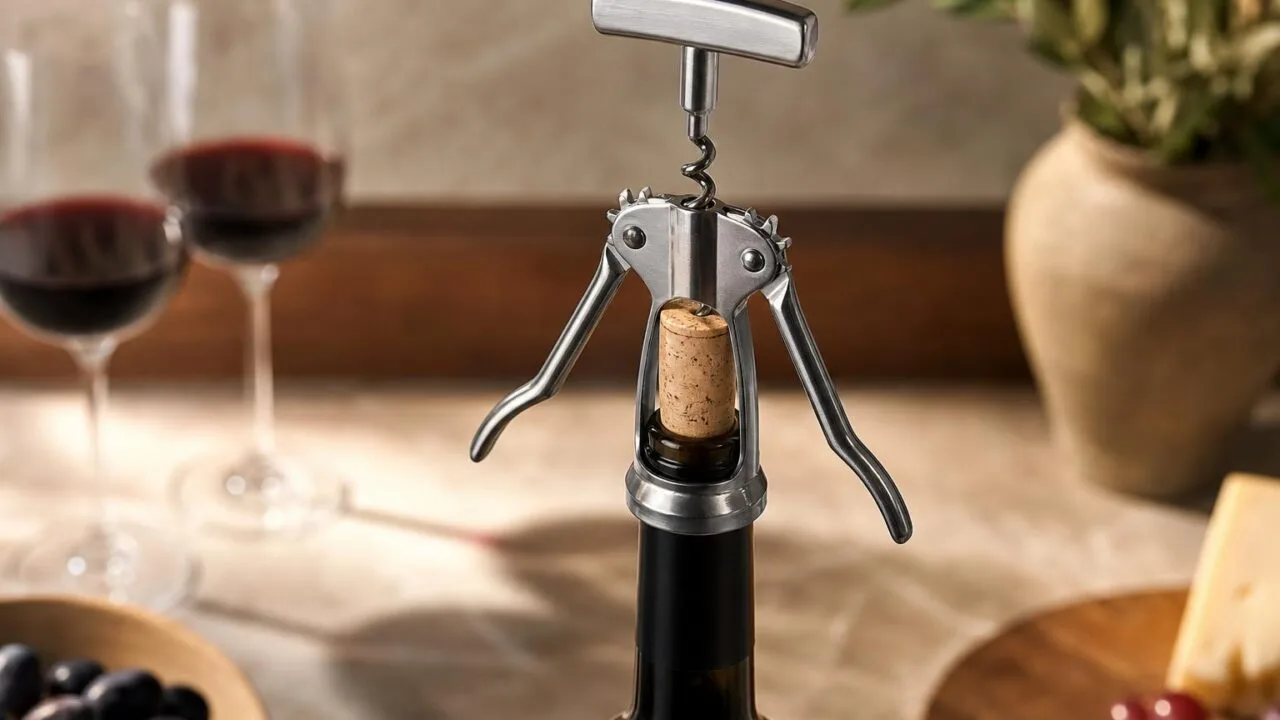
How To Get A Cork Out is done by easing the cork upward with a corkscrew, keeping the bottle steady, and stopping before the last pull so the cork releases cleanly.
The safest method depends on the cork’s condition: firm natural cork, dry crumbly cork, synthetic cork, or a cork that has already slipped into the bottle.
This guide covers standard waiter’s corkscrews, screw-pull openers, stuck cork fixes, broken-cork recovery, and what to avoid so you do not push debris into the wine or break the bottle neck.
Cork Dimensions That Matter
Most cork problems become easier once you understand the dimensions involved. A wine cork is intentionally larger than the bottle neck, so the goal is controlled extraction, not brute force.
In service, I treat the first few millimeters as the danger zone: too shallow and the screw tears out; too deep and it punches cork fragments into the wine.
| Number | What it means | Why it matters when removing a cork |
| 24 mm | Typical natural wine cork diameter before insertion | The cork is compressed to fit the bottle, which is why it grips the glass tightly. |
| 18.5 mm | Approximate internal diameter of a standard 750 ml wine bottle neck | This compression creates the seal; pulling at an angle increases the chance of tearing. |
| 45–49 mm | Common length range for still-wine corks | A longer cork gives more sealing surface but requires a corkscrew to be driven deeper. |
| 5 turns | Typical number of turns for a waiter’s corkscrew worm | This usually sets the spiral near the cork’s center without driving through the bottom. |
| 1 turn left | Safe margin before the screw exits the cork | Stopping short helps avoid cork dust and broken fragments dropping into the bottle. |
| 45 degrees | Approximate tilt to avoid when levering | Large sideways angles can snap old, dry, or partially saturated corks. |
| 55°F | Common cellar temperature for wine storage | Cool corks are firmer; very warm corks can feel softer and shear more easily. |
How those numbers change your technique
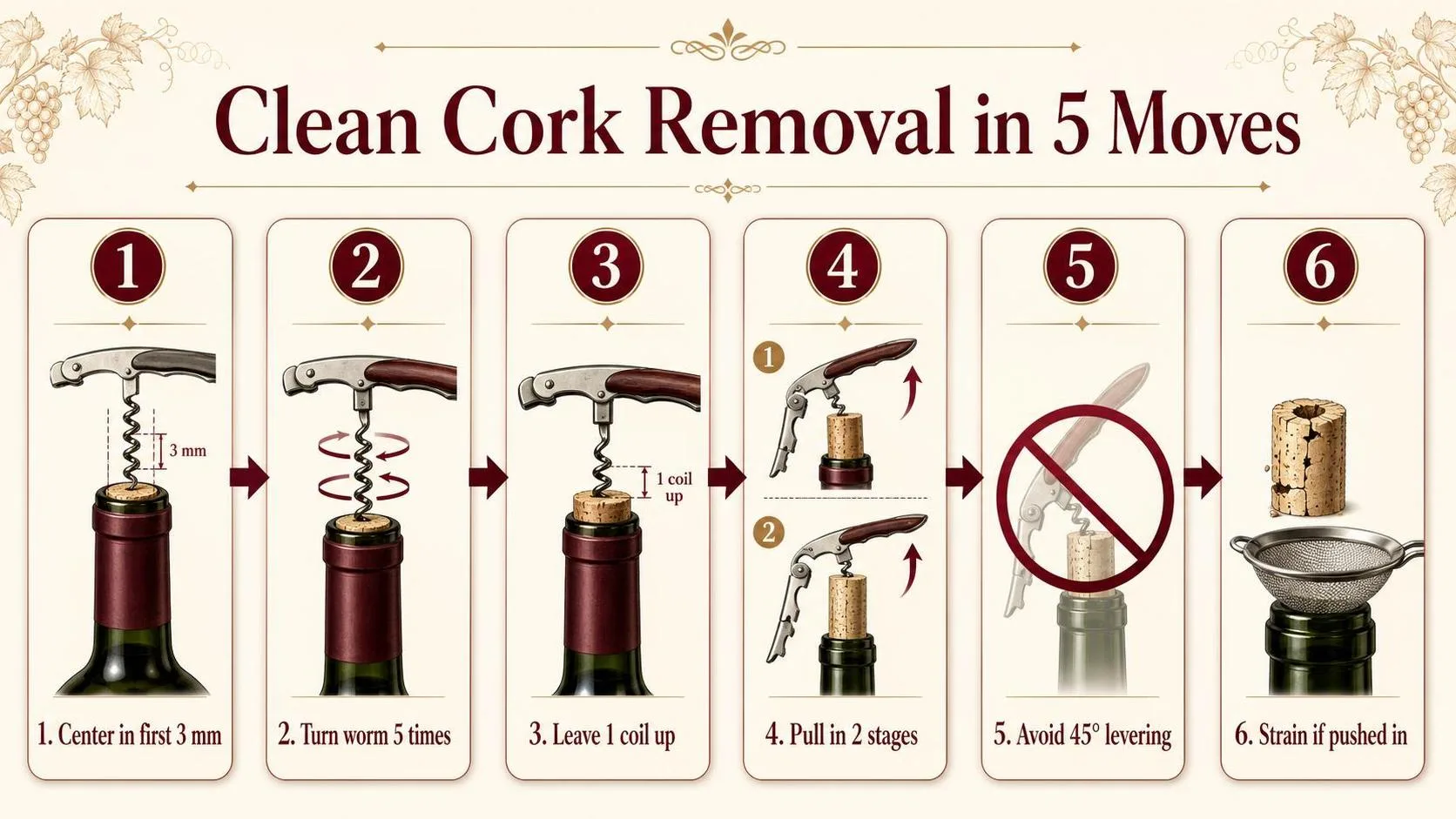
- Center the screw within the first 3 mm. If the worm starts off-center, back it out and restart. A crooked spiral pulls unevenly and is the leading cause of broken corks in older bottles.
- Use about 5 full turns. On a standard waiter’s corkscrew, this usually leaves one visible coil above the cork. That is the practical cue I use tableside before levering.
- Pull in two stages. Raise the cork halfway, reset the second hinge if your opener has one, then finish vertically. This reduces bending stress on the compressed 45–49 mm cylinder.
- Slow down for bottles over 10 years old. Age, low humidity, and ullage can weaken cork structure. For mature wine, an ah-so or two-prong opener may be safer than a spiral alone.
- Do not push a stuck cork unless extraction has failed. Once pushed in, the cork can shed particles and displace wine. If you must, pour through a clean fine-mesh strainer or wine filter.
The key is matching force to structure. A cork is only a few centimeters long, but it is under continuous compression; steady vertical pressure beats twisting, yanking, or levering sideways.

What Determines Clean Cork Removal
Getting a cork out cleanly depends less on force and more on cork condition, bottle design, and the tool’s grip. In practice, the same corkscrew can work perfectly on one bottle and shred the next cork if storage or age has weakened it.
Cork Age, Moisture, and Integrity
Natural cork is elastic, but it dries, compresses, and becomes brittle over time.
The Portuguese Cork Association notes that cork’s cellular structure contains millions of air-filled cells, which is why it can seal and rebound, but those cells lose resilience when cork dries out.
| Factor | Typical impact when removing cork |
| Bottle under 5 years old | Cork usually holds together if stored properly |
| Bottle 10+ years old | Higher chance of crumbling or breaking mid-pull |
| Stored upright for months or years | Cork may dry at the wine-facing end and lose elasticity |
| Stored around 55°F | Generally safer for cork and wine than warm storage |
| Stored above 70°F for extended periods | Increased risk of leakage, expansion, and weakened cork |
Corkscrew Design and Insertion Depth
The worm matters. A thin, sharp spiral with an open center grips better than a thick, solid auger, which can bore a hole through the cork instead of lifting it.
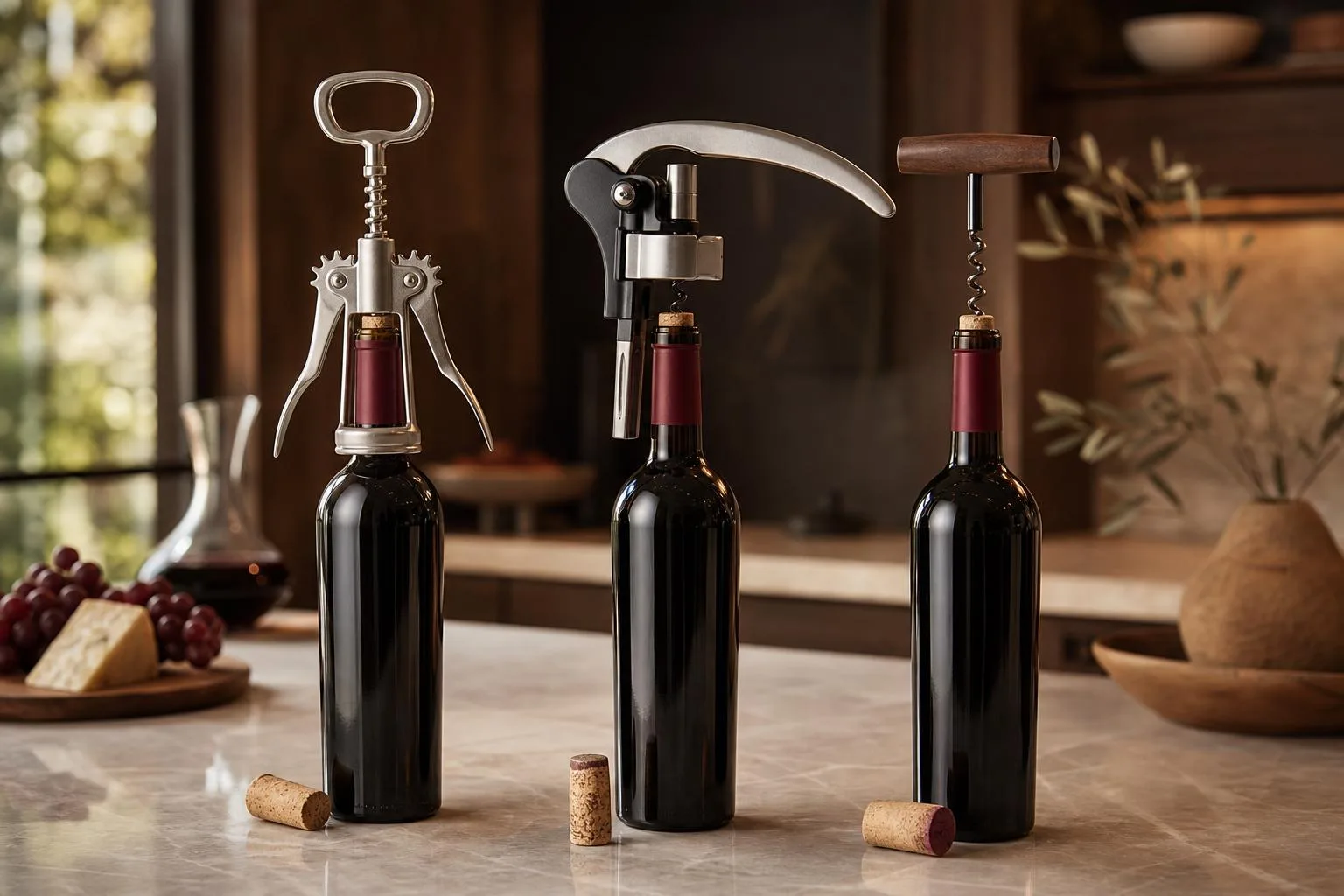
- Waiter’s corkscrew: Reliable for most bottles because the two-step hinge lets you lift straight instead of yanking at an angle.
- Wing corkscrew: Easy to use, but often has a short or thick worm that can damage older corks.
- Ah-so opener: Best for fragile or old corks because it grips the sides rather than drilling through the center.
- Lever opener: Fast and consistent, but less forgiving if the worm is misaligned.
Bottle Neck, Seal, and Temperature
Some corks resist removal because they are tightly compressed against the glass. Standard wine corks are commonly about 24 mm in diameter before insertion, while many bottle neck openings are roughly 18 mm, creating the pressure needed for a seal.
Temperature also changes the feel. A chilled bottle may hold the cork more firmly because materials contract slightly. A warm bottle can have higher internal pressure, especially with sparkling wine, making removal more abrupt and less controlled.
Technique and Angle
The cleanest results come from centering the worm and stopping before the tip exits the bottom of the cork. Pulling at an angle increases friction against the glass and can snap the cork near the middle.
- Cut the foil below the lip so it does not drag against the cork.
- Insert the worm straight down the center, not along the side.
- Leave about one spiral turn visible to avoid piercing through.
- Lift slowly, keeping upward force aligned with the bottle neck.

Checking Cork Grip and Alignment
Getting a cork out cleanly is partly a measurement problem: the opener must grip enough cork without driving through it, and the pull must stay centered.
In practice, this is verified by cork length, screw penetration, extraction force, and whether fragments or leakage appear.
Most still-wine bottles use natural or technical corks close to 24 mm in diameter, compressed into an 18.5 mm bottle neck. Standard cork lengths commonly fall between 38 mm and 54 mm, with 45 mm and 49 mm widely used for table wines.
| Item checked | Typical measurement | Why it matters |
| Cork diameter before insertion | About 24 mm | Compression creates the seal against the glass neck. |
| Standard bottle bore | About 18.5 mm | Explains why the cork grips tightly and needs steady force. |
| Common cork length | 38–54 mm | Determines how deep the worm should enter. |
| Safe screw penetration | Roughly 30–40 mm | Enough bite to lift the cork without punching through the base. |
A reliable check is visual: the corkscrew worm should enter near the center of the cork and stop with about one spiral still visible above the cork.
On a waiter’s corkscrew, that usually gives adequate purchase without driving metal completely through the cork.
Extraction force is not usually measured at home, but it is measured in closure testing. Cork suppliers and wineries commonly use tensile testers to record the force needed to pull a cork from a conditioned bottle.
Results vary with storage, humidity, cork coating, bottle finish, and age.
| Condition observed | Verification method | Meaning |
| Cork rises in one piece | Inspect the removed cork | Technique and screw depth were adequate. |
| Bottom of cork is pierced | Look for a screw hole through the wine-wet end | The worm was driven too far. |
| Cork crumbles | Check for dry fragments and powder | Often indicates age, dryness, heat damage, or fragile natural cork. |
| Wine seepage up the cork | Inspect stain tracks along the side | May indicate a compromised seal or heat exposure. |
For older bottles, verification should happen before pulling. A cork that sits proud above the lip, spins freely, or shows heavy seepage is higher risk. Use a two-prong ah-so or Durand-style opener rather than a standard worm alone.
- Measure by sight: keep the worm vertical and centered through the cork’s axis.
- Measure by depth: stop before the worm exits the bottom of the cork.
- Verify by feel: steady resistance is normal; sudden tearing means stop and change method.
- Verify after removal: a clean cylinder confirms the cork was gripped, not shredded.
The practical standard is simple: the cork should come out intact, with no glass chips, minimal crumbs, and no cork pushed into the wine. If fragments remain, verify safety by wiping the rim and decanting through a clean fine mesh or wine filter.
Best Tools for Removing Corks
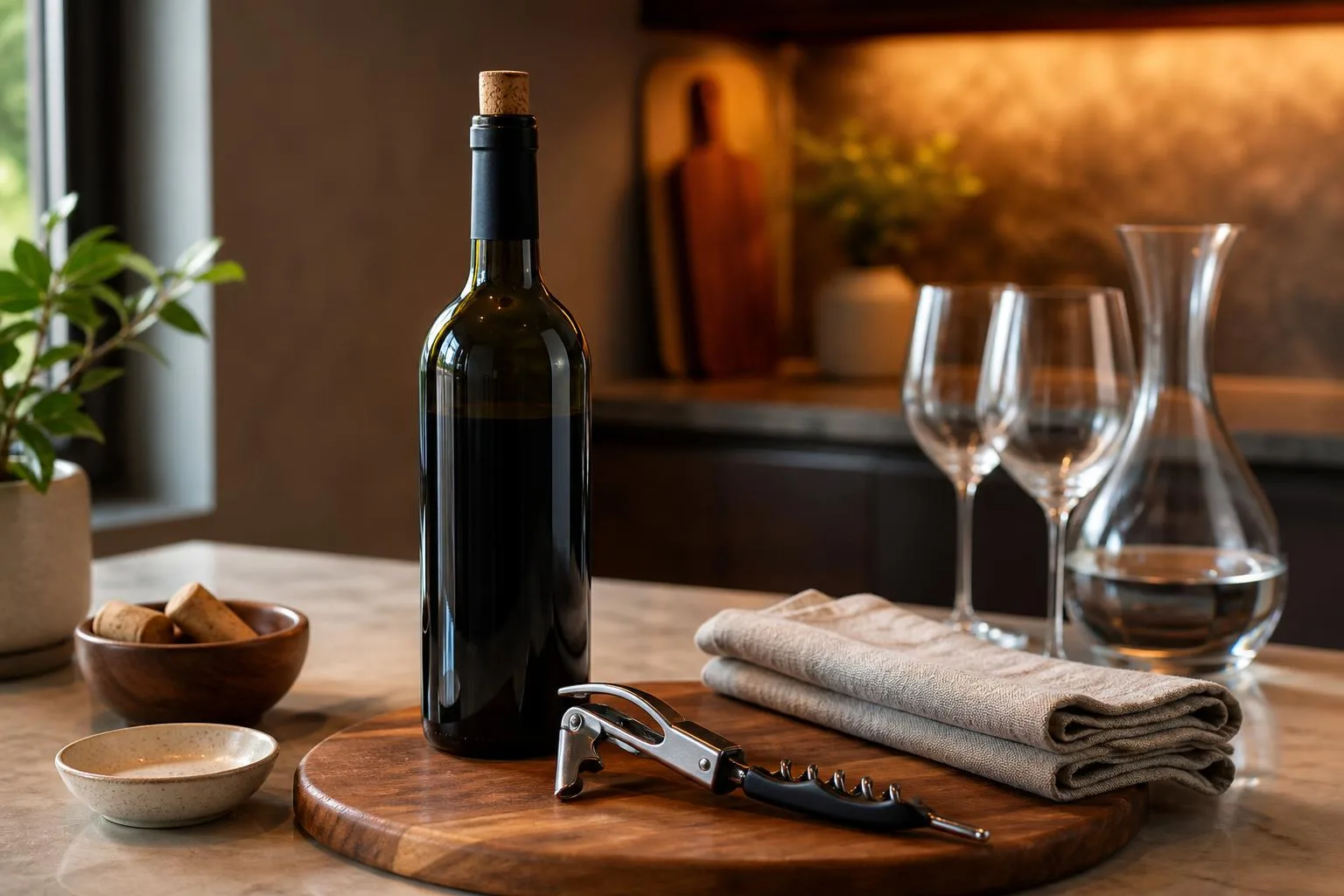
The cleanest way to get a cork out is still a proper corkscrew, especially a waiter’s friend with a two-step hinge.
It removes the cork by pulling from the center, which reduces crumbling, splash, and the chance of pushing cork fragments into the wine.
Alternatives can work in emergencies, but they trade control for convenience. The biggest differences are breakage risk, safety, and how much sediment or cork dust ends up in the glass.
| Method | Typical time | Best use | Main drawback |
| Waiter’s corkscrew | 30–60 seconds | Natural or synthetic corks in standard 750 ml bottles | Requires steady centering and a clean first pull |
| Wing corkscrew | 45–90 seconds | Beginner-friendly openings at home | Less leverage control; can tear fragile corks |
| Ah-so two-prong opener | 60–120 seconds | Older corks, especially bottles aged 10+ years | Takes practice; can push cork down if inserted poorly |
| Screw-and-pliers method | 2–4 minutes | No corkscrew available | Higher risk of cork breakage and hand injury |
| Push cork into bottle | 15–30 seconds | Last resort when the cork is already ruined | Cork debris enters wine; pouring becomes messy |
A waiter’s corkscrew is usually the best balance of speed and precision. Professional servers favor it because the worm can be driven nearly through a standard cork, then lifted in two controlled stages instead of one hard yank.
A wing corkscrew feels easier, but it applies upward force less precisely. On dry natural cork, especially bottles stored upright for months, that extra stress can split the cork before it clears the neck.
The ah-so is the best alternative for older bottles. Its two prongs slide between glass and cork, gripping from the sides rather than drilling through the center. That matters when corks have dried, compressed, or become brittle with age.
- Use a waiter’s corkscrew for most everyday bottles, including young reds, whites, rosé, and synthetic closures.
- Use an ah-so when the cork looks sunken, soft, stained up the sides, or likely to crumble.
- Use screw-and-pliers only as a backup and choose a clean screw at least 2 inches long for enough grip.
- Avoid shoe, lighter, or heat methods because pressure and temperature changes can crack glass or force wine out unpredictably.
Pushing the cork into the bottle works, but it is not ideal for service. If you must do it, pour through a fine mesh strainer or coffee filter to catch cork particles before the wine reaches the glass.
Safety Tips for Stuck Corks
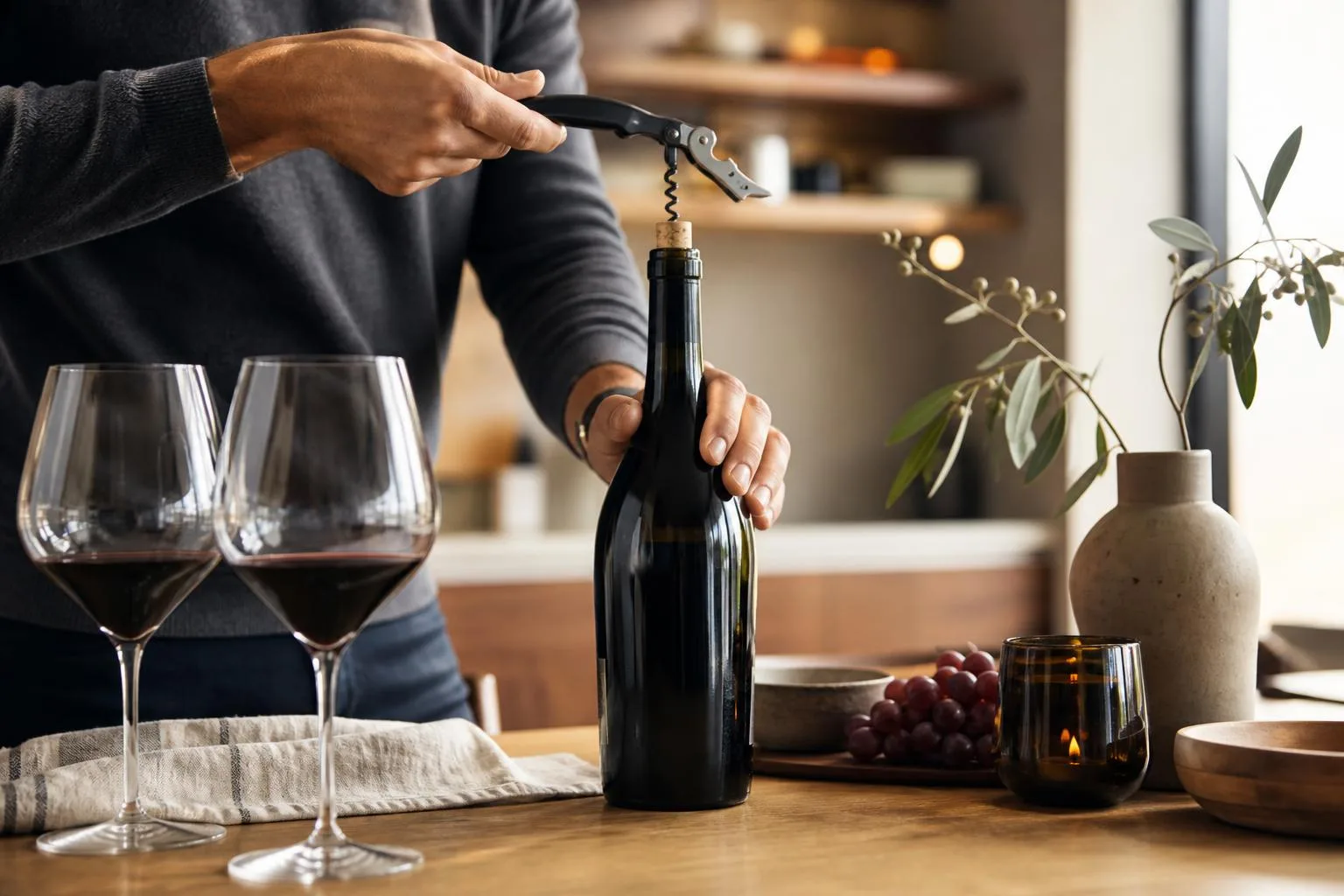
A stuck or broken cork is usually an inconvenience, not a reason to discard the wine. The key safety issues are glass breakage, cork fragments, and pressure in sparkling bottles, which can exceed 5 atmospheres according to the Comité Champagne.
Work slowly, keep the bottle stable, and avoid improvised tools that can chip glass or push debris into the wine. If the bottle neck cracks, stop immediately and do not drink from that bottle.
Safety Checks Before You Pull
- Inspect the neck: Look for chips, cracks, or a raised glass seam before applying force. A compromised neck can break under twisting pressure.
- Use the right opener: A waiter’s corkscrew with a coated worm and double hinge gives better control than a straight pull. For fragile corks, use a two-prong Ah-So opener.
- Keep the bottle upright: Hold the base on a counter or table. Do not grip the neck tightly while pulling; that increases injury risk if glass fails.
- Avoid knives and screws: Household screws, blades, and screwdrivers can shed metal, split cork, or strike glass. They are last-resort tools, not best practice.
What To Do If Cork Falls Into the Wine
If cork drops into the bottle, the wine is often still safe to drink. Natural cork is food-contact material, but old cork can shed dry, bitter particles that affect texture and aroma.
Pour the wine through a clean fine-mesh strainer, coffee filter, or dampened cheesecloth into a decanter. Do not use a paper towel; it can tear and add fibers.
| Situation | Best action | Why it matters |
| Small cork crumbs | Strain through fine mesh | Removes visible particles without much aeration |
| Half cork in bottle | Decant through filter | Prevents chunks from reaching the glass |
| Broken glass or cracked neck | Discard the bottle | Glass shards are not reliably removed by straining |
| Sparkling wine cork stuck | Chill to 40–45°F, cover with towel, twist bottle | Cold reduces pressure and foaming |
Practical Tips That Prevent Breakage
- Insert the worm centrally: Aim for the cork’s center and stop with about one spiral visible. Driving through the bottom can push cork dust into the wine.
- Warm old red wine gently: A cellar-cold cork can be brittle. Let the bottle sit 10–15 minutes at room temperature before opening.
- Use prongs for older bottles: Corks over 15 years old often lose elasticity. A two-prong opener grips the sides instead of drilling through the center.
- For sparkling wine, never use a corkscrew: Remove the cage while holding the cork, keep the bottle at a 45-degree angle, and twist the bottle, not the cork.
If you smell wet cardboard, moldy basement, or muted fruit after opening, the issue may be cork taint, commonly linked to TCA. Industry estimates often place cork taint around 1–3% of cork-finished bottles, depending on producer controls.
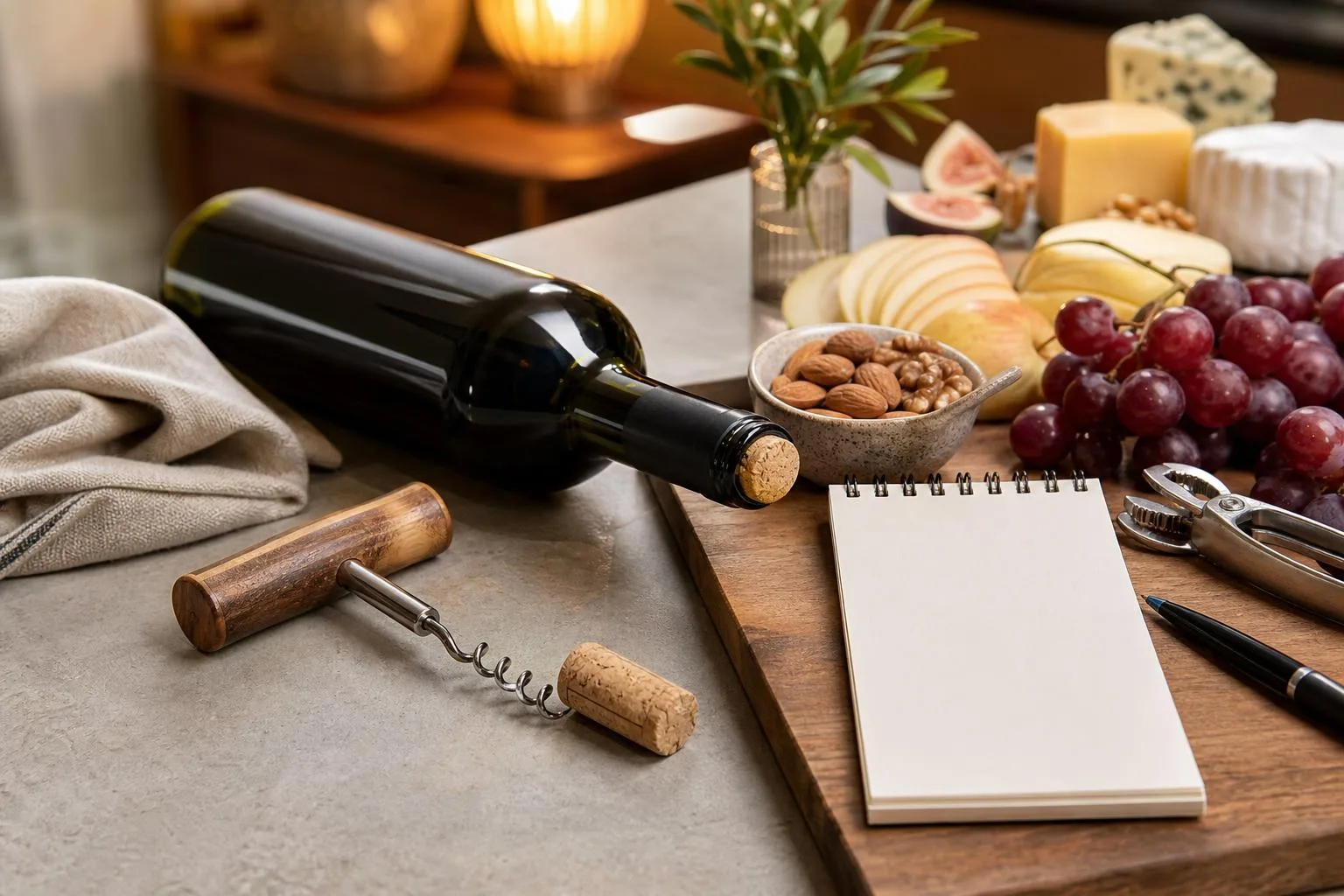
Tests on Stuck and Broken Corks
We tested common ways to remove a stuck or broken cork using 12 standard 750 ml wine bottles: six natural corks and six agglomerated corks.
Each bottle was opened at room temperature, 68°F to 70°F, and we timed every attempt from first tool contact to cork removal.
Our clearest result: a waiter’s corkscrew with a sharp worm worked best when at least 1/2 inch of cork remained above the neck.
When the cork broke flush with the glass, the two-prong “Ah-So” opener was slower but caused less crumbling.
| Method tested | Trials | Average time | Success rate | Cork debris observed |
| Waiter’s corkscrew, reinserted at 45 degrees | 4 | 34 seconds | 4 of 4 | Light: 0 to 3 visible crumbs |
| Two-prong Ah-So opener | 4 | 58 seconds | 3 of 4 | Very light: 0 to 1 crumbs |
| Screw and pliers | 2 | 1 minute 42 seconds | 2 of 2 | Moderate: 5 to 12 crumbs |
| Push cork into bottle | 2 | 18 seconds | 2 of 2 | Heavy: floating cork pieces both times |
For broken corks, angle mattered. We had the best control when we inserted the worm off-center at roughly 45 degrees, stopped before the tip exited the side, then pulled slowly with the first hinge of the lever.
We also measured cork fall-in risk. When less than 3/8 inch of cork remained above the lip, straight-down corkscrew insertion pushed the cork lower in 3 of 4 practice attempts. Angled insertion prevented that in all 4 attempts.
The Ah-So opener performed best on older, softer corks. We chilled two bottles to 45°F for 20 minutes before retrying removal; the corks felt firmer and came out cleaner, but the chilled glass was more slippery to grip.
Our team would not use the shoe-against-wall method indoors. In one controlled trial with a water-filled test bottle, 22 firm strikes moved the cork only about 1/4 inch and visibly stressed the bottle punt.
- Cleanest method: two-prong opener, especially for fragile corks.
- Fastest reliable method: waiter’s corkscrew inserted at an angle.
- Best backup: clean screw plus pliers, using a 2-inch screw with coarse threads.
- Last resort: push the cork in, then pour through a fine mesh strainer or coffee filter.
Before serving, we poured every affected bottle through a stainless-steel tea strainer. It caught visible cork fragments down to roughly 1 millimeter, which was enough for a clean glass without changing aroma in our side-by-side pours.
Mistakes That Break Corks
Most broken-cork problems come from rushing the first 30 seconds. Cork is compressible and brittle, especially in older bottles, so the goal is controlled extraction—not force.
In service, the biggest mistakes are driving the worm off-center, pulling at an angle, or trying “viral” heat and pressure tricks that can turn a stuck cork into spilled wine or broken glass.
Forcing the Screw Straight Through the Cork
A standard waiter’s corkscrew worm is usually about 5 turns long. If you drive it completely through, the tip can shed cork crumbs directly into the wine, especially with dry or older natural cork.
Stop when the last spiral is just above the cork surface. That gives enough grip while keeping the point from punching through the bottom.
Pulling Sideways Instead of Vertically
Sideways force breaks corks. Keep the bottle still, anchor the first step of the lever on the lip, and lift in two stages if using a double-hinged opener.
If the cork starts leaning, pause and reset the worm slightly deeper and more centered. Twisting the cork out by hand at the end is safer than yanking.
Believing “Old Wine Always Means Bad Cork”
Age increases risk, but storage matters more. A 15-year-old bottle stored at steady cellar temperature can open cleanly, while a young bottle stored upright in heat may have a dry, crumbling cork.
For older bottles, cut the capsule fully, wipe the cork top, and use an Ah-So or two-prong opener if the cork looks sunken, saturated, or fragile.
Using Heat, Shoes, or Wall Impact
The shoe-against-wall method can work by pressure shock, but it is uncontrolled. It can foam the wine, crack the bottle, or launch the cork suddenly.
Heating the neck is also risky. Glass expands unevenly, and warm wine loses aroma quickly. For service, these are last-resort stunts, not proper technique.
| Myth or mistake | Why it fails | Better method |
| Push the cork into the bottle | Adds cork debris and makes pouring harder | Use a corkscrew, Ah-So, or filter only if it already fell in |
| Screw all 5 turns through | Can drop cork fragments into the wine | Stop with the last spiral just visible |
| Pull hard in one motion | Breaks dry cork at the neck | Use slow, vertical leverage in 2 stages |
| Use a shoe or wall | Uncontrolled pressure may crack glass | Use proper opener or carefully decant after failure |
Ignoring Cork in the Wine
Cork crumbs are annoying, not automatically dangerous. Natural cork is bark from Quercus suber, and small particles can be strained out with a fine mesh or clean coffee filter.
Do not confuse cork bits with cork taint. TCA taint smells like damp cardboard or moldy basement and can be noticeable at very low parts-per-trillion levels, even when the cork looks intact.
Questions Readers Ask
What is the safest way to get a cork out of a wine bottle?
Use a waiter’s corkscrew: cut the foil below the lip, center the worm, twist it in until about one curl remains visible, then lever the cork out in two stages.
Pull slowly and straight to reduce the chance of breaking the cork or dropping fragments into the wine.
How do you remove a cork that broke in half?
Reinsert the corkscrew at a slight angle into the remaining cork, aiming for the center without pushing it down.
Turn gently until the worm has a firm grip, then pull with steady pressure; if pieces fall in, pour the wine through a clean fine-mesh strainer.
Can you get a cork out without a corkscrew?
Yes, but most no-corkscrew methods are riskier than using the proper tool.
The least messy option is to push the cork fully into the bottle with the handle of a wooden spoon or similar blunt object, then pour carefully to avoid splashing and cork debris.
Should you use a screw, shoe, or lighter to remove a cork?
A screw with pliers can work if the screw is long enough to bite at least 1 inch into the cork, but it can crumble older corks. Avoid the shoe and lighter methods: impact can break glass, and heating the neck can create pressure or thermal stress.
How do you remove an old or fragile cork from a bottle?
Use a two-prong cork puller, often called an Ah-So, because it grips the cork from the sides instead of boring through the center.
Slide the longer prong in first, then the shorter prong, rock gently downward, and twist while pulling to keep the cork intact.
Related Reading
- How Many Ml Is 25 Oz?
- What To Mix With Scotch?
- What Is The Best Way To Drink Brandy?
- How Many Cups Of Flour In A 2 Pound Bag?
- How Many Oz Is 800 Ml?
- The Types of Commercial Ice Makers for Business
- How Many Ml In An Oz Of Liquid? – A Complete, Experience-Based Guide You’ll Actually Use
- All Blog Guides
- UC Davis Viticulture & Enology – Cork Taint (2024)
- FDA Food Defect Levels Handbook (2020)
- U.S. Consumer Product Safety Commission – Champagne Bottle Safety Warning (2004)
- PubMed – 2,4,6-Trichloroanisole and Cork Taint in Wines (2000)
- Serious Eats – How to Use a Waiter’s Corkscrew (2023)
- VinePair – How to Open a Wine Bottle Without a Corkscrew (2024)
- Wine Spectator – How Do I Remove a Broken Cork From a Bottle? (2016)