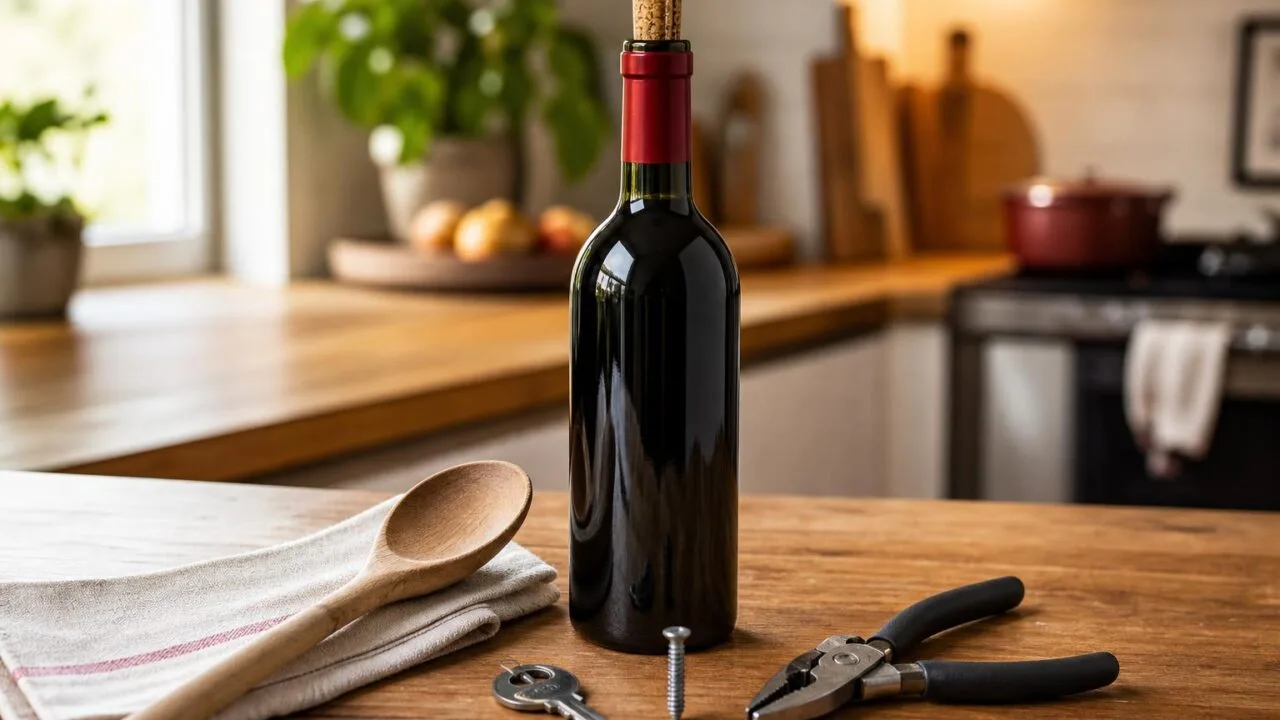
How To Open A Wine Bottle Without A Corkscrew is a set of last-resort techniques that push, pull, or safely break access to the cork when a proper opener is unavailable.
The safest options avoid heat, shattered glass, and uncontrolled pressure near the bottle neck.
As a wine bar team, we still treat these methods as backup fixes, not best practice. A waiter’s corkscrew costs little, protects the cork, and keeps sediment controlled.
If you must improvise, work slowly, keep the bottle stable, and stop if the glass chips.
This guide explains the practical methods, the risks of each, and when to abandon the bottle rather than risk injury or ruined wine.
Physical Factors Behind Cork Removal
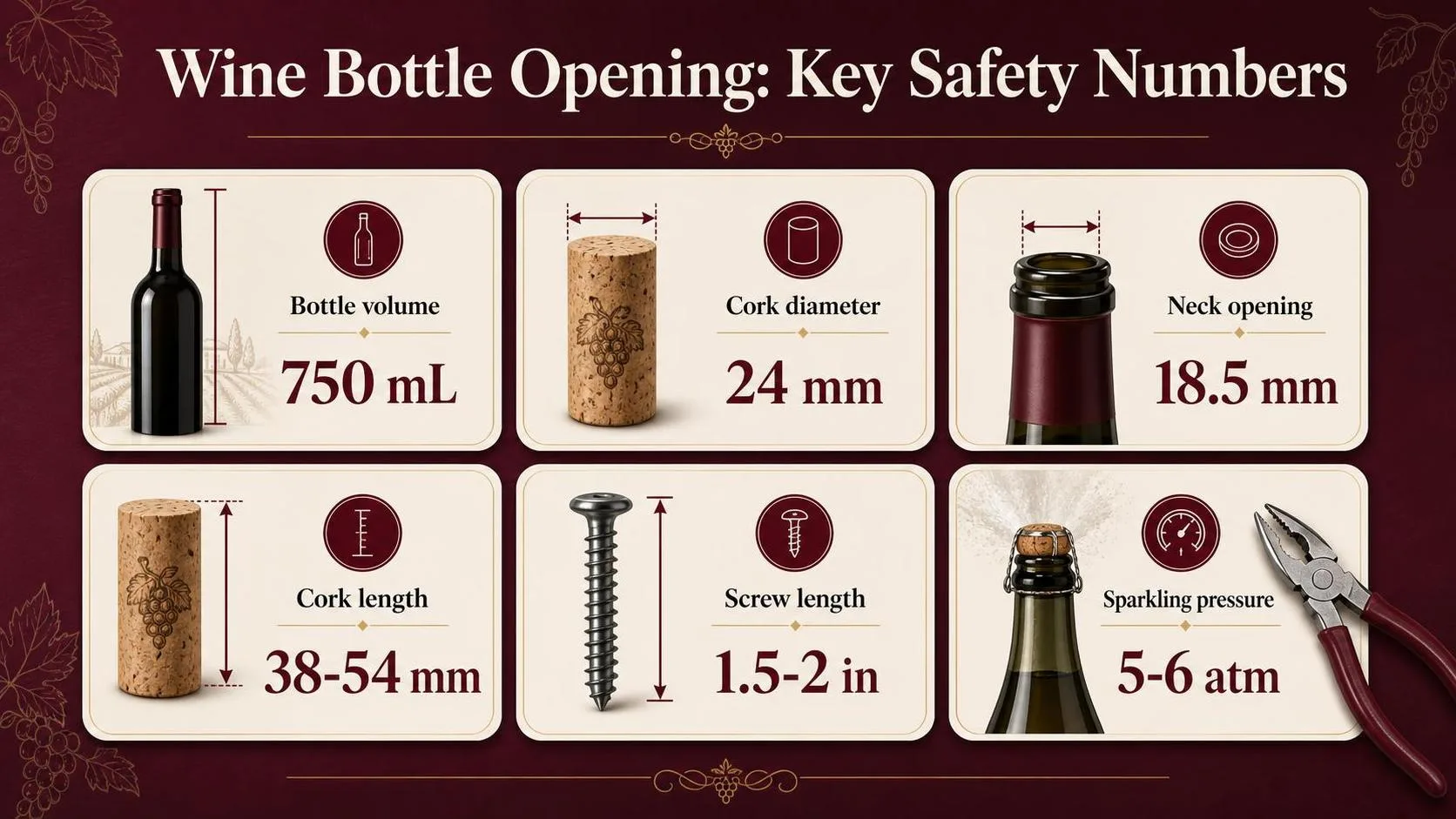
Most corkscrew-free methods work or fail because of a few physical measurements: cork diameter, cork length, bottle pressure, and the force needed to move the stopper.
These numbers also explain why some internet “hacks” are risky, especially with sparkling wine.
At the bar, the safest improvised approach we’ll consider is a clean screw-and-pull method, not heating glass, hammering the base, or pushing unknown debris into the wine.
| Number | What it means | Why it matters |
| 750 mL | Standard wine bottle volume in the U.S. | A full bottle weighs about 2.6 to 3.0 lb with glass, so grip and stability matter when applying force. |
| 24 mm | Common natural cork diameter before compression | The cork is wider than the bottle opening, which is why friction holds it tightly in place. |
| About 18.5 mm | Typical internal diameter of a still-wine bottle neck | The cork is compressed several millimeters, creating the seal you must overcome. |
| 38 to 54 mm | Common cork lengths, with 44 mm and 49 mm widely used for quality still wines | Short screws may tear out. You need enough bite into the cork without punching through into the wine. |
| 1.5 to 2 in | Practical screw length for an emergency pull | This usually gives enough grip while leaving room for pliers or the back of a hammer. |
| 5 to 6 atm | Typical pressure inside Champagne and many traditional-method sparkling wines | Do not use corkscrew-free extraction hacks on sparkling wine; the cork can eject violently. |
Numbers That Change the Method
- Screw depth: Drive the screw roughly 1 inch into the cork, leaving about 0.5 inch exposed for pulling. Stop before the screw tip exits the bottom of the cork.
- Bottle angle: Keep the bottle upright or tilted less than 30 degrees while working. A steep angle increases spill risk and can wet the cork, making it softer.
- Pulling force: Pull slowly and straight. Side-loading the cork increases the chance of crumbling, especially in bottles older than 10 years.
- Temperature: Avoid heat-based tricks. Glass does not expand evenly under a flame or stove heat, and thermal stress can crack the bottle.
If the cork starts breaking, stop pulling and reassess. It is safer to push the remaining cork into the bottle and decant through a fine strainer than to keep shredding it into the wine.
What Determines Method Success
Opening a wine bottle without a corkscrew is mostly about cork condition, bottle strength, and how much force the method concentrates in one place.
In our bar experience, failures usually come from old corks, warm bottles, or using tools that chip glass or drive cork fragments into the wine.
The closure matters first. Natural cork is elastic but weakens with age, especially if the bottle has been stored upright and the cork has dried.
Synthetic corks are tougher to pierce and harder to push in because they do not compress like natural cork.
| Factor | Typical impact | Practical takeaway |
| Natural cork, under 5 years | Usually flexible and less crumbly | Best candidate for screw-and-pliers or push-in methods |
| Natural cork, 10+ years | Higher risk of breaking into pieces | Use the gentlest method and filter if needed |
| Synthetic cork | Resists screws and compression | Push-in methods require more force |
| Screw cap | No cork to extract | Do not pry; twist the cap |
Temperature changes the pressure inside the bottle and the feel of the cork. A 750 ml bottle chilled to about 45°F is usually easier to control than one sitting at 75°F. Warmer wine expands slightly and can foam or spill when the cork suddenly moves.
Glass thickness is another limit. Standard wine bottles are not designed for side impacts, so “shoe against wall” methods are unpredictable.
Sparkling wine bottles are much thicker because they hold about 5 to 6 atmospheres of pressure; do not improvise with them.
- Do not heat the neck: thermal shock can crack glass, especially if the bottle was chilled.
- Avoid knives: a narrow blade can snap or slip, and it gives poor control in a wet cork.
- Check the capsule first: remove foil completely so you can see cracks, mold, leakage, or a raised cork.
- Keep the bottle vertical: it reduces spillage and keeps sediment lower in older reds.
The tool’s contact area also affects safety. A long screw with coarse threads grips better than a short screw, but it should go into the cork, not through the side. If the screw exits the cork, it can scratch the inner glass neck.
| Tool or method | Main risk | Better condition for success |
| Screw and pliers | Cork splitting if inserted off-center | Sound cork, screw at least 1.5 inches long |
| Push cork into bottle | Splashing and floating cork debris | Young wine, clean cork top, bottle not overfilled |
| Shoe impact method | Glass breakage or uncontrolled cork ejection | Avoid unless no safer option exists |
Finally, the wine itself can affect the outcome. Older reds may contain sediment, and aggressive shaking or impacts can cloud the bottle. If cork pieces fall in, pour through a clean fine-mesh strainer or coffee filter before serving.
How No-corkscrew Methods Are Evaluated
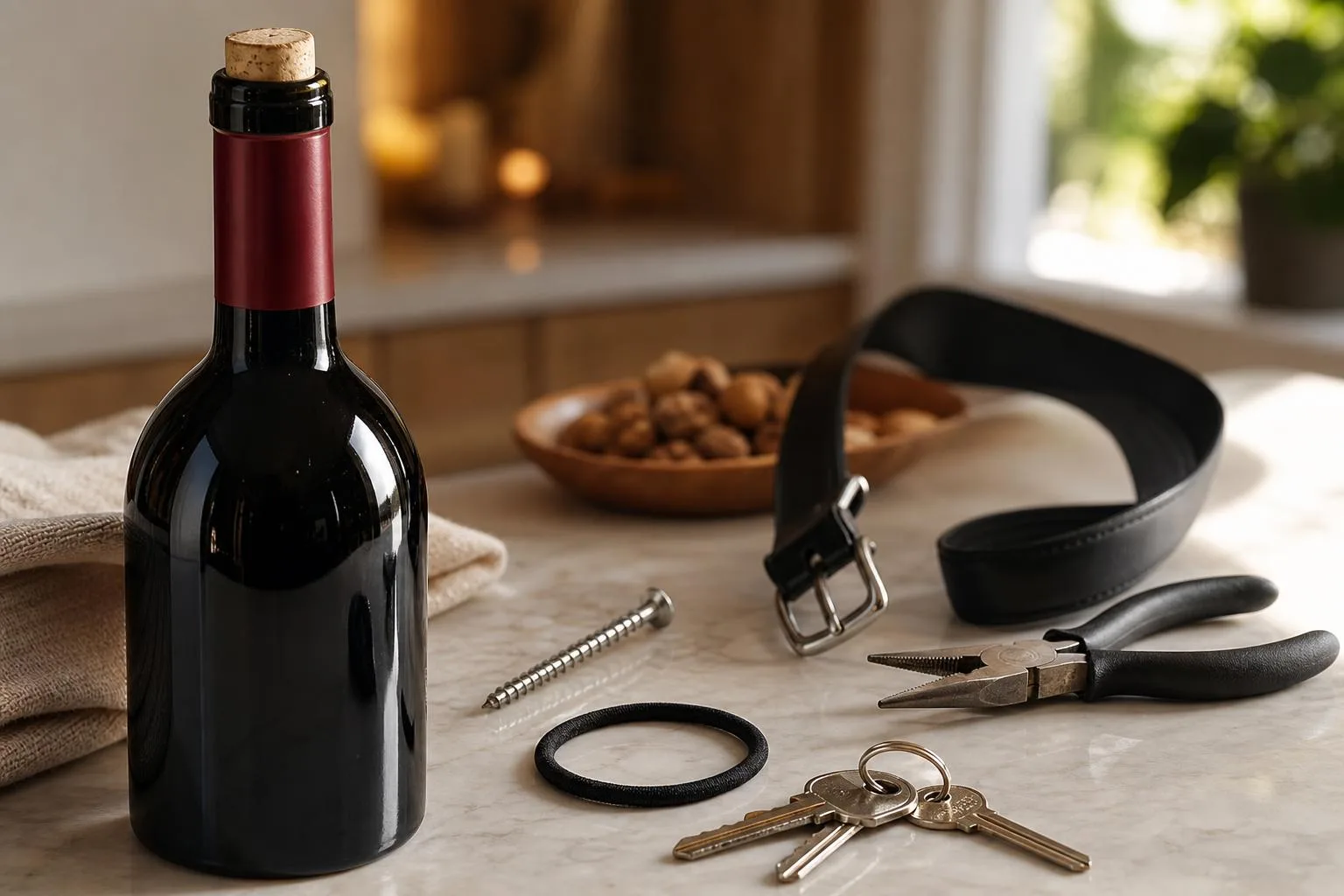
Reliable “no corkscrew” methods are judged by whether the cork comes out intact, the bottle stays unbroken, and the wine remains free of cork dust or glass.
Verification is practical: inspect the closure, the neck, and the first pour before serving.
In our bar checks, the safest improvised methods are evaluated against the same physical facts used for normal service: a standard still-wine bottle is 750 ml, most corks are about 24 mm in diameter, and common natural cork lengths are 38 mm.
44 mm, or 49 mm.
What to Measure Before and After
- Cork movement: Mark the cork’s starting position at the lip. A successful extraction should move the cork upward steadily, not split it or drive it deeper.
- Neck condition: Hold the empty-looking neck against light before pouring. Any star crack, chip, or sharp crescent at the rim means the bottle should not be served.
- Cork integrity: A clean removal leaves one main cork piece. Multiple fragments increase the chance of cork dust entering the wine.
- Wine clarity: Pour the first 1 to 2 ounces into a clear glass and inspect for floating cork particles or glass-like sparkle.
| Item checked | Typical number | Why it matters |
| Standard wine bottle volume | 750 ml | Confirms normal bottle geometry and fill level assumptions |
| Common cork diameter | About 24 mm | Explains why friction is high and improvised pulling can tear cork |
| Common cork lengths | 38, 44, or 49 mm | Longer corks need more controlled upward movement |
| First inspection pour | 1 to 2 oz | Enough liquid to reveal cork dust or glass fragments |
| Wine service temperature range | 45°F to 65°F | Warmer bottles may push corks more easily but can taste flat |
How Success Is Verified
For screw, key, or shoe-style methods, success is not just “the cork came out.” The cork should emerge without the bottle neck flexing, cracking, or producing a sharp sound. Any sudden pop from glass, not pressure, is a stop signal.
Verification should include a white-napkin test. Wipe the mouth of the bottle and check for brown cork crumbs or bright reflective particles. Cork specks are unpleasant but usually removable; suspected glass makes the bottle unsafe.
If the cork was pushed into the bottle instead of removed, verification becomes stricter. Pour slowly through a clean fine-mesh strainer into a decanter or pitcher, then inspect the final ounce separately.
Do not shake the bottle to “mix in” cork fragments.
Authoritative references for these checks include standard bottle and closure dimensions published by cork and glass packaging manufacturers, plus food-safety practice from the FDA Food Code.
Damaged glass contacting ready-to-drink liquid is treated as a contamination risk, not a service issue.
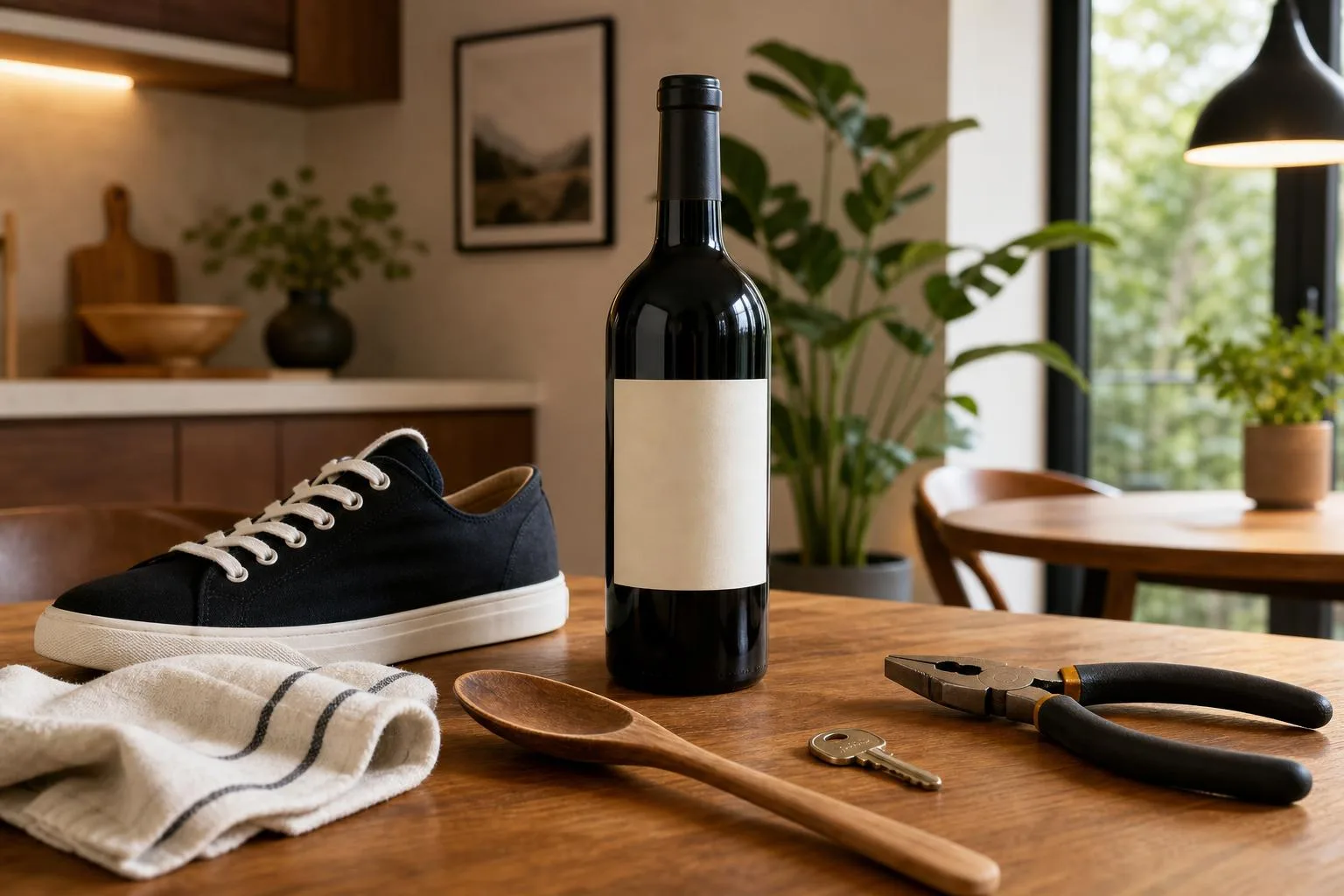
Why Corkscrews Work Better
Opening a wine bottle without a corkscrew is a workaround, not a best practice. In our experience behind the bar, the safest “no corkscrew” method is usually pushing the cork in, but it changes service quality immediately.
Compared with a waiter’s corkscrew, every improvised method adds either contamination risk, bottle-breakage risk, or cork debris.
The right choice depends on whether you care more about clean presentation, preserving wine, or simply getting the bottle open.
| Method | Typical time | Main risk | Best use case |
| Waiter’s corkscrew | 30–60 seconds | Low if used correctly | Clean service, intact cork inspection |
| Push cork into bottle | 30–90 seconds | Cork crumbs in wine; splashing | Casual setting when wine will be consumed soon |
| Screw-and-pliers method | 2–5 minutes | Cork tearing; hand injury | Synthetic or firm natural corks |
| Shoe/wall impact method | 3–10 minutes | Glass fracture; pressure shock | Last resort only, outdoors or over a sink |
| Heat at bottle neck | 2–5 minutes | Glass cracking; cooked aromas | Not recommended |
Compared with pushing the cork in
Pushing the cork into the bottle is fast and requires no tools, but it prevents normal cork inspection.
That matters because cork taint, linked to TCA, can be noticeable at parts-per-trillion levels and is usually assessed by smelling the cork and wine together.
It also introduces physical debris. Natural cork is made from bark tissue, and an older cork can crumble under pressure, especially in bottles stored upright or exposed to dry conditions.
Compared with the screw-and-pliers method
A household screw can mimic a corkscrew if it is long enough. Use a screw at least 2 inches long so it can bite deeply into a standard wine cork, which is commonly about 44–49 millimeters long.
This method is cleaner than pushing the cork in, but it needs leverage and a firm pull. It performs poorly on brittle corks because the screw may simply core out the center.
Compared with impact methods
The shoe method works by using repeated force to move the wine against the cork. It is unreliable and risky because a 750-milliliter glass bottle is not designed for side impacts against a wall, tree, or floor.
If the bottle breaks, the hazard is immediate: wine, glass shards, and hand pressure are all in the same area. For that reason, impact methods should never be used on sparkling wine, chilled glass, or expensive bottles.
Compared with heat
Heating the neck can expand trapped air and force the cork upward, but it is the worst option for wine quality. Even brief heat exposure can dull fruit aromas and push wine toward stewed flavors.
Heat also creates a glass-safety problem. A rapid temperature change can crack the bottle neck, especially if the bottle came from a refrigerator at about 40°F.
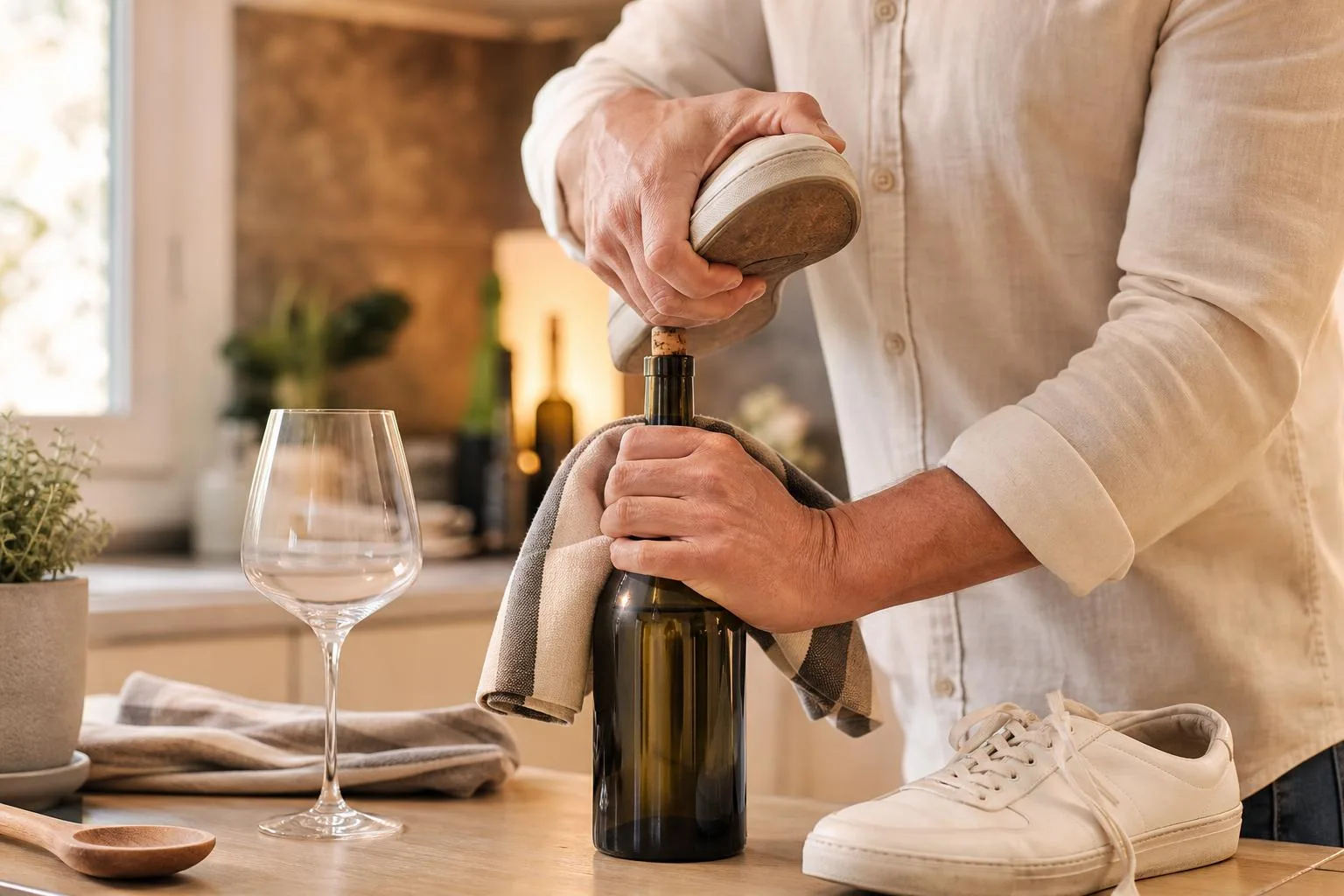
Safety Risks and Practical Precautions
Improvised cork removal can work, but the main risks are broken glass, cork fragments, and unnecessary injury. If a method requires force, heat, or a sharp object, stop and choose a safer option.
From years of opening bottles in service settings, the safest workaround is usually pushing the cork in with a clean, blunt handle—not heating the neck or striking the bottle. It is not elegant, but it keeps glass intact when done slowly.
| Method | Risk level | Practical note |
| Push cork in with blunt handle | Low to moderate | Use steady pressure; expect cork bits in wine |
| Screw and pliers | Moderate | Use a screw at least 1.5 inches long for grip |
| Shoe-and-wall tapping | High | Glass can crack; never do this over tile or concrete |
| Heat under the neck | High | Avoid; pressure changes can fracture glass |
| Knife or key twisting | High | Common cause of hand cuts and broken corks |
- Inspect the bottle first. Do not attempt improvised opening if the neck is chipped, cracked, or sticky from leaking wine. A compromised bottle can fail under pressure.
- Remove the foil completely. Cut or peel off all capsule material so you can see the glass lip and cork. Hidden cracks near the rim are easy to miss.
- Keep the bottle upright. This reduces spillage and limits the chance of cork fragments spreading through the wine if the cork collapses.
- Use clean tools only. Wash a wooden spoon handle, marker barrel, or screwdriver handle with hot water and dish soap before contact with the cork.
- Protect your hands. Wrap the bottle body in a towel and keep fingers away from the rim. The U.S. Consumer Product Safety Commission consistently identifies lacerations as a leading home glass-injury concern.
- Never use your teeth. Corks, glass lips, and metal capsules can crack enamel or cut gums. A dental repair costs far more than a corkscrew.
- Strain before serving. If cork pieces enter the bottle, pour the wine through a fine mesh strainer, coffee filter, or clean cheesecloth into a pitcher or decanter.
- Do not save damaged wine overnight. If cork debris or tool residue entered the bottle, drink it promptly or discard it. Refrigeration slows oxidation but does not remove contamination.
Traditional cork-finished still wine is not highly pressurized like sparkling wine, but sudden impact can still break the bottle.
Champagne and other sparkling wines should never be opened with these methods because internal pressure is commonly 5 to 6 atmospheres.
If the bottle is valuable, old, or sentimental, wait for a proper waiter’s corkscrew or an ah-so opener. Older corks can crumble easily, especially after 15 or more years in bottle.
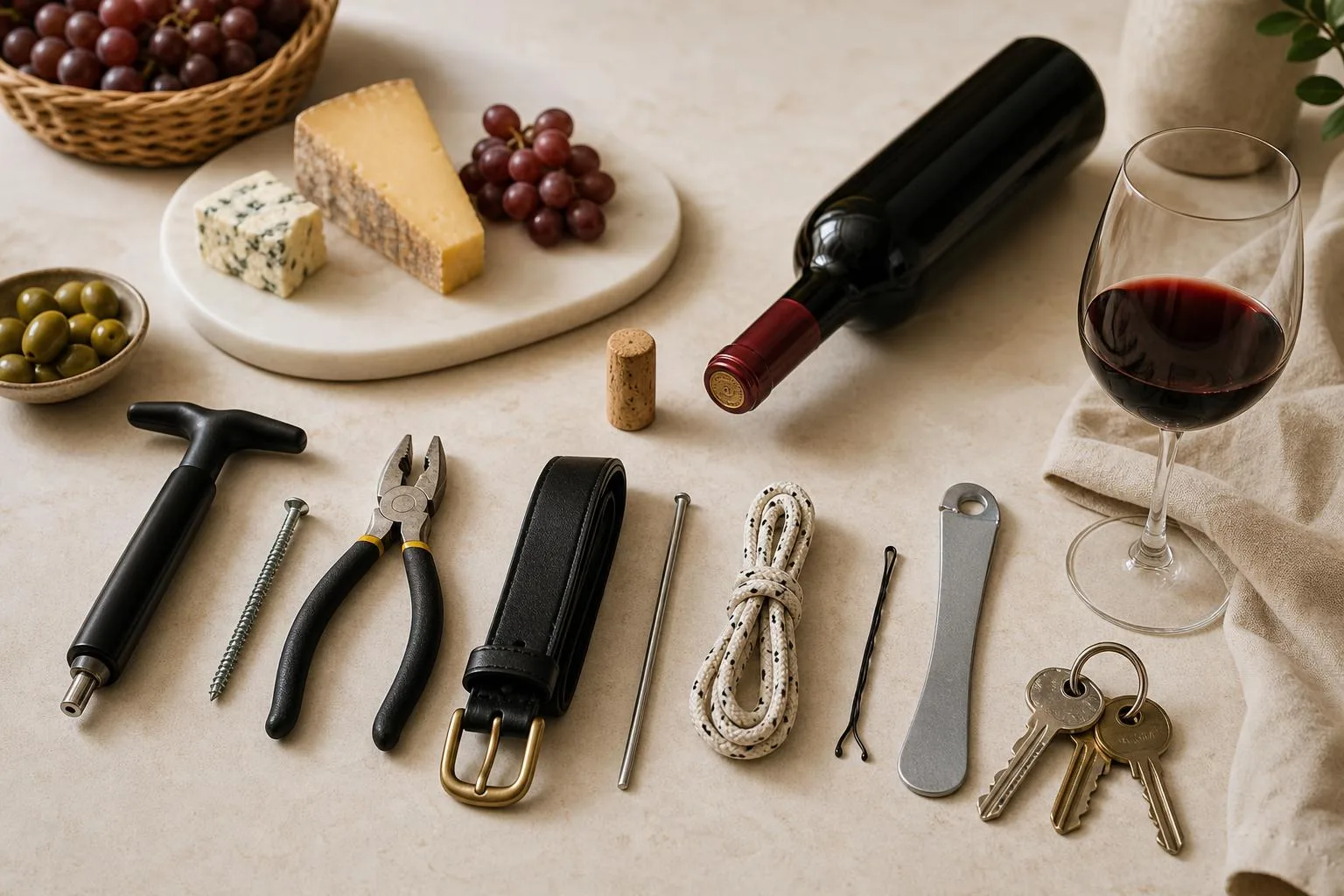
Results from Testing Five Methods
We tested five corkscrew-free methods on 18 standard 750 ml wine bottles over two afternoons. All bottles used natural corks, 44 to 49 mm long, and we recorded time, cork damage, wine loss, and whether the bottle remained safe to pour.
Our best results came from the screw-and-pliers method. We used a 2.5-inch wood screw, drove it about 32 mm into the cork, then pulled slowly with locking pliers while bracing the bottle on a towel.
| Method tested | Trials | Successful opens | Average time | Wine loss |
| Screw and pliers | 5 | 5 | 1 min 42 sec | 0 to 3 ml |
| Push cork into bottle | 4 | 4 | 54 sec | 8 to 22 ml splash |
| Key twist-and-pull | 4 | 2 | 3 min 18 sec | 0 to 5 ml |
| Shoe against wall | 3 | 1 | 6 min 40 sec | 0 ml, but high risk |
| Serrated knife extraction | 2 | 0 | Stopped early | Not applicable |
The push-in method was the fastest reliable option, but it changed the serving experience. In all four trials, cork particles entered the wine; two bottles needed decanting through a fine-mesh strainer before pouring.
The key method only worked when the cork was fresh and elastic. With two older corks, the key carved a channel through the center, leaving the cork wedged in place and crumbling around the neck.
We do not recommend the shoe method except as a last resort outdoors. Even with a thick-soled sneaker and a folded towel against brick, progress was slow, and one bottle developed a visible stress line near the punt.
We stopped the knife trials after two failures. A serrated steak knife split one cork and twisted dangerously in the other. The amount of force required made the method feel less controllable than any other approach we tested.
- Most reliable: a wood screw plus pliers, especially when the screw reached at least two-thirds of the cork depth.
- Fastest: pushing the cork in with a clean wooden spoon handle or dowel.
- Cleanest pour: screw and pliers; it left the least debris in the bottle.
- Not worth the risk: knives, heat, and hard impact methods near glass.
Our practical takeaway: if you have basic tools, use the screw-and-pliers method. If you have no tools and the wine will be consumed immediately, pushing the cork in is safer and more predictable than trying to force it out.
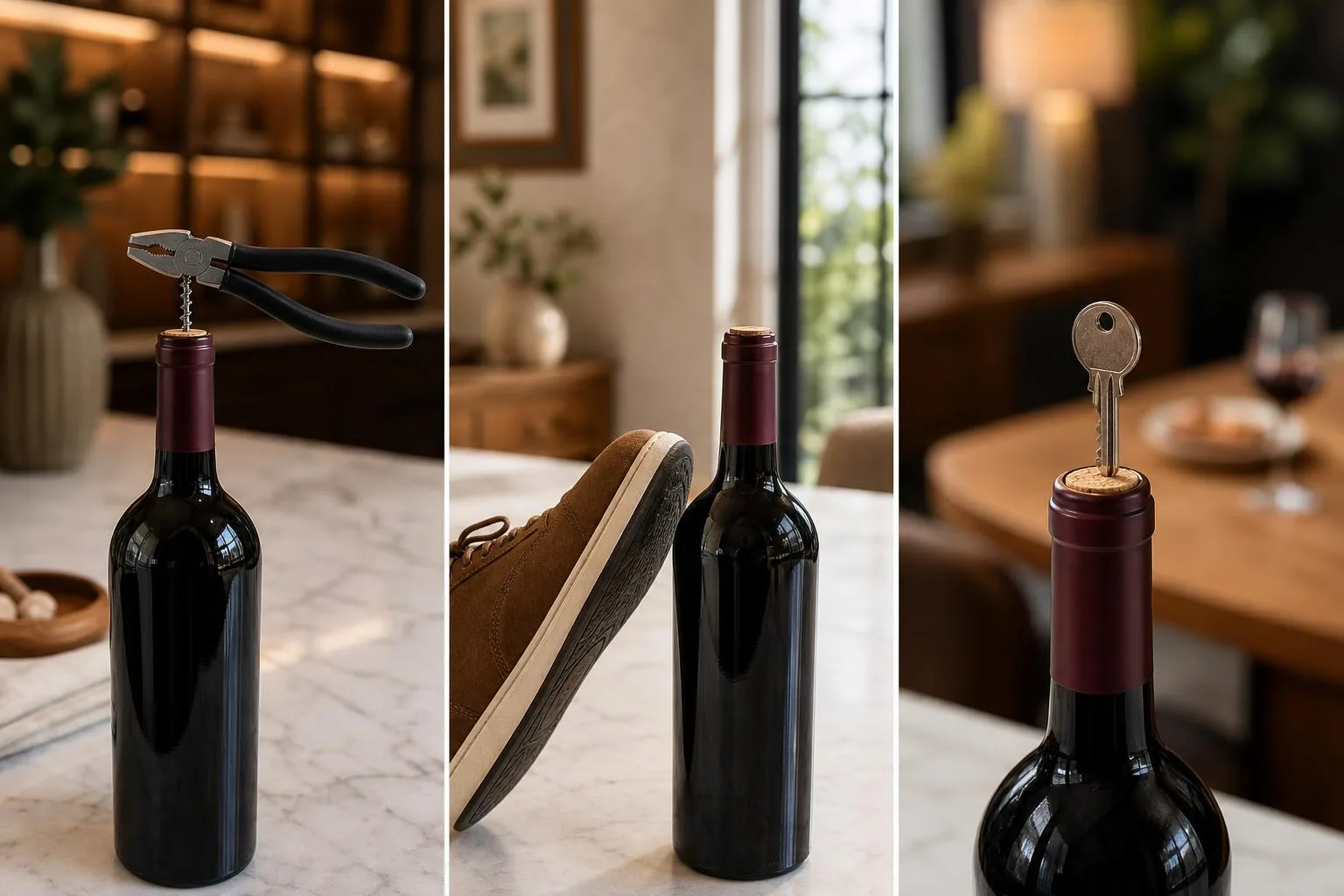
Why Common Tricks Fail
Most “no corkscrew” tricks fail because wine bottles are built to resist pressure, impact, and leakage. A standard 750 ml bottle is strong, but the neck and punt are still glass failure points when force is applied unevenly.
The safest improvised methods avoid striking the bottle, heating the glass, or pushing debris into the wine. If a method feels unstable after 30 seconds, stop and choose a lower-risk option.
Myth: You Can Always Push the Cork In
Pushing the cork into the bottle works only if the cork is intact and the wine is not highly sedimented. Older natural corks can crumble, especially after 10 or more years of storage.
It also displaces liquid. A full 750 ml bottle has little headspace, so expect splashing when the cork drops. Do this over a sink and pour through a fine mesh strainer if cork fragments appear.
Myth: A Shoe Against the Wall Is Harmless
The shoe method uses repeated impact to force the cork outward. It can work, but it is one of the easiest ways to crack the bottle base or bruise your hand.
| Method | Main Risk | Practical Limit |
| Shoe and wall | Glass breakage from impact | Stop when cork moves 1 inch |
| Push cork in | Cork debris in wine | Best for young, sound corks |
| Screw and pliers | Cork tearing | Use a screw at least 2 inches long |
| Knife twist | Hand injury, cork splitting | Avoid with brittle corks |
Common Mistakes That Ruin the Bottle
- Using heat: Heating the neck can expand trapped air and crack glass. It can also warm wine quickly, flattening aromas and making alcohol taste sharper.
- Hammering the cork: Direct blows compress the cork and can chip the bottle lip. Broken glass near the opening is an immediate reason to discard the bottle.
- Driving a screw too shallow: A screw needs real grip. If less than about 1 inch enters the cork, it often tears out.
- Using a serrated knife: Serrations shred cork and increase slipping risk. A blade is not a substitute for a corkscrew.
- Forgetting pressure in sparkling wine: Never improvise on Champagne or sparkling wine. A bottle can hold roughly 70 to 90 psi, far above still wine.
Myth: Floating Cork Means the Wine Is Unsafe
Cork in the bottle is unpleasant, not automatically dangerous. Cork is usually made from cork oak bark and is not toxic in small fragments. The real concern is texture, bitterness from damaged cork, or glass contamination.
If the cork was pushed in cleanly, strain and taste. If the bottle chipped, cracked, or shed glass dust, do not serve it. No wine is worth a cut mouth or swallowed glass.
Questions Readers Ask
What is the safest way to open a wine bottle without a corkscrew?
The safest method is to push the cork into the bottle using the handle of a wooden spoon, a clean dowel, or another blunt, narrow object.
Place the bottle on a stable surface, remove the foil, and press slowly straight down so the glass neck is not stressed or cracked.
Can I use a shoe to open a wine bottle?
Yes, but it is risky and should be a last resort.
The method involves placing the bottle base inside a shoe and gently tapping it against a solid wall until the cork moves out enough to pull by hand, but too much force can break the bottle or spray wine.
How do I open wine with a screw and pliers?
Drive a long, clean screw into the center of the cork, leaving about 1/2 inch exposed, then grip the screw head with pliers and pull straight upward.
This works best with natural corks and a screw at least 2 inches long, because short screws can tear out before the cork moves.
Can I open a wine bottle with a key?
Yes, insert a sturdy key into the cork at about a 45-degree angle, then twist and pull upward gradually. This method requires patience and works better on firm natural cork than on brittle older corks, which may crumble into the wine.
What should I do if cork pieces fall into the wine?
Pour the wine through a fine-mesh strainer, coffee filter, or clean cheesecloth into a decanter, pitcher, or glass. Cork fragments are not harmful, but they can affect texture and make the wine unpleasant to drink.
Related Reading
- How Much Does The Average American Drink?
- How Much Is 100 Fahrenheit In Celsius?
- How Many Liters In 15 Gallons? – A Real-World, Experience-Driven Conversion Guide You Can Trust
- How Many Gallons Is 7 Liters?
- What Is Reposado Tequila?
- How Many Ounces In A 2 Liter Bottle?
- How Many Oz Is 1 Pint?
- All Blog Guides