Does Crown Royal Glass Break Easily
Crown Royal bottles can chip, crack, or shatter, but their appearance does not establish how easily they break.
Treat the bottle as breakable packaging: a countertop knock and a fall onto tile impose very different stresses, and no verified Crown Royal drop-test rating supports a “shatter-resistant” claim.
What Makes the Bottle Break?
Glass is brittle: it does not bend substantially before fracturing. Surface scratches and small chips can concentrate stress, so an older, damaged bottle may break under an impact that an undamaged bottle survives.
A substantial-looking base does not make the neck or shoulders impact-proof.
- Hard landing surfaces: Concrete, stone, and ceramic tile stop a falling bottle abruptly. Carpet can cushion impact, but it does not guarantee survival.
- Impact location: A strike against an edge concentrates force over a small area. Landing orientation can therefore matter as much as drop height.
- Temperature differences: Rapid, uneven heating or cooling can create thermal stress. Do not pour boiling water into a cold bottle or use direct heat to remove labels.
What Drop Height Actually Tells You
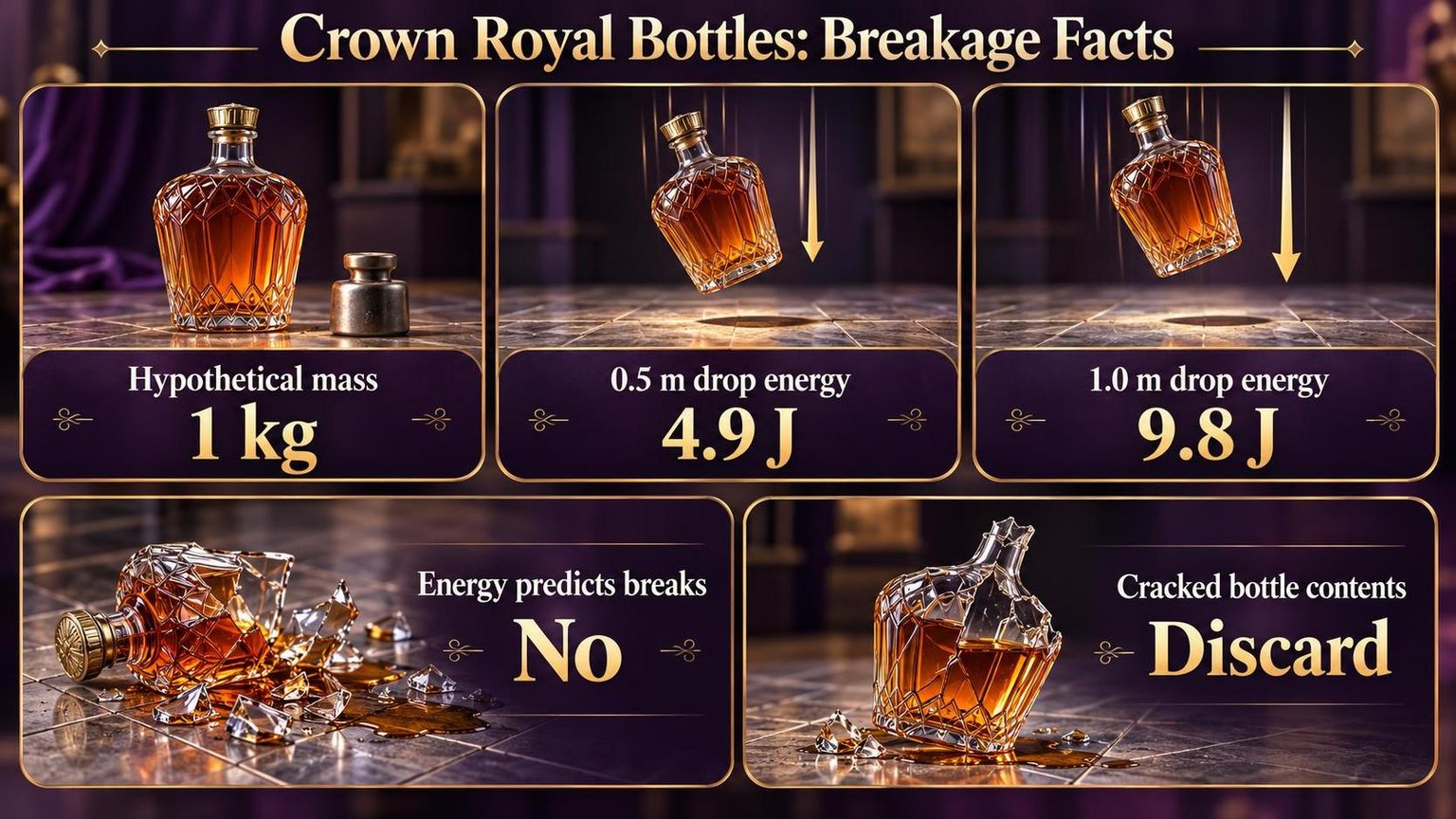
The table illustrates gravitational energy for a hypothetical bottle and contents weighing 1 kilogram—not a measured Crown Royal bottle.
It uses energy = mass × gravitational acceleration × height, with gravitational acceleration rounded to 9.8 meters per second squared.
| Vertical drop | Gravitational energy released |
| 0.5 meter | 4.9 joules |
| 1.0 meter | 9.8 joules |
These values are not breaking thresholds. They cannot predict survival without knowing the bottle’s condition, geometry, landing orientation, and how quickly the surface stops it.
A successful drop shown in a video does not establish reliable performance for another bottle.
How to Handle Damage Safely
Keep bottles away from shelf edges, carry them securely, and use protective packaging during transport. Crown Royal’s cloth bag is not certified impact protection.
If the neck chips or the bottle cracks, stop pouring and discard the contents; straining cannot reliably establish that glass-contaminated whiskey is safe.
Sources: Encyclopaedia Britannica, “Glass,” explains glass structure and properties. OpenStax, College Physics 2e, section 7.3, provides the gravitational-energy equation.
FDA Compliance Policy Guide 555.425 addresses injury hazards from hard or sharp foreign objects in food.
What Happens If You Drop the Bottle
A Crown Royal bottle can survive a fall, chip, crack, or shatter. The outcome depends on the landing surface, impact angle, falling distance, and existing damage—not simply the bottle’s distinctive shape.
Hard Floors Make Breakage More Likely
Concrete, ceramic tile, and stone stop a falling bottle abruptly, concentrating stress where the glass strikes. Carpet and padding can cushion the impact, but neither guarantees survival.
A bottle that lands intact can still bounce into furniture or hit an exposed floor edge.
The shoulder, neck, and base can experience different stresses depending on how the bottle lands. Existing scratches and chips can weaken glass.
The fabric presentation bag is not protective packaging and should not be treated as a reliable impact cushion.
Even a Short Fall Produces Significant Speed
These approximate impact speeds describe a bottle released from rest, ignoring air resistance. They illustrate the effect of falling distance; they are not Crown Royal breakage thresholds or results from bottle-drop testing.
| Vertical fall | Approximate impact speed |
| 1 foot | 5.5 mph |
| 3 feet | 9.5 mph |
The calculations use the free-fall relationship v = √(2gh). Breakage also depends on stopping distance and how impact forces spread through the glass.
Physics reference: OpenStax, University Physics Volume 1, “Free Fall”: https://openstax.org/books/university-physics-volume-1/pages/3-5-free-fall.
Check the Bottle Before Pouring
- Keep people and pets away. Put on closed-toe shoes before approaching spilled whisky or broken glass.
- Inspect without tasting. Look for leaks, cracks, missing glass, and damage around the neck and closure. Avoid running bare fingers over suspicious areas.
- Discard whisky if glass contamination is possible. Do not strain it through a coffee filter or cloth and assume it is safe. Home filtering does not reliably establish that every fragment is gone.
- Clean beyond the puddle. Pick up large pieces with suitable tools, then collect smaller fragments carefully. Check nearby floor edges and underneath furniture.
If the bottle appears undamaged, check the closure and base before returning it to storage. An intact-looking exterior alone cannot rule out every crack.
Can Crown Royal Freeze and Crack in the Freezer
Standard Crown Royal is unlikely to freeze solid or crack its bottle in a properly operating household freezer.
Its alcohol content lowers the freezing temperature, but unusually cold conditions, added water, or existing glass damage can change the risk.
Freezer Temperature Versus Whisky Freezing Temperature
Crown Royal’s official product information lists its Deluxe Canadian whisky at 40% alcohol by volume. USDA guidance recommends keeping household freezers at 0°F; that setting normally leaves undiluted Deluxe liquid.
| Condition or product | Temperature | Practical meaning |
| Recommended household freezer setting | 0°F / −18°C | Normally too warm to freeze standard Crown Royal Deluxe. |
| Approximate initial freezing range for a 40% ABV ethanol-water mixture | About −9°F to −17°F / −23°C to −27°C | Ice may begin forming; this does not mean the entire bottle immediately freezes solid. |
The freezing range is an estimate from ethanol-water phase behavior, not a Crown Royal bottle-safety specification. Whisky contains other dissolved compounds, and freezing progressively concentrates alcohol in the remaining liquid.
When the Bottle Could Crack
- The contents partially freeze. Water expands as it becomes ice. If enough ice develops and the bottle lacks sufficient expansion space, pressure can fracture the glass or compromise the closure.
- The whisky has been diluted. Added water or mixers raise its freezing temperature. Do not assume a homemade cocktail will behave like the original spirit.
- The product has less alcohol. Flavored expressions and ready-to-drink products can differ from Deluxe. Check the bottle’s ABV rather than relying on the Crown Royal name.
- The glass experiences thermal shock. Moving a deeply chilled bottle into hot water can create uneven expansion and cause cracking, even without frozen contents.
Handle a Frozen or Damaged Bottle Safely
If slush appears, keep the bottle upright in a leak-catching container and let it warm gradually, away from direct heat. Do not microwave it or use hot water.
Discard the contents if the glass cracks or chips. Straining cannot reliably remove tiny glass fragments. For routine storage, keep Crown Royal upright in a cool, dark location; freezer storage is unnecessary.
Why Sealed Bottles Face More Breakage Risk
A sealed Crown Royal bottle is not inherently more fragile than an opened one. Greater risk comes from the liquid’s weight, restricted expansion space, and temperature changes—not the intact factory seal alone.
Full Bottles Carry More Impact Energy
A full bottle weighs more than the same bottle empty. At the same drop height, that additional mass increases impact energy. Whether glass breaks still depends on the landing surface, impact angle, existing damage, and bottle construction.
| Factor | Specific fact | Practical meaning |
| Crown Royal Deluxe strength | 40% alcohol by volume; 80 proof | Its freezing behavior differs substantially from plain water. |
| Recommended household freezer setting | 0°F (−18°C) | Deluxe ordinarily remains liquid at this temperature. |
| Drop height | Doubling height doubles gravitational potential energy for the same bottle. | A higher fall supplies more energy, although breakage is not guaranteed. |
Headspace Matters More Than the Seal
Headspace is the gap between the whisky and closure. When liquid warms, it expands into that space and compresses the trapped gas. A nearly full, tightly closed bottle has less room to accommodate expansion than a partially emptied bottle.
An opened bottle that has been tightly recapped is also closed. Opening alone does not confer lasting protection; removing liquid increases headspace.
Heating does not automatically shatter a sealed bottle, and the closure may leak before the glass fails.
Extreme Cold and Sudden Heating Create Different Hazards
Crown Royal Deluxe does not freeze like water. Nevertheless, sufficiently low temperatures can produce ice within an alcohol–water mixture. Expansion during partial freezing can stress a constrained container.
Do not apply Deluxe’s freezer behavior to lower-alcohol Crown Royal products.
Thermal shock is separate: rapidly warming cold glass creates uneven expansion and stress. Let a chilled bottle warm gradually; avoid hot water, radiators, and direct heat.
- Store bottles upright in a cool location with stable temperatures.
- Inspect the base, corners, and neck for chips or cracks.
- Do not drink from a cracked bottle; glass fragments may contaminate the whisky.
Sources: Crown Royal Deluxe product information: https://www.crownroyal.com/canadian-whisky/crown-royal-deluxe.
FDA freezer guidance: https://www.fda.gov/consumers/consumer-updates/are-you-storing-food-safely.
OpenStax, thermal expansion: https://openstax.org/books/college-physics-2e/pages/13-2-thermal-expansion-of-solids-and-liquids.

How Shipping and Handling Damage Crown Royal Bottles
Crown Royal bottles can crack or shatter when shipping impacts concentrate force on the glass.
The signature cloth bag prevents neither crushing nor hard contact; safe delivery depends on cushioning, separation, and a carton that keeps the bottle from moving.
Drops and Hard Contact
A bottle striking a conveyor edge, doorstep, or another bottle can develop a chip or fracture. Glass condition, impact angle, and stopping distance matter, so no single drop height reliably predicts whether a Crown Royal bottle will break.
The comparison below shows calculated impact speeds for an object dropped from rest, ignoring air resistance. These are physics examples, not Crown Royal packaging-test results or safe-drop limits.
| Drop height | Approximate impact speed |
| 0.5 meter | 3.1 meters per second |
| 1.0 meter | 4.4 meters per second |
Doubling the height doubles the gravitational energy released for the same package mass. Cushioning reduces peak force by extending the stopping distance, provided it does not compress completely and allow the glass to hit a hard surface.
Movement, Compression, and Weak Packaging
- Bottle-to-bottle contact: Loose bottles can collide repeatedly during transport. Use individual compartments and cushioning that prevent glass surfaces from touching.
- Carton compression: Stacked freight can crush an inadequate outer box. A fitted bottle shipper helps keep those loads from transferring directly to the neck or shoulder.
- Internal movement: Empty space lets the bottle accelerate inside its carton. Secure it without forcing pressure against the closure.
- Inadequate cushioning: FedEx’s general packaging guidance calls for fragile products to be individually wrapped with at least 3 inches of air-cellular cushioning. Purpose-built bottle packaging must follow its own assembly instructions.
Inspect Before Opening or Pouring
Photograph crushed corners, wet patches, and damaged internal packaging before discarding anything.
A leak can come from a closure failure rather than broken glass, but any visible crack, missing glass, or suspected contamination means the whiskey should not be consumed.
Sources: Free-fall package testing: ASTM D5276, https://www.astm.org/d5276-19.html. Cushioning guidance: FedEx, General Packaging Guidelines, https://www.fedex.com/content/dam/fedex/us-united-states/services/GrlPkgGuidelines_fxcom.pdf.

Signs Your Crown Royal Bottle Is Compromised
A compromised Crown Royal bottle can have cracked glass, a leaking closure, or evidence of tampering.
Check the neck, base, cap, and whisky before pouring; a bottle that remains upright without leaking can still have damage that makes it unsafe to handle.
Cracks, Chips, and Fresh Leaks
Inspect the bottle under bright light without squeezing it or running your fingers over suspicious marks. Pay particular attention after a drop or impact, including when the bottle landed on carpet.
- Cracks: Branching lines, star-shaped fractures, or a new line extending from an impact point warrant stopping use. Mold seams are manufacturing features, but appearance alone cannot reliably distinguish every scratch from a crack.
- Chipped opening: Missing glass around the pouring lip creates a cutting hazard and may introduce fragments into the whisky.
- Unexplained wetness: Dry the exterior gently and stand the bottle upright on a clean paper towel. Renewed wetness suggests leakage, although residue from an earlier pour can initially look similar.
A Damaged Cap or Questionable Seal
A cap that will not tighten, damaged threads, or persistent seepage around the neck indicates a closure problem.
On a newly purchased bottle, disturbed tamper-evident packaging deserves investigation before drinking; packaging details can vary by product and market.
Crown Royal lists Original Canadian Whisky at 40% ABV. That alcohol concentration does not make damaged packaging safe or eliminate the risk of foreign material.
If an unopened purchase appears compromised, photograph it and contact the retailer or manufacturer.
Unexpected Material or Changes Inside
Look for floating fragments, unexplained sediment, or cloudiness that persists at room temperature. These observations do not establish the cause: haze can reflect temperature or dilution, while visible particles could indicate contamination.
Appearance and smell cannot prove safety.
- If glass damage is possible: Do not taste the whisky or attempt to salvage it with a coffee filter. Stop using the bottle.
- If tampering is suspected: Keep the bottle away from others and request return or disposal instructions.
Sources: Crown Royal, “Crown Royal Fine De Luxe”; FDA, “CPG Sec. 555.425 Foods, Adulteration Involving Hard or Sharp Foreign Objects.”.
How to Store Crown Royal to Prevent Breakage
Crown Royal’s glass bottle can break from a fall, a hard impact, or sudden temperature changes. Store it upright on a stable shelf, away from edges and heat; the protective bag does not make the glass shatterproof.
Choose a Stable, Temperature-Controlled Location
A closed cabinet away from the stove, dishwasher, and direct sunlight reduces exposure to heat and accidental knocks. Use the following temperature range as a practical household storage target, not a manufacturer-tested breakage limit.
| Storage factor | Practical recommendation |
| Ambient temperature | Approximately 60–75°F (16–24°C), without abrupt changes. |
| Bottle position | Upright, with the entire base supported. |
| Location | A low, secure shelf inside a cabinet, inaccessible to children. |
| Spacing | Enough clearance to remove the bottle without striking neighboring glass. |
Do not place a cold bottle in hot water or beside a heater. Uneven heating creates stress within glass.
Crown Royal does not publish a universal temperature difference that guarantees its bottles will survive, so avoid treating any specific threshold as safe.
Prevent Falls and Bottle-to-Bottle Contact
- Check the shelf’s rated load and mounting hardware before adding a collection. Include the weight of both the whisky and its glass containers.
- Keep bottles away from shelf edges and cabinet doors. Avoid stacking bottles or balancing them on boxes.
- Use a clean, dry, nonslip shelf liner. Replace liners that curl, slide, or create an uneven base.
- When relocating bottles, use a divided carton with cushioning around each bottle. Carry the carton from underneath, not by its flaps.
Inspect the Glass Before Handling
Remove the bag before checking the bottle for cracks, chips, or leaks. Support the base while carrying it, especially when your hands are wet. Do not lift a bottle by its cap or rely on the bag’s drawstring as a handle.
If the bottle cracks or chips around the opening, do not drink its contents or attempt to remove fragments with a kitchen strainer.
Storage reference: The Scotch Whisky Association’s FAQs recommend upright storage in a cool location away from direct sunlight: https://www.scotch-whisky.org.uk/discover/faqs/.
These principles support whisky storage; they are not Crown Royal bottle-impact specifications.

Common Questions
Does a Crown Royal bottle break if dropped?
Yes. A Crown Royal glass bottle can crack or shatter when dropped, especially on concrete, tile, or stone. The outcome depends on the impact angle, surface, and existing glass damage; there is no universally safe drop height.
Can a Crown Royal bottle break in the freezer?
Crown Royal Original contains 40% alcohol by volume, according to the producer, and ordinarily stays liquid in a household freezer set to 0°F (-18°C).
Freezing-related breakage is therefore unlikely under those conditions, but diluted whisky or lower-alcohol products may freeze more readily and create pressure as they expand.
Can sudden temperature changes crack a Crown Royal bottle?
Yes. Pouring hot water over a freezer-cold bottle can create uneven expansion that stresses the glass and may cause cracks. Let the bottle warm gradually rather than using boiling water, a microwave, or direct heat.
Does the Crown Royal bag protect the bottle from breaking?
The fabric bag is not impact-resistant packaging and cannot reliably protect glass from a drop. Use a padded bottle carrier or a purpose-built shipping insert when transporting the bottle.
Is Crown Royal safe to drink from a cracked bottle?
No. Discard the contents because small glass fragments may be present, even when the whisky looks clear.
The FDA identifies glass as a hard or sharp foreign-object hazard; straining the whisky through a household filter does not establish that it is safe.
Can an unopened Crown Royal bottle break during shipping?
Yes. An intact seal does not protect the glass against crushing, vibration, or impacts during transport. Use packaging designed for glass spirits bottles, prevent movement inside the carton, and keep bottles from touching one another.
Does a chipped Crown Royal bottle rim make pouring unsafe?
Yes. A chipped rim can cut your hand or release glass into the whisky while you pour. Stop using the bottle and discard its contents rather than transferring them to another container.
How should you clean up a broken Crown Royal bottle?
Keep children and pets away, wear closed-toe shoes and protective gloves, and collect large pieces with a brush and dustpan rather than bare hands.
Pick up remaining slivers with damp disposable towels, absorb the spilled whisky, and place the glass in a puncture-resistant container for disposal under local rules.
Keep Exploring
- What Does Scotch Neat Mean?
- Is Jack Daniel’S Whiskey Or Bourbon?
- What's the Difference Between Whiskey and Cognac?
- Jack Daniels Alcohol Percentage – Deepest Knowledge
- What Does Jameson Taste Like? Professional Answer
- All Alcohol Guides
- Crown Royal — Official Whisky and Packaging Information (n.d.)
- FDA — Foods: Adulteration Involving Hard or Sharp Foreign Objects (2005)
- USDA FSIS — Freezing and Food Safety (n.d.)
- USDA FSIS — Shelf-Stable Food Safety (n.d.)
- NIST — Fractography of Ceramics and Glasses, Second Edition (2016)
- Glass Packaging Institute — Glass Container Industry Resources (n.d.)
- O-I Glass — Glass Bottle and Container Manufacturer (n.d.)
- Encyclopaedia Britannica — Glass (n.d.)
- Corning Museum of Glass — Glass Science and Education Resources (n.d.)
- Princeton University Environmental Health and Safety — Glassware and Sharps (n.d.)