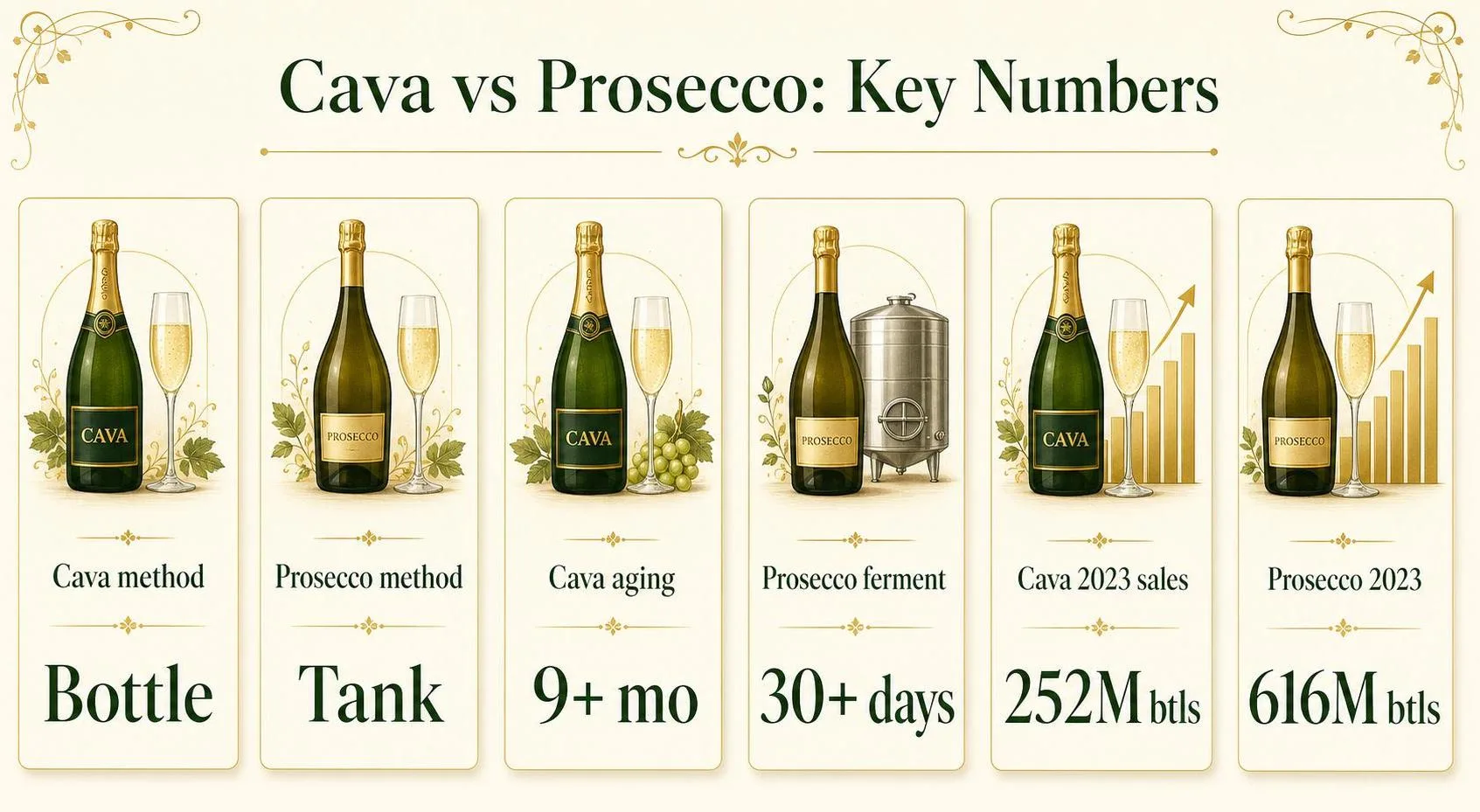
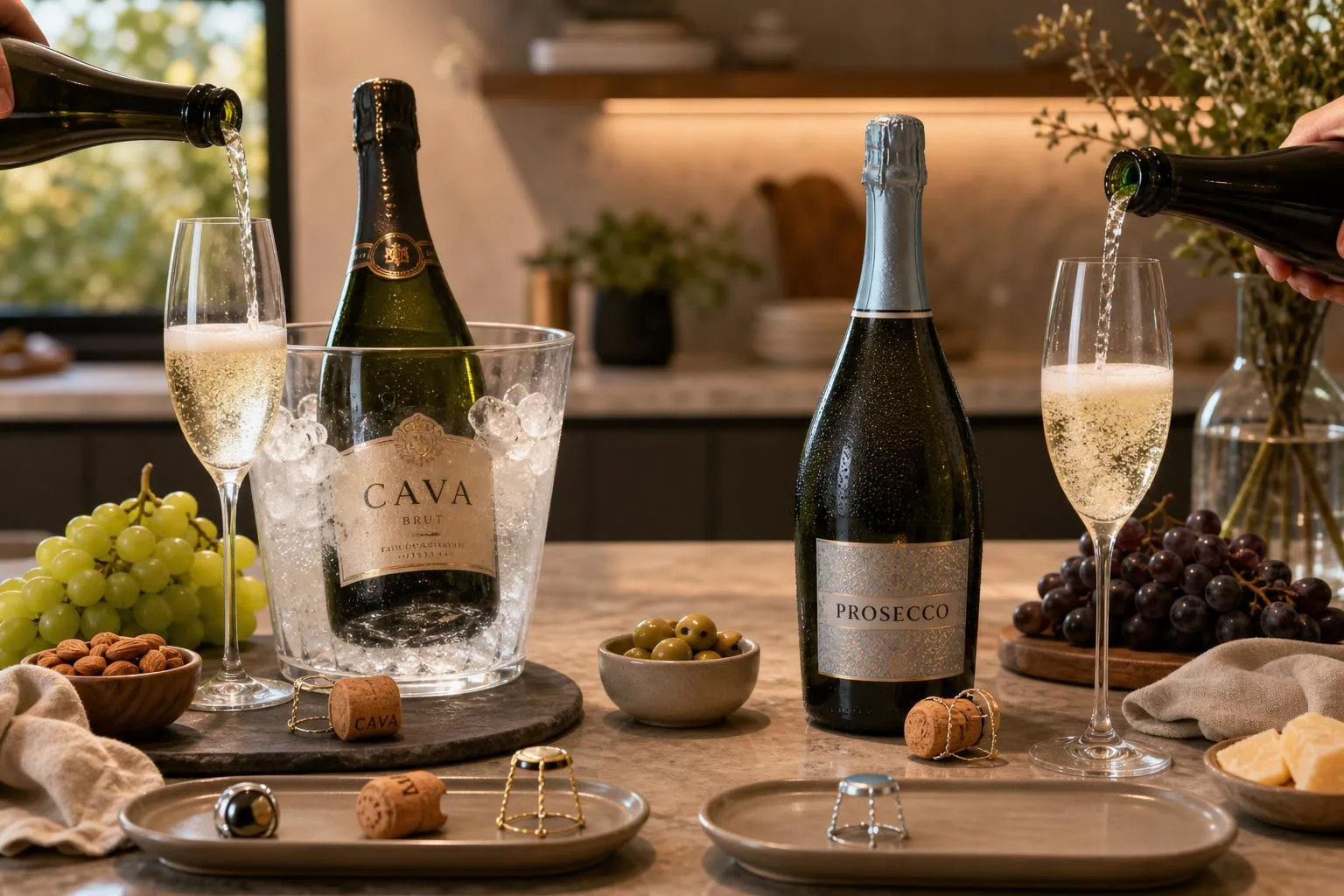
9 months is the minimum lees-aging requirement that defines Cava Vs Prosecco: Cava is made by the traditional bottle-fermentation method, while Prosecco is usually made by the faster tank, or Charmat, method.
That production split drives the main sensory difference: Cava often tastes drier, toastier, and more structured, while Prosecco is typically fresher, fruitier, and more aromatic, with pear, apple, and floral notes.
In a wine bar flight, I’d pour them side by side to show how method, grape varieties, and aging rules shape bubbles, texture, and price—not just country of origin.
Key Differences Between Cava and Prosecco
Cava and Prosecco differ most clearly in production time, pressure, grape rules, and sweetness. These numbers explain why Cava usually tastes more toasty and structured, while Prosecco is typically fruitier, softer, and more immediate.
| Measure | Cava | Prosecco |
| Primary production method | Traditional method: second fermentation in the same bottle sold to you | Tank method, also called Martinotti or Charmat: second fermentation in pressurized tanks |
| Minimum aging before release | 9 months on lees for Cava de Guarda; 18 months for Reserva; 30 months for Gran Reserva; 36 months for Paraje Calificado | Typically much shorter tank aging; Prosecco DOC requires at least 30 days for the sparkling fermentation process |
| Pressure in bottle | Generally at least 3.5 bar for fully sparkling Cava | Spumante is above 3 bar; Frizzante is lower, usually 1 to 2.5 bar under EU categories |
| Core grape rule | Usually based on Macabeo, Xarel-lo, and Parellada, with other authorized grapes allowed | Must be at least 85% Glera under Prosecco DOC and DOCG rules |
| Major production scale | About 252 million bottles sold in 2023, according to the Cava regulatory council | About 616 million bottles produced in 2023 by Prosecco DOC, according to its consortium |
The lees-aging numbers matter most in the glass. Cava’s required bottle aging allows yeast-derived flavors such as brioche, almond, pastry crust, and dried apple to develop, especially in Reserva and Gran Reserva bottlings.
Prosecco’s tank method is designed to protect primary aromatics.
That is why good Prosecco often emphasizes pear, white peach, apple blossom, citrus, and a gentle froth rather than the nutty, baked-bread notes associated with extended lees contact.
| Sweetness term | Residual sugar | What it usually feels like |
| Brut Nature | 0 to 3 g/L, with no added dosage | Very dry, common in serious Cava |
| Extra Brut | 0 to 6 g/L | Dry, sharp, food-friendly |
| Brut | 0 to 12 g/L | Dry to most drinkers |
| Extra Dry | 12 to 17 g/L | Slightly sweeter; common on Prosecco labels |
| Dry | 17 to 32 g/L | Noticeably sweet despite the name |
One label trap is “Extra Dry.” It sounds drier than Brut, but under EU sparkling-wine terms it contains more sugar. Many popular Proseccos sit in this range because a little sweetness amplifies Glera’s peachy fruit.
For buying, the numbers point to a simple rule: choose Cava when you want bottle-fermented complexity and firmer structure; choose Prosecco when you want fresh fruit, softer bubbles, and an easy aperitif style.

Why Cava and Prosecco Taste Different
Cava and Prosecco taste different because they are built differently from the vineyard onward. The biggest variables are grape variety, fermentation method, aging time, pressure, sweetness, and serving freshness.
In tastings, I find Cava usually reads drier, more savory, and more textured, while Prosecco shows brighter pear, apple, peach, and floral notes. Those differences are not accidental; they come from regulated production choices.
Production Method
Cava is made by the traditional method, the same core process used for Champagne: the second fermentation happens inside the bottle. Prosecco is usually made by the tank method, where the second fermentation occurs in pressurized stainless steel.
| Factor | Cava | Prosecco |
| Main method | Traditional method, bottle fermentation | Tank method, pressurized vat fermentation |
| Minimum lees aging | 9 months for basic Cava under DO rules | Often a few weeks to several months, depending on producer |
| Typical pressure | About 5 to 6 atmospheres | Usually about 3 to 5 atmospheres |
| Common texture | Finer mousse, more bread-dough notes | Softer bubbles, fruitier profile |
Grapes and Aromatics
Traditional Cava relies heavily on Macabeo, Xarel·lo, and Parellada. Xarel·lo is especially important because it can add structure, citrus peel, fennel, and earthy tones that make Cava feel more serious with food.
Prosecco is based primarily on Glera. Under Prosecco DOC rules, at least 85% must be Glera, which helps explain its recognizable apple, pear, white peach, and blossom character.
Aging Category and Sweetness
Lees aging changes aroma and mouthfeel. A young Cava can be brisk and lemony, while longer-aged Cava can show almond, toast, pastry, and dried herb notes.
| Cava category | Minimum aging on lees |
| Cava | 9 months |
| Cava Reserva | 18 months |
| Cava Gran Reserva | 30 months |
| Cava de Paraje Calificado | 36 months |
Sweetness also affects the result. Brut Nature has 0 to 3 grams per liter of residual sugar, while Brut can have up to 12 grams per liter. Extra Dry Prosecco, despite the name, is sweeter at 12 to 17 grams per liter.
Freshness, Serving, and Glassware
- Temperature matters: serve most Cava and Prosecco at about 43 to 48°F. Too cold mutes aroma; too warm makes alcohol and sweetness more obvious.
- Freshness matters more for Prosecco: its fruit-driven style is usually best within 1 to 2 years of release.
- Glass shape changes aroma: a white wine glass shows more nuance than a narrow flute, especially for aged Cava.
How Cava and Prosecco Are Verified
Cava and Prosecco are verified less by taste descriptors than by legally audited production records.
In practice, I check the bottle’s appellation wording, pressure category, sweetness term, lot code, and official seal before judging style in the glass.
The core measurement is the production method. Cava must complete its second fermentation in the same bottle sold to the consumer, the traditional method.
Prosecco is normally measured against the Martinotti, or Charmat, method, where second fermentation occurs in a pressurized tank.
| Verification point | Cava DO | Prosecco DOC / DOCG |
| Second fermentation | In bottle, traditional method | In pressurized tank for most wines |
| Minimum lees aging | 9 months for Cava de Guarda; 18 months Reserva; 30 months Gran Reserva; 36 months Paraje Calificado | Minimum tank fermentation period is commonly 30 days under Prosecco production rules |
| Typical pressure category | Usually spumante, above 3 bar | Spumante above 3 bar; frizzante 1 to 2.5 bar under EU sparkling-wine rules |
| Main grape requirement | Authorized grapes include Macabeo, Xarel·lo, Parellada, Chardonnay, Garnacha, Trepat, Pinot Noir, Subirat Parent | At least 85% Glera for Prosecco DOC and DOCG |
| Geographic control | Cava DO zones, led by Catalonia’s Penedès area | DOC across Veneto and Friuli Venezia Giulia; DOCG for Conegliano Valdobbiadene and Asolo |
Cava is controlled by the Consejo Regulador de la D.O. Cava. Wineries must document grape origin, base wine, tirage date, disgorgement, aging time, and bottle counts.
Bottles carry a numbered control mark, which is the quickest physical verification cue.
Prosecco is certified through the Italian DOC or DOCG system, with inspection bodies such as Valoritalia verifying vineyard registration, yield, grape variety, winery records, chemical analysis, and sensory conformity.
DOCG bottles also carry a numbered Italian government strip.
Sweetness is verified by residual sugar, not by the producer’s marketing language. The same EU sweetness bands apply to both wines, so “Brut” on Cava and “Brut” on Prosecco means the same legal sugar range.
| Label term | Residual sugar |
| Brut Nature | 0–3 g/L, with no sugar added after disgorgement |
| Extra Brut | 0–6 g/L |
| Brut | 0–12 g/L |
| Extra Dry | 12–17 g/L |
| Dry | 17–32 g/L |
For buying verification, match three items: appellation name, sweetness term, and production category. “Cava Reserva Brut” signals bottle fermentation and at least 18 months aging.
“Prosecco DOC Extra Dry” signals Glera-based tank-fermented sparkling wine with 12–17 g/L residual sugar.
How Cava Differs from Prosecco
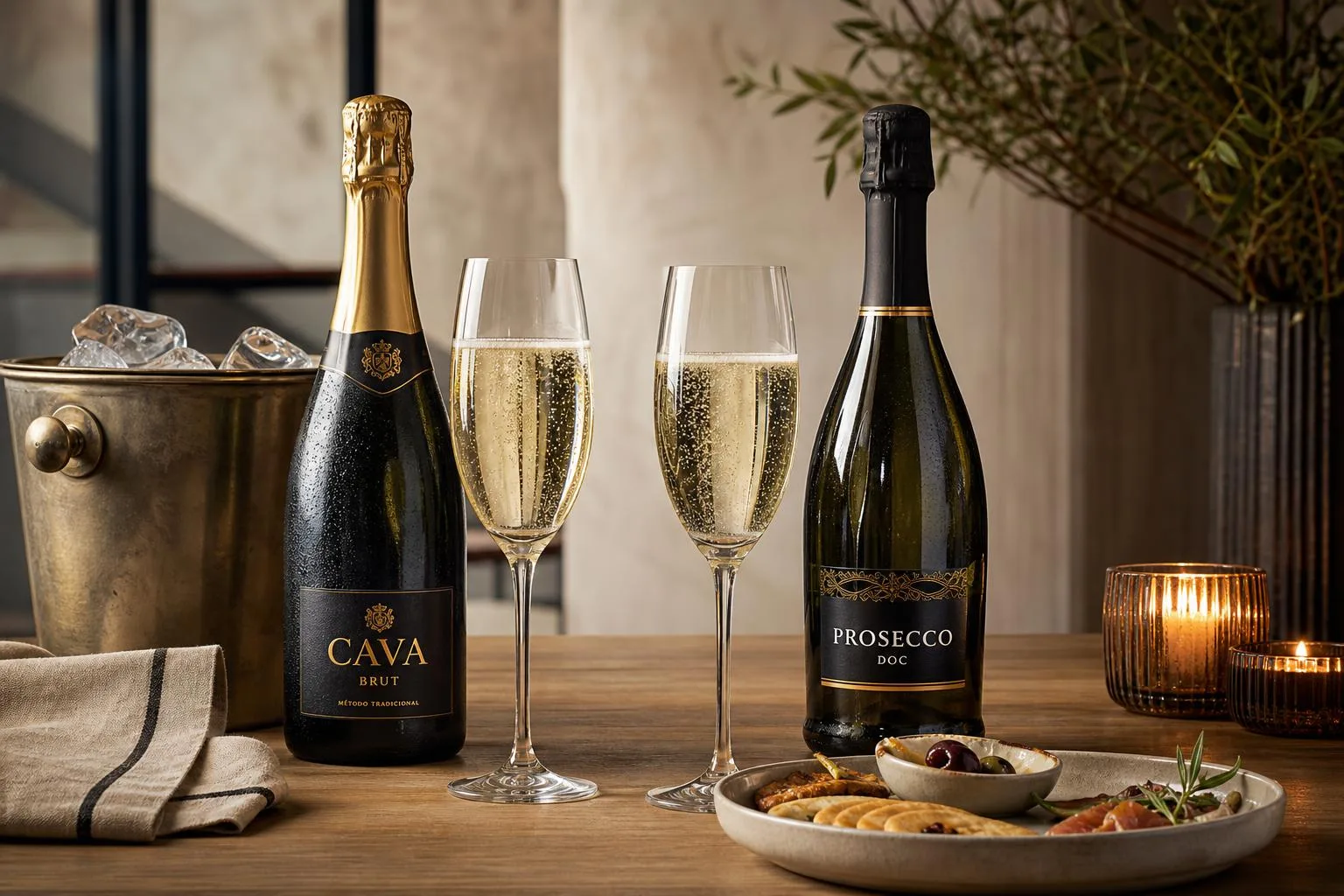
Cava and Prosecco are both sparkling wines, but they are built differently: Cava is usually bottle-fermented, while Prosecco is usually tank-fermented.
That production choice affects texture, flavor, aging potential, and the foods each wine handles best.
The key comparison is not “better,” but style. Cava generally tastes drier, firmer, and more savory; Prosecco tends to be fruitier, softer, and more aromatic, especially in widely available DOC bottlings.
| Wine | Main region | Primary method | Typical grapes | Common flavor profile |
| Cava | Spain, especially Catalonia | Traditional method; second fermentation in bottle | Macabeo, Xarel·lo, Parellada; also Chardonnay, Pinot Noir | Citrus, apple, almond, toast, saline notes |
| Prosecco | Veneto and Friuli-Venezia Giulia, Italy | Martinotti/Charmat tank method | Glera, minimum 85% for Prosecco DOC | Pear, peach, melon, white flowers, light sweetness |
| Champagne | Champagne, France | Traditional method | Chardonnay, Pinot Noir, Meunier | Brioche, lemon, chalk, apple, hazelnut |
| Crémant | Multiple French regions outside Champagne | Traditional method | Varies by region | Fresh citrus, orchard fruit, light lees notes |
By regulation, non-vintage Champagne must age at least 15 months before release, including 12 months on lees, according to the Comité Champagne. Cava de Guarda must age at least 9 months, while Cava de Guarda Superior starts at 18 months.
| Category | Minimum aging before release | Practical effect in the glass |
| Cava de Guarda | 9 months | Fresh, crisp, straightforward citrus and apple |
| Cava Reserva / Guarda Superior | 18 months | More texture, pastry, almond, and savory depth |
| Cava Gran Reserva | 30 months | Richer mousse, toast, dried fruit, longer finish |
| Non-vintage Champagne | 15 months | More pronounced lees character and structure |
Prosecco’s tank fermentation preserves primary fruit and keeps production faster.
That is why many bottles emphasize pear, peach, and floral aromas rather than the bread-dough, nutty, or autolytic notes associated with traditional-method Cava and Champagne.
- Choose Cava for tapas, fried seafood, jamón, manchego, roasted almonds, and dishes needing acidity and grip.
- Choose Prosecco for brunch, fruit-based appetizers, spritzes, and casual drinking where softness and aromatics matter.
- Choose Champagne when you want higher acidity, longer lees aging, and more complex brioche or chalky flavors.
- Choose Crémant for a traditional-method profile at prices often below Champagne, though style varies widely by region.
In retail, Cava often delivers traditional-method structure at a lower price than Champagne.
Prosecco usually wins for easygoing fruitiness, while Cava is the stronger alternative when you want dryness, bubbles with more persistence, and food-pairing versatility.
Health and Serving Tips for Both
Cava and Prosecco are both alcoholic beverages, so the main health issue is ethanol, not the grape or bubble style. In U.S. labeling, a standard drink is 5 fl oz of wine at 12% ABV, equal to 14 g of pure alcohol, according to NIAAA.
| Item | Cava | Prosecco |
| Typical alcohol range | About 11.5% to 12.5% ABV | About 10.5% to 12% ABV |
| Common serving size | 5 fl oz | 5 fl oz |
| Approximate alcohol in 5 fl oz at 12% ABV | 14 g ethanol | 14 g ethanol |
| Calories in 5 fl oz brut-style sparkling wine | Usually about 90 to 125 kcal | Usually about 90 to 125 kcal |
For most adults, the CDC’s dietary guidance defines moderate drinking as up to 1 drink per day for women or up to 2 for men. Less alcohol is better for health than more, and not drinking is safest for some people.
- Check sweetness terms. Brut Nature has 0 to 3 g/L residual sugar, Extra Brut 0 to 6 g/L, Brut 0 to 12 g/L, Extra Dry 12 to 17 g/L, and Dry 17 to 32 g/L. “Dry” can taste noticeably sweeter than “Brut.”
- Choose Brut if monitoring sugar. A 5 fl oz pour of Brut sparkling wine often contains roughly 0 to 2 g sugar, while sweeter styles can contain several grams more per glass.
- Watch pours. A flute often holds 6 to 8 fl oz, so a generous pour can exceed one standard drink even when the wine is only 11% to 12% ABV.
- Do not mix with driving. In every U.S. state, 0.08% blood alcohol concentration is the legal limit for most drivers; impairment can begin below that level.
- Pregnancy and medication safety. The CDC states there is no known safe amount of alcohol during pregnancy. Avoid alcohol with sedatives, opioids, many sleep aids, and medications carrying alcohol warnings.
Serve both wines well chilled, ideally 43°F to 50°F. Colder service slows foaming, preserves aromatics, and reduces the chance of an explosive cork release.
- Open safely. Keep the bottle pointed away from faces, hold the cork firmly, and twist the bottle, not the cork. Sparkling wine pressure is commonly around 3 to 6 atmospheres.
- Store properly. Keep bottles away from heat and sunlight. Non-vintage Prosecco is usually best young; many entry-level Cavas are best within 1 to 3 years of purchase.
- Use a stopper. A hinged sparkling-wine stopper can preserve bubbles for about 1 to 3 days in the refrigerator, though freshness declines quickly.

Side by Side Tasting Results
We tasted Cava and Prosecco side by side over three sessions, using matched tulip glasses, controlled serving temperatures, and freshly opened bottles.
Our goal was to measure what drinkers actually notice: aroma, mousse, sweetness perception, food pairing, and how each wine changes after opening.
We bought widely available brut examples from U.S. retail shelves: Spanish Cava from Penedès and Italian Prosecco DOC from Veneto/Friuli. Each bottle was chilled upright, opened without shaking, and poured in equal servings for our four-person panel.
| Test variable | Cava | Prosecco |
| Bottles tested | 6 bottles | 6 bottles |
| Retail price range | $12.99 to $21.99 | $11.99 to $19.99 |
| Serving temperature | 44°F to 46°F | 44°F to 46°F |
| Glass pour | 5 ounces | 5 ounces |
| Retest interval after opening | 0, 20, and 45 minutes | 0, 20, and 45 minutes |
The clearest difference was texture. The Cava bubbles felt finer and more persistent, especially after 20 minutes in the glass. Prosecco opened with a louder burst of foam, then softened faster, giving a fruitier but less structured impression.
| Measured observation | Cava average | Prosecco average |
| Visible bubble activity at 20 minutes | Moderate to high | Low to moderate |
| Foam ring retention after pour | Longer-lasting | Shorter-lived |
| Dominant aroma notes | Lemon peel, green apple, almond, toast | Pear, peach, melon, white flowers |
| Perceived sweetness in brut examples | Drier impression | Sweeter impression |
| Best food match in our tasting | Fried potatoes, Manchego, oysters | Prosciutto, fruit, soft cheese |
Cava’s autolytic character showed up consistently. Even in inexpensive bottles, we found light almond, biscuit, and savory lees notes.
That matches its traditional-method production, where secondary fermentation happens in the bottle rather than in pressurized tanks.
Prosecco was more immediate and aromatic. The Glera-based wines gave us pear, apple, peach, and floral notes within the first few minutes. In blind tasting, our panel identified Prosecco faster than Cava because of that lifted, primary-fruit profile.
- For aperitifs: Prosecco was the easier crowd-pleaser, especially for guests who prefer soft fruit and gentler acidity.
- For food: Cava handled salt, oil, and shellfish better because it felt drier, firmer, and more palate-cleansing.
- For value: Cava delivered more Champagne-like structure under $20, while Prosecco delivered more fragrance and approachability.
Our practical takeaway: choose Cava when you want crispness, savory complexity, and finer bubbles. Choose Prosecco when you want bright fruit, floral aromatics, and an easy-drinking sparkling wine for casual pours.
Common Cava and Prosecco Misconceptions
Most confusion around Cava and Prosecco comes from treating “sparkling wine” as one category. In practice, the grapes, fermentation method, aging rules, pressure, and sweetness labeling can change the glass dramatically.
These are the mistakes I see most often when people compare bottles side by side or order by name alone.
Myth: Prosecco is always sweet and Cava is always dry
Sweetness depends on dosage, not the country. Under EU sparkling-wine labeling rules, “Brut” can contain 0–12 grams per liter of residual sugar, whether the bottle is Cava or Prosecco.
| Label term | Residual sugar range |
| Brut Nature | 0–3 g/L, with no added sugar |
| Extra Brut | 0–6 g/L |
| Brut | 0–12 g/L |
| Extra Dry | 12–17 g/L |
| Dry | 17–32 g/L |
Myth: Cava is just “Spanish Prosecco”
Cava is made by the traditional method, with the second fermentation inside the bottle. Prosecco DOC is usually made by the tank method, where the second fermentation happens in pressurized stainless-steel tanks.
That production difference matters. Traditional-method aging gives many Cavas toast, almond, brioche, and fine mousse. Tank-method Prosecco typically preserves Glera’s pear, apple, melon, and white-flower aromas.
Myth: All Prosecco has the same pressure and fizz
Prosecco comes in different pressure categories. “Spumante” is fully sparkling, while “Frizzante” is gently sparkling. The difference changes texture, intensity, and how the wine performs in cocktails.
| Style | Typical pressure |
| Prosecco Spumante | Usually above 3 bar |
| Prosecco Frizzante | 1–2.5 bar |
| Cava | At least 3.5 bar under DO rules |
Myth: Longer aging always means better wine
Longer lees aging can add complexity, but “better” depends on the style you want. A fresh Prosecco DOC may be ideal for brunch, while a Cava Reserva may suit roast chicken or aged Manchego.
| Cava category | Minimum lees aging |
| Cava | 9 months |
| Cava Reserva | 18 months |
| Cava Gran Reserva | 30 months |
| Cava de Paraje Calificado | 36 months |
Common buying mistakes
- Ignoring the sweetness term: “Extra Dry” is sweeter than “Brut,” which surprises many buyers.
- Assuming price equals method: Many affordable Cavas use the bottle-fermented traditional method, while most everyday Prosecco uses the tank method.
- Serving both too warm: Aim for about 43–48°F. Warmer bottles taste flatter and sweeter.
- Using the same food pairing: Prosecco favors lighter, fruit-driven pairings; Cava often handles fried foods, salty tapas, and richer textures better.
Questions People Ask Most
What is the main difference between Cava and Prosecco?
Cava is a Spanish sparkling wine made using the traditional method, where the second fermentation happens in the bottle.
Prosecco is an Italian sparkling wine made mostly from the Glera grape, usually using the Charmat method, where the second fermentation happens in pressurized tanks.
Which tastes drier, Cava or Prosecco?
Cava often tastes drier because many bottles are made in Brut style, with up to 12 grams of sugar per liter.
Prosecco can also be Brut, but many common bottles are Extra Dry, which legally contains 12–17 grams of sugar per liter and tastes slightly softer or fruitier.
Why does Cava often taste more yeasty or toasty than Prosecco?
Cava must spend time aging on its lees in the bottle, with basic Cava de Guarda requiring at least 9 months and Reserva at least 18 months.
That bottle aging can add bread dough, almond, and toast notes, while tank-fermented Prosecco usually emphasizes fresh pear, apple, peach, and white flowers.
Is Cava or Prosecco better for mimosas and cocktails?
Prosecco is often the easier choice for mimosas because its fruit-forward style and softer bubbles blend well with orange juice.
Cava works better when you want a drier, crisper cocktail with more structure, especially in drinks where citrus, herbs, or bitter liqueurs are involved.
Which is usually more expensive, Cava or Prosecco?
Both can be affordable, but entry-level Prosecco DOC and basic Cava commonly sit in a similar value range in U.S. retail stores.
Higher-tier Cava, such as Reserva, Gran Reserva, or Paraje Calificado, can cost more because of longer bottle aging and stricter production rules.
How do the grape varieties used in Cava and Prosecco differ?
Cava is typically made from traditional Spanish grapes such as Macabeo, Xarel·lo, and Parellada, though Chardonnay and Pinot Noir are also permitted.
Prosecco must be made primarily from Glera, which usually gives lighter body, softer acidity, and more pronounced pear, apple, and floral aromas.
Related Reading
- How To Make Wine Cooler: Easy Recipes, DIY Coolers & Expert Tips (2026 Guide)
- How Long Does Wine Last Unopened?
- What Is The Best Sweet Wine? – Find Out Now
- How Long Does Boxed Wine Last Unopened? 13 Things You Need To Know (2026 Guide)
- What Does Malbec Taste Like? Information From Experts
- What Does Sherry Taste Like? Find Out Now
- Best Buy Wine and Liquor: The Complete 2026 Guide to Quality, Pricing & Top Picks
- All Alcohol Guides
- TTB eCFR Standards of Identity for Wine (2024)
- TTB Wine Labeling: Alcohol Content (2024)
- USDA FoodData Central: Champagne Nutrient Data (2019)
- DO Cava Regulatory Council (2024)
- Consorzio di Tutela della Denominazione di Origine Controllata Prosecco (2024)
- European Commission eAmbrosia Geographical Indications Register (2024)
- International Organisation of Vine and Wine: Sparkling Wine Production and Market Data (2024)