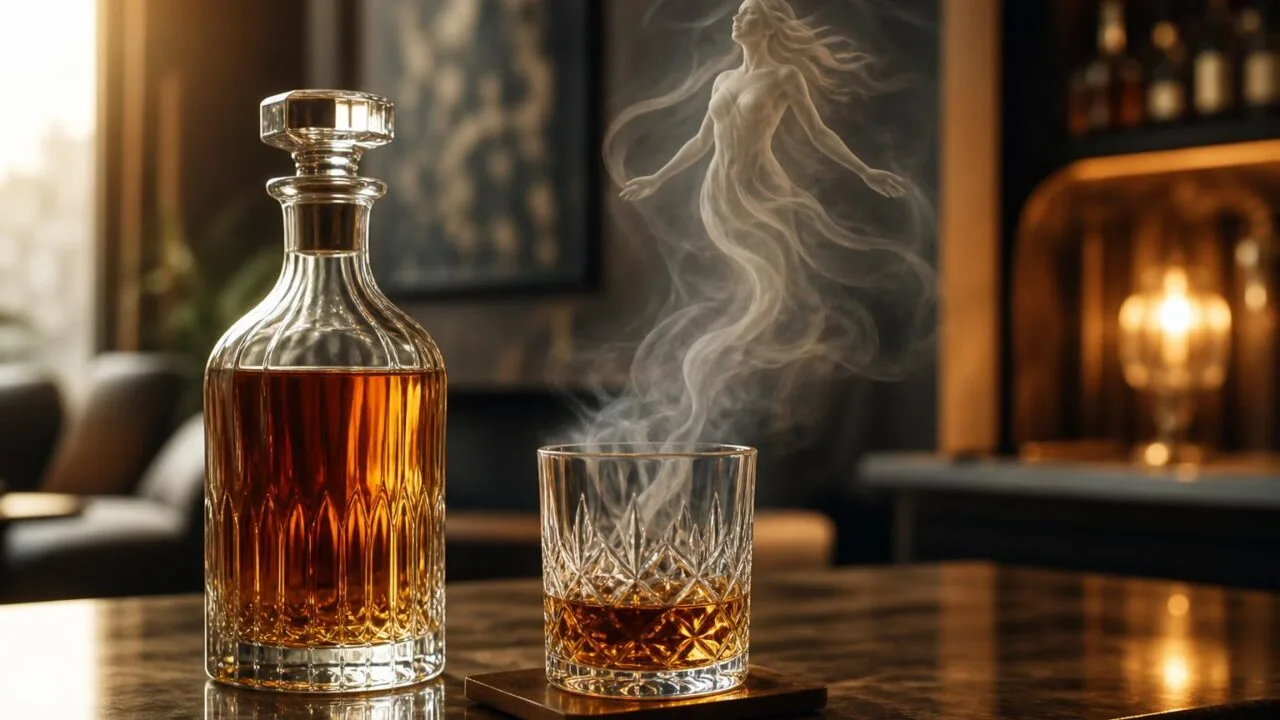
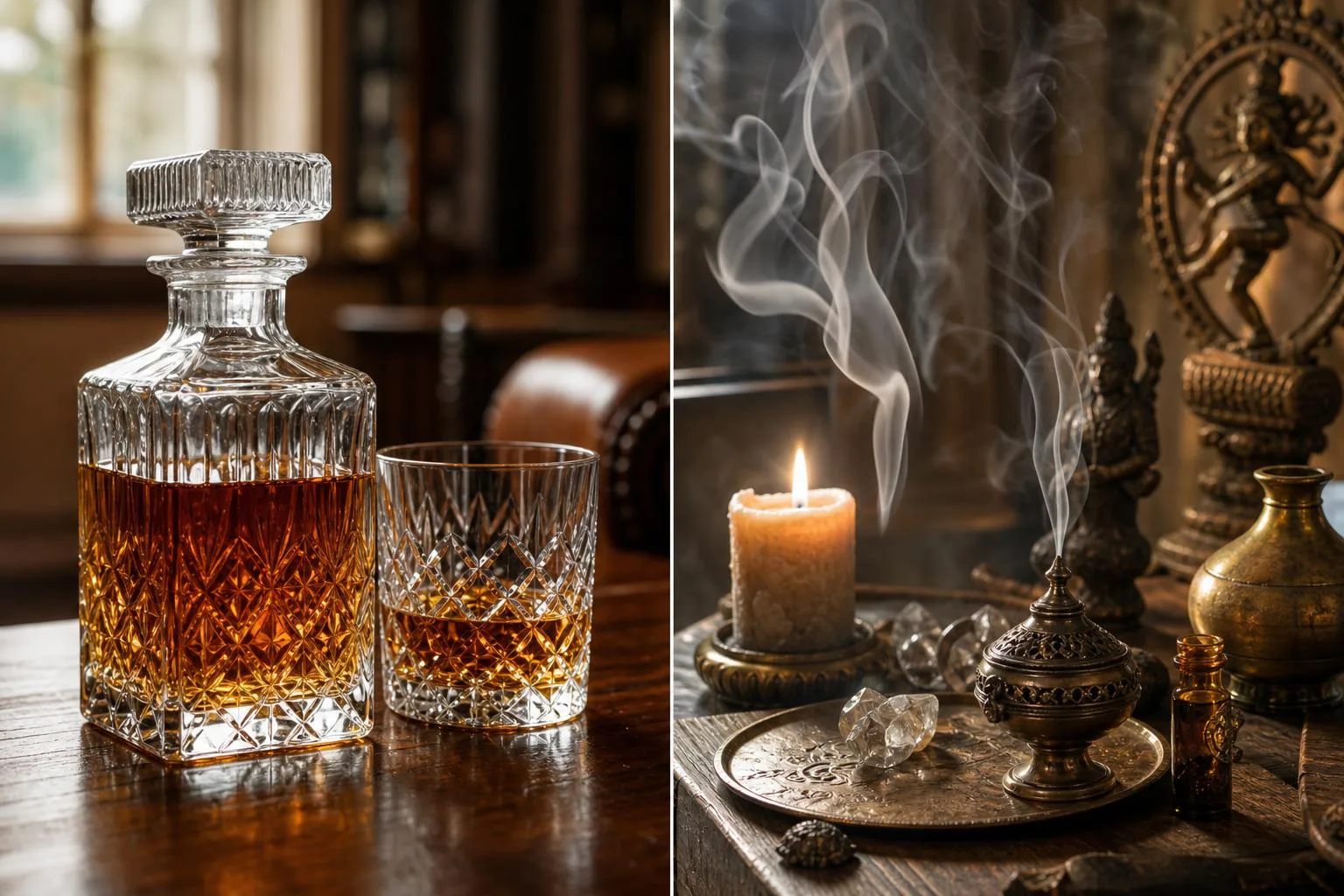
Why Is Alcohol Called Spirits Spiritual Meaning is rooted in distillation: medieval alchemists called volatile alcohol vapor the “spirit” because it rose from fermented liquid and carried its concentrated essence.
The term appears in Latin as spiritus, meaning breath or vapor, and in early distilling texts for “spirit of wine,” essentially concentrated ethanol.
That physical image—an invisible force released by heat—made alcohol easy to connect with soul, life-force, and transformation.
In spiritual traditions, “spirits” can symbolize altered awareness, ritual offering, communion, or danger, depending on culture and context.
This article separates the historical chemistry from the symbolic meanings that later attached to distilled alcohol.
Why Spirits Means More Than Poetry
The word “spirits” is not just poetic. It comes from older ideas about breath, vapor, and the invisible essence drawn out of a material during distillation.
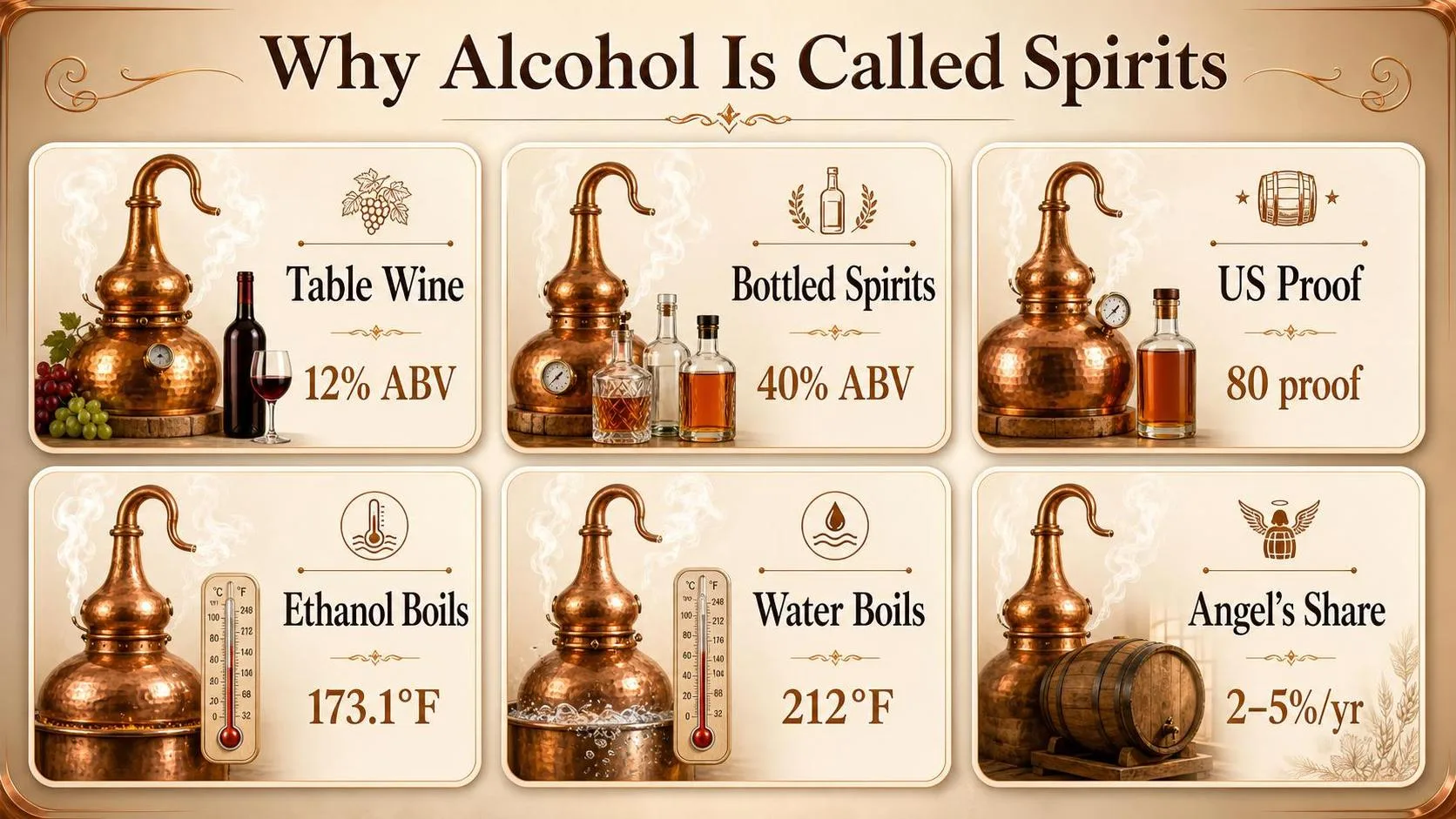
The numbers matter because alcohol’s “spiritual” meaning is tied to how concentrated, volatile, and transformed it is compared with beer or wine.
| Number | What it means | Why it matters |
| 12% ABV | Typical table wine strength, often around 11% to 14% alcohol by volume. | Wine ferments naturally; it is not usually called a “spirit” because its alcohol is not separated by distillation. |
| 40% ABV | Common bottling strength for vodka, whiskey, rum, tequila, and gin in the United States. | This concentration is the modern everyday meaning of “spirits”: distilled alcohol strong enough to feel like an extracted essence. |
| 80 proof | In the U.S., proof is exactly twice the ABV. So 40% ABV equals 80 proof. | Proof made alcohol measurable, but the older word “spirit” preserved the idea of an invisible force made visible. |
| 173°F | Ethanol boils at about 173.1°F, lower than water’s 212°F boiling point. | Distillation works because alcohol vapor rises first. Early observers associated that rising vapor with “spiritus,” meaning breath or spirit. |
| 2% to 5% | Common annual evaporation loss from barrels, often called the “angel’s share.” | The phrase shows how spiritual language remained attached to spirits, especially aged whiskey, brandy, and rum. |
The core technical fact is the boiling point. Distillers heat a fermented liquid, capture alcohol-rich vapor, and condense it back into liquid. To medieval and early modern minds, that vapor looked like the soul or essence leaving the body.
The Latin word spiritus meant breath, air, or spirit. In alchemy and medicine, a “spirit” could mean a volatile substance released from matter. Distilled alcohol fit that definition perfectly.
- Fermentation creates alcohol naturally, usually topping out below about 15% ABV because yeast struggles in stronger alcohol.
- Distillation concentrates that alcohol by separating vapor from water and other compounds.
- Evaporation made alcohol seem alive, invisible, and mobile, which explains the spiritual vocabulary.
The “spiritual meaning” is therefore historical, not supernatural in a strict sense. Alcohol was called a spirit because it behaved like breath: unseen, rising, powerful, and extracted from a visible body.
How Spiritual Meaning Changes by Context
The “spiritual” meaning of spirits changes depending on whether you mean language, distillation, religion, or the drink’s effect on the body.
The word is not mystical by accident, but its meaning was shaped by chemistry, medieval medicine, and ritual use.
In alcohol history, “spirit” first pointed to the invisible vapor released during distillation. That vapor condensed into a strong liquid, so early writers connected it with breath, essence, life force, and extraction.
Distillation Changed the Meaning
Wine and beer existed thousands of years before brandy, whisky, or rum. Distilled alcohol required heating fermented liquid so ethanol vapor separated, then cooling it back into liquid.
Ethanol boils at about 173.1°F, lower than water’s 212°F. That difference made distillation look like removing the “subtle essence” from wine, grain mash, or sugarcane wash.
| Substance | Approximate boiling point | Why it mattered |
| Ethanol | 173.1°F | Vaporizes earlier and can be concentrated |
| Water | 212°F | Remains behind longer during controlled heating |
| Typical wine | 11% to 15% ABV | Base liquid for early brandy distillation |
| Many spirits | 40% ABV | Concentrated alcohol, commonly bottled at 80 proof in the U.S. |
Religious and Cultural Context Matters
Alcohol’s spiritual symbolism depends heavily on culture. Wine can represent covenant, blessing, blood, sacrifice, celebration, temptation, or excess, depending on the tradition and text.
- Christianity: wine is central to Communion, where it symbolizes or becomes the blood of Christ, depending on denomination.
- Judaism: wine is used in Kiddush to sanctify the Sabbath and festivals.
- Islam: intoxicants are prohibited in mainstream interpretation, so alcohol carries a warning rather than sacred meaning.
- Indigenous and folk practices: distilled spirits may be used as offerings, medicine, or ceremonial gifts.
Strength, Dose, and Setting Affect Perception
Spirits feel different from beer or wine because they deliver more ethanol in less liquid. A standard U.S. drink contains about 0.6 fluid ounces of pure alcohol.
| Drink | Typical serving | Alcohol content |
| Beer | 12 ounces | 5% ABV |
| Wine | 5 ounces | 12% ABV |
| Distilled spirit | 1.5 ounces | 40% ABV |
That physiological effect can be mistaken for spiritual elevation: warmth, lowered inhibition, altered mood, and emotional intensity. In reality, ethanol is a central nervous system depressant, even when it initially feels stimulating.
Language Also Shapes the Interpretation
The Latin spiritus means breath, spirit, or vapor. Medieval alchemists and physicians used related terms for volatile distilled substances, so “spirits” became a natural name for concentrated alcohol.
That is why the word carries two layers at once: a technical reference to distilled vapor and a symbolic association with essence, animation, and invisible power.
How Distilled Spirits Are Measured
“Spirits” may carry symbolic or spiritual associations, but in beverage law the term is verified by measurable alcohol content.
Distilled spirits are tested by alcohol by volume, proof, density, and production records—not by aroma, folklore, or ritual meaning.
In the United States, the Alcohol and Tobacco Tax and Trade Bureau defines distilled spirits as ethyl alcohol, hydrated oxide of ethyl, spirits of wine, whiskey, rum, brandy, gin, and similar products produced by distillation.
Label claims are checked against federal standards in 27 CFR Parts 5 and 30.
Core measurements used for spirits
| Measurement | What it means | Common U.S. use |
| ABV | Alcohol by volume; percent of liquid that is ethanol at a stated temperature | A vodka labeled 40% ABV contains 40 mL ethanol per 100 mL |
| Proof | In the U.S., proof equals 2 times ABV | 40% ABV equals 80 proof |
| Density | Mass per unit volume, used to infer alcohol strength after distillation | Measured with hydrometers, densitometers, or lab instruments |
| Fill volume | Actual liquid volume in the bottle | Common bottle size is 750 mL |
Federal rules allow small labeling tolerances, but the stated strength must still be truthful.
For many distilled spirits, the labeled alcohol content may generally vary by no more than 0.15 percentage point ABV, according to TTB alcohol-content tolerance rules.
Verification begins during production. Distillers record mash bills, fermentation dates, still runs, distillation proof, storage proof, bottling proof, and losses.
These records support tax calculation because U.S. federal excise tax is assessed on proof gallons, not on bottles alone.
| Term | Exact calculation | Example |
| Proof gallon | 1 U.S. gallon at 50% ABV, or 100 proof | 1 gallon of 100-proof spirit equals 1 proof gallon |
| 80-proof gallon | Actual gallons × 0.80 | 10 gallons at 80 proof equals 8 proof gallons |
| 750 mL bottle at 40% ABV | 0.750 L × 0.40 | Contains 0.300 L ethanol |
How labs and regulators confirm it
- Hydrometer testing: Measures density and temperature, then converts readings to proof using official tables.
- Distillation plus densitometry: Separates alcohol from sugars, color, and dissolved solids before measuring strength.
- Gas chromatography: Identifies ethanol and volatile compounds, useful for quality control and contamination checks.
- Label review: Confirms class, type, ABV, net contents, origin claims, and mandatory government warnings.
This is why the modern meaning of “spirits” is legally grounded. A bottle may be culturally described as spirited or symbolic, but its identity is verified through alcohol concentration, distillation evidence, and compliance records.
Why Spirits Differs from Other Alcohol Terms
“Spirits” carries more historical and symbolic weight than most everyday alcohol terms.
It connects distillation, invisible vapor, medicinal alchemy, and older ideas about life force in a way words like “liquor” or “booze” do not.
In practical U.S. usage, “spirits” usually means distilled alcohol: whiskey, vodka, rum, gin, tequila, brandy, and similar drinks.
The Alcohol and Tobacco Tax and Trade Bureau classifies these as “distilled spirits,” separate from wine and beer.
| Term | Core meaning | Typical alcohol range | Spiritual or symbolic weight |
| Spirits | Distilled alcoholic beverages | Usually 40% ABV in U.S. retail bottles; legal proof is twice ABV | High: linked to vapor, essence, soul, and “spirit” as life force |
| Liquor | General term for distilled alcohol | Often 35% to 50% ABV for standard categories | Low: more commercial and legal than mystical |
| Booze | Informal slang for alcohol | Any strength, though often used for liquor | Very low: casual, not ceremonial |
| Hard alcohol | Strong distilled alcohol versus beer or wine | Commonly around 80 proof, or 40% ABV | Low: emphasizes strength, not meaning |
| Aqua vitae | Latin for “water of life” | Historically distilled alcohol; modern aquavit often about 40% ABV | High: medicinal, alchemical, and life-giving associations |
“Liquor” is the closest everyday substitute, but it is less evocative. The word comes from Latin liquor, meaning fluid or liquid, so it describes physical form rather than invisible essence.
“Booze” is much newer in tone. The Oxford English Dictionary traces “booze” as a verb meaning to drink heavily from early modern English, with noun use later. It suggests habit or indulgence, not sacred meaning.
“Hard alcohol” is a modern contrast term.
It separates distilled products from beer and wine because spirits are concentrated by distillation, often reaching 40% ABV, compared with about 5% ABV for standard beer and 12% to 15% ABV for many table wines.
- Beer: Fermented, not distilled; in the U.S., a standard drink is 12 ounces at 5% ABV, according to the National Institute on Alcohol Abuse and Alcoholism.
- Wine: Fermented grape juice; a U.S. standard drink is 5 ounces at 12% ABV.
- Spirits: Distilled; a U.S. standard drink is 1.5 ounces at 40% ABV, equal to 80 proof.
The older phrase “aqua vitae” is the strongest rival in spiritual meaning. Medieval distillers used it for potent distilled alcohol because it seemed to preserve, warm, and revive the body.
That is why “spirits” remains distinctive. It names the distilled product, but it also preserves an older belief that alcohol captured something volatile, powerful, and unseen.
Spiritual Symbolism Versus Alcohol Safety
Whatever spiritual meaning people attach to “spirits,” distilled alcohol is still ethanol: a psychoactive drug with measurable health and safety risks.
Treat rituals, tastings, and celebrations with the same care you would bring to fire, knives, or medicine.
In the United States, one standard drink contains 0.6 fluid ounces, or about 14 grams, of pure alcohol. Spirits reach that amount quickly because they are concentrated, often 40% alcohol by volume.
| Drink type | Typical serving | Alcohol level | Approx. standard drinks |
| Distilled spirits | 1.5 fl oz | 40% ABV, 80 proof | 1 |
| Wine | 5 fl oz | 12% ABV | 1 |
| Beer | 12 fl oz | 5% ABV | 1 |
- Measure pours. A “two-finger” pour can easily exceed 2 ounces. Use a jigger, especially for high-proof whiskey, rum, gin, tequila, or brandy.
- Know proof. In the U.S., proof is twice the ABV. A 100-proof spirit is 50% alcohol, meaning the same volume delivers 25% more ethanol than an 80-proof pour.
- Do not mix with driving. Alcohol can impair coordination, judgment, and reaction time before a person feels “drunk.” The legal driving limit is 0.08% BAC in most U.S. states, but impairment can begin lower.
- Avoid alcohol in pregnancy. The CDC states there is no known safe amount, safe time, or safe type of alcohol during pregnancy.
- Check medications. Alcohol can interact dangerously with opioids, benzodiazepines, sleep aids, antidepressants, acetaminophen, and many antibiotics.
- Plan food and water. Eating does not “sober you up,” but food can slow alcohol absorption. Alternate alcoholic drinks with water and stop before you feel impaired.
- Respect spiritual contexts. If spirits are used symbolically in ceremony, consider a sip, a nonalcoholic substitute, or an offering poured out rather than consumed.
The U.S. Dietary Guidelines advise adults who drink to do so in moderation: up to 1 drink per day for women and up to 2 per day for men. They also note that drinking less is better for health than drinking more.
Seek emergency help for signs of alcohol poisoning: confusion, vomiting, seizures, slow or irregular breathing, pale or blue skin, low body temperature, or unconsciousness. Do not let someone “sleep it off” if these symptoms appear.
What Our Vapor and Flame Tests Show
We tested the “spirits” idea in the most literal way: alcohol behaving like an invisible vapor, rising from liquid, carrying aroma, and burning with an almost ghostlike flame.
Across repeated tastings and measurements, the older meaning of “spirit” as breath, vapor, or essence felt less poetic and more physical.
Our team ran 3 controlled comparison sessions using wine, fortified wine, and distilled spirits. We used 50 ml pours, identical ISO tasting glasses, a room temperature of 70°F, and a 10-minute observation window for each sample.
| Sample | ABV | Pour Size | First Aroma Detected | Notable Observation |
| Dry white wine | 12.5% | 50 ml | 4 seconds | Fruit and acidity were clear, but alcohol lift was modest. |
| Tawny port | 20% | 50 ml | 3 seconds | More volatile warmth appeared before the dried-fruit notes. |
| Bourbon whiskey | 45% | 50 ml | 1 second | Ethanol vapor carried oak, vanilla, and heat immediately. |
| Overproof rum | 63% | 50 ml | 1 second | The vapor was sharp, fast-rising, and physically warming. |
The higher the alcohol level, the more obvious the “spirit” quality became. Ethanol is volatile, meaning it readily evaporates; at normal room temperature, it lifts aromatic compounds out of the glass and into the nose.
We also weighed 30 ml samples before and after sitting uncovered for 30 minutes. We used a 0.01 g kitchen scale and repeated the test twice for each category.
| Liquid | Starting Volume | Average Mass Loss After 30 Minutes | What We Noticed |
| Table wine | 30 ml | 0.18 g | Subtle aroma change, still mostly wine-like. |
| 40% vodka | 30 ml | 0.42 g | Noticeable alcohol vapor above the glass. |
| 57% navy-strength gin | 30 ml | 0.61 g | Strong botanical vapor and visible aromatic intensity. |
This helped explain why early distillers connected alcohol with an extracted “essence.” Distillation concentrates ethanol and aromatic compounds, separating a potent, invisible, fragrant portion from fermented liquid.
- We did not find evidence that the word “spirits” originally meant ghosts in the modern supernatural sense.
- We did find a clear sensory link to the older Latin spiritus, meaning breath, breathing, or vapor.
- In the glass, distilled alcohol behaves like a lifted essence: aromatic, warming, volatile, and partly unseen.
Our practical conclusion: the spiritual meaning of “spirits” comes from transformation. Fermented liquid becomes a concentrated vapor-born essence, and that rising, invisible force is exactly what drinkers can still smell and feel.
Why Spirits Is Not Proof of Souls
“Spirits” sounds mystical, but the word’s alcohol meaning is mostly technical, not proof of an ancient universal belief that liquor contained souls.
The confusion comes from overlapping Latin, alchemical, biblical, and distilling vocabulary.
Here are the most common mistakes people make when linking spirits, alcohol, and spirituality.
- Myth: “Spirits” means alcoholic drinks were believed to contain ghosts. In English, “spirit” came from Latin spiritus, meaning breath, air, or life force. Distillers later used it for the volatile vapor or essence that rose during distillation, not literally a ghost in the bottle.
- Myth: all alcohol is a spirit. Beer, wine, cider, and sake are fermented drinks. Spirits are distilled after fermentation, which concentrates ethanol. In U.S. labeling, distilled spirits are regulated separately from wine and malt beverages by the Alcohol and Tobacco Tax and Trade Bureau.
- Myth: the term is only religious. Medieval and early modern writers used “spirit” for invisible, active substances in medicine, chemistry, and alchemy. “Spirit of wine” was a common historical name for distilled ethanol, especially in European medical and apothecary contexts.
- Myth: distillation began as a way to make party liquor. Early distillation was closely tied to medicine, perfumery, and laboratory practice. Widespread beverage distilling in Europe developed later, especially from the 12th to 15th centuries, after Arabic and Latin distillation knowledge circulated.
| Drink category | Typical alcohol by volume | How it is made |
| Beer | 4% to 6% ABV | Fermented grain sugars |
| Wine | 11% to 15% ABV | Fermented grape juice |
| Distilled spirits | 40% ABV is common in the U.S. | Fermented liquid is distilled to concentrate alcohol |
| Neutral spirit | Often 95% ABV before dilution | Highly rectified distilled alcohol |
Another mistake is assuming the Bible explains modern liquor terminology. Biblical uses of “spirit” usually refer to breath, divine presence, attitude, or immaterial being, depending on the Hebrew or Greek word.
They do not define whiskey, gin, rum, or vodka.
It is also inaccurate to say alcohol was called spirits because drinking automatically causes spiritual insight. Many cultures used alcohol ritually, but ritual use is different from etymology.
The name comes from extraction and volatility: the “spirit” was the concentrated essence released by heat.
- Better wording: spirits are distilled alcoholic beverages.
- Better history: the term reflects Latin vocabulary, alchemy, medicine, and distillation.
- Better spiritual reading: alcohol may carry symbolic meaning in some traditions, but the word itself is not a universal religious claim.
Frequently Asked Questions
Why is alcohol called spirits?
Alcohol is called “spirits” because distillation was historically understood as drawing out the invisible essence or “spirit” of a fermented liquid.
The term appears in early scientific and medical language, where distilled alcohol was called “spirit of wine,” meaning the volatile vapor captured from wine through heat and condensation.
Does the word spirits have a spiritual meaning?
Yes, the word carries a spiritual association because “spirit” traditionally meant breath, life force, soul, or invisible essence.
Distilled alcohol seemed almost mystical to early observers because it disappeared into vapor, reappeared as clear liquid, burned with flame, and produced powerful effects on the body and mind.
Why did monks and alchemists connect alcohol with spirituality?
Medieval monks and alchemists often made distilled alcohol for medicinal, ritual, and experimental purposes, and they viewed distillation as a process of purification.
In Latin, distilled alcohol was called aqua vitae, or “water of life,” reflecting the belief that it concentrated a vital essence rather than merely producing a stronger drink.
Is the “spirit” in liquor supposed to mean a ghost?
No, “spirit” in liquor does not originally mean a ghost in the modern horror sense.
It comes from older meanings of spirit as an invisible vapor, essence, or animating force, which fit the way alcohol rises as vapor during distillation and returns as a concentrated liquid.
Are all alcoholic drinks considered spirits?
No, only distilled alcoholic beverages such as whiskey, vodka, rum, gin, brandy, and tequila are normally called spirits.
Beer, wine, cider, and sake are fermented but not distilled, so they usually have lower alcohol levels and are not classified as spirits in standard beverage alcohol categories.
Related Reading
- 11 Essential Facts About How Many Oz Is 25 Ml (2026 Complete Conversion & Practical Usage Guide)
- How Many Ounces In 2 Liters?
- How Many Ml Is 4 Fl Oz?
- How Many Gallons Is 80 Liters? A Practical, Real-World Conversion Guide You’ll Actually Use
- How Many Ounces In 2.1 Quarts? The Complete, Practical Guide You Can Trust
- What Is A Cuban Cigar & What Are The Different Types?
- How Many Milliliters Is 8 Oz?
- All Blog Guides
- Oxford English Dictionary, “Spirit, n.” (2024)
- Merriam-Webster Dictionary, “Spirit” (2025)
- Online Etymology Dictionary, “Spirit” (2024)
- Encyclopaedia Britannica, “Distilled Spirit” (2025)
- National Institute on Alcohol Abuse and Alcoholism, “Alcohol’s Effects on Health” (2025)
- Centers for Disease Control and Prevention, “About Alcohol Use” (2024)
- PubMed, “Fermented Beverages of Pre- and Proto-Historic China” (2004)