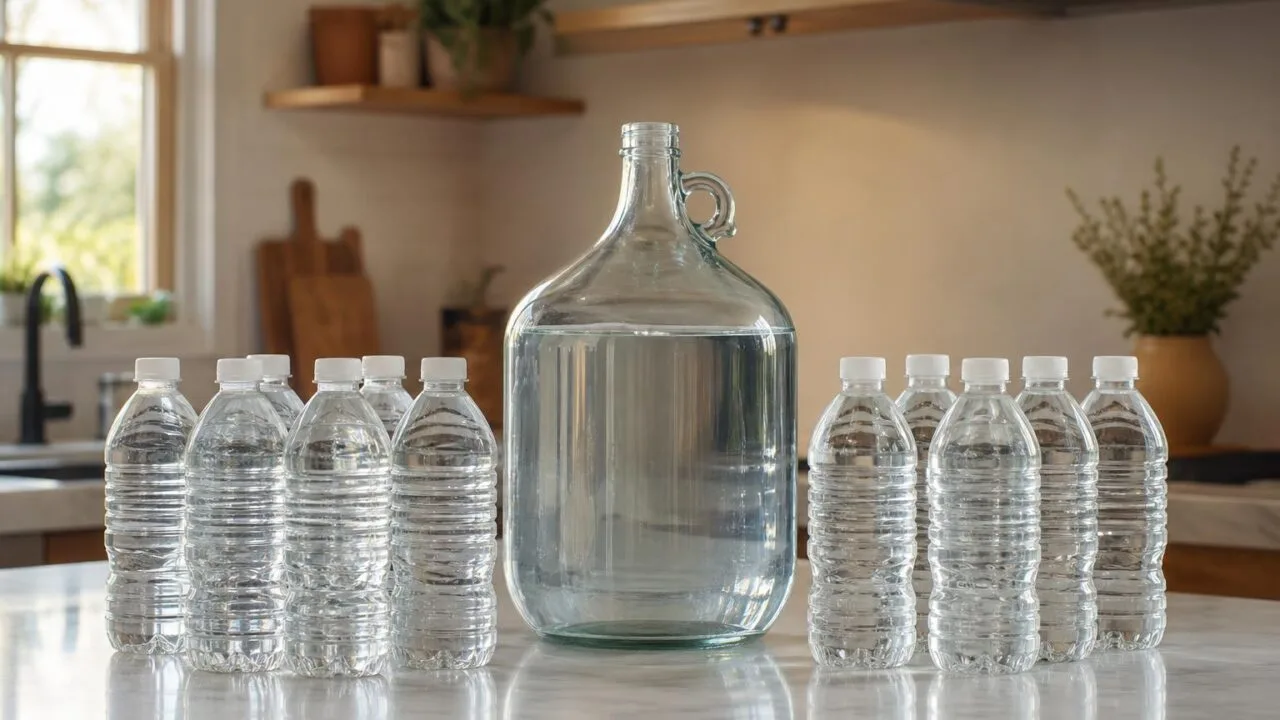
How Many Water Bottles Equal A Gallon is 8 bottles of 16 fluid ounces each. A U.S. gallon contains 128 fluid ounces, so the count changes with bottle size: 10.7 bottles at 12 ounces, 7.1 at 18 ounces, and 5.3 at 24 ounces.
This guide uses U.S. liquid measurements, the standard for water packaging and nutrition labels in the United States.
You’ll see quick conversions by common bottle sizes, plus practical ways to measure a gallon accurately for hydration tracking, recipes, events, or emergency water storage.
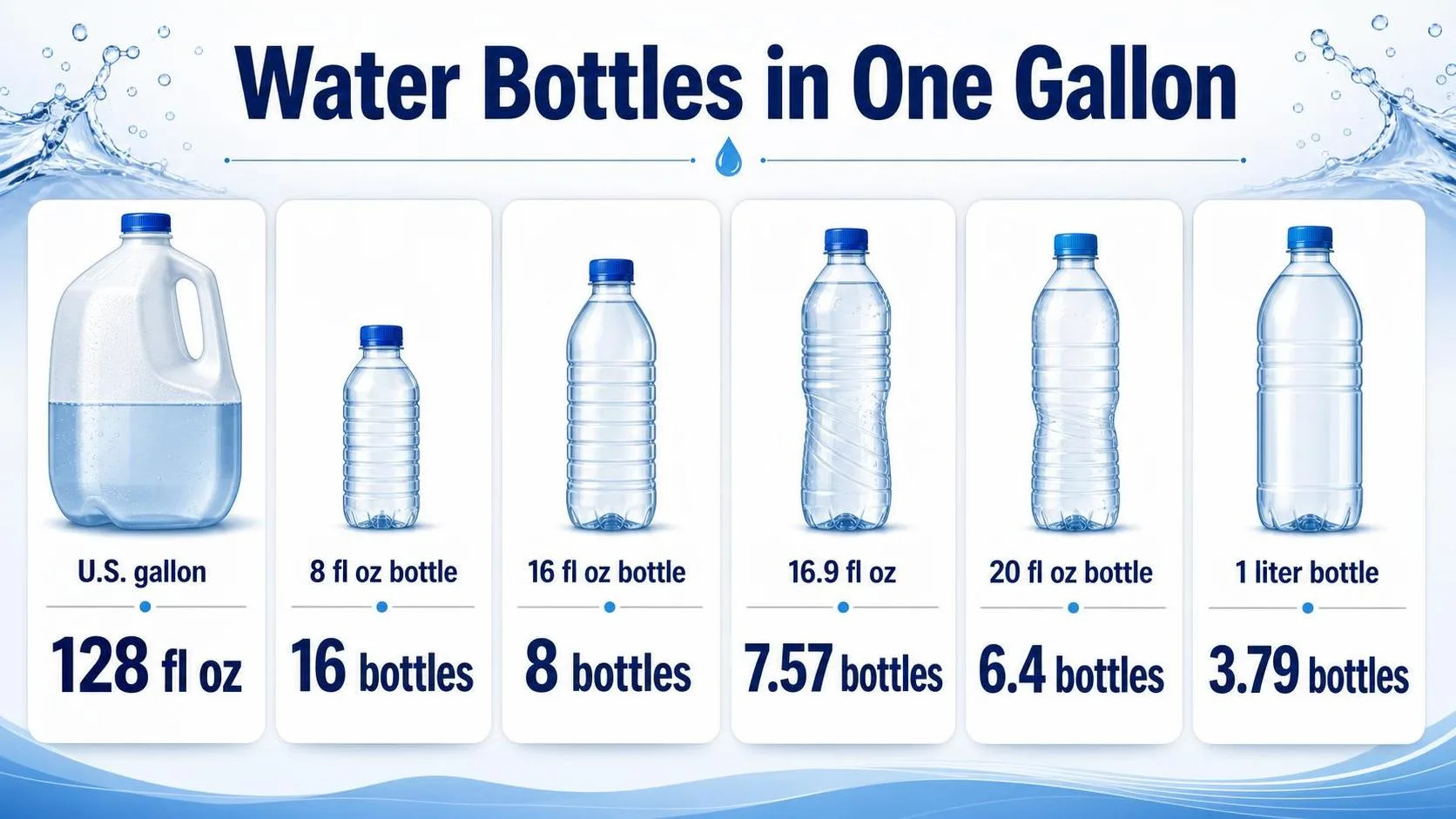
Bottle Size Determines Bottles Per Gallon
A U.S. gallon equals 128 U.S. fluid ounces. So the number of water bottles in a gallon depends entirely on the bottle size printed on the label, usually in fluid ounces or milliliters.
The most common single-use water bottle in the U.S. is 16.9 fluid ounces, also labeled 500 mL. One gallon is about 3.785 liters, so it takes a little more than seven and a half of those bottles to make a gallon.
| Bottle size | Calculation | Bottles per U.S. gallon |
| 8 fl oz | 128 ÷ 8 | 16 bottles |
| 12 fl oz | 128 ÷ 12 | 10.67 bottles |
| 16 fl oz | 128 ÷ 16 | 8 bottles |
| 16.9 fl oz / 500 mL | 128 ÷ 16.9 | 7.57 bottles |
| 20 fl oz | 128 ÷ 20 | 6.4 bottles |
| 24 fl oz | 128 ÷ 24 | 5.33 bottles |
| 32 fl oz | 128 ÷ 32 | 4 bottles |
In everyday terms, if you are using standard 16.9-ounce bottles, 8 bottles is slightly more than a gallon. Seven bottles equal 118.3 fluid ounces, while eight bottles equal 135.2 fluid ounces.
| Number of 16.9-oz bottles | Total fluid ounces | Compared with 1 gallon |
| 7 bottles | 118.3 fl oz | 9.7 fl oz short |
| 7.57 bottles | 128 fl oz | Exactly 1 gallon |
| 8 bottles | 135.2 fl oz | 7.2 fl oz over |
For metric labels, the same rule applies. A U.S. gallon is 3,785 mL, so divide 3,785 by the bottle’s milliliter size.
| Metric bottle size | Calculation | Bottles per U.S. gallon |
| 330 mL | 3,785 ÷ 330 | 11.47 bottles |
| 500 mL | 3,785 ÷ 500 | 7.57 bottles |
| 750 mL | 3,785 ÷ 750 | 5.05 bottles |
| 1 liter | 3,785 ÷ 1,000 | 3.79 bottles |
One important distinction: these figures use the U.S. liquid gallon. The imperial gallon used in the U.K. and some Commonwealth contexts is larger, at about 160 imperial fluid ounces or 4.546 liters.
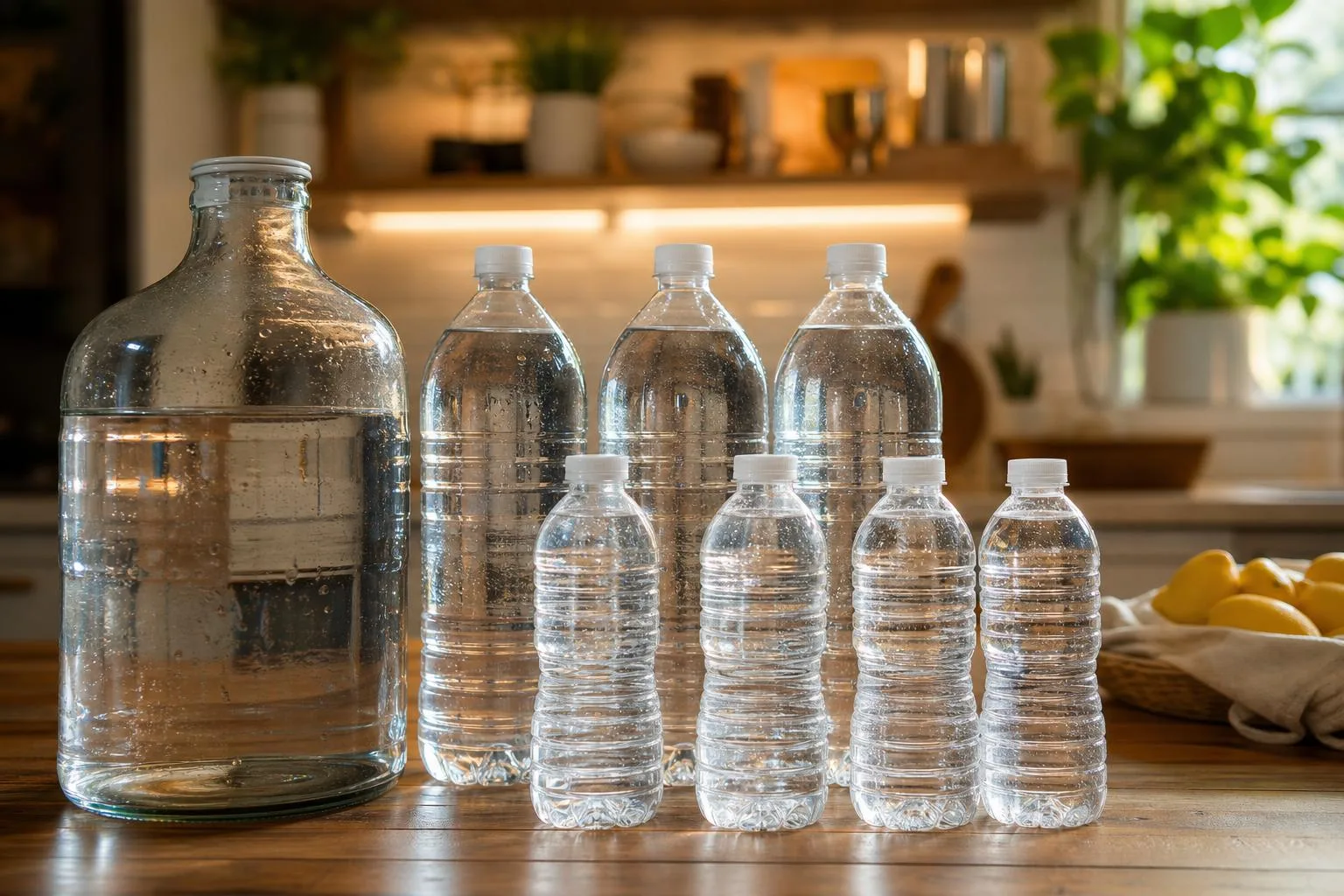
Gallon Type and Bottle Volume Matter
The answer depends on which “gallon” you mean and the actual bottle volume printed on the label.
In the U.S., a liquid gallon is 128 U.S. fluid ounces, but many water bottles are labeled in milliliters, which creates small rounding differences.
| Measure | Exact volume | Why it matters |
| U.S. liquid gallon | 128 U.S. fl oz | Standard used for drinks and hydration calculations in the United States. |
| Imperial gallon | 160 Imperial fl oz | Used in the U.K.; about 20% larger than a U.S. gallon. |
| 1 liter | 33.814 U.S. fl oz | Common on bottle labels; 1 U.S. gallon equals 3.785 liters. |
Bottle size is the biggest factor
A “regular” bottle is not one fixed size. Convenience-store bottles are often 16.9 fl oz, sports bottles may be 20 fl oz, and larger single bottles may be 1 liter or 33.8 fl oz.
| Bottle size | Bottles per U.S. gallon | Practical count |
| 8 fl oz | 16 | Sixteen small bottles equal exactly 1 gallon. |
| 12 fl oz | 10.67 | Eleven bottles slightly exceed 1 gallon. |
| 16 fl oz | 8 | Eight bottles equal exactly 1 gallon. |
| 16.9 fl oz | 7.57 | About 7.5 bottles; eight bottles exceed 1 gallon. |
| 20 fl oz | 6.4 | Six bottles are short; seven bottles exceed 1 gallon. |
| 1 liter | 3.785 | Four 1-liter bottles exceed 1 gallon. |
Label rounding can change the math
The common 16.9 fl oz bottle is usually a 500 mL bottle. Since 500 mL equals 16.907 U.S. fl oz, the label often rounds to 16.9 fl oz.
- Using 16.9 fl oz: 128 ÷ 16.9 = 7.57 bottles.
- Using 500 mL: 3,785 mL ÷ 500 mL = 7.57 bottles.
- Using eight bottles: 8 × 16.9 fl oz = 135.2 fl oz, or about 1.06 U.S. gallons.
Filled volume and serving assumptions matter
A bottle’s labeled volume refers to its net contents, not necessarily the brim-full capacity. If you refill disposable bottles, pouring to the shoulder, cap line, or top can change the amount by several ounces.
Serving size can also mislead the count. Some labels list multiple servings per bottle, but the gallon calculation should use total bottle volume, not the nutrition-panel serving size.
How to Verify Bottles Per Gallon
A U.S. liquid gallon is defined as exactly 128 U.S. fluid ounces.
To verify how many water bottles equal a gallon, compare the bottle’s labeled fluid ounces to 128, then confirm the label size against an actual measured volume if accuracy matters.
In the United States, bottled water volume is labeled in fluid ounces and often milliliters. The key conversion is fixed: 1 U.S. fluid ounce equals 29.5735 milliliters, so 1 gallon equals about 3,785 milliliters, or 3.785 liters.
| Bottle label size | Calculation | Bottles per U.S. gallon |
| 8 fl oz | 128 ÷ 8 | 16 bottles |
| 12 fl oz | 128 ÷ 12 | 10.67 bottles |
| 16 fl oz | 128 ÷ 16 | 8 bottles |
| 16.9 fl oz / 500 mL | 128 ÷ 16.9 | 7.57 bottles |
| 20 fl oz | 128 ÷ 20 | 6.4 bottles |
| 24 fl oz | 128 ÷ 24 | 5.33 bottles |
| 33.8 fl oz / 1 L | 128 ÷ 33.8 | 3.79 bottles |
The most common single-serve bottle in U.S. stores is 16.9 fluid ounces, which is the rounded U.S. label for 500 milliliters. Since 128 divided by 16.9 is 7.57, it takes about 7 and 1/2 bottles to equal one gallon.
For practical verification, use a container marked at 1 gallon or 128 fluid ounces. Pour full bottles into it at room temperature, keeping the bottle level and allowing foam or trapped air to settle before reading the mark.
- Check the unit first: use U.S. fluid ounces, not imperial fluid ounces. An imperial gallon is about 160 imperial fluid ounces, which changes the count.
- Read the actual label: “500 mL” bottles are approximately 16.907 U.S. fluid ounces, though many labels round this to 16.9.
- Use a calibrated pitcher: kitchen measuring cups are acceptable for home checks, but molded marks can be slightly off.
- Account for partial bottles: if the result is 7.57 bottles, that means 7 full bottles plus about 57% of another 16.9-ounce bottle.
Commercial bottlers verify fill volume using metering, weight checks, and regulatory labeling rules.
Because water has a predictable density near normal room temperatures, weight can be used as a cross-check: one U.S. gallon of water weighs about 8.34 pounds.
| Measurement reference | Exact or accepted value |
| 1 U.S. gallon | 128 U.S. fluid ounces |
| 1 U.S. fluid ounce | 29.5735 milliliters |
| 1 U.S. gallon | 3.785 liters |
| Water weight per U.S. gallon | About 8.34 pounds |
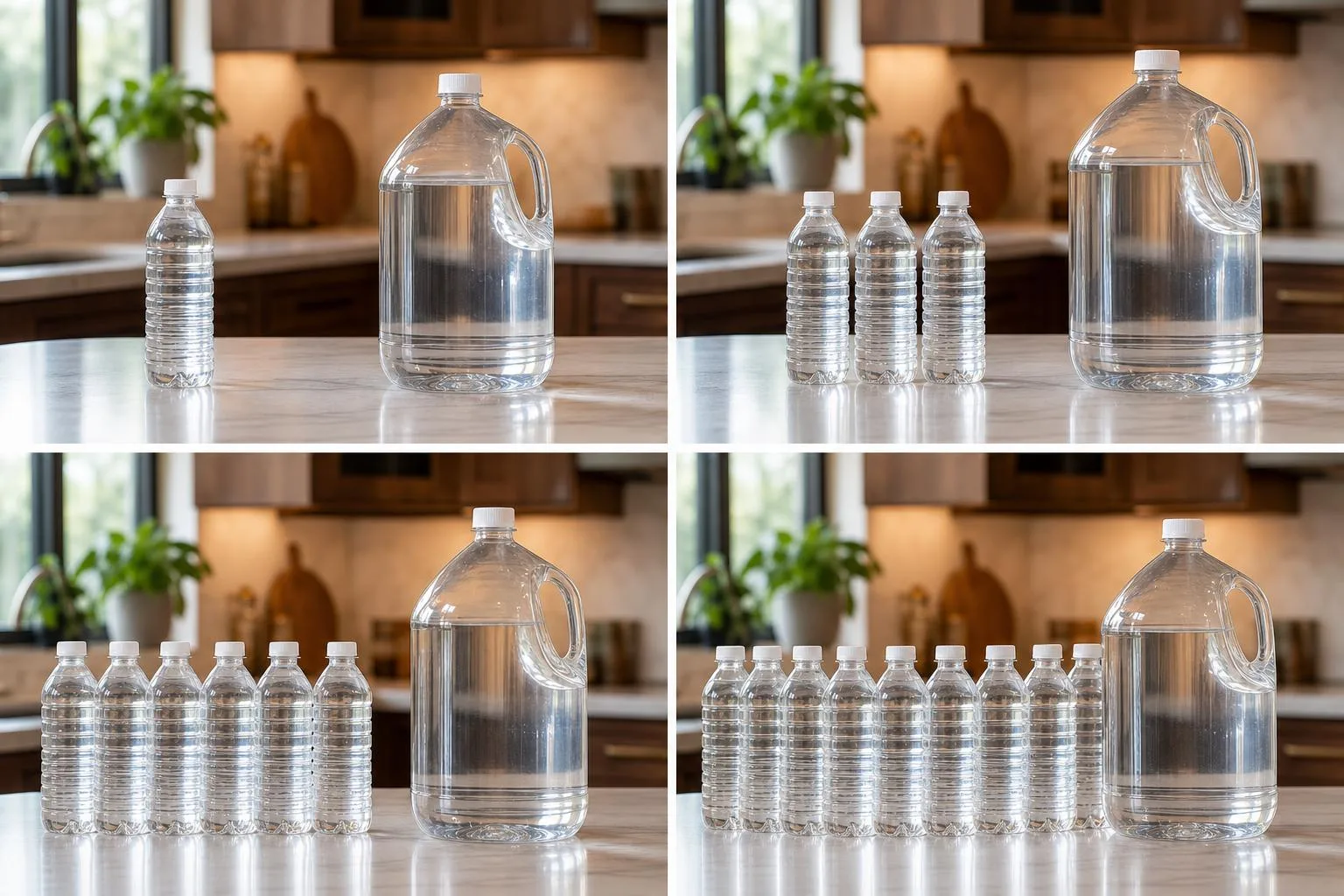
Why Bottle Counts Change
A U.S. liquid gallon is 128 U.S. fluid ounces, so the bottle count changes as soon as the bottle size changes. The everyday “single-use” water bottle in the U.S. is usually 16.9 fluid ounces, or 500 milliliters.
That means one gallon is not exactly eight standard disposable bottles. It is about 7.57 bottles, so in practical terms you need 8 bottles to slightly exceed a gallon.
| Container size | Fluid ounces | Bottles or containers per 1 U.S. gallon | Practical takeaway |
| Small mini bottle | 8 fl oz | 16 | Two mini bottles equal one 16-ounce pint. |
| Standard disposable bottle | 16.9 fl oz | 7.57 | 8 bottles equals 135.2 fl oz, slightly over 1 gallon. |
| Reusable bottle | 20 fl oz | 6.4 | 6 full bottles is 120 fl oz; 7 is 140 fl oz. |
| Large reusable bottle | 24 fl oz | 5.33 | 5 bottles is short; 6 bottles is 144 fl oz. |
| Large bottle | 32 fl oz | 4 | Exactly 4 bottles equal 1 gallon. |
| Half-gallon jug | 64 fl oz | 2 | Two half-gallon jugs equal 1 gallon. |
| Metric liter bottle | 33.814 fl oz | 3.79 | About 3.8 liters equals 1 U.S. gallon. |
The cleanest comparison is the 32-ounce bottle. Since 128 divided by 32 equals 4, four 32-ounce bottles make exactly one U.S. gallon with no rounding.
The 16.9-ounce bottle is less exact because it is based on the metric 500 mL size. Using the National Institute of Standards and Technology conversion of 1 liter equaling about 33.814 U.S. fluid ounces, 500 mL equals about 16.907 ounces.
- For meal prep or tracking intake: use 32-ounce bottles if you want simple gallon math.
- For disposable 16.9-ounce bottles: count 8 bottles as roughly one gallon, though it is about 7.2 fluid ounces over.
- For liter bottles: 4 liters is more than a U.S. gallon, totaling about 135.3 fluid ounces.
- For half-gallon jugs: 2 jugs equal one gallon exactly in U.S. liquid measurement.
Do not confuse a U.S. gallon with an imperial gallon. An imperial gallon is about 160 imperial fluid ounces, or roughly 153.7 U.S. fluid ounces, so bottle counts are higher under the U.K. system.
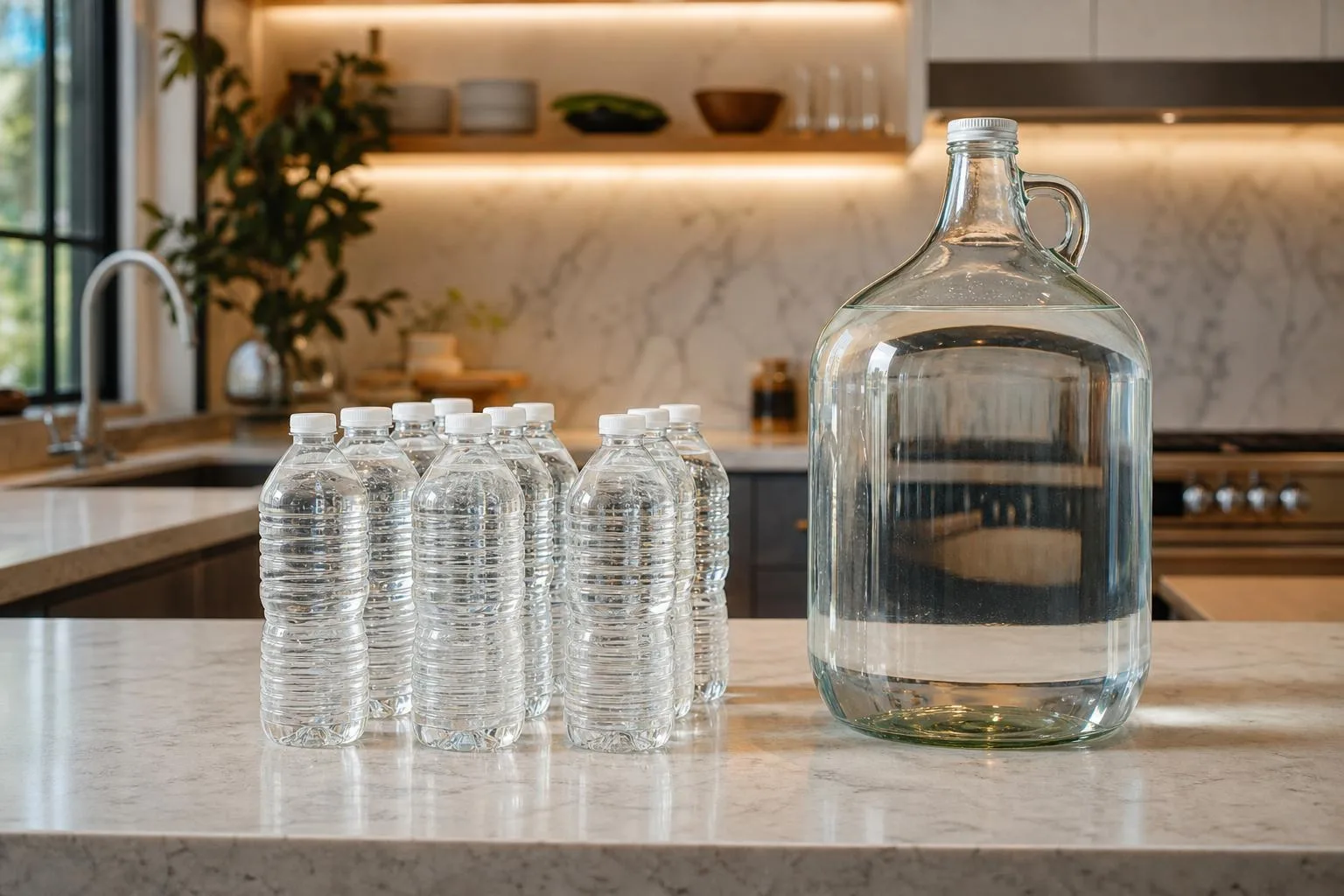
A Gallon Is Not for Everyone
A gallon is a useful measuring target, but it is not automatically the right daily water goal for everyone. Your needs depend on body size, activity, heat exposure, diet, pregnancy, medications, and medical conditions.
In U.S. measurements, one gallon equals 128 fluid ounces. Use the bottle size printed on the label, because “standard” disposable bottles vary by brand and setting.
| Bottle size | Bottles in 1 U.S. gallon |
| 8 fl oz | 16 bottles |
| 12 fl oz | 10.67 bottles |
| 16.9 fl oz | 7.57 bottles |
| 20 fl oz | 6.4 bottles |
| 24 fl oz | 5.33 bottles |
| 32 fl oz | 4 bottles |
Hydration guidance that is safer than chasing a gallon
The National Academies’ adequate intake for total water includes beverages and food, not plain water alone. Food commonly supplies about 20% of daily water intake, especially from fruit, vegetables, soups, and yogurt.
| Reference intake | Total water per day |
| Adult women | About 2.7 liters, or 91 fl oz |
| Adult men | About 3.7 liters, or 125 fl oz |
| One U.S. gallon | 3.79 liters, or 128 fl oz |
- Do not force water rapidly. Drinking very large amounts in a short period can dilute blood sodium, a condition called hyponatremia. Risk rises during endurance exercise, extreme dieting, or after taking certain medications.
- Use urine color as a quick check. Pale yellow usually suggests reasonable hydration. Completely clear urine all day can mean you are drinking more than needed, especially if you are urinating constantly.
- Increase fluids with sweat losses. Heat, alcohol, air travel, fever, vomiting, diarrhea, and hard workouts can raise needs. For long sweaty sessions, include electrolytes and salty foods rather than plain water only.
- Ask a clinician before targeting a gallon if you have kidney disease, heart failure, liver disease, low sodium history, or take diuretics, SSRIs, carbamazepine, or desmopressin.
- Refill safely. Wash reusable bottles daily with hot soapy water, scrub the cap and straw, and let parts air-dry. Replace bottles with persistent odor, cracks, or damaged lids.
- Make the math practical. If you use a 32-ounce bottle, four full bottles equal a gallon. Many people find two to three refills more realistic than carrying several disposable bottles.
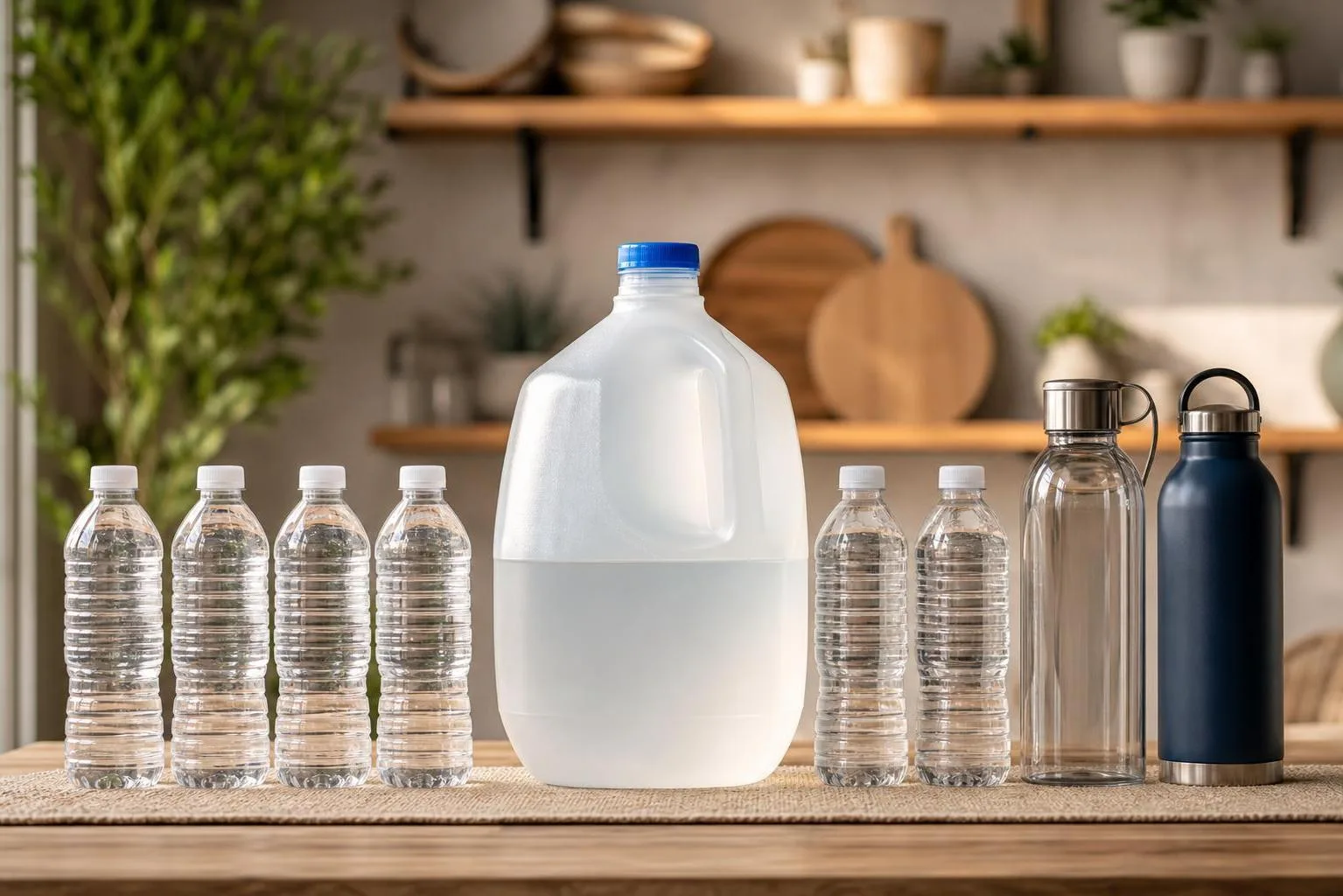
Testing Bottles Against One Gallon
We tested the gallon-to-bottle question using actual packaged water bottles, a 1-gallon pitcher marked at 128 fl oz, and a digital kitchen scale. Our goal was to see what works in real use, not just on paper.
We ran three fill trials for each bottle size, pouring slowly and stopping at the pitcher’s 1-gallon line. We also weighed the filled pitcher each time to check consistency, since 1 US gallon of water weighs about 8.34 lb at room temperature.
| Bottle label | Fluid ounces per bottle | Bottles for 1 gallon by math | Whole bottles needed in practice |
| 8 fl oz mini bottle | 8 fl oz | 16 bottles | 16 bottles |
| 12 fl oz bottle | 12 fl oz | 10.67 bottles | 11 bottles, with leftover |
| 16.9 fl oz bottle / 500 mL | 16.9 fl oz | 7.57 bottles | 8 bottles, with leftover |
| 20 fl oz bottle | 20 fl oz | 6.4 bottles | 7 bottles, with leftover |
| 1 liter bottle | 33.8 fl oz | 3.79 bottles | 4 bottles, with leftover |
The 16.9 fl oz bottle was the most useful real-world test because it is the standard single-serve bottle we most often see in cases. Seven full bottles did not reach a gallon. The eighth bottle pushed the total past the gallon mark.
| 16.9 fl oz bottle count | Total volume | Result versus 128 fl oz gallon |
| 7 bottles | 118.3 fl oz | 9.7 fl oz short |
| 8 bottles | 135.2 fl oz | 7.2 fl oz over |
In our pour tests, the small differences came from bottle fill variation and reading the pitcher line at eye level. Across repeated trials, the practical answer stayed the same: use 8 standard 16.9 fl oz bottles if you need at least 1 gallon.
- Exact answer: 1 US gallon equals 128 fl oz.
- Most common bottled-water answer: 7.57 bottles of 16.9 fl oz water equals 1 gallon.
- Practical answer: bring or buy 8 standard bottles to have at least 1 gallon.
- For meal planning or hydration tracking: count 8 bottles, but remember you are drinking about 7.2 fl oz more than a gallon.
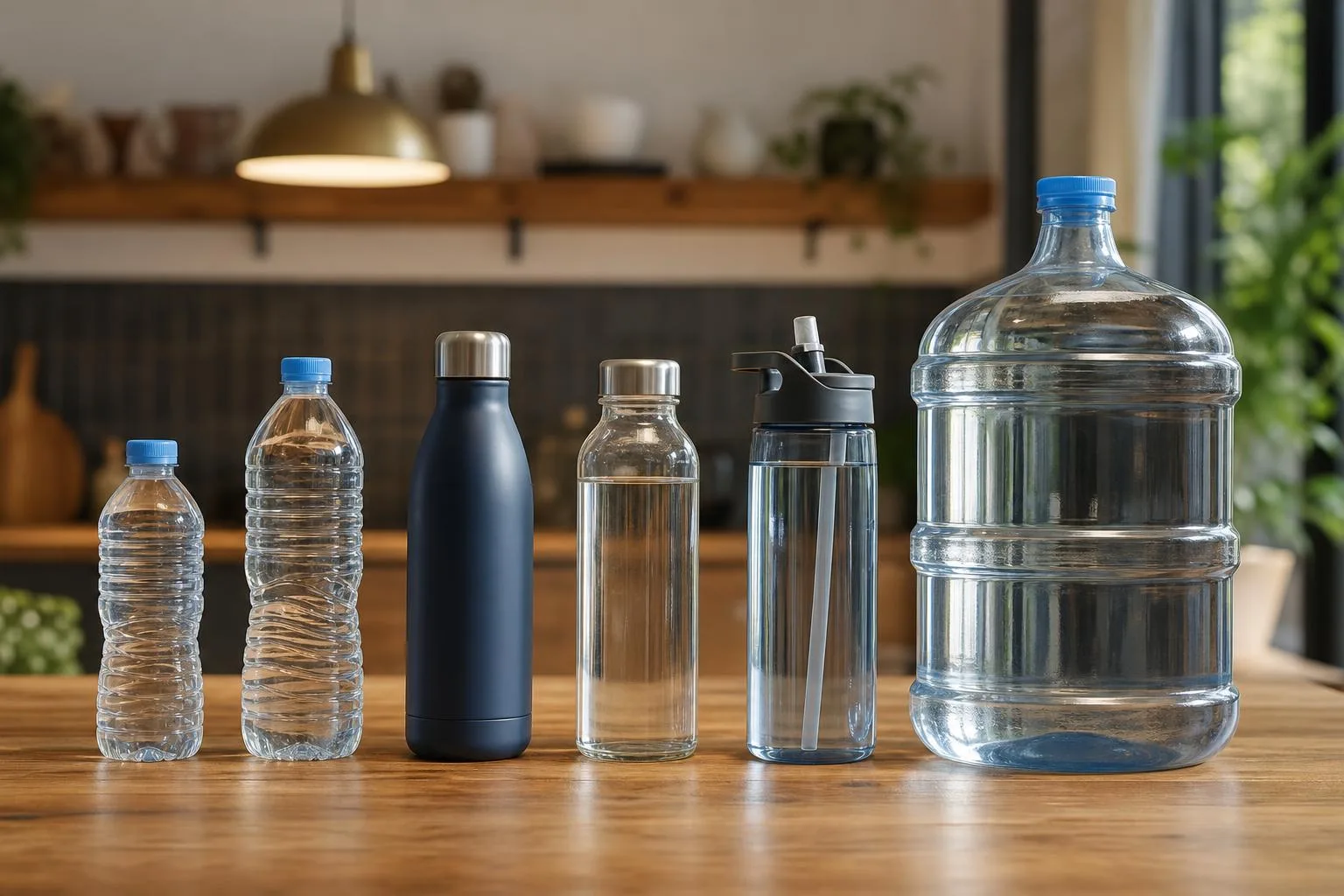
Mistaking a Bottle for a Standard Unit
The biggest mistake is treating “a bottle” as a standard unit. A U.S. gallon is fixed at 128 U.S. fluid ounces, but bottled water sizes vary by brand, package, and country.
For accuracy, use the fluid-ounce amount printed on the label, not the bottle shape or the word “standard.” NIST defines the U.S. liquid gallon as 231 cubic inches, which equals 128 U.S. fluid ounces.
Myth: Every Water Bottle Is 16.9 Ounces
The common 16.9-ounce bottle is popular because it is 500 milliliters, but it is not universal. Many single-serve bottles are 8, 12, 16, 20, 24, or 33.8 fluid ounces.
| Bottle size | Bottles per 1 U.S. gallon | Practical count |
| 8 fl oz | 16 | Exactly 16 bottles |
| 12 fl oz | 10.67 | 10 bottles is short; 11 is over |
| 16 fl oz | 8 | Exactly 8 bottles |
| 16.9 fl oz | 7.57 | About 7.6 bottles |
| 20 fl oz | 6.4 | 6 bottles is short; 7 is over |
| 33.8 fl oz | 3.79 | About 3.8 one-liter bottles |
Myth: Eight 16.9-Ounce Bottles Equal One Gallon
Eight 16.9-ounce bottles equal 135.2 fluid ounces. That is 7.2 fluid ounces more than a U.S. gallon, or about 5.6% extra.
If you are tracking hydration, meal prep, or storage space, that difference matters. Seven 16.9-ounce bottles equal 118.3 fluid ounces, which is 9.7 fluid ounces short of a gallon.
Myth: A Gallon Is the Same Everywhere
A U.S. gallon is not the same as an Imperial gallon used in some Commonwealth countries. The Imperial gallon is about 4.546 liters, while the U.S. gallon is about 3.785 liters.
This means an Imperial gallon is about 20% larger than a U.S. gallon. If a hydration target says “one gallon,” confirm whether it means U.S. or Imperial measurement.
Other Common Errors
- Confusing ounces by weight with fluid ounces: Water is often close, but bottle labels use volume, not weight.
- Rounding too early: 128 divided by 16.9 is 7.57, not simply 8.
- Ignoring metric labels: A 500 mL bottle is about 16.9 U.S. fluid ounces, using FDA and NIST conversion standards.
- Assuming filled-to-the-cap volume: Use the labeled net contents, not the apparent physical capacity of the bottle.
Questions People Ask Most
How many 16.9 oz water bottles equal a gallon?
A U.S. gallon contains 128 fluid ounces, so 128 ÷ 16.9 = 7.57 bottles. In practical terms, about 7.5 standard 16.9 fl oz bottles equal one gallon, and 8 bottles equal 135.2 fl oz, which is slightly more than a gallon.
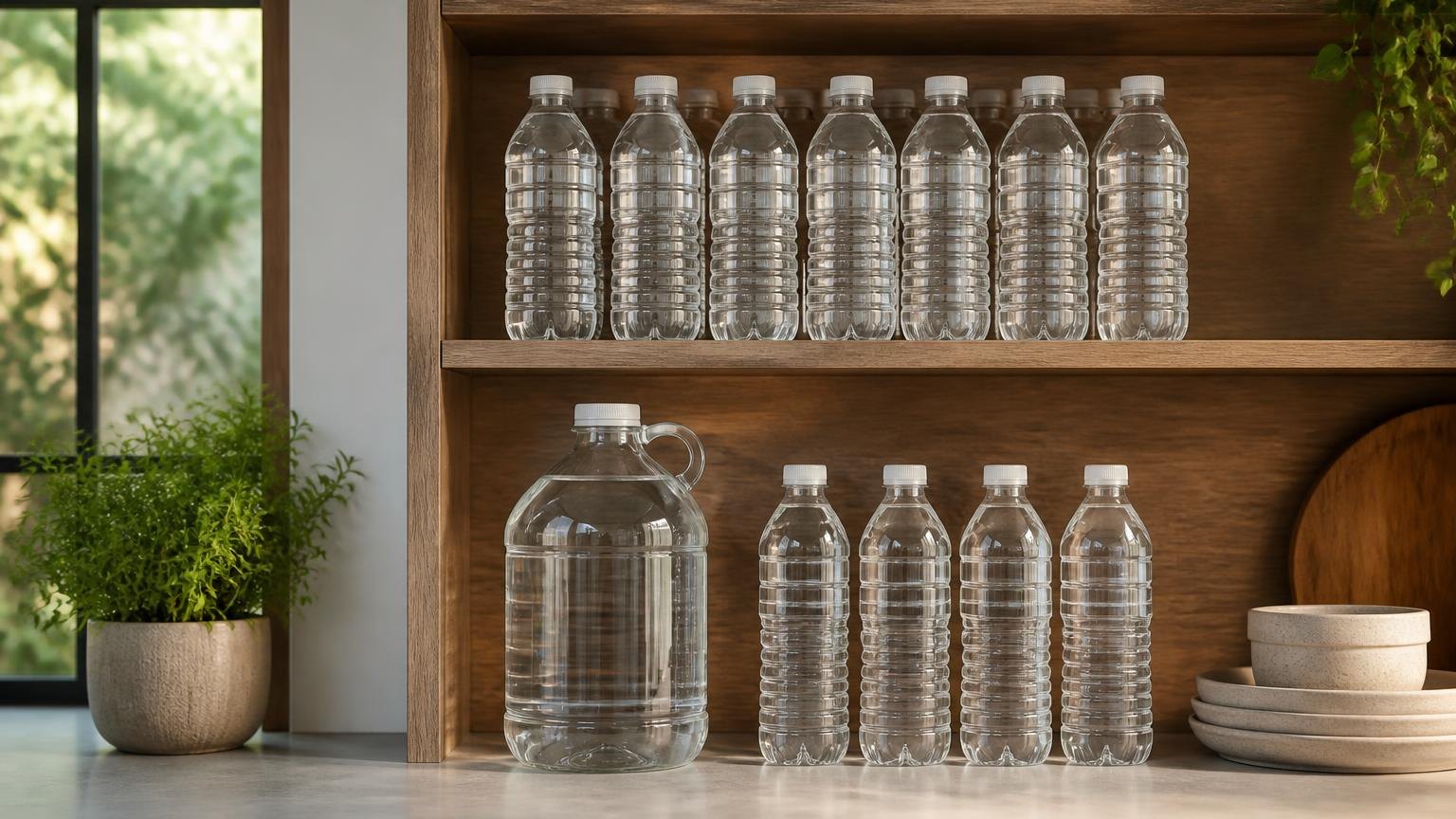
How many 16 oz water bottles are in a gallon?
A 16 fl oz bottle goes evenly into a U.S. gallon because 128 ÷ 16 = 8. That means exactly 8 bottles of 16 oz water equal 1 gallon.
How many 20 oz water bottles make a gallon?
Since 1 U.S. gallon is 128 fl oz, 128 ÷ 20 = 6.4 bottles. You would need 6 full 20 oz bottles plus 8 more ounces, or 7 bottles if you want to exceed a gallon slightly.
How many 12 oz water bottles equal a gallon?
For 12 fl oz bottles, 128 ÷ 12 = 10.67 bottles. That means 10 bottles give you 120 fl oz, and 11 bottles give you 132 fl oz, which is 4 fl oz more than a gallon.
Is a gallon always 128 ounces when counting water bottles?
In the United States, a liquid gallon is 128 U.S. fluid ounces, which is the standard used for bottled water calculations.
An imperial gallon used in some other countries is larger at about 153.7 U.S. fluid ounces, so the bottle count would be different outside U.S. measurements.
Related Reading
- What Alcohol Goes With Dr Pepper?
- How Many Oz Is 1 Pint?
- How Many Gallons Is 2 Liters?
- Which Gasolina Drink Is The Best? Answer By Expert
- Why Is A Bottle Opener Called A Church Key?
- How Many Liters In 55 Gallons?
- How Many Ounces Is 1/3 Cup Of Cream Cheese?
- All Blog Guides
- NIST Appendix C: General Tables of Units of Measurement (2024)
- eCFR 21 CFR § 165.110: Bottled Water (2026)
- CDC: Water and Healthier Drinks (2024)
- PubMed: Water, Hydration, and Health (2010)
- USGS Water Science School: Water Q&A—How Much Water Do I Use at Home Each Day? (2019)
- National Academies Press: Dietary Reference Intakes for Water, Potassium, Sodium, Chloride, and Sulfate (2005)
- International Bottled Water Association: Bottled Water Facts (2024)