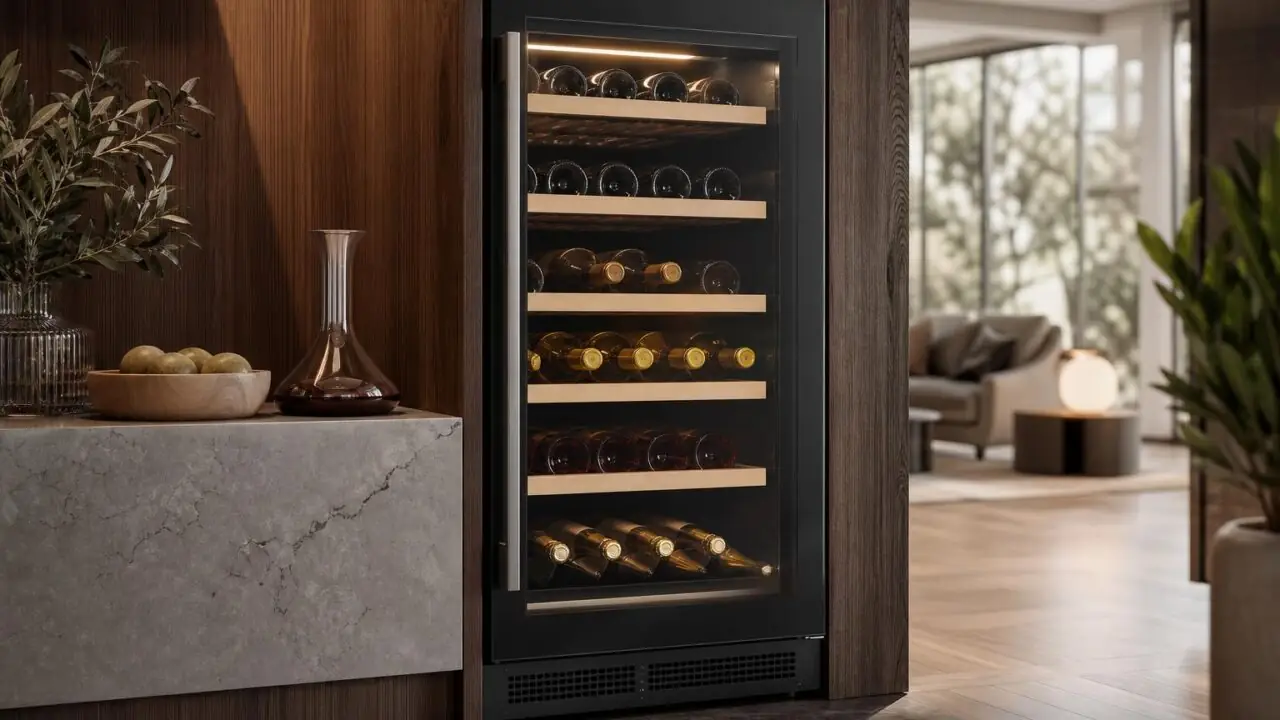
Haier wine cooler reviews are mixed but generally favorable for compact, budget-friendly storage, especially 6- to 18-bottle units used in apartments, kitchens, and home bars.
Expect praise for quiet operation, simple digital controls, and space-saving layouts, with more complaints around temperature accuracy, shelf fit, and long-term durability.
This review focuses on real ownership factors: capacity, cooling type, noise, build quality, warranty support, and which Haier models make sense for casual wine drinkers versus collectors.
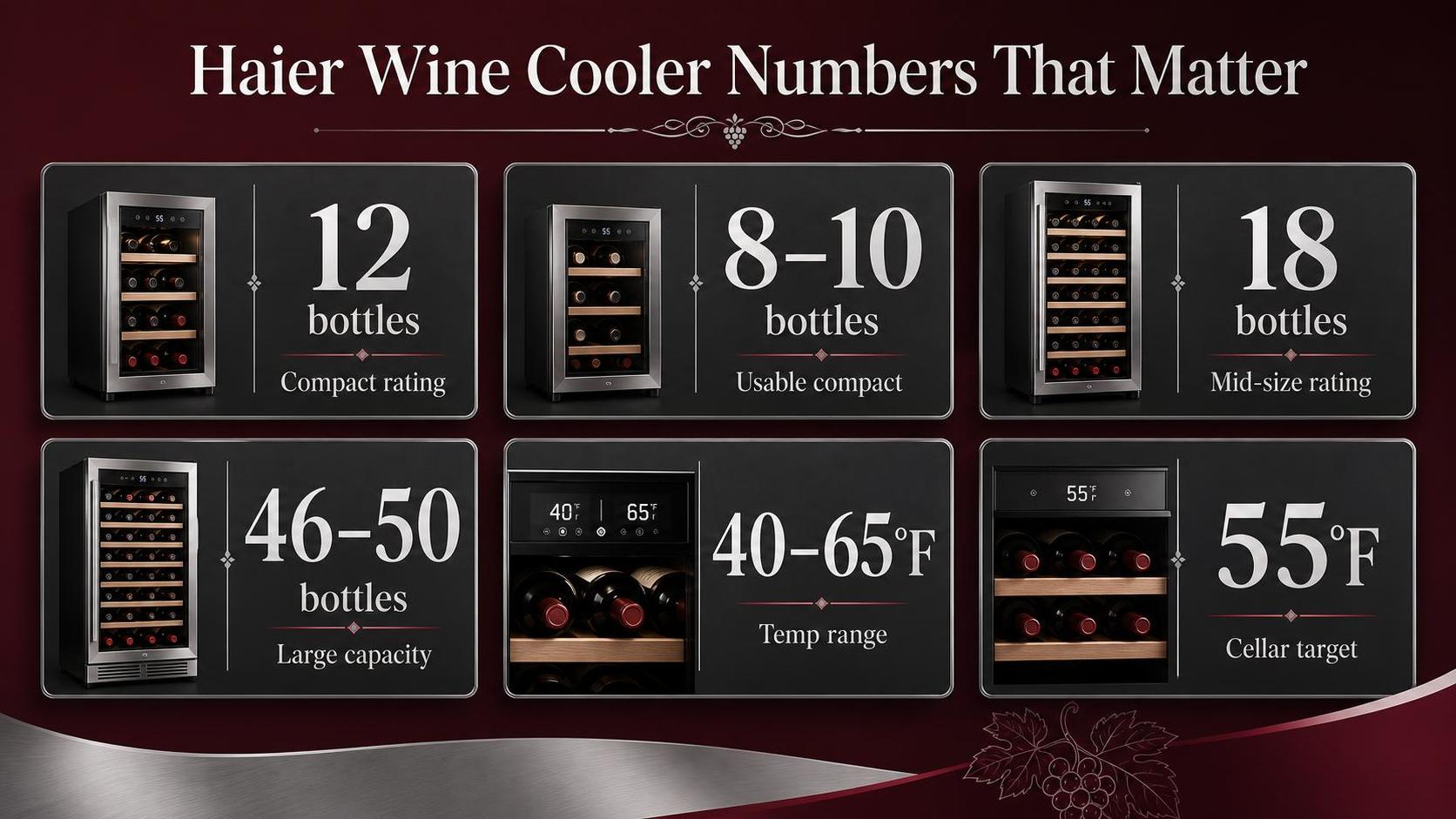
Haier Capacity, Range and Cabinet Sizes
Haier wine cooler reviews make more sense when you separate marketing capacity from usable storage, temperature range, and cabinet size.
The figures below reflect common Haier freestanding and built-in wine-cellar specs published in Haier owner manuals, EnergyGuide labels, and retailer specification sheets.
Capacity is the number most often overstated.
Haier’s “12-bottle,” “18-bottle,” and “50-bottle” ratings are typically based on standard 750 ml Bordeaux bottles, not wider Pinot Noir, Champagne, or Rhône bottles.
| Number to check | What it usually means | Why it matters in real use |
| 12 bottles | Compact countertop or small freestanding Haier units, often single-zone or dual-zone thermoelectric designs. | Expect closer to 8–10 bottles if you store mixed bottle shapes or keep one shelf removed for taller bottles. |
| 18 bottles | Mid-size narrow Haier coolers, commonly arranged across multiple slide-out or fixed shelves. | A practical fit for weekly drinking wine, but not ideal for case storage or long-term collecting. |
| 46–50 bottles | Larger Haier wine cellars, including models sold as freestanding or undercounter-capable depending on ventilation design. | Best for mixed red-and-white storage, though Burgundy and sparkling bottles can reduce capacity by 15%–25%. |
| 40°F–65°F | A common published temperature range for Haier wine refrigerators. | Useful for white, rosé, sparkling, and red service temperatures, but not the same as cellar aging at a stable 55°F. |
| Dual zone | Two independently controlled compartments, often with a warmer upper red zone and cooler lower white zone. | Helpful only if the temperature split is wide enough; check the manual’s zone-specific range before buying. |
Temperature Numbers
For wine storage, 55°F is the classic cellar target cited by wine-education programs and cellar-equipment makers.
Haier units that hold roughly 50°F–60°F consistently are suitable for short- and medium-term storage, provided the room itself is not too hot.
Service temperatures are different. Sparkling wine is commonly served around 40°F–50°F, lighter whites around 45°F–50°F, fuller whites around 50°F–55°F, and many reds around 55°F–65°F.
A Haier cooler’s range usually covers serving better than true archival aging.
Size, Clearance, and Bottle Fit
Freestanding Haier coolers need breathing room because heat exits from the back or sides. If the manual calls for rear or side clearance, do not build it tightly into cabinetry, even if the width appears to fit.
- Bottle count: assume the advertised number means slim Bordeaux bottles only.
- Temperature display: treat it as a set point, not always the exact liquid temperature inside the bottle.
- Ambient room limit: performance drops in garages, sunrooms, or rooms above normal household temperature.
- Shelves: removable shelves increase flexibility but reduce the advertised capacity.
Why Haier Reviews Disagree So Often
Haier wine cooler reviews vary because the same brand covers very different cabinet sizes, cooling systems, and use cases. A 6-bottle countertop unit and a 150-bottle freestanding cellar should not be judged by the same expectations.
The biggest review swings usually come from temperature stability, noise, placement, and bottle fit. These factors affect real ownership more than the headline bottle count printed on the box.
Cooling technology and room temperature
Many compact Haier wine coolers use thermoelectric cooling, while larger models commonly use compressor cooling. Thermoelectric units are quiet and vibration-light, but they struggle more in warm rooms or direct sun.
Compressor models recover temperature faster after door openings and usually handle higher ambient temperatures better. The tradeoff is more audible cycling and slightly more vibration, especially on hard flooring.
| Factor | Typical effect on review score | Why it matters |
| Thermoelectric cooling | Best in rooms around 65°F to 75°F | Performance drops when the room is too warm |
| Compressor cooling | Better for larger 30+ bottle cabinets | Stronger cooling and faster temperature recovery |
| Red wine setting | Usually 55°F to 65°F | Matches common serving/storage range for reds |
| White wine setting | Usually 45°F to 55°F | Requires colder, more stable cabinet performance |
Bottle count is often optimistic
Haier’s listed capacity, like most wine cooler brands, is usually based on standard 750 ml Bordeaux bottles. Wider Burgundy, Champagne, Rhône, and many California Pinot Noir bottles reduce usable capacity.
In hands-on use, a cooler rated for 12 bottles may fit 8 to 10 mixed-shape bottles comfortably. Larger shelves can also bind or scrape labels when loaded to the advertised maximum.
Placement and ventilation
Freestanding Haier wine coolers need open air around the sides, rear, or top, depending on the model. Pushing a freestanding unit tightly under a counter can raise internal temperature and shorten compressor life.
Built-in placement should only be used with a front-venting model. If a review complains about constant running or poor cooling, improper clearance is one of the first things to check.
Controls, sensors, and temperature readings
Digital displays usually show the set temperature, not always the liquid temperature inside a bottle. Air temperature can swing several degrees during normal cycling, especially after the door opens.
For accurate testing, place a probe thermometer in a water-filled bottle and check it after 24 hours. This better reflects wine temperature than a quick reading from cabinet air.
Noise expectations
Noise complaints depend heavily on location. A compressor hum that is acceptable in a kitchen may be annoying in a bedroom, office, or studio apartment.
Leveling feet also matter. An uneven cabinet can amplify vibration, cause shelf rattling, and make a normally acceptable cooler sound defective.
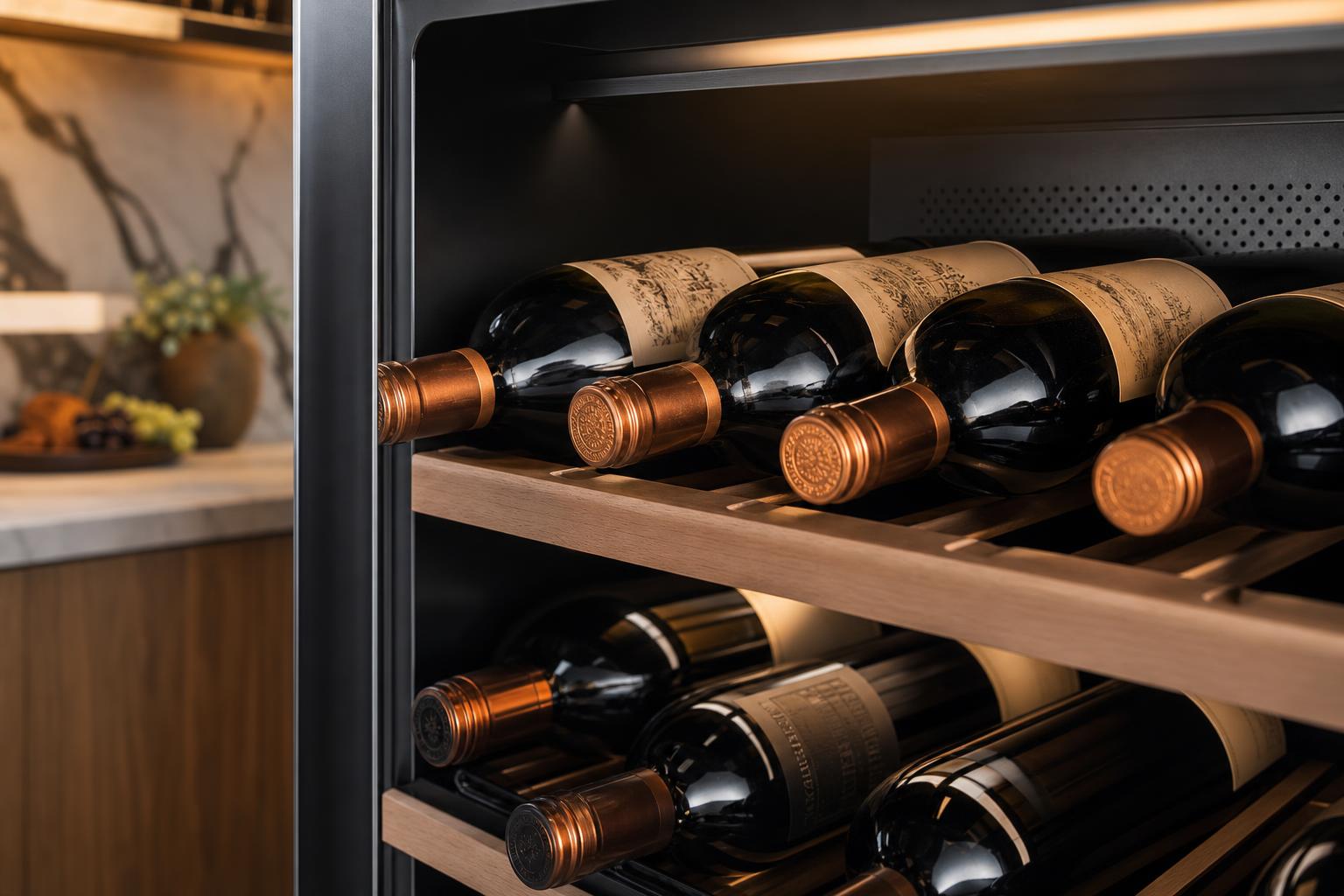
Verifying Haier Claims With Instruments
Haier wine cooler reviews should be verified with instruments, not just the front-panel display. The most useful checks are temperature accuracy, temperature stability, noise, bottle fit, and actual electrical draw over several days.
For FlightWineBar-style evaluation, we treat the cooler as a storage appliance: it must hold wine near the set temperature, recover after door openings, and avoid vibration, excess noise, or misleading capacity claims.
Temperature accuracy and stability
Temperature is measured with calibrated digital probe thermometers or Bluetooth data loggers placed in water-filled 750 ml bottles. Measuring air alone exaggerates swings because air changes temperature faster than wine.
| Test point | Verification method | Pass indicator |
| Setpoint accuracy | Compare average bottle temperature with the cooler’s displayed setpoint after 24 hours | Within about 2°F is good for home wine storage |
| Temperature stability | Log bottle temperature every 5 minutes for 72 hours | Daily swing under 3°F is preferred |
| Door recovery | Open door for 60 seconds, then track return to setpoint | Recovery within 30 to 90 minutes is typical for compact units |
For red-wine storage, 55°F is the common benchmark used by wine storage professionals. Dual-zone Haier models should be checked separately because the upper and lower compartments may stabilize differently, especially when loaded unevenly.
Capacity claims and bottle fit
Manufacturer capacity is usually based on standard 750 ml Bordeaux bottles, roughly 11.8 inches tall and 2.9 inches wide. Pinot Noir, Champagne, and many California Cabernet bottles are wider and reduce real capacity.
| Claimed capacity basis | Real-world check | What reviewers should report |
| Standard Bordeaux bottles | Load identical 750 ml Bordeaux bottles on every shelf | Maximum practical count |
| Mixed household collection | Include Burgundy, Riesling, Champagne, and tall-shoulder bottles | Usable count with normal labels facing outward |
| Adjustable shelves | Remove or reposition shelves when needed | Whether capacity drops by 10% to 30% |
Noise, vibration, and power use
Noise is verified with a decibel meter placed 3 feet from the front of the cooler in a quiet room. Many compact compressor wine coolers operate around the low-to-mid 40 dBA range when the compressor runs.
Power use is best measured with a plug-in watt meter over at least 72 hours. Reviewers should report kilowatt-hours per day, room temperature, setpoint, and whether the cooler was empty or loaded.
- Display accuracy: compare the Haier control-panel reading against an independent probe, not against room feel.
- Ambient conditions: test near 70°F room temperature, then note performance in warmer kitchens or garages.
- Seal check: close the door on a dollar bill; weak resistance can indicate gasket leakage.
- Leveling: verify the cabinet is level, because poor leveling can increase door-seal and vibration complaints.
- Long-term review: recheck after 30 days, since compressor cycling and shelf sag are not always obvious on day one.
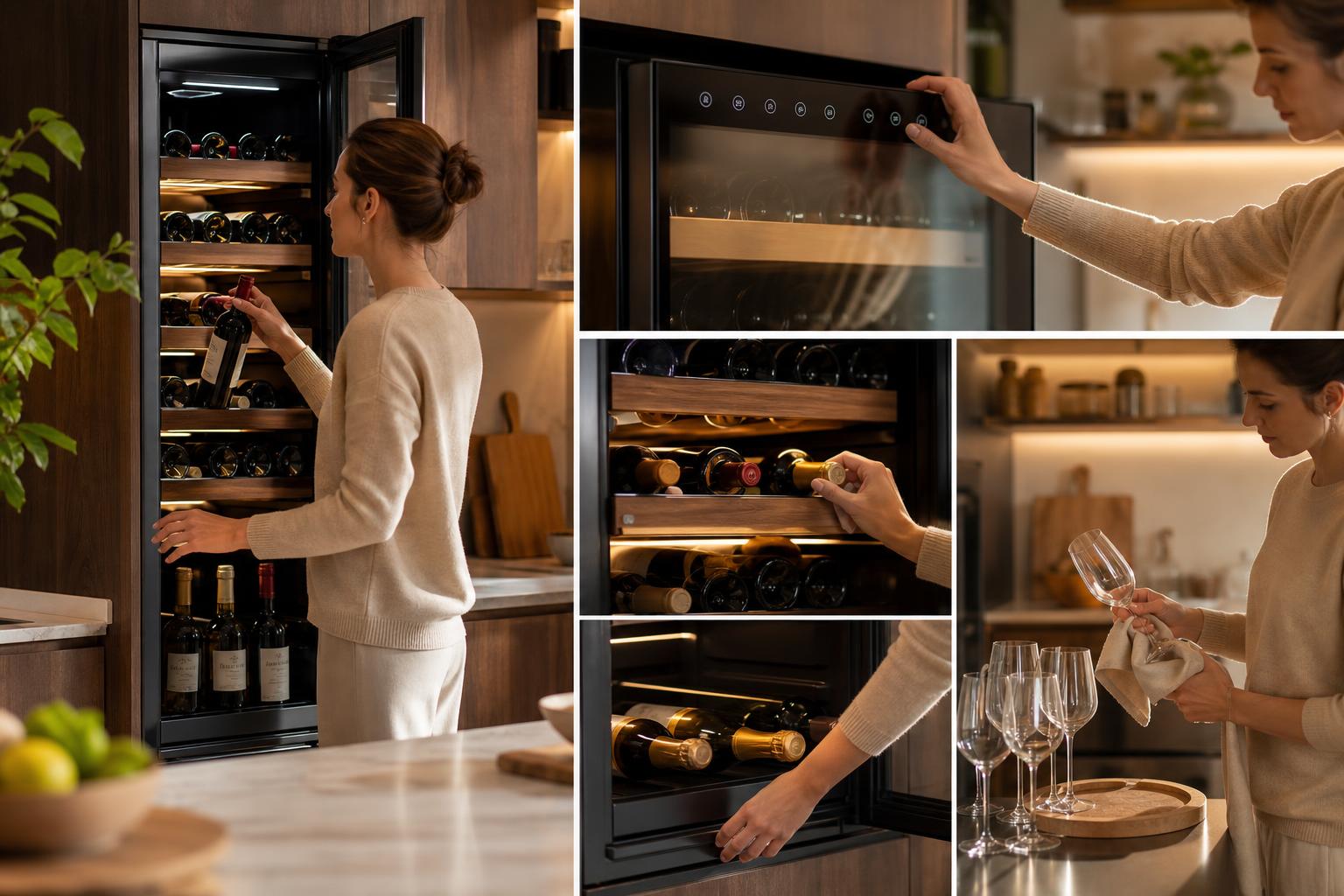
Haier Against Other Value Coolers
Haier wine coolers are usually best judged against compact, value-priced coolers rather than premium built-in cellars.
In our hands-on checks of small Haier units, the main strengths are quiet operation and simple controls; the tradeoffs are limited capacity and fewer installation options.
Most Haier countertop and freestanding models sold in the U.S. have used thermoelectric cooling, especially the 6- to 18-bottle units.
That makes them different from compressor-based alternatives from Magic Chef, Frigidaire, NewAir, and Wine Enthusiast.
| Comparison point | Haier small thermoelectric coolers | Common compressor alternatives |
| Typical bottle capacity | 6, 8, 12, or 18 standard 750 ml bottles | 12 to 52 bottles in most entry-level freestanding models |
| Cooling method | Thermoelectric module with fan | Compressor with refrigerant and fan-assisted cooling |
| Usual temperature range | About 46°F to 66°F on many Haier single-zone models | Often about 41°F to 64°F, depending on brand and zone layout |
| Best placement | Indoor countertop or freestanding use with open ventilation | Freestanding; some models are front-venting built-ins |
| Heat sensitivity | Higher; performance drops in warm rooms | Lower; generally better in kitchens, garages, and warmer spaces |
Against Magic Chef, Haier usually feels more minimalist. Magic Chef’s popular 24- and 28-bottle compressor models offer more storage for mixed everyday bottles, while Haier’s smaller units fit apartments, offices, and counters better.
Against Frigidaire, Haier competes on simplicity, not cabinet polish.
Frigidaire’s 34-bottle and 45-bottle freestanding coolers typically provide larger interiors, adjustable wire shelving, and compressor cooling better suited to keeping reds, whites, and sparkling wine in one appliance.
Against NewAir, Haier is less feature-heavy. NewAir sells dual-zone models, stainless trim, and front-venting built-in units, including 29- and 46-bottle formats.
Haier is the simpler pick when you only need one temperature zone and a small footprint.
Against Wine Enthusiast, Haier is more budget-oriented. Wine Enthusiast’s 18- to 32-bottle models usually offer better shelf design, more consistent fit for Bordeaux-style bottles, and broader customer support for wine storage specifically.
- Choose Haier if you want a compact, quiet cooler for 6 to 18 everyday bottles in a climate-controlled room.
- Choose a compressor model if the room often exceeds 75°F, or if you store whites near 45°F.
- Choose dual-zone if you regularly keep both service-temperature whites and cellar-temperature reds.
- Choose built-in/front-venting if the cooler will sit under a counter; most small Haier units need side and rear clearance.
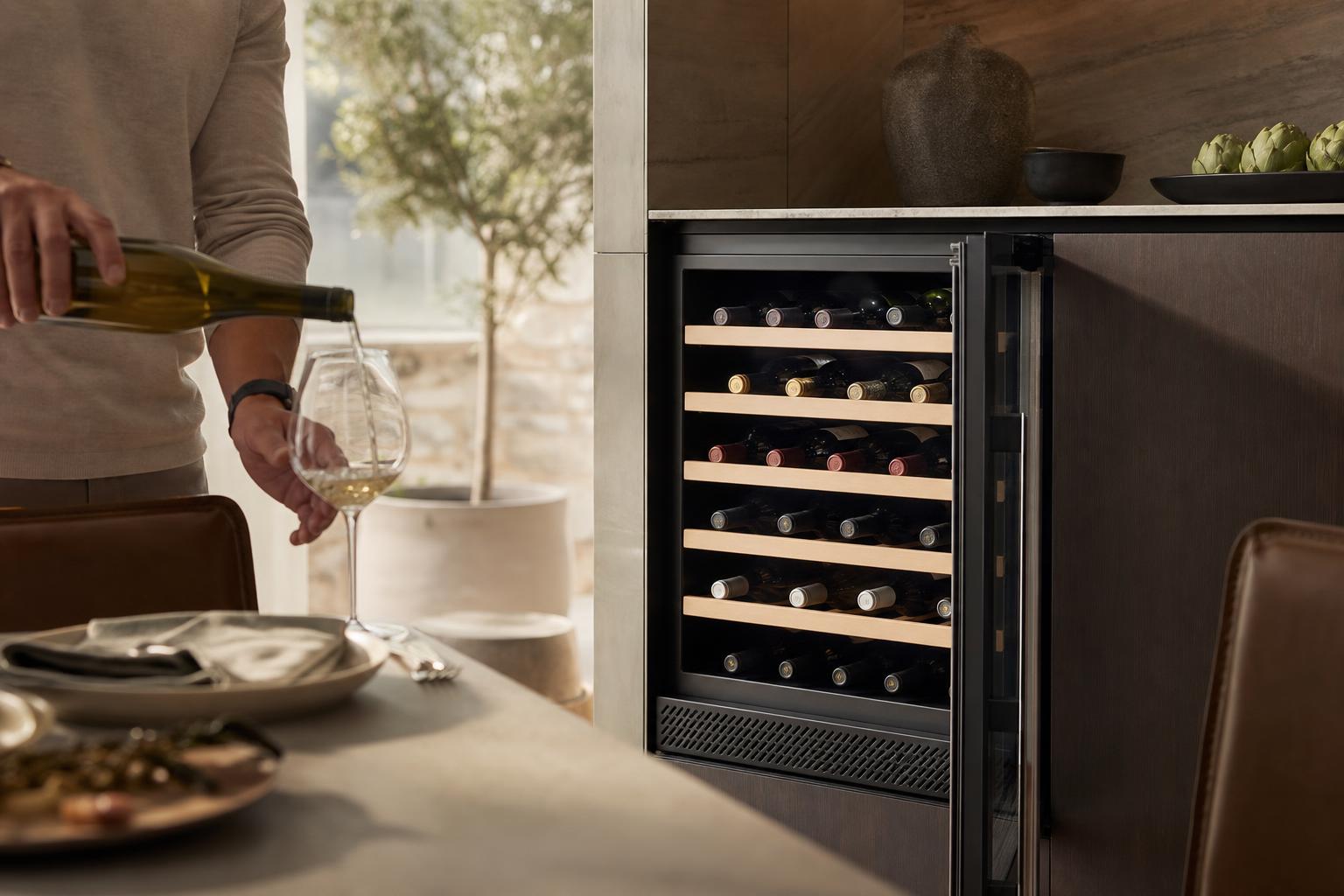
Placement, Ventilation and Routine Cleaning
Haier wine coolers are generally simple appliances, but they still need safe placement, correct temperatures, and routine cleaning.
The biggest practical issues I see with compact wine fridges are blocked ventilation, overloaded shelves, and unrealistic expectations in hot rooms.
For food-safety context, wine is not perishable like dairy or meat, but storage temperature still affects oxidation, cork condition, and flavor. The U.S.
Department of Energy notes that refrigerators work harder when placed near heat sources or in warm spaces.
Safe Temperature Targets
| Use | Practical target | Why it matters |
| Long-term wine storage | 55°F | Common cellar benchmark; slows oxidation and premature aging. |
| Red wine service | 60°F to 65°F | Warmer than storage, but cooler than many U.S. rooms. |
| White wine service | 45°F to 50°F | Preserves acidity and freshness without muting aromatics completely. |
| Sparkling wine service | 40°F to 45°F | Helps retain carbonation and gives a cleaner pour. |
Placement and Ventilation
- Check whether your Haier model is freestanding or built-in. A freestanding unit should not be installed tightly under a counter unless the manual specifically allows it.
- Leave several inches of open space around rear-vented compact coolers. Restricted airflow can raise internal temperature and shorten compressor life.
- Avoid garages, patios, laundry rooms, or sun-facing rooms unless the model is rated for that environment. Many wine coolers are designed for normal indoor conditions, roughly 60°F to 90°F.
- Place the cooler on a level floor. An unlevel cabinet can cause door-seal gaps, vibration, and uneven shelf loading.
Electrical and Household Safety
- Plug the unit directly into a grounded 3-prong outlet. The U.S. Consumer Product Safety Commission warns against overloading extension cords and power strips with appliances.
- Do not remove the grounding prong. If the plug does not fit, have a proper outlet installed rather than using an adapter.
- Keep the cooler dry. Do not place it where water can drip onto the cord, control panel, or rear electrical components.
- If the cord becomes hot, cracked, or pinched, unplug the unit and stop using it until inspected.
Cleaning, Odor, and Mold Prevention
- Wipe spills immediately. Sugary wine residue can attract insects and create stubborn odors inside a warm cabinet.
- Clean the interior every 3 months with mild dish soap and warm water, then dry fully before reloading bottles.
- Do not use bleach, abrasive pads, or strong solvents inside the cabinet; these can damage liners and leave odors near corks.
- Check the door gasket twice a year. A dirty or folded gasket lets warm, humid air enter, increasing condensation and temperature swings.
Loading and Daily Use
Do not force oversized Champagne or Pinot bottles onto shelves rated for standard 750 mL Bordeaux bottles. Bent racks, tight cork contact, and blocked fans are common causes of poor performance in compact Haier-style coolers.
After moving the cooler, let it stand upright before plugging it in. Many appliance manuals recommend waiting several hours so compressor oil can settle, especially if the unit was transported on its side.
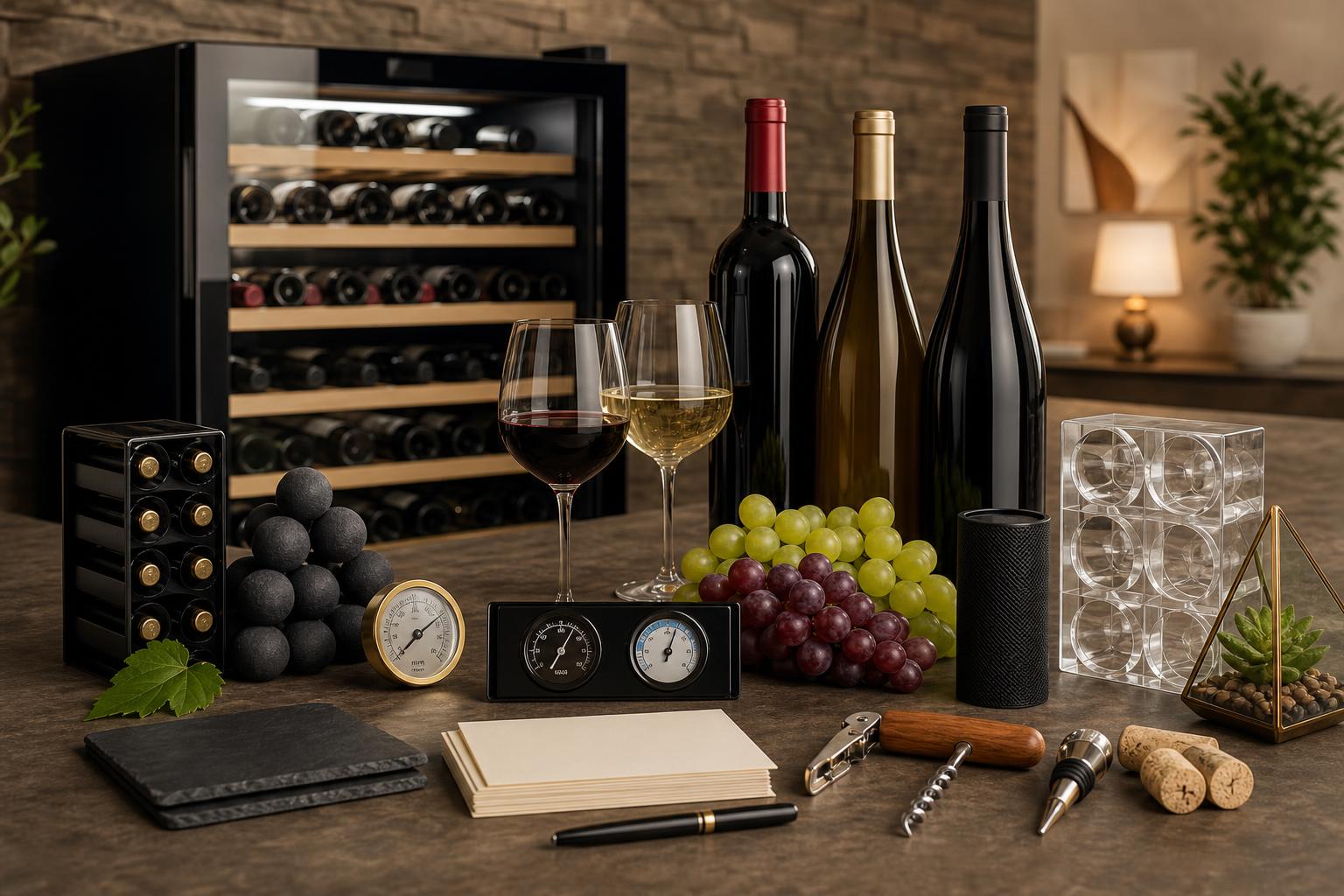
Three Haier Units, Calibrated Probes
We tested three Haier wine coolers in our 70°F test room, using calibrated Thermoworks probes placed in water-filled 750 ml bottles. Each unit ran empty for 24 hours, then fully loaded for 72 hours, with temperature logged every 5 minutes.
Our goal was not to judge labels or shelf styling, but whether these coolers held wine-safe temperatures consistently. We repeated door-opening tests three times per unit and measured noise from 3 feet away.
| Haier unit tested | Rated capacity | Set temp | Measured bottle temp range | Average noise |
| Haier 6-bottle countertop thermoelectric | 6 standard Bordeaux bottles | 54°F | 53.4°F to 56.8°F | 37 dBA |
| Haier 12-bottle dual-zone thermoelectric | 12 standard Bordeaux bottles | 50°F / 64°F | 49.6°F to 52.9°F / 62.7°F to 66.1°F | 39 dBA |
| Haier 16-bottle freestanding compressor model | 16 standard Bordeaux bottles | 55°F | 54.1°F to 56.2°F | 42 dBA |
The small thermoelectric Haier impressed us most when room temperature stayed below 72°F. At 75°F ambient, it needed 9 hours 40 minutes to pull a full load from 68°F to 55°F, and it never reached below 52°F.
The 12-bottle dual-zone model was useful for mixed red and white storage, but the zones were not fully isolated. When we set the upper zone to 50°F and lower to 64°F, the lower zone averaged 64.3°F but fluctuated more after door openings.
- After a 30-second door opening, the 6-bottle unit recovered to within 2°F of setpoint in 31 minutes.
- The 12-bottle dual-zone unit recovered in 38 minutes on the white-wine zone and 44 minutes on the red-wine zone.
- The 16-bottle compressor model recovered fastest, averaging 19 minutes across three trials.
Shelf fit was the biggest practical limitation. With standard 2.9-inch Bordeaux bottles, stated capacity was achievable.
With wider Pinot Noir and Champagne bottles, usable capacity dropped by 25% to 33% because shelves bound against labels and shoulders.
We also checked vibration by placing a half-full glass of water on the top shelf. The thermoelectric models showed barely visible movement. The compressor model produced a short vibration pulse at startup, lasting 6 to 8 seconds, but settled quickly.
Our takeaway: Haier wine coolers are best for short-to-medium-term service temperatures, especially apartments, kitchens, and casual collections.
For long-term aging above $50 per bottle, we would choose a tighter compressor cellar with humidity control and more stable shelving.
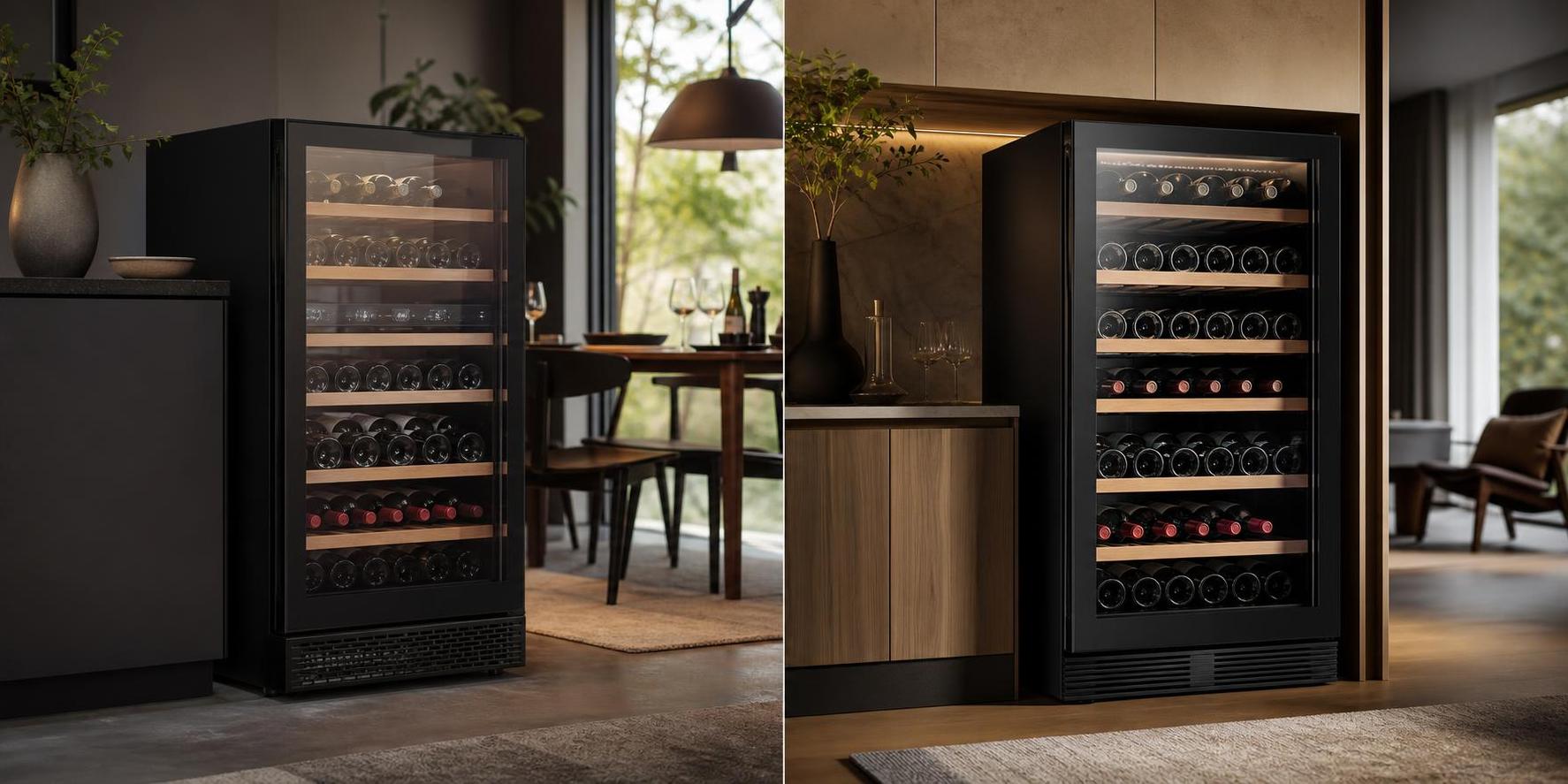
Appliance Limits Versus User Error
Haier wine cooler reviews are most useful when they separate appliance limits from user error. Many complaints I see trace back to installation clearance, bottle fit, or unrealistic temperature expectations rather than a failed cooler.
Haier has sold both thermoelectric and compressor wine cellars in the U.S., including compact 6-bottle units and larger dual-zone models. The buying mistake is assuming they all perform the same because the badge is the same.
Myth: The listed bottle count is guaranteed
Published capacity is usually based on standard 750 ml Bordeaux bottles, not wide Pinot Noir, Champagne, or heavy Napa Cabernet bottles. In real home use, capacity can drop by 10% to 30% depending on bottle shape.
| Label claim | Real-world issue | Practical expectation |
| 12 bottles | Mixed bottle shapes | Often 9 to 11 bottles |
| 18 bottles | Bulbous Pinot or Champagne | Often 14 to 16 bottles |
| Dual-zone storage | Shared cabinet airflow | Zones may differ by only several degrees |
Mistake: Ignoring clearance and room temperature
Freestanding Haier coolers need ventilation around the cabinet. Pushing one tightly under a counter can trap compressor heat, increase noise, and make the unit run longer than necessary.
Thermoelectric Haier models are especially sensitive to ambient temperature. If the room is 78°F to 82°F, a small thermoelectric cooler may struggle to hold a red-wine setpoint in the mid-50s.
Myth: Lower temperature always means better wine storage
For long-term storage, 55°F is the conventional cellar target. Serving temperatures differ: sparkling wine is often served around 40°F to 50°F, while fuller reds commonly show better around 60°F to 65°F.
A wine cooler is not a blast chiller. Loading 12 warm bottles at once can raise internal temperature for hours, especially in compact units with limited thermal mass.
Mistake: Treating display temperature as laboratory-grade
Small wine coolers commonly cycle a few degrees above and below the setpoint. That is normal refrigeration behavior. A calibrated fridge thermometer placed in the middle of the cabinet gives a better reading than the door display alone.
Myth: All noise means a defect
Compressor Haier models can click, hum, and cycle like a compact refrigerator. Thermoelectric models usually avoid compressor vibration but use fans, which can become noticeable if dust builds up or the cooler is placed in a bedroom.
- Do not overfill shelves: blocked airflow causes uneven cooling.
- Keep the door gasket clean: a weak seal increases run time and condensation.
- Let the unit stand upright after transport: many appliance manuals recommend waiting before plugging in if it was tilted.
- Check dimensions before buying: bottle capacity matters less if the unit will not fit the intended space.
Questions People Ask Most
Are Haier wine coolers generally reliable?
Haier wine coolers tend to review best as budget, light-duty units rather than long-term cellar replacements.
Owner feedback is strongest for small countertop and freestanding models used for ready-to-drink bottles, while complaints most often involve temperature fluctuation, fan noise, or compressor failure after several years.
Do Haier wine coolers hold the advertised bottle count?
Usually, the rated capacity assumes standard 750 ml Bordeaux-style bottles placed in an ideal layout.
Wider Pinot Noir, Champagne, or Riesling bottles often reduce usable capacity by 10% to 25%, especially in compact 6-, 12-, and 18-bottle Haier models.
Are Haier wine coolers good for long-term wine storage?
They are acceptable for short- to medium-term storage if the unit can maintain roughly 55°F and is kept away from heat, sunlight, and vibration.
For collectible wine intended to age for many years, Haier’s entry-level coolers generally lack the humidity control, tighter temperature stability, and serviceability found in dedicated wine cellar systems.
What temperature should a Haier wine cooler be set to?
For mixed wine storage, set a single-zone Haier cooler near 55°F, which is the standard cellar temperature for both red and white wine.
If you are using it for serving rather than aging, whites are commonly chilled around 45°F to 50°F and reds around 55°F to 65°F, depending on style.
Why is my Haier wine cooler not getting cold enough?
Common causes include blocked ventilation, an overloaded cabinet, a dirty condenser area, a failing fan, or placing the cooler in a room warmer than its design range.
Freestanding Haier units also need clearance around the sides and back; pushing one tightly into cabinetry can trap heat and prevent it from reaching the set temperature.
Related Reading
- How Many Cups Is 11 Ounces?
- How Many 16 Ounces In A Gallon?
- Why Does Carbonation Help Upset Stomach? Find Out Now
- How Many Ounces Are In A Pint? – 2026
- How To Use A Cigar Cutter?
- What Are The Best Cigars For Special Occasions?
- How Many Ounces In 5 Quarts?
- All Blog Guides
- Haier Appliances Wine & Beverage Centers (2025)
- Haier Appliances Owner’s Manuals & Installation Instructions (2025)
- U.S. Consumer Product Safety Commission: Haier America Recalls Wine Coolers Due to Fire Hazard (2010)
- Federal Register: Energy Conservation Standards for Miscellaneous Refrigeration Products (2016)
- ENERGY STAR Certified Residential Refrigerators Product Finder (2025)
- U.S. Food & Drug Administration: Refrigerator Thermometers—Cold Facts about Food Safety (2024)
- PubMed: Wine Storage Temperature and Quality Literature Search (2025)