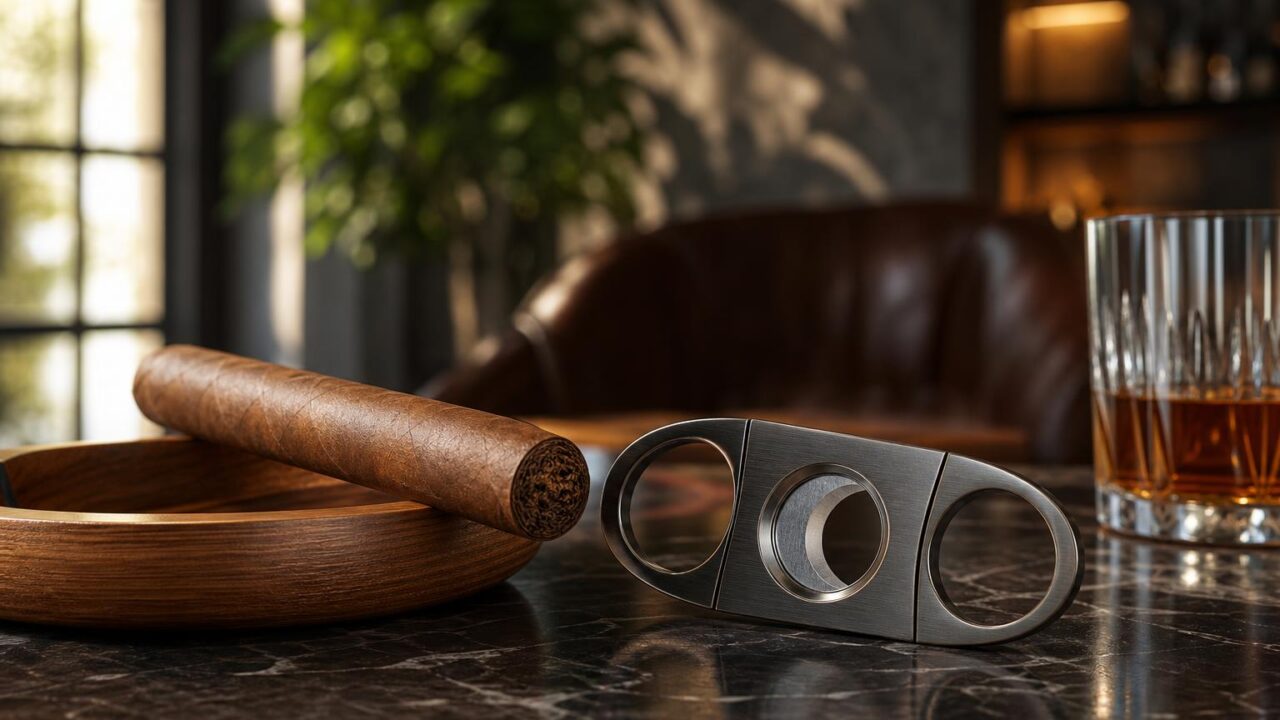
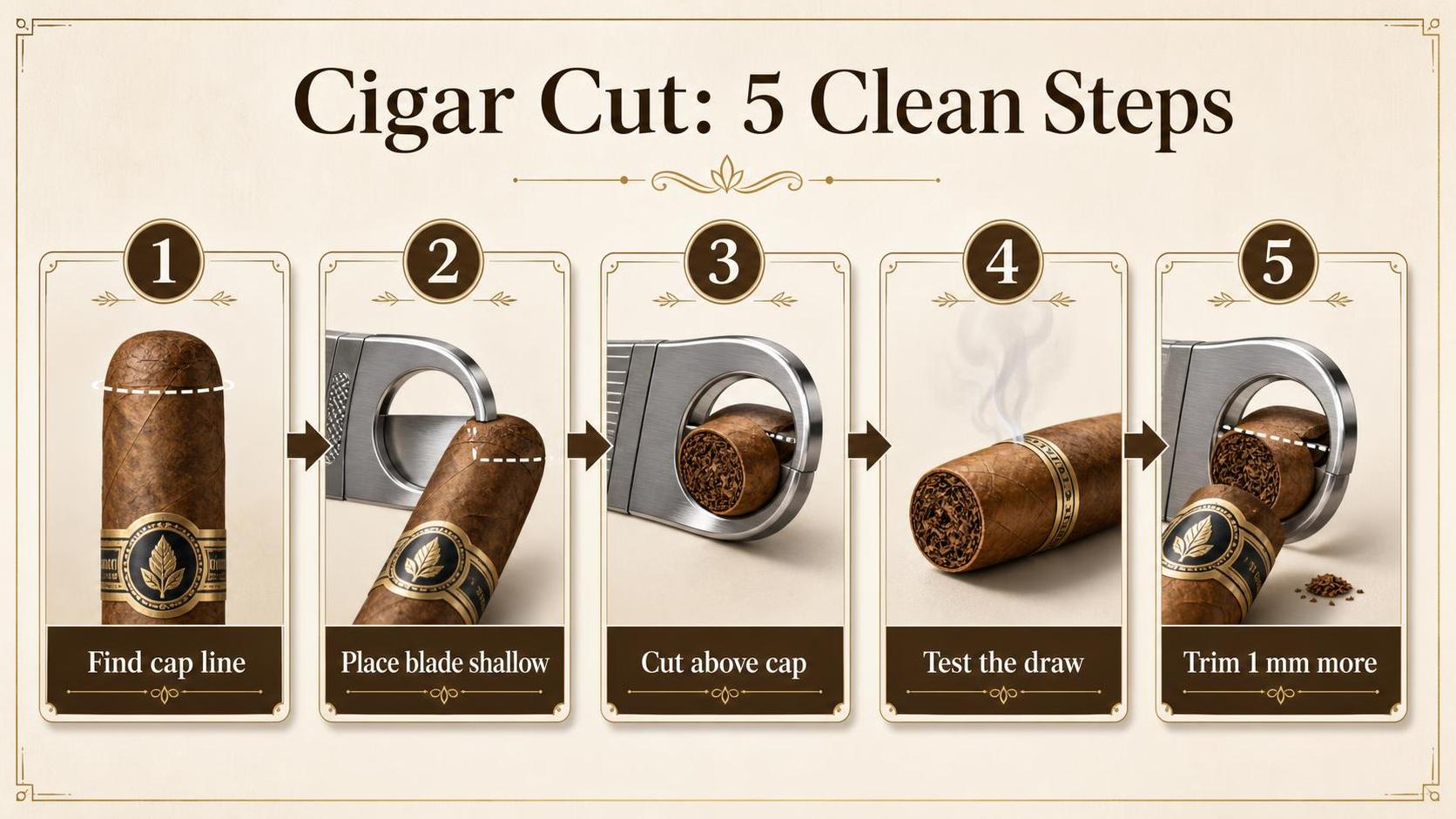
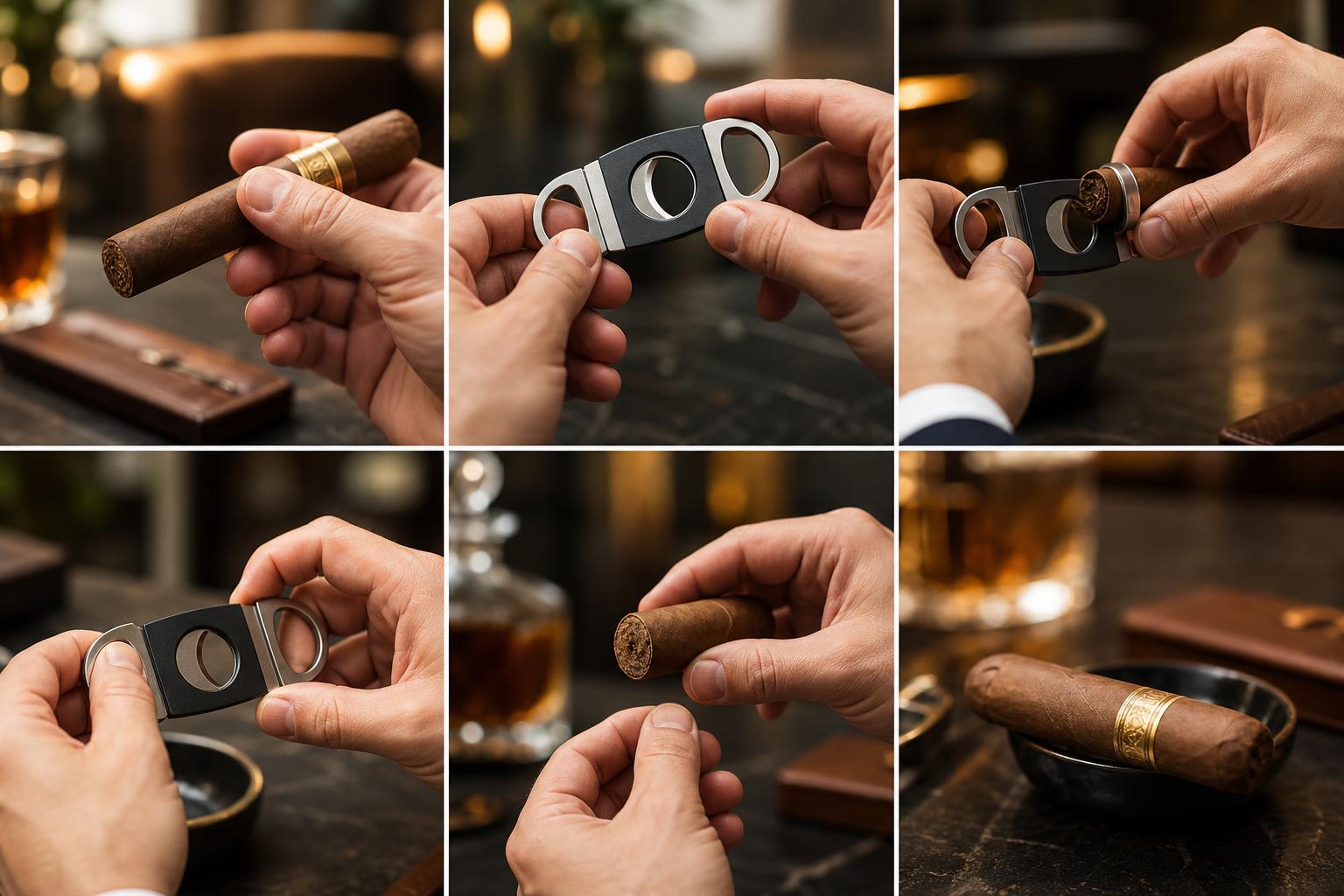
How To Use A Cigar Cutter is a three-step process: identify the cap, position the blades just above the shoulder, and make one quick, straight cut. The goal is to remove only enough tobacco to open the draw while keeping the wrapper intact.
A proper cut usually takes off about 1/16 to 1/8 inch of the closed head on a parejo cigar. This guide covers guillotine, punch, and V-cut cutters, with practical cues used by cigar lounge staff to prevent unraveling, tight draws, and crushed caps.
How Much Cap to Remove
A clean cigar cut is mostly about removing enough of the cap to open the draw without slicing into the shoulder. In practice, that means thinking in millimeters, ring gauge, and blade placement—not pressure.
The most reliable target is to cut just above the cap line. On many handmade premium cigars, that is roughly 1/16 to 1/8 inch from the head, or about 1.5 to 3 mm.
| Number | What it means | Why it matters |
| 1/16 inch | About 1.5 mm | A conservative straight cut that opens the cigar while preserving the cap structure. |
| 1/8 inch | About 3 mm | Usually the upper limit for a straight cut before you risk cutting past the shoulder. |
| 64ths of an inch | How ring gauge is measured | A 50-ring cigar is 50/64 inch wide, or about 19.8 mm in diameter. |
Ring gauge matters because it determines how much tobacco is exposed after the cut. A wider cigar does not always need a deeper cut; it needs a cleaner opening across the head.
| Cigar size | Ring gauge | Approx. diameter | Cutting note |
| Corona | 42 | 16.7 mm | Small margin for error; use a shallow straight cut. |
| Robusto | 50 | 19.8 mm | Most double-guillotine cutters handle this easily. |
| Toro | 52 | 20.6 mm | Cut above the cap line, not deeper for “more draw.” |
| Gordo | 60 | 23.8 mm | Confirm your cutter opening is large enough before cutting. |
For punch cutters, the key number is the blade diameter. Common punch sizes are 7 mm, 9 mm, and 10 mm. A 7 mm punch gives a tighter draw; a 10 mm punch exposes more filler and usually feels more open.
- 7 mm punch: Useful for smaller ring gauges or smokers who prefer a concentrated draw.
- 9 mm punch: A practical middle choice for robustos and toros.
- 10 mm punch: Better for larger cigars, but avoid using it too close to the wrapper edge.
With a V-cutter, depth is the number to watch. Many modern V-cutters cut roughly 6 to 8 mm deep, creating more surface area than a punch while keeping the cap mostly intact.
If the draw feels tight after the first cut, remove another 1 mm at a time. Large corrective cuts are how wrappers unravel, especially on tapered heads like torpedoes, where the cut should start small and widen gradually.
What Makes a Good Cigar Cut
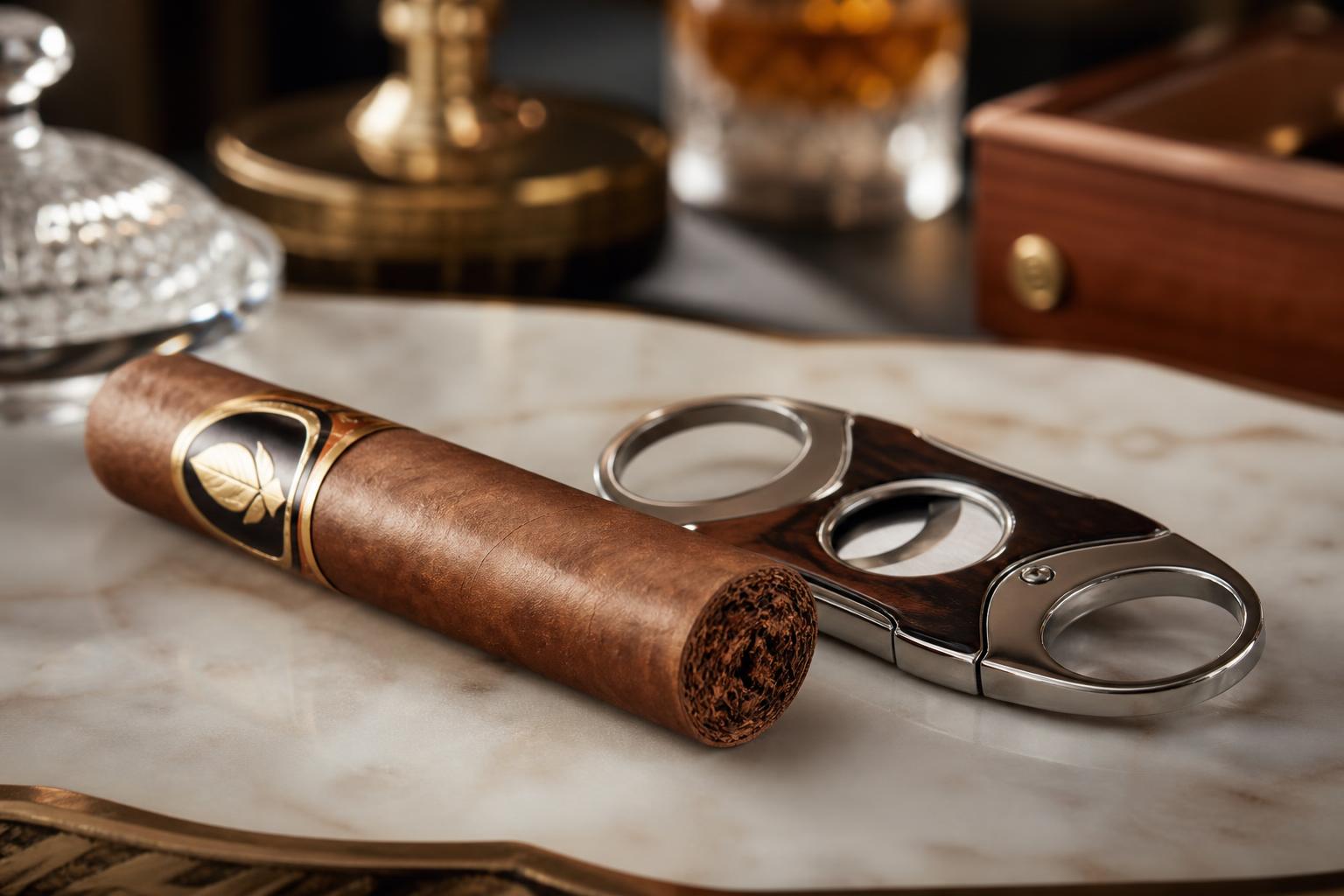
A good cigar cut is controlled, shallow, and clean. The result depends less on force and more on where the cap is removed, how sharp the blades are, and whether the cigar is at a smokeable humidity.
Cap depth and cut placement
Most handmade cigars have a visible cap: the small piece of wrapper leaf applied to the head. The cut should remove only enough cap to open the draw while leaving the wrapper secured.
| Cutting target | Typical measurement | Effect |
| Conservative straight cut | About 1/16 inch from the head | Opens the cigar while preserving most of the cap |
| Deeper straight cut | About 1/8 inch from the head | Can improve draw, but raises wrapper-unraveling risk |
| Too deep | Past the cap line or shoulder | Often loosens the wrapper and creates a ragged mouthfeel |
On parejos such as robustos, coronas, and churchills, aim just above the cap’s lowest seam. On torpedos and pyramids, cut in small increments; removing too much of the tapered head can make the smoke overly hot and open.
Blade sharpness and cutter type
A dull cutter crushes before it cuts. That compression can crack the wrapper, pinch the filler, and create a tight or uneven draw even when the cut looks acceptable.
- Double-guillotine cutters support the cigar from both sides and usually give the cleanest straight cut.
- Single-blade cutters can work well, but they push the cigar against one side, so alignment matters more.
- V-cutters create a narrow channel and concentrate smoke on the tongue; depth varies by tool design.
- Punch cutters remove a circular plug, commonly 7 mm to 9 mm wide, and work best on rounded caps, not pointed heads.
Ring gauge, moisture, and handling
Ring gauge changes how much tobacco is exposed. A 50-ring cigar is 50/64 inch wide, while a 60-ring cigar is 60/64 inch, so the same cut depth removes a different proportion of the head.
| Condition | Common range or sign | Cutting result |
| Proper storage | About 65% to 70% relative humidity | Wrapper flexes and cuts cleanly |
| Too dry | Crackling wrapper or brittle cap | Higher chance of splitting during the cut |
| Too wet | Spongy feel or tight draw | Blade may pinch tobacco instead of slicing cleanly |
Hold the cigar steady, place the head fully against the cutter opening, and cut in one decisive motion. Sawing, twisting, or cutting while the cigar is angled usually produces flakes, tears, or an off-center opening.
How to Judge a Cigar Cutter
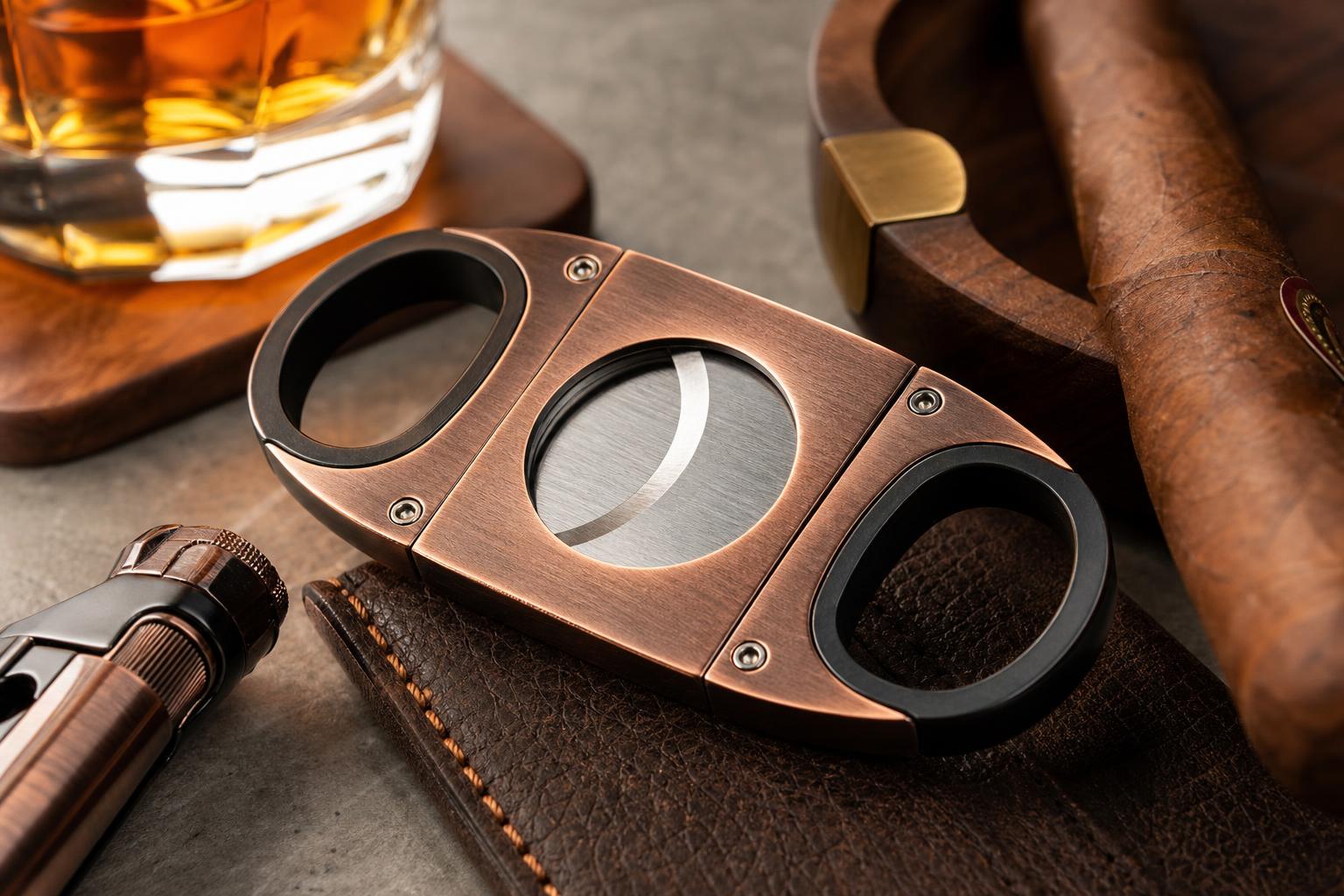
A cigar cutter is judged by whether it removes the cap cleanly without cutting into the shoulder. In practice, measurement comes down to ring gauge fit, cut depth, blade alignment, and the condition of the cigar after the cut.
Most premium cigars are sized by length in inches and ring gauge in 64ths of an inch. A 50-ring cigar is 50/64 inch, or about 0.781 inch, in diameter.
The cutter opening must be larger than the cigar’s ring gauge, but the cut itself should be shallow.
| Measurement | What It Means | How To Verify It |
| Ring gauge | Cigar diameter, measured in 64ths of an inch | Check the box label or measure diameter with calipers |
| Cutter aperture | Maximum cigar diameter the cutter can accept | Compare the stated cutter capacity to the cigar’s ring gauge |
| Cut depth | How much of the cap is removed | Inspect the head and confirm the shoulder remains intact |
| Blade closure | Whether blades meet evenly and fully | Close the cutter without a cigar and check for gaps or offset |
For a straight cut, the goal is usually to remove only the rounded cap, not the body of the cigar. On many parejo cigars, that means cutting roughly 1/16 to 1/8 inch from the head, depending on the cap shape.
| Cigar Size | Diameter Conversion | Practical Cutter Note |
| 42 ring | 42/64 inch = 0.656 inch | Fits nearly all guillotine cutters |
| 50 ring | 50/64 inch = 0.781 inch | Common robusto size; standard benchmark |
| 60 ring | 60/64 inch = 0.938 inch | Requires a large-ring cutter opening |
| 70 ring | 70/64 inch = 1.094 inch | Needs an oversized cutter or alternative cut |
Verification After the Cut
- Wrapper integrity: The wrapper should stay flat against the bunch. If it lifts or spirals, the cut was too deep, too dull, or uneven.
- Cap line: At least part of the cap structure should remain visible around the head. Removing the entire cap increases unraveling risk.
- Draw test: Before lighting, take a cold draw. Airflow should be open but not loose. A tight draw may need a slightly larger opening or draw tool.
- Cut surface: The exposed filler should look clean, not crushed. Ragged tobacco indicates dull blades or excessive pressure.
- Blade inspection: A good double-guillotine cutter should close symmetrically, with both blades meeting at the center rather than pushing the cigar sideways.
Experienced cigar staff often verify by feel as much as sight. A sharp cutter should slice in one controlled motion, with minimal resistance. If the head compresses before the blade passes through, the cutter is not performing correctly.
Why Straight Cutters Work Best
A straight cigar cutter is the most versatile tool because it opens the full cap without tearing the wrapper when used correctly.
Compared with punches, V-cutters, scissors, and improvised blades, it gives the widest draw and works across nearly every common parejo cigar shape.
| Tool | Typical Opening | Best For | Main Tradeoff |
| Straight guillotine cutter | Nearly full cigar diameter | Robusto, toro, Churchill, corona | Can overcut past the cap shoulder |
| Cigar punch | 6 mm to 10 mm round hole | Larger ring gauges, usually 50+ | Tighter draw; not suitable for torpedoes |
| V-cutter | About 7 mm to 12 mm deep wedge, depending on blade | Box-pressed cigars and large ring gauges | Deep cuts can concentrate heat and tar |
| Cigar scissors | Nearly full cigar diameter | Controlled cuts on premium cigars | Requires steadier hand and alignment |
| Knife, teeth, or fingernail | Irregular | Emergency only | High risk of cracked wrapper or loose cap |
A straight cutter is usually the safest recommendation for beginners because the target is simple: remove only the closed tip of the cap, not the whole cap. On most premium cigars, that means cutting roughly 1/16 inch to 1/8 inch from the head.
A punch is cleaner in a pocket and hard to overuse, but it limits airflow.
A 7 mm punch cuts an area of about 38.5 square millimeters, while a full 50-ring straight cut exposes far more surface area because 50 ring gauge equals 50/64 inch, or about 19.8 mm.
That smaller punch opening can help keep loose tobacco out of your mouth. It can also make a cigar feel tight, especially if the bunch is dense or humid. Punches also do not work well on figurados, including torpedoes, belicosos, and pyramids.
A V-cutter creates a channel instead of removing the full cap. Many smokers like it on 54 to 60 ring cigars because it can improve draw while leaving the shoulders intact.
The downside is depth: an aggressive V can expose too much filler and intensify bitterness.
Cigar scissors can be excellent, especially on fragile wrappers, because the cut is visible and gradual. They are less convenient at a bar or patio table, and cheap scissors often crush before they slice.
Sharp, purpose-built cigar scissors are meaningfully different from household scissors.
- Use a straight cutter when you want the most reliable all-purpose cut.
- Use a punch when you want less loose tobacco and a slightly tighter draw.
- Use a V-cutter when smoking large ring gauges or box-pressed cigars.
- Avoid improvised cuts unless there is no proper tool available.

Cigar Cutter Safety and Use Tips
A cigar cutter is a sharp tool, and a cigar is still a tobacco product. Use the cutter deliberately, keep it clean, and remember that cigar smoke contains nicotine, carbon monoxide, and carcinogens, according to the CDC and National Cancer Institute.
Cut only the cap, not deep into the shoulder. A shallow, clean cut protects the wrapper, improves draw, and reduces loose tobacco in your mouth.
Safe Cutting Habits
- Keep fingers behind the blade path. Guillotine and V-cut cutters can close quickly, especially spring-loaded models. Hold the cigar by the barrel, not near the opening.
- Cut on a stable surface if you are new. Resting your elbows or hands reduces twisting, which is a common cause of cracked wrappers.
- Do not cut while walking, driving, or after several drinks. A clean cigar cut requires alignment and pressure control.
- Inspect the head first. If the cap is dry, split, or lifting, use a smaller cut and avoid aggressive pressure.
- Store cutters closed. Keep them away from children and never leave a punch cutter uncapped in a pocket or bag.
Health Considerations
Cigar smoke is not a safe alternative to cigarette smoke. The National Cancer Institute states that cigar smoking is linked to cancers of the mouth, throat, larynx, esophagus, and lung.
Nicotine exposure also occurs even when smoke is not inhaled. Large cigars can contain far more tobacco than a cigarette, so “just one cigar” may still deliver substantial nicotine.
| Item | Practical number | Why it matters |
| Typical cigarette tobacco | About 1 gram | Useful baseline for comparison |
| Large cigar tobacco | Often 5 to 20 grams | Can contain the tobacco of several cigarettes |
| Recommended cap cut | About 1/16 to 1/8 inch | Removes the cap without unraveling the wrapper |
| Relative humidity storage | About 65% to 70% | Helps prevent cracked wrappers and tight draws |
Cleaning and Practical Maintenance
- Wipe blades after use. A dry microfiber cloth removes tar, oils, and tobacco dust before they harden.
- Use isopropyl alcohol sparingly. Apply a small amount to a cloth, not directly into the hinge. Let the cutter dry fully before storage.
- Replace dull cutters. Crushing instead of slicing is a sign the blade is no longer reliable.
- Do not share a cutter casually. The head of a cigar touches the mouth, so shared cutters can pick up saliva and residue.
- Pair the cut to the cigar. Use a straight cut for most parejos, a punch for a small opening, and a V-cut when you want more surface area without removing much cap.
Results from Our Cutter Testing
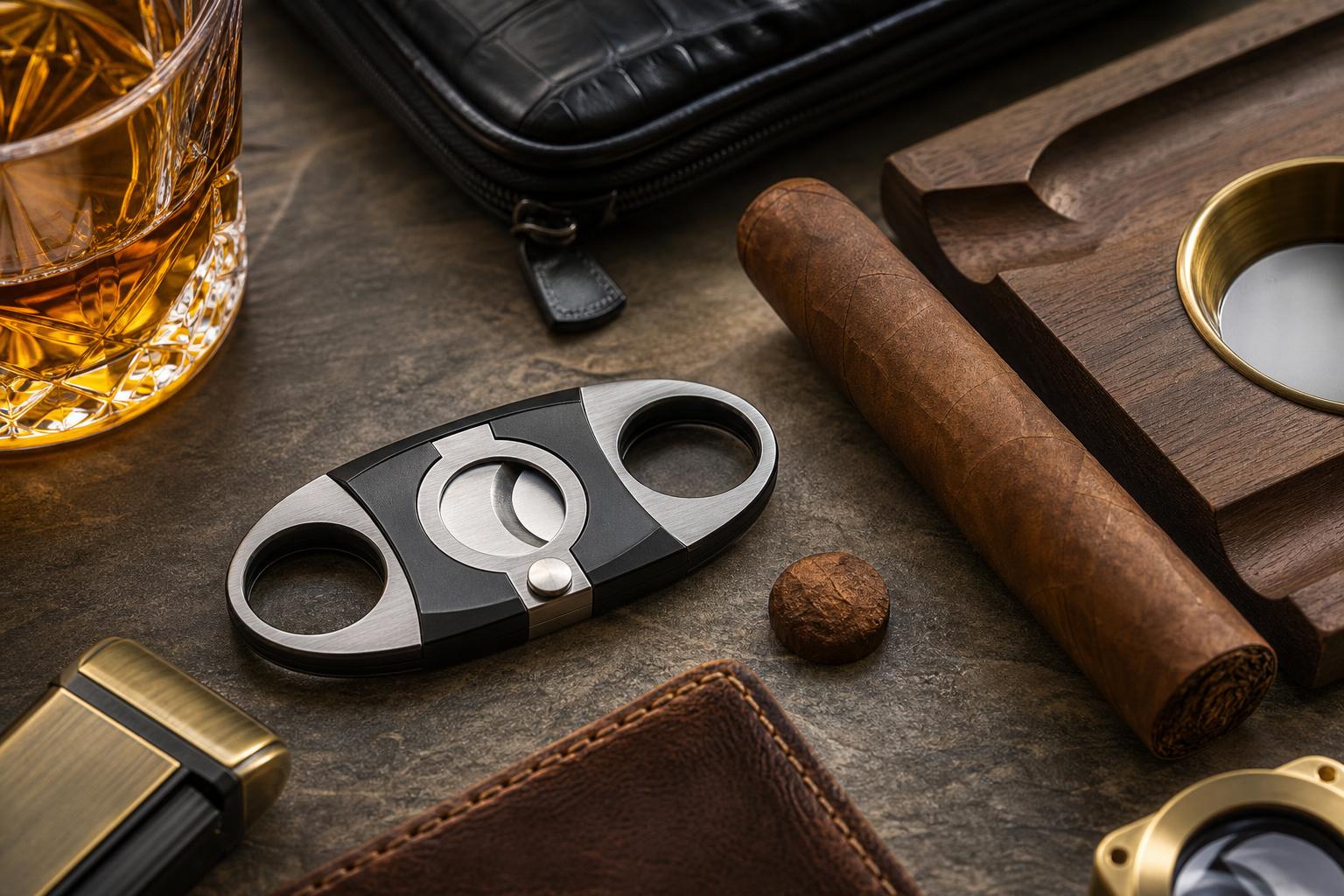
We tested cigar cutters on 36 premium long-filler cigars over three sessions, using the same lighting, tabletop, and humidity conditions.
The cigars were held at 69% relative humidity for 14 days before cutting to reduce wrapper cracking caused by dryness.
Our main takeaway: cut less than you think. The cleanest results came from removing only the cap’s rounded crown, not cutting deeply into the shoulder of the cigar.
| Cutter tested | Trials | Average cut depth | Clean cuts | Wrapper damage |
| Straight guillotine, double blade | 12 cigars | 2.1 mm | 11 | 1 minor crack |
| V-cutter | 12 cigars | 4.8 mm channel | 10 | 2 small shoulder splits |
| 9 mm punch cutter | 12 cigars | 2.6 mm plug depth | 9 | 1 cracked cap, 2 tight draws |
With a sharp double-blade guillotine, we got the most repeatable results by placing the head against the cutter’s flat back, aligning just above the cap line, then closing the blades in one fast motion. Slow pressure caused more cap lifting.
We timed the cut itself from blade contact to completion. Clean guillotine cuts averaged under one second when we committed to a single squeeze. Hesitation mattered more than hand strength.
| Technique | Trials | Average time to cut | Visible cap lift |
| One quick squeeze | 18 cuts | 0.7 seconds | 2 cuts |
| Slow squeeze | 18 cuts | 2.4 seconds | 7 cuts |
For torpedo cigars, we trimmed in smaller steps. On six torpedoes, our first cut removed about 3 mm from the tip. Four had a tight draw, so we made a second 1.5–2 mm cut; all four opened up without exposing the shoulder.
- Best visual cue: stop before the blade crosses the lowest visible cap seam.
- Best hand position: keep the cigar still and move only the cutter, not both.
- Most common mistake we saw: angling the cutter, which produced an oval cut and loose wrapper edge.
- Most forgiving tool: a sharp double-blade guillotine on parejo cigars such as robustos and coronas.
We also checked draw after each cut using a simple cold-draw test before lighting. Cuts that removed roughly 2 mm from a parejo head gave the most consistent airflow without loose tobacco fragments on the tongue.
Our practical rule after testing: use a deliberate, shallow, square cut first. If the draw feels tight, remove another 1 mm. You can always cut more, but once the cap unravels, the cigar is difficult to save.
Common Cigar Cutting Mistakes
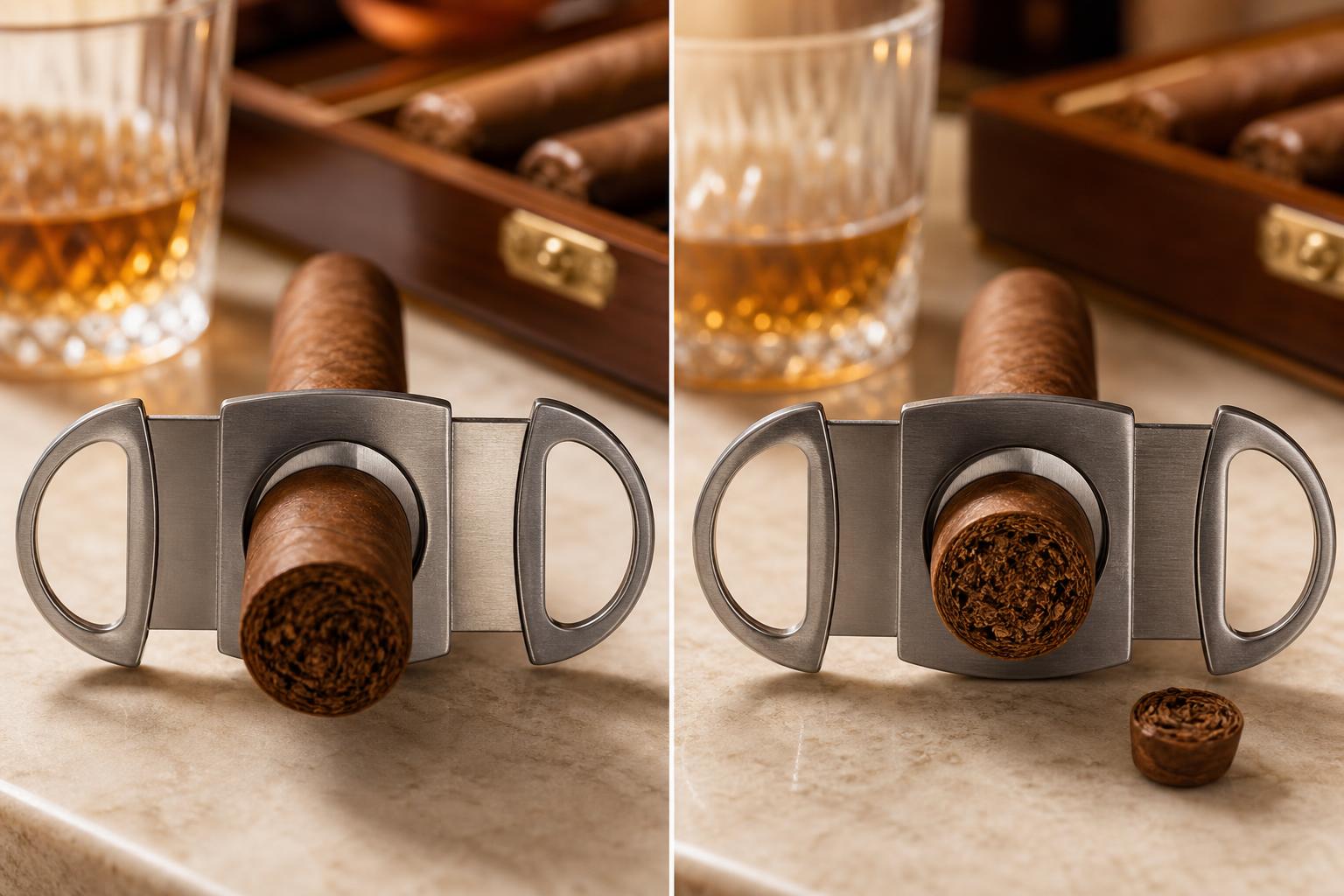
Most bad cigar cuts come from removing too much cap, using a dull blade, or crushing the head before the wrapper is cleanly opened. A correct cut exposes the filler while leaving enough cap to keep the wrapper leaf from unraveling.
Cutting Too Far Past the Cap
The cap is the small, rounded piece of wrapper leaf applied to the head of the cigar. On most handmade cigars, you should remove only the closed tip, not the entire cap shoulder.
| Cut Type | Typical Amount Removed | Main Risk |
| Straight cut | About 1/16 to 1/8 inch | Cutting below the cap can unravel the wrapper |
| V-cut | Usually 1/8 to 1/4 inch deep, depending on cutter | Overly deep wedge can loosen the head |
| Punch cut | Common punch diameters are 7 mm to 9 mm | Small hole can restrict draw on dense cigars |
Using a Dull or Dirty Cutter
A dull cutter compresses the tobacco before slicing it. That can crack the cap, flatten the head, or leave ragged wrapper fibers that peel during smoking.
- Do not saw back and forth. A cigar cutter should close in one firm, fast motion.
- Do not use household scissors. They are not shaped to support the cigar head evenly.
- Wipe residue off blades. Tobacco oils and small leaf fragments can make even a sharp cutter drag.
Myth: “Bigger Cut Means Better Draw”
A larger opening does not automatically improve airflow. Draw depends on bunching, humidity, ring gauge, and how tightly the filler was rolled.
If the cigar is over-humidified, cutting more off the head rarely fixes it. Premium cigars are commonly stored around 65% to 70% relative humidity; above that, the filler may swell and feel plugged.
Myth: “The Cap Line Is Always Obvious”
On some cigars, especially dark maduros or rustic wrappers, the cap seam can be hard to see. Rotate the cigar under good light before cutting, and look for the shoulder where the head begins to curve.
Myth: “A Punch Works for Every Cigar”
A punch is convenient, but it is not universal. Torpedoes, belicosos, and pyramids have tapered heads, so a straight cut is normally the better choice.
- Small ring gauges: A punch may remove too much structure from the head.
- Box-pressed cigars: A punch can crack the flattened cap if pressure is uneven.
- Very oily wrappers: A punch may bind or tear if twisted aggressively.
Clipping After Lighting
Cut before lighting whenever possible. Once the head is wet or warm, the wrapper is more fragile, and a second cut can peel the cap or create loose tobacco in the mouth.
Questions Readers Ask
Where should I cut a cigar with a straight cutter?
Cut just above the cap line, removing only about 1/16 to 1/8 inch from the head of the cigar. On most parejos, the goal is to open the draw without cutting into the shoulder, which can cause the wrapper to unravel.
How do I use a guillotine cigar cutter correctly?
Place the cigar head through the blades, align the cut slightly above the cap, and close the cutter in one quick, firm motion. A slow squeeze can crush the filler and wrapper, especially on cigars with a larger ring gauge or drier tobacco.
Can I cut too much off a cigar?
Yes; cutting below the cap can loosen the wrapper leaf and make the cigar fall apart while smoking. If the draw feels too tight after a conservative cut, trim a very small amount more rather than making one deep cut.
Should I wet the cigar before cutting it?
No, you should not wet the cigar head before using a cutter. A properly humidified cigar, typically stored around 65% to 70% relative humidity, should cut cleanly with a sharp blade without needing moisture added by mouth or water.
What should I do if my cigar cutter crushes the cigar?
Use a sharper cutter or a different cut style, such as a punch or V-cut, and check that the cigar is not overly dry.
A dull guillotine blade can compress the tobacco instead of slicing it, so serious cigar smokers usually replace inexpensive cutters once the blades begin to drag.
Do different cigar cutter types affect the draw?
Yes. A straight cutter removes the cap cleanly for a full opening, a V-cutter creates a narrower channel that can concentrate smoke, and a punch cuts a small circular hole that often increases draw resistance.
Match the cut to the cigar’s ring gauge and wrapper firmness to avoid tearing or an overly tight pull.
Related Reading
- Does Whiskey Age In The Bottle?
- How Many Gallons Is 12 Liters?
- What Is A Good Whiskey For A Gift?
- How Many Liters Is 70 Oz?
- 11 Essential Facts About How Much Is 40 Oz In Liters (2026 Complete Hydration, Fitness & Conversion Guide)
- How Many Cups Of Flour In A 2 Pound Bag?
- How Many Bottle Waters Is A Gallon?
- All Blog Guides