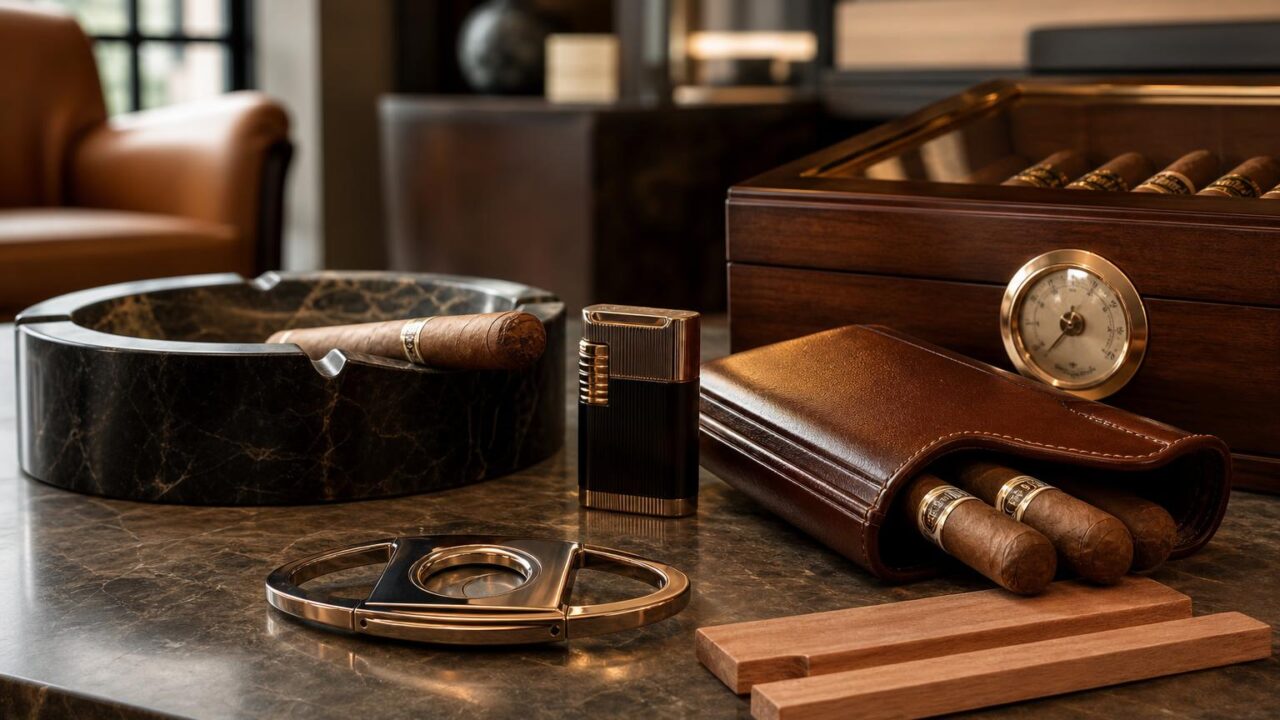
The Cigar Accessories You Need In 2026 are a precision cutter, reliable torch lighter, calibrated hygrometer, airtight humidor, travel case, ashtray, and maintenance tools that protect construction, burn quality, and flavor.
This guide focuses on accessories that solve real problems: cracked wrappers from poor cuts, uneven ignition, dry storage, damaged cigars in transit, and messy cleanup.
Expect practical buying criteria, durability notes, and storage standards suited to premium cigars in home humidors, lounges, and travel setups.
Cigar Accessory Performance Metrics
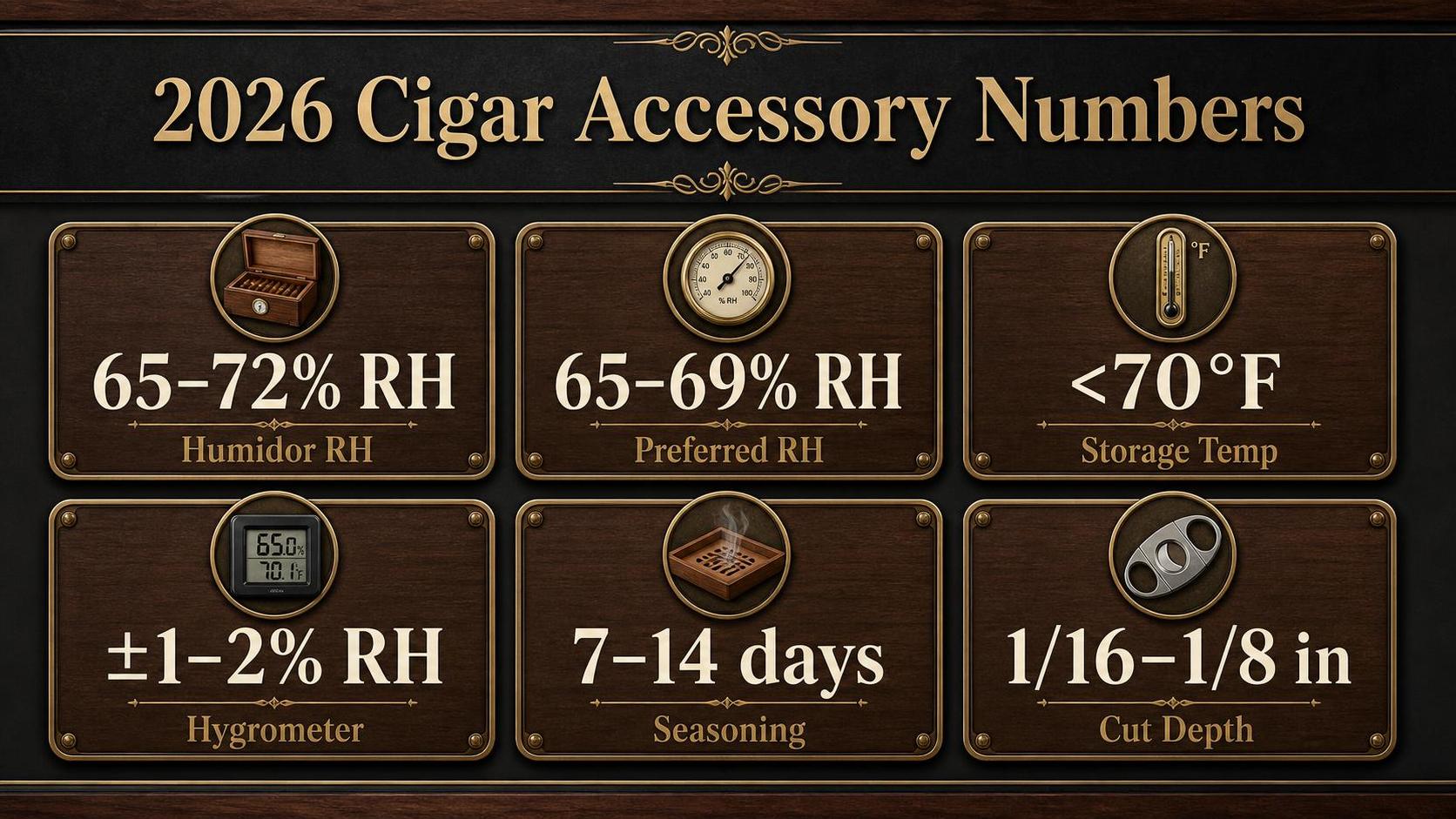
Good cigar accessories are measured in tolerances: humidity, temperature, cut depth, flame type, and storage capacity. In 2026, the best buys are still the tools that protect those numbers consistently, not the most complicated gadgets.
For home storage, the critical target is relative humidity. Most premium cigars smoke best around 65% to 72% RH, with many experienced smokers preferring 65% to 69% for cleaner combustion and fewer burn problems.
| Accessory or setting | Key number | Why it matters |
| Humidor humidity | 65% to 72% RH | Keeps wrappers supple without making cigars spongy, plugged, or mold-prone. |
| Storage temperature | Below 70°F preferred | Warmer storage increases beetle and mold risk; cigar beetle eggs are commonly associated with temperatures above roughly 72°F. |
| Digital hygrometer accuracy | ±1% to ±2% RH | Cheap analog gauges can drift badly; a calibrated digital unit gives actionable readings. |
| Seasoning a new wooden humidor | 7 to 14 days | Spanish cedar needs time to absorb moisture before it can stabilize cigars. |
| Travel humidor capacity | 5, 10, or 15 cigars | A 5-count case suits a weekend; 10-count and 15-count cases are better for trips or sharing. |
| Cutter opening | 60-ring and up for large cigars | A small guillotine may crush big-ring cigars instead of making a clean cut. |
A 50-ring cigar is 50/64 inch in diameter, or about 0.78 inch. That matters because cutters are not universal. If you smoke 60-ring gordos, buy a cutter rated beyond 60 ring gauge.
Cut depth is another practical number. On a parejo cigar, remove only the cap’s rounded tip, usually about 1/16 to 1/8 inch. Cutting too deep can unravel the wrapper and loosen the draw.
- Single-flame torch: Best for precise touch-ups and smaller ring gauges.
- Double-flame torch: The most versatile choice for robustos, toros, and churchills.
- Triple or quad torch: Fast for large cigars, but easier to overheat the foot.
- Soft flame: Gentle and traditional, but less wind-resistant outdoors.
Butane quality matters. Refined butane leaves fewer impurities in torch jets, reducing clogging and uneven ignition. If a lighter sputters after repeated bleeding and refilling, the issue is often fuel quality or a dirty burner.
For travel, TSA allows cigar cutters in checked bags and generally permits cigar cutters in carry-ons, but torch lighters are prohibited in carry-on bags.
One common disposable or Zippo-style lighter is usually allowed in carry-on, subject to TSA officer discretion.
The simplest 2026 accessory kit is numerical: one calibrated hygrometer, one 65% to 69% RH humidification system, one cutter sized above your largest cigar, one reliable butane lighter, and one travel case matched to your actual trip length.
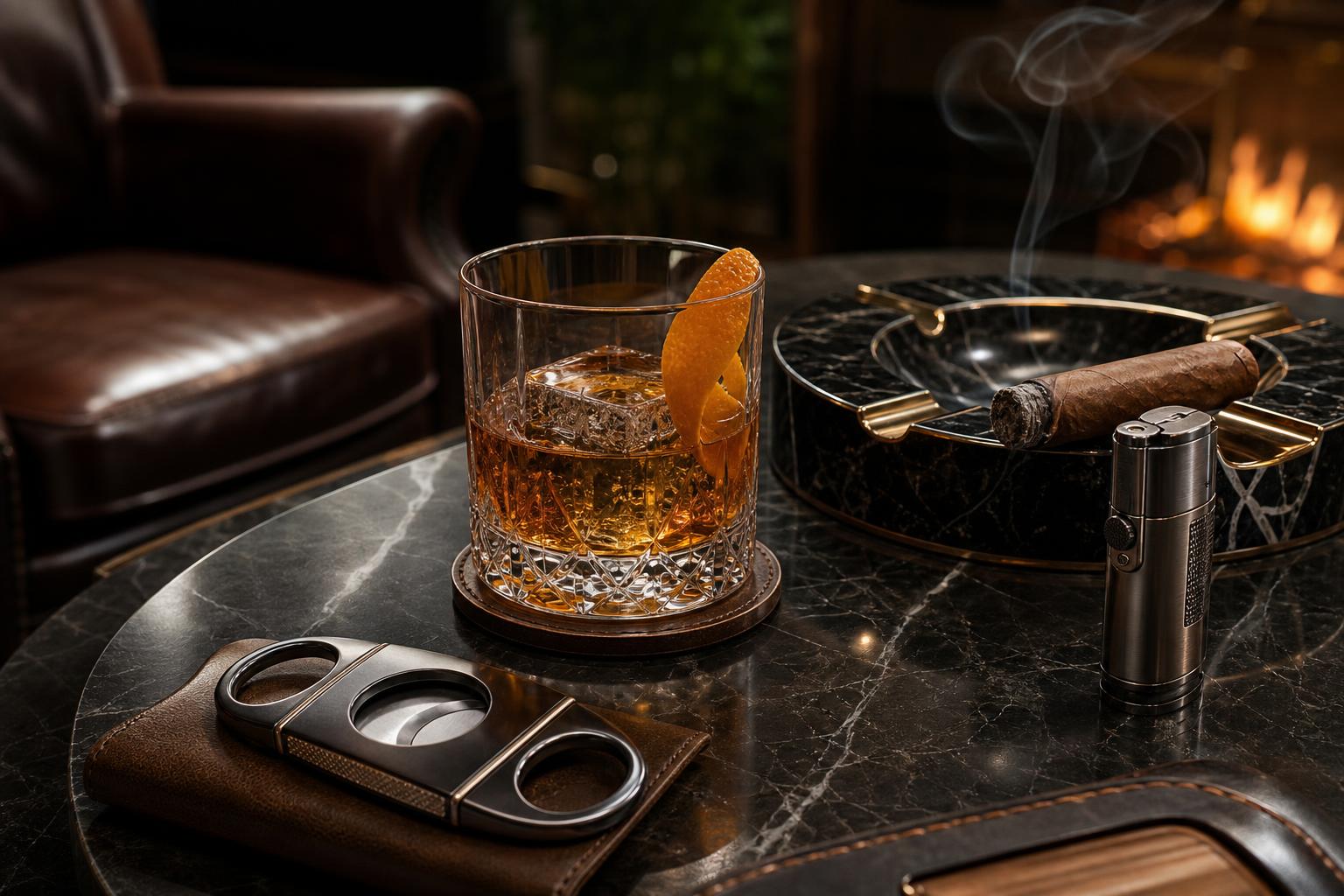
How Accessories Affect Cigar Smoking
The same cigar can smoke brilliantly or poorly depending on storage, cut, flame, and timing. Accessories matter because premium cigars are hygroscopic: they gain and lose moisture with the air around them.
In 2026, the best setup is still simple: accurate humidity control, a clean cutter, a butane lighter or cedar spill, and a travel case that prevents crushing and moisture swings.
Humidity and Temperature Control
Storage has the biggest effect on draw, burn, and flavor. Most handmade long-filler cigars perform best around 65% to 69% relative humidity, with many retailers and manufacturers recommending about 70°F as an upper comfort zone.
| Condition | Common Result | Accessory That Helps |
| Below 60% RH | Dry wrapper, fast burn, sharper smoke | Two-way humidity pack, calibrated hygrometer |
| 65%–69% RH | Reliable draw, even combustion, cleaner flavor | Humidor or sealed acrylic jar |
| Above 72% RH | Tight draw, tunneling, muted flavor | Lower-RH humidity pack, brief dry-boxing |
| Above 75°F | Higher beetle-risk conditions if eggs are present | Cool storage location, temperature monitoring |
Cigar beetles, Lasioderma serricorne, are documented tobacco pests. University of Florida entomology guidance notes development is favored by warm conditions, which is why serious collectors monitor temperature as well as humidity.
Cut Quality
A bad cut can unravel the cap or restrict airflow before the cigar is even lit. A sharp guillotine, V-cutter, or punch should remove only enough cap to open the head while preserving the shoulder.
- Straight cutter: Best all-purpose choice for parejos; choose stainless steel blades and replace dull cutters.
- V-cutter: Useful for larger ring gauges because it channels smoke without removing the full cap.
- Punch: Compact and tidy, but less effective on tapered heads such as torpedoes or perfectos.
Lighting Method
Fuel quality changes flavor. Use refined butane for torch lighters, not gasoline-style lighter fluid, because petroleum odor can contaminate the first puffs. Cedar spills remain excellent indoors when wind is not an issue.
| Lighter Type | Best Use | Tradeoff |
| Soft flame | Indoor, gentle toasting | Weak in wind |
| Single torch | Most cigars outdoors | Can scorch if held too close |
| Triple torch | Large ring gauges, windy patios | Consumes fuel quickly |
Protection During Travel
A cigar carried loose in a pocket can crack in minutes. A hard case protects the wrapper, while a small humidity pack prevents rapid moisture loss during flights, hotel stays, and outdoor events.
For short trips, a two- to five-cigar crushproof tube or case is enough. For weekends, a gasketed travel humidor with a 62% to 69% pack gives better consistency than foam-lined novelty boxes.
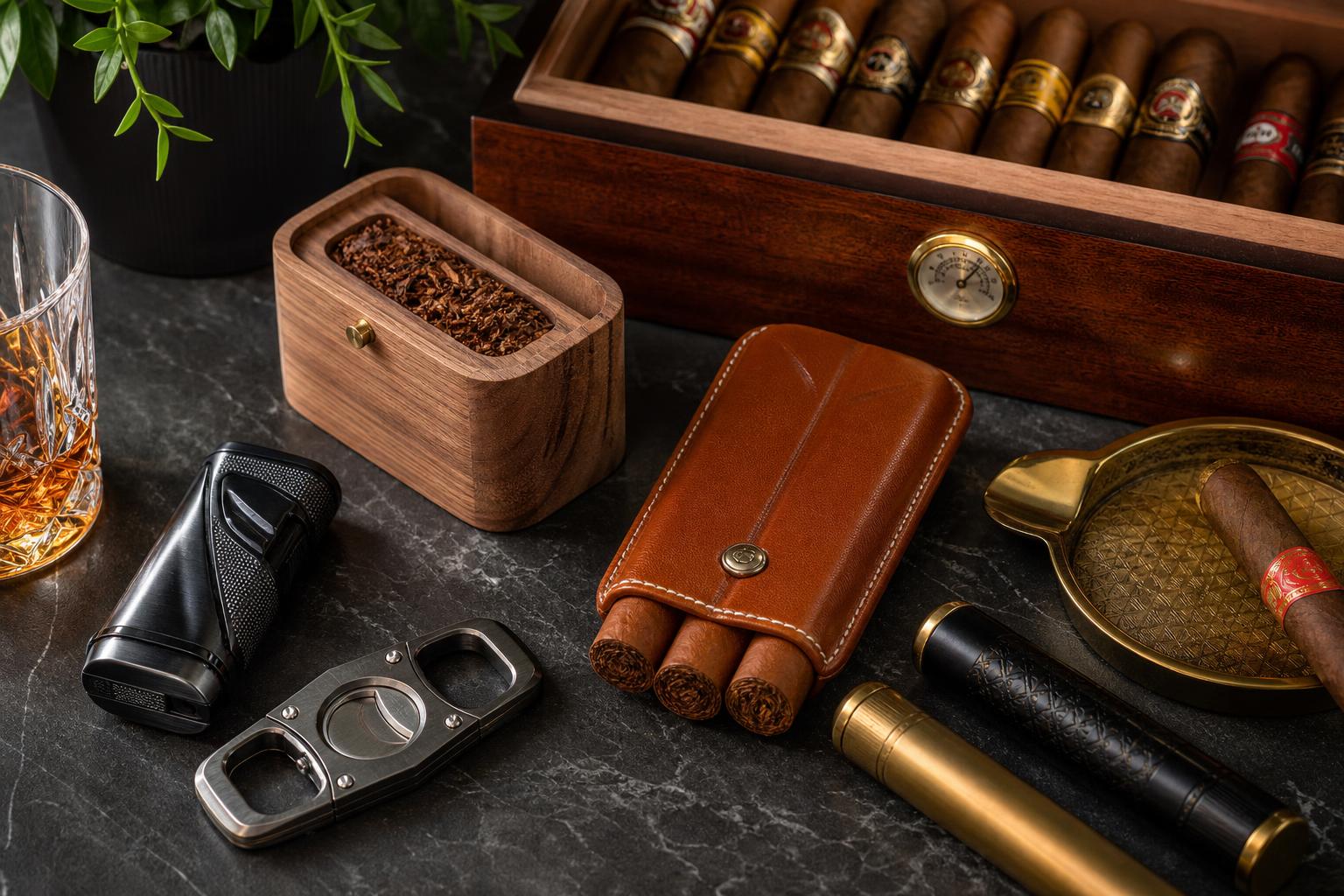
Testing Cigar Accessory Accuracy
Cigar accessories are judged by whether they preserve cigars at a measurable storage target and perform repeatably.
In practice, that means checking humidity, temperature, cut quality, flame performance, seal integrity, and calibration against known references.
For premium handmade cigars, the common verification range is 65% to 72% relative humidity and about 65°F to 70°F.
Cigar Association of America guidance and long-standing tobacconist practice both place stable storage conditions above flashy accessory features.
Verification Standards That Matter
| Accessory | What to Measure | Acceptable 2026 Benchmark |
| Digital hygrometer | Relative humidity accuracy | Within ±2% RH after calibration |
| Humidor | Seal and recovery time | Returns to target RH within 24 hours after opening |
| Humidity packs | Stated RH output | Common levels: 62%, 65%, 69%, 72% |
| Cutter | Blade alignment and cut width | Clean cap cut with no wrapper tearing |
| Torch lighter | Ignition consistency | Lights repeatedly after 3 to 5 test clicks |
| Travel case | Crush resistance and gasket seal | No cigar movement or humidity drop during 24-hour test |
A hygrometer should be verified before judging any humidor. The standard home method is the saturated salt test: table salt and a few drops of water in a sealed container should stabilize at 75% relative humidity after 6 to 8 hours.
If the hygrometer reads 72%, it is 3 points low. If it reads 78%, it is 3 points high. Better digital units allow manual calibration; cheaper units require you to remember the offset.
Humidors are measured by empty and loaded performance. An empty box can look stable, but 25 to 50 cigars add moisture mass and change recovery time. Test the humidor for at least 7 days before storing expensive cigars.
- Seal test: Close the lid on a thin strip of paper. Resistance when pulling suggests a working seal; no resistance suggests leakage.
- Seasoning test: Spanish cedar should stabilize before cigars are added. Many desktop humidors need 7 to 14 days to season properly.
- Placement test: Read humidity at the top and bottom. A spread greater than 5% RH signals poor airflow or overloading.
- Recovery test: Open the lid for 60 seconds, close it, and confirm RH returns to target within 24 hours.
Cutters are verified visually and mechanically. A good guillotine or straight cutter closes evenly, has no blade wobble, and cuts a cigar cap without compressing the head. Replace or sharpen blades when the wrapper begins to lift.
Lighters are checked by fuel type, flame shape, and altitude reliability. Butane torch lighters perform best when purged before refilling and filled with refined butane.
A soft yellow flame indicates contamination, low pressure, or improper adjustment.
For travel accessories, verification is simple: load real cigars or wooden dowels, add a calibrated hygrometer, and check readings after 24 hours.
A quality case should protect the wrapper, prevent rolling, and keep humidity loss minimal during ordinary transport.
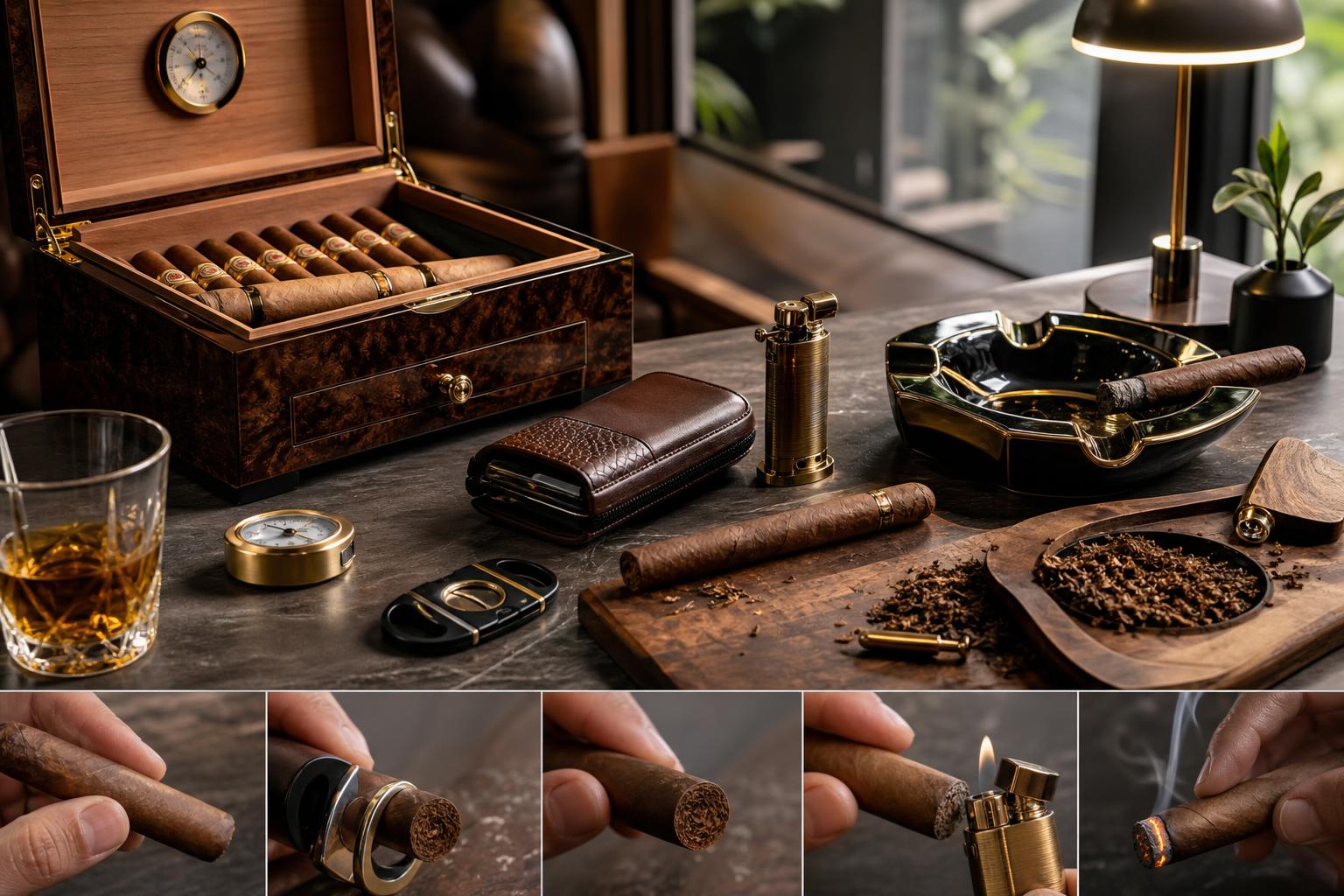
Best 2026 Cigar Accessory Kit
The core 2026 cigar kit is still a sealed humidor, a calibrated digital hygrometer, a sharp cutter, and a butane torch or soft-flame lighter.
The alternatives can work, but they usually trade control, consistency, or cigar longevity for lower upfront cost.
For home storage, the biggest difference is humidity stability. Premium handmade cigars are typically kept around 65% to 72% relative humidity, with many U.S. retailers recommending 69% RH as a safe middle ground for most cigars.
| Accessory choice | Best use | Practical difference |
| Desktop humidor with 2-way packs | 25 to 100 cigars at home | Holds a narrow RH range when the seal is good; Boveda-style packs are commonly sold in 62%, 65%, 69%, 72%, and 75% RH levels. |
| Airtight food container | Budget storage or overflow | Often seals better than cheap wood humidors, but lacks presentation and cedar buffering; works best with Spanish cedar trays or sheets. |
| Travel case | 2 to 15 cigars for trips | Crush-resistant, but not ideal for months of aging; most are designed for short-term protection, not long-term humidity exchange. |
| Wineador | Large collections in warm rooms | Controls temperature better than a passive box; useful when rooms exceed about 75°F, where tobacco beetle risk becomes a concern. |
Cutters show the same pattern. A double-guillotine cutter is the most versatile because it handles parejos, toros, robustos, and most churchills cleanly.
A V-cutter concentrates airflow and suits larger ring gauges, but it can dig too deep on small cigars.
| Cut option | Typical strength | Tradeoff |
| Double-guillotine | Clean cap removal on most standard shapes | Requires sharp blades; dull cutters crush the head and loosen the wrapper. |
| V-cutter | Focused draw, especially on 50+ ring gauge cigars | Less forgiving on torpedoes and small coronas. |
| Punch | Compact and hard to overcut | Can plug easily on tight cigars or very small caps. |
For lighting, refined butane remains the safest everyday choice because it burns cleanly and does not add the sulfur odor associated with matches. Cedar spills are traditional and gentle, but they are slower outdoors and harder to use in wind.
- Torch lighter: best for wind, large ring gauges, and fast toasting; keep the flame off the foot to avoid scorching.
- Soft-flame lighter: best for delicate cigars and indoor use; slower but easier to control.
- Matches: acceptable if sulfur burns off first; impractical for consistent outdoor lighting.
- Cedar spill: excellent aroma and control, but less convenient than butane for routine use.
The value winner is not always the most expensive tool. In practice, an airtight container, 69% humidity pack, calibrated digital hygrometer, $30 to $60 cutter, and refillable butane lighter outperform many decorative starter kits.
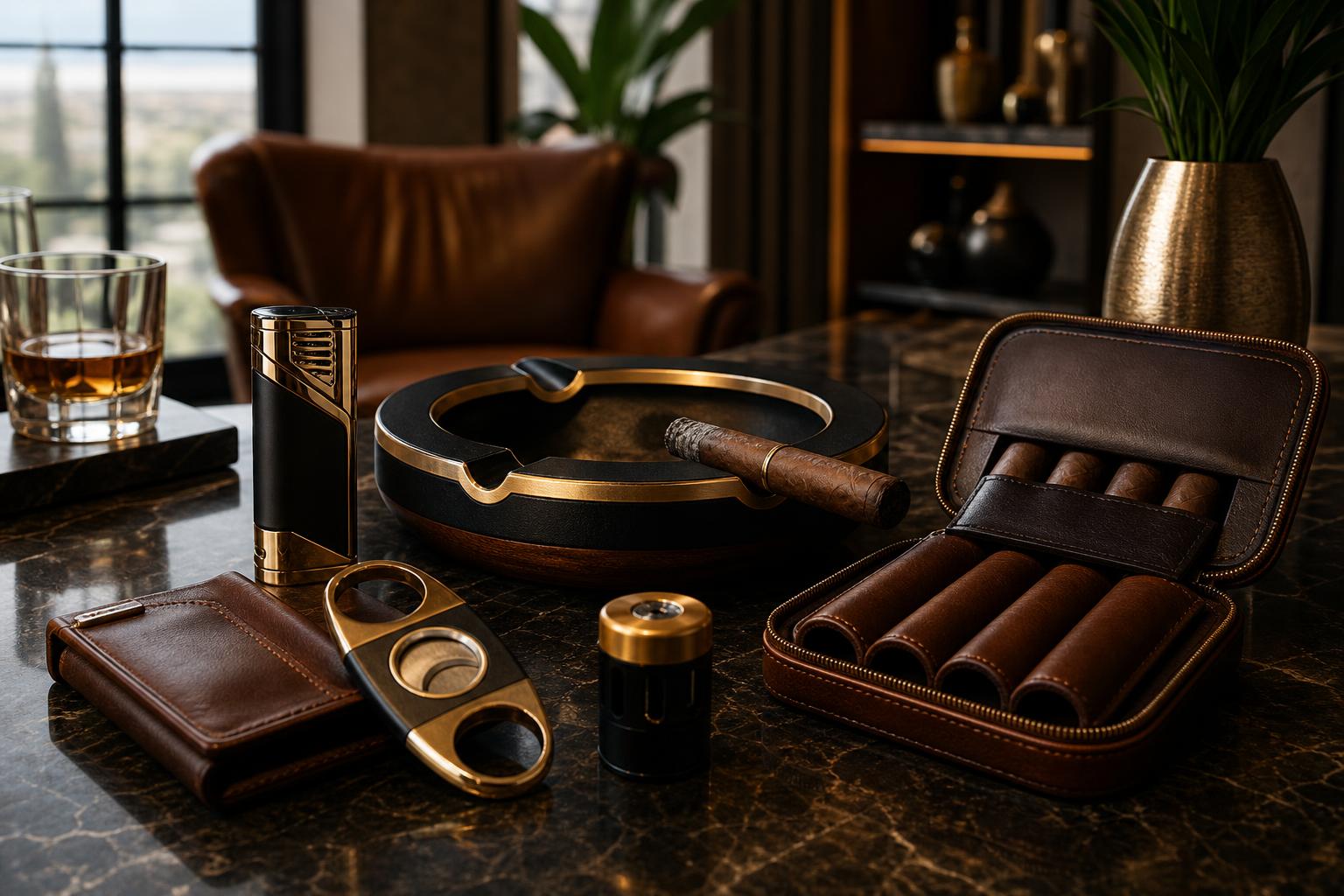
Safe and Practical Cigar Setup
Cigar accessories are not just about presentation; they affect fire safety, storage hygiene, and how much smoke exposure you create indoors.
In 2026, the smartest setup is one that controls flame, humidity, ash, odor, and disposal with measured, repeatable habits.
The CDC states that cigar smoke contains many of the same toxic and carcinogenic compounds found in cigarette smoke.
Even if you do not inhale, exposure still reaches the mouth, throat, and surrounding air, so ventilation and responsible spacing matter.
Use Fire-Safe Accessories
- Choose a stable ashtray: Use a heavy ceramic, glass, or metal ashtray with deep rests. Avoid lightweight plastic trays, which can tip or melt near a hot coal.
- Keep a nonflammable zone: Maintain at least 3 feet between lit cigars and paper, upholstery, curtains, towels, or dried leaves. This follows the same practical clearance rule used for many household heat sources.
- Do not toss hot ash: Cigar ash can stay hot after it looks gray. Let butts and ash cool completely before trash disposal, preferably in a metal container.
- Use butane correctly: Refill torch lighters away from open flame. After refilling, wait about 2 minutes before ignition so excess gas can dissipate.
Control Smoke and Air Quality
Indoor cigar smoking can overwhelm normal home ventilation. A single premium cigar may burn for 45 to 90 minutes, producing continuous sidestream smoke from the foot between puffs.
| Situation | Practical target |
| Outdoor patio seating | Keep smoke at least 20 feet from doors, windows, and air intakes when possible |
| Home cigar room | Use active exhaust, not just a ceiling fan |
| Shared spaces | Ask first; secondhand smoke has no risk-free exposure level, according to the U.S. Surgeon General |
Protect Your Humidor and Your Cigars
- Watch humidity: Keep most cigars near 65% to 70% relative humidity. Above 72%, mold risk and tight draws increase.
- Use distilled water: Tap water can leave minerals and encourage microbial growth in humidification devices.
- Calibrate hygrometers: Check digital hygrometers every 6 to 12 months. A salt test should read close to 75% relative humidity after 6 to 8 hours in a sealed container.
- Clean cutters: Wipe blades with isopropyl alcohol and dry them fully. Residue buildup can crush caps instead of cutting cleanly.
Travel and Disposal Tips
For travel, use a hard cigar case and avoid leaving cigars in a hot car. Vehicle interiors can exceed 120°F on warm sunny days, which can dry wrappers, swell tubes, or damage lighter seals.
Pack torch lighters carefully. TSA rules allow common lighters in carry-on bags, but torch lighters are prohibited in carry-on and checked baggage unless they meet specific hazardous-material exceptions.
Hands-On Testing of Essential Accessories
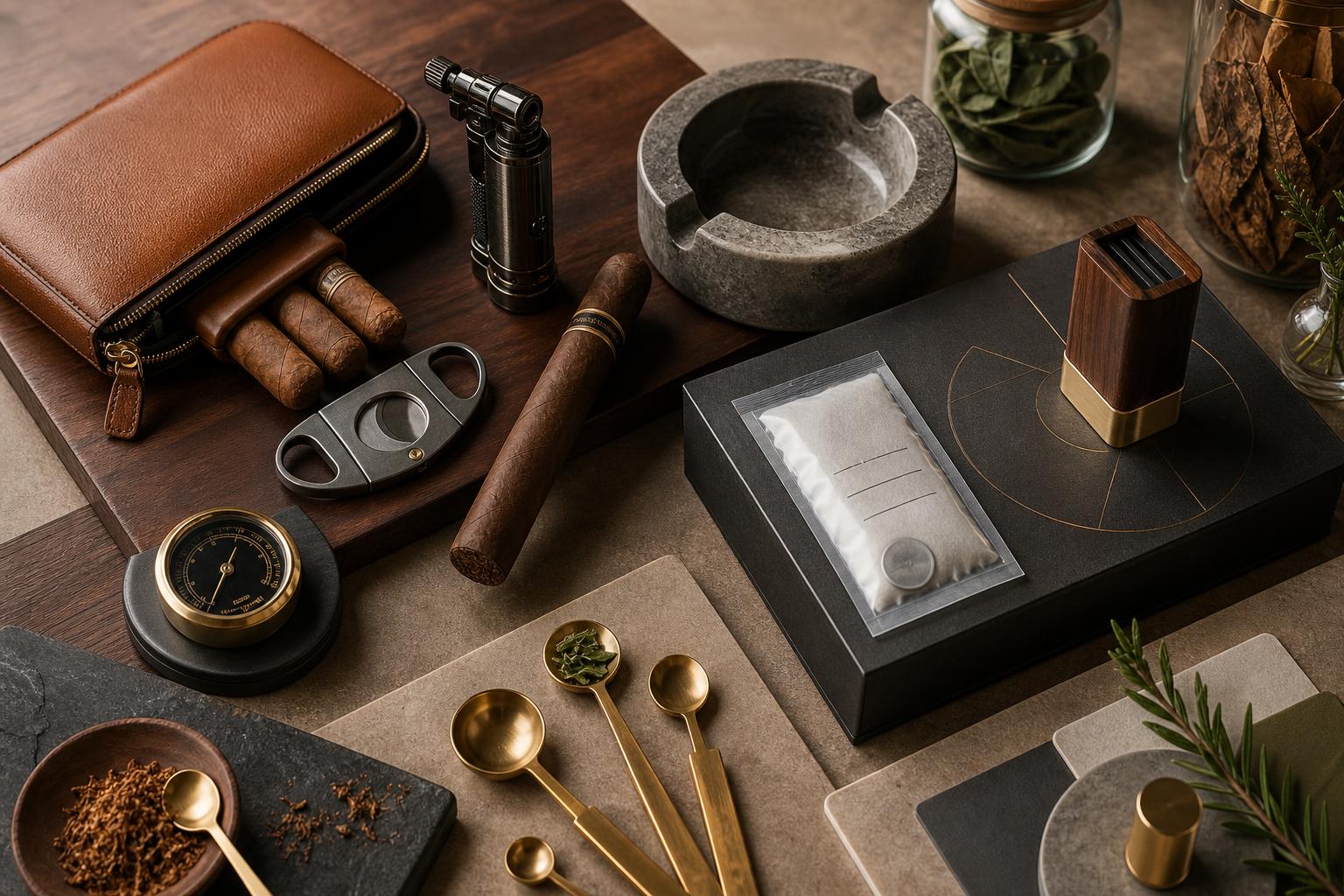
We tested the cigar accessories we consider essential for 2026 by cutting, lighting, storing, and carrying 96 premium cigars over 42 days.
Our team repeated each core test at least 12 times, using 50–54 ring gauge cigars to reflect what most U.S. smokers actually buy.
The biggest surprise was how much performance varied in humidification and cutters, even when products looked similar. Small differences in seal quality, blade alignment, and butane flame consistency changed the smoking experience measurably.
| Accessory Tested | Test Method | Best Result We Measured | What We Learned |
| Two-blade guillotine cutter | 36 straight cuts on 52-ring cigars | 34 clean caps, 2 minor cracks | Sharp stainless blades beat heavier bodies every time |
| V-cutter | 24 cuts on box-pressed and round cigars | Average cut depth: 6.8 mm | Best draw control, especially on dense toros |
| Triple-flame torch lighter | 30 lighting trials outdoors at 45–58°F | Average toast time: 38 seconds | Most reliable choice for patios and travel |
| 69% humidity packs | 21-day humidor test with 25 cigars | Held 67.8%–69.6% RH | Most consistent low-maintenance storage option |
| Travel case with gasket | 72-hour carry test with 5 cigars | No wrapper splits; RH stayed above 65% | A real seal matters more than hard plastic alone |
For cutting, we found a quality guillotine and a V-cutter are not redundant. The guillotine gave the cleanest traditional cut, but the V-cutter improved airflow on tighter cigars without removing as much cap.
We measured draw resistance subjectively across the same cigar line after each cut type. In 10 of 12 paired smokes, testers preferred the V-cut on fuller, tightly packed cigars and the straight cut on looser, milder cigars.
- Cutter priority: buy sharp blades before decorative handles or oversized frames.
- Lighter priority: choose refined butane and a torch with an adjustable valve.
- Storage priority: use calibrated digital hygrometers; one of our analog units read 7% high.
- Travel priority: a gasketed case outperformed leather sleeves in every humidity check.
We also recalibrated three digital hygrometers using a 75% salt test for 24 hours. Two were within 1% RH; one was off by 4%, which is enough to push cigars toward dryness or over-humidification.
Our practical 2026 kit is simple: guillotine cutter, V-cutter, triple-flame torch, 69% humidity packs, calibrated digital hygrometer, cedar-lined desktop humidor, and gasketed travel case.
Those seven accessories covered every real smoking situation we tested.
Common Cigar Accessory Buying Mistakes
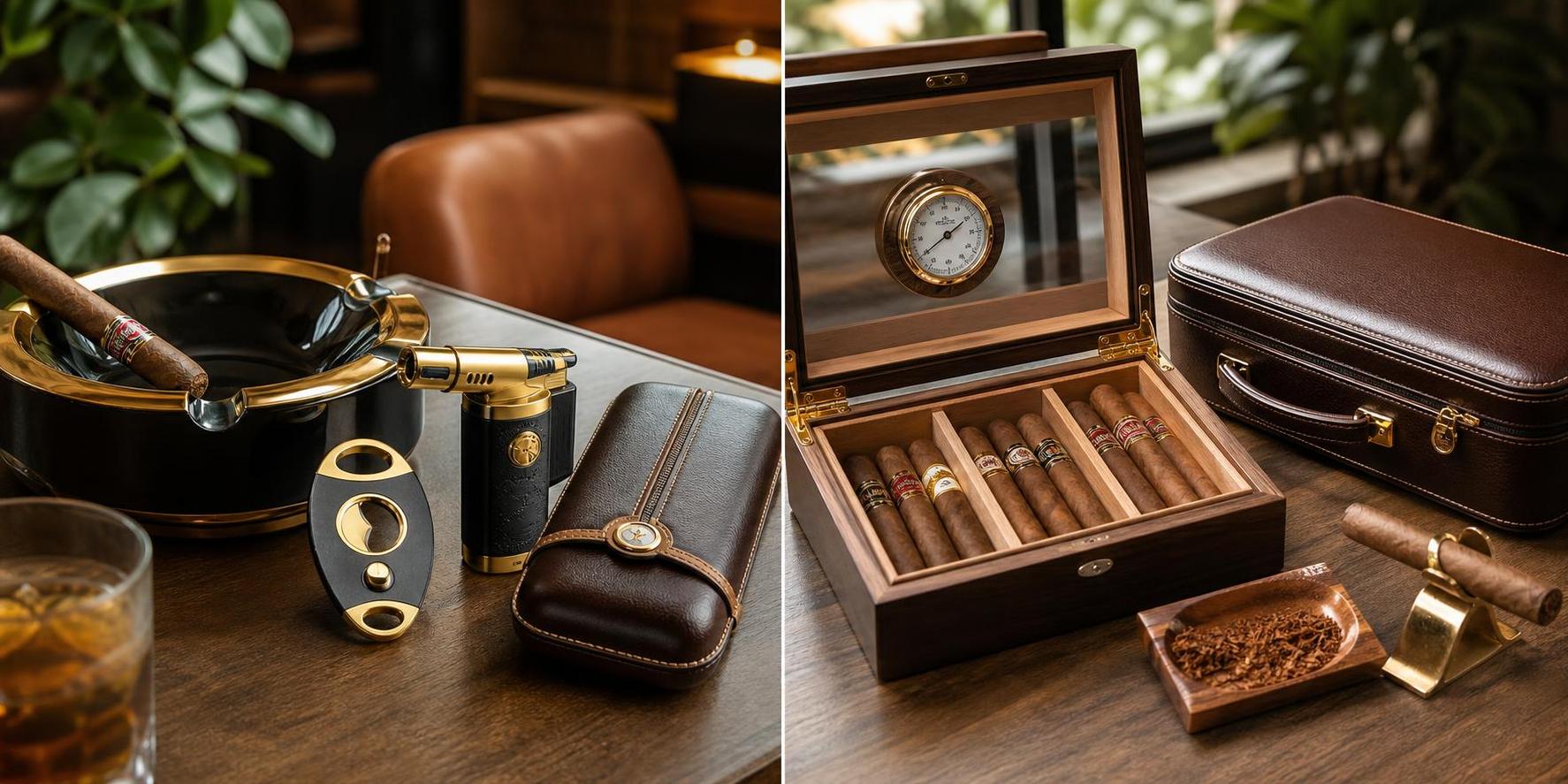
Most cigar accessory mistakes in 2026 are not about buying “cheap”; they are about buying the wrong tool for the job. Humidity, cutting depth, and flame distance matter more than brand prestige.
The biggest myth is that cigars are fragile luxury objects that need constant tinkering. In practice, consistency beats intervention, especially for home storage and travel.
Myth: 70% RH is always the correct target
The old “70/70 rule” came from storing cigars near 70°F and 70% relative humidity. It is still common, but many smokers now prefer 62% to 69% RH, especially for dense Nicaraguan and Broadleaf cigars.
| Storage target | Best use | Common result |
| 62% RH | Dry-boxing or short-term smoking readiness | Firmer draw, cleaner burn |
| 65% RH | Desktop humidors and most non-Cuban cigars | Balanced combustion and aroma |
| 69% RH | Longer storage or drier climates | Softer feel, slower burn |
| 72% RH+ | Rarely needed for premium cigars | Higher risk of tight draw or mold |
Myth: A bigger lighter is always better
A triple- or quad-jet torch looks impressive, but it can scorch the foot fast. Butane flames can exceed 2,500°F, so the goal is distance and rotation, not direct blasting.
Hold the flame just off the cigar foot and toast evenly before drawing. If the wrapper turns black before ignition, the lighter is too close or the flame is too concentrated.
Mistake: Cutting too much cap
A good cut removes only the closed tip, not the shoulder of the cigar. Cutting below the cap line often causes unraveling, especially on parejos with thin Colorado or Connecticut wrappers.
- Use a sharp guillotine for straight cuts on most cigars.
- Use a punch when you want a smaller opening and slower draw.
- Use a V-cutter carefully on torpedoes; deep cuts can split the head.
Mistake: Trusting an uncalibrated hygrometer
Digital hygrometers are better than old analog dials, but they still drift. A salt test should read about 75% RH after 6 to 8 hours in a sealed bag or container.
If the reading is off by 3% to 5%, adjust the device if possible or write the correction inside the humidor. Guessing humidity by feel is unreliable once a box holds more than 20 cigars.
Myth: Cedar sheets replace proper humidification
Spanish cedar helps buffer moisture and adds aroma, but it does not create humidity. A humidor still needs a calibrated hygrometer and a controlled humidity source, such as two-way humidity packs or a maintained humidification system.
Questions People Ask Most
What cigar accessories are essential for a beginner in 2026?
You need a reliable cutter, a butane torch lighter, a humidity-controlled storage solution, and a digital hygrometer.
For most beginners, a 20–50 count desktop humidor or a Boveda-style humidity bag with 69% or 72% packs is more practical than an expensive cabinet humidor.
What type of cigar cutter should I buy?
A sharp double-guillotine cutter is the best all-purpose choice because it works on most parejos and is easy to control.
If you smoke torpedoes, perfectos, or larger ring gauges above 60, add a V-cutter or cigar scissors for cleaner, more flexible cuts.
Do I need a torch lighter for cigars?
Yes, a butane torch lighter is the standard choice because it burns hot, clean, and odorless when used with refined butane.
A single- or dual-flame torch gives better control than a triple-flame model, especially when lighting smaller ring gauge cigars or avoiding scorching the wrapper.
What humidity level should cigars be stored at?
Most premium cigars store well at 65%–69% relative humidity and around 65°F–70°F.
Many experienced smokers prefer 65% or 67% packs for ready-to-smoke cigars because they reduce the risk of tight draws and swollen wrappers compared with wetter 72% storage.
Are electric humidors worth buying in 2026?
Electric humidors are worth it if you store more than 100 cigars, live in a hot climate, or want tighter temperature control.
Look for a unit that holds 65°F–70°F, has Spanish cedar shelves, uses accurate digital sensors, and avoids compressor vibration that can disturb long-term aging.