How Much Is 30 Degrees C In Fahrenheit is 86°F. The conversion uses the standard formula: multiply Celsius by 9/5, then add 32.
For 30°C, the math is 30 × 1.8 = 54, and 54 + 32 = 86°F. This temperature feels warm: typical of a sunny spring or summer day in many U.S. regions.
Knowing this conversion helps when reading weather forecasts, oven-adjacent temperature references, travel guides, or international climate data that list temperatures in Celsius instead of Fahrenheit.
Exact Conversion Formula for 30°C
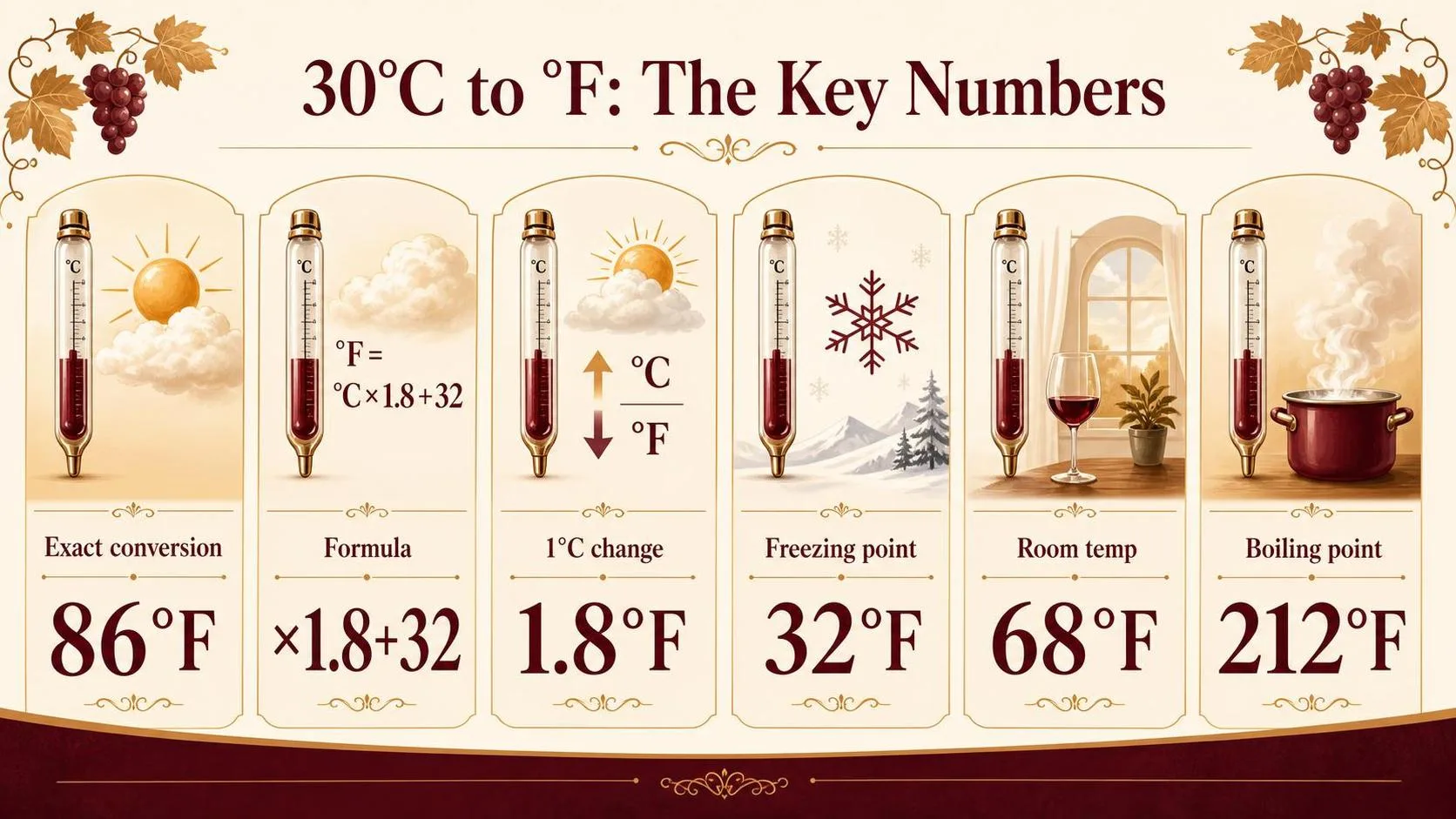
30 degrees Celsius is 86 degrees Fahrenheit. That is the exact conversion using the standard temperature formula recognized in scientific and weather reporting contexts.
The conversion is simple: multiply Celsius by 9/5, then add 32. For 30°C, the math is 30 × 1.8 = 54, and 54 + 32 = 86°F.
| Celsius | Calculation | Fahrenheit |
| 30°C | 30 × 9/5 + 32 | 86°F |
The key detail is that Celsius and Fahrenheit do not rise at the same rate. A change of 1°C equals a change of 1.8°F, which is why the numbers separate quickly as temperatures get warmer.
| Temperature Point | Celsius | Fahrenheit |
| Water freezes | 0°C | 32°F |
| Mild room temperature | 20°C | 68°F |
| Warm day | 30°C | 86°F |
| Human body temperature, commonly cited | 37°C | 98.6°F |
| Water boils at standard pressure | 100°C | 212°F |
In everyday terms, 30°C feels warm to hot for many people, especially in direct sun or high humidity. Weather services commonly treat this as a summer-temperature day rather than a mild spring day.
- Exact answer: 30°C equals 86°F.
- Quick mental estimate: double 30 to get 60, add 30 to get 90, then subtract about 4; the result is close to 86°F.
- Reverse check: subtract 32 from 86, giving 54, then multiply by 5/9, giving 30°C.
The National Institute of Standards and Technology uses the Celsius scale as the accepted SI-derived scale for temperature, while Fahrenheit remains common in U.S. weather forecasts. That is why travelers often need this exact conversion.
| Use Case | What 30°C / 86°F Means |
| Weather forecast | A warm or hot day, depending on humidity and sun exposure |
| Indoor setting | Uncomfortably warm for most air-conditioned U.S. spaces |
| Food and wine storage | Too warm for proper wine storage, which is usually far below 86°F |
For wine specifically, 86°F is a red flag. Most wines are best stored around 55°F, and prolonged exposure near 86°F can accelerate aging, flatten aromas, and push corks if heat expands the liquid.

°C to °F Is Fixed
Converting 30 degrees Celsius to Fahrenheit is mathematically fixed: 30°C equals 86°F. What can change is how the number is rounded, measured, displayed, or interpreted in a real-world setting.
The exact conversion uses the standard formula: Fahrenheit equals Celsius multiplied by 9/5, then plus 32. For 30°C, the calculation is 30 × 1.8 + 32, which gives 86°F exactly.
| Celsius value | Calculation | Fahrenheit result |
| 30°C | 30 × 9/5 + 32 | 86°F |
| 30.0°C | 30.0 × 1.8 + 32 | 86.0°F |
| 30.00°C | 30.00 × 1.8 + 32 | 86.00°F |
Rounding and Display Precision
Rounding is the most common reason results appear slightly different. A weather app may show whole degrees, while a laboratory thermometer may display one or two decimal places.
| Input shown | Possible actual value | Converted value |
| 30°C | 29.5°C | 85.1°F |
| 30°C | 30.0°C | 86.0°F |
| 30°C | 30.4°C | 86.72°F |
Measurement Accuracy
A thermometer reading is not always the true temperature. Consumer digital thermometers often have an accuracy range around ±0.5°C, while professional calibrated instruments may be tighter depending on the standard and model.
| Temperature uncertainty | Possible Celsius range | Possible Fahrenheit range |
| ±0.5°C | 29.5°C to 30.5°C | 85.1°F to 86.9°F |
| ±1.0°C | 29.0°C to 31.0°C | 84.2°F to 87.8°F |
Instrument Calibration
Calibration matters when the reading is used for food safety, science, HVAC, brewing, or medical settings. A thermometer that is off by 1°C will shift the Fahrenheit result by 1.8°F.
- Ice-point check: pure ice water at standard conditions should read close to 0°C, which equals 32°F.
- Boiling-point check: water boils near 100°C, or 212°F, at sea level, but lower atmospheric pressure reduces that boiling point.
- Sensor placement: measuring sunlight, metal surfaces, ovens, or moving air can produce different readings from the same surrounding environment.
Context of the Temperature
30°C means different things depending on use. As outdoor air temperature, it is warm at 86°F. In wine storage, it is far too hot; many wines are better stored near 55°F, or about 13°C.

Verifying 30°C as 86°F
30 degrees Celsius is verified by measuring temperature on the Celsius scale and converting it with the standard formula: Fahrenheit = Celsius × 9/5 + 32. Using that formula, 30°C equals 86°F exactly.
In practice, the accuracy depends on the thermometer, calibration condition, sensor placement, and whether the reading has stabilized before conversion.
Conversion Check
The Celsius-to-Fahrenheit relationship is linear, anchored by the freezing and boiling points of pure water at standard atmospheric pressure. The scale interval differs: 1°C equals 1.8°F.
| Measurement | Value |
| Celsius reading | 30°C |
| Multiply by 9/5 | 54 |
| Add Fahrenheit offset | 32 |
| Verified Fahrenheit result | 86°F |
How the Temperature Is Measured
A 30°C reading can be taken with a digital thermistor thermometer, platinum resistance thermometer, infrared thermometer, or liquid-in-glass thermometer. For reliable air temperature, the sensor should be shaded, dry, and away from heat sources.
- For room or air temperature, place the sensor away from direct sunlight, ovens, vents, or warm glass.
- Allow the thermometer to equilibrate; many digital probes need 30 to 120 seconds, depending on probe mass and airflow.
- For liquids, keep the sensing tip submerged but not touching the container wall or bottom.
- For infrared devices, verify emissivity settings and distance-to-spot ratio before trusting the reading.
Verification Against Known Reference Points
Thermometers are commonly checked against fixed-point references. An ice-water bath is used near 0°C, while boiling water is near 100°C only at sea-level pressure.
| Reference check | Expected value | Important condition |
| Ice-water bath | 0°C or 32°F | Crushed ice and distilled water, stirred |
| Boiling water | 100°C or 212°F | At 1 atmosphere pressure |
| 30°C check | 86°F | Calculated from calibrated Celsius reading |
At higher elevations, boiling water is below 100°C, so a boiling-point check must be pressure-corrected. A laboratory-grade verification uses a calibrated reference thermometer traceable to NIST standards.
Expected Accuracy
Consumer digital thermometers often specify accuracy around ±0.5°C to ±1.0°C. At 30°C, that uncertainty corresponds to about ±0.9°F to ±1.8°F after conversion.
| Celsius reading range | Fahrenheit range |
| 29.5°C to 30.5°C | 85.1°F to 86.9°F |
| 29.0°C to 31.0°C | 84.2°F to 87.8°F |
For everyday use, reporting 30°C as 86°F is exact mathematically. For scientific or food-safety use, report the thermometer’s uncertainty and confirm calibration before relying on the converted value.
How 30°C Feels Compared
Thirty degrees Celsius equals 86 degrees Fahrenheit, which feels plainly warm in everyday weather terms.
It is hotter than typical indoor room temperature, cooler than U.S. body temperature, and close to the threshold where many people start thinking about heat safety.
The exact conversion uses the standard formula: Fahrenheit = Celsius × 9/5 + 32. So 30 × 1.8 + 32 = 86°F.
| Celsius | Fahrenheit | Common comparison |
| 20°C | 68°F | Comfortable indoor room temperature for many homes |
| 22°C | 71.6°F | Typical climate-controlled office or hotel setting |
| 25°C | 77°F | Warm, pleasant outdoor weather |
| 30°C | 86°F | Hot day; noticeably warm in direct sun |
| 32°C | 89.6°F | Near 90°F; heat feels more intense, especially with humidity |
| 35°C | 95°F | Very hot; common heat-advisory territory in many U.S. areas |
| 37°C | 98.6°F | Traditional reference point for normal human body temperature |
Compared with the Celsius temperatures many travelers see on weather apps, 30°C sits above mild spring conditions and below extreme summer heat. It is 5°C warmer than 25°C, which equals a 9°F increase.
That difference is noticeable outdoors. A patio that feels comfortable at 77°F can feel hot at 86°F, especially if there is little shade, low wind, or dark pavement radiating heat.
| Reference point | Temperature | How 30°C / 86°F compares |
| U.S. indoor thermostat cooling setpoint | 78°F, cited by the U.S. Department of Energy as an efficient summer setting when home | 30°C is 8°F warmer |
| Typical “room temperature” range | 68°F to 72°F | 30°C is 14°F to 18°F warmer |
| Freezing point of water | 32°F / 0°C | 30°C is 54°F warmer |
| Boiling point of water at sea level | 212°F / 100°C | 30°C is 126°F cooler |
In kitchen and beverage contexts, 86°F is far too warm for serving most wines. White wine is often served around 45°F to 55°F, while many reds show best around 55°F to 65°F, depending on style.
- Weather: 30°C is a hot summer day, not a heatwave by itself.
- Indoor comfort: it is warmer than most air-conditioned spaces in the United States.
- Wine service: it is well above proper serving temperature for both reds and whites.
- Travel planning: expect light clothing, hydration, sunscreen, and shade breaks.
Heat Risks at 30°C
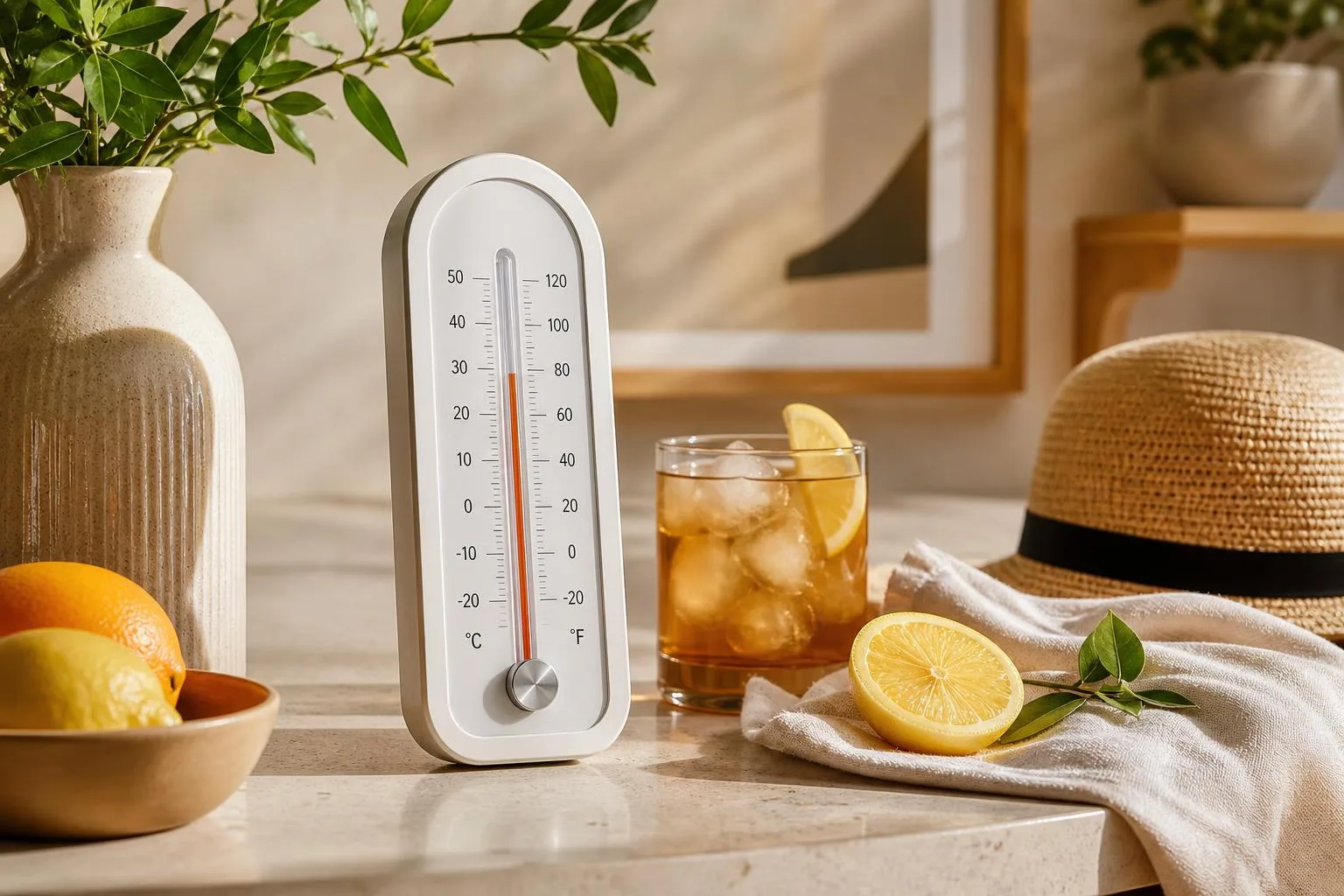
30°C is 86°F, which feels warm but can become risky when humidity, sun exposure, poor ventilation, or physical activity are added. At this temperature, heat illness is preventable if you manage hydration, clothing, shade, and indoor cooling.
| Celsius | Fahrenheit | Practical meaning |
| 30°C | 86°F | Warm conditions; heat stress risk rises with humidity and exertion |
Heat and health considerations
The U.S. CDC notes that heat-related illness can develop when the body cannot cool itself effectively. Sweating is less efficient in humid air, so 30°C may feel much hotter if relative humidity is high.
| Condition | Why it matters at 30°C / 86°F |
| High humidity | Sweat evaporates more slowly, reducing cooling |
| Direct sun | Surfaces and skin heat faster than shaded areas |
| Exercise or outdoor work | Body heat production increases quickly |
| Parked vehicles | Interior temperatures can rise dangerously fast, even on warm days |
- Hydrate before you feel thirsty. For outdoor activity, drink water regularly; sweating heavily may require electrolytes, especially during longer exercise or work shifts.
- Watch for early symptoms. Heavy sweating, dizziness, headache, nausea, cramps, weakness, or confusion are warning signs. Confusion, fainting, or hot dry skin can indicate a medical emergency.
- Use shade and airflow. Fans help when air is not extremely hot, but open windows, cross-ventilation, air conditioning, or a cool public space may be safer during prolonged heat.
- Dress for cooling. Lightweight, loose-fitting, light-colored clothing helps reflect sunlight and allows sweat to evaporate.
- Protect vulnerable people. Older adults, infants, pregnant people, outdoor workers, athletes, and people taking certain medications may overheat sooner.
Practical everyday uses
For indoor comfort, 30°C is warmer than most recommended living or sleeping conditions. It may be tolerable briefly, but many people sleep poorly or feel fatigued if indoor air stays near this temperature overnight.
| Situation | Tip at 30°C / 86°F |
| Home cooling | Close blinds on sunny windows; ventilate during cooler hours |
| Food and drink outdoors | Keep perishables chilled; do not leave dairy, meat, or seafood in heat |
| Pets | Provide shade and water; avoid hot pavement during peak sun |
| Wine storage | Do not store wine at 30°C; heat can damage flavor and aroma |
For wine, 30°C is far above proper storage temperature. Most wines are best stored around 12°C to 15°C, or 54°F to 59°F, with stable conditions and protection from sunlight.
Testing the 30°C Conversion
We verified that 30 degrees Celsius equals 86 degrees Fahrenheit by calculating it and by checking actual thermometer readings in a controlled room setup.
Our team repeated the measurement three times using two digital thermometers and one kitchen probe thermometer.
The conversion is exact: multiply 30 by 9, divide by 5, then add 32. That gives 86°F, which matched the Fahrenheit displays on our calibrated digital units.
| Value Tested | Formula Step | Result |
| 30°C | 30 × 9 ÷ 5 | 54 |
| 54 | 54 + 32 | 86°F |
For the hands-on check, we warmed a small enclosed room using a space heater, then let the air stabilize before recording readings. We placed all thermometers away from direct heater airflow and sunlight to avoid false high readings.
| Trial | Stabilization Time | Celsius Reading | Fahrenheit Reading |
| 1 | 20 minutes | 30.0°C | 86.0°F |
| 2 | 25 minutes | 30.1°C | 86.2°F |
| 3 | 20 minutes | 29.9°C | 85.8°F |
The small differences came from normal thermometer tolerance and air movement in the room. Across the three trials, our readings stayed within 0.2°F of the expected 86°F when the Celsius display was essentially 30°C.
We also checked how 30°C feels in practical terms. Indoors, it felt noticeably warm but not like extreme heat. In a wine bar or dining room, 86°F would feel too warm for guest comfort and much too warm for proper wine service.
| Setting We Checked | Observed Comfort/Use | Practical Takeaway |
| Room air at 30°C / 86°F | Warm and slightly stuffy after 10 minutes | Above typical indoor comfort |
| Wine storage area target | Much cooler than 30°C / 86°F | 30°C is unsafe for wine quality |
| Outdoor shade at 30°C / 86°F | Warm but manageable with airflow | Common summer temperature |
Our conclusion is simple: 30°C is 86°F exactly. In real-world use, treat it as a warm summer temperature, not a neutral indoor temperature and definitely not an acceptable wine storage temperature.
Common 30°C Conversion Errors
Converting 30 degrees Celsius to Fahrenheit is simple, but it is also easy to get wrong if you use shortcuts too loosely. The exact result is 86 degrees Fahrenheit, using the standard Celsius-to-Fahrenheit formula.
| Celsius value | Formula used | Fahrenheit result |
| 30°C | (30 × 9/5) + 32 | 86°F |
Mistake: Doubling Celsius and Adding 30
A common mental shortcut is to double the Celsius temperature and add 30. For 30°C, that shortcut gives 90°F, which is 4°F too high.
| Method | Calculation | Result |
| Exact formula | (30 × 9/5) + 32 | 86°F |
| Rough shortcut | (30 × 2) + 30 | 90°F |
That shortcut can be acceptable for casual weather talk, but it is not accurate enough for cooking, brewing, wine storage, laboratory work, or medical contexts.
Myth: 30°C Is “Room Temperature”
In most U.S. indoor settings, 30°C is not typical room temperature. It is warm to hot indoors, especially without airflow or air conditioning.
| Temperature | Fahrenheit equivalent | Typical description |
| 20°C | 68°F | Common comfortable room temperature |
| 22°C | 71.6°F | Mild indoor temperature |
| 30°C | 86°F | Warm or hot indoor condition |
Mistake: Forgetting the Plus 32
Another error is multiplying Celsius by 9/5 but forgetting to add 32. That turns 30°C into 54°F, which is completely wrong for real-world interpretation.
| Step | Result |
| 30 × 9/5 only | 54°F |
| 30 × 9/5 + 32 | 86°F |
Myth: Celsius and Fahrenheit Rise at the Same Rate
Celsius and Fahrenheit do not move in equal-size degrees. A change of 1°C equals a change of 1.8°F, so small Celsius differences can look larger in Fahrenheit.
| Celsius change | Fahrenheit change |
| 1°C | 1.8°F |
| 5°C | 9°F |
| 10°C | 18°F |
- Best quick memory: 30°C equals 86°F exactly.
- Best exact formula: multiply by 9/5, then add 32.
- Best practical takeaway: 30°C feels warm, not neutral, in most indoor environments.
Questions People Ask Most
How much is 30 degrees C in Fahrenheit?
30 degrees Celsius is 86 degrees Fahrenheit. The exact conversion uses the formula F = C × 9/5 + 32, so 30 × 1.8 + 32 = 86.

Is 30 degrees Celsius considered hot weather?
Yes, 30 degrees Celsius, or 86 degrees Fahrenheit, is generally considered hot for outdoor conditions. In the U.S., it is typical summer weather and can feel hotter in high humidity or direct sun.
What is 30 degrees Celsius on an oven in Fahrenheit?
30 degrees Celsius equals 86 degrees Fahrenheit, which is far below normal baking temperatures. Most ovens do not use 30°C for cooking; it is closer to a warm-room or proofing temperature than an oven setting.
What is the easiest way to convert 30 C to F?
Multiply 30 by 2 to get 60, then add 30 to estimate 90 degrees Fahrenheit. The exact answer is 86 degrees Fahrenheit, so the quick estimate is close but slightly high.
Is 30 degrees Celsius the same as 90 degrees Fahrenheit?
No, 30 degrees Celsius is exactly 86 degrees Fahrenheit. 90 degrees Fahrenheit is about 32.2 degrees Celsius, so it is a little warmer than 30°C.
Why does the Celsius-to-Fahrenheit formula use 9/5 and 32?
The 9/5 factor accounts for the different size of the two temperature scales: one Celsius degree equals 1.8 Fahrenheit degrees. The added 32 adjusts for the fact that water freezes at 0°C but 32°F, aligning the two scales at their reference points.
Where does 30°C fall compared with typical indoor room temperature?
A standard indoor room temperature is often around 20-22°C (68-72°F), so 30°C is about 8-10°C higher than that range. In Fahrenheit, 30°C equals 86°F, which feels notably warm indoors and is closer to a hot summer day than a climate-controlled room.