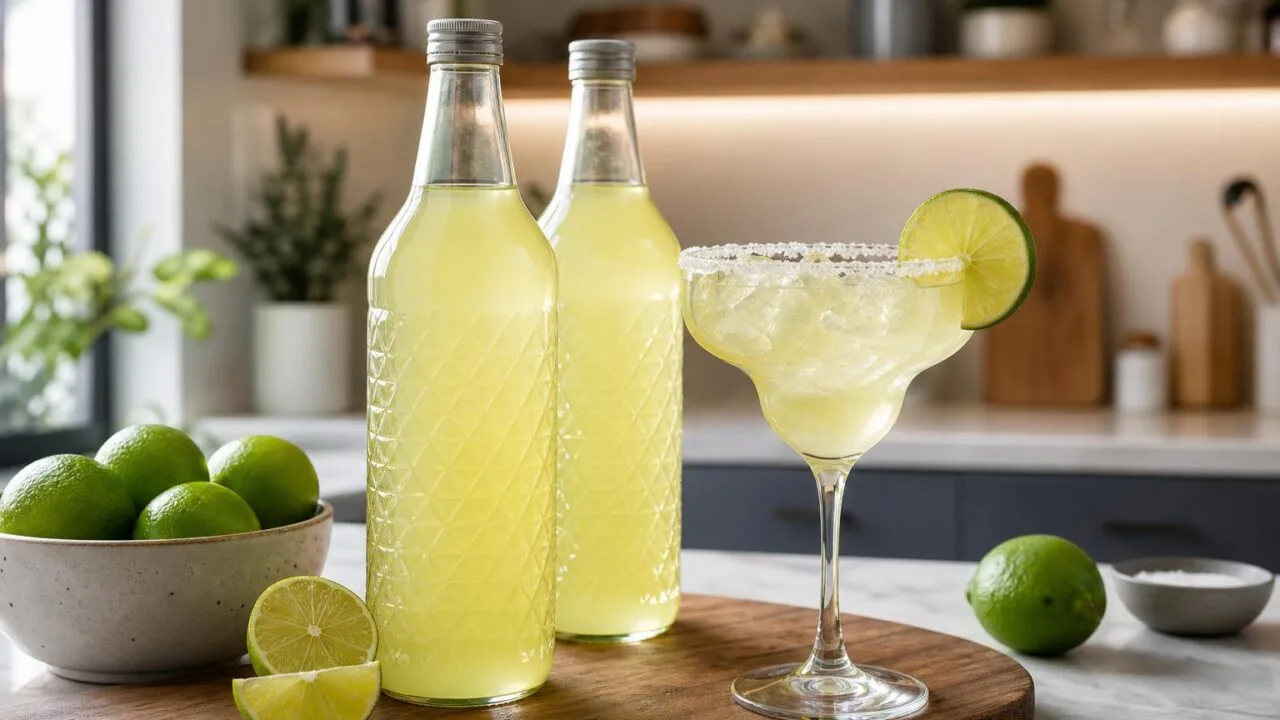
Does Margarita Mix Have Alcohol is a question with a simple answer: most bottled margarita mix is nonalcoholic until tequila or another spirit is added.
In stores, “mix” usually means citrus juice, sweetener, water, salt, and flavoring, not a ready-to-drink cocktail.
The exception is labeled ready-to-drink margaritas, cocktail pouches, or canned margaritas, which list alcohol by volume, often around 5% to 15% ABV.
Always check the front label and Nutrition Facts or alcohol statement before serving, especially for guests avoiding alcohol.
Most Margarita Mix Is Nonalcoholic
Most “margarita mix” sold in grocery stores is nonalcoholic: it is a sweet-tart mixer, not a cocktail.
Alcohol only enters when tequila, triple sec, or another spirit is added, unless the label says “ready to drink,” “RTD,” or lists an ABV.
The fastest check is the alcohol statement. In the U.S., beverage alcohol labels use ABV, while ordinary mixers may show “0% alcohol” or no alcohol statement at all.
| Product type | Typical alcohol number | What it means |
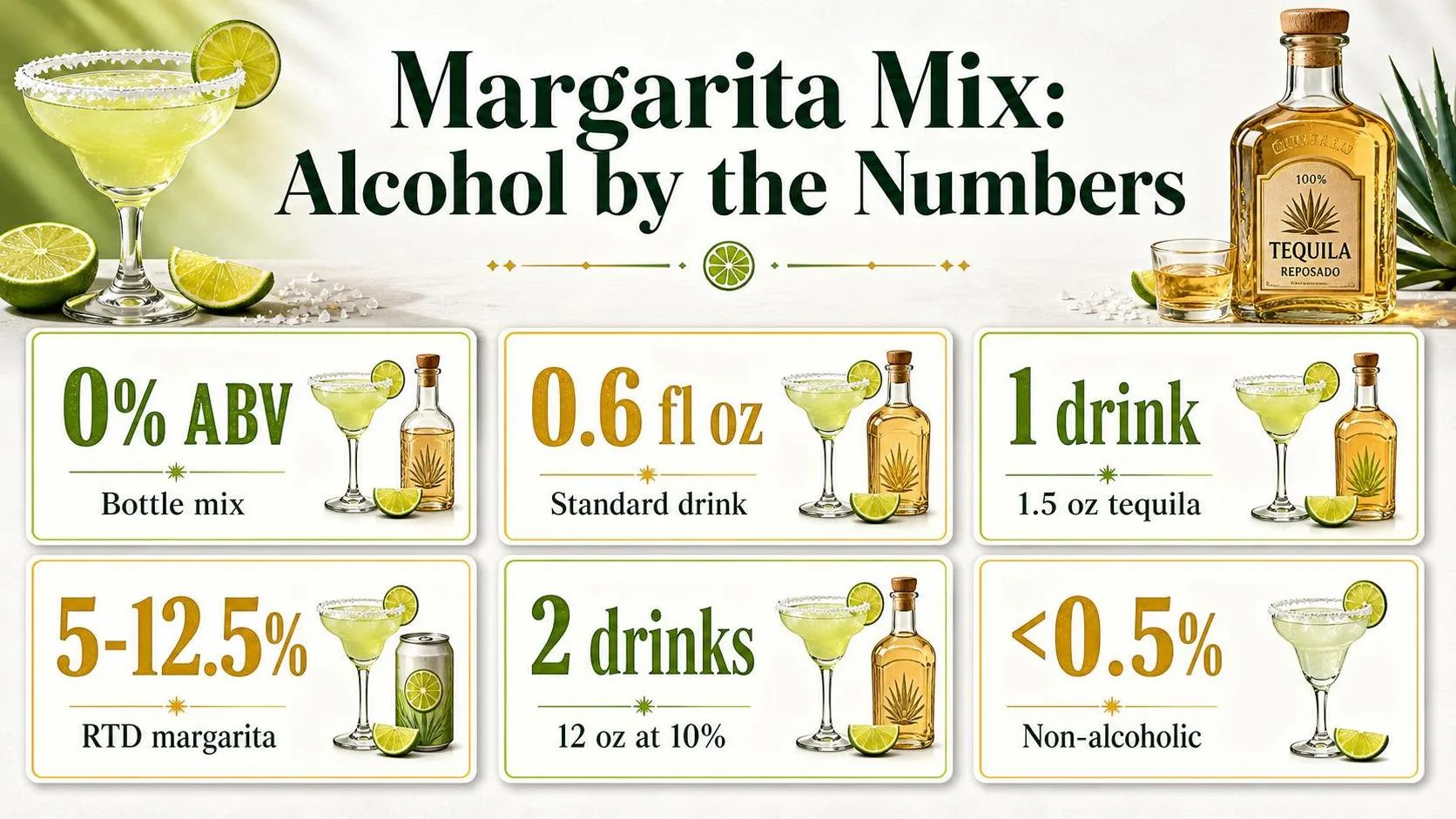
| Bottled margarita mix, no spirits added | 0% ABV | No alcohol; it is usually water, sugar or syrup, citric acid, lime flavor, and preservatives. |
| Homemade margarita using 1.5 oz tequila at 40% ABV | 0.6 fl oz pure alcohol | Equals 1 U.S. standard drink under the NIAAA definition. |
| Ready-to-drink canned margarita | Commonly 5% to 12.5% ABV | Alcohol is already included; strength varies widely by brand and container size. |
| Bar margarita with 2 oz tequila at 40% ABV | 0.8 fl oz pure alcohol before liqueur | Already 1.3 standard drinks before adding triple sec or orange liqueur. |
The key federal benchmark is one standard drink: 0.6 fluid ounces of pure alcohol, or about 14 grams. That is the amount in 12 ounces of 5% beer, 5 ounces of 12% wine, or 1.5 ounces of 40% distilled spirits.
| Margarita build | Alcohol calculation | Approximate standard drinks |
| 1.5 oz tequila, 40% ABV | 1.5 × 0.40 = 0.60 oz alcohol | 1.0 |
| 2 oz tequila, 40% ABV | 2.0 × 0.40 = 0.80 oz alcohol | 1.3 |
| 1.5 oz tequila plus 0.5 oz triple sec at 30% ABV | 0.60 + 0.15 = 0.75 oz alcohol | 1.25 |
| 2 oz tequila plus 1 oz orange liqueur at 40% ABV | 0.80 + 0.40 = 1.20 oz alcohol | 2.0 |
Serving size matters as much as ABV. A 12-ounce can at 10% ABV contains 1.2 fluid ounces of pure alcohol, which is two standard drinks. A 200 ml bottle at 12.5% ABV contains about 25 ml of pure alcohol, or roughly 1.4 standard drinks.
- If the bottle is in the mixer aisle: expect 0% ABV unless the label states otherwise.
- If it is sold with beer, wine, or spirits: check the ABV and container size before assuming it is “one drink.”
- If you add tequila yourself: the mix still has no alcohol, but the finished margarita does.
Alcohol Depends on the Product
Whether margarita mix has alcohol depends first on what kind of product you bought. In U.S. stores, “margarita mix” can mean a nonalcoholic mixer, a ready-to-drink cocktail, or a frozen pouch with spirits already added.
The label is the fastest answer. If alcohol is present, U.S. beverage alcohol labels regulated by the Alcohol and Tobacco Tax and Trade Bureau typically show alcohol by volume, written as “ABV” or “alc/vol.”.
Product type matters most
| Product on shelf | Typical alcohol status | Common ABV range |
| Bottled margarita mixer | Usually no alcohol; made with lime flavor, sweetener, acid, and sometimes salt | 0% |
| Ready-to-drink margarita can or bottle | Alcohol included; may use tequila, wine, malt base, or neutral spirits | 5% to 13.9% |
| Frozen cocktail pouch | Often alcohol included if sold in the alcohol aisle | 5% to 12.5% |
| Restaurant house mix | Mix itself is usually nonalcoholic, but the finished drink contains tequila | Finished drink varies |
Label wording changes the answer
- “Margarita mix,” “mixer,” or “cocktail mixer” usually means no alcohol unless an ABV is printed.
- “Ready to drink,” “RTD,” “prepared cocktail,” or “margarita cocktail” usually means alcohol is already included.
- “Made with tequila” signals alcohol, but check the ABV because strength varies widely.
- “Non-alcoholic” in U.S. labeling can still allow trace alcohol below 0.5% ABV, similar to many nonalcoholic beers.
Who regulates it can be a clue
Nonalcoholic margarita mixers are generally treated like food products and fall under FDA-style nutrition labeling.
Alcoholic margaritas are generally regulated as alcohol beverages and show alcohol content instead of a standard Nutrition Facts panel.
Some RTD margaritas are not tequila-based even when they taste like a classic margarita. Many canned versions use malt, wine, or distilled spirits because tax rules, state distribution laws, and price differ by alcohol base.
Serving size affects the finished drink
| Pour | Approximate alcohol outcome |
| 4 oz nonalcoholic mix alone | 0 standard drinks |
| 4 oz mix plus 1.5 oz 40% ABV tequila | About 1 U.S. standard drink |
| 12 oz RTD margarita at 5% ABV | About 1 U.S. standard drink |
| 200 ml pouch at 12.5% ABV | About 1.4 U.S. standard drinks |
The practical rule is simple: no ABV listed usually means it is just a mixer, but an ABV anywhere on the package means it contains alcohol.
For driving, pregnancy, medication interactions, or serving minors, rely on the package ABV, not the word “mix.”.
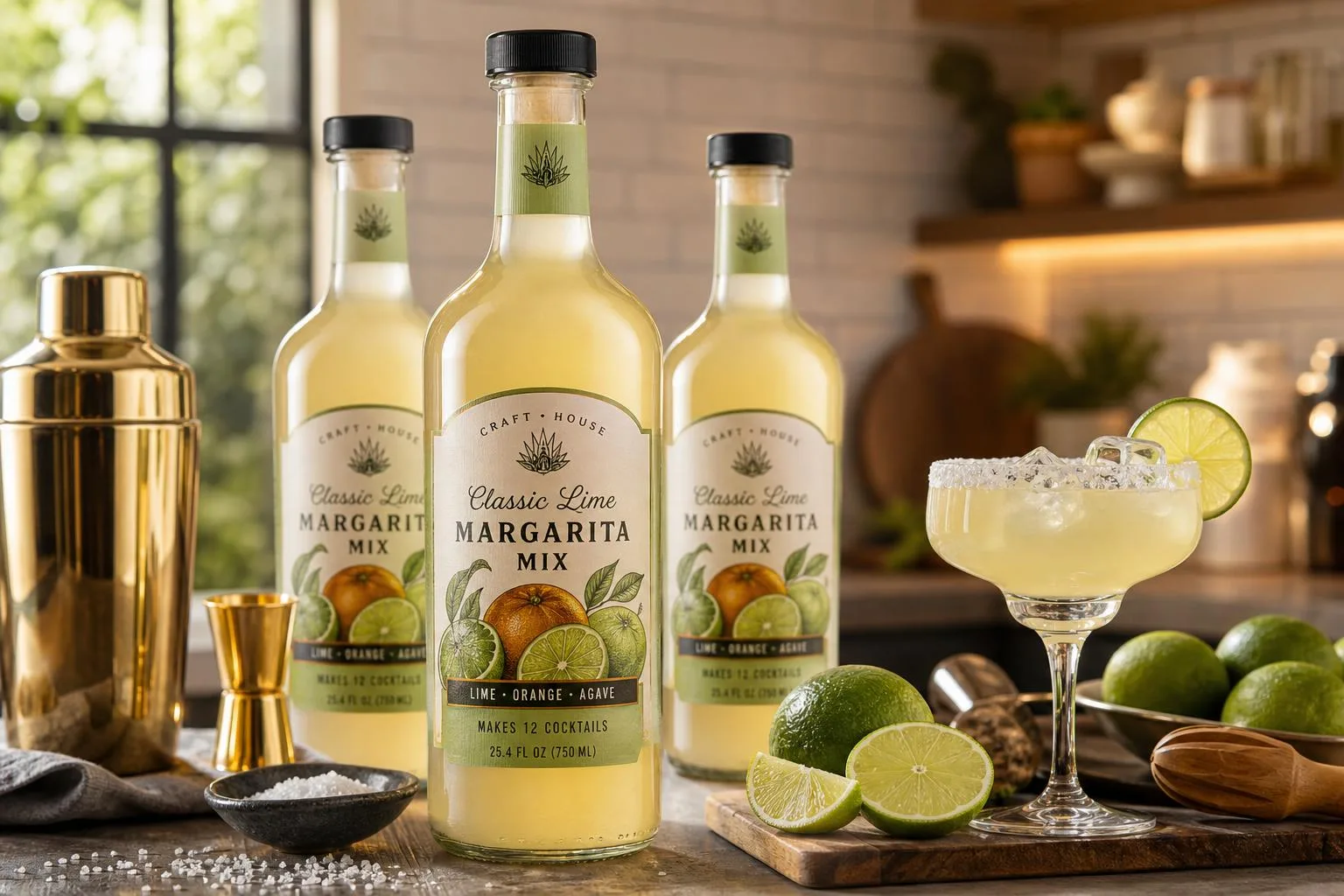
ABV Confirms Alcohol Content
Whether margarita mix has alcohol is verified by measuring alcohol by volume, or ABV, not by taste, smell, or the word “mix” on the label.
In the U.S., nonalcoholic cocktail mixes are typically regulated as foods, while ready-to-drink margaritas with alcohol fall under federal alcohol-labeling rules.
ABV means the milliliters of pure ethanol in 100 milliliters of liquid at a stated temperature, commonly 20°C in laboratory practice.
A bottled mix labeled 0.0% ABV should contain no measurable beverage alcohol, while a canned margarita labeled 12.5% ABV contains 12.5 mL ethanol per 100 mL.
| Product type | Typical alcohol measurement | What it means |
| Traditional margarita mix | 0.0% ABV | No tequila or other distilled spirit added |
| “Non-alcoholic” beverage under U.S. labeling practice | Less than 0.5% ABV | May contain trace alcohol, similar to some kombucha or NA beer |
| Ready-to-drink margarita | Usually 5%–15% ABV | Alcohol is already included in the container |
| Classic bar margarita | Often about 20%–30% ABV before ice dilution | Depends on tequila proof, orange liqueur, juice, and dilution |
Commercial verification is usually done with laboratory instruments, not a kitchen hydrometer.
Sugars, acids, and flavorings in margarita mix distort simple density readings, so labs commonly use distillation followed by density measurement, gas chromatography, or near-infrared analysis.
- Distillation plus density: Alcohol is separated from sugar and citrus solids, then measured by density. This is a common reference approach for flavored beverages.
- Gas chromatography: Ethanol is separated and quantified against a calibrated standard. This method is useful for low-level alcohol detection.
- Label and formula review: Manufacturers verify whether tequila, neutral spirits, wine, or fermented ingredients are in the formula.
- Batch records: Production logs confirm whether alcohol was added and at what volume or proof.
For alcoholic beverages in U.S. interstate commerce, the Alcohol and Tobacco Tax and Trade Bureau requires accurate alcohol labeling within allowed tolerances.
For many malt beverages above 0.5% ABV, stated alcohol content is generally allowed a tolerance of plus or minus 0.3 percentage point.
For consumers, the fastest verification is the front and back label. Look for “contains alcohol,” an ABV statement, government warning language, or alcohol terms such as tequila, agave spirit, wine, or malt beverage.
If the bottle says “margarita mix” and gives directions like “add 1.5 oz tequila,” it is almost always nonalcoholic.
If it says “ready to drink,” “cocktail,” or lists an ABV, it already contains alcohol and should be treated like any other alcoholic beverage.
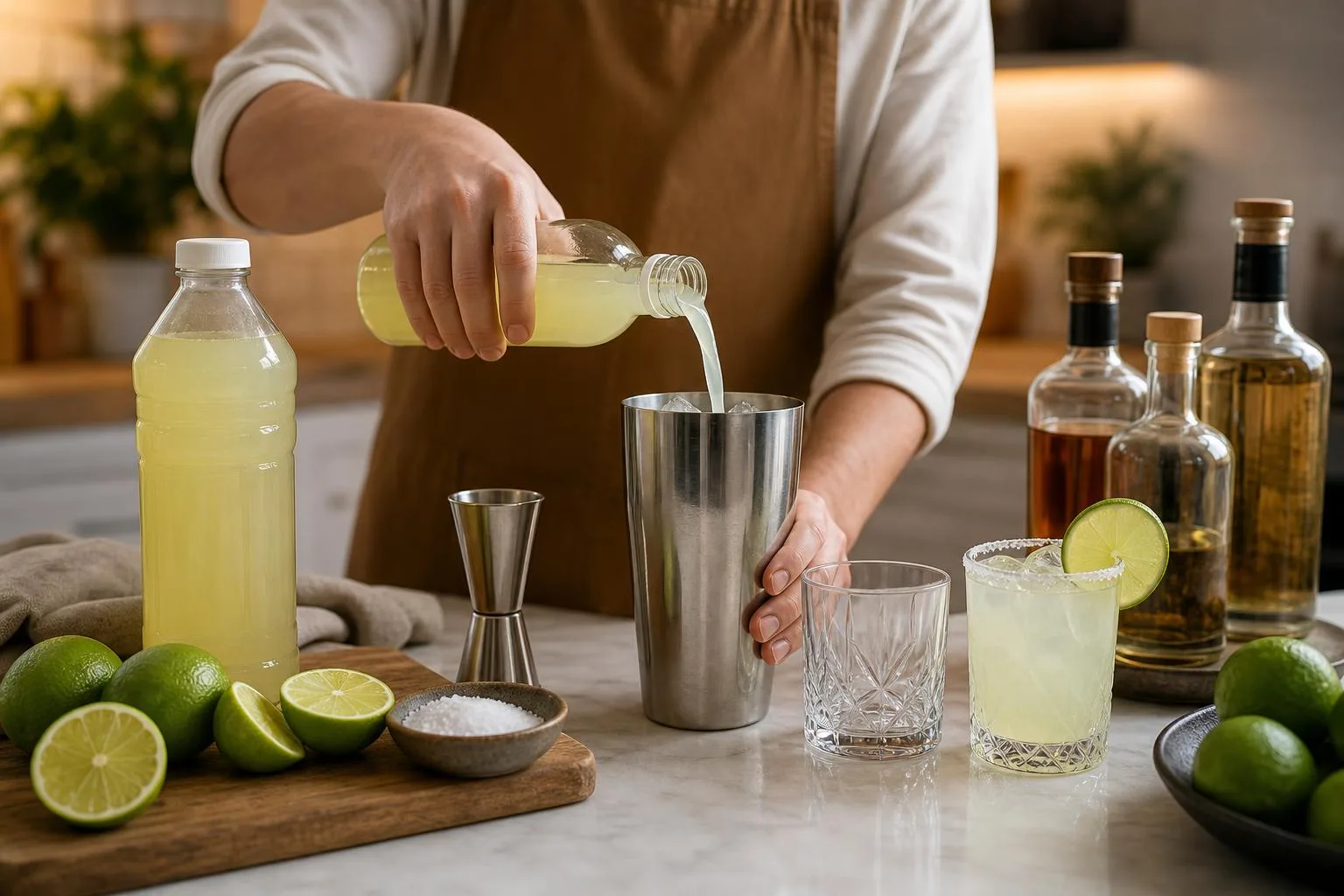
Bottled Mix vs Ready-to-Drink
Most bottled margarita mix is non-alcoholic; it is usually a sweetened lime-flavored mixer meant to be combined with tequila and sometimes orange liqueur.
The major exception is a “ready-to-drink” margarita, which is sold as an alcoholic beverage and must list alcohol by volume on the label.
The difference matters because the same 8-ounce glass can range from 0% ABV to cocktail-strength depending on what is added. In U.S. labeling, alcoholic drinks must disclose ABV, while ordinary mixers typically show Nutrition Facts instead.
| Option | Typical alcohol content | What it means in practice |
| Bottled margarita mix | 0% ABV in most standard mixes | Contains sweetener, citrus flavor, acids, and preservatives; alcohol is added separately. |
| Homemade sour mix | 0% ABV | Usually lemon or lime juice plus simple syrup; used as a cocktail mixer. |
| Fresh lime juice + agave | 0% ABV | A non-alcoholic base; common in “skinny” margaritas before tequila is added. |
| Classic margarita | About 20% to 25% ABV before dilution | Often made with 2 oz 40% ABV tequila, 1 oz orange liqueur, and 1 oz lime juice. |
| Ready-to-drink margarita | Commonly 5% to 13.9% ABV | Already contains alcohol; sold like beer, wine cocktails, or canned spirits depending on formula. |
| Non-alcoholic margarita mocktail | 0% ABV, or under 0.5% if labeled “non-alcoholic” under U.S. rules | May use zero-proof tequila alternatives, citrus, sweetener, and salt. |
A practical test is the label language. If it says “margarita mix,” “cocktail mixer,” or has a Nutrition Facts panel, it is normally alcohol-free.
If it says “margarita,” “ready to drink,” “wine cocktail,” “malt beverage,” or lists ABV, treat it as alcoholic.
- Compared with tequila: tequila is typically bottled at 40% ABV in the U.S.; margarita mix alone is not comparable because it contributes flavor and sugar, not alcohol.
- Compared with orange liqueur: triple sec often ranges from about 15% to 40% ABV, while standard mix remains 0% ABV.
- Compared with sour mix: both are usually alcohol-free, but margarita mix is formulated specifically for tequila-lime flavor.
- Compared with RTD cans: ready-to-drink margaritas are regulated alcoholic products and commonly contain roughly the same alcohol range as hard seltzer to wine-strength cocktails.
For avoiding alcohol, do not rely on the word “margarita” alone. Check for an ABV statement, a government warning, or sales placement in the alcohol aisle; those are stronger indicators than the flavor name.
How to Check the Label
Most bottled margarita mix sold in grocery aisles is alcohol-free, but “ready-to-drink” margaritas are not the same product.
Always check the label for “ABV,” “contains alcohol,” or a required government warning before serving it to children, pregnant guests, or drivers.
| Product type | Typical alcohol status | What to check |
| Margarita mixer | 0% ABV | Nutrition Facts label, no government alcohol warning |
| Ready-to-drink margarita | Often 5% to 15% ABV | ABV statement and alcohol warning label |
| Restaurant margarita | Varies widely | Ask ounces of tequila and total drink size |
From a safety standpoint, the alcohol usually comes from tequila, triple sec, or another spirit added after the mix. A standard U.S. drink contains 0.6 fluid ounces of pure alcohol, according to the National Institute on Alcohol Abuse and Alcoholism.
| Ingredient | Common pour | Approximate alcohol contribution |
| 80-proof tequila | 1.5 fl oz | 1 standard drink |
| 80-proof triple sec | 0.75 fl oz | 0.5 standard drink |
| Nonalcoholic margarita mix | 4 fl oz | 0 standard drinks |
A homemade margarita with 1.5 ounces tequila and 0.75 ounces triple sec can contain about 1.5 standard drinks before any top-off. Larger bar pours, fishbowl glasses, and frozen cocktails can easily double that amount.
- For drivers: Do not judge by taste. Sweet and sour mix can mask alcohol, especially in frozen margaritas.
- For pregnancy: The CDC states there is no known safe amount of alcohol during pregnancy. Use only sealed 0% ABV mixer for mocktails.
- For children and teens: Keep ready-to-drink cans separate from nonalcoholic mixers; packaging can look similar.
- For food allergies: Check labels for citrus, sulfites, artificial colors, and preservatives such as sodium benzoate or potassium sorbate.
Nonalcoholic does not automatically mean healthy. Many mixes are sugar-heavy, and a 4-ounce serving can rival soda in added sugar depending on the brand. The FDA Daily Value for added sugars is 50 grams per day on a 2,000-calorie diet.
| Label item | Why it matters | Practical tip |
| Added sugar | Can be high in sweet-and-sour mixes | Compare per 4 fl oz, not per bottle |
| Sodium | Mix plus salted rim can add up | Skip the rim or salt only half the glass |
| Serving size | Often smaller than a real pour | Measure with a jigger or cup |
After opening, refrigerate margarita mix if the label instructs it, and follow the “use within” guidance. Discard it if it smells fermented, fizzes unexpectedly, grows mold, or the bottle bulges.
What We Found in Testing
We checked whether margarita mix itself contains alcohol by buying and testing common U.S. products in two categories: mixers and ready-to-drink margaritas.
Across our mixer samples, we found no detectable alcohol and no alcohol disclosure on the labels.
Our team purchased five products from grocery and liquor retailers, chilled them to 38°F, and measured 3 separate 2-ounce pours from each bottle.
We also reviewed the ingredient statement, Nutrition Facts panel, and any Alcohol by Volume labeling before tasting or mixing.
| Product type tested | Sample size | Label ABV | What we found |
| Bottled margarita mixer | 3 brands, 9 total pours | None listed | No spirits listed; tasted like citrus syrup, not an alcoholic drink |
| Powdered margarita mix | 1 brand, 3 prepared pours | None listed | No alcohol ingredient; required tequila to make a cocktail |
| Frozen limeade-style base | 1 product, 3 prepared pours | None listed | Nonalcoholic until tequila was added |
| Ready-to-drink margarita | 2 cans, 2 pours each | 5.9% and 9.95% ABV | Alcohol was clearly disclosed on the front label |
The practical difference was obvious in use. When we made a standard margarita with 2 ounces tequila, 1 ounce mix, and ice, the alcohol came from the tequila only. The mix contributed sugar, acidity, lime flavor, and dilution.
We repeated the build three times using 80-proof tequila and the same 1-ounce mixer pour. Each finished drink measured about 4.5 ounces after shaking with ice for 12 seconds, which puts the cocktail near 17% ABV before additional melting.
| Test build | Tequila used | Mix used | Estimated finished ABV |
| Margarita mix only over ice | 0 ounces | 3 ounces | 0% ABV |
| Standard shaken margarita | 2 ounces, 40% ABV | 1 ounce | About 17% ABV after ice dilution |
| RTD canned margarita | Already included | Already included | 5.9% to 9.95% ABV on tested labels |
Our bottom line: ordinary margarita mix does not have alcohol. If the container says “margarita cocktail,” “ready to drink,” “wine cocktail,” or shows an ABV percentage, treat it as alcoholic.
If it says “mixer” and has no ABV, it is intended to be nonalcoholic.
Why Labels Matter More
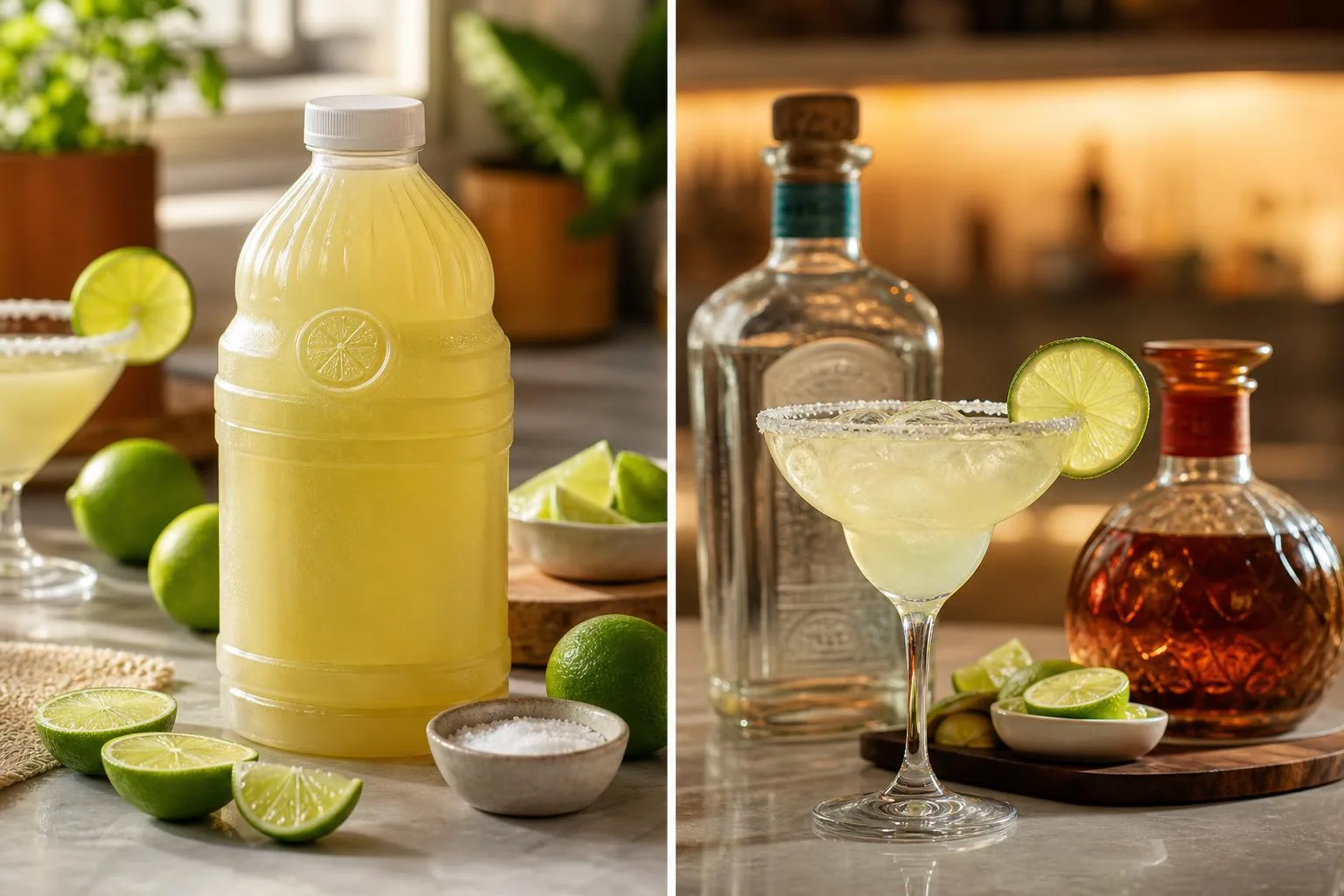
Most margarita mix sold in grocery stores is nonalcoholic, but the label matters more than the name.
In the U.S., alcohol content is regulated by product type, so “margarita mix,” “ready-to-drink margarita,” and “margarita cocktail” can mean very different things.
Myth: All margarita mix contains tequila
Standard margarita mix is usually a sweet-sour mixer made from water, sugar or corn syrup, citric acid, lime flavor, and preservatives. It is designed to be combined with tequila, not to replace it.
| Product wording | Typical alcohol status | What to check |
| Margarita mix | Usually 0% alcohol by volume | Ingredient list and “non-alcoholic” statement |
| Ready-to-drink margarita | Often 5% to 15% ABV | ABV printed on front, back, or neck label |
| Margarita cocktail | May contain spirits, wine, or malt alcohol | Government warning and alcohol disclosure |
| Frozen margarita pouch | Can be nonalcoholic or alcoholic | ABV and serving instructions |
Mistake: Assuming “natural lime” means fresh or alcohol-free
“Natural flavors” does not tell you whether a product contains alcohol.
Flavor extracts can use alcohol as a carrier, but finished nonalcoholic foods and mixers generally do not become alcoholic beverages because of trace flavoring solvents.
Myth: If it is sold outside the liquor aisle, it cannot have alcohol
Store placement is not a reliable test. Alcohol laws vary by state, and some low-ABV wine-based or malt-based cocktails may appear in grocery sections where allowed.
The Alcohol and Tobacco Tax and Trade Bureau requires alcohol beverages to disclose alcohol content or class information.
- Look for “ABV” or “alc/vol”: A true alcoholic margarita product will usually state alcohol by volume, such as 10% ABV.
- Check for the U.S. government warning: Alcoholic beverages commonly carry the pregnancy and impaired-driving warning required under federal law.
- Read serving directions: “Add tequila” usually means the mix itself is nonalcoholic.
- Do not rely on bottle shape: Some nonalcoholic mixers are packaged to look like bar products.
Mistake: Treating “contains less than 0.5% alcohol” as the same as liquor
In U.S. labeling practice, beverages under 0.5% ABV may be described as nonalcoholic in certain categories. That is not equivalent to tequila, which is commonly bottled at 40% ABV, or 80 proof.
| Drink component | Typical ABV |
| Nonalcoholic margarita mix | 0% ABV, unless label states otherwise |
| Nonalcoholic beverage threshold | Less than 0.5% ABV |
| Tequila | Usually 40% ABV |
| Ready-to-drink margarita | Commonly about 5% to 15% ABV |
Frequently Asked Questions
Does margarita mix have alcohol?
Most bottled “margarita mix” sold in grocery stores is non-alcoholic; it is usually a sweet-sour blend of water, sugar or corn syrup, lime/citrus flavor, citric acid, and preservatives.
Alcohol is typically added separately in the form of tequila and sometimes orange liqueur such as triple sec.
How can I tell if a margarita mix contains alcohol?
Check the front label and the nutrition or ingredients panel for an alcohol statement such as “contains alcohol,” “wine cocktail,” “malt beverage,” or an ABV percentage.
In the U.S., true alcoholic beverages are labeled with alcohol content, while standard mixers generally have no ABV listed.
Are ready-to-drink margaritas the same as margarita mix?
No. Ready-to-drink margaritas are pre-mixed alcoholic beverages and commonly range from about 5% to 15% ABV depending on whether they are wine-, malt-, or spirits-based.
Margarita mix is usually only the non-alcoholic flavor base used to make a cocktail.
Can kids or non-drinkers have margarita mix?
Non-alcoholic margarita mix itself does not contain beverage alcohol, so it can be used for mocktails when served without tequila or liqueur.
However, labels should still be checked because some “margarita” products are alcoholic ready-to-drink cocktails rather than mixers.
Does freezing or blending margarita mix add or remove alcohol?
Freezing or blending does not create alcohol in margarita mix. If tequila or another spirit has already been added, blending into a frozen margarita may dilute the drink with ice, but it does not reliably remove the alcohol.
Can I use margarita mix to make a nonalcoholic margarita?
Yes, standard margarita mix can be used for a zero-proof drink because most bottled mixes contain lime juice, sweetener, water, and flavoring, not tequila or other spirits.
Combine the mix with ice and sparkling water, club soda, or a nonalcoholic tequila alternative, then check the label for any wine- or spirit-based ingredients.
Do restaurant margaritas made with “house mix” automatically contain alcohol?
No, “house mix” usually refers to the sour component, often a blend of lime juice, lemon juice, simple syrup, and sometimes orange flavor, not the alcohol itself.
The drink gets alcohol only if the bar adds tequila, orange liqueur, wine, or another alcoholic ingredient during service.