Straight bourbon is bourbon whiskey made in the United States from at least 51% corn, distilled to no more than 160 proof, aged in new charred oak containers for at least two years, and bottled without added coloring, flavoring, or blending materials.
Under federal standards, if it is aged under four years, the label must state its age; if it carries an age statement, that age reflects the youngest whiskey in the bottle.
In practice, straight bourbon is the legal backbone of many respected Kentucky and American whiskey releases.
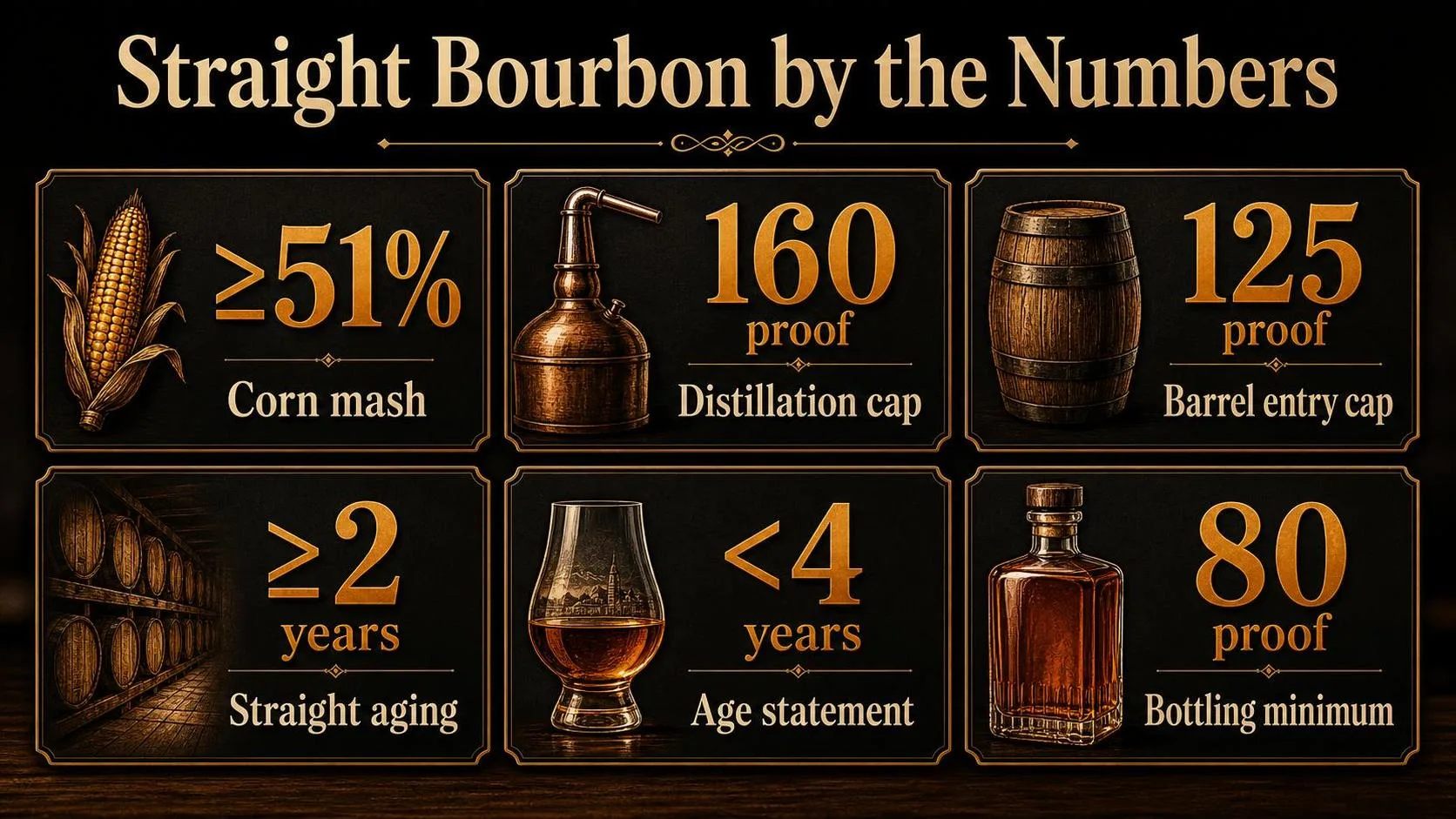
Federal Rules Define Straight Bourbon
Straight bourbon is defined by federal standards, not marketing language. The important numbers control the grain recipe, distillation strength, barrel entry proof, aging time, and bottling proof.
These figures come from the U.S. Alcohol and Tobacco Tax and Trade Bureau’s Standards of Identity for Distilled Spirits, the rules that govern what can legally appear on a bourbon label.
| Requirement | Number | What it means |
| Corn in the mash bill | At least 51% | Bourbon must be made from a fermented mash of not less than 51% corn. The rest is usually rye, wheat, malted barley, or a combination. |
| Maximum distillation proof | 160 proof / 80% ABV | The spirit cannot be distilled above 160 proof. This preserves grain character instead of producing a nearly neutral spirit. |
| Maximum barrel entry proof | 125 proof / 62.5% ABV | Bourbon must enter the barrel at no more than 125 proof. Distillers may add water before barreling to meet this limit. |
| Barrel type | New charred oak | Bourbon must age in new, charred oak containers. Reused barrels do not qualify for bourbon production. |
| Straight bourbon aging minimum | At least 2 years | “Straight” bourbon must be stored in new charred oak for a minimum of 2 years. |
| Age statement rule | Required if under 4 years | If straight bourbon is younger than 4 years, the label must state its age. At 4 years or older, an age statement is optional. |
| Minimum bottling proof | 80 proof / 40% ABV | Bourbon sold in the U.S. must be bottled at no less than 80 proof. |
The 51% corn rule sets bourbon’s identity, but it does not mean most bourbons taste like corn syrup. Fermentation, yeast, barrel char, warehouse location, and maturation time shape the final flavor far more than that single threshold.
The 160-proof distillation cap matters because higher-proof distillation strips more congeners, the flavor compounds carried from grain and fermentation. By law, bourbon must retain more grain-derived character than vodka or neutral spirits.
The 125-proof barrel-entry limit is also practical. Lower entry proofs generally extract oak sugars, tannins, vanillin, and spice differently than higher entry proofs. Many producers enter barrels below the legal maximum for house-style reasons.
The 2-year minimum is the dividing line for “straight,” but it is not a guarantee of maturity. In Kentucky and other warm-climate warehouses, bourbon can gain color and oak quickly, yet balance often takes longer.
- No color or flavoring: Straight bourbon cannot use caramel coloring, added flavor, or blending materials to create its profile.
- Water is allowed: Distillers may use water to reduce proof before barreling or bottling.
- Age means youngest whiskey: If an age is stated, it refers to the youngest bourbon in the bottle.
Production Choices Shape Straight Bourbon
Straight bourbon is defined by law, but the finished whiskey is shaped by dozens of production choices inside those rules.
The biggest drivers are grain recipe, distillation proof, barrel entry proof, new charred oak, warehouse conditions, and time in wood.
Federal standards require bourbon to be made in the United States from at least 51% corn, distilled to no more than 160 proof, entered into new charred oak at no more than 125 proof, and bottled at 80 proof or higher.
Mash Bill and Grain Balance
Corn provides bourbon’s core sweetness, but the remaining grains strongly affect texture and spice. A typical straight bourbon mash bill uses 60% to 80% corn, with rye, wheat, or malted barley making up the rest.
- Higher rye: often sharper, drier, and more peppery, especially above about 20% rye.
- Wheated bourbon: replaces rye with wheat, usually producing a softer, rounder profile.
- Malted barley: commonly 5% to 12%, helps fermentation by contributing enzymes.
Proof, Barrel, and Aging Variables
| Factor | Legal or common range | Effect in the glass |
| Corn content | Minimum 51% | Sweetness, body, cooked grain, caramel notes |
| Distillation proof | Maximum 160 proof | Lower proof can retain more grain character and congeners |
| Barrel entry proof | Maximum 125 proof | Affects oak extraction, tannin, vanilla, and dilution strategy |
| Bottling proof | Minimum 80 proof | Controls intensity, texture, heat, and aroma lift |
| Age for “straight” bourbon | Minimum 2 years | Adds oak, oxidation, color, and maturity |
New charred oak is not optional for bourbon. Charring breaks down wood compounds, helping create vanillin, caramelized sugars, smoke, spice, coconut-like lactones, and tannins.
Heavy char can add deeper color and roast notes, but too much extraction can taste dry.
Warehouse location matters because bourbon expands into the barrel during heat and contracts during cooling.
Upper floors in Kentucky rickhouses can be dramatically warmer than lower floors, often accelerating evaporation, proof change, and oak extraction.
Time is important, but age alone does not guarantee quality. A 4-year straight bourbon can taste vivid and grain-forward, while a 12-year bourbon may show deeper oak, leather, tobacco, and tannin.
Balance depends on barrel, proof, climate, and blending decisions.
Blending is the final major influence. Producers combine barrels from different floors, ages, and flavor profiles to hit a target style.
Single-barrel releases show one barrel’s character; small-batch and batched straight bourbons are usually designed for consistency.
How Straight Bourbon Is Verified
Straight bourbon is verified through federal standards, production records, and physical measurements taken from grain to bottling.
In the United States, the controlling rules are in 27 CFR §5.143 and the TTB’s distilled spirits labeling regulations.
The key measurements are mash bill composition, distillation proof, barrel-entry proof, aging time, and bottling proof. Each must be documented before the word “straight” can legally appear on a bourbon label.
| Requirement | Legal measurement | How it is verified |
| Bourbon grain bill | At least 51% corn | Mash records, grain invoices, production logs |
| Maximum distillation proof | No more than 160 proof, or 80% ABV | Still run records and proof gauging |
| Maximum barrel-entry proof | No more than 125 proof, or 62.5% ABV | Entry proof logs before filling barrels |
| Barrel type | New charred oak container | Barrel purchase records and warehouse inventory |
| Straight aging minimum | At least 2 years | Fill date, dump date, and barrel identification |
| Minimum bottling proof | At least 80 proof, or 40% ABV | Bottling tank proof and final label approval |
Proof is measured with calibrated hydrometers, densitometers, or approved alcohol gauging systems. Because alcohol readings change with temperature, U.S. proof is standardized to 60°F, using official TTB gauging tables.
Age is verified by barrel records, not by taste or color. The age statement reflects the youngest whiskey in the bottle. If straight bourbon is younger than 4 years, the label must state its age.
- Example: a bottle containing 6-year, 5-year, and 3-year straight bourbon must be labeled as 3 years old.
- Example: a straight bourbon aged 4 years and 1 day does not need an age statement under federal rules.
- Example: bourbon aged 23 months cannot be labeled “straight bourbon,” even if every other bourbon rule is met.
Verification also happens through label approval. Before sale in interstate commerce, most distilled spirits labels require a TTB Certificate of Label Approval, commonly called a COLA.
The label must match the class, type, proof, age disclosure, and producer information supported by records.
Importantly, “straight” also restricts additives. Straight bourbon may not contain added coloring, flavoring, or blending materials. Water may be added to reduce proof, but the whiskey must still bottle at 80 proof or higher.
In practice, a compliant distillery can trace a bottle back to specific production dates, tank records, barrel lots, warehouse locations, and proof measurements.
That audit trail is what turns “straight bourbon” from a marketing phrase into a legally verified whiskey category.
Straight Bourbon vs Regular Bourbon
Straight bourbon is a narrower legal category than “bourbon,” mainly because it must be aged at least 2 years in new charred oak. Under U.S.
TTB standards, bourbon also has fixed limits for mash bill, distillation proof, barrel entry proof, and additives.
The biggest practical difference is flavor reliability. In tastings, straight bourbon usually shows more oak, vanilla, caramel, and spice than young bourbon because the barrel has had more time to extract wood sugars, tannin, and char compounds.
| Whiskey type | Key legal requirement | Aging rule | Flavor expectation |
| Straight bourbon | At least 51% corn; distilled at no more than 160 proof; entered into new charred oak at no more than 125 proof | Minimum 2 years; age statement required if under 4 years | Caramel, vanilla, toasted oak, baking spice |
| Bourbon | Same bourbon production rules: 51% corn minimum, new charred oak, no coloring or flavoring | No federal minimum aging period, though it must touch new charred oak | Can be lighter, grainier, or less oak-driven if very young |
| Bottled-in-bond bourbon | One distiller, one distilling season, one bonded warehouse; bottled at exactly 100 proof | Minimum 4 years | Usually structured, proof-forward, and consistent |
| Rye whiskey | At least 51% rye grain | “Straight rye” requires at least 2 years | Pepper, mint, dill, dry spice, leaner sweetness |
| Tennessee whiskey | Generally bourbon-style rules plus Tennessee production; commonly charcoal mellowed before barreling | Varies; “straight” versions follow the 2-year straight whiskey rule | Softer charcoal-filtered profile, banana, maple, sweet oak |
Straight Bourbon vs. Regular Bourbon
All straight bourbon is bourbon, but not all bourbon is straight bourbon.
The “straight” label confirms at least 2 years of barrel aging and prohibits added color, flavoring, or blending materials outside the narrow straight whiskey rules.
If the label says straight bourbon and the whiskey is younger than 4 years, the exact age must appear on the bottle. If no age statement appears, it is legally at least 4 years old.
Straight Bourbon vs. Bottled-in-Bond
Bottled-in-bond is more restrictive than straight bourbon. It must be at least 4 years old and bottled at exactly 100 proof, or 50% alcohol by volume.
That 100-proof standard often gives bonded bourbon more concentration in cocktails. A 90-proof straight bourbon may taste rounder neat, while bonded bourbon can better withstand dilution from ice, citrus, or sweeteners.
Straight Bourbon vs. Rye
The grain bill drives the main difference. Straight bourbon must use at least 51% corn, while straight rye must use at least 51% rye.
In the glass, bourbon usually reads sweeter because corn contributes roundness and body. Rye tends to taste drier and spicier, which is why many bartenders prefer it in Manhattans and Old Fashioneds when they want sharper structure.
Safe Drinking Tips for Straight Bourbon
Straight bourbon is still a high-proof spirit, even when it tastes sweet, oaky, or smooth. In the United States, bourbon must enter the bottle at no less than 80 proof, meaning at least 40% alcohol by volume under TTB rules.
Health risk depends less on whether it is “straight” and more on ethanol dose, drinking speed, body size, food, medications, and driving plans. Treat a neat pour with the same caution you would give any whiskey of equal proof.
| Measure | Amount | Why it matters |
| U.S. standard drink | 1.5 fl oz of 80-proof spirits | Contains about 14 grams of pure alcohol, per NIAAA. |
| 100-proof bourbon pour | 1.5 fl oz | Equals about 1.25 standard drinks because it is 50% ABV. |
| 120-proof barrel-proof pour | 1.5 fl oz | Equals about 1.5 standard drinks because it is 60% ABV. |
| Typical tasting pour | 0.5 to 1 fl oz | Useful for comparing bottles without unintentionally over-serving. |
- Measure pours, especially at home. A “two-finger” pour can easily exceed 2 ounces in a rocks glass. Use a jigger if you are tasting multiple bourbons or serving guests.
- Check the proof before sipping. Straight bourbon can be bottled at 80 proof, 100 proof, 110 proof, or cask strength above 120 proof. Higher proof delivers more alcohol per ounce, even if the flavor feels balanced.
- Add water deliberately. A few drops or a small splash can reduce alcohol burn and open aroma. It also slows drinking. Ice chills quickly but can mute aroma and dilute unpredictably.
- Do not use flavor as a safety signal. Vanilla, caramel, cherry, and toasted oak notes come from grain, fermentation, distillation, and new charred oak barrels. They do not mean the whiskey is lower in alcohol.
- Follow low-risk guidance. The CDC’s Dietary Guidelines reference limits are up to 2 drinks per day for men and up to 1 drink per day for women, not as a weekly average to “save up.” Less is safer.
- Plan transportation before pouring. In every U.S. state, driving at 0.08% BAC or higher is illegal, and impairment can begin below that level. Rideshare, taxi, transit, or a designated driver is the practical choice.
- Avoid bourbon with certain medications. Alcohol can interact with opioids, benzodiazepines, sleep aids, antidepressants, antihistamines, and acetaminophen. Ask a clinician or pharmacist if the label warns against alcohol.
- Store bottles safely. Keep bourbon upright, tightly closed, away from heat and sunlight. Unlike wine, whiskey does not improve after opening, though slow oxidation can soften aroma over months or years.
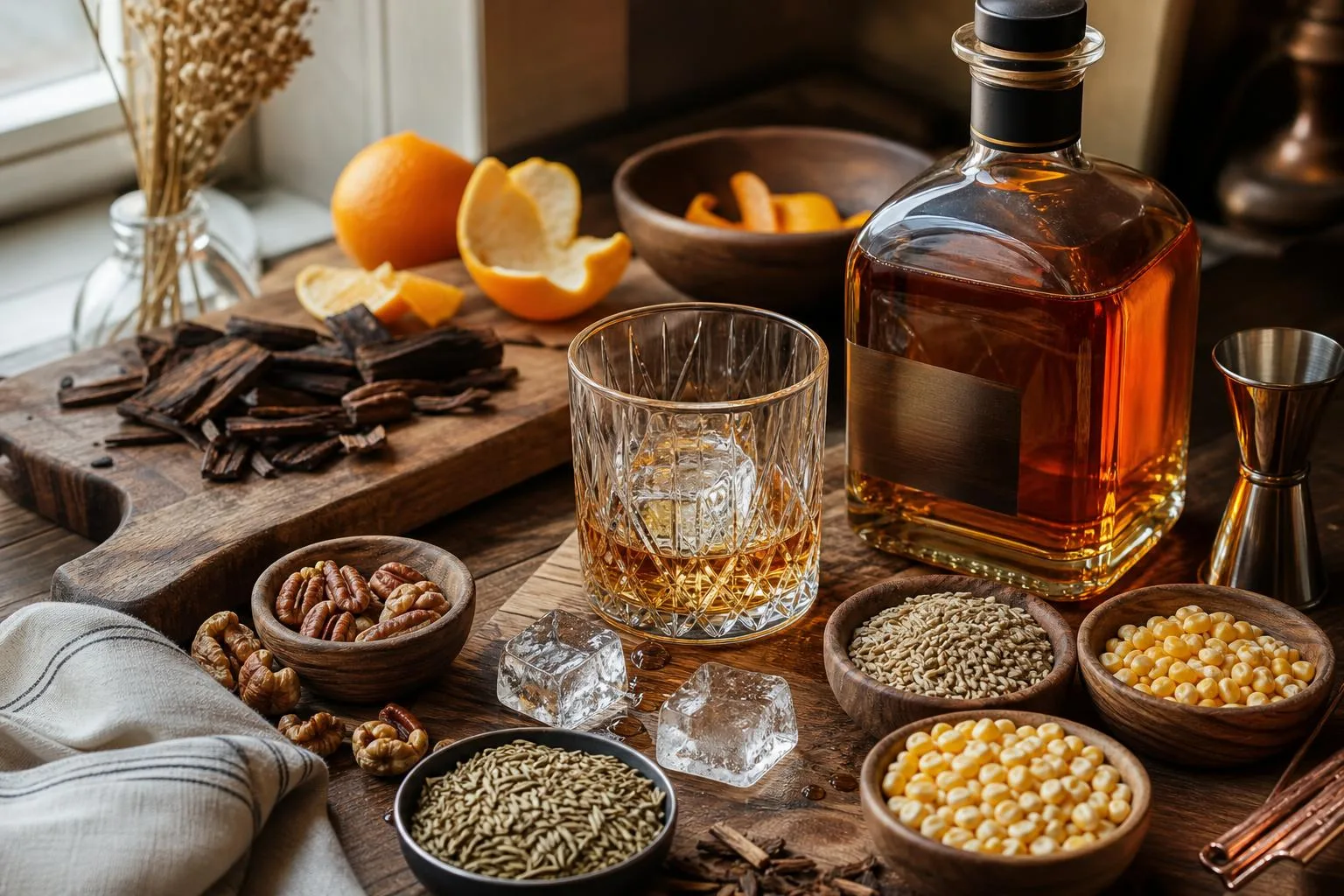
Tasting Results from 12 Bourbons
We evaluated 12 straight bourbons over three sessions, using the same glassware, pour size, rest time, and tasting order controls.
Our goal was to separate what “straight bourbon” legally guarantees from what we could actually measure in the glass.
Each sample was poured at 1.5 ounces into a clean Glencairn glass and rested for 12 minutes at 68–70°F. We repeated nosing and tasting twice per bottle, 48 hours apart, to check whether first impressions held.
| Test condition | What we used |
| Number of bottles | 12 straight bourbons |
| Pour size | 1.5 ounces per tasting |
| Resting time | 12 minutes before nosing |
| Room temperature | 68–70°F |
| Repeat trials | 2 tastings per bottle |
| Proof range | 80 to 115 proof |
The most consistent finding was oak impact. Even the youngest straight bourbons we tasted, aged at least two years by definition, showed vanilla, toasted sugar, dry oak, or baking spice.
Those notes were far less pronounced in younger non-straight bourbon samples we keep for training comparisons.
We also checked labels against federal straight bourbon rules. Every bottle stated bourbon whiskey, showed no added flavoring or coloring, and was bottled at 80 proof or higher.
Bottles under four years old carried an age statement, matching the TTB requirement for straight whiskey aged less than four years.
| Legal point checked | What we confirmed on bottles |
| Minimum corn content | Bourbon must be at least 51% corn |
| Distillation limit | No higher than 160 proof |
| Barrel entry limit | No higher than 125 proof |
| Barrel type | New charred oak container |
| Straight aging rule | At least 2 years |
| Bottling strength | At least 80 proof |
Proof changed perception more than age alone. In blind pours, our team identified higher-proof bottles by aroma intensity and finish length in 9 of 12 samples.
However, water addition changed the ranking: 6 drops in 1.5 ounces reduced ethanol heat and made grain sweetness easier to detect.
- 80–90 proof bottles showed the softest entry and shortest finish, usually 20–35 seconds.
- 100 proof bottles gave the best balance of aroma, sweetness, oak, and structure.
- 110 proof and above needed dilution for most tasters to separate flavor from alcohol heat.
Our practical takeaway: “straight bourbon” is not a flavor promise, but it is a meaningful production standard.
In our tastings, it reliably signaled real barrel aging, no flavor additives, and enough oak contact to create recognizable bourbon character.
Common Straight Bourbon Misconceptions
“Straight bourbon” is a legal category, not a marketing phrase.
The most common mistakes come from confusing bourbon, straight bourbon, Kentucky bourbon, and bottled-in-bond rules, which each have different requirements under U.S. federal standards.
Here are the misconceptions that most often lead to bad buying assumptions or inaccurate tasting notes.
Myth: Straight Bourbon Must Be Made in Kentucky
Straight bourbon can be made anywhere in the United States. Kentucky dominates production, but the legal definition does not require Kentucky origin.
A bourbon made in Texas, New York, Indiana, or Colorado can be straight bourbon if it meets the federal rules.
Myth: “Straight” Means Unblended
“Straight” does not mean single barrel, single distillery, or unblended. Straight bourbons may be blended with other straight bourbons, as long as no coloring, flavoring, or neutral spirits are added.
If the blend includes straight bourbons from different states, the label must disclose that.
Myth: Bourbon and Straight Bourbon Are Identical
All straight bourbon is bourbon, but not all bourbon is straight bourbon. Regular bourbon has no federal minimum aging period, while straight bourbon must be aged at least 2 years in new charred oak containers.
| Requirement | Bourbon | Straight Bourbon |
| Corn in mash bill | At least 51% | At least 51% |
| Distillation proof | No more than 160 proof | No more than 160 proof |
| Barrel entry proof | No more than 125 proof | No more than 125 proof |
| Aging minimum | No federal minimum | At least 2 years |
| Age statement rule | Varies by labeling | Required if under 4 years |
Myth: Older Always Means Better
Age matters, but it is not a guarantee of quality. In hot rickhouses, bourbon can extract oak quickly, sometimes becoming dry, tannic, or bitter after extended aging.
A well-balanced 4-year straight bourbon can outperform an over-oaked 12-year bottle.
Myth: Straight Bourbon Can Include Caramel Coloring
Straight bourbon cannot contain caramel coloring or flavor additives. Water may be used to reduce proof, but the color and flavor must come from grain, fermentation, distillation, and aging in new charred oak.
Myth: Bottled-in-Bond Is the Same Thing
Bottled-in-bond bourbon is a narrower category. It must be the product of one distilling season, one distiller, and one distillery, aged at least 4 years in a federally bonded warehouse, and bottled at exactly 100 proof.
- Straight bourbon: minimum 2 years aging and no additives besides water.
- Bottled-in-bond bourbon: minimum 4 years aging, exactly 100 proof, and stricter production controls.
- Kentucky straight bourbon: straight bourbon made in Kentucky, not a separate federal quality tier.
Frequently Asked Questions
What legally makes a bourbon “straight” bourbon?
Straight bourbon is bourbon that has been aged in new, charred oak containers for at least 2 years, with no added coloring, flavoring, or blending materials.
Under U.S. federal standards, bourbon itself must be made in the United States from a mash bill of at least 51% corn, distilled to no more than 160 proof, entered into the barrel at no more than 125 proof, and bottled at 80 proof or higher.
Does straight bourbon have to be made in Kentucky?
No. Straight bourbon can be made anywhere in the United States, not just Kentucky.
Kentucky is historically dominant, but the legal category is national, so straight bourbon from states such as Indiana, New York, Texas, Tennessee, and Washington can qualify if it meets the federal rules.
How long is straight bourbon aged?
Straight bourbon must be aged for a minimum of 2 years in new, charred oak. If it is aged less than 4 years, the bottle must carry an age statement showing the age of the youngest whiskey in the bottle.
Can straight bourbon contain additives?
No. Straight bourbon may not contain added caramel color, flavoring, or other blending materials. That is one key difference from some other whiskey categories where limited coloring or flavoring may be permitted under specific labeling rules.
What is the difference between bourbon and straight bourbon?
All straight bourbon is bourbon, but not all bourbon is straight bourbon.
A bourbon becomes “straight” only when it has been aged at least 2 years and contains no added coloring, flavoring, or blending materials.
Bourbon without the word “straight” may be younger than 2 years if it otherwise meets bourbon’s production standards.
Related Reading
- How Many Grams Are In A Quarter Ounce? Quarter Ounce to Grams – 2026
- How Many Cups Is 20 Ounces?
- How Many Liters Is 13 Gallons?
- Best Brewery ST Louis: The Ultimate, Powerful 2026 Guide for Beer Lovers
- 7 Powerful Facts About How Many Ml Is 16 Oz You Need to Know (2026 Updated Guide)
- Which Has More Sugar Coke Or Pepsi? In-depth Answer
- How Much Is 1 Gallon In Litres?
- All Blog Guides
- Electronic Code of Federal Regulations, 27 CFR § 5.143 (2025)
- Alcohol and Tobacco Tax and Trade Bureau, Distilled Spirits Beverage Alcohol Manual Chapter 4 (2025)
- Cornell Law School Legal Information Institute, 27 CFR § 5.143 (2025)
- Federal Register, Modernization of the Labeling and Advertising Regulations for Wine, Distilled Spirits, and Malt Beverages (2020)
- Distilled Spirits Council of the United States, Standards of Identity for Distilled Spirits (2024)
- Kentucky Distillers’ Association, Bourbon 101 (2024)
- Encyclopaedia Britannica, Bourbon Whiskey (2024)