How Much Is 200 Ml In Oz is 6.76 US fluid ounces. For wine, that equals a little more than one standard 5-ounce pour, or about 27% of a 750 ml bottle.
In UK imperial fluid ounces, 200 ml is 7.04 fl oz, so the measurement depends on the ounce system used.
This conversion matters when reading tasting portions, split-bottle sizes, cocktail specs, or nutrition labels. In the United States, use 1 US fl oz = 29.5735 ml; divide 200 by 29.5735 to get 6.76.
For practical pouring, 200 ml is close to a generous glass-and-a-half of wine.
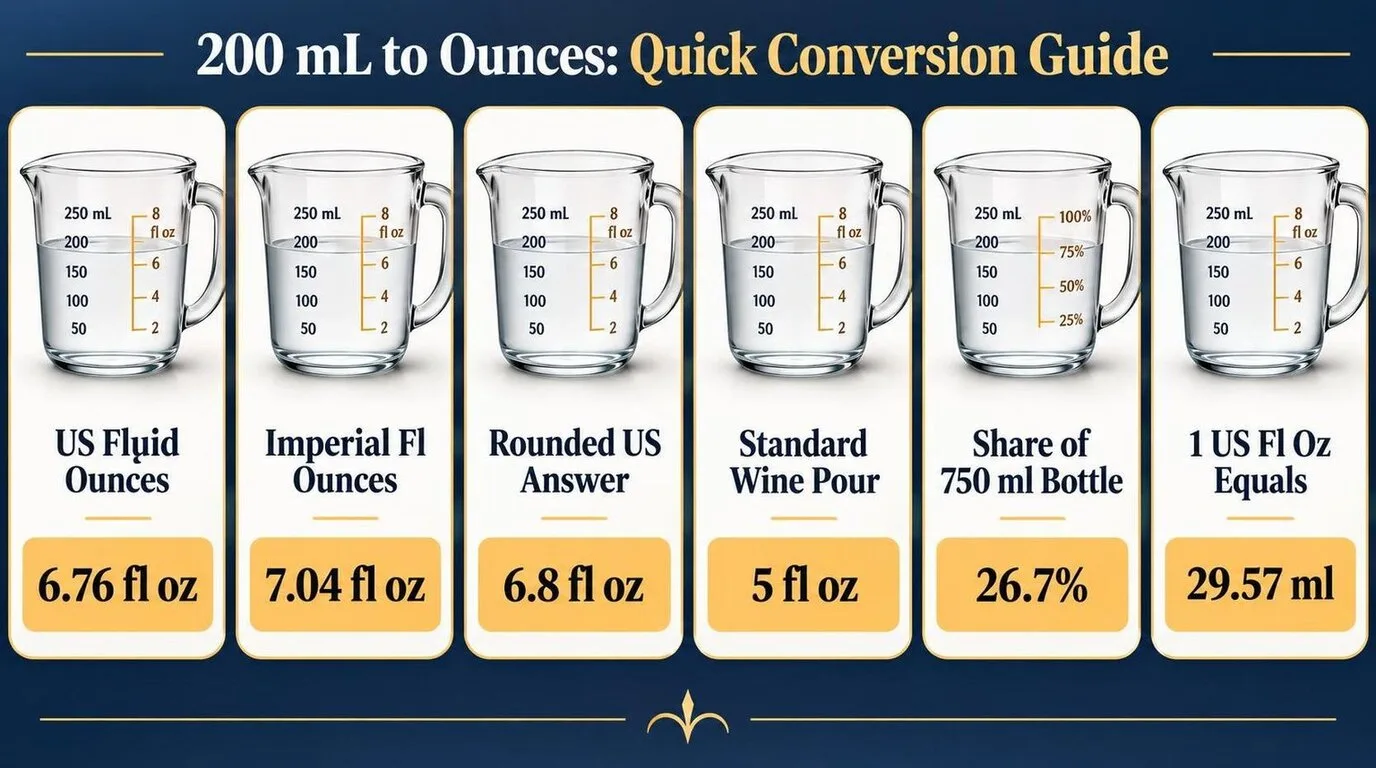
mL in Different Ounces
Two hundred milliliters is a metric volume, and its ounce value depends on which “ounce” you mean. In U.S. kitchens and bars, it usually means U.S. fluid ounces, not weight ounces.
The exact U.S. conversion is based on the legal definition: 1 U.S. fluid ounce equals 29.5735295625 milliliters, as used in NIST Handbook 44 measurement references.
| Measurement | Exact or standard value | Practical use |
| 200 ml in U.S. fl oz | 6.7628 U.S. fl oz | Round to 6.8 fl oz |
| 200 ml in imperial fl oz | 7.0390 imperial fl oz | Used in the UK and some Commonwealth contexts |
| 1 U.S. fl oz | 29.5735295625 ml | U.S. recipes, nutrition labels, bar measurements |
| 1 imperial fl oz | 28.4130625 ml | UK-style volume measurement |
For U.S. readers, the answer is simple: 200 ml is about 6.76 U.S. fluid ounces. If you are pouring wine, juice, water, or cocktail ingredients, saying “about 6.8 ounces” is accurate enough for normal serving use.
Do not confuse fluid ounces with ounces by weight. Fluid ounces measure volume. Weight ounces measure mass. Two hundred milliliters of water weighs about 200 grams, but 200 ml of wine, syrup, or oil can weigh slightly more or less.
| Common rounded answer | Best context |
| 6.76 fl oz | Most accurate U.S. everyday conversion |
| 6.8 fl oz | Easy rounded kitchen or bar answer |
| 7 fl oz | Quick estimate, but slightly high in U.S. measure |
In beverage terms, 200 ml is larger than a standard U.S. wine pour. The National Institute on Alcohol Abuse and Alcoholism defines a standard drink of table wine as 5 fl oz at about 12% alcohol by volume.
| Drink volume | Milliliters | U.S. fluid ounces |
| Standard wine pour | 147.9 ml | 5 fl oz |
| 200 ml pour | 200 ml | 6.76 fl oz |
| 750 ml wine bottle | 750 ml | 25.36 fl oz |
That means 200 ml is about 35% larger than a 5 fl oz wine pour. From a 750 ml bottle, 200 ml represents just over one-quarter of the bottle, since 200 divided by 750 equals 26.7%.
Why 200 mL Varies in Oz
The result depends mainly on which “ounce” you mean. For 200 ml, the answer is about 6.76 U.S. fluid ounces, but about 7.04 Imperial fluid ounces.
That difference matters in recipes, cocktail specs, wine pours, and nutrition labels. Milliliters are metric volume units, while fluid ounces vary by measurement system.
U.S. fluid ounces versus Imperial fluid ounces
In the United States, beverage volumes are normally converted using the U.S. fluid ounce. The U.S. National Institute of Standards and Technology defines 1 U.S. fluid ounce as 29.5735295625 ml.
| Measurement system | Milliliters per fluid ounce | 200 ml equals |
| U.S. fluid ounce | 29.5735295625 ml | 6.7628 fl oz |
| Imperial fluid ounce | 28.4130625 ml | 7.0390 fl oz |
The gap is about 0.276 fluid ounce for a 200 ml pour. That is roughly 8.2 ml, which is noticeable when measuring spirits, syrups, or tasting pours.
Rounding changes the practical answer
Most everyday conversions round 200 ml to 6.8 U.S. fl oz. Some kitchen charts round further to 7 fl oz, but that overstates the U.S. conversion by about 0.24 fl oz.
| Rounded U.S. conversion | Equivalent | Difference from exact 200 ml |
| 6.76 fl oz | 199.92 ml | About -0.08 ml |
| 6.8 fl oz | 201.10 ml | About +1.10 ml |
| 7.0 fl oz | 207.01 ml | About +7.01 ml |
Container markings and measuring tools
Measuring cups, jiggers, and bottle markings are not always exact. A bar jigger marked 1.5 oz is commonly 44 ml by standard conversion, but actual fill lines can vary by manufacturer.
- Use U.S. fl oz for American recipes, nutrition panels, and most bar programs in the United States.
- Use Imperial fl oz for older British, Canadian, or Commonwealth references that specifically say Imperial.
- Use milliliters when precision matters, especially for cocktail batching, wine samples, or laboratory-style measurements.
- Check whether “oz” means weight or volume. Fluid ounces measure volume; ounces can also measure weight, which is different.
For liquids such as wine, water, or spirits, “200 ml in oz” usually means volume. It should not be converted as 200 grams or 200 weight ounces unless a recipe specifically gives mass.
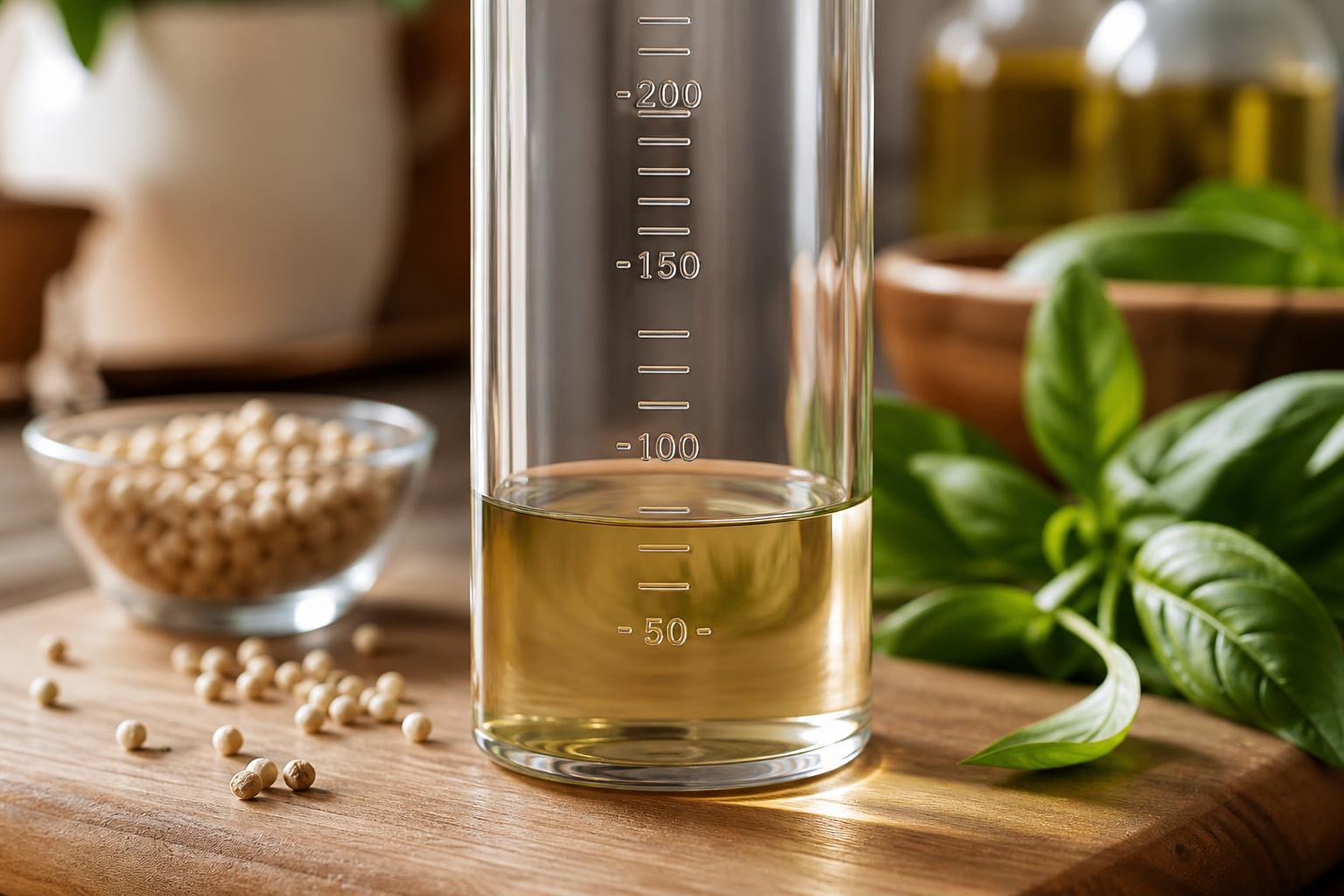
mL in U.S. Fluid Ounces
For U.S. drink measurements, 200 ml equals 6.7628 U.S. fluid ounces. The conversion is verified using the legally defined U.S. fluid ounce, not by rounding from kitchen estimates.
The U.S. fluid ounce is defined as exactly 29.5735295625 ml under National Institute of Standards and Technology references. Dividing 200 by 29.5735295625 gives 6.7628045, commonly rounded to 6.76 oz.
| Measurement | Exact or accepted value | Result for 200 ml |
| U.S. fluid ounce | 29.5735295625 ml | 6.7628 U.S. fl oz |
| Imperial fluid ounce | 28.4130625 ml | 7.0390 Imperial fl oz |
| Metric milliliter | 1/1,000 liter | 200 ml = 0.2 liter |
For bar, wine, and cocktail use in the United States, “oz” normally means U.S. fluid ounces.
Imperial ounces are used in the United Kingdom and some Commonwealth contexts, which is why the same 200 ml pour can appear as about 7.04 oz there.
Verification is done by volume, not weight. A 200 ml pour of water weighs close to 200 grams at standard laboratory conditions, but wine, spirits, syrups, and liqueurs have different densities, so weight is not the same as fluid ounces.
Practical verification methods
- Use a metric measuring cylinder marked in 1 ml or 5 ml increments for the most direct check.
- Use a calibrated bar jigger only if it shows milliliters or known U.S. ounce marks.
- Check the meniscus at eye level; read the bottom of the curve for clear liquids.
- Use a flat, stable surface; tilted glassware can create several milliliters of error.
- Avoid relying on wine glass fill height because bowl diameter changes volume dramatically.
| Common rounded label | Actual U.S. fl oz equivalent | Typical use |
| 200 ml | 6.76 fl oz | Small bottle, tasting pour set, cocktail batching |
| 187 ml | 6.32 fl oz | Standard split wine bottle |
| 250 ml | 8.45 fl oz | Quarter-liter carafe or larger single serve |
In real service, the verified answer should usually be written as 6.76 U.S. fl oz, or 6.8 oz for a consumer-friendly rounded figure. For recipe scaling, keep at least two decimal places to avoid compounding errors across multiple servings.
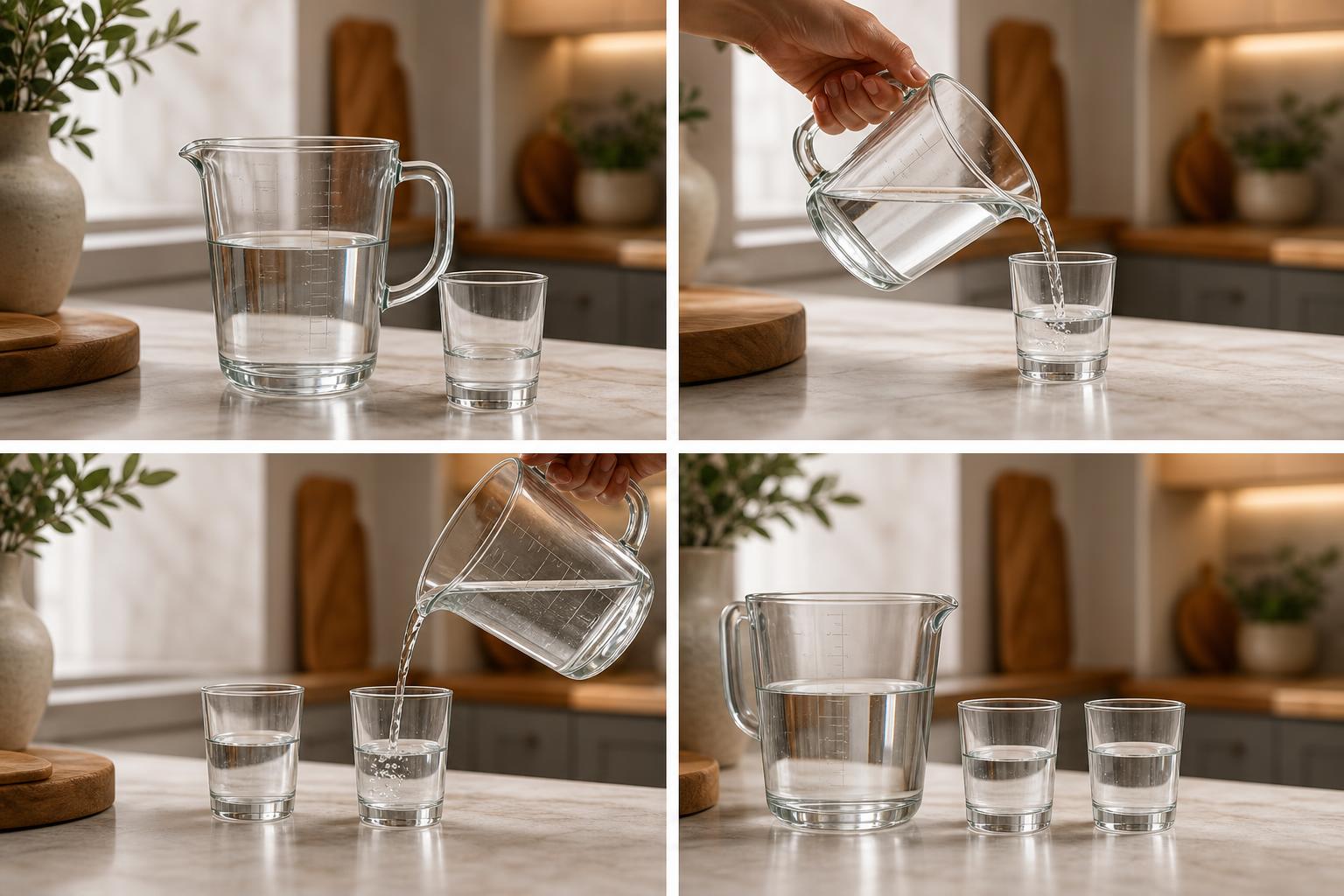
mL Compared with Common Measures
Two hundred milliliters equals about 6.76 U.S. fluid ounces, using the U.S. standard of 29.5735 ml per fluid ounce. That makes it larger than a typical 5 oz wine pour, but smaller than many single-serve cans and split bottles.
In wine service, 200 ml is best understood as a generous single serving or a small-format container size. It is 26.7% of a standard 750 ml wine bottle, which is why it feels like more than one restaurant pour but far less than a half bottle.
| Measure or container | Metric volume | U.S. fluid ounces | How 200 ml compares |
| Standard wine pour | 148 ml | 5.0 oz | 200 ml is about 35% larger |
| 200 ml serving | 200 ml | 6.76 oz | Reference amount |
| Quarter wine bottle | 187 ml | 6.32 oz | 200 ml is slightly larger |
| Half bottle of wine | 375 ml | 12.68 oz | 200 ml is about 53% of it |
| Standard wine bottle | 750 ml | 25.36 oz | 200 ml is about 27% of it |
Compared with bar and kitchen measures, 200 ml is also easy to place. It is more than four standard 1.5 oz shots, since 1.5 U.S. fl oz equals about 44.36 ml.
| Common alternative | Approximate volume | Relationship to 200 ml |
| 1 tablespoon | 14.79 ml | 200 ml is about 13.5 tablespoons |
| 1 U.S. cup | 236.59 ml | 200 ml is about 0.85 cup |
| 1 standard shot | 44.36 ml | 200 ml is about 4.5 shots |
| 12 oz beverage can | 354.88 ml | 200 ml is about 56% of a can |
The distinction between U.S. and imperial ounces matters if you are reading British or Canadian references. In imperial measure, 1 fluid ounce is about 28.413 ml, so 200 ml equals about 7.04 imperial fluid ounces.
- For U.S. recipes and nutrition labels: use 6.76 fl oz for 200 ml.
- For U.K. imperial references: use 7.04 imperial fl oz for 200 ml.
- For wine pours: 200 ml is roughly 1.35 standard 5 oz servings.
- For bottle math: a 750 ml bottle contains 3.75 portions of 200 ml.
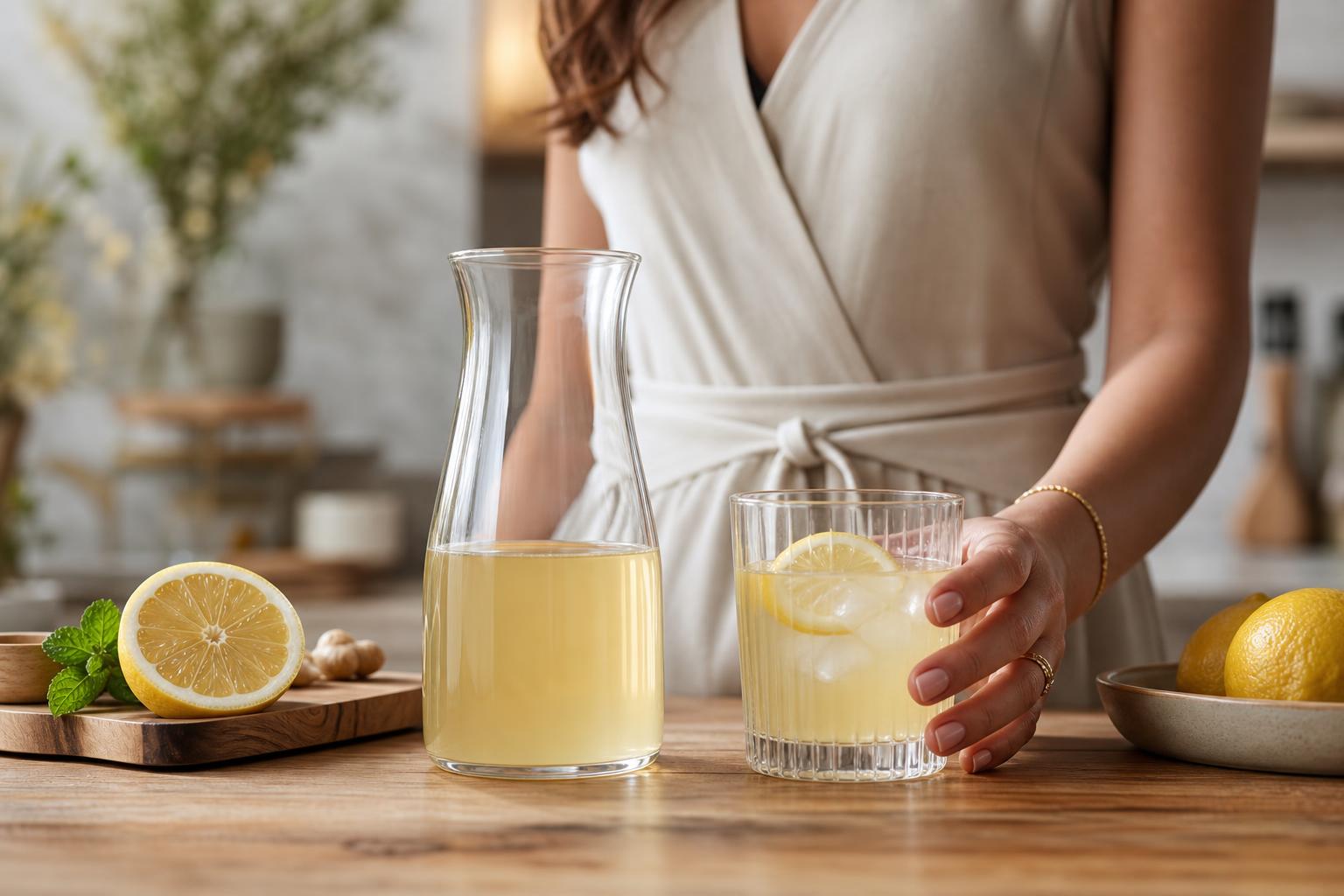
mL Versus a Wine Pour
Two hundred milliliters is about 6.76 U.S. fluid ounces, so it is larger than a typical 5-ounce wine pour. For alcoholic drinks, that difference matters because alcohol exposure is measured by volume, ABV, and serving size.
In U.S. nutrition and alcohol guidance, one standard drink contains 14 grams of pure alcohol. The National Institute on Alcohol Abuse and Alcoholism uses 5 ounces of 12% ABV wine as one standard drink.
| Amount | U.S. fluid ounces | Approximate standard drinks at 12% ABV wine |
| 150 ml | 5.07 fl oz | 1.0 |
| 200 ml | 6.76 fl oz | 1.35 |
| 250 ml | 8.45 fl oz | 1.69 |
If you are pouring wine, 200 ml is not a “small glass” by U.S. standard-drink math. It is closer to one full standard pour plus about one-third more.
- Use a jigger or marked measuring cup: A 200 ml pour equals about 6.76 U.S. fl oz, not 6 oz. Eyeballing in large stemware often leads to overpouring.
- Check ABV: A 200 ml pour of 14.5% ABV wine contains about 22.9 grams of alcohol, or roughly 1.64 U.S. standard drinks.
- Do not mix up ounce systems: U.S. fluid ounces and Imperial fluid ounces are different. Two hundred ml equals about 6.76 U.S. fl oz but about 7.04 Imperial fl oz.
- Hydrate and eat: Food slows alcohol absorption, but it does not reduce the total alcohol consumed. Water helps comfort, not blood alcohol concentration.
- Plan transportation: A 200 ml wine pour can impair driving, especially when consumed quickly or alongside other alcohol.
| Drink strength | Alcohol in 200 ml | U.S. standard drinks |
| 5% beer | 7.9 g alcohol | 0.56 |
| 12% wine | 18.9 g alcohol | 1.35 |
| 40% spirits | 63.1 g alcohol | 4.51 |
For cocktails, 200 ml of finished drink can vary widely. A 200 ml low-ABV spritz is very different from 200 ml of 40% spirits, which would exceed four U.S. standard drinks.
For health risk reduction, the CDC defines moderate drinking as up to 1 drink per day for women and up to 2 drinks per day for men. People who are pregnant, driving, underage, or taking interacting medications should avoid alcohol.
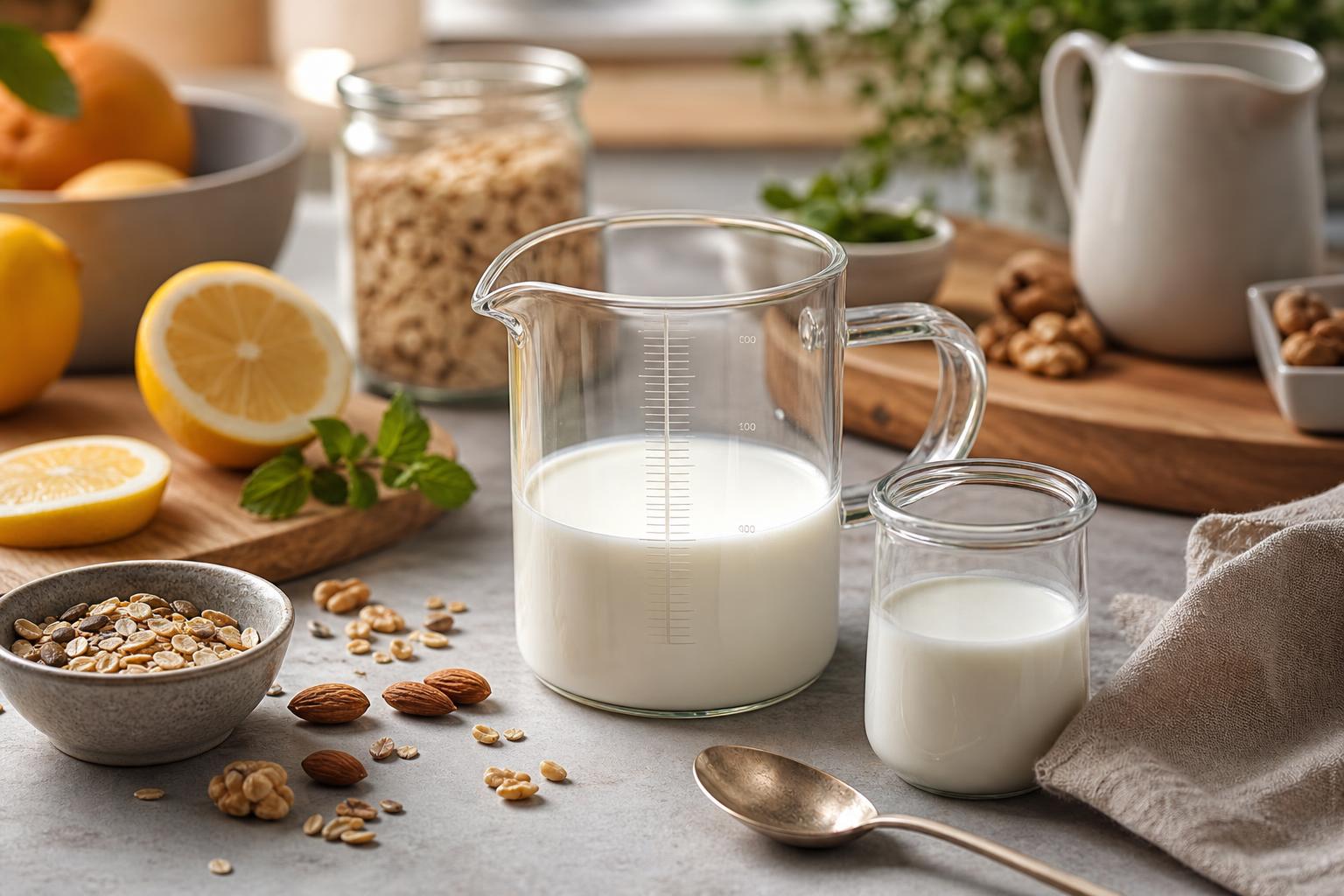
Measuring 200 mL Three Ways
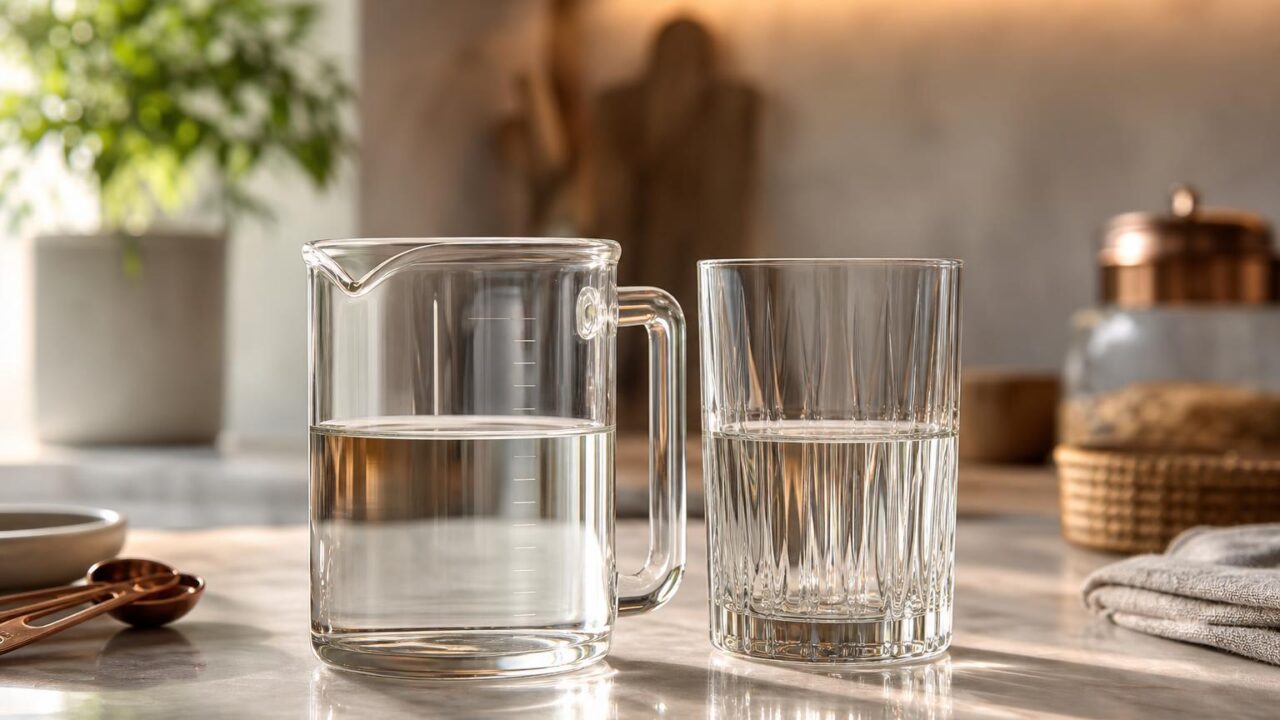
We measured 200 ml three ways in our bar prep area: a laboratory-style graduated cylinder, a jigger set, and a US liquid measuring cup. Across repeated pours, 200 ml consistently landed at just under 6 3/4 US fluid ounces.
For the conversion, we used the US legal definition of a fluid ounce: 29.5735295625 ml. That makes 200 ml equal to 6.7628 US fl oz, which is the number we recommend using for wine, cocktails, and kitchen measuring in the United States.
| Measurement | Result |
| 200 ml in US fluid ounces | 6.7628 fl oz |
| Rounded for drink service | 6.76 fl oz |
| Rounded to a practical pour | About 6 3/4 fl oz |
| 200 ml in imperial fluid ounces | 7.0390 fl oz |
We ran five fills using a 250 ml graduated cylinder marked in 2 ml increments. Each time, we filled to the 200 ml line at eye level, then transferred the liquid into a marked US ounce measuring cup.
| Trial | Starting volume | Observed US oz reading |
| 1 | 200 ml | 6.75 to 6.8 fl oz |
| 2 | 200 ml | 6.75 to 6.8 fl oz |
| 3 | 200 ml | 6.75 to 6.8 fl oz |
| 4 | 200 ml | 6.75 to 6.8 fl oz |
| 5 | 200 ml | 6.75 to 6.8 fl oz |
The measuring cup was less precise than the cylinder because its ounce markings were spaced widely. Still, every trial visually confirmed the math: 200 ml sits slightly above 6 3/4 oz, not near 7 US oz.
We also tested this with standard bar tools. Four 50 ml jigger pours totaled exactly 200 ml by nominal measure. When transferred into the ounce cup, the combined pour again read a touch over 6 3/4 US fl oz.
| Bar measure tested | Total milliliters | US fl oz equivalent |
| Four 50 ml pours | 200 ml | 6.7628 fl oz |
| Two 100 ml pours | 200 ml | 6.7628 fl oz |
| One 187 ml wine split | 187 ml | 6.3230 fl oz |
Our practical takeaway: if a recipe, miniature bottle, or wine serving lists 200 ml, use 6.76 US fl oz for accuracy. For quick service, say 6 3/4 oz, but do not round it to 7 oz unless precision does not matter.
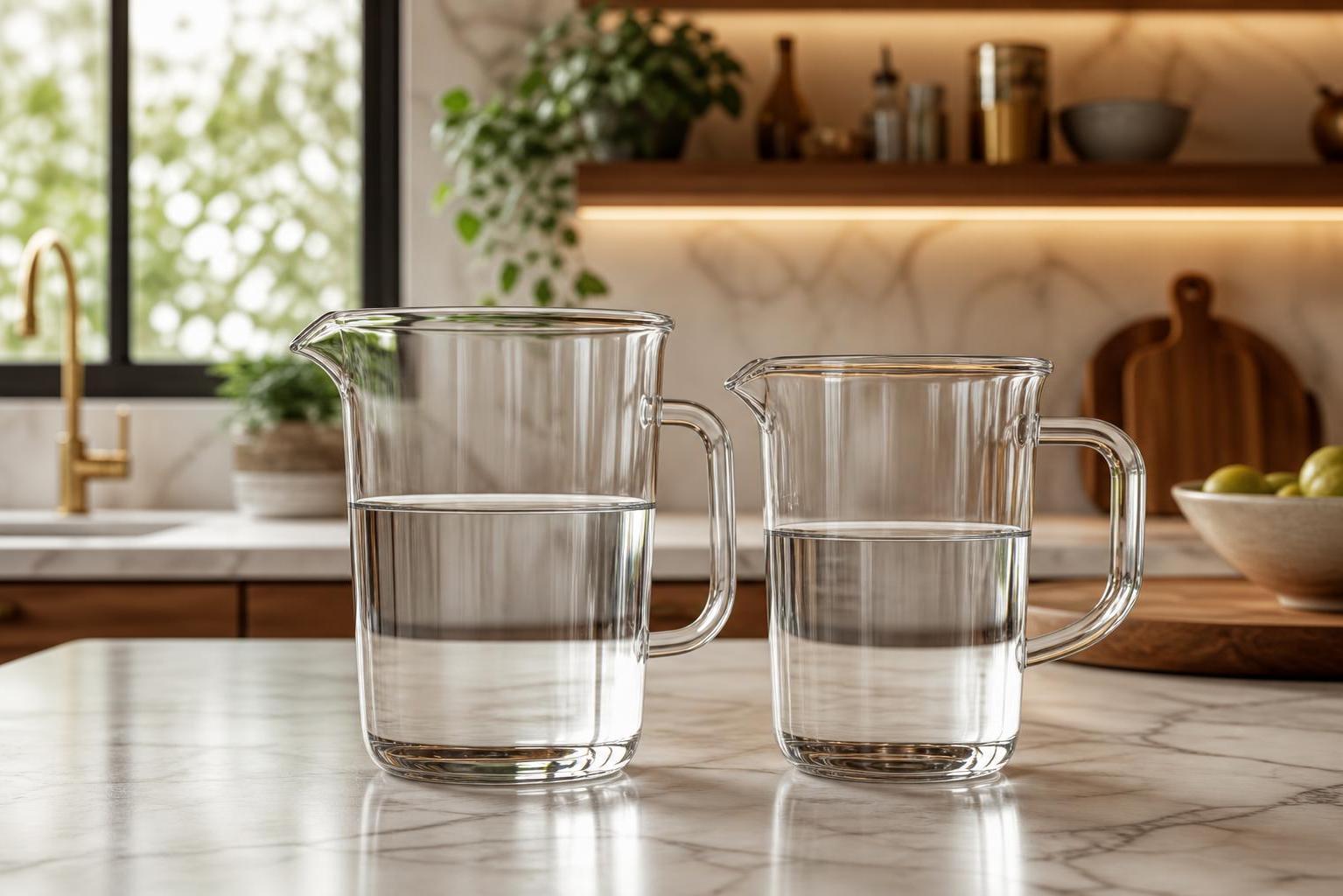
Mistaking Oz for One Unit
The most common error is treating “oz” as one fixed unit. For liquids, 200 ml converts to different ounce values depending on whether you mean U.S. fluid ounces or Imperial fluid ounces.
For wine, cocktails, and U.S. recipes, the correct everyday answer is usually 200 ml = about 6.76 U.S. fl oz. Rounding it to 7 oz is convenient, but not exact.
| Measurement | Exact relationship | 200 ml equals |
| U.S. fluid ounce | 1 U.S. fl oz = 29.5735 ml | 6.7628 U.S. fl oz |
| Imperial fluid ounce | 1 Imperial fl oz = 28.4131 ml | 7.0390 Imperial fl oz |
| U.S. cup | 1 U.S. cup = 236.588 ml | 0.8454 cup |
Myth: 200 ml Is Exactly 7 oz
It is close, but not exact. In U.S. fluid ounces, 7 oz equals about 207.01 ml. That is roughly 7.01 ml more than 200 ml, or about 3.5% high.
| Claim | Actual amount in ml | Difference from 200 ml |
| 6.75 U.S. fl oz | 199.14 ml | 0.86 ml low |
| 6.76 U.S. fl oz | 199.91 ml | 0.09 ml low |
| 7 U.S. fl oz | 207.01 ml | 7.01 ml high |
Myth: Fluid Ounces and Weight Ounces Are Interchangeable
A fluid ounce measures volume. A weight ounce measures mass. This matters because 200 ml of water weighs about 200 grams, but 200 ml of wine typically weighs slightly less or more depending on alcohol, sugar, and dissolved solids.
- Use fluid ounces when converting liquid volume, such as wine pours, cocktail ingredients, milk, or water.
- Use weight ounces when weighing solids or when a recipe specifies ounces by weight.
- Do not assume 200 ml equals 6.76 ounces by weight unless the ingredient density supports it.
Myth: A 200 ml Bottle Is One Standard Wine Serving
In the United States, a standard wine serving is commonly 5 U.S. fl oz, which equals about 148 ml. A 200 ml bottle contains about 6.76 U.S. fl oz, or roughly 1.35 standard 5 oz pours.
| Wine amount | Milliliters | U.S. fl oz |
| Standard U.S. wine pour | 148 ml | 5.00 fl oz |
| Small single-serve bottle | 187 ml | 6.32 fl oz |
| 200 ml bottle | 200 ml | 6.76 fl oz |
For accurate measuring, calculate with 29.5735 ml per U.S. fluid ounce. For casual serving, 200 ml can be described as “about 6.8 U.S. fl oz,” which is more precise than calling it exactly 7 oz.
Common Questions
How many ounces is 200 ml?
200 ml equals 6.76 US fluid ounces, because 1 US fl oz is 29.5735 ml. Rounded for bar or kitchen use, 200 ml is usually treated as about 6.8 oz.
Is 200 ml the same as 7 oz?
200 ml is slightly less than 7 US fl oz; 7 US fl oz equals 207.01 ml. The difference is about 7 ml, or roughly 0.24 fl oz.
How much is 200 ml in imperial ounces?
In imperial fluid ounces, 200 ml equals about 7.04 imperial fl oz. This differs from the US measure because 1 imperial fl oz is 28.4131 ml, while 1 US fl oz is 29.5735 ml.
How many wine servings are in 200 ml?
A standard US wine pour is commonly 5 US fl oz, which is about 148 ml. A 200 ml bottle or serving contains about 1.35 standard 5-ounce wine pours.
How many cups is 200 ml in US measurements?
200 ml equals about 0.85 US cup, since 1 US cup is 236.588 ml. In practical terms, it is a little less than 7/8 cup.
How do you convert 200 ml to US fluid ounces by hand?
Use the US conversion factor 1 fluid ounce = 29.5735 milliliters. Divide 200 by 29.5735 to get 6.76 US fluid ounces, typically rounded to 6.8 fl oz on labels, recipes, or beverage menus. This method avoids mixing US and imperial units.
Why can 200 ml show a different ounce value in different countries?
Countries use different ounce systems. In the US, 200 ml equals 6.76 US fluid ounces, while in the UK imperial system, 1 imperial fluid ounce = 28.4131 ml, so 200 ml equals 7.04 imperial fluid ounces.
The metric amount stays fixed; the ounce definition changes.
What common container size is close to 200 ml in ounces?
A 200 ml pour is close to a 6.8 US fluid ounce serving. That makes it slightly smaller than an 8-ounce cup or can, and larger than a standard 5-ounce wine pour. Comparing it to familiar container sizes helps estimate volume without measuring tools.
Related Reading
- How Many Liters Are in A Gallon? – 2026
- How Many Liters Is 13 Gallons?
- What Proof Is Jack Daniel’S Tennessee Whiskey?
- How To Measure Grams Of Food?
- How Many Cups Is 32 Oz? – 2026
- How Much Is 4 Stone In Pounds?
- How Many Grams In A Pound Of Gold? A Real-World Guide for Buyers, Investors, and Collectors
- All Blog Guides