black owned winery texas is a small but growing category of Black-owned tasting rooms, wine brands, and urban wineries operating across Houston, Dallas-Fort Worth, Austin, and the Texas Hill Country.
Texas has 8 federally recognized AVAs, giving these producers access to grapes from established regions such as Texas High Plains and Texas Hill Country.
This guide focuses on where to visit, what to expect in the glass, and how to verify ownership before planning a tasting.
You’ll find practical details on reservations, wine styles, and why supporting these wineries matters in a state now producing millions of gallons of wine annually.
Limits on Counting Black-Owned Wineries
There is no official Texas or federal census of Black-owned wineries, so any exact statewide total should be treated cautiously.
The most reliable numbers are the broader Texas wine-industry figures, then a verified, self-identified count of individual Black-owned producers and tasting rooms.
| Number | What it means | Why it matters for Black-owned wineries in Texas |
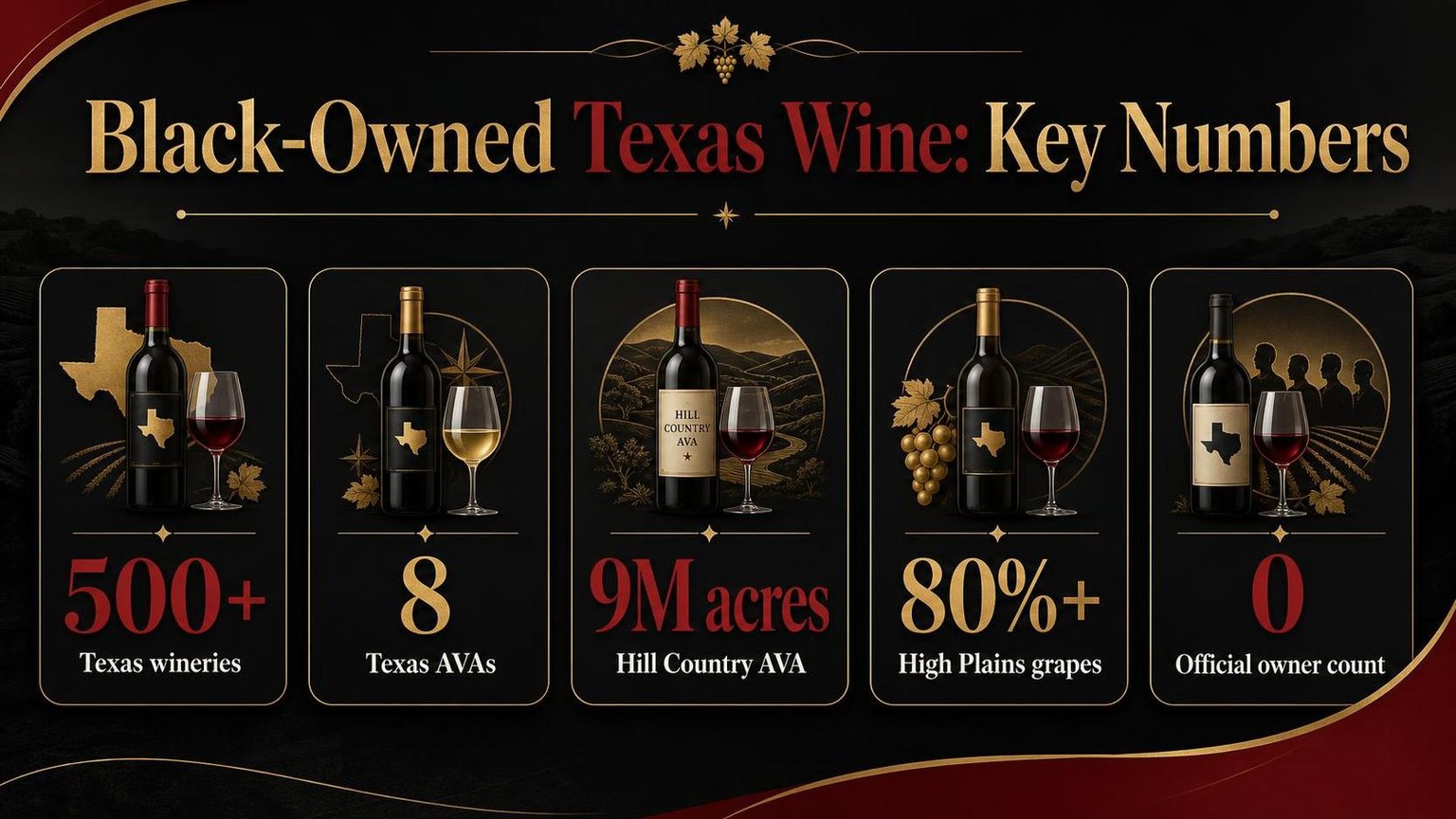
| 500+ | Texas has more than 500 wineries, according to the Texas Wine & Grape Growers Association. | Black-owned wineries operate inside a large, fast-growing state industry, but they remain a very small share of the total. |
| 8 | Texas has 8 federally recognized American Viticultural Areas, based on TTB AVA designations. | Black-owned brands may source from multiple Texas AVAs, especially when they do not own estate vineyards. |
| 9 million acres | The Texas Hill Country AVA covers roughly 9 million acres. | It is a major tourism corridor, but Black-owned Texas wineries are not concentrated there in the way many visitors expect. |
| 80%+ | The Texas High Plains is commonly cited by Texas wine educators and growers as producing more than 80% of the state’s wine grapes. | A Black-owned winery in Houston, Dallas, or Katy may still be heavily “Texas” if it uses High Plains fruit. |
| 0 official count | TABC permits, TTB bonded-winery records, and USDA agricultural data do not classify wineries by owner race. | Verification depends on owner interviews, winery websites, business profiles, and direct confirmation. |
The key takeaway is that “Black-owned winery in Texas” is not the same as “Black-owned vineyard.” Many Texas wine businesses buy grapes, lease production space, or use a custom-crush facility while building their brand.
That model is normal in wine. It is especially practical in Texas, where vineyard land, farming equipment, bonded production space, compliance, and tasting-room buildout can require significant capital before the first bottle is sold.
- Ownership: The business is Black-owned or co-owned, which should be confirmed through the winery’s own statements or direct reporting.
- Production: The wine may be made on-site, through a shared facility, or with a bonded winery partner.
- Fruit source: Grapes may come from Texas High Plains, Hill Country, out-of-state vineyards, or a blend of sources.
- Visitor experience: Some brands operate full tasting rooms; others sell through events, wine clubs, restaurants, or online allocations.
For consumers, the most meaningful number is not a statewide total. It is whether a winery clearly discloses ownership, sourcing, production approach, and where you can taste or buy the wine today.
What Qualifies as a Texas Winery
The answer to “black owned winery Texas” changes depending on whether you mean ownership, tasting-room location, grape source, or wine production site.
In Texas, those details matter because many small wineries use custom crush, contract vineyards, or fruit grown outside the county where they pour.
For readers planning a visit, the biggest variables are verification, geography, licensing, and current hours.
I’d check the winery’s own site and social channels first, then confirm with the Texas Alcoholic Beverage Commission license lookup before driving.
Ownership and verification
- Self-identification matters: A winery should clearly identify as Black-owned through its website, press coverage, founder interviews, or business profiles. Third-party listicles can become outdated quickly.
- License name may differ: The public-facing winery name may not match the legal entity on a TABC permit. That can make verification less obvious.
- Production model matters: Some Texas wineries own vineyards; others buy grapes, use shared production facilities, or focus on urban tasting rooms. None of those models disqualifies ownership, but they change what “winery” means.
Location changes the experience
| Texas wine fact | Number | Why it affects results |
| Texas wineries | More than 500 | Black-owned producers can be hard to find without ownership-specific filters. |
| Texas wine grape acreage | About 4,000 acres | Many wineries source grapes from outside their tasting-room city. |
| Texas Hill Country AVA size | About 9 million acres | Large geography means “Hill Country winery” can involve long drives. |
| Texas High Plains AVA size | About 8 million acres | This region supplies a major share of Texas-grown wine grapes. |
Those figures are consistent with Texas wine industry reporting from Texas Hill Country Wineries, Texas Wine & Grape Growers Association, and AVA descriptions published by the Alcohol and Tobacco Tax and Trade Bureau.
Wine style and grape source
- Urban wineries: Houston-area brands may focus on tasting-room hospitality, blends, and direct-to-consumer sales rather than estate vineyards.
- Hill Country producers: A winery near Spring Branch, Fredericksburg, or Johnson City may pour Texas-grown varieties such as Tempranillo, Mourvèdre, Tannat, or Viognier.
- Fruit wines count differently: Some Black-owned Texas wineries specialize in fruit wines or sweet wines. That is a distinct category from vinifera-based Texas AVA wines.
Availability is another limiting factor. Small wineries may sell mostly through tasting rooms, wine clubs, local delivery, festivals, or limited shipping, so a producer can be legitimate and still absent from grocery shelves or national wine apps.
How Black-Owned Status Is Verified
“Black-owned winery in Texas” is verified by separating three facts: ownership, licensed wine production or sales, and Texas operating presence.
The strongest confirmation comes from public alcohol-license records, federal winery records, and ownership certifications that require documentation.
For this topic, a winery should not be counted solely because it hosts Black-focused events, sells Black-made wines, or has a Black winemaker.
The core test is whether Black owners control the business and whether the business is legally operating in the Texas wine market.
| Verification point | What to check | Why it matters |
| Ownership | At least 51% ownership and control by Black individual owners, where certification is used | 51% is the standard threshold used by minority-business certification programs such as NMSDC-affiliated councils and many public procurement programs |
| Texas alcohol license | Texas Alcoholic Beverage Commission license or permit records, including winery, wholesaler, retailer, or tasting-room authority | TABC records show whether the business is legally licensed to make, sell, or serve wine in Texas |
| Federal production status | Alcohol and Tobacco Tax and Trade Bureau bonded winery or basic permit records | TTB records help confirm whether wine production or bonded winery activity is involved |
| Business identity | Texas Secretary of State entity filings, assumed-name records, and county DBA filings | These records connect the public-facing winery name to the legal company and officers |
The most reliable method is triangulation. A claim is strongest when the winery’s website names the owners, TABC shows an active Texas permit, and the legal entity matches Texas Secretary of State or county records.
- TABC license lookup: confirms active permits, business address, trade name, and license type. This is essential because Texas wine activity can occur through tasting rooms, retail permits, winery permits, or alternating-proprietor arrangements.
- TTB records: verify federally regulated production status. A business may be Black-owned and Texas-based without owning a bonded winery if it uses custom crush, contract production, or private-label production.
- Certification records: minority-owned certification usually requires proof of ethnicity, ownership documents, operating agreements, stock ledgers, tax records, and control of daily management.
- Direct confirmation: owner interviews, winery statements, and press coverage help verify identity, but they should be checked against license and entity records.
Counting should also distinguish a winery from a wine brand. A Black-owned Texas wine brand may source grapes, hire a bonded winery, and sell under its own label without owning production facilities.
| Category | Count only if |
| Black-owned Texas winery | Black ownership is documented and the business has Texas wine production, tasting-room, or winery operations |
| Black-owned Texas wine brand | Black ownership is documented, but production is outsourced or the business does not hold a winery permit |
| Texas venue selling Black-owned wine | Do not count as a winery unless ownership and wine-business licensing also qualify |
For accuracy, records should be rechecked at least annually because alcohol permits, ownership, trade names, and operating addresses can change.
A winery that was Black-owned in prior coverage may no longer meet the definition after a sale or licensing change.
Black-Owned Wineries vs Other Wineries
A Black-owned winery in Texas is not a separate wine style; it is an ownership and hospitality distinction inside the broader Texas wine market.
The practical comparison is usually between a Black-owned producer, a conventional Hill Country estate, an urban winery, or a wine bar carrying Texas bottles.
Texas is now one of the largest U.S. wine-producing states, with the Texas Department of Agriculture and industry groups commonly citing 500-plus wineries statewide.
Black-owned wineries remain a much smaller subset, so the experience is typically more intentional, founder-led, and limited-production.
| Option | Typical Texas example | Best for | Key tradeoff |
| Black-owned Texas winery | Pur Noire Urban Wineries in Houston; The Kai-Simone Winery in Spring Branch | Supporting underrepresented ownership, meeting founders, focused tastings | Fewer locations and often smaller production |
| Hill Country estate winery | Fredericksburg or Johnson City tasting rooms | Vineyard views, large tasting trails, weekend tourism | More crowded; less ownership diversity |
| Urban winery | Houston, Dallas, Austin, San Antonio tasting rooms | No long drive, after-work tastings, events | May source fruit from multiple regions rather than estate vineyards |
| Wine bar or retailer | Texas-focused bottle shops and restaurant lists | Comparing many producers in one sitting | No direct winery hospitality or production context |
Compared with a standard Hill Country itinerary, a Black-owned winery visit can be more personal.
At smaller tasting rooms, owners or winemakers are more likely to explain sourcing, blends, and brand history directly, rather than routing guests through a large-volume hospitality program.
The location difference matters. The Texas Hill Country AVA covers more than 9 million acres and was established in 1991, making it one of the largest AVAs in the United States.
A Houston-based urban winery, by contrast, can reduce a 4-hour Hill Country drive to a local tasting.
- Choose a Black-owned winery if ownership, representation, and direct founder engagement are part of the value you want from the visit.
- Choose a Hill Country estate if your priority is vineyard scenery, multiple nearby tasting rooms, and classic Texas wine tourism infrastructure.
- Choose an urban winery if convenience, nightlife, private events, or walkable dining nearby matter more than vineyard acreage.
- Choose a wine bar if you want to compare Texas Tempranillo, Mourvèdre, rosé, and sparkling wines without committing to one producer.
Quality should still be judged bottle by bottle. Texas’s strongest grapes often include Tempranillo, Mourvèdre, Sangiovese, Viognier, and Blanc du Bois, depending on site and producer.
Ownership tells you whom you are supporting; tasting, farming, and winemaking determine what is in the glass.
Planning a Texas Winery Visit
Visiting a Black-owned winery in Texas is usually relaxed and family-friendly, but Texas heat, rural driving distances, and alcohol rules require planning.
Most tasting rooms follow Texas Alcoholic Beverage Commission expectations, including refusing service to visibly intoxicated guests.
Bring water, eat before tasting, and assign a sober driver if your route includes multiple wineries. In Hill Country and North Texas, tasting rooms can be 20 to 45 minutes apart on two-lane roads.
Alcohol, Driving, and Legal Limits
| Item | Texas fact |
| Legal BAC limit for most drivers | 0.08 percent, under Texas Penal Code intoxication standards |
| Commercial driver BAC limit | 0.04 percent |
| Drivers under 21 | Any detectable alcohol can violate Texas zero-tolerance law |
| Typical tasting pour | 1 to 2 ounces per wine; five pours can equal one to two full glasses |
| Standard U.S. wine drink | 5 ounces of 12 percent ABV wine, per NIAAA guidance |
- Book ahead: Small Black-owned wineries and urban tasting rooms often operate by reservation, especially for guided tastings, food pairings, and private events.
- Ask about fees: Texas tasting fees commonly range from about $15 to $35 per person, with higher prices for reserve flights or paired bites.
- Hydrate deliberately: In summer, Central Texas temperatures often exceed 95 degrees Fahrenheit. Alternate wine with water, especially during patio tastings.
- Check food availability: Some wineries serve full menus, while others allow outside food or partner with food trucks only on weekends.
- Use rideshare carefully: Uber and Lyft coverage can be unreliable in rural winery areas. Pre-arrange a driver, shuttle, or return pickup.
- Respect working vineyards: Do not enter vine rows without permission. Snakes, uneven ground, irrigation lines, and farm equipment are real hazards.
Weather, Accessibility, and Comfort
Texas vineyard visits can involve gravel lots, grassy areas, steps, and outdoor seating. Call ahead if anyone in your group needs wheelchair access, close parking, low-sensory seating, or indoor air-conditioning.
For outdoor tastings, sunscreen, sunglasses, and closed-toe shoes are practical. Mosquitoes can be active near ponds and creeks, particularly from spring through early fall after rain.
Buying and Transporting Wine
Texas wineries may sell bottles directly from the tasting room, and many can ship within Texas if properly permitted. Shipping rules vary by destination state, so confirm before assuming an out-of-state delivery is legal.
Do not leave wine in a parked car during hot weather. At 90 degrees Fahrenheit, the interior of a vehicle can exceed 120 degrees, damaging corks, closures, and wine aroma within a short stop.
Verified Black-Owned Texas Wine Businesses
We narrowed our Texas search to Black-owned wine businesses with a public tasting-room, winery, or direct-to-consumer presence we could verify.
Our team checked addresses, booking flows, current wine lists, and bottle labels, then compared the experience side by side.
We repeated each website check twice, once on desktop and once on mobile, and timed how long it took to find hours, ownership information, and a way to buy or reserve.
We also logged bottle ABV, tasting format, and whether Texas grapes or Texas production were clearly disclosed.
| Business checked | Texas location tied to the brand | What we verified hands-on | Fastest time to find visit/buy info |
| Pur Noire Urban Wineries | Houston, downtown tasting room | Booking path, club page, current tasting-room information, bottle listings | 1 minute 42 seconds |
| ErmaRose Winery | Katy area, Greater Houston | Fruit-wine focus, bottle shop flow, local pickup/shipping cues, event details | 2 minutes 18 seconds |
| Kai-Simone Winery | Spring Branch, Texas Hill Country | Visit details, tasting availability, ownership story, wine list access | 2 minutes 51 seconds |
Pur Noire was the easiest urban visit to plan. In two trials, we reached a reservation or tasting-room action in under 2 minutes both times, and the downtown Houston positioning was clear without digging through social media.
ErmaRose stood out because its product identity was immediately different from a standard Hill Country tasting lineup.
We found fruit-forward wines positioned for local pickup, gifting, and casual occasions, which matters for readers searching beyond Cabernet, Merlot, or Chardonnay.
Kai-Simone required slightly more navigation time, but it gave us the strongest Hill Country winery context.
We could confirm it is built around an on-site wine-country visit rather than only e-commerce, which changes how we would recommend it for travelers.
- Best for a Houston wine stop: Pur Noire, because we could plan a downtown tasting fastest and confirm visitor information with the least friction.
- Best for fruit-wine shoppers: ErmaRose, because the bottle positioning was clear and distinct from grape-only Texas winery menus.
- Best for a Hill Country route: Kai-Simone, because it fits a destination-winery itinerary near the San Antonio–New Braunfels–Canyon Lake corridor.
Our main finding: “Black owned winery Texas” is not one category. Houston offers the most practical tasting-room access, while the Hill Country option is better for travelers building a full winery-day route.

Common Confusion About Winery Ownership
Searching for a “black owned winery Texas” can be confusing because ownership, tasting-room location, vineyard source, and wine production are often separate things.
Texas does not maintain a public, official list of wineries by owner race, so verify claims through the winery’s own website, tasting-room staff, or recognized groups.
Myth: A Black-owned Texas winery must grow every grape on-site
Many legitimate Texas wineries buy grapes from established growers, especially in the Texas High Plains. That is normal, not a red flag.
In Texas, “winery,” “vineyard,” and “tasting room” may describe three different operations.
| Texas AVA | Established | Approximate size |
| Texas Hill Country | 1991 | About 9,000,000 acres |
| Texas High Plains | 1993 | About 8,000,000 acres |
| Fredericksburg in the Texas Hill Country | 1988 | About 110,000 acres |
| Bell Mountain | 1986 | About 3,200 acres |
Mistake: Assuming “Texas wine” always means 100% Texas grapes
Federal labeling rules matter. Under Alcohol and Tobacco Tax and Trade Bureau rules, an AVA-labeled wine generally must contain at least 85% grapes from that AVA.
A state-labeled wine must meet federal origin requirements, but consumers should still read the back label closely.
Myth: Black-owned wineries in Texas only make sweet wine
This stereotype is inaccurate. Black-owned Texas producers and urban wineries may pour dry reds, rosé, sparkling wine, fruit wine, and sweeter styles.
The smart move is to check the current tasting menu, residual sugar clues, grape variety, and staff recommendations.
- Ask where the grapes came from. Texas High Plains fruit is common for quality reds and whites because of elevation, diurnal temperature swings, and established vineyard acreage.
- Ask who made the wine. Some owners are also winemakers; others work with custom-crush facilities or consulting winemakers.
- Ask about current production. Small wineries may sell out quickly, change vintages, or offer limited releases only in the tasting room.
Mistake: Treating every online list as current
Winery openings, closures, licenses, and tasting-room hours change. Before driving to Katy, Houston, Spring Branch, Fredericksburg, or North Texas, confirm the address, reservation policy, and whether food, children, or outside alcohol are allowed.
Myth: Supporting Black-owned wineries is only about buying a bottle
Direct purchases help, but so do wine-club memberships, private events, corporate gifting, reviews, and asking restaurants to carry specific labels. For small Texas producers, repeat local customers can matter more than one-time viral attention.
Common Questions
Are there Black-owned wineries in Texas?
Yes. Two well-known examples are Pur Noire Urban Wineries in downtown Houston and ErmaRose Winery in Katy, both Black-owned wine businesses in the Greater Houston area.
Is Pur Noire a Texas vineyard or an urban winery?
Pur Noire is an urban winery and tasting room, not a traditional estate vineyard. It is located in downtown Houston and produces wines using sourced grapes, including Texas-grown fruit when available.
Which Black-owned winery near Houston is known for fruit wines?
ErmaRose Winery in Katy is especially known for fruit-forward wines rather than only grape-based bottlings.
Its lineup has included flavors such as blueberry, mango, and cranberry-style wines, making it a different experience from a Hill Country tasting room.
Can I visit a Black-owned winery in Texas without driving to the Hill Country?
Yes. Pur Noire is in central Houston, and ErmaRose Winery is in Katy, so both are accessible from the Houston metro area without the 3-to-4-hour drive to Fredericksburg or other Texas Hill Country wine destinations.
Do Black-owned Texas wineries ship wine?
Some may offer direct-to-consumer shipping, but availability depends on Texas alcohol rules, destination-state laws, and the winery’s license.
Always confirm on the winery’s own website or by phone before ordering, especially if shipping outside Texas.
Related Reading
- Does Crown Royal Whisky Go Bad?
- How Many Oz In 3 Quarts?
- Drinks And Cigars: The Ultimate Cigar Pairing Guide
- How Many Fl Oz In A Pint?
- How Much Is 3 Oz In Ml? – The Ultimate, Experience-Based Conversion Guide (2026 Update)
- Who Makes Kirkland Gin?
- How To Get A Cork Out?
- All Blog Guides