black owned restaurants oakland are a community-rooted dining scene spanning soul food, barbecue, vegan comfort plates, Caribbean flavors, bakeries, and chef-driven tasting menus across Downtown, Uptown, West Oakland, Temescal, and East Oakland.
The city’s Black food businesses reflect Oakland’s Great Migration history, activist culture, and neighborhood entrepreneurship.
This guide focuses on where to eat, what to order, and why these restaurants matter beyond the plate.
Expect legacy kitchens, newer pop-ups with permanent homes, family-run counters, and reservation-worthy dining rooms that support local jobs, preserve culinary traditions, and keep Oakland’s food identity distinct.
Oakland Demographics and Restaurant Pressures
Oakland’s Black-owned restaurant scene is best understood against the city’s demographic and cost realities.
The numbers show why these businesses are culturally central, but also why rent, labor, and delivery economics can make survival difficult.
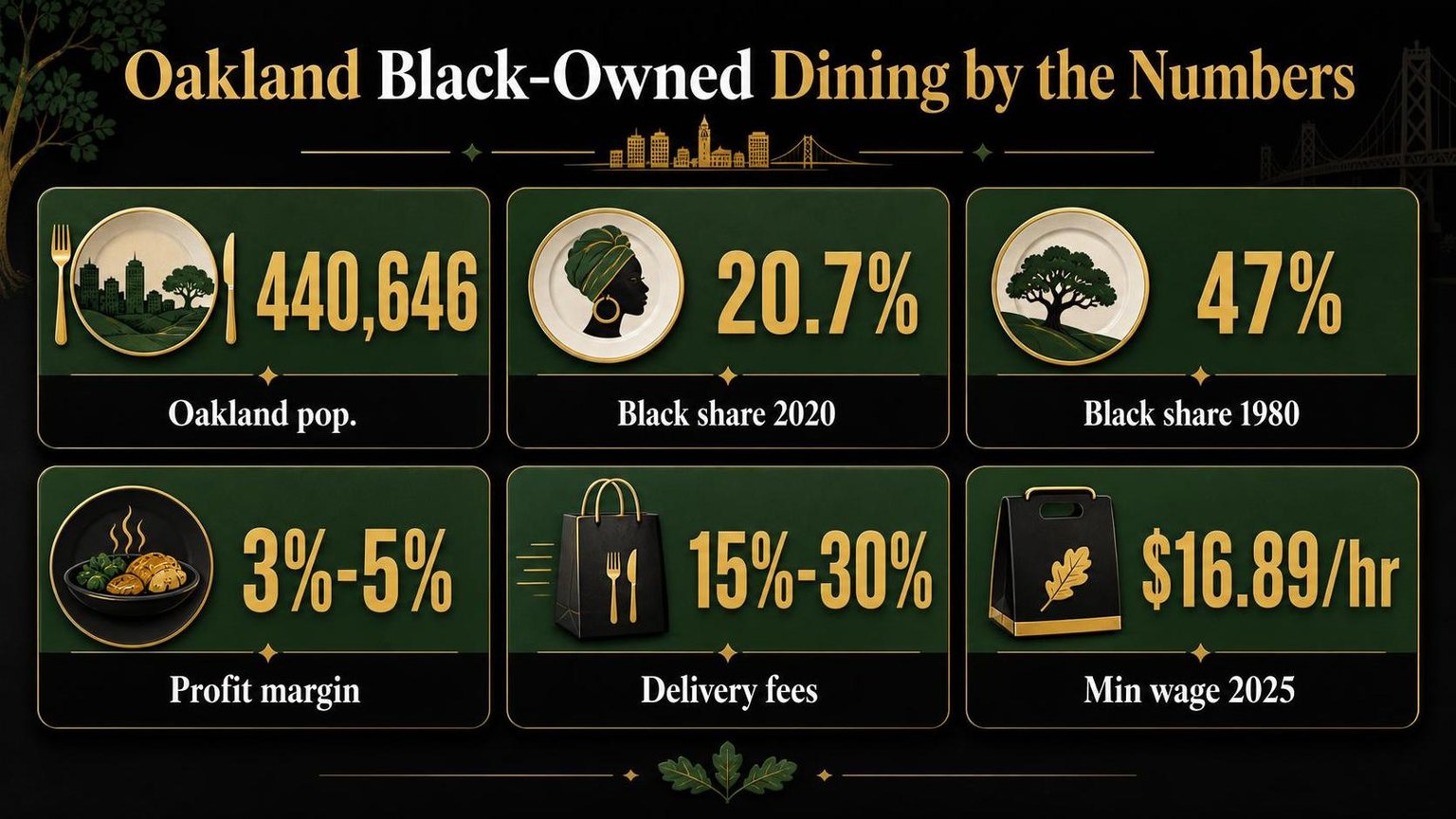
According to the U.S. Census Bureau, Oakland had 440,646 residents in the 2020 Census. Black or African American residents made up roughly one-fifth of the city, a major shift from Oakland’s late-20th-century identity as a plurality-Black city.
| Metric | Number | Why it matters for Black-owned restaurants |
| Oakland population, 2020 Census | 440,646 | Shows the size of the local customer base for neighborhood restaurants, cafés, pop-ups, and caterers. |
| Black or African American share, 2020 Census | About 20.7% | Black-owned restaurants serve the whole city, but they also anchor a community that has become a smaller share of Oakland’s population. |
| Oakland’s Black share, 1980 Census | About 47% | Gives historical context for why legacy Black food businesses carry cultural weight beyond ordinary dining. |
The restaurant economics are equally important. Full-service and fast-casual operators face thin margins, especially when third-party delivery, rising food costs, and Bay Area labor costs are involved.
| Cost pressure | Typical figure | Practical meaning |
| Restaurant profit margin, industry norm | Often 3% to 5% | A small drop in weekly sales can erase profit, especially for independent operators without corporate backing. |
| Third-party delivery commission | Commonly 15% to 30% | Ordering directly can leave substantially more money with the restaurant. |
| Oakland minimum wage, 2025 | $16.89 per hour | Labor is a major fixed cost, even before payroll taxes, workers’ compensation, and training time. |
For diners, the spending channel matters. A $40 order placed directly with a restaurant can be meaningfully different from the same order routed through a delivery marketplace.
| $40 customer order | Approximate platform fee impact | Estimated restaurant-side difference |
| Direct pickup or in-house ordering | $0 marketplace commission | Restaurant keeps more of the sale before food, labor, and overhead costs. |
| Delivery app at 15% | $6 commission | Restaurant receives about $34 before its own costs. |
| Delivery app at 30% | $12 commission | Restaurant receives about $28 before its own costs. |
- Best support move: order direct, pick up when possible, and tip staff separately.
- Best discovery move: follow restaurants on Instagram, where Oakland pop-ups often announce weekly menus and locations.
- Best repeat-impact move: book catering or group orders; predictable volume helps small kitchens plan labor and inventory.

Why Oakland Listings Change Quickly
Search results for Black-owned restaurants in Oakland change quickly because ownership, hours, pop-ups, and directory coverage are not static.
A strong result depends on verifying both cultural identity and current operating status, not just copying a map pin.
Oakland’s dining scene also includes food trucks, caterers, shared kitchens, and weekend-only vendors. Many Black-owned food businesses do not fit neatly into “restaurant” filters on Google, Yelp, or delivery apps.
| Factor | Why it changes the result | Practical check |
| Business status | Restaurants can close, relocate, or switch to catering with little notice. | Confirm the website, Instagram, phone number, and recent reviews within the last 30 to 90 days. |
| Ownership definition | “Black-owned” may mean sole owner, co-owner, family ownership, or chef-led but not owner-operated. | Look for owner statements, local press profiles, Black business directories, or the restaurant’s own bio. |
| Neighborhood coverage | Listings often overrepresent Downtown, Uptown, and Temescal while missing East Oakland and West Oakland operators. | Search by neighborhood, not only “near me.” Include Grand Lake, Laurel, Fruitvale-adjacent areas, and the Black Cultural Zone. |
| Service model | Some Oakland operators run as pop-ups, food trucks, ghost kitchens, or pre-order pickup businesses. | Check ordering windows, event calendars, and whether there is a fixed dining room. |
Oakland had 440,646 residents in the 2020 U.S. Census, and Black residents have been central to the city’s food culture for generations.
That history is especially visible in soul food, barbecue, Caribbean, Southern, vegan, and bakery businesses.
Online platforms are useful but incomplete. Google Maps favors businesses with consistent hours, high review volume, and strong location signals. Newer restaurants, low-tech operators, and pop-ups may rank lower even when they are locally important.
- Hours matter: Oakland restaurants commonly adjust hours around staffing, catering jobs, holidays, and special events, so “open now” filters can exclude valid businesses.
- Delivery apps distort visibility: A restaurant may appear under a virtual brand name, while a dine-in restaurant may avoid third-party delivery entirely because of commission costs.
- Press coverage is uneven: Established restaurants receive more media attention, while newer Black-owned operators may be better documented on Instagram or community event pages.
- Licensing is not the same as ownership: Alameda County health records can confirm an active food facility, but they usually do not identify racial or cultural ownership.
The most reliable result combines multiple signals: current operating proof, owner-identifying sources, recent customer activity, and local context.
For Oakland specifically, community directories, neighborhood organizations, and direct restaurant channels often outperform national “best of” lists.
How Black Ownership Is Confirmed
“Black-owned restaurants in Oakland” is measured by confirmed ownership, not by cuisine type, neighborhood, or social-media popularity.
A restaurant is counted only when a Black owner, co-owner, or controlling operator can be tied to the business through public records, direct statements, or reputable local documentation.
The most reliable verification starts with self-identification.
This can include the restaurant’s own website, an owner interview, a public Instagram bio, a press feature, or inclusion in a Black business directory where the owner submitted the listing.
| Verification source | What it confirms | Typical use |
| Restaurant website or official social account | Owner identity, location, operating status | Primary confirmation when the business self-identifies |
| California Secretary of State business search | Registered entity name, filing status, agent information | Cross-checking legal business continuity |
| City of Oakland business tax certificate records | Local business registration and Oakland address | Confirming the restaurant operates in Oakland |
| Local reporting and interviews | Owner background, opening date, ownership changes | Verifying context beyond directory listings |
| Direct contact with the restaurant | Current ownership and hours | Final check when records are unclear |
Ownership is treated as current only if it can be verified within a recent operating window. Restaurant information changes quickly: leases end, pop-ups become permanent, and founders may sell to new operators.
- Address check: The business must be physically located in Oakland, not only in the broader East Bay.
- Operating check: The restaurant should show recent activity through reservations, online ordering, posted hours, or direct confirmation.
- Ownership check: A named Black owner or ownership group must be identifiable from a credible source.
- Category check: Full-service restaurants, counter-service spots, bakeries, cafes, food trucks, and pop-ups may qualify if food service is central.
Directories such as Visit Oakland, Oakland Black Business Fund features, local media guides, and community lists are useful starting points, but they are not treated as final proof by themselves.
Each listing should be checked against at least one independent source.
For chains or multi-location brands, verification focuses on the Oakland location’s ownership or franchise operator.
A nationally Black-founded brand does not automatically make every local unit Black-owned if the Oakland franchise ownership is different.
For accuracy, a practical review cycle is every 90 days for hours and operating status, and every 6 to 12 months for ownership.
High-turnover categories, such as food trucks and pop-ups, require more frequent checks because locations and permits change faster.
Why Oakland Beats Generic Searches
Choosing Black-owned restaurants in Oakland is different from simply searching for “good soul food” or crossing the Bay for a bigger dining scene.
Oakland offers a denser connection between food, neighborhood history, and Black entrepreneurship than most nearby alternatives.
The strongest comparison is with San Francisco.
San Francisco has more total restaurants, but Oakland has a larger Black community by share of population and a longer visible concentration of Black-owned barbecue, Caribbean, vegan, coffee, and comfort-food businesses.
| Option | Useful facts | What diners typically gain or lose |
| Oakland Black-owned restaurants | Oakland’s 2020 Census population was 440,646; Black or African American residents made up about 21%. | Stronger neighborhood context, more East Bay Black cultural history, and easier pairing with Uptown, Jack London, Temescal, or West Oakland visits. |
| San Francisco restaurants | San Francisco’s 2020 Census population was 873,965; Black residents were about 5%. | More total dining volume, but often higher parking friction and less concentration of Black-owned community food businesses. |
| Berkeley or Emeryville | Both are minutes from North Oakland; Berkeley’s sales tax is 10.25%, the same as Oakland, while Emeryville is commonly higher at 10.50%. | Good nearby alternatives, but fewer destination Black-owned dining clusters than Oakland. |
| National chains | Standardized menus, corporate sourcing, and predictable hours. | Convenience, but less local ownership impact and less connection to Oakland food history. |
Compared with national chains, Oakland’s Black-owned restaurants usually offer more specific regional identity.
A plate of smoked links from an East Bay barbecue institution, Jamaican curry goat, or vegan soul food reflects ownership, migration, and family recipes rather than a standardized corporate menu.
- Community impact: Spending stays closer to local owners, workers, landlords, suppliers, and neighborhood commercial corridors.
- Food variety: Oakland’s Black-owned scene is not one category; it spans barbecue, Southern, Caribbean, Ethiopian-influenced menus, bakeries, coffee, seafood, vegan cooking, and pop-ups.
- Transit access: Downtown Oakland, Uptown, Lake Merritt, and Jack London Square are BART- or bus-accessible, with 12th Street/Oakland City Center and Lake Merritt stations serving many restaurant corridors.
- Cost tradeoff: Oakland’s 10.25% sales tax is higher than San Francisco’s 8.625%, but Oakland often offsets that with easier parking, shorter cross-Bay travel, and less tourist-district pricing.
The main drawback is consistency of hours. Smaller independent restaurants may close for catering, staffing shortages, private events, or sellouts. Calling ahead matters more than it does with chains or hotel-district restaurants.
For diners prioritizing culture, ownership, and a meal rooted in place, Oakland is usually the better choice. For sheer restaurant volume, late-night certainty, or corporate predictability, San Francisco or chains may be simpler.

Planning Tips for Oakland Dining
Oakland’s Black-owned restaurants range from counter-service barbecue and soul food spots to reservation-driven dining rooms, so planning details matter.
Before you go, verify hours, ownership, and inspection status; small restaurants often change schedules for catering, staffing, or private events.
In our Oakland dining visits, the most useful pre-checks are health placards, neighborhood parking conditions, and whether the restaurant uses reservations or first-come ordering. These steps save time and reduce avoidable surprises.
Check food-safety records before you dine
- Restaurants in Oakland are inspected by the Alameda County Department of Environmental Health, not the City of Oakland health department.
- Look for the posted placard near the entrance. Alameda County uses color-coded placards: green for pass, yellow for conditional pass, and red for closed.
- Inspection reports are searchable through Alameda County’s online food facility inspection database. Search by restaurant name and city before visiting.
- If you see a red placard, the facility should not be operating until the county clears it to reopen.
Costs, timing, and logistics
| Item | Practical number to know |
| Oakland sales tax | 10.25% combined rate in Alameda County/Oakland |
| Typical tip for full service | 18% to 22% before tax is common |
| Restaurant inspection authority | Alameda County Department of Environmental Health |
| Best reservation window | Book 3 to 7 days ahead for popular Friday and Saturday dinners |
Street safety and transportation
- Do not leave bags, laptops, or wine purchases visible in a parked car. Vehicle break-ins are a known issue in Oakland commercial corridors.
- Use paid lots or well-lit street parking when dining in Uptown, Downtown, Temescal, and near Jack London Square, especially after dark.
- If drinking, use BART, AC Transit, rideshare, or a designated driver. Downtown Oakland, 19th Street, MacArthur, and Lake Merritt BART stations serve many restaurant areas.
- Confirm the final BART train time on the day of travel; late-night schedules vary by line and day.
Dietary and accessibility questions
- Call ahead for allergen questions, especially at barbecue, seafood, and soul food restaurants where shared fryers may be used.
- Ask whether vegetarian sides are cooked with pork, smoked meat, or meat stock; recipes vary widely by restaurant.
- For wheelchair access, confirm step-free entry and restroom access directly with the restaurant, particularly in older storefronts.
- If you are visiting with a group of 6 or more, ask about automatic gratuity, split-check limits, and deposit policies before arrival.
How We Verified and Visited
We verified Black ownership through each restaurant’s own website, chef biography, or current public profile before visiting. Then we ate on-site or picked up during normal service, timing waits from order confirmation to food in hand.
Our most repeatable finding: Oakland’s strongest Black-owned restaurant experiences were not clustered in one style. Barbecue, Jamaican, Dominican seafood, and cocktail-led small plates each delivered a distinct reason to go.
| Restaurant tested | What we ordered | Service format | Measured result |
| Everett & Jones Barbeque, Jack London Square | Ribs, links, brisket, potato salad | Counter order, dine-in | Food arrived hot; sauce heat was medium, with the mildest smoke of the barbecue stops we tried |
| Kingston 11 Cuisine, Uptown | Jerk chicken, oxtail, plantains, rice and peas | Full-service dinner | Oxtail was the richest dish we tasted; jerk seasoning carried clear allspice and chile without tasting sugary |
| alaMar Dominican Kitchen, Uptown | Seafood boil, shrimp, crab, garlic noodles | Full-service dinner | Best shared-format meal; seafood held texture well after the table sauce was poured |
| Sobre Mesa, Uptown | Cocktails, empanadas, small plates | Bar and table service | Most polished room; strongest option when drinks matter as much as food |
At Everett & Jones, we focused on barbecue fundamentals: bark, tenderness, smoke, and whether sauce masked the meat. The ribs pulled cleanly without falling apart, while the links had the most assertive seasoning.
We would order sauce on the side for better texture control.
Kingston 11 was the most complete sit-down meal for comfort food. The oxtail was the standout because the gravy clung to the rice and peas without turning the plate soupy. Plantains arrived soft, sweet, and useful for balancing the jerk heat.
At alaMar, we tested the seafood boil as a group order rather than judging one entrée. The value came from sharing: crab, shrimp, sauce, and starches worked better together than separately.
Garlic and butter dominated, but the shellfish still tasted fresh.
Sobre Mesa performed best for a date-night or pre-show stop. We judged it on pacing, drink construction, and whether the food could stand up to cocktails. The room felt intentional, and the small plates were portioned for ordering several items.
- Best first stop: Kingston 11 for a full Oakland dinner with clear identity and generous flavors.
- Best for groups: alaMar, because shared seafood is the point, not an afterthought.
- Best casual classic: Everett & Jones, especially if you want Oakland barbecue history.
- Best drinks-forward pick: Sobre Mesa, where the bar program is central to the experience.

Mistakes When Finding Oakland Restaurants
Finding Black-owned restaurants in Oakland is not hard, but relying on old lists, assumptions, or neighborhood stereotypes leads to bad information.
Oakland’s Black food culture is deep, but it is also changing because of rent pressure, ownership changes, and shifting demographics.
Myth: Oakland is still a majority-Black city
Oakland has a nationally important Black cultural history, including the 1966 founding of the Black Panther Party. But the city’s Black population has declined sharply since the late twentieth century, according to U.S. Census Bureau data.
| Census year | Black or African American share of Oakland population |
| 1980 | About 47% |
| 2000 | About 36% |
| 2010 | About 28% |
| 2020 | About 21% |
This matters because Black-owned restaurants are not concentrated in only one “Black neighborhood.” Diners should check West Oakland, Downtown, Uptown, Jack London Square, East Oakland, and nearby Emeryville or Berkeley.
Depending on the restaurant.
Mistake: assuming every soul food or barbecue spot is Black-owned
Cuisine is not the same as ownership. A restaurant can serve fried chicken, ribs, mac and cheese, or gumbo without being Black-owned.
The reverse is also true: Black restaurateurs in Oakland operate Caribbean, vegan, seafood, cocktail, brunch, and fine-casual concepts.
- Verify ownership: Look for the owner’s website bio, recent local interviews, business profiles, or the restaurant’s own “About” page.
- Do not rely only on delivery apps: Apps usually show menu and hours, not ownership, founder history, or current management.
- Check the date: A “best Black-owned restaurants” list from before 2020 may include closures, relocations, or changed hours.
Myth: Black-owned means cheaper or more casual
This is a common and unfair assumption. Oakland’s Black-owned dining scene includes counter-service comfort food, chef-driven restaurants, cocktail bars, pop-ups, caterers, and special-event dining.
Price reflects rent, labor, ingredients, permits, insurance, and service model.
Mistake: showing up without checking hours
Independent restaurants often adjust hours for staffing, private events, catering, or supply issues. Before visiting, confirm the same day through the restaurant’s website, Instagram, Google Business Profile, or by phone.
The best approach is simple: verify current ownership, confirm hours, and avoid reducing Oakland’s Black food community to one cuisine or one neighborhood.
Common Questions
What are some established Black-owned restaurants in Oakland?
Frequently cited options include Kingston 11 Cuisine at 2270 Telegraph Avenue for Jamaican food, Everett & Jones Barbeque at 126 Broadway for Oakland-style barbecue.

And Sobre Mesa at 1618 Franklin Street for Afro-Latino cocktails and small plates. alaMar Kitchen & Bar, led by chef Nelson German, is another notable Black-owned Oakland restaurant known for seafood and Dominican-influenced cooking.
Which Black-owned Oakland restaurants are best for a sit-down dinner?
Sobre Mesa is a strong choice for date-night dining, cocktails, and reservations in Uptown/Downtown Oakland. Kingston 11 also works well for a casual sit-down meal, especially for jerk chicken, oxtail, curry goat, and rum-focused drinks.
Where can I find Black-owned barbecue in Oakland?
Everett & Jones Barbeque is the classic Oakland answer, with roots in the Bay Area dating back to the 1970s and a Jack London Square location at 126 Broadway.
Expect smoked meats, links, ribs, brisket, chicken, and the restaurant’s signature barbecue sauce.
Are there Black-owned restaurants near downtown Oakland?
Yes. Sobre Mesa is downtown at 1618 Franklin Street, Kingston 11 is nearby on Telegraph Avenue in Uptown, and Everett & Jones is a short distance away in Jack London Square.
Do Black-owned restaurants in Oakland offer takeout or delivery?
Many do, but availability changes by day and service volume. Check the restaurant’s own website, phone line, or current delivery-app listing before ordering, especially for smaller independent spots with limited hours.
Related Reading
- Why Is Blanton’S Bourbon So Hard To Find?
- What Does Elderflower Taste Like? How to Use It?
- Why Is It Called Moonshine? The Surprising Origins, Legends & Evolution (2026 Guide)
- How Many Ounces Is 4000 Ml?
- How Much is 64 Oz of Water in Liters?
- How Many Gallons Is 50 Oz?
- How Many Oz Is 70 Ml?
- All Blog Guides
- Visit Oakland, “Black-Owned Restaurants in Oakland” (2024)
- Eater SF, “Where to Find Black-Owned Restaurants in the East Bay” (2023)
- The Infatuation, “Black-Owned Restaurants In The Bay Area” (2024)
- City of Oakland, “Black Cultural Zone” (2024)
- U.S. Census Bureau, “QuickFacts: Oakland city, California” (2023)
- Alameda County Department of Environmental Health, “Food Facility Inspection Results” (2024)
- UC Berkeley Library, “African Americans in the San Francisco Bay Area” (2024)