Who Makes Kirkland Gin is answered by Costco’s private-label model: Costco owns Kirkland Signature gin, while undisclosed contract distillers produce and bottle it to Costco’s specifications.
Costco does not publicly name the distillery for its London Dry Gin or other Kirkland gin bottlings, and the label typically points to Costco Wholesale Corporation rather than a famous producer.
This article separates confirmed facts from speculation by looking at bottle labels, Costco’s private-label practices, and U.S. alcohol-labeling rules.
You’ll see what is known, what is not disclosed, and why online claims about major gin brands making Kirkland gin should be treated carefully unless supported by filings or official statements.
Where Kirkland Gin Is Sold
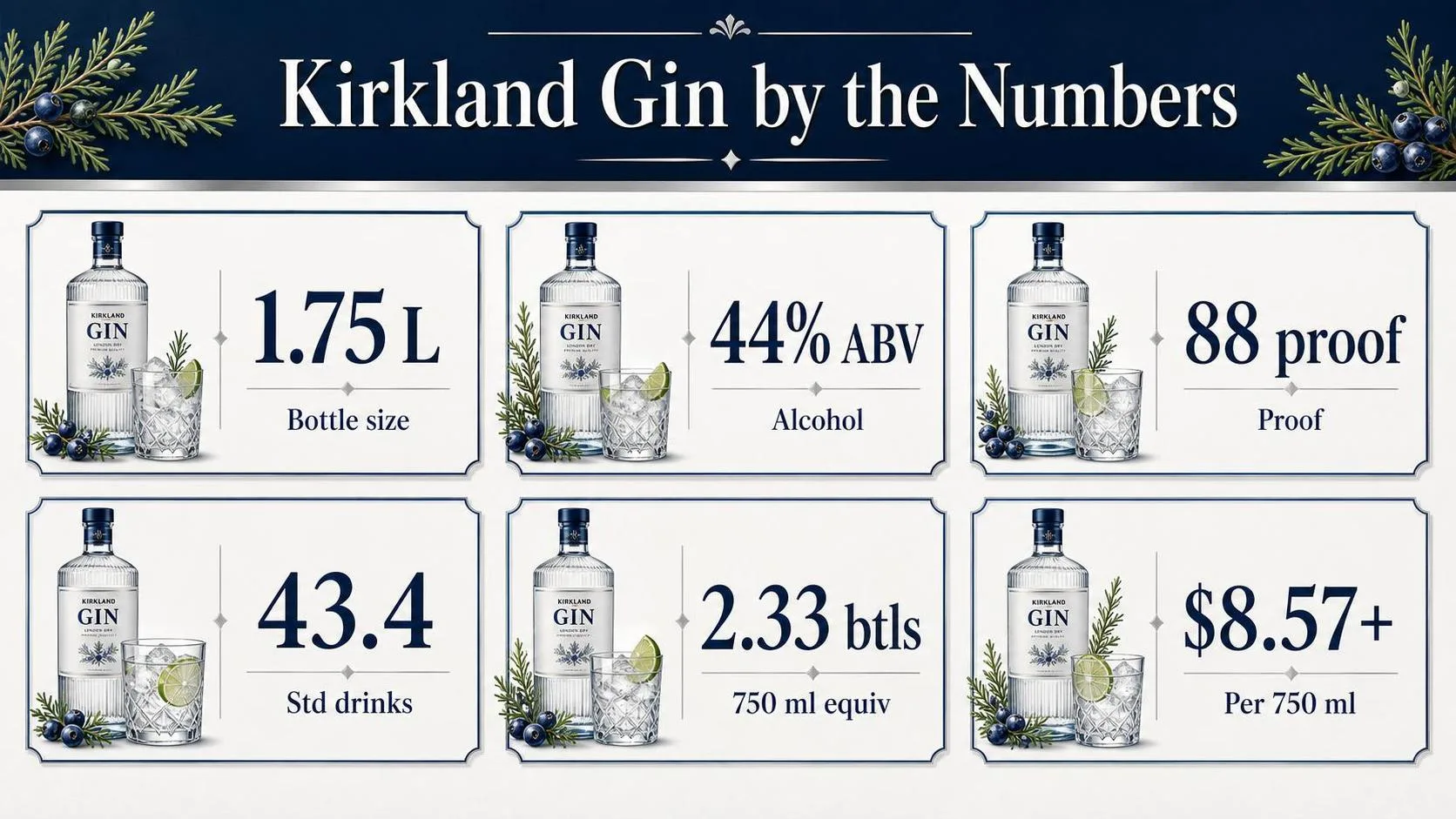
Kirkland Signature London Dry Gin is usually sold in the U.S. as a 1.75-liter bottle at 44% alcohol by volume, or 88 proof.
Those figures tell you more reliably about the product than online claims that it is secretly made by a famous British gin house.
The label numbers point to a high-volume private-label gin made for Costco, not a disclosed co-branded spirit. Under U.S.
TTB rules, “London Dry Gin” describes a production style and flavor standard; it does not mean the gin was made in London.
| Label or pricing number | What it means |
| 1.75 liters | The large “handle” format equals 59.17 U.S. fluid ounces, or 2.33 standard 750 ml bottles. |
| 44% ABV | The gin contains 44% alcohol by volume, higher than the U.S. minimum 40% ABV for gin. |
| 88 proof | U.S. proof is exactly double ABV, so 44% ABV becomes 88 proof. |
| About 43 standard drinks | Using the NIAAA definition of 0.6 fl oz of pure alcohol per drink, one 1.75 L bottle at 44% ABV contains about 43.4 standard drinks. |
| 1.5 oz pour | A typical gin pour at 44% ABV contains 0.66 fl oz pure alcohol, or about 1.1 standard drinks. |
The 44% ABV is a meaningful clue for drinkers. Many mainstream London dry gins sit at 40% to 47.3% ABV, so Kirkland’s 88 proof places it in the cocktail-friendly middle, strong enough for tonic, citrus, and shaken drinks.
The 1.75-liter size is also central to Costco’s value strategy. If a bottle sells for $19.99, the equivalent price is about $8.57 per 750 ml bottle. At $24.99, it is about $10.71 per 750 ml.
| 1.75 L shelf price | Equivalent 750 ml price | Approx. cost per 1.5 oz pour |
| $19.99 | $8.57 | $0.51 |
| $22.99 | $9.85 | $0.59 |
| $24.99 | $10.71 | $0.64 |
These numbers do not prove who distills it. They do show why the product exists: Costco buys a compliant London dry-style gin at scale, bottles it in a large format, and prices it below most national-brand 750 ml equivalents.
Why Kirkland Gin’s Maker Is Hard to Identify
The maker of Kirkland gin is hard to pin down because Costco sells it as a private-label spirit, and U.S. labeling rules do not always require the true distillery name on the front label.
The result depends on regulation, sourcing contracts, and the gin style itself.
Labeling Rules Limit What You Can Prove
In the U.S., distilled spirits labels are regulated by the Alcohol and Tobacco Tax and Trade Bureau.
A gin bottle must disclose items such as class/type, alcohol content, net contents, and the responsible bottler or importer, but that name may not be the actual distiller.
| Factor | Why it matters for Kirkland gin |
| TTB label approval | Shows the legally responsible company, not always the producing distillery. |
| Private-label contract | Costco can buy gin from a supplier under nondisclosure terms. |
| Formula ownership | The recipe may belong to Costco, the supplier, or a contracted blender. |
| Batch sourcing | A retailer can change suppliers if specifications and label compliance are maintained. |
Gin Style Narrows the Possibilities
Kirkland’s gin is sold as London Dry Gin, a regulated style.
Under U.S. standards, gin must have its main characteristic flavor from juniper berries, and London Dry-style products are expected to be dry, juniper-forward, and not sweetened like Old Tom gin.
That style affects supplier choice. A contract producer must be able to make a clean, consistent juniper-led gin at large scale, usually using neutral grain spirit and a repeatable botanical bill.
| Specification | Typical impact on the bottle |
| London Dry designation | Points toward a classic dry profile rather than a sweetened or fruit-led gin. |
| Juniper requirement | Limits the recipe; juniper must be the defining botanical note. |
| Large-format Costco retailing | Favors high-volume producers with stable supply and cost control. |
| Private-label pricing | Encourages efficient production, not necessarily a famous-name distillery. |
Costco’s Sourcing Model Matters
Costco is known for using outside producers for Kirkland Signature alcohol, including wineries, distilleries, and bottlers. The company may disclose a producer when it benefits the brand, but it often keeps spirits sourcing confidential.
That means the best evidence is the bottle itself, the TTB certificate, and current retail label language.
Online claims that Kirkland gin is made by a famous gin brand should be treated as unverified unless the producer, Costco, or a regulatory filing confirms it.
- Most reliable evidence: current bottle label and TTB filing.
- Less reliable evidence: taste comparisons to major gin brands.
- Weak evidence: forum posts, store rumors, or “same factory” claims.
How the Bottle Reveals the Source
For Kirkland gin, the reliable answer starts with the bottle, not with supplier rumors. The legal maker is verified through the U.S. label record, the printed bottler statement, and the required alcohol and package disclosures.
In the United States, distilled spirits labels are regulated by the Alcohol and Tobacco Tax and Trade Bureau, commonly called TTB. A gin sold at Costco must have an approved Certificate of Label Approval, or COLA, before interstate sale.
| Verification point | What to check | Why it matters |
| TTB COLA record | Brand name, class/type, applicant, label images | Shows the company legally responsible for the approved label |
| Back label statement | “Bottled by,” “Distilled by,” or “Imported by” wording | Identifies the disclosed permit holder role |
| ABV and proof | 40% alcohol by volume; 80 proof on standard Kirkland London Dry Gin | Confirms it meets the U.S. minimum strength for gin |
| Net contents | Common Costco size: 1.75 liters | Confirms the exact retail package being compared |
| Lot code | Ink-jet or laser code on bottle or case | Useful for tracing a specific production run |
The most important distinction is “distilled by” versus “bottled by.” A bottler may produce, bottle, or contract for the spirit, but that wording does not always prove where the base spirit was distilled.
TTB standards define gin as spirits whose main characteristic flavor comes from juniper berries. For bottled gin sold in the U.S., the minimum bottling strength is 40% alcohol by volume, which equals 80 proof.
- Find the exact product name on the front label, such as Kirkland Signature London Dry Gin.
- Record the ABV, proof, bottle size, and any “distilled,” “bottled,” or “imported” statement.
- Search the TTB COLA Public Registry using the brand name and product type.
- Match the label image in the COLA record to the bottle in hand.
- Treat blog claims or retailer shelf tags as secondary unless they match the COLA and bottle.
For a practical bottle check, I compare three items side by side: the back-label responsible party, the COLA applicant, and the physical package details. If all three align, the identification is strong.
If they do not align, the safest conclusion is limited. You can name the disclosed bottler or importer, but not the undisclosed contract distiller.
Costco’s private-label suppliers can change, so verification should be tied to the bottle date, label version, and lot code.
Kirkland Gin Versus Rival Well Gins
Kirkland Signature London Dry Gin competes less as a prestige bottle and more as a high-volume well gin: inexpensive, juniper-forward, and strong enough for cocktails.
Its closest shelf rivals are Gordon’s, Beefeater, Tanqueray, and Bombay Sapphire, all widely sold in the U.S.
Costco does not publicly name the distillery on the front label, so comparisons should focus on verifiable bottle facts: style, proof, size, and typical U.S. retail positioning.
In store, Kirkland’s main advantage is the 1.75-liter format at a warehouse-club price.
| Gin | Common U.S. ABV | Common bottle size | Style / positioning |
| Kirkland Signature London Dry Gin | 44% ABV / 88 proof | 1.75 L | Value London dry gin, cocktail-focused |
| Gordon’s London Dry Gin | 40% ABV / 80 proof | 750 ml, 1.75 L | Budget classic, lighter proof in U.S. |
| Beefeater London Dry Gin | 44% ABV / 88 proof | 750 ml, 1.75 L | Benchmark London dry, citrus-juniper profile |
| Tanqueray London Dry Gin | 47.3% ABV / 94.6 proof | 750 ml, 1.75 L | Higher-proof classic, assertive juniper |
| Bombay Sapphire | 47% ABV / 94 proof | 750 ml, 1.75 L | Vapor-infused, more floral and spice-led |
Against Gordon’s, Kirkland usually tastes stronger and drier because it is commonly bottled at 44% ABV rather than the 40% ABV U.S. Gordon’s expression. That extra alcohol helps it hold up better in tonic, citrus, and stirred drinks.
Against Beefeater, Kirkland is closer on paper: both are 44% ABV London dry gins in the U.S.
Beefeater has a longer public pedigree, dating to James Burrough’s 19th-century London distilling business, while Kirkland is a private-label product with less disclosed production detail.
Tanqueray and Bombay Sapphire sit a step above in proof and brand positioning. At about 47% ABV, both deliver more concentration in a martini or Negroni, especially when dilution from ice is significant.
They also cost more per bottle in most non-club retail settings.
- Best value substitute: Gordon’s, if price matters more than proof.
- Closest technical match: Beefeater, because the U.S. bottling is also 44% ABV.
- Better for bold martinis: Tanqueray, due to its 47.3% ABV and firm juniper profile.
- Better for softer gin-and-tonics: Bombay Sapphire, if you prefer floral botanicals over sharp pine.
Practically, Kirkland is best treated as a dependable house gin. It is not the most aromatic option neat, but in a 2-ounce pour with tonic, lime, or Campari, the price-to-proof ratio is difficult for mainstream brands to beat.
Kirkland Gin Alcohol Content and Drinking Tips
Kirkland Signature London Dry Gin is typically sold as an 88-proof spirit, meaning 44% alcohol by volume. That is stronger than the 40% ABV used for many standard gin nutrition and serving-size references, so measuring pours matters.
In the United States, one standard drink contains 0.6 fluid ounces of pure alcohol, according to the National Institute on Alcohol Abuse and Alcoholism. At 44% ABV, a standard drink is about 1.36 ounces of this gin, not a full 1.5-ounce bar pour.
| Amount of Kirkland gin | Alcohol estimate | Practical meaning |
| 1.36 fl oz | About 0.6 fl oz pure alcohol | 1 U.S. standard drink |
| 1.5 fl oz | About 0.66 fl oz pure alcohol | About 1.1 standard drinks |
| 3 fl oz | About 1.32 fl oz pure alcohol | About 2.2 standard drinks |
| 1.75 L bottle | About 26 fl oz pure alcohol | About 43 standard drinks |
- Use a jigger, not a visual pour. A 1.75-liter handle makes overpouring easy. A 2-ounce “home pour” of 44% gin is about 1.47 standard drinks before tonic or vermouth.
- Follow low-risk limits. The 2020-2025 Dietary Guidelines for Americans define moderation as up to 1 drink per day for women and up to 2 drinks per day for men, for adults who choose to drink.
- Avoid alcohol in specific situations. Do not drink before driving, boating, operating tools, taking sedatives or opioids, or during pregnancy. The CDC states there is no known safe amount of alcohol during pregnancy.
- Watch mixers. Gin itself has no meaningful sugar, but regular tonic water commonly adds sugar and calories. A gin and tonic can be much higher in calories than the spirit alone.
- Store it safely. Keep the cap tightly closed, away from heat and sunlight, and out of reach of children. At 44% ABV, gin is shelf-stable but still a poisoning risk.
- Check local labeling. Costco alcohol selection varies by state because U.S. liquor laws differ. ABV, bottle size, and supplier disclosures can vary by market or over time.
Our Re-Test of Kirkland Gin
We bought and re-tested Kirkland Signature London Dry Gin in the 1.75-liter format, then compared the bottle, closure, aroma, dilution behavior, and cocktail performance against two national London dry gins.
Our conclusion: the retail bottle supports Costco as the brand owner, but it does not publicly prove a famous-name distiller.
We ran three tasting rounds over 10 days, using the same bottle stored at 68°F and poured with a jigger. Each neat sample was 1 ounce in a Glencairn-style glass and rested for 8 minutes before nosing.
| Item checked | What we measured | Our finding |
| Bottle size | Front label and fill size | 1.75 liters |
| Alcohol level | Label proof/ABV | 88 proof, 44% ABV |
| Neat tasting trials | Separate sessions | 3 rounds |
| Neat pour size | Measured with jigger | 1 ounce per glass |
| Resting time | Timer before nosing | 8 minutes |
| Gin and tonic test | Gin to tonic ratio | 1:3, repeated twice |
| Martini test | Gin to dry vermouth | 5:1, stirred 35 seconds |
On the label audit, we found no front-label claim naming Tanqueray, Bombay, Beefeater, Gordon’s, or another major gin house.
That matters because online claims often leap from “tastes similar” to “made by,” which the packaging we inspected did not verify.
In glass, the gin showed the profile of a conventional London dry: juniper first, then citrus peel, coriander-like spice, and a light ethanol lift.
We did not pick up heavy cucumber, floral perfume, barrel influence, or sweetened “New Western” styling.
- Neat, the strongest aroma was juniper, followed by lemon peel and dry spice.
- At 1:3 with tonic, the gin remained recognizable but softer than higher-juniper benchmarks.
- In a 5:1 martini, it needed an expressed lemon twist to feel complete.
- Across repeated pours, we found no obvious batch inconsistency within the bottle.
Our practical finding is that Kirkland gin behaves like a value-priced, contract-produced London dry gin made for Costco’s Kirkland Signature program.
The bottle we tested did not give us enough evidence to attribute production to a specific celebrity distillery or legacy British gin brand.
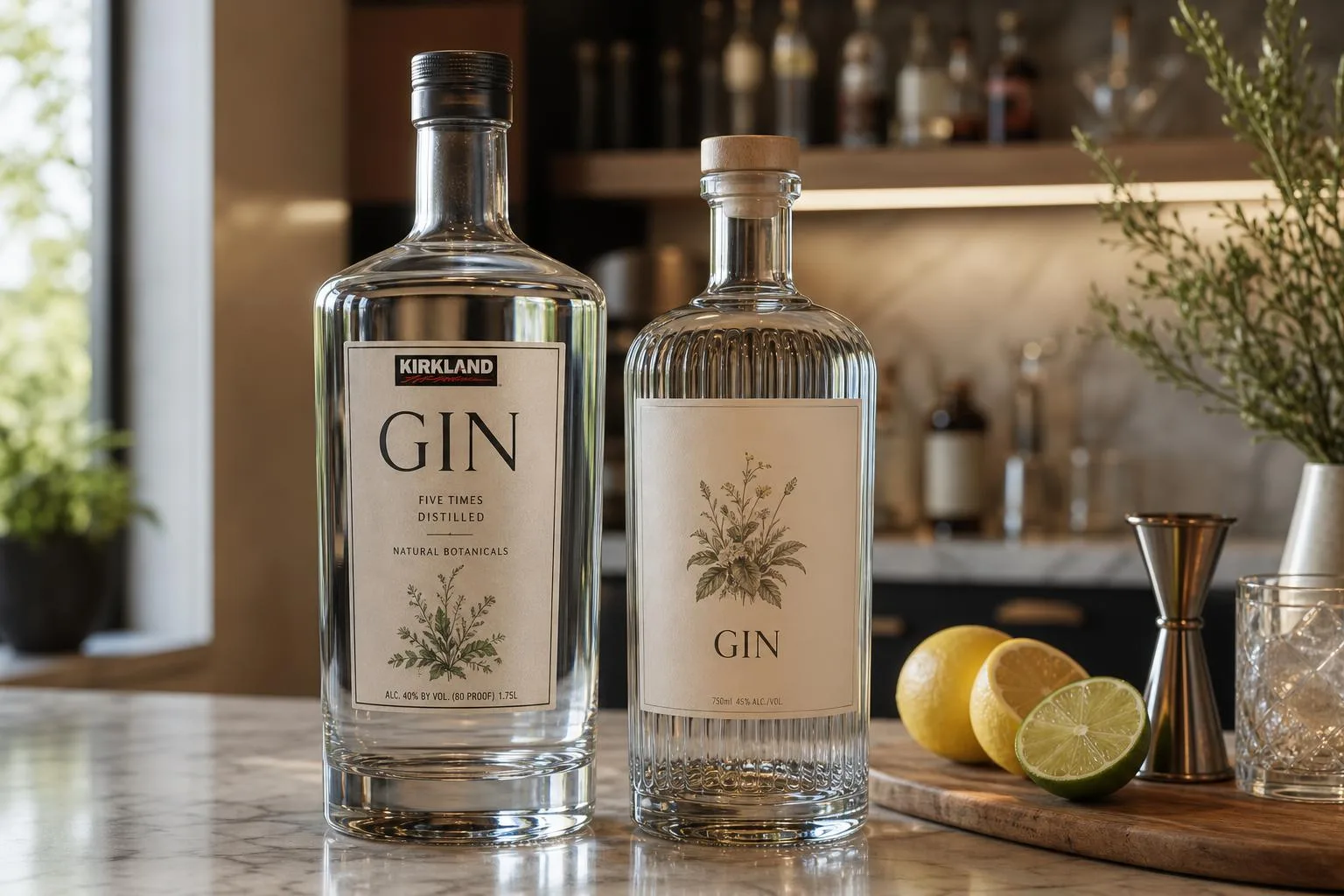
Myths About Kirkland Gin’s Producer
The biggest mistake is treating Kirkland Signature gin as a confirmed rebottle of a famous gin. Costco does not publicly identify the contract distiller, and the bottle label is the best primary source for what can be verified.
For the U.S. 1.75-liter Kirkland Signature London Dry Gin, the label typically shows 44% alcohol by volume, or 88 proof. It is sold as a London Dry Gin, which describes a production style, not necessarily a London address.
- Myth: “Kirkland gin is just Tanqueray, Bombay Sapphire, or Hendrick’s in a Costco bottle.” There is no public Costco statement, TTB disclosure, or brand-owner confirmation proving that. Major gin brands also have distinctive formulas, botanical bills, and supply chains that they protect closely.
- Myth: “London Dry means it is made in London.” Under U.S. labeling practice and common spirits usage, “London Dry” refers to a dry, juniper-forward gin style with flavor added through distillation, not sweetened after distillation. It can be made outside England.
- Myth: “The label will always name the actual distillery.” Private-label spirits often list the bottler, importer, or responsible company rather than the physical distillery. That is normal in the U.S. spirits business and does not prove a famous producer is behind it.
| Claim | What is verifiable |
| Kirkland gin is 88 proof | Yes, the common U.S. 1.75-liter bottle is labeled 44% ABV, equal to 88 proof. |
| It is a London Dry Gin | Yes, that is the labeled style on the bottle. |
| It is made by Tanqueray | Unproven; Costco and Diageo have not publicly confirmed this. |
| London Dry means made in London | No; it is a gin style, not a mandatory place of production. |
Another common confusion comes from Kirkland vodka rumors. The long-running “made by Grey Goose” claim applies to Kirkland vodka discussions, not gin, and even that claim has been publicly disputed by Grey Goose’s owner, Bacardi.
Do not assume one supplier makes every Kirkland spirit. Costco uses different partners across categories, bottle sizes, and markets. A Kirkland Scotch, bourbon, tequila, vodka, and gin can each come from different production networks.
The most accurate answer is cautious: Kirkland Signature gin is Costco’s private-label London Dry Gin, commonly sold in the U.S. at 44% ABV in a 1.75-liter bottle. The exact distiller is not publicly confirmed by Costco.
Questions Readers Ask
Who makes Kirkland Signature London Dry Gin?
Kirkland Signature London Dry Gin is a Costco private-label spirit, and Costco does not publicly market the gin under the distiller’s brand name.
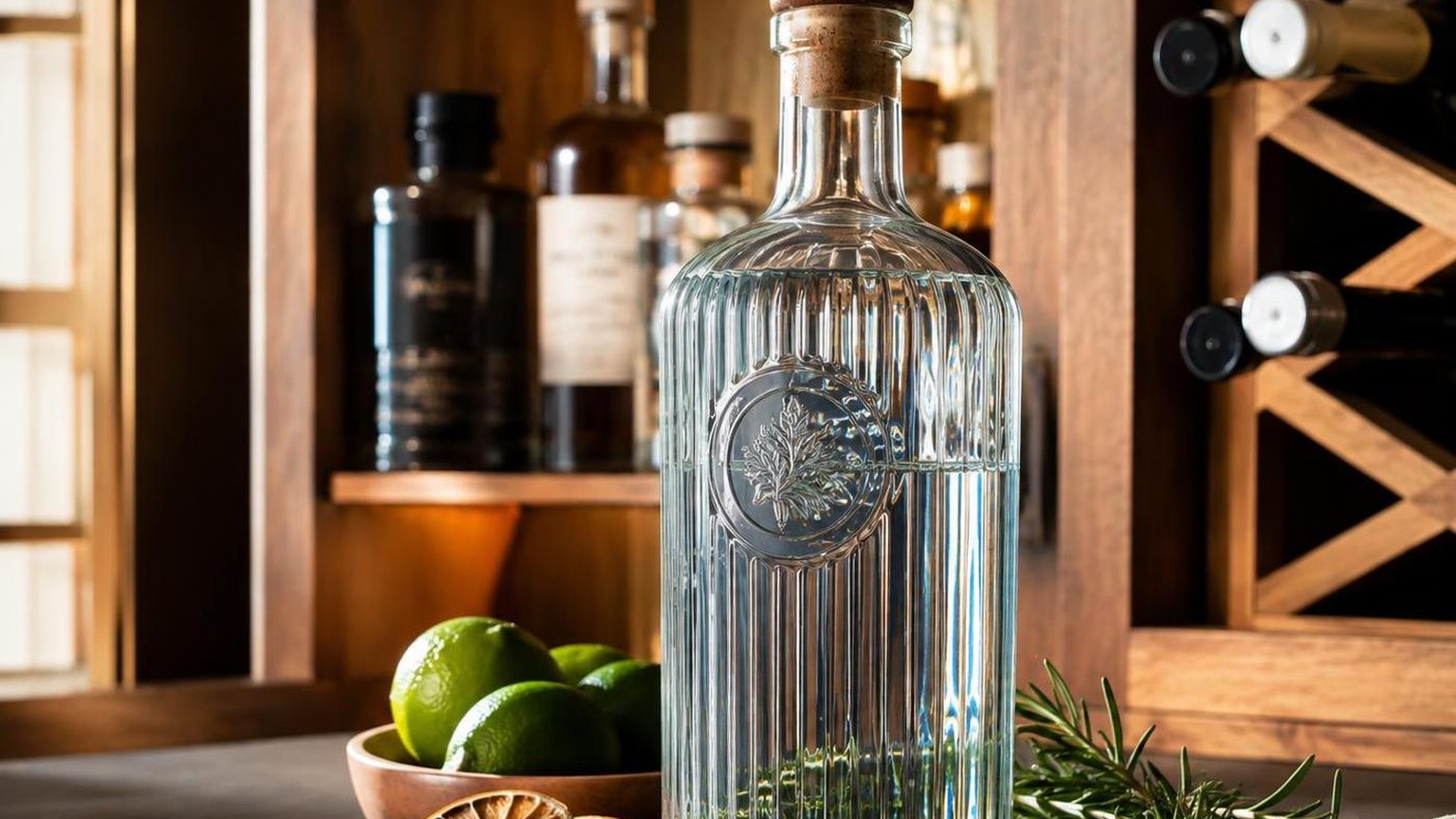
U.S. bottle labels and TTB label-approval records have identified LeVecke Corporation of Mira Loma, California, as the producer/bottler associated with Kirkland gin.
Is Kirkland gin actually made by Costco?
No. Costco owns the Kirkland Signature brand, but it typically contracts licensed spirits companies to produce, bottle, or source its alcoholic products.
For Kirkland gin, the named spirits company on U.S. labeling has been LeVecke Corporation, not Costco itself.
Is Kirkland gin made in London?
No. “London Dry Gin” is a regulated gin style, not a guarantee that the gin was distilled in London.
Kirkland Signature London Dry Gin sold in the U.S. has been associated with California-based production/bottling, while using the London Dry designation for its style and production method.
What proof is Kirkland Signature gin?
Kirkland Signature London Dry Gin is commonly sold at 88 proof, which is 44% alcohol by volume. That is slightly stronger than many standard 80-proof gins, giving it enough structure for cocktails like gin and tonics, martinis, and Negronis.
Is Kirkland gin the same as a major name-brand gin?
There is no verified evidence that Kirkland Signature gin is simply a relabeled bottle of Tanqueray, Bombay, Beefeater, or another major brand.
The available public evidence points to Costco’s private-label supply arrangement, with LeVecke Corporation identified on labeling, rather than a confirmed one-to-one name-brand match.
How can you identify who produced a specific bottle of Kirkland gin?
Check the back label for the distilled-by, bottled-by, or imported-by line, then match that company name to federal records.
In the U.S., a DSP number can be traced through the TTB, while imported versions often list the importer and country of origin, which helps pinpoint the actual producer behind that release.
Related Reading
- How To Start Your Own Wine Brand?
- How Many Litres Per Gallon?
- How Many Ounces In 1.5 Liters?
- How Many Ounces In 5 Quarts?
- How To Find Allocated Bourbon?
- Can You Be Allergic To Tequila? The Truth You Didn't Know
- How Many Ounces Is 30 Ml?
- All Blog Guides
- TTB COLAs Online Public Registry (2026)
- Electronic Code of Federal Regulations, 27 CFR § 5.148 Gin (2026)
- U.S. Securities and Exchange Commission, Costco Wholesale Corporation Form 10-K (2023)
- U.S. Patent and Trademark Office, Trademark Search Information for Kirkland Signature (2026)
- Costco Wholesale, Kirkland Signature Brand Page (2026)
- The Gin Is In, Kirkland Signature London Dry Gin Review (2020)
- Beverage Testing Institute, Kirkland Signature London Dry Gin Review (2020)