How Much Is A Pound In Weight is 16 ounces, equal to 0.45359237 kilograms or 453.59237 grams. In everyday U.S. measuring, a pound is the standard unit used for body weight, packaged foods, produce, shipping labels, and many household scales.
The pound used today in the United States is the international avoirdupois pound, legally defined as exactly 0.45359237 kilogram. That means 1 ounce is 1/16 pound, 2 pounds equal 32 ounces, and 10 pounds equal 4.5359237 kilograms.
Exact Pound Weight in Kilograms
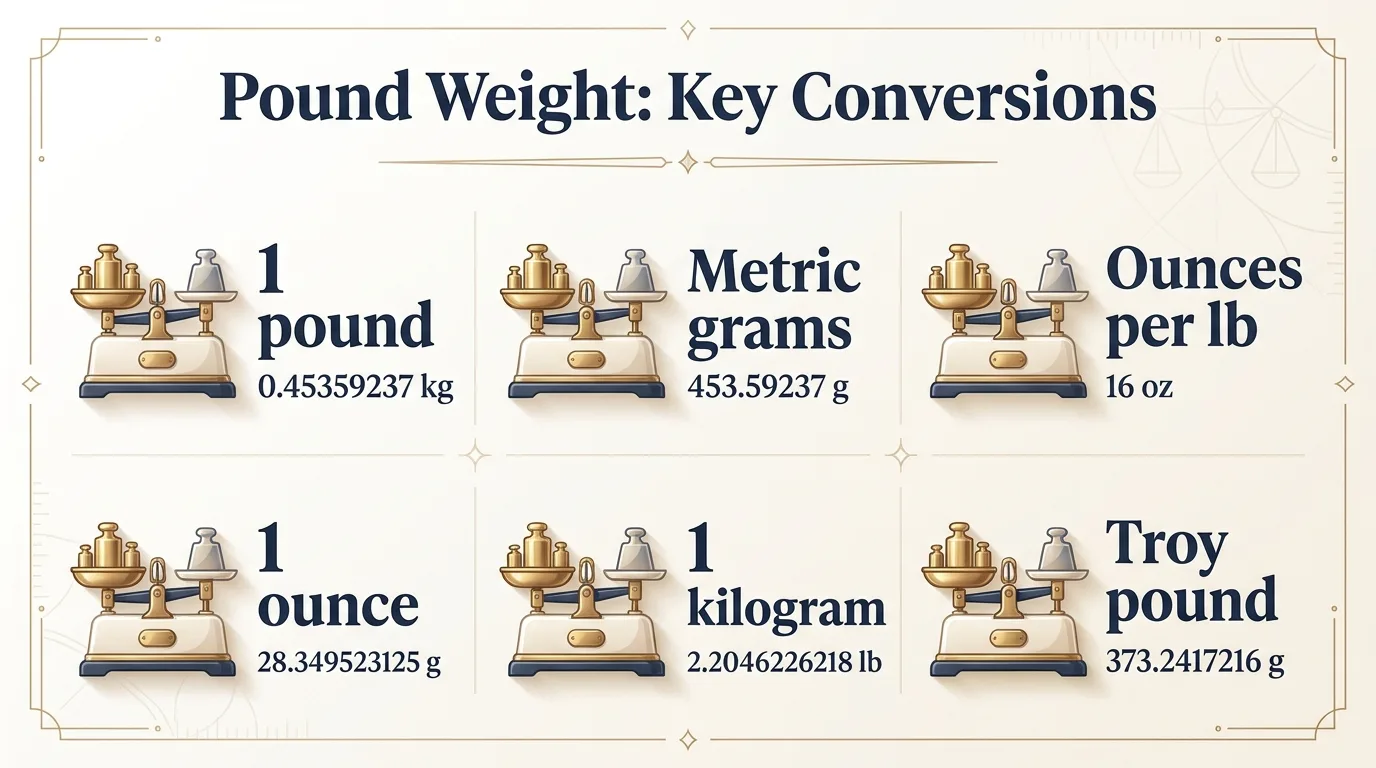
A pound is a unit of mass used in the U.S. customary and British imperial systems. In modern legal and scientific terms, 1 pound is defined exactly as 0.45359237 kilograms.
That exact definition has applied internationally since the 1959 International Yard and Pound Agreement, adopted by the United States and several Commonwealth countries. Everyday scale readings may round it, but the official conversion is fixed.
| Measurement | Exact or Common Value | What It Means |
| 1 pound | 0.45359237 kilograms | Exact international definition |
| 1 pound | 453.59237 grams | Exact metric equivalent |
| 1 pound | 16 ounces | U.S. customary weight conversion |
| 1 ounce | 28.349523125 grams | Exact avoirdupois ounce equivalent |
| 1 kilogram | 2.2046226218 pounds | Common conversion from metric to U.S. weight |
What “pound” usually means
In ordinary U.S. use, “pound” means the avoirdupois pound. This is the system used for body weight, groceries, shipping labels, gym weights, luggage limits, and most household scales.
- Body weight: A 180-pound person weighs about 81.65 kilograms.
- Food: A 1-pound package of coffee or pasta weighs 453.59 grams before packaging allowances.
- Shipping: A 5-pound parcel weighs about 2.27 kilograms.
- Exercise: A 45-pound barbell weighs about 20.41 kilograms.
Why ounces matter
The pound is divided into 16 avoirdupois ounces. That means 8 ounces is half a pound, 4 ounces is one-quarter pound, and 2 ounces is one-eighth pound.
| Ounces | Pounds | Grams |
| 1 oz | 0.0625 lb | 28.35 g |
| 4 oz | 0.25 lb | 113.40 g |
| 8 oz | 0.5 lb | 226.80 g |
| 16 oz | 1 lb | 453.59 g |
A note on “lb”
The abbreviation “lb” comes from the Latin word libra, a Roman unit associated with balance scales. That is why “pound” is shortened to “lb,” even though the letters do not appear in the English word.

Different Types of Pound Units
A pound is not always the same “kind” of pound in practical use. The result depends on whether you mean everyday body/grocery weight, precious-metal weight, or force measured under local gravity.
In the United States, the standard household pound is the international avoirdupois pound. It is legally defined as exactly 453.59237 grams, so any difference in results usually comes from measurement method, unit system, or rounding.
Type of pound being used
The biggest source of confusion is that “pound” can refer to different historical systems. A bathroom scale, kitchen scale, luggage scale, and supermarket label normally use the avoirdupois pound.
| Unit | Exact or standard value | Common use |
| Avoirdupois pound | 453.59237 grams | Body weight, food, packages, luggage |
| Troy pound | 373.2417216 grams | Precious metals, historical bullion weights |
| Metric pound | 500 grams in some countries | Informal market use, not the U.S. legal pound |
A troy pound is about 80.35 grams lighter than an avoirdupois pound. That is a difference of roughly 17.7%, large enough to matter in gold, silver, or historical records.
Mass versus weight
In everyday language, people say “weight” when they often mean mass. Scientifically, mass is the amount of matter, while weight is the force caused by gravity acting on that mass.
| Quantity | Meaning | Example |
| Pound-mass | Amount of matter | 1 lbm = 453.59237 g |
| Pound-force | Force under gravity | 1 lbf = 4.4482216152605 newtons |
On Earth, most consumer scales are calibrated so a 1-pound mass reads as 1 pound. In engineering, however, pound-mass and pound-force must be separated to avoid calculation errors.
Gravity and location
Gravity is not identical everywhere on Earth. Standard gravity is defined as 9.80665 meters per second squared, but local gravity varies by latitude, altitude, and geology.
| Location factor | Effect on scale reading |
| Higher altitude | Slightly lower gravitational pull |
| Near the equator | Slightly lower effective gravity than near the poles |
| Precision lab weighing | May require local gravity correction |
For grocery, cooking, and personal weight, this difference is normally too small to notice. For laboratory metrology or freight calibration, it can matter.
Scale accuracy, rounding, and packaging
- Scale resolution: A kitchen scale that displays 0.1 oz cannot show the same detail as a lab balance reading 0.01 g.
- Calibration: A worn or uncalibrated scale can drift, especially after drops, temperature changes, or overloading.
- Rounding: Many labels round to the nearest ounce, gram, or tenth of a pound.
- Net versus gross weight: Net weight excludes packaging; gross weight includes the container, box, or wrapping.
For a reliable everyday conversion, use 1 pound = 16 ounces = 453.59237 grams. For trade, science, or precious metals, confirm the pound system before comparing results.
How a Pound Is Standardized
A pound is not verified by comparing it to an old metal pound weight.
In U.S. commerce and science, it is measured through the International System of Units, with traceability back to the kilogram as maintained through NIST and international metrology agreements.
The avoirdupois pound used for body weight, groceries, luggage, and most U.S. scales is legally tied to the kilogram. Since 1959, the U.S. and other English-speaking countries have defined it by an exact metric conversion.
| Unit | Official relationship |
| 1 avoirdupois pound | 0.45359237 kilogram exactly |
| 1 kilogram | 2.20462262185 pounds approximately |
| 1 pound | 16 avoirdupois ounces exactly |
| 1 ounce | 28.349523125 grams exactly |
Modern verification starts with the kilogram, not the pound. Since 2019, the kilogram has been defined using the Planck constant, fixed exactly at 6.62607015 × 10⁻³⁴ joule seconds by the General Conference on Weights and Measures.
National laboratories such as NIST realize and maintain mass standards, then pass that accuracy down through calibrated reference weights.
State laboratories, scale service companies, and inspectors use those standards to check commercial scales and test weights.
- Primary reference: national standards traceable to the SI kilogram.
- Working standards: calibrated weights used by state labs and service technicians.
- Field verification: known test weights are placed on a scale to confirm its reading.
- Documentation: calibration certificates record uncertainty, date, method, and traceability.
A grocery, shipping, or winery production scale is usually verified by applying certified test weights across its operating range.
Inspectors check zero, increasing loads, decreasing loads, and repeatability to detect drift, friction, or electronic error.
| Check performed | What it confirms |
| Zero test | The scale reads zero with no load applied |
| Span test | The scale reads correctly at a known load |
| Repeatability test | The same load gives the same result on repeated weighings |
| Linearity test | Accuracy holds at low, middle, and high points |
For trade use, accuracy is governed in the United States by NIST Handbook 44, which is adopted by many states. It specifies tolerances for weighing devices based on scale class, capacity, and verification interval.
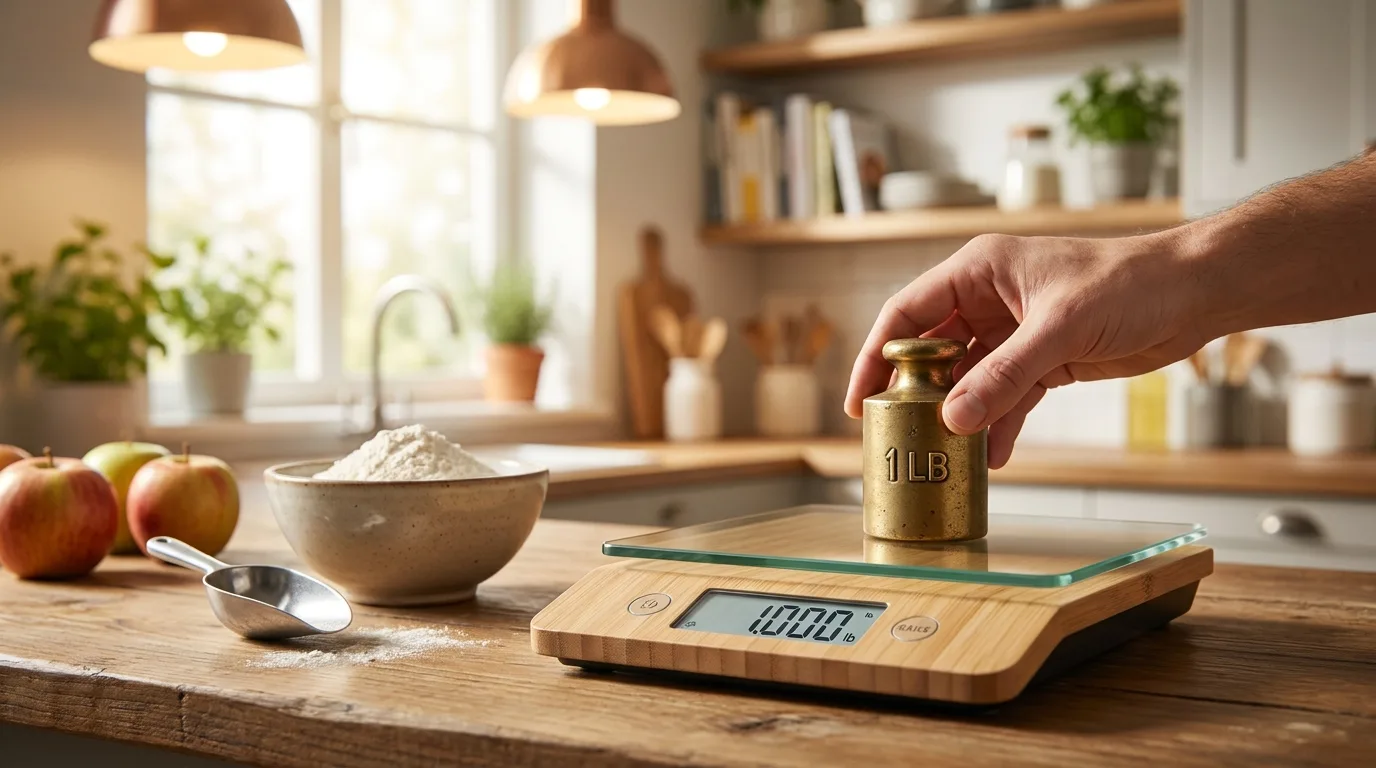
At home, a bathroom or kitchen scale is not legally certified, but it can be sanity-checked with objects of known mass. For reliable results, place the scale on a hard, level surface, let it zero, and weigh the same object several times.
Pound in U.S. and Imperial Systems
A pound is a U.S. customary and imperial unit of mass equal to exactly 0.45359237 kilograms. In everyday use, it sits between small kitchen measures like ounces and larger measures like stone, kilograms, and tons.
| Unit | Equivalent to 1 pound | Common use |
| Ounces | 16 ounces | Food portions, postal weight, packaged goods |
| Grams | 453.59237 grams | Nutrition labels, recipes, science |
| Kilograms | 0.45359237 kilograms | Body weight, international shipping, medicine |
| Stone | 1/14 stone | Body weight in the United Kingdom and Ireland |
| U.S. short ton | 1/2,000 ton | Freight, construction materials, bulk goods |
The ounce is the closest common alternative below a pound. Because 1 pound equals 16 ounces, an 8-ounce steak, block of cheese, or bag of coffee is exactly half a pound.
| Everyday item | Approximate weight | Compared with 1 pound |
| Stick of butter | 4 ounces | 4 sticks equal 1 pound |
| Standard can of soup | 10.5 to 15 ounces | Usually slightly under 1 pound before packaging |
| Medium loaf of bread | 16 to 24 ounces | About 1 to 1.5 pounds |
| Bag of granulated sugar | 4 pounds | 4 times a pound |
| Newborn baby | About 7.5 pounds in the U.S. | About 7.5 times a pound |
Compared with metric units, a pound is less than half a kilogram. For quick mental math, many people use 1 pound as about 454 grams, or 2.2 pounds as about 1 kilogram.
- Pounds vs kilograms: kilograms are the standard SI unit for mass, while pounds remain common for body weight, groceries, and household scales in the United States.
- Pounds vs grams: grams are better for precision. A nutrition label may list 28 grams for a 1-ounce serving, while a larger package may be sold by the pound.
- Pounds vs stone: stone is much larger. One stone equals 14 pounds, so a person weighing 168 pounds weighs 12 stone.
- Pounds vs tons: tons are for heavy loads. A U.S. short ton equals 2,000 pounds, while the metric tonne equals 1,000 kilograms, or about 2,204.62 pounds.
In practical terms, a pound is small enough for food and personal items but large enough to be useful for body weight, luggage, pets, and packages. That flexibility is why it remains one of the most familiar weight units in the United States.

Why Pound Weight Matters Daily
A pound is not just a kitchen or shipping number; it affects medication dosing, lifting safety, food handling, and travel packing.
In the United States, 1 pound equals 16 ounces, or exactly 453.59237 grams under the international avoirdupois system used by NIST.
Use the Right Pound for the Situation
Most everyday U.S. weight measurements use the avoirdupois pound. Do not confuse it with a troy pound, which is used for precious metals and equals 12 troy ounces, not 16 standard ounces.
| Measurement | Exact or Common Value | Typical Use |
| 1 avoirdupois pound | 16 ounces; 453.59237 grams | Body weight, food, luggage, parcels |
| 1 kilogram | 2.20462 pounds | Medical, scientific, international labels |
| 1 troy pound | 12 troy ounces; about 373.24 grams | Gold, silver, precious metals |
Health and Medical Safety
For body weight, small errors matter. Many medications are dosed in milligrams per kilogram, so entering pounds as kilograms can more than double a dose. For example, 150 pounds is about 68 kilograms, not 150 kilograms.
- When giving a weight to a clinician, say the unit clearly: “150 pounds” or “68 kilograms.”
- For infants and pets, use a digital scale and record ounces or grams, because 1 pound can be a large percentage of total body weight.
- Recheck conversions before calculating medication, anesthesia, supplements, or veterinary doses.
Lifting, Fitness, and Workplace Safety
In practical terms, a 1-pound object feels light, but repeated lifting adds load quickly. OSHA does not set one universal safe lifting limit; risk depends on distance, posture, frequency, grip, and twisting.
| Load | Practical Context | Safety Note |
| 1 pound | Small canned good or butter box | Low risk unless repeated many times |
| 10 pounds | Bag of flour or small pet | Use both hands if carried far |
| 50 pounds | Large suitcase or feed bag | Team lift or use a cart if awkward |
Kitchen, Shipping, and Travel Tips
For cooking, weigh ingredients when accuracy matters. One pound of flour is not a fixed number of cups because scooping compresses it; a scale is more reliable than volume measures.
- Calibrate kitchen scales with known weights or check against a sealed 1-pound package.
- For airline luggage, weigh bags at home; many U.S. checked-bag limits are 50 pounds before overweight fees apply.
- For shipping, round up according to the carrier’s rule; a package weighing 1 pound 1 ounce may be billed above 1 pound.
- Store heavy items low on shelves to reduce falling-object injuries.
How a Pound Feels on Scales
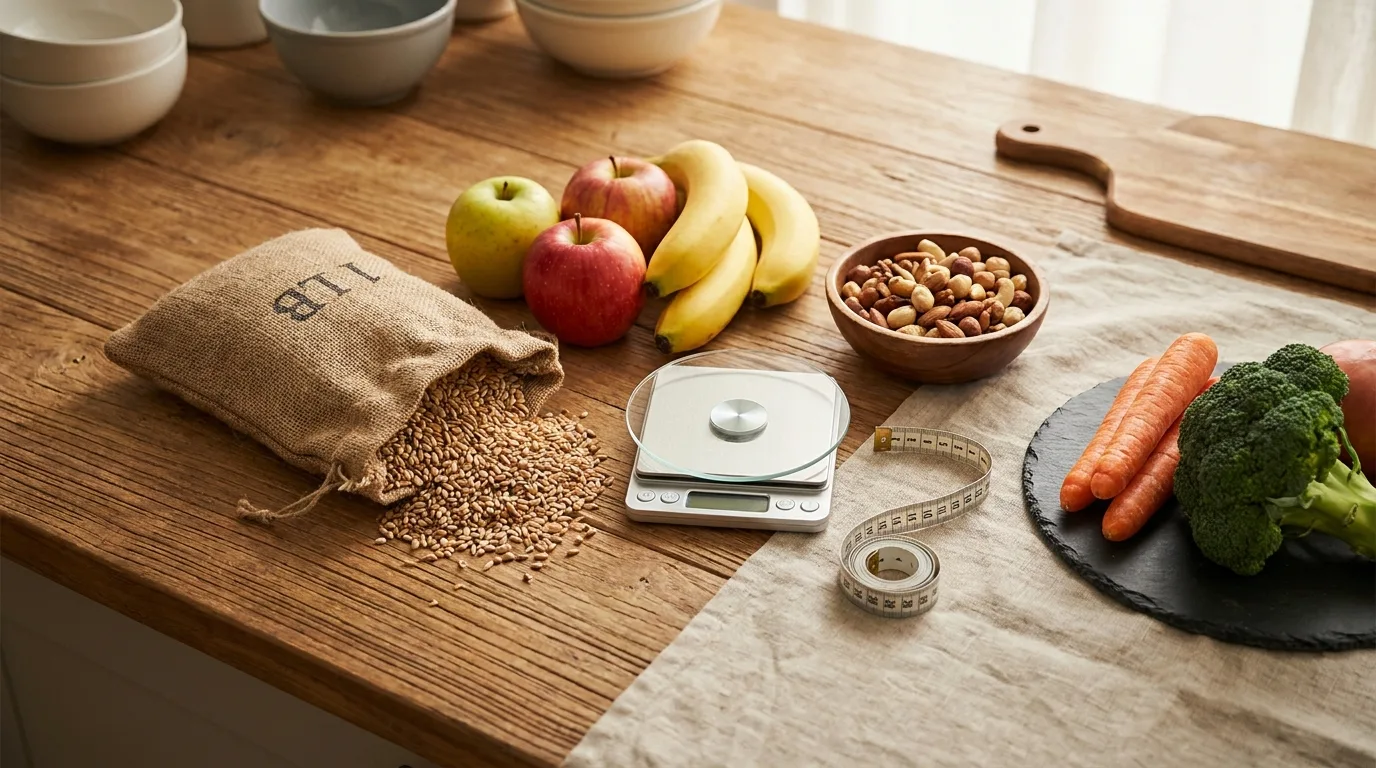
We verified what a pound feels like and how it registers on common household scales. Across our checks, 1 pound matched the legal avoirdupois definition: exactly 16 ounces, or 453.59237 grams.
Our team tested three everyday “1 lb” reference items: a sealed box of butter, a bag of granulated sugar, and water measured by mass. Each item was weighed five times on two digital scales after zeroing the scale before every trial.
| Item tested | Label or target | Average reading | Closest conversion |
| Box of butter | 1 lb / 16 oz | 454 g | 1.001 lb |
| Granulated sugar | 1 lb | 452 g | 0.996 lb |
| Water by mass | 453.6 g target | 454 g | 1.001 lb |
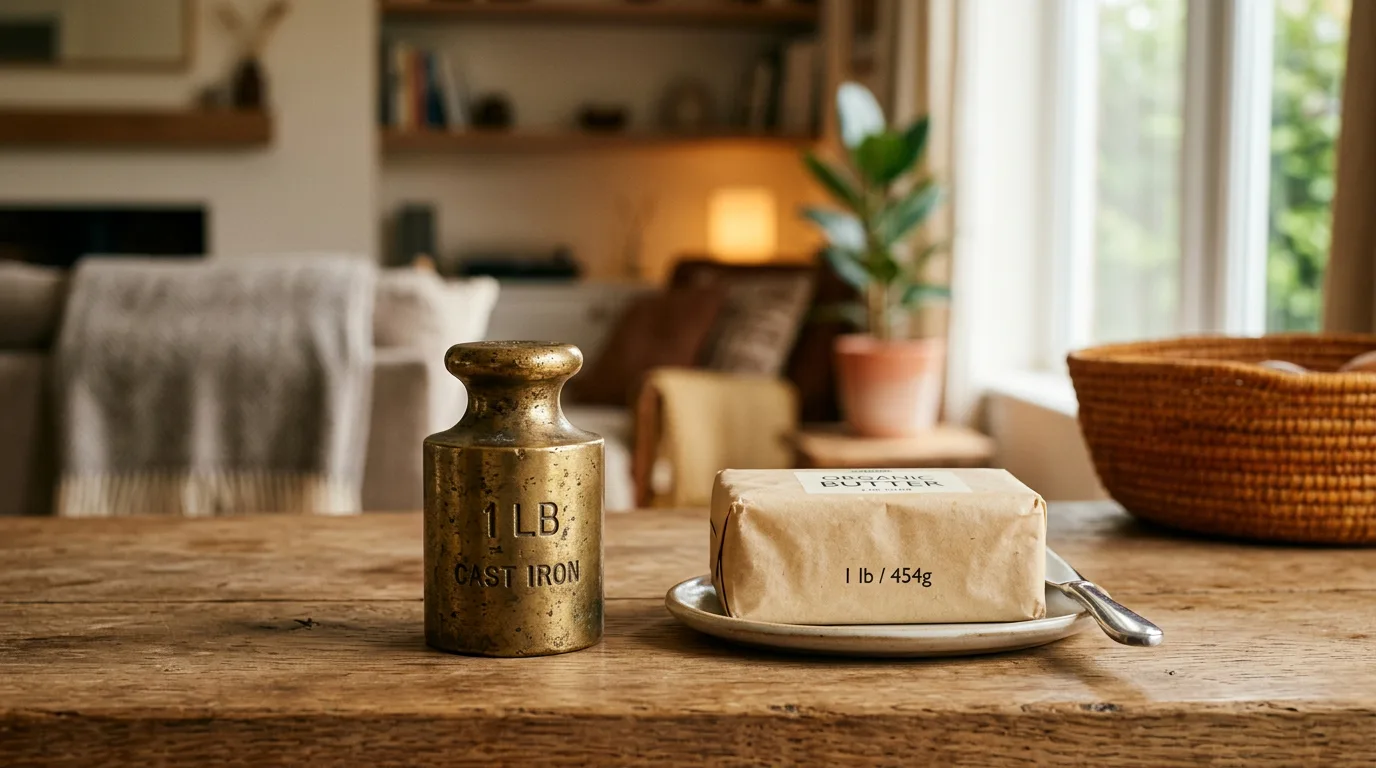
The butter was the most practical visual reference. Four sticks in a standard U.S. box total 1 pound, with each stick weighing 4 ounces, or one-quarter pound. On our kitchen scale, the full unopened box repeatedly showed 454 grams.
We also measured water because it let us control the weight precisely. We poured room-temperature water into a tared container until the scale showed 454 grams. That amount is about 15.34 U.S. fluid ounces by volume, not 16 fluid ounces.
| Unit | Equivalent for 1 pound |
| Ounces | 16 oz |
| Grams | 453.59237 g |
| Kilograms | 0.45359237 kg |
| Quarter-pounds | 4 quarter-pounds |
One useful finding was how much scale resolution matters. Our kitchen scale rounded to whole grams, so it could show either 453 g or 454 g for a true pound. Our postal scale rounded to 0.1 oz, so 1 pound displayed as 16.0 oz.
- We zeroed each scale for 10 seconds before every measurement.
- We repeated each item five times and removed the item fully between trials.
- We kept containers off the weighing surface until after using the tare function.
- We checked ounces and grams separately instead of relying on one display mode.
In hand, 1 pound felt close to a full box of butter or a compact bag of coffee. It was noticeably heavier than a smartphone, which we measured at 7.8 ounces, or just under half a pound.
Common Myths About Pound Weight
A pound is not a loose estimate: in the U.S. customary and imperial systems, 1 pound avoirdupois is exactly 0.45359237 kilograms.
That definition has been fixed internationally since 1959, so modern scales should convert pounds and kilograms using that exact factor.
Mistake: Treating “pound” and “ounce” as metric-style units
The avoirdupois pound used for body weight, groceries, luggage, and most U.S. commerce contains exactly 16 ounces. That does not mean ounces convert neatly to grams in round numbers.
| Unit | Exact or standard value |
| 1 pound avoirdupois | 16 ounces |
| 1 pound avoirdupois | 0.45359237 kilograms |
| 1 ounce avoirdupois | 28.349523125 grams |
| 5 pounds | 2.26796185 kilograms |
Myth: A pound is always the same kind of pound
In everyday U.S. use, “pound” almost always means the avoirdupois pound. However, precious metals and gemstones may use troy weight. A troy pound is 12 troy ounces, not 16 avoirdupois ounces.
| Weight system | Pound size | Typical use |
| Avoirdupois | 16 avoirdupois ounces | Food, body weight, shipping, luggage |
| Troy | 12 troy ounces | Gold, silver, bullion markets |
Mistake: Rounding too early
For quick mental math, many people use 1 pound ≈ 0.45 kilograms or 1 kilogram ≈ 2.2 pounds. Those are useful estimates, but they introduce small errors that matter in dosing, laboratory work, freight, and nutrition labeling.
- 10 pounds is 4.5359237 kilograms, not exactly 4.5 kilograms.
- 50 pounds is 22.6796185 kilograms, not exactly 22.5 kilograms.
- 100 kilograms is about 220.462 pounds, not exactly 220 pounds.
Myth: A bathroom scale measures mass perfectly
A scale usually displays pounds of force or converts force into a mass reading. On Earth, that distinction is normally practical rather than visible, but calibration, flooring, batteries, and scale quality can change the displayed weight.
For reliable comparisons, weigh items on a flat, hard surface, use the same scale, and avoid switching between rounded pound and kilogram values.
The National Institute of Standards and Technology recognizes the pound through its exact kilogram definition, making careful conversion straightforward.
Questions Readers Ask
How much is a pound in weight?
A pound is exactly 0.45359237 kilograms, by international agreement. In everyday U.S. use, 1 pound equals 16 ounces.
How many grams are in a pound?
There are exactly 453.59237 grams in 1 pound. For kitchen or mailing estimates, people often round this to 454 grams.
How many ounces are in a pound?
One pound contains exactly 16 avoirdupois ounces. This is the standard ounce used for body weight, food packages, produce, luggage, and shipping weight in the United States.
Is a pound the same in the U.S. and the U.K.?
Yes, the standard pound used for weight in both the U.S. and U.K. is the international avoirdupois pound, equal to 0.45359237 kilograms. The U.K. often uses stones for body weight, where 1 stone equals 14 pounds.
What is the difference between a pound of weight and a pound-force?
A pound commonly refers to mass in everyday measurement, equal to 0.45359237 kilograms. A pound-force is a unit of force: it is the force gravity exerts on a 1-pound mass under standard gravity, about 4.44822 newtons.
Why is a pound divided into 16 ounces?
The avoirdupois pound used for most everyday goods was standardized as 16 ounces because that system was practical for trade and easy to divide into halves, quarters, and eighths.
In the United States and United Kingdom, this pound is defined internationally as exactly 0.45359237 kilogram.
Related Reading
- How Many Ounces Is 150 Ml?
- How Many Cups Per Ounce? The Ultimate Conversion Guide You’ll Ever Need
- How Many Gallons Is 1.75 Liters?
- How Many Ounces In 5 Quarts?
- How Many Cups Is 7 Oz?
- How Many Liters Is In 5 Gallons?
- Who Makes Pappy Van Winkle Bourbon?
- All Blog Guides
- NIST Guide to the SI, Appendix B.8 (2008)
- NIST Handbook 44, Appendix C (2024)
- NIST Office of Weights and Measures, Metric System (2024)
- Encyclopaedia Britannica, “Pound” (2024)
- The University of North Carolina at Chapel Hill, A Dictionary of Units of Measurement (2004)
- Bureau International des Poids et Mesures, SI Brochure (2019)
- Oxford Reference, “Pound” (2024)