How To Start Your Own Tequila Brand is a regulated spirits venture built around NOM-certified production, TTB label approval, state licensing, and a defined distribution path.
You can create a brand without owning a distillery by partnering with a licensed tequila producer in Mexico and importing through compliant U.S. channels.
This guide focuses on the practical sequence: choosing blanco, reposado, or añejo; budgeting for formulation, bottles, closures, and taxes; securing import and wholesale partners; and preparing brand assets that pass federal review.
Expect decisions on agave source, additive disclosure, minimum order quantities, and launch-market strategy before your first case ships.
Cash Flow and Compliance Basics
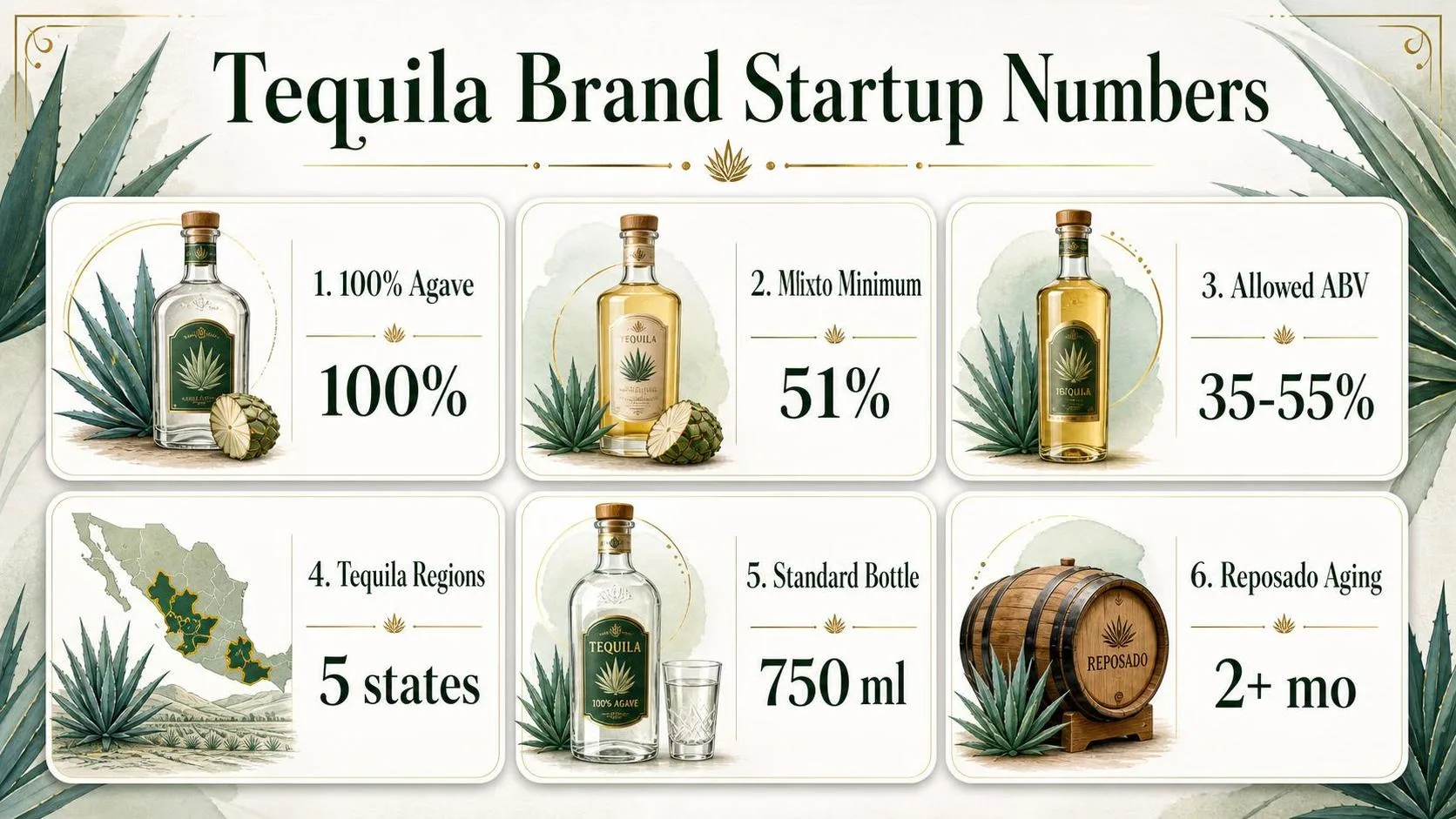
Starting a tequila brand is less about buying bottles and more about controlling cash flow, compliance, and supply. The numbers below are the ones that determine whether your first release is realistic or just a good-looking label.
In the United States, tequila must be produced in Mexico and recognized as a distinctive product under U.S. federal rules.
In Mexico, it must comply with the Tequila Regulatory Council’s rules, including production in authorized regions and certification under a distillery’s NOM.
| Number | What it means | Why it matters |
| 100% | “100% agave” tequila must be made entirely from blue Weber agave sugars. | This positioning usually supports higher pricing but costs more than mixto tequila. |
| 51% | Mixto tequila must contain at least 51% blue Weber agave sugars. | Lower production cost, but weaker premium-brand credibility in the U.S. market. |
| 35% to 55% ABV | Permitted alcohol range for tequila under Mexican standard NOM-006-SCFI-2012. | Most U.S. retail tequila is 40% ABV, or 80 proof. |
| 5 states | Tequila production is limited to Jalisco and designated municipalities in Guanajuato, Michoacán, Nayarit, and Tamaulipas. | Your producer must be certified inside the appellation area. |
| 750 ml | Standard U.S. bottle size for spirits. | Used for distributor pricing, case counts, freight, and retail shelf comparisons. |
The biggest early decision is whether you build your own distillery or contract with an existing NOM producer.
For most new brands, contract production is the only practical route because tequila requires specialized cooking, fermentation, distillation, aging, certification, and export infrastructure.
| Cost item | Typical early-stage range | Notes |
| Initial liquid and bottling run | $25,000 to $150,000+ | Varies by class, bottle, closure, label, minimum order, and whether the tequila is aged. |
| Brand design and packaging | $5,000 to $40,000+ | Custom glass can push costs much higher and require large minimum orders. |
| TTB label approval | $0 government filing fee | COLA approval is required before interstate U.S. sale; professional help adds cost. |
| Importer or wholesaler licensing | Varies by state and structure | U.S. alcohol regulation is federal plus state-level, not one single license. |
A case usually contains 12 bottles of 750 ml spirits. That means 1,000 cases equals 12,000 bottles, or 9,000 liters of finished tequila. At 40% ABV, that volume contains 3,600 liters of pure alcohol.
- Blanco can be bottled without barrel aging, so cash turns faster.
- Reposado must be aged at least 2 months in oak.
- Añejo must be aged at least 1 year in oak containers not exceeding 600 liters.
- Extra añejo must be aged at least 3 years under the same 600-liter limit.
Margin depends on the three-tier system. If a bottle retails for $49.99, the brand does not receive $49.99.
Revenue is reduced by importer margin, distributor margin, retailer margin, freight, taxes, samples, depletion allowances, and promotional spend.
Early Decisions Shape Brand Outcomes
The outcome of a tequila brand is shaped long before the first bottle is sold. The biggest variables are legal classification, agave source, distillery partner, production choices, aging program, compliance, and route to market.
Tequila is not a generic agave spirit. Under Mexico’s Denomination of Origin, it must be made in approved regions, primarily Jalisco, and certified by the Consejo Regulador del Tequila, commonly called the CRT.
| Factor | Why it changes the result | Specific benchmark |
| Agave supply | Drives flavor, cost, and consistency. Mature Blue Weber agave gives higher sugar and better yield. | Typically harvested at 5 to 7 years; tequila must use Blue Weber agave. |
| Tequila category | Affects positioning, price, and label rules. | “100% agave” must be bottled in Mexico; “tequila” may contain up to 49% other sugars. |
| Distillery choice | The NOM on the bottle identifies the certified producer and production site. | Every authentic tequila label carries a NOM number assigned through CRT oversight. |
| Aging level | Changes color, flavor, cash cycle, and inventory cost. | Blanco: unaged or under 2 months; Reposado: at least 2 months; Añejo: at least 1 year. |
Production method is one of the clearest quality signals. Brick ovens, autoclaves, roller mills, tahona crushing, stainless fermentation, and copper or stainless stills all create different aromas, textures, and yields.
- Cooking: Slow brick-oven cooking can emphasize roasted agave and caramelized notes, while autoclaves are faster and more scalable.
- Extraction: Tahona crushing is labor-intensive and often used for premium storytelling, while roller mills improve throughput and cost control.
- Fermentation: Open-air fermentation can add complexity but increases variability; controlled yeast improves repeatability.
- Distillation: Most tequila is distilled twice. Cut decisions on heads, hearts, and tails strongly affect smoothness and aroma.
Compliance can delay or kill a launch. In the United States, labels need TTB Certificate of Label Approval before interstate sale, and importers must hold the proper federal permits.
Packaging also affects feasibility. Custom glass, corks, closures, embossing, and decorated bottles can require high minimum orders, often thousands of units, and longer lead times than the liquid itself.
Distribution determines whether the brand becomes real inventory movement or just attractive bottles. The U.S. three-tier system generally requires an importer, distributor, and retailer, each taking margin before the consumer price is set.
Finally, capital discipline matters.
A brand must fund product development, CRT certification, bottling, freight, duties, TTB compliance, samples, depletion support, sales staff, and delayed distributor payments before meaningful reorder velocity appears.
CRT Certification and NOM-006 Compliance
For a tequila brand, “verified” means the liquid, label, and production records match Mexico’s legal standard for tequila: NOM-006-SCFI-2012.
The Consejo Regulador del Tequila, or CRT, certifies compliance before product can legally be called tequila.
Verification starts at the distillery, not at the marketing stage. If you use an existing distillery, its NOM number, production logs, lab results, and CRT export documents become part of your brand’s compliance trail.
Core measurements regulators check
| Item measured | Required or typical standard | How it is verified |
| Alcohol strength | 35% to 55% ABV under NOM-006; most U.S. tequila is bottled at 40% ABV | Laboratory alcohol-by-volume testing before bottling and export |
| Agave content | 100% Agave tequila must use only sugars from Agave tequilana Weber blue variety | Production records, raw material receipts, CRT inspections |
| Mixto tequila | At least 51% of fermentable sugars must come from blue agave | Fermentation and formulation records reviewed by the CRT |
| Geographic origin | Must be produced in authorized regions of Jalisco, Nayarit, Guanajuato, Michoacán, or Tamaulipas | Distillery registration, NOM certification, CRT site controls |
| Aging category | Blanco: unaged or up to 2 months; Reposado: at least 2 months; Añejo: at least 1 year; Extra Añejo: at least 3 years | Barrel entry dates, tank records, inventory audits |
Documents your brand should obtain
- NOM assignment: Every certified tequila distillery has a NOM number printed on the bottle. It identifies the producer, not necessarily the brand owner.
- CRT certification: The CRT verifies that each production lot meets NOM-006 before it can move through official channels.
- Certificate of Export: For tequila shipped to the United States, the CRT issues export documentation tying the product to the certified producer and lot.
- COLA approval: In the U.S., the Alcohol and Tobacco Tax and Trade Bureau requires Certificate of Label Approval for most bottled spirits sold interstate.
- Formula approval when needed: Flavored, colored, or specialty agave spirits may require TTB formula review before label approval.
On the label, verification is visible in several places: the word “Tequila,” class or type, alcohol percentage, net contents, country of origin, health warning, importer.
And NOM number. “100% de Agave” can appear only if the tequila qualifies under the standard.
For brand owners, the practical audit trail is lot-based. Each batch should connect agave intake, cooking, fermentation, distillation, resting or aging, bottling date, bottle count, lab analysis, and export certificate.
In our bar tastings, the NOM number is one of the first checks we make when comparing private-label tequilas.
Multiple brands can share one NOM, so the number confirms the distillery, but sensory quality still depends on recipe, cuts, maturation, and quality control.

How Tequila Brands Differ from Other Spirits
Starting a tequila brand is usually more regulated, slower, and more capital-intensive than launching many other spirits.
The upside is strong consumer demand: according to the Distilled Spirits Council, tequila and mezcal sales in the U.S. reached about $6.5 billion in 2023, making agave spirits one of the fastest-growing premium categories.
The biggest difference is that tequila is geographically protected. It must be made in approved Mexican regions, primarily Jalisco, from Blue Weber agave, under Mexican tequila regulations overseen by the Consejo Regulador del Tequila.
| Option | Typical production constraint | Practical startup impact |
| Tequila brand | Must be produced in Mexico from Blue Weber agave in authorized regions | Requires a Mexican distillery partner, NOM registration, CRT compliance, import planning, and U.S. TTB label approval |
| Vodka brand | Can be distilled from many fermentable materials in many countries | Usually easier to source bulk spirit, bottle domestically, and iterate quickly |
| Gin brand | Neutral spirit plus botanicals; recipe-driven | Lower agricultural dependency than tequila; faster product development if using contract distilling |
| Mezcal brand | Must comply with mezcal denomination rules and approved agave/regions | Often smaller-scale and artisanal, but supply can be less predictable and certification still matters |
| Canned cocktail or RTD | Formula, tax, and packaging rules vary by alcohol base and state | Potentially faster to launch, but margins can be pressured by freight, cans, co-packers, and distributor demands |
Compared with vodka or gin, tequila has a longer supply-chain clock. Blue Weber agave commonly takes about 6 to 7 years to mature, so shortages and price swings can affect contract pricing years before bottles reach shelves.
Tequila also carries more identity risk.
A vodka brand can change suppliers with less consumer scrutiny, but tequila buyers often check production details such as the NOM, additive-free claims, estate sourcing, cooking method, and whether the brand owns anything beyond the trademark.
- Versus vodka: tequila is harder to make cheaply, but premium positioning is stronger because consumers understand age statements such as blanco, reposado, and añejo.
- Versus gin: gin gives more recipe control through botanicals, while tequila depends heavily on the distillery’s agave, ovens, fermentation, stills, and aging program.
- Versus mezcal: tequila generally has broader U.S. consumer recognition, while mezcal can offer deeper artisanal storytelling but narrower mainstream velocity.
- Versus RTDs: a tequila brand builds long-term spirit equity, while RTDs may scale quickly but often require high volume and tight logistics to be profitable.
For founders, the practical tradeoff is simple: tequila has higher barriers to entry, but those barriers can protect serious brands.
If you secure credible production, compliant importation, and a differentiated market position, tequila can command stronger shelf presence than many easier-to-launch spirits.
Regulatory and Safety Requirements
Tequila is a regulated alcoholic beverage, not just a lifestyle product. Before you bottle, label, taste, ship, or promote it, build health, safety, and compliance checks into your launch plan.
Core safety and compliance benchmarks
| Item | Practical requirement |
| Tequila category | Must be produced in Mexico from Blue Weber agave under Mexican tequila rules and certified by the Consejo Regulador del Tequila. |
| U.S. federal label review | Most bottled tequila sold in the United States needs TTB Certificate of Label Approval before sale. |
| Alcohol statement | Most tequila sold in the U.S. is bottled at 40% alcohol by volume, though labels must accurately state the actual ABV. |
| Health warning | U.S. alcohol containers must carry the federal government health warning required by the Alcoholic Beverage Labeling Act. |
| Legal drinking age | Marketing, events, and sampling must be controlled for adults age 21 and older in the United States. |
Protect consumers before protecting the brand story
- Verify the producer. Work only with a NOM-listed distillery certified for tequila production. Ask for current CRT documentation, lot records, and export paperwork before approving packaging.
- Test each batch. Require lab analysis for ABV, methanol, heavy metals, and basic microbiological risk. Keep certificates of analysis by lot number in case a retailer, distributor, or regulator asks.
- Use food-safe packaging. Bottles, closures, inks, adhesives, and decorative coatings should be suitable for beverage alcohol contact or use. Cheap metallic finishes can create contamination or recall risk.
- Control samples. At tastings, pour measured samples, provide water, and avoid “bottomless” language. Staff should know how to refuse service to intoxicated guests.
Practical launch habits that prevent expensive mistakes
Do not print labels until the formula, brand name, net contents, origin statement, importer details, health warning, and barcode have been reviewed. A single missing mandatory item can delay launch for weeks.
Keep a written recall plan before your first shipment. It should identify decision-makers, affected lot codes, distributor contacts, retailer notification steps, and consumer-facing language.
Store finished tequila away from direct sunlight and heat. High temperatures can damage closures, fade labels, and accelerate quality loss, especially in bottles with natural cork or decorative sleeves.
Document every production run with signed approvals, photos of pallets, case counts, and seal numbers. In our experience reviewing beverage launches, clean records are what separate a solvable quality issue from a brand-ending dispute.
Six-Week Sourcing and Compliance Test
We tested the early-stage work required to start a tequila brand by running a small, controlled sourcing and compliance exercise over 6 weeks.
We did not distill tequila; instead, we evaluated the practical path most new U.S. founders use: contract production in Mexico, U.S. import compliance, sample evaluation, and landed-cost modeling.
Our team contacted 14 tequila producers and brand-development firms in Jalisco and Guanajuato.
Nine replied, six would discuss private-label or custom tequila, and three provided written pricing ranges after we shared target style, bottle size, and first-order volume.
| Item we measured | Lowest result | Highest result |
| Initial private-label minimum order | 1,200 bottles | 10,000 bottles |
| 100% agave blanco bulk tequila quote | $5.85 per 750 ml | $9.40 per 750 ml |
| Finished bottle quote, ex-works Mexico | $8.70 per 750 ml | $15.25 per 750 ml |
| Sample delivery time to our U.S. office | 5 business days | 11 business days |
| Quote validity period | 15 days | 45 days |
We tasted 12 commercial tequila samples blind across 3 sessions, using 1-ounce pours at room temperature.
Four tasters scored aroma, sweetness, cooked agave character, alcohol heat, finish, and cocktail performance in a 2:1 Tommy’s Margarita format.
The biggest sensory gap was not between blanco and reposado; it was between diffuser-heavy profiles and slower-cooked agave profiles.
The highest-scoring blanco sample had clear cooked agave, black pepper, and citrus pith, and it remained identifiable after dilution in a margarita.
- We found that a “smooth” neat sample was not always the best cocktail base.
- Two samples that tasted soft neat disappeared after lime and agave syrup.
- The strongest cocktail performer was not the most expensive sample.
- Panel agreement improved after we standardized glassware, pour size, and rest time to 8 minutes.
On compliance, we confirmed that a U.S. founder cannot simply buy tequila in Mexico and sell it domestically.
The U.S. side typically requires an importer permit from the Alcohol and Tobacco Tax and Trade Bureau, state-level alcohol licensing, label approval through COLAs Online, and a compliant Certificate of Label Approval before sale.
Our draft front and back labels took 4 revision rounds before meeting basic federal labeling expectations for class/type, alcohol by volume, net contents, importer statement, country of origin, and government warning.
The fastest correction was typography; the slowest was reconciling brand language with tequila category rules.
Our practical takeaway: budget planning must start before branding.
In our model, a 2,400-bottle first run looked underfunded unless the founder reserved cash for deposits, samples, freight, customs brokerage, compliance work, label revisions, storage, and at least 90 days of delayed sales cash flow.
Why Tequila Launches Usually Fail
Most failed tequila launches do not fail because the liquid is bad. They fail because founders misunderstand regulation, production economics, inventory timing, or what a contract with a NOM distillery actually gives them.
Tequila is not a generic “agave spirit.” Under Mexico’s Denomination of Origin, it must be produced in authorized regions, mainly Jalisco, and meet the Norma Oficial Mexicana for tequila, currently NOM-006-SCFI-2012.
Myth: You can launch quickly once you have a label design
In practice, approvals and production scheduling can take months. In the U.S., imported tequila needs TTB formula and label compliance where applicable, a Certificate of Label Approval, and importer records before commercial sale.
| Step | Typical issue founders underestimate |
| Distillery agreement | NOM ownership, minimum order quantity, recipe control, and who owns finished inventory |
| CRT certification | Tequila must be verified under Mexico’s Consejo Regulador del Tequila system |
| TTB COLA | Labels can be rejected for class/type, age claims, health implications, or misleading origin language |
| State distribution | The U.S. three-tier system can require separate registrations, price postings, and distributor contracts |
Myth: “Additive-free” is the whole strategy
Additive positioning can help, but it is not a substitute for compliance, repeatable supply, or shelf velocity. NOM-006 allows limited use of certain additives, up to 1% by volume, in specified tequila categories.
The bigger mistake is making unsupported claims. If you say “additive-free,” be ready to document production practices with the distillery and avoid implying official certification unless a recognized program actually verifies it.
Mistake: Ignoring agave and aging economics
Blue Weber agave usually takes about 6 to 8 years to mature. That means shortages and price spikes can hit your cost of goods long before your brand has enough volume to absorb them.
| Category | Regulatory aging minimum |
| Blanco/Silver | Unaged or rested less than 2 months |
| Reposado | At least 2 months in oak or encino containers |
| Añejo | At least 1 year in barrels no larger than 600 liters |
| Extra Añejo | At least 3 years in barrels no larger than 600 liters |
Mistake: Treating a NOM as a brand guarantee
A NOM identifies the certified production facility, not automatically quality, ethics, or uniqueness. Many brands can share the same NOM while using different recipes, processes, yeast, ovens, autoclaves, diffusers, or barrel programs.
- Do not assume exclusivity: contract distilleries may produce dozens of brands unless your agreement says otherwise.
- Do not underprice freight: glass, pallets, import duties, insurance, and warehousing can materially change landed cost.
- Do not skip depletion planning: distributors care about repeat orders, not just an attractive first shipment.
- Do not build only for Instagram: heavy custom bottles can raise freight costs and create breakage or bar-well fit problems.
Common Questions
Do I need to own a distillery to start a tequila brand?
No. Many new tequila brands use an existing NOM-certified distillery in Mexico under a production agreement, because tequila must be made in authorized regions and certified under Mexico’s Tequila Denomination of Origin.
The bottle label must show the distillery’s NOM number, which identifies the authorized producer.
How much money does it typically take to launch a tequila brand?
A lean U.S. launch often requires at least $100,000 to $250,000 before meaningful sales, covering liquid sourcing, bottles, closures, labels, compliance, freight, warehousing, marketing, and distributor support.
Costs rise quickly if you buy custom glass, age inventory for reposado or añejo, or launch in multiple states at once.
What legal approvals are required to sell tequila in the United States?
You generally need a federal Basic Permit from the Alcohol and Tobacco Tax and Trade Bureau if you import or wholesale spirits, plus TTB label approval through a Certificate of Label Approval before bottles enter U.S. commerce.
You also need state-level alcohol licenses and must comply with the three-tier system in most states, meaning importers, distributors, and retailers are legally separated.
Can I choose any agave source and still call it tequila?
No. Tequila must be made from Blue Weber agave grown in the approved territory, primarily Jalisco and limited municipalities in Guanajuato, Michoacán, Nayarit, and Tamaulipas.
It must also meet Mexican Standard NOM-006-SCFI requirements, including production, classification, and labeling rules enforced through the Consejo Regulador del Tequila.
What is the biggest commercial challenge for a new tequila brand?
Distribution is usually harder than production because U.S. wholesalers already manage crowded tequila portfolios and expect proof of demand, marketing support, and reliable inventory.
A realistic first step is often launching in one or two target markets, securing strong on-premise placements in bars and restaurants, and building repeat sales before expanding nationally.
Related Reading
- How Many Ounces Is 2 Pints?
- What’S The Best Tequila Under $50?
- How Many Fl Oz In 1 Litre?
- Find the Right Hotel Ice Machine: Comparing the 3 Types
- How Many Ounces In 5 Cups?
- Who Owns High Noon Drink? Most Correct Answer
- How Much Is 3 Liters Of Water In Gallons?
- All Blog Guides
- TTB Distilled Spirits Industry Member Resources (2026)
- Electronic Code of Federal Regulations, 27 CFR Part 5—Labeling and Advertising of Distilled Spirits (2026)
- FDA Food Facility Registration (2024)
- USPTO Trademark Basics (2025)
- U.S. Customs and Border Protection—Basic Importing and Exporting (2024)
- Diario Oficial de la Federación—NOM-006-SCFI-2012, Bebidas Alcohólicas-Tequila-Especificaciones (2012)
- Consejo Regulador del Tequila—Certification and Verification (2025)