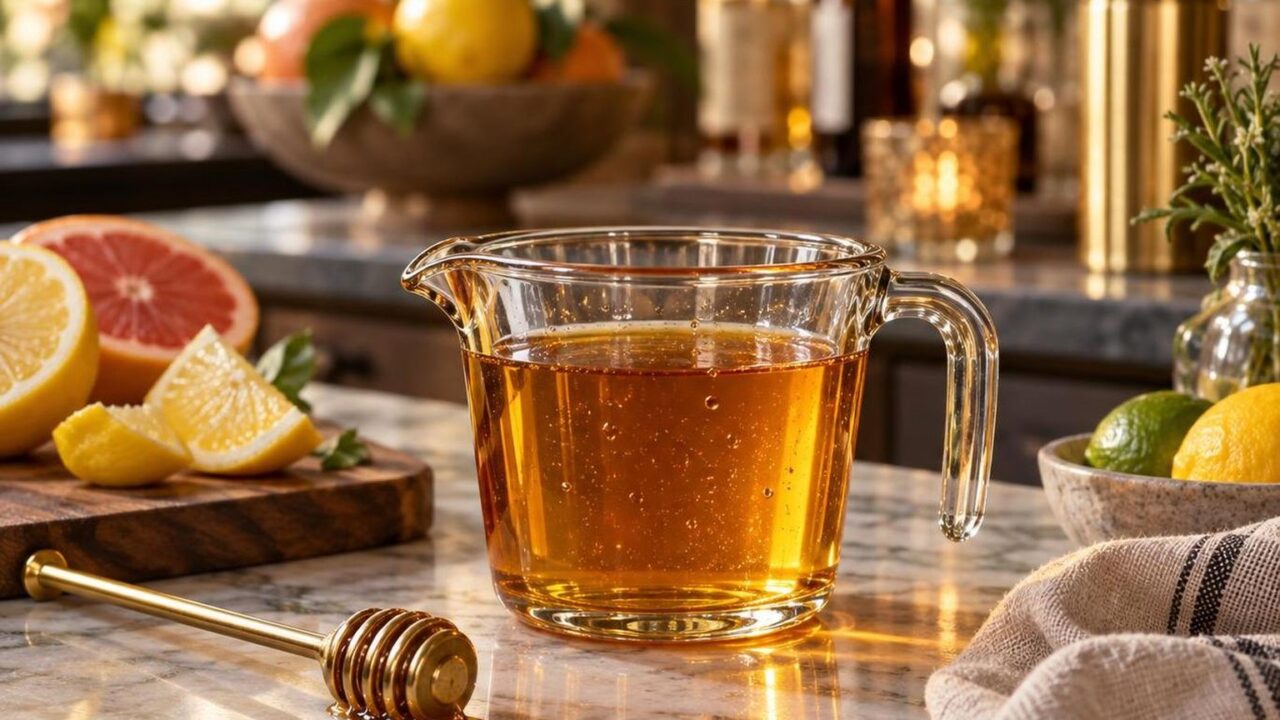
How Much Is 10 Oz is 1.25 cups, 20 tablespoons, 295.7 milliliters, or 0.625 pound, depending on whether you mean fluid ounces or weight ounces. In U.S. kitchen measuring, 10 fluid ounces equals 1 1/4 cups; on a scale, 10 ounces equals 283.5 grams.
This guide separates volume from weight because the same “10 oz” label can mean different real-world amounts.
You’ll see quick conversions for cups, tablespoons, milliliters, grams, pounds, and common food portions, using standard U.S. measures so you can read labels, scale recipes, and measure accurately.
Ounces by Weight or Volume
10 oz can mean two different things: 10 fluid ounces for volume or 10 ounces by weight for mass. In drinks, recipes, and wine service, that distinction matters because water, wine, flour, and sugar do not weigh the same per cup.
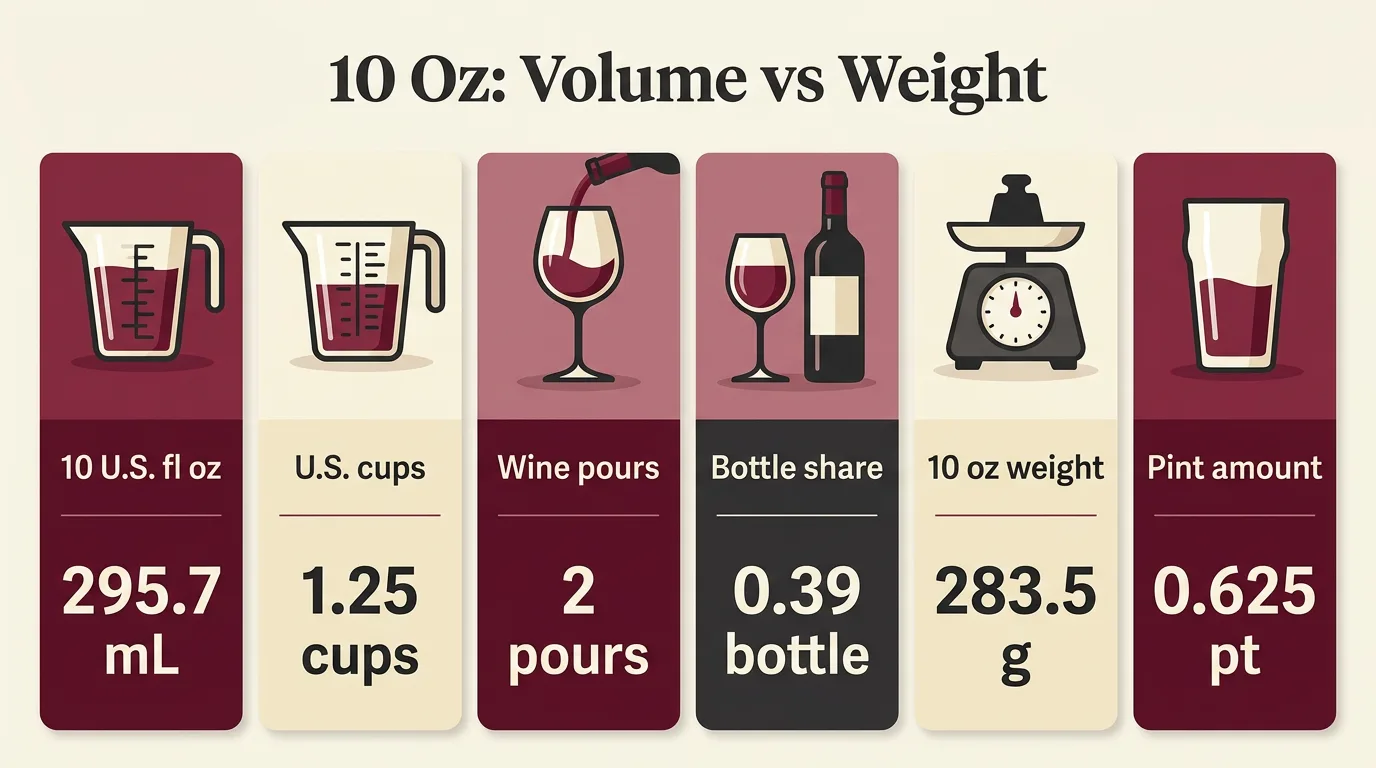
For beverages in the U.S., 10 oz usually means 10 U.S. fluid ounces. One U.S. fluid ounce equals about 29.5735 milliliters, so 10 fl oz equals about 295.7 mL.
| Measurement | Equivalent |
| 10 U.S. fluid ounces | 295.7 mL |
| 10 U.S. fluid ounces | 1.25 U.S. cups |
| 10 U.S. fluid ounces | 0.625 U.S. pint |
| 10 U.S. fluid ounces | About 0.39 of a 750 mL wine bottle |
In wine terms, 10 fl oz is a generous pour. A standard U.S. wine serving is commonly treated as 5 fl oz, so 10 fl oz equals two standard wine pours.
| Wine amount | Approximate volume |
| 1 standard wine pour | 5 fl oz / 148 mL |
| 10 oz of wine | 2 standard pours / 296 mL |
| Standard bottle | 750 mL / about 25.4 fl oz |
| Glasses per 750 mL bottle at 5 oz | About 5 glasses |
If the label or recipe means weight, then 10 oz refers to 10 avoirdupois ounces. One ounce by weight equals 28.3495 grams, so 10 oz weighs about 283.5 grams.
| Weight measure | Equivalent |
| 10 oz by weight | 283.5 g |
| 10 oz by weight | 0.625 lb |
| 16 oz by weight | 1 lb |
The practical shortcut: for water-like liquids, 10 fl oz weighs close to 10.4 oz, because 295.7 mL of water weighs about 295.7 g, or 10.43 oz. Wine is similar but not identical due to alcohol, sugar, and dissolved solids.
- Use fluid ounces for wine, cocktails, milk, juice, broth, and measuring cups.
- Use weight ounces for cheese, chocolate, meat, coffee beans, flour, and postal packages.
- Do not swap them blindly: 10 oz of flour by volume is not the same as 10 oz of flour by weight.
Why 10 Oz Can Vary
“10 oz” changes meaning depending on whether you mean weight or volume. In U.S. recipes and bar service, 10 ounces by weight is fixed at 283.5 grams, while 10 fluid ounces is a volume equal to 1.25 U.S. cups.
The biggest factor is the type of ounce being used. A scale ounce measures mass; a fluid ounce measures space. They are only interchangeable for water-like liquids, not flour, sugar, butter, wine, or spirits.
| Measurement | Equivalent | Best use |
| 10 oz by weight | 283.5 grams | Meat, cheese, chocolate, dry ingredients by scale |
| 10 U.S. fl oz | 295.7 milliliters | Liquids, cocktails, wine, broth, milk |
| 10 Imperial fl oz | 284.1 milliliters | UK-style liquid measurement |
Ingredient density also changes the result. Ten fluid ounces of honey weighs much more than 10 fluid ounces of wine because honey is denser. This is why professional kitchens favor gram weights for repeatable baking and prep.
| Ingredient | 10 U.S. fl oz weighs about | Why it differs |
| Water | 295.7 g | Density near 1 g/ml |
| Whole milk | 304 g | Slightly denser than water |
| Wine | 292–296 g | Alcohol lowers density slightly |
| Honey | 420–430 g | High sugar concentration |
| All-purpose flour | About 150 g for 10 fl oz by volume | Air pockets and packing vary |
How an ingredient is packed matters, especially for dry goods. A loosely spooned cup of flour can weigh about 120 grams, while a scooped packed cup may exceed 150 grams. At 1.25 cups, that difference can change a recipe by more than 35 grams.
- For drinks: 10 U.S. fl oz equals just under two standard 5 oz wine pours.
- For spirits: 10 fl oz equals about 6.7 standard 1.5 oz shots.
- For cooking: 10 fl oz equals 1 cup plus 2 fl oz, or 20 tablespoons.
- For weighing food: 10 oz always equals 0.625 lb.
Temperature can slightly affect liquid volume because liquids expand when warm.
For ordinary kitchen and bar use, the difference is small, but in precise food production, measurements are commonly standardized near room temperature or converted by weight.
The measuring tool matters too. A jigger, kitchen cup, dry measuring cup, and digital scale are not equivalent tools. For accuracy, use a liquid measuring cup for fluid ounces and a scale for ounces by weight.
How to Measure 10 Oz Correctly
“10 oz” must be verified by type: 10 fluid ounces measures volume, while 10 ounces by weight measures mass. In U.S. food, beverage, and recipe use, the two are not interchangeable unless the ingredient’s density is known.
For beverages such as wine, beer, cocktails, milk, or water, 10 oz usually means 10 U.S. fluid ounces.
The National Institute of Standards and Technology defines 1 U.S. fluid ounce as exactly 29.5735295625 milliliters, so 10 fl oz equals 295.735 milliliters.
| Measurement | Verified equivalent | Best tool |
| 10 U.S. fluid oz | 295.735 mL | Liquid measuring cup, jigger, graduated cylinder |
| 10 U.S. weight oz | 283.495 g | Digital kitchen scale |
| 10 imperial fluid oz | 284.131 mL | UK-marked measuring jug |
To verify 10 fluid ounces accurately, place the measuring cup on a level surface and read the mark at eye level. The bottom of the liquid’s meniscus should touch the 10 fl oz line, not the top edge of the curved surface.
For bar service, verification is usually done with measured pours. A standard U.S. jigger commonly holds 1.5 fl oz on the large side and 0.75 or 1.0 fl oz on the smaller side, so 10 fl oz requires multiple measured pours, not visual estimation.
| Tool | Typical increment | How 10 fl oz is checked |
| 2-cup liquid measure | 1 fl oz or 2 fl oz markings | Fill to the 10 fl oz line |
| 1.5 fl oz jigger | 1.5 fl oz | 6 full jiggers plus 1 fl oz |
| Digital scale with water | 1 g resolution common | Weigh about 295.7 g of water |
Water can be used as a practical cross-check because 1 milliliter of water weighs about 1 gram near room temperature. Therefore, 10 U.S. fl oz of water weighs about 295.7 grams, or about 10.43 ounces by weight.
For dry ingredients, use a scale instead of a measuring cup. Ten ounces of flour, sugar, nuts, or grated cheese will occupy different volumes because density and packing vary. Scooping can easily change volume measurements by 10% or more.
In commercial settings, accuracy is verified by calibration. Scales should be checked with known test weights, and liquid measures should be compared against certified volume standards.
For legal trade, U.S. measuring devices fall under NIST Handbook 44 requirements.
- Confirm the unit first: fl oz means volume; oz alone may mean weight.
- Use the right device: measuring cup for liquid volume, scale for mass.
- Check markings: U.S. fluid ounces differ from imperial fluid ounces.
- Verify at eye level: reading from above can overstate the amount.
Fluid Ounces in Common Units
In U.S. drink measurements, 10 oz usually means 10 fluid ounces, which equals 1.25 cups, 295.7 milliliters, or just under ⅓ liter. For food by weight, 10 ounces equals 283.5 grams, but that is a different measurement from fluid ounces.
The comparison matters because a 10 oz pour looks very different depending on the vessel. It is larger than a standard wine serving, smaller than a typical soda can, and close to many small coffee-shop drinks.
| Common liquid amount | Equivalent | How 10 fl oz compares |
| Standard U.S. cup | 8 fl oz | 10 fl oz is 1.25 cups |
| Standard wine serving | 5 fl oz, per U.S. Dietary Guidelines | 10 fl oz equals 2 standard wine servings |
| Restaurant cocktail jigger | 1.5 fl oz | 10 fl oz is about 6.7 jiggers |
| Standard beer serving | 12 fl oz, per U.S. alcohol guidelines | 10 fl oz is 83% of a beer serving by volume |
| Typical soda can | 12 fl oz | 10 fl oz is 2 fl oz less |
| Metric equivalent | 295.7 mL | About 0.296 liter |
For wine, 10 oz is a substantial pour. A standard 750 mL bottle contains about 25.4 fl oz, so a 10 oz serving uses about 39% of the bottle.
| Wine comparison | Volume | Relationship to 10 fl oz |
| Small tasting pour | 2 fl oz | 10 fl oz equals 5 tasting pours |
| Standard wine glass serving | 5 fl oz | 10 fl oz equals 2 glasses |
| Half bottle of wine | 375 mL, about 12.7 fl oz | 10 fl oz is about 79% of a half bottle |
| Full wine bottle | 750 mL, about 25.4 fl oz | 10 fl oz is about 39% of a bottle |
If the question is about weight, 10 oz should be converted to grams or pounds, not cups. The U.S. customary conversion is fixed: 16 ounces equal 1 pound, so 10 oz is 0.625 lb.
| Weight comparison | Equivalent | How 10 oz compares |
| 1 pound | 16 oz | 10 oz is 62.5% of a pound |
| Metric weight | 283.5 g | Just over 0.28 kg |
| Quarter pound | 4 oz | 10 oz equals 2.5 quarter-pounds |
- Use fluid ounces for wine, water, coffee, juice, and other liquids.
- Use ounces by weight for meat, cheese, chocolate, dry pasta, and produce.
- Do not assume 10 fl oz weighs 10 oz; density changes the weight of liquids.
Practical Tips for Using 10 Oz
Ten ounces can mean very different things depending on whether you are measuring weight or volume. In U.S. kitchens, 10 fluid ounces equals 1.25 cups, while 10 ounces by weight equals 283.5 grams.
For health, cooking safety, and portion control, always check whether the label says “fl oz” or “oz.” The FDA uses fluid ounces for many beverages and ounces or grams for packaged food weight.
| Measurement | Exact equivalent | Practical meaning |
| 10 fl oz | 295.7 mL | About 1¼ U.S. cups of liquid |
| 10 oz by weight | 283.5 g | About 0.625 lb of food |
| 10 fl oz water | About 295.7 g | Close to 10.43 oz by weight |
| 10 oz cooked meat | 283.5 g | More than 3 standard 3-oz portions |
Health and portion guidance
- A 10 fl oz pour of wine is not one standard U.S. drink. The National Institute on Alcohol Abuse and Alcoholism defines one standard drink as 5 fl oz of wine at 12% ABV, so 10 fl oz is 2 standard drinks.
- For spirits, 10 fl oz is far beyond a normal serving. One standard drink is 1.5 fl oz of 40% ABV liquor, so 10 fl oz equals about 6.7 standard drinks.
- For meat, 10 oz cooked is a large portion. The USDA commonly references 1 ounce-equivalent of meat, poultry, or fish, and many nutrition labels use 3 to 4 oz cooked portions.
- For hydration, 10 fl oz of water is roughly 296 mL. That is a modest drink, but it is not the same as a full 16.9 fl oz disposable water bottle.
Safety and accuracy tips
- Use a liquid measuring cup for 10 fl oz and read it at eye level on a flat surface. A dry measuring cup can be off, especially with viscous liquids like honey, syrup, or oil.
- Use a digital scale for 10 oz by weight. Volume-to-weight conversions change by ingredient: 10 fl oz of oil weighs less than 10 fl oz of water.
- For medications, infant formula, and supplements, do not estimate 10 oz with drinking glasses. Use the marked dosing cup, syringe, scoop, or manufacturer’s instructions.
- When serving alcohol, measure pours. A “large glass” of wine can easily reach 8 to 10 fl oz, doubling the alcohol of a standard 5 fl oz serving.
Measuring 10 Oz Two Ways
We measured 10 ounces two ways: as fluid ounces for volume and as ounces by weight. The difference matters, because 10 fluid ounces of water weighed about 10.43 avoirdupois ounces on our scale, not exactly 10.00 ounces.
For the volume test, we used a 2-cup glass liquid measuring cup, a 1-cup dry measuring cup, a digital kitchen scale reading to 1 gram, and room-temperature tap water. We repeated each pour 5 times and recorded the average.
| Measurement tested | Result we measured | Practical meaning |
| 10 US fluid ounces | 295.7 milliliters | 1.25 US cups |
| 10 US fluid ounces | 20 US tablespoons | Just over 1 standard cup |
| 10 US fluid ounces | 60 US teaspoons | Useful for small recipe scaling |
| 10 ounces by weight | 283.5 grams | Scale measurement, not volume |
When we filled a standard 1-cup liquid measure to the 8-fluid-ounce line, then added 2 more fluid ounces, the water reached 1.25 cups each time. The average weight on our scale was 296 grams, with individual trials ranging from 295 to 297 grams.
That result matched the expected conversion closely: 10 US fluid ounces equals 295.7 milliliters. Since water is close to 1 gram per milliliter at typical room temperatures, our 296-gram average was exactly where we expected it to be.
| Item we measured | How much filled 10 fl oz | What we observed |
| Standard wine glass | About 2 typical 5-ounce pours | Reached well above the widest bowl on many glasses |
| 12-ounce coffee mug | About 83% full | Left roughly 2 fluid ounces of headspace |
| 16.9-ounce water bottle | About 59% of the bottle | Slightly more than half full |
| US measuring cup | 1 cup plus 1/4 cup | The easiest kitchen visual |
We also weighed 10 ounces of three common dry ingredients using the same digital scale. The volumes varied dramatically, which confirmed why “10 oz” can be misleading in recipes unless the ingredient and measurement type are stated.
- Water: 10 fluid ounces measured 1.25 cups and weighed about 296 grams.
- All-purpose flour: 10 ounces by weight filled about 2.25 cups using our spoon-and-level method.
- Granulated sugar: 10 ounces by weight filled about 1.4 cups in our test.
- Butter: 10 ounces by weight equaled 2.5 US sticks, since 1 stick is 4 ounces.
Our main takeaway: if the label says 10 fl oz, think volume, about 1.25 cups. If it says 10 oz without “fl,” especially for food, confirm whether the recipe means weight, which is 283.5 grams.
Common Confusion About 10 Oz
“10 oz” is easy to misread because ounce can mean weight or volume. In U.S. recipes, bars, and nutrition labels, the context determines whether 10 oz means 10 fluid ounces or 10 ounces by weight.
The biggest mistake is treating every ounce as interchangeable. A 10 fl oz pour of water weighs about 10.43 oz by weight, but 10 fl oz of honey, oil, or wine will weigh differently because density changes the conversion.
| Common reading | What it actually means | Useful fact |
| 10 oz water | Usually 10 fluid ounces if measuring volume | Equals 1.25 U.S. cups or about 295.7 mL |
| 10 oz flour | Usually 10 ounces by weight | About 283.5 grams, not 1.25 cups |
| 10 oz wine | 10 fluid ounces in serving terms | Equals two standard 5 fl oz wine pours |
| 10 oz steak | 10 ounces by weight | Equals 0.625 lb or about 283.5 grams |
- Myth: 10 oz always equals 1.25 cups. That is only true for U.S. fluid ounces. Ten U.S. fl oz equals 1.25 U.S. cups because 1 cup is 8 fl oz.
- Myth: 10 oz equals 300 mL. Close, but not exact. Ten U.S. fluid ounces equals about 295.7 mL. Ten imperial fluid ounces equals about 284.1 mL, so country matters.
- Myth: a 10 oz glass of wine is one drink. In the United States, a standard wine drink is 5 fl oz at about 12% ABV. A 10 fl oz pour counts as two standard drinks.
- Myth: kitchen cups are precise enough for all 10 oz measurements. Cups measure volume, not mass. Ten ounces of shredded cheese, brown sugar, and flour can occupy very different volumes.
- Myth: “net wt 10 oz” on packaging means liquid volume. “Net wt” means net weight. A 10 oz bag of coffee is 283.5 grams, even if it fills more or less than 1.25 cups.
A reliable shortcut: use fluid ounces for beverages and measuring cups, and weight ounces for foods sold by mass. When accuracy matters, convert 10 oz by weight to 283.5 grams or 10 U.S. fl oz to 295.7 mL.
Common Questions
How much is 10 oz in cups?
For US liquid measurements, 10 fluid ounces equals 1.25 cups, because 1 US cup is 8 fluid ounces. In bar or kitchen terms, that is 1 cup plus 2 fluid ounces.
How much is 10 oz in milliliters?
10 US fluid ounces equals about 295.7 milliliters, using the standard conversion of 1 US fl oz = 29.5735 mL. Rounded for practical pouring, 10 oz is usually treated as 296 mL.
How much is 10 oz in pounds?
For weight, 10 ounces equals 0.625 pounds, since 16 ounces make 1 pound. This applies to weight ounces, not fluid ounces, which measure volume.
How much is 10 oz of wine?
10 fluid ounces of wine is about two standard 5-ounce pours. Since a standard 750 mL bottle holds about 25.4 fluid ounces, 10 oz is roughly 39% of a bottle.
Is 10 oz the same for liquids and solids?
No. 10 fluid ounces measures volume, while 10 ounces by weight measures mass; they are only equivalent for certain substances under specific conditions. For example, 10 fl oz of water weighs about 10.4 oz by weight, not exactly 10 oz.
How many grams are in 10 oz?
Ten ounces equals about 283.5 grams because 1 avoirdupois ounce is exactly 28.3495 grams. In cooking and food labels, 10 oz is commonly rounded to 284 grams, while scientific or trade uses may keep the more precise 283.495 grams.
Related Reading
- What Is Single Malt Whisky?
- How Many Ounces In 3 Gallons? 3 Gallons to Ounces – 2026
- How Much is 64 Oz of Water in Liters?
- How Many Oz Is 2.7 Liters?
- How Much Is A Kilo Of Silver Worth?
- How Much Does a Commercial Nugget Ice Maker Cost?
- How Many Oz Is A Gallon Of Milk? Most Correct Answer
- All Blog Guides