
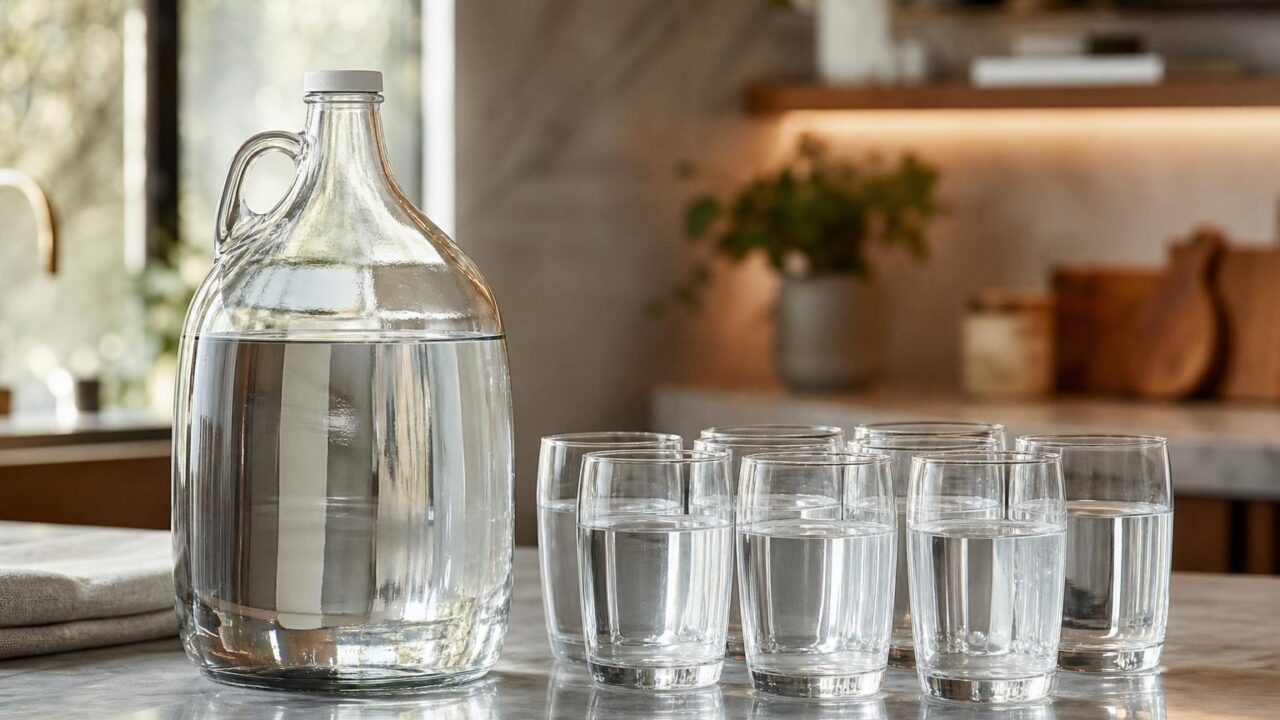
How Many 8 Ounces In A Gallon is 16 8-ounce servings. In U.S. customary measurement, 1 gallon equals 128 fluid ounces, so dividing 128 by 8 gives 16.
This conversion is useful for portioning liquids, scaling recipes, filling containers, and checking serving counts without guesswork.
The key is using U.S. fluid ounces, not dry ounces or imperial gallons. A U.S. gallon is legally defined as 231 cubic inches, which converts to exactly 128 U.S. fluid ounces.
Once that standard is clear, every 8-ounce portion fits evenly into a gallon with no remainder.
Calculating 8-Ounce Servings Per Gallon
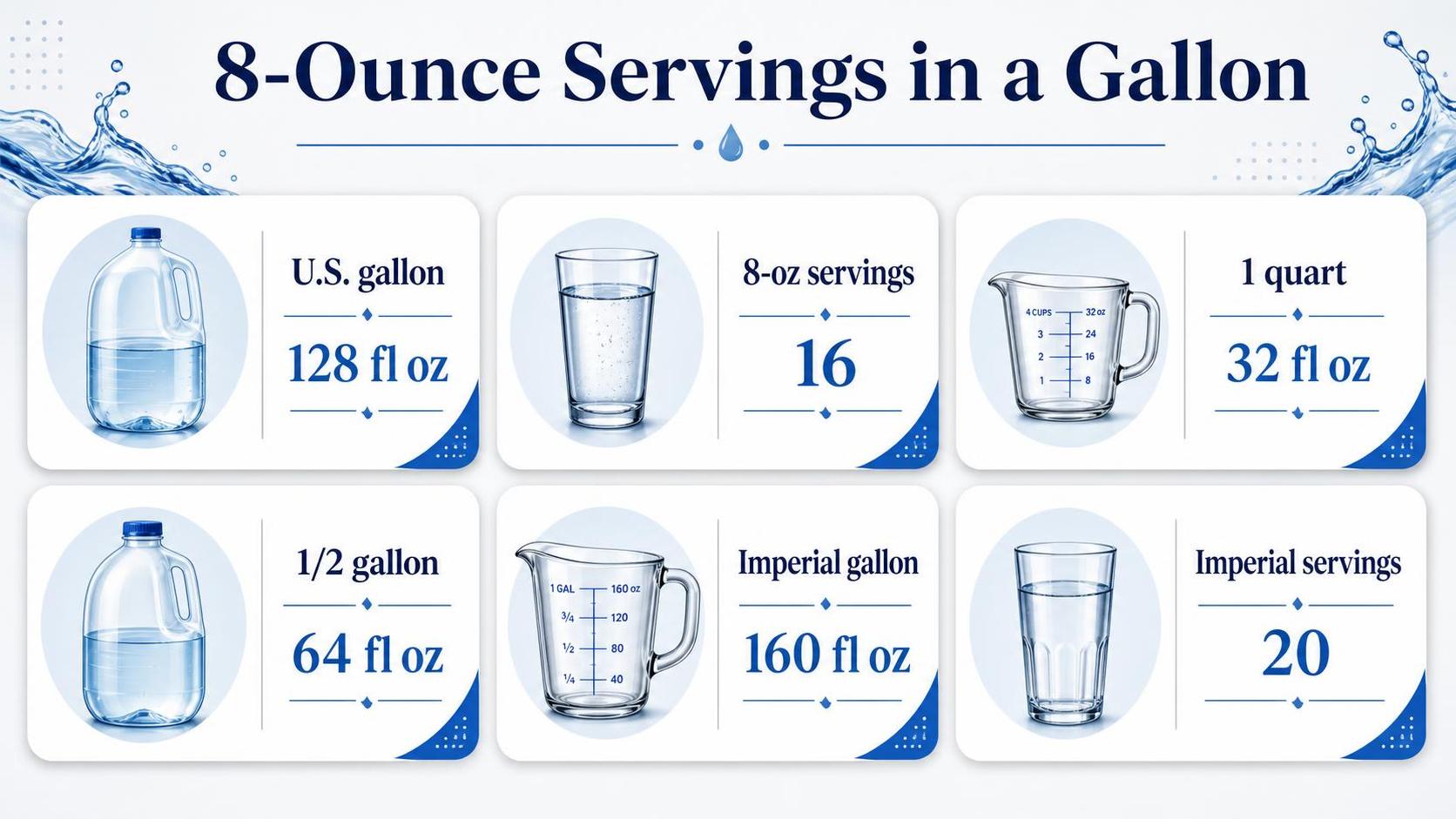
A U.S. liquid gallon contains 128 U.S. fluid ounces. Divide 128 by an 8-ounce serving, and the answer is 16 eight-ounce servings in 1 U.S. gallon.
This is the number used on U.S. nutrition labels, beverage containers, recipes, and food-service measurements. It is based on the U.S. customary liquid measurement system, not the British imperial system.
| Measurement | U.S. liquid amount | How many 8-ounce servings |
| 1 cup | 8 fluid ounces | 1 |
| 1 pint | 16 fluid ounces | 2 |
| 1 quart | 32 fluid ounces | 4 |
| 1/2 gallon | 64 fluid ounces | 8 |
| 1 gallon | 128 fluid ounces | 16 |
The math is straightforward: 128 ÷ 8 = 16. So if a recipe, water goal, or drink dispenser says “1 gallon,” it equals sixteen standard 8-ounce portions.
The National Institute of Standards and Technology lists the U.S. liquid gallon as 231 cubic inches, which equals 128 U.S. fluid ounces. That is the legal basis behind the everyday kitchen conversion.
Why “ounces” can be confusing
An 8-ounce glass usually means 8 U.S. fluid ounces, a volume measurement. It does not mean 8 ounces by weight, which would measure mass instead of liquid volume.
- Fluid ounces measure volume, such as water, milk, juice, or wine.
- Ounces by weight measure mass, such as flour, cheese, or coffee beans.
- For water, 8 U.S. fluid ounces weighs about 8.35 ounces, because water’s density is close to 1 gram per milliliter.
There is also an imperial gallon used in the United Kingdom and some Commonwealth contexts. It is larger than the U.S. gallon, so the 8-ounce count changes if imperial units are being used.
| System | Fluid ounces per gallon | 8-ounce servings per gallon |
| U.S. liquid gallon | 128 U.S. fluid ounces | 16 |
| Imperial gallon | 160 imperial fluid ounces | 20 |
For U.S. readers, the practical answer is almost always 16 glasses of 8 fluid ounces per gallon. Use the imperial figure only when a container, recipe, or label specifically says “imperial gallon.”.
Using 128 Fluid Ounces to Calculate
The usual U.S. kitchen answer is 16, because 1 U.S. liquid gallon equals 128 U.S. fluid ounces, and 128 divided by 8 equals 16. The result changes when “gallon” or “ounce” means a different measurement system.
For recipe math, the first thing to verify is whether the source uses U.S. liquid measure, Imperial measure, or weight ounces.
The National Institute of Standards and Technology defines the U.S. liquid gallon as exactly 231 cubic inches, which equals 128 U.S. fluid ounces.
| Measurement used | Gallon size | 8-ounce portions | Practical result |
| U.S. liquid gallon with U.S. fluid ounces | 128 U.S. fl oz | 128 ÷ 8 | 16 portions |
| Imperial gallon with Imperial fluid ounces | 160 Imperial fl oz | 160 ÷ 8 | 20 portions |
| U.S. dry gallon converted to U.S. fluid ounces | About 148.95 U.S. fl oz | 148.95 ÷ 8 | About 18.62 portions |
| Imperial gallon measured in U.S. fluid ounces | About 153.72 U.S. fl oz | 153.72 ÷ 8 | About 19.22 portions |
The second issue is fluid ounces versus ounces by weight. “8 oz” on a beverage glass usually means 8 fluid ounces, a volume. “8 oz” on a food scale means 8 ounces by weight, which depends on density.
| Liquid or ingredient | Approximate weight of 8 U.S. fl oz | Why it matters |
| Water | About 8.35 oz by weight | Water is close, but not exactly 8 oz by weight |
| Whole milk | About 8.6 oz by weight | Milk is denser than water |
| Vegetable oil | About 7.6 oz by weight | Oil is less dense than water |
- Country of origin matters: U.S. recipes, nutrition labels, and bar measurements usually use U.S. fluid ounces. Older British, Canadian, Australian, or pub-related references may use Imperial units.
- Container labels can mislead: A “gallon” milk jug in the United States is 128 U.S. fluid ounces. A “gallon” reference in the United Kingdom historically means 160 Imperial fluid ounces.
- Rounding affects small servings: If a container holds 1 gallon exactly, sixteen 8-fluid-ounce pours leave no remainder. If pours are 8.5 ounces, the same gallon yields about 15 full pours.
- Real pouring is imperfect: Foam, headspace, ice, meniscus reading, and measuring-cup accuracy can shift actual servings by several ounces across a full gallon.
Volume Verification Rather Than Weight
A U.S. gallon is verified by volume, not by weight, and it contains sixteen 8-fluid-ounce servings. The key is using U.S. customary fluid ounces; an imperial gallon or a dry gallon gives a different result.
In kitchen terms, the check is straightforward: measure out 8 U.S. fluid ounces repeatedly into a calibrated 1-gallon container. When the sixteenth pour reaches the 1-gallon mark, the conversion is confirmed.
| Measure | U.S. customary volume |
| 1 U.S. gallon | 128 U.S. fluid ounces |
| 1 serving glass | 8 U.S. fluid ounces |
| 128 ÷ 8 | 16 servings |
The official U.S. volume relationship is based on the customary system used in food labeling, recipes, and beverage service.
The National Institute of Standards and Technology recognizes the U.S. gallon as 231 cubic inches, equal to 128 U.S. fluid ounces.
| Unit | Exact or standard relationship |
| U.S. gallon | 231 cubic inches |
| U.S. gallon | 128 U.S. fluid ounces |
| U.S. fluid ounce | 29.5735295625 milliliters |
| 8 U.S. fluid ounces | 236.5882365 milliliters |
| 16 portions of 8 U.S. fluid ounces | 3,785.411784 milliliters |
For practical verification, use a liquid measuring cup with fluid-ounce markings, not a dry measuring cup. Set it on a level surface and read the meniscus at eye level, using the bottom of the curve for water, wine, juice, or similar liquids.
- Use fluid ounces: “Ounces” can mean weight or volume. An 8-fluid-ounce pour is a volume measure; 8 ounces by weight depends on the liquid’s density.
- Check the container: Many pitchers marked “1 gallon” are approximate. Laboratory or commercial measuring vessels are more reliable than decorative drink dispensers.
- Control temperature when precision matters: Volume changes slightly with temperature. Calibration work is commonly referenced near room temperature, often 20°C, while kitchen use tolerates small variation.
- Avoid imperial units: An imperial gallon is 160 imperial fluid ounces, so it would contain twenty 8-imperial-fluid-ounce portions, not sixteen U.S. portions.
In beverage service, the most reliable field check is multiplication: count sixteen 8-fluid-ounce pours. If the liquid began as one full U.S. gallon, no more liquid should remain after the sixteenth correctly measured pour.
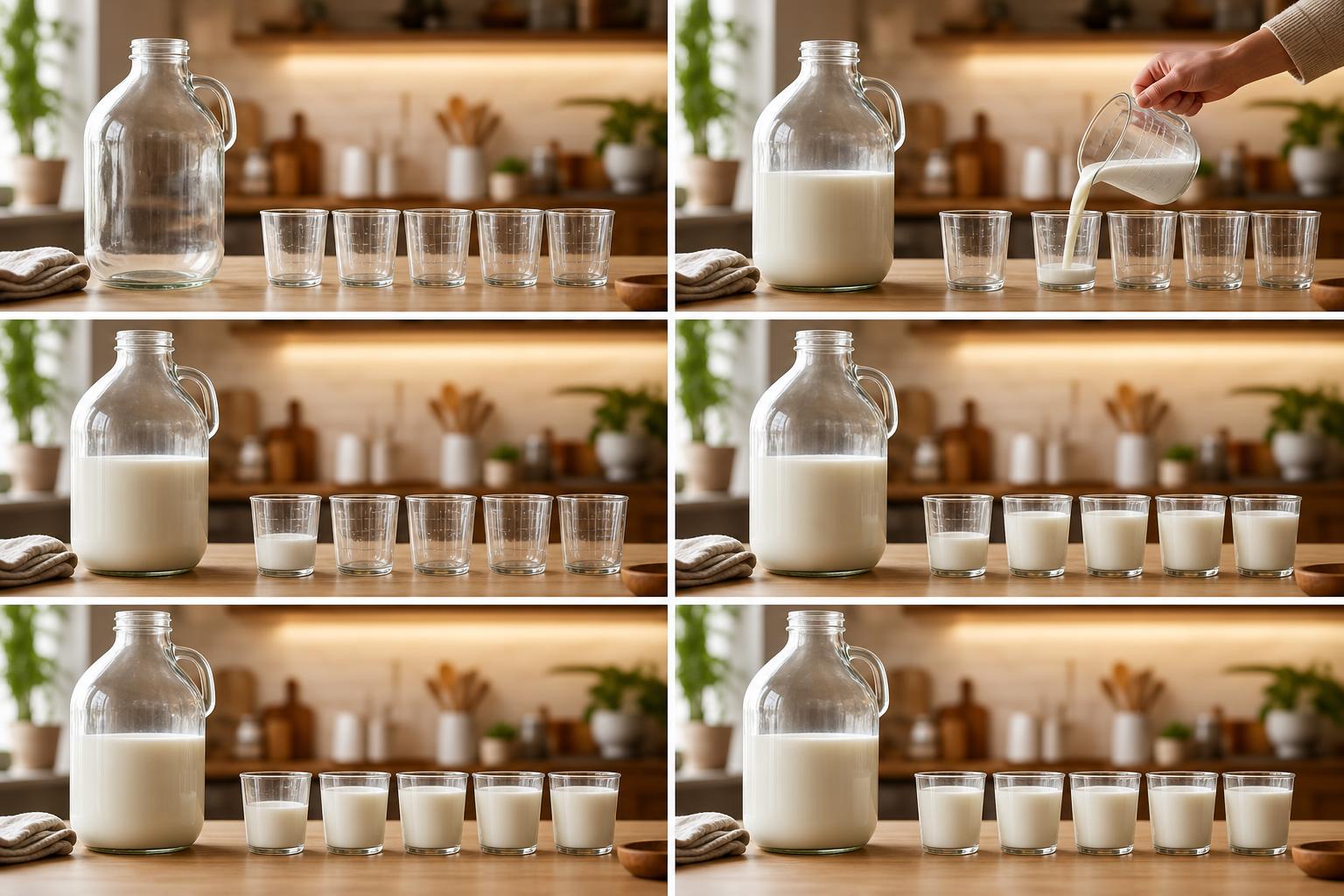
Exact Eight-Ounce Serving Total
A U.S. gallon contains 128 U.S. fluid ounces, so it equals exactly sixteen 8-ounce servings. That makes the gallon a useful anchor when comparing common drink sizes, recipe measures, and retail containers.
The key detail is that these figures use U.S. liquid measures. An imperial gallon, still used in some contexts in the U.K. and Commonwealth countries, is larger at about 160 imperial fluid ounces.
| Container or measure | U.S. fluid ounces | Number of 8-ounce servings | Equivalent in U.S. gallons |
| 1 cup | 8 fl oz | 1 | 1/16 gallon |
| 1 pint | 16 fl oz | 2 | 1/8 gallon |
| 1 quart | 32 fl oz | 4 | 1/4 gallon |
| 1 half-gallon | 64 fl oz | 8 | 1/2 gallon |
| 1 U.S. gallon | 128 fl oz | 16 | 1 gallon |
Compared with everyday beverage containers, an 8-ounce serving is smaller than many retail bottles and cans. A standard U.S. soda can is 12 fluid ounces, while many single-serve water bottles are 16.9 fluid ounces, or 500 milliliters.
| Common beverage size | Fluid ounces | 8-ounce serving comparison | Approximate share of a gallon |
| Small juice box | 6.75 fl oz | 0.84 serving | 5.3% of a gallon |
| Standard cup measure | 8 fl oz | 1 serving | 6.25% of a gallon |
| Soda can | 12 fl oz | 1.5 servings | 9.4% of a gallon |
| Typical bottled water | 16.9 fl oz | 2.11 servings | 13.2% of a gallon |
| Wine bottle | 25.4 fl oz | 3.17 servings | 19.8% of a gallon |
For wine and bar service, this distinction matters because an 8-ounce pour is not the standard wine pour. In the U.S., a typical wine serving is 5 fluid ounces, meaning a gallon holds about 25.6 standard wine pours.
- Water tracking: sixteen 8-ounce glasses equal one U.S. gallon.
- Cooking: four 8-ounce cups equal one quart; sixteen equal one gallon.
- Wine service: a 750 mL bottle is about 25.4 fl oz, not a full quart.
- Bulk drinks: a 1-gallon pitcher serves sixteen 8-ounce portions before ice displacement.
In practical terms, “8 ounces in a gallon” is best understood as a portion count. One gallon gives 16 cup-sized servings, 8 pint-sized servings, 4 quart-sized portions, or roughly 25 standard 5-ounce wine pours.
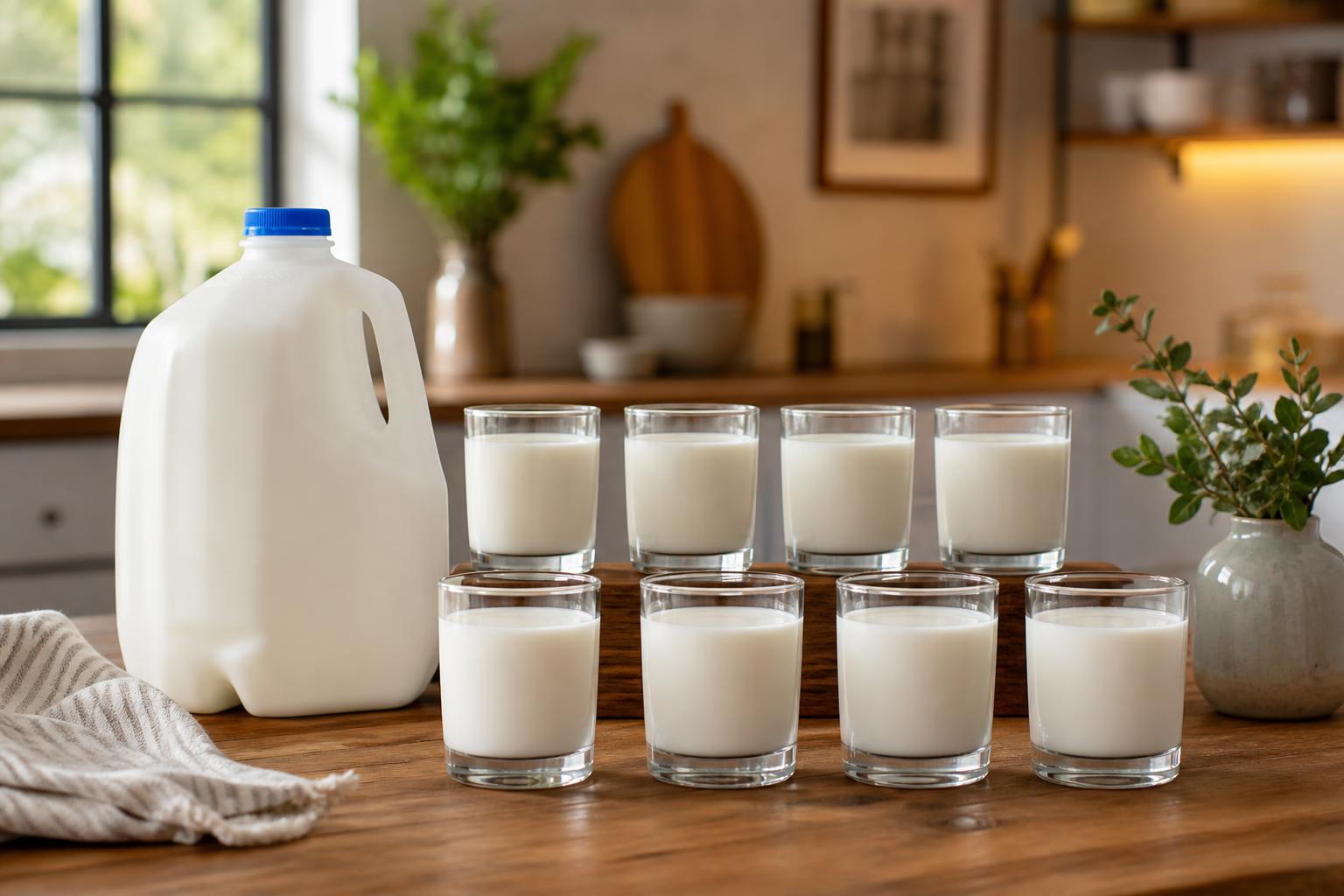
Fluid Ounces Per Gallon
A U.S. liquid gallon contains 128 fluid ounces, so it equals exactly sixteen 8-ounce servings. That simple conversion is useful for hydration, food prep, beverage service, and avoiding unsafe storage or mixing mistakes.
Use the Right Gallon
In the United States, recipes and nutrition labels usually mean the U.S. liquid gallon. It is not the same as an imperial gallon used in the United Kingdom and some Commonwealth contexts.
| Measure | Fluid ounces | 8-ounce servings |
| 1 U.S. liquid gallon | 128 U.S. fl oz | 16 |
| 1 half-gallon | 64 U.S. fl oz | 8 |
| 1 quart | 32 U.S. fl oz | 4 |
| 1 pint | 16 U.S. fl oz | 2 |
Hydration and Health Notes
Sixteen 8-ounce cups is a full gallon, but that does not mean every adult should drink a gallon of water daily. Fluid needs vary by body size, activity, heat exposure, pregnancy, breastfeeding, medications, and medical conditions.
- The National Academies’ adequate intake is about 3.7 liters daily for men and 2.7 liters for women, including water from food and all beverages.
- One U.S. gallon is about 3.785 liters, which may exceed typical daily needs for many sedentary adults.
- Drinking excessive water quickly can contribute to hyponatremia, a dangerous drop in blood sodium.
- People with kidney, heart, or liver disease should follow clinician-specific fluid limits, not generic gallon-based goals.
Food and Beverage Safety
For batch drinks, dairy, broth, or cocktail mixers, measuring by 8-ounce servings helps portion control. One gallon gives 16 standard 8-ounce pours before ice, foam, spillage, or garnish displacement.
- Keep perishable liquids at 40°F or below, according to USDA food-safety guidance.
- Discard perishable beverages left in the 40°F to 140°F “danger zone” for more than 2 hours.
- If the room is above 90°F, reduce that limit to 1 hour.
- Use food-grade containers marked for liquids; do not reuse chemical, fuel, or cleaning-product jugs.
Practical Measuring Tips
For accuracy, use a liquid measuring cup at eye level on a flat surface. Dry measuring cups can be less reliable for liquids, especially when scaling recipes to a gallon.
- For parties, divide expected 8-ounce servings by 16 to estimate gallons needed.
- For children, use age-appropriate portions; an 8-ounce serving may be too large for young kids.
- Label mixed gallons with contents, date, allergens, and alcohol presence when serving guests.
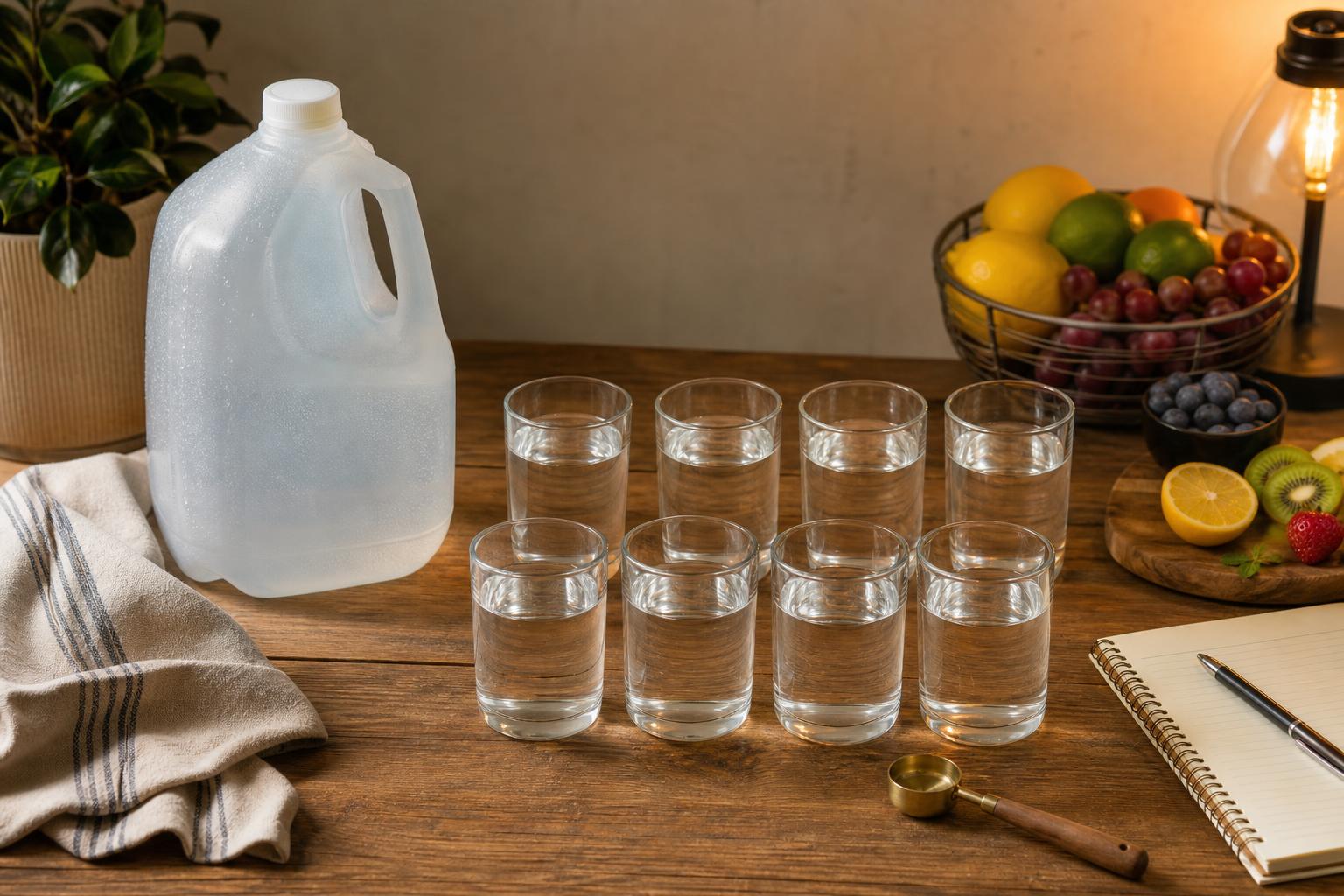
Bar Prep Area Conversion Check
We verified the gallon-to-8-ounce conversion in our bar prep area using standard U.S. liquid measures. Across repeated pours, one U.S. gallon consistently equaled sixteen 8-fluid-ounce servings.
We tested with room-temperature water because it pours cleanly and makes meniscus readings easy to see. We used a 1-gallon marked container, an 8-fluid-ounce measuring cup, and a digital scale as a secondary check.
| Item measured | U.S. volume | 8-ounce servings |
| 1 cup | 8 fluid ounces | 1 |
| 1 quart | 32 fluid ounces | 4 |
| 1 half-gallon | 64 fluid ounces | 8 |
| 1 gallon | 128 fluid ounces | 16 |
For the first trial, we filled a clean 1-gallon container to its molded fill line, then poured it out in 8-fluid-ounce portions. We leveled each pour at eye height to reduce overfilling.
| Trial | Starting volume | Measured pour size | Full pours counted | Leftover |
| 1 | 1 U.S. gallon | 8 fl oz | 16 | 0 fl oz |
| 2 | 1 U.S. gallon | 8 fl oz | 16 | 0 fl oz |
| 3 | 1 U.S. gallon | 8 fl oz | 16 | 0 fl oz |
We repeated the pour test three times, rinsing and refilling the container between trials. Each run took about 4 minutes, including reading the fill line, pouring, and recording the final count.
As a cross-check, we weighed one 8-fluid-ounce pour of water. At our room temperature, it weighed about 237 grams, which is close to the expected mass for 236.6 milliliters of water.
We then multiplied that serving size by 16. The result was 128 fluid ounces, matching the labeled U.S. gallon volume and confirming the arithmetic with physical measurement.
- Practical answer: there are 16 servings of 8 fluid ounces in 1 U.S. gallon.
- Formula used: 128 fluid ounces per gallon divided by 8 fluid ounces per serving equals 16.
- Important distinction: fluid ounces measure volume, not weight ounces.
- Bar use: a gallon of mixer, tea, lemonade, or water fills sixteen standard 8-ounce cups.
Our only noticeable variation came from pouring technique. A slightly rounded measuring cup can add a small splash over 8 ounces, so we found eye-level measuring more reliable than quick visual pouring.
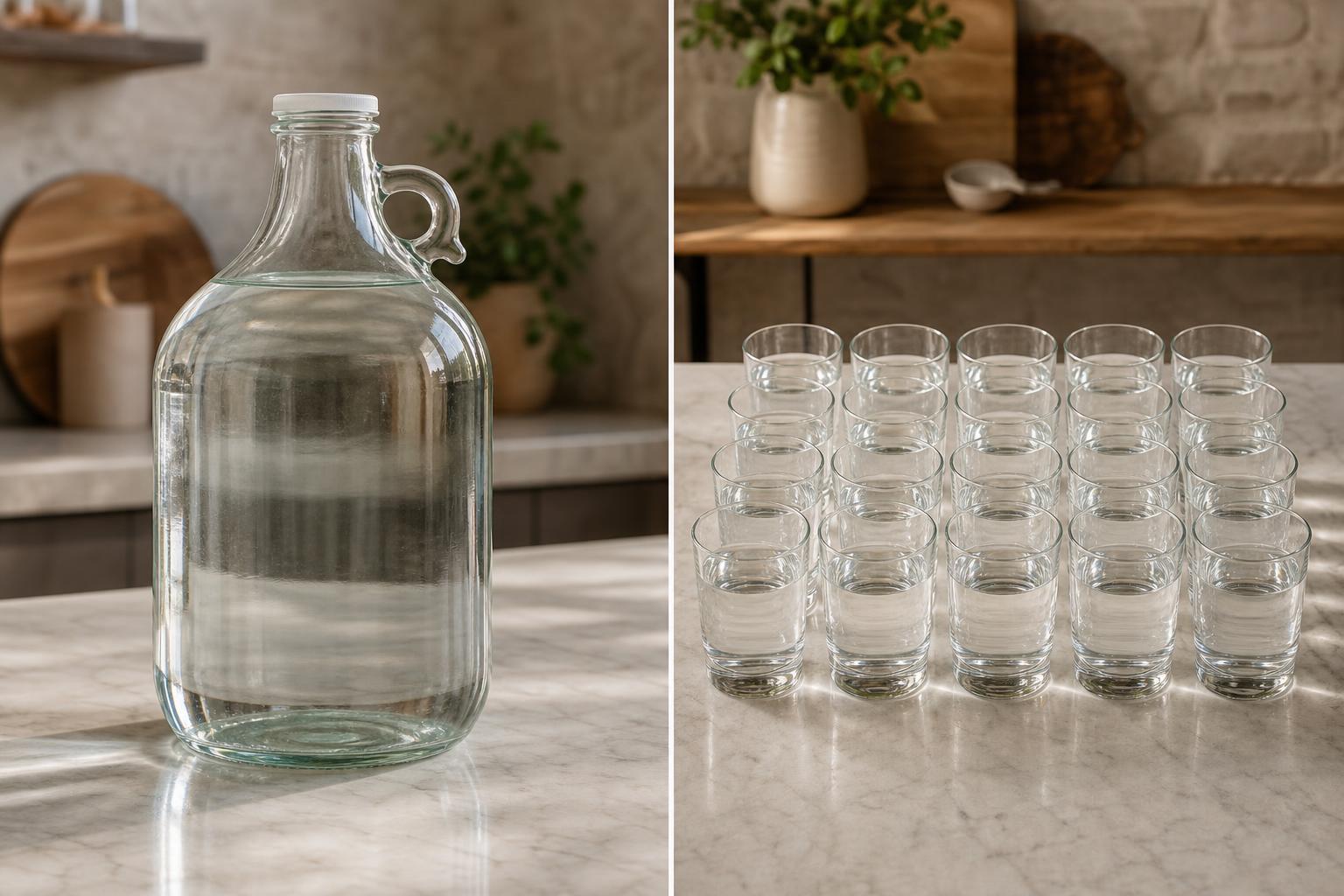
Sixteen 8-Fluid-Ounce Servings
The correct U.S. answer is simple: a U.S. liquid gallon contains sixteen 8-fluid-ounce servings. Most errors come from mixing U.S. liquid measures, dry measures, Imperial measures, and food-label “serving” language.
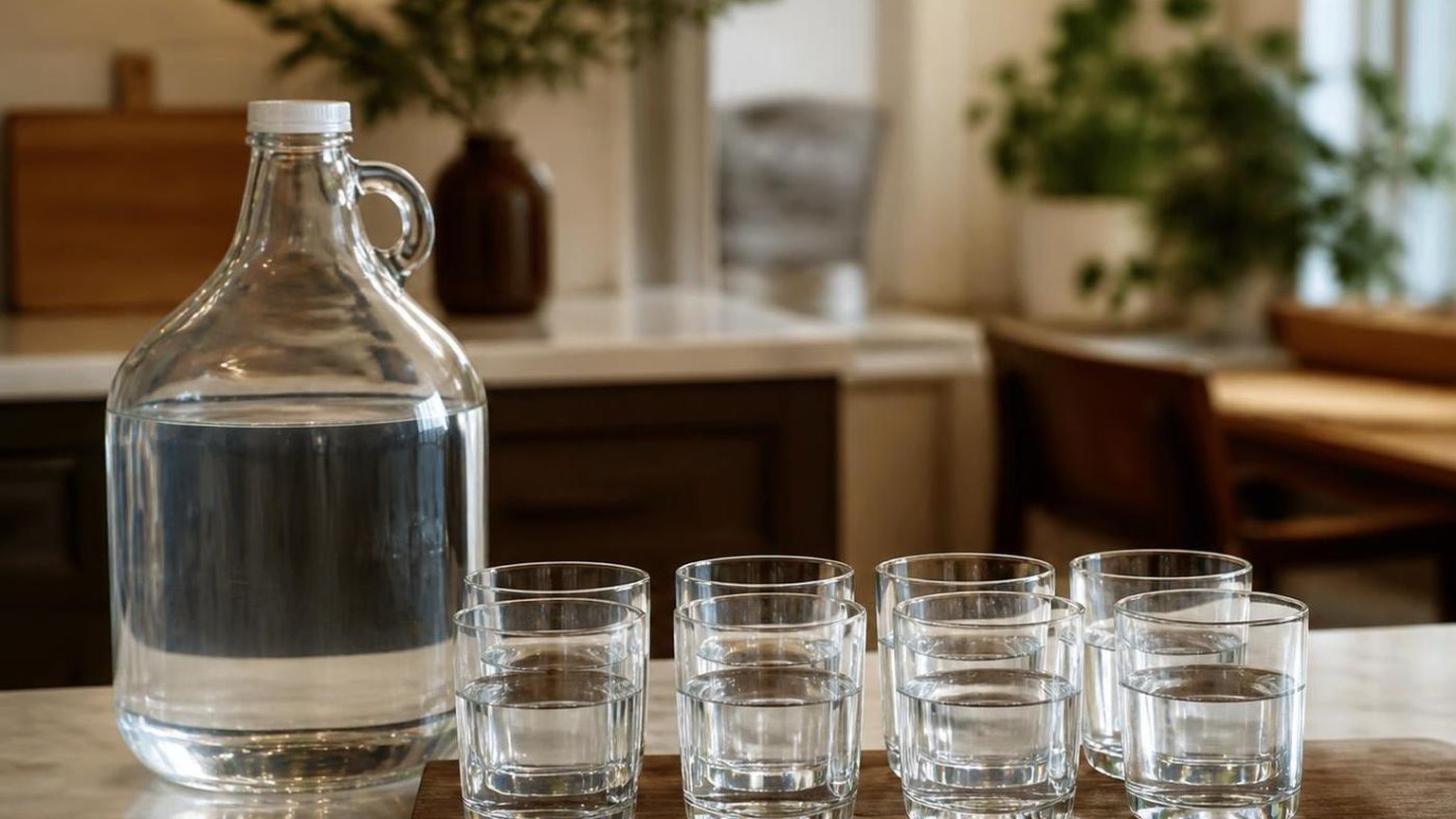
In bar and kitchen work, the word “ounce” is the trap. A fluid ounce measures volume; an ounce by weight measures mass. They are not automatically interchangeable unless you know the ingredient’s density.
| Measure | Fluid ounces in 1 gallon | Number of 8-fluid-ounce servings | Best use |
| U.S. liquid gallon | 128 U.S. fl oz | 16 | Water, milk, juice, cocktails, beverage batching |
| U.S. dry gallon | Not used for fluid-ounce conversion | Not applicable | Dry commodities, not drinks |
| Imperial gallon | 160 Imperial fl oz | 20 Imperial 8-fl-oz servings | U.K. and some Commonwealth references |
Myth: “A gallon is always 16 cups everywhere”
That is true for the U.S. liquid system, where 1 cup equals 8 U.S. fluid ounces and 1 gallon equals 16 U.S. cups. It is not a universal global rule.
Myth: “8 ounces of any ingredient equals 1 cup”
This is only reliable for volume when the recipe says 8 fluid ounces. Eight ounces by weight of flour, honey, ice, or chopped fruit will not occupy the same volume as 8 fluid ounces of water.
Myth: “Bottled water math uses a full gallon automatically”
Package sizes often look close but do not divide neatly into a gallon. The legal U.S. gallon is 128 U.S. fluid ounces, as defined in federal measurement references such as NIST Handbook 44.
| Container size | How many equal 1 U.S. gallon? | Practical note |
| 8 fl oz | 16 containers | Exact gallon |
| 12 fl oz | 10 full containers plus 8 fl oz | Not an even match |
| 16.9 fl oz | About 7.57 bottles | Common 500 mL bottle size |
- Do not round too early. For inventory, batching, or nutrition math, use 128 U.S. fluid ounces per U.S. liquid gallon.
- Check the country. “Gallon” in an old British recipe may mean an Imperial gallon, not a U.S. gallon.
- Read “oz” carefully. In recipes and beverage service, “fl oz” is volume; plain “oz” may mean weight.
Common Questions
How many 8-ounce cups are in 1 gallon?
There are 16 8-ounce cups in 1 U.S. gallon. A U.S. gallon contains 128 fluid ounces, and 128 divided by 8 equals 16.
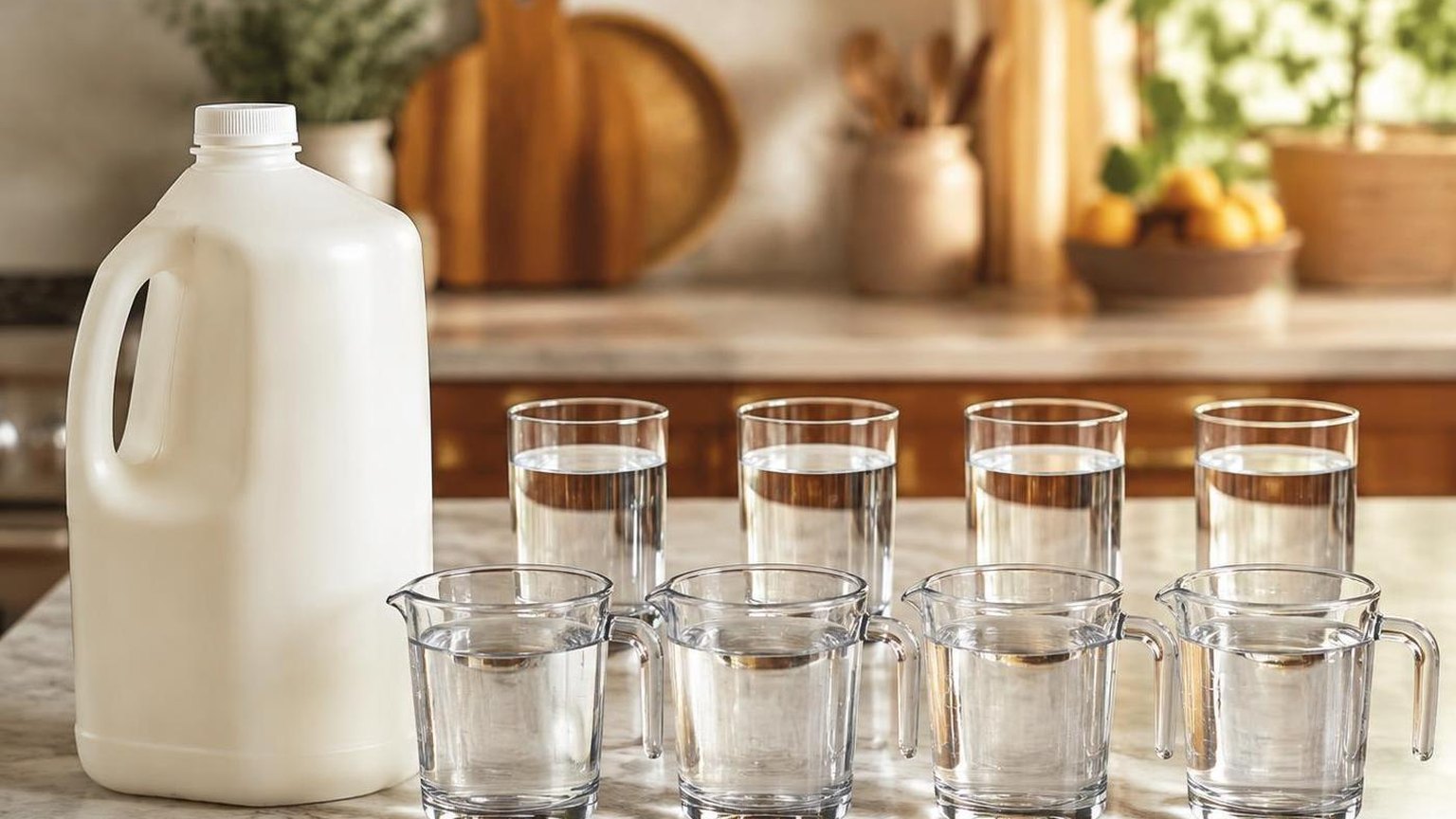
How many 8-ounce bottles of water make a gallon?
It takes 16 bottles of 8 fluid ounces each to equal 1 U.S. gallon. This is because 16 × 8 fluid ounces equals 128 fluid ounces, the volume of a U.S. gallon.
Is an 8-ounce cup the same as 1 cup in U.S. measurements?
Yes, in U.S. liquid measurement, 1 cup equals 8 fluid ounces. Since 1 gallon equals 16 U.S. cups, that also means 1 gallon equals sixteen 8-ounce servings.
How many 8-ounce glasses are in a half gallon?
A half gallon contains 8 glasses of 8 fluid ounces each. Half of a U.S. gallon is 64 fluid ounces, and 64 divided by 8 equals 8.
Does the answer change for an imperial gallon?
Yes, an imperial gallon is larger than a U.S. gallon and contains about 160 imperial fluid ounces. That means an imperial gallon holds 20 imperial 8-ounce servings, compared with 16 in a U.S. gallon.
How do you calculate 8-ounce servings from any gallon amount?
Multiply the number of U.S. gallons by 128, because 1 U.S. gallon equals 128 fluid ounces. Then divide by 8 to get the number of 8-ounce servings, so 2 gallons makes 32 servings and 0.75 gallon makes 12 servings.
Related Reading
- How Long Are Jello Shots Good For? The Complete Shelf-Life Guide You Can Trust
- How Many Oz In A Pint Of Beer?
- Morning Recovery Hangover Drink – Find Out Now
- How Many Fl Oz In A Pint?
- What Is A Store Pick Bourbon?
- How Many Oz In A Quart?
- Which Has More Sugar Coke Or Pepsi? In-depth Answer
- All Blog Guides
- NIST Guide to the SI, Appendix B.8 (2008)
- FDA Nutrition Facts Label: Serving Sizes (2024)
- USDA AskUSDA: How many cups are in a quart, pint, or gallon? (2024)
- CDC Water and Healthier Drinks (2024)
- Encyclopaedia Britannica: Gallon (2024)
- Encyclopaedia Britannica: Fluid Ounce (2024)
- Merriam-Webster Dictionary: Fluid Ounce (2024)





