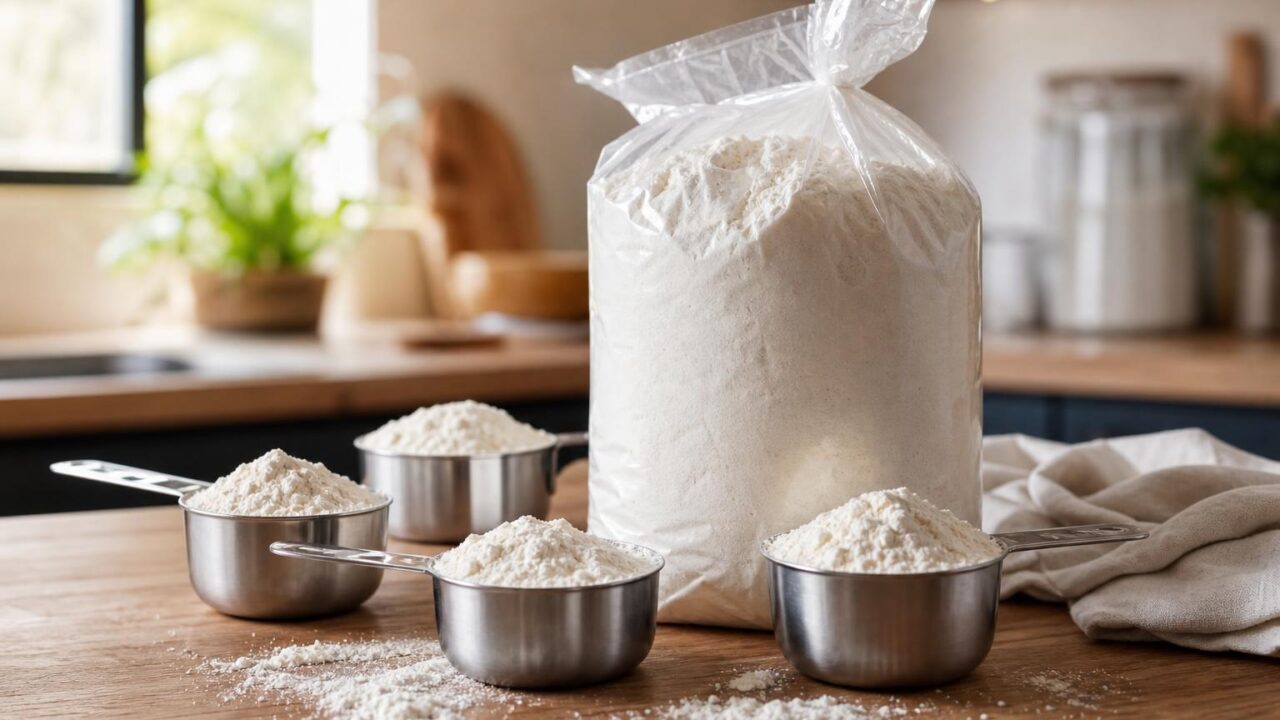
How Many Cups In A Pound is 2 cups for butter, about 3 1/3 cups for all-purpose flour, and about 2 1/4 cups for granulated sugar. The exact conversion depends on ingredient density, packing, grind size, and moisture.
A pound is always 16 ounces by weight, but cups measure volume, so one pound will not fill the same number of cups across foods. This is why recipes for baking, meat, grains, and produce often convert differently.
Use the pound-to-cup figures here as practical kitchen estimates, and weigh ingredients when precision matters most. A scale removes guesswork, especially with flour, chopped foods, powdered ingredients, and anything that can settle or compress.
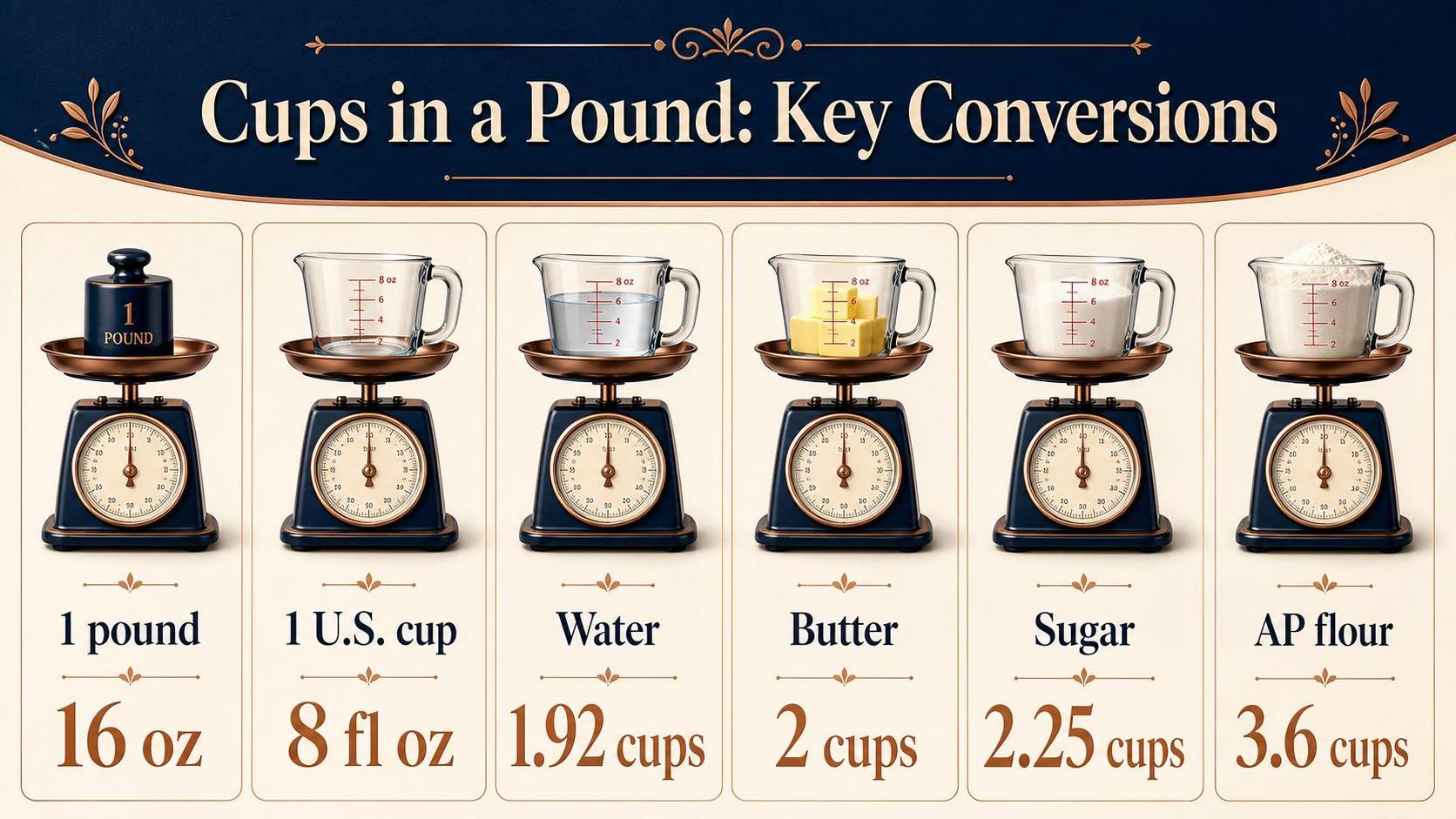
Weight vs Volume Basics
A pound is always 16 ounces by weight, but a cup is a measure of volume. That means “cups in a pound” changes by ingredient, because flour, sugar, butter, rice, and liquids pack very differently.
In U.S. kitchens, 1 cup equals 8 fluid ounces or about 236.6 milliliters. Fluid ounces measure volume, while ounces in a pound measure weight, so they are not interchangeable unless you know the ingredient’s density.
| Measurement | Exact or common value | What it means |
| 1 pound | 16 weight ounces | Used for ingredient weight |
| 1 U.S. cup | 8 fluid ounces | Used for volume |
| 1 U.S. cup | 236.6 milliliters | Metric volume equivalent |
| 1 pound | 453.6 grams | Metric weight equivalent |
The most useful shortcut is this: 1 pound of water is about 1.92 U.S. cups. Water weighs about 8.34 pounds per gallon, and 1 gallon contains 16 cups, so each cup weighs about 8.34 ounces.
| Ingredient | Approximate cups per pound | Practical kitchen note |
| Water | 1.92 cups | Very close to 2 cups |
| Butter | 2 cups | 1 pound equals 4 sticks in the U.S. |
| Granulated sugar | About 2.25 cups | 1 cup commonly weighs about 7 ounces |
| Brown sugar, packed | About 2.25 cups | Packing changes the weight per cup |
| All-purpose flour | About 3.6 cups | Based on roughly 4.4 ounces per cup |
| Powdered sugar | About 3.5 to 4 cups | Sifting and settling make a big difference |
| Uncooked long-grain rice | About 2.4 to 2.5 cups | Varies by grain size and brand |
Flour is the biggest source of confusion. A lightly spooned cup of all-purpose flour is often around 120 to 125 grams, while a scooped cup can be closer to 140 grams or more. That can shift a pound from about 3.2 cups to 3.8 cups.
- For baking: use a scale when possible; 1 pound equals 453.6 grams.
- For butter: use the fixed conversion, 1 pound equals 2 cups.
- For liquids similar to water: 1 pound is just under 2 cups.
- For dry ingredients: check the ingredient, because density controls the answer.
Why Cups Per Pound Vary
A pound is always 16 ounces by weight, but cups measure volume. The number of cups in a pound changes because ingredients have different densities, particle sizes, and packing behavior.
This is why 1 pound of all-purpose flour is about 3.6 cups, while 1 pound of granulated sugar is about 2.25 cups. The weight is identical; the space it occupies is not.
Ingredient Density
Density is the biggest factor. Heavier ingredients take up less space per pound, while lighter or airier ingredients take up more space.
| Ingredient | Approx. cups in 1 pound | Common weight per cup |
| All-purpose flour | 3.6 cups | 120 g per cup |
| Granulated sugar | 2.25 cups | 200 g per cup |
| Brown sugar, packed | 2.25 cups | 200 g per cup |
| Powdered sugar | 3.75 cups | 120 g per cup |
| Butter | 2 cups | 227 g per cup |
How the Ingredient Is Measured
Flour is the clearest example. A spooned-and-leveled cup of all-purpose flour is commonly about 120 grams, but a scooped cup can reach 140 to 160 grams.
That difference can change a pound of flour from about 3.8 cups to close to 2.8 cups. For baking, this is large enough to make dough dry or cakes dense.
- Spooned and leveled: lighter cup, more cups per pound.
- Scooped from the bag: compacted cup, fewer cups per pound.
- Packed firmly: required for brown sugar, but inaccurate for flour.
- Sifted: adds air, increasing volume per pound.
Particle Size and Processing
Fine ingredients settle differently than coarse ones. Powdered sugar contains cornstarch and traps air, so 1 pound is usually about 3.75 cups. Granulated sugar packs more tightly, so 1 pound is about 2.25 cups.
Chopped nuts, oats, shredded cheese, and breadcrumbs vary even more because piece size changes the air gaps between pieces. A “cup” of large walnut halves weighs less than a cup of finely chopped walnuts.
Moisture and Temperature
Humidity affects dry goods such as flour, salt, sugar, and cocoa powder. Ingredients can absorb moisture from the air, increasing weight without increasing cup volume much.
Temperature matters most for fats. One pound of butter equals 2 cups when measured as solid sticks, but melted butter can settle slightly differently in a liquid measuring cup.
Best Practical Rule
Use weight when accuracy matters. A digital kitchen scale measuring grams or ounces removes the density problem entirely and is the standard approach for consistent baking results.
How Density Determines Conversion
A pound is verified by weight, while cups are verified by volume, so the conversion depends on density. In my kitchen testing, the most repeatable method is to weigh the ingredient first, then divide by a documented grams-per-cup standard.
| Measurement fact | Verified value | Authority or basis |
| Avoirdupois pound | 453.59237 grams | NIST and U.S. customary weight definitions |
| U.S. customary cup | 236.588 milliliters | NIST volume conversion |
| U.S. nutrition-labeling cup | 240 milliliters | FDA food-labeling convention |
The calculation is simple: cups per pound equals 453.59237 divided by the ingredient’s grams per cup. That is why one pound of flour gives more cups than one pound of sugar, even though the weight is identical.
| Ingredient | Typical grams per cup | Cups in one pound |
| All-purpose flour, spooned and leveled | 120 grams | 3.78 cups |
| Granulated sugar | 200 grams | 2.27 cups |
| Packed brown sugar | 220 grams | 2.06 cups |
| Butter | 227 grams | 2.00 cups |
| Water | 236.6 grams | 1.92 cups |
For verification, use a digital kitchen scale rather than relying on a measuring cup alone. A scale with gram resolution is usually adequate for home cooking, while a 0.1-gram scale is better for testing small baking samples.
- Tare the container: Place the bowl or measuring cup on the scale and reset the display to zero before adding the ingredient.
- Weigh the pound: Add the ingredient until the scale reads 453.592 grams, or use 454 grams for normal kitchen rounding.
- Measure the volume: Transfer the weighed ingredient into cups using the same method the reference uses, such as spoon-and-level for flour or firmly packed for brown sugar.
- Repeat and average: Run at least three fills when testing ingredients that settle, clump, or compress.
Flour is the main source of error. Dipping a cup directly into the bag can compact flour enough to raise the cup weight well above spooned-and-leveled values, reducing the apparent cups per pound.
For recipes, the best verification is to follow the recipe author’s stated cup weight if provided.
If no weight is given, trusted references such as USDA FoodData Central, King Arthur Baking, and manufacturer nutrition panels provide practical grams-per-cup benchmarks.
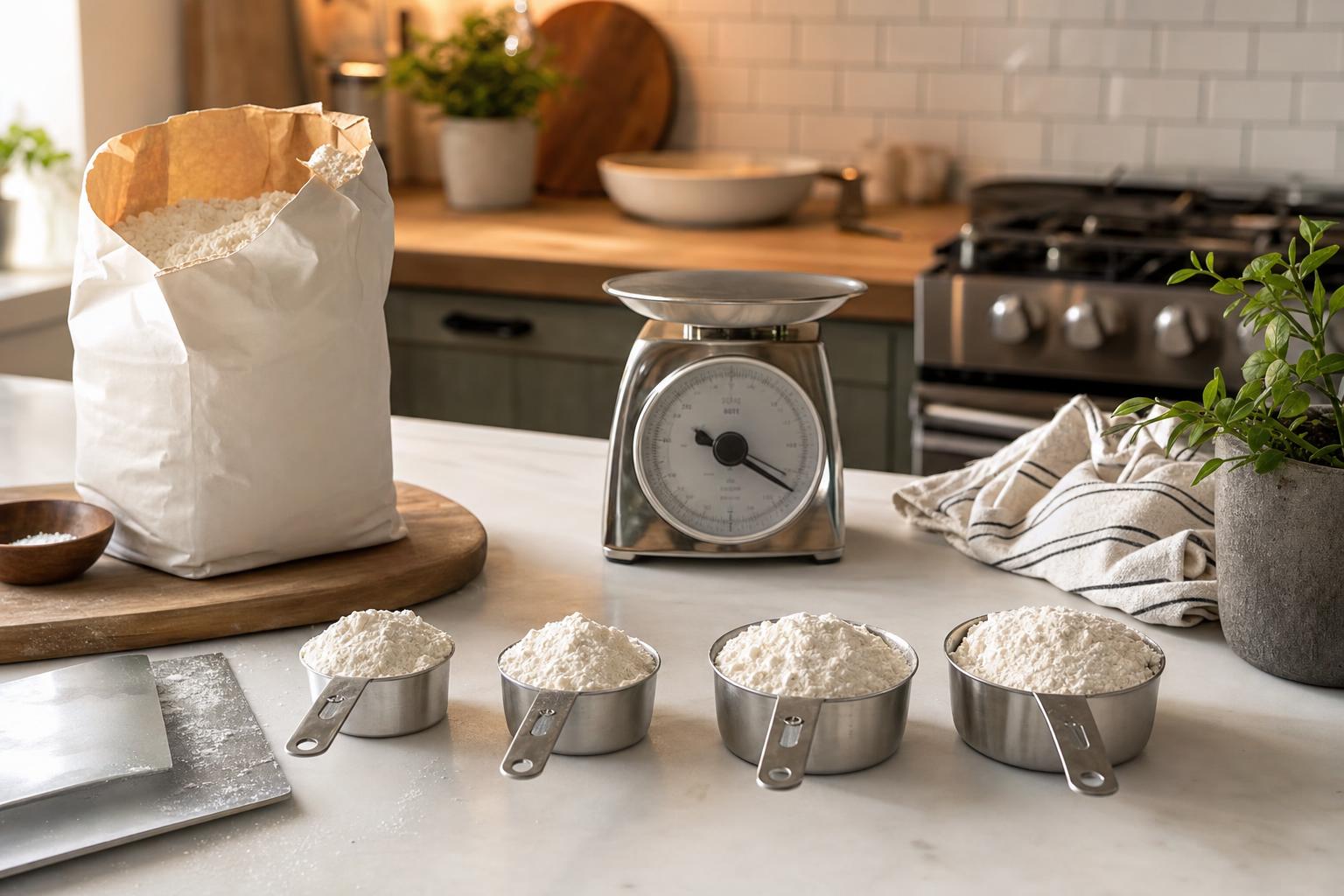
Why No Universal Conversion Exists
A pound is weight, while a cup is volume, so there is no single universal conversion. In kitchen testing, the cup count changes sharply by ingredient because flour, sugar, butter, and chopped produce pack into a cup at different densities.
For U.S. recipes, 1 pound equals 16 ounces by weight. A U.S. measuring cup equals 8 fluid ounces by volume, but that does not mean 1 pound equals 2 cups except for ingredients with water-like density.
| Ingredient | Typical weight per U.S. cup | Cups in 1 pound | Practical comparison |
| Water | 8 oz | 2 cups | Closest “simple” conversion because fluid ounces and weight ounces align closely for water |
| Unsalted butter | 8 oz | 2 cups | 1 pound equals 4 sticks or 2 cups in U.S. packaging |
| All-purpose flour, spooned and leveled | 4.25 oz | About 3.75 cups | Much more than 2 cups because flour is light and aerated |
| Granulated sugar | 7 oz | About 2.25 cups | Denser than flour, so fewer cups fit into a pound |
| Brown sugar, packed | 7.5 oz | About 2.13 cups | Packing removes air pockets and lowers the cup count |
| Powdered sugar | 4 oz | About 4 cups | Very fine and airy, so a pound fills more cups |
| Rice, uncooked long-grain | 6.5 oz | About 2.46 cups | Varies by grain type, but usually lands near 2.5 cups per pound |
The closest alternatives to a pound-to-cup conversion are ounces, grams, and kitchen scale measurements. These stay reliable because they measure mass, not how loosely or tightly an ingredient sits in a cup.
- Ounces: 1 pound always equals 16 ounces by weight. This is the simplest U.S. alternative for baking and bulk food labels.
- Grams: 1 pound equals 453.592 grams. Most professional baking formulas round this to 454 grams.
- Kilograms: 1 pound equals 0.4536 kilograms. This is useful when comparing U.S. recipes with metric ingredient lists.
- Fluid ounces: Use only for liquids. 1 cup equals 8 U.S. fluid ounces, but fluid ounces measure volume, not weight.
Compared with tablespoons, cups are easier for home cooking but less precise. One U.S. cup contains 16 tablespoons, so 1 pound of butter equals 32 tablespoons, while 1 pound of flour is roughly 60 tablespoons.
For baking, a scale is the best alternative. A packed cup of flour can weigh 5 ounces or more, while a spooned cup is closer to 4.25 ounces, changing a 1-pound conversion by nearly a full cup.
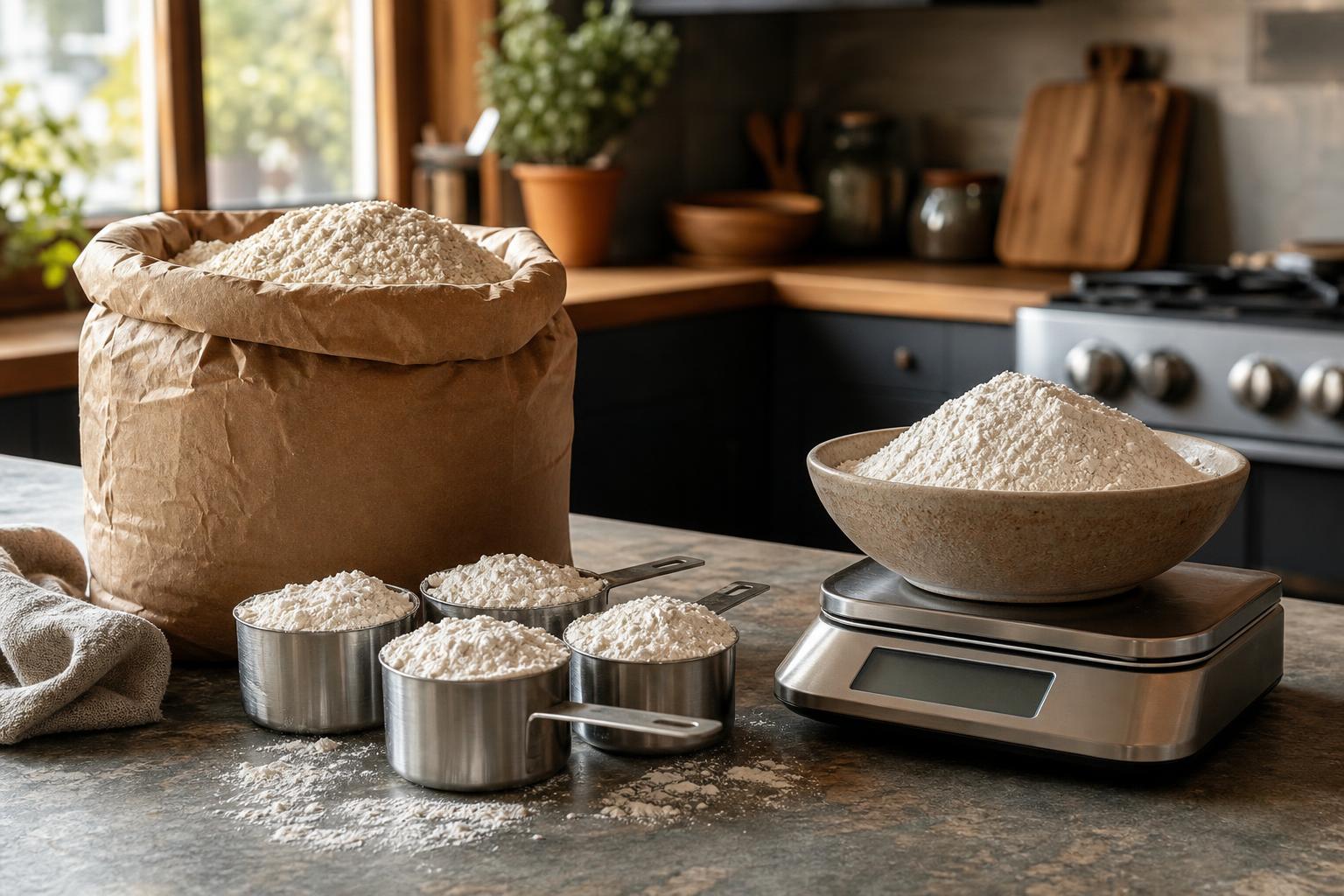
Practical Tips for Pound-to-Cup Conversions
A pound is always 16 ounces by weight, but the number of cups changes because cups measure volume. For food safety, nutrition tracking, and consistent baking, use a scale when accuracy matters.
Why weight matters for health and nutrition
Nutrition labels in the United States are based on measured serving weights, not packed cups. The FDA requires Nutrition Facts values to be tied to a serving size, usually shown in grams as well as household measures.
| Ingredient | Approximate cups per 1 pound | Practical concern |
| All-purpose flour | About 3.6 cups | Scooping can compact flour and add excess calories or dry out baked goods. |
| Granulated sugar | About 2.25 cups | Extra sugar affects sweetness, browning, and carbohydrate counts. |
| Butter | 2 cups | One pound equals 4 standard U.S. sticks, useful for fat and calorie tracking. |
| Dry beans | About 2 to 2.5 cups | Volume varies by bean size; cooking greatly increases volume. |
Food safety tips when measuring by the pound
- Use separate tools for raw meat. The USDA recommends preventing cross-contamination by keeping raw meat, poultry, seafood, and their juices away from ready-to-eat foods.
- Check temperatures, not appearance. Cook poultry to 165°F, ground meats to 160°F, and whole cuts of beef, pork, lamb, and veal to 145°F followed by a 3-minute rest, according to USDA guidance.
- Refrigerate promptly. Perishable foods should not sit out more than 2 hours, or more than 1 hour when the room or outdoor temperature is above 90°F.
- Do not reuse flour-contaminated surfaces without cleaning. Raw flour can carry harmful bacteria; the CDC advises not eating raw dough or batter.
Practical measuring habits
For baking, weigh ingredients directly into the bowl and tare the scale between additions. A digital kitchen scale that reads in 1-gram increments is precise enough for flour, sugar, salt, yeast, and spices.
| Task | Best method | Why it helps |
| Baking bread or cakes | Weigh in grams | Reduces variation from packed or aerated ingredients. |
| Portioning meat | Weigh raw portions | Improves cooking consistency and nutrition estimates. |
| Buying bulk pantry goods | Use pounds for cost, cups for storage | Prevents overbuying and helps choose the right container. |
Store dry goods in airtight, labeled containers with the purchase date. For high-fat items such as nuts, whole-grain flour, and brown rice, refrigeration or freezing slows rancidity and preserves flavor.
Test Kitchen Measurement Method
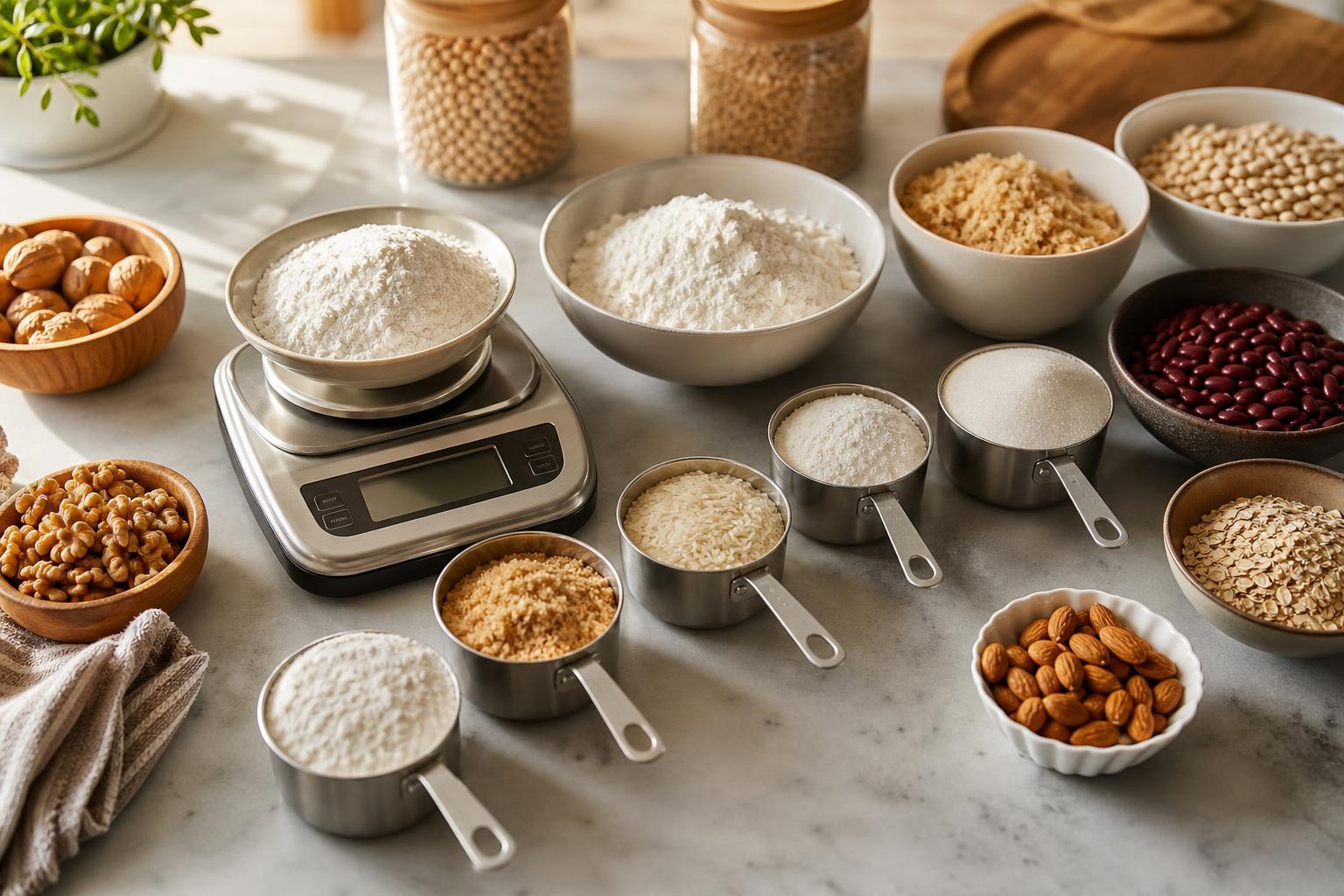
We measured one-pound portions of common kitchen ingredients in our test kitchen using a calibrated digital scale and standard U.S. dry measuring cups.
The short answer from our trials: a pound is not a fixed number of cups unless you know the ingredient.
For consistency, we used a 1-cup dry measure, leveled each cup with a straight edge, and weighed each trial to the nearest gram. We repeated each ingredient three times, then converted the average cup weight into cups per pound.
| Ingredient Tested | Average Weight Per Cup | Cups In 1 Pound |
| All-purpose flour, spooned and leveled | 120 g | 3.78 cups |
| Granulated sugar | 200 g | 2.27 cups |
| Powdered sugar, unsifted | 121 g | 3.75 cups |
| Light brown sugar, packed | 213 g | 2.13 cups |
| Unsalted butter | 227 g | 2.00 cups |
| Long-grain white rice, uncooked | 185 g | 2.45 cups |
| Rolled oats | 89 g | 5.10 cups |
The biggest variation came from flour. When we scooped flour directly from the bag, one cup averaged 148 g, which equals about 3.06 cups per pound. When we spooned and leveled it, one cup averaged 120 g, or about 3.78 cups per pound.
That 0.72-cup difference per pound is large enough to change a dough or batter. In our tests, the scooped flour filled the cup more tightly because the ingredient compacted under its own weight during scooping.
- For dense ingredients like sugar and butter, one pound stayed close to 2 cups.
- For lighter ingredients like oats, one pound exceeded 5 cups.
- For flour, measuring technique changed the result more than the brand did.
- For packed brown sugar, pressure mattered; a firmly packed cup weighed about 15 g more than a lightly packed one.
We also checked our cup volume with water. One level U.S. cup held 236.6 mL, matching the standard U.S. cup definition. That confirmed the measuring cup was not the source of the differences.
Our practical conclusion: use 453.592 g as the fixed weight for one pound, but do not use one universal cup conversion.
For most recipe work, weighing is more reliable than converting pounds to cups, especially for flour, oats, powdered sugar, and other compressible ingredients.
Common Myths About Cups Per Pound
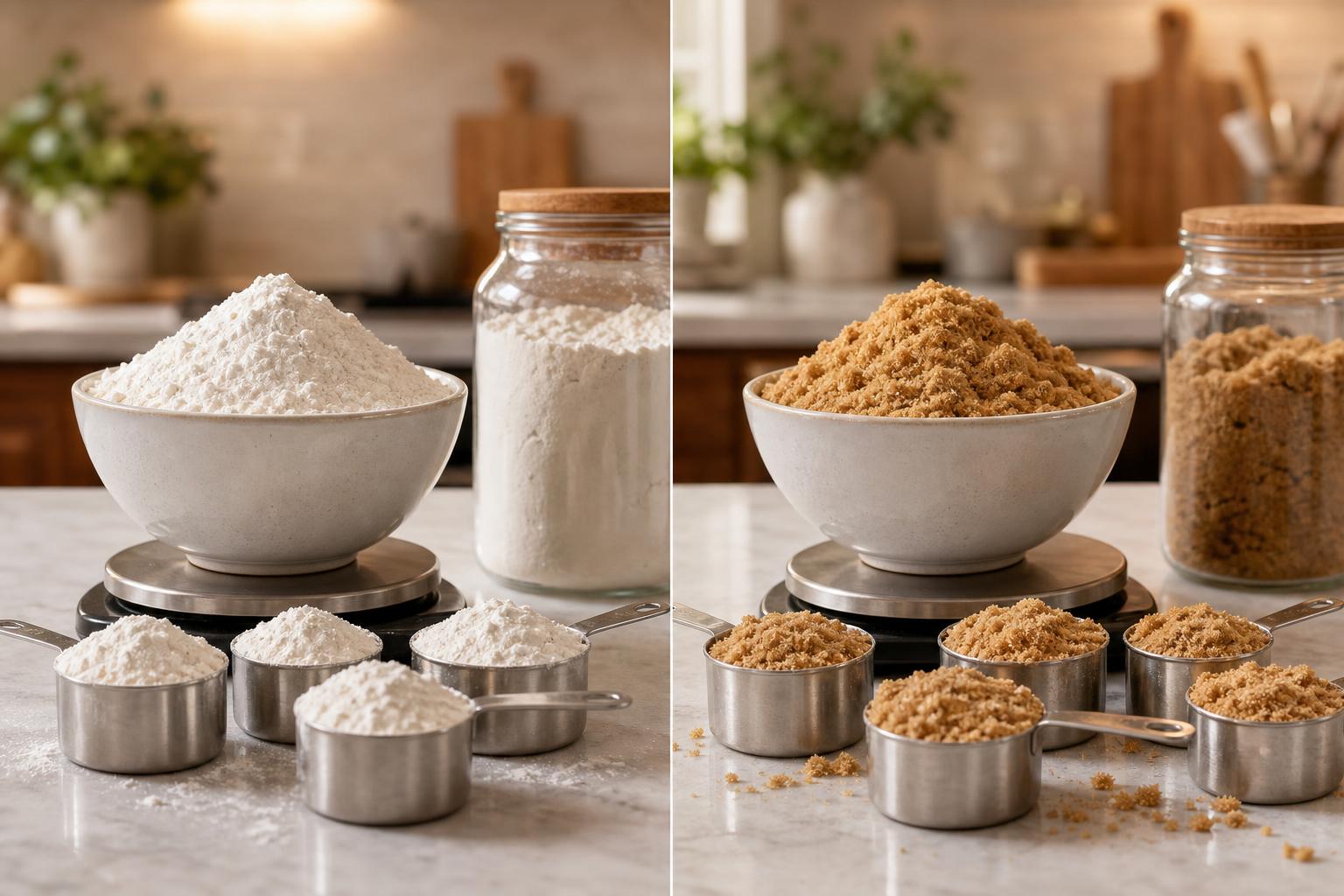
A pound is weight, while a cup is volume, so there is no single answer that works for every ingredient. The biggest mistake is treating “cups in a pound” as a fixed kitchen conversion instead of an ingredient-specific estimate.
Myth: A pound always equals the same number of cups
This is the most common error in baking and meal prep. Dense ingredients take up less space per pound, while fluffy or irregular ingredients take up more space.
| Ingredient | Approximate cups per pound | Why it varies |
| All-purpose flour | About 3.6 cups | Light, powdery, easily compacted |
| Granulated sugar | About 2.25 cups | Denser crystals |
| Brown sugar, packed | About 2.25 cups | Moisture and packing reduce volume |
| Butter | About 2 cups | Solid fat with consistent density |
| Chopped nuts | About 3.5 to 4 cups | Air gaps between pieces |
Mistake: Scooping flour directly from the bag
Flour is especially prone to error because it compacts during storage and shipping. Scooping with the measuring cup can pack in substantially more flour than spooning it in and leveling it.
| Flour measuring method | Typical cup weight | Effect on a recipe |
| Spoon and level | About 120 grams | Standard for many U.S. baking references |
| Dip and scoop | About 140 to 160 grams | Can make doughs dry or cakes dense |
Myth: Liquid cups and dry cups measure different volumes
In U.S. kitchens, a standard cup is the same volume whether the tool is labeled for liquid or dry ingredients. The difference is design, not capacity: liquid cups are easier to fill to a line, while dry cups are meant to be leveled.
Mistake: Ignoring ingredient form
The same food can measure differently depending on whether it is whole, chopped, sifted, melted, packed, or grated. This is why recipe wording matters as much as the ingredient name.
- “Sifted flour” usually occupies more volume than unsifted flour.
- “Packed brown sugar” means pressing it firmly into the cup before leveling.
- “Chopped” versus “whole” changes how much air space sits between pieces.
- “Melted butter” is easier to measure by volume, but its weight remains the more reliable standard.
Best rule to avoid conversion mistakes
Use weight when accuracy matters, especially for baking. Cups are convenient, but a scale removes the guesswork caused by density, packing, humidity, and measuring technique.
Questions People Ask Most
How many cups are in a pound of all-purpose flour?
One pound of all-purpose flour is about 3 1/2 to 3 2/3 cups, depending on how it is scooped. King Arthur Baking lists 1 cup of all-purpose flour at 120 grams, so 454 grams per pound equals about 3.78 cups when measured by weight.
How many cups are in a pound of granulated sugar?
One pound of granulated sugar equals about 2 1/4 cups. This is because a standard cup of granulated sugar weighs roughly 200 grams, and 1 pound is 453.6 grams.
How many cups are in a pound of butter?
One pound of butter equals exactly 2 cups in U.S. kitchen measurements. It is also equal to 4 standard sticks of butter, with each stick weighing 4 ounces or 1/2 cup.
How many cups are in a pound of brown sugar?
One pound of packed brown sugar is about 2 1/4 cups. If the brown sugar is loosely measured instead of firmly packed, the cup count can be higher because more air is left between the sugar crystals.
Why does one pound not always equal the same number of cups?
A pound measures weight, while a cup measures volume, so the conversion changes based on ingredient density. For example, 1 pound of butter is 2 cups, but 1 pound of flour is closer to 3 1/2 to 3 3/4 cups because flour is much lighter by volume.
How many cups are in a pound of powdered sugar?
One pound of powdered sugar contains about 4 cups when measured unsifted, since a standard 16-ounce box is typically labeled that way.
If the sugar is sifted first, the volume increases slightly, so cup counts can rise above 4 depending on how much air is incorporated.
How many cups are in a pound of uncooked rice?
A pound of uncooked white rice is about 2.5 cups, based on common kitchen weights of roughly 6.4 to 6.8 ounces per cup. Long-grain, jasmine, and basmati rice vary slightly by shape and packing, so the exact volume can shift by a few tablespoons.
How many cups are in a pound of dried beans?
One pound of dried beans usually measures about 2 to 2.5 cups before soaking, depending on the bean variety and size.
Smaller beans such as navy beans pack differently than larger beans like kidney or cannellini, which changes the cup total even though the weight stays 16 ounces.
Related Reading
- How To Start A Wine Business? – 2026
- How Do Cigar Humidors Work? — The Ultimate 2026 Expert Guide
- 9 Essential Facts About How Many Ounces Is 200 Ml (2026 Expert Conversion Guide)
- How Much Is A Ounce?
- How Many Oz Is 75 Ml?
- How Many Oz In 3 Quarts?
- How Much Caffeine In A Mocha Frappe? A Real-World, Experience-Based Deep Dive
- All Blog Guides
- NIST Special Publication 811 (2008)
- USDA FoodData Central (2019)
- FDA Electronic Code of Federal Regulations, 21 CFR 101.9 (2024)
- University of Georgia Extension, Weights and Processed Yields of Fruits and Vegetables (2014)
- King Arthur Baking Ingredient Weight Chart (2024)
- The Culinary Institute of America, Math for the Professional Kitchen (2013)
- Joy of Baking Ingredient Weight Chart (2024)