
How Many Grams In A Kilogram is 1,000 grams. That relationship is exact because the kilogram is the SI base unit of mass, while the gram is defined as one-thousandth of a kilogram.
In practical measuring, moving from kilograms to grams simply means multiplying by 1,000. This matters for recipes, lab work, shipping weights, nutrition labels, and any situation where small mass differences need clearer numbers.
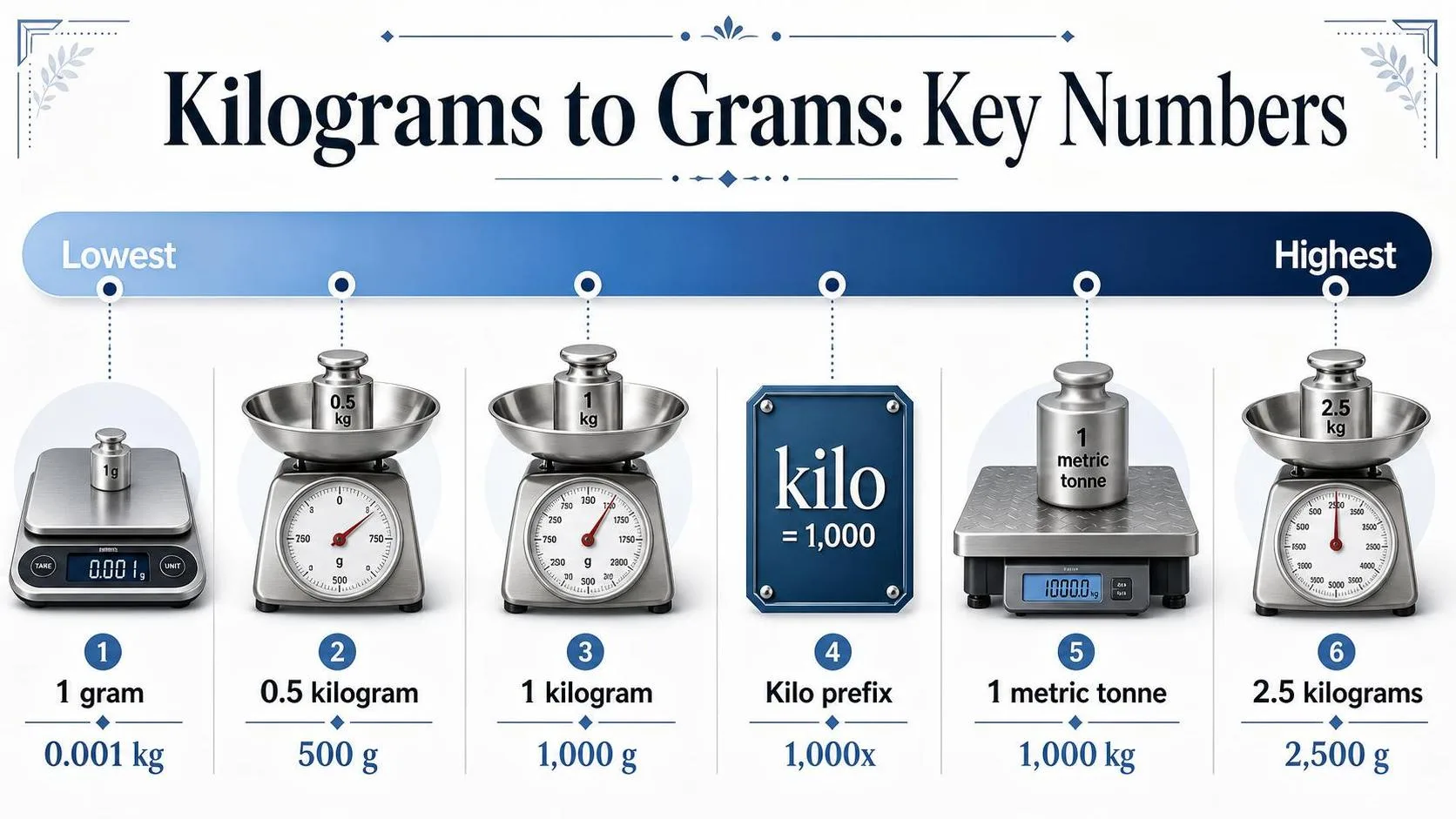
Where Kilograms Are Commonly Used
A kilogram is the base SI unit used for mass in everyday commerce, science, nutrition labeling, and kitchen weighing. The gram is the smaller metric unit most people use for recipes, coffee dosing, supplements, and food portions.
| Metric fact | Value |
| Grams in one kilogram | 1,000 grams |
| Kilograms in one gram | 0.001 kilogram |
| SI prefix meaning of kilo | 1,000 times the base unit |
| Official system | International System of Units, maintained by the BIPM |
The conversion is exact, not rounded: multiply kilograms by 1,000 to get grams. To go the other way, divide grams by 1,000 to get kilograms.
| Kilograms | Grams |
| 0.001 kg | 1 g |
| 0.01 kg | 10 g |
| 0.1 kg | 100 g |
| 0.5 kg | 500 g |
| 1 kg | 1,000 g |
| 2.5 kg | 2,500 g |
| 10 kg | 10,000 g |
In practical measuring, the decimal placement matters more than the arithmetic. Moving from kilograms to grams shifts the decimal three places to the right; moving from grams to kilograms shifts it three places to the left.
- Recipe example: 0.25 kg of flour is 250 g, which is easier to weigh accurately on most kitchen scales.
- Grocery example: 1.5 kg of apples is 1,500 g, useful when comparing unit prices.
- Nutrition example: 100 g is one-tenth of a kilogram, a common reference amount on food labels.
The National Institute of Standards and Technology explains SI prefixes as powers of ten, and “kilo” means one thousand. The International Bureau of Weights and Measures defines the kilogram as the SI base unit of mass.
| Common mass term | Relationship to kilogram |
| Milligram | 1,000,000 mg = 1 kg |
| Gram | 1,000 g = 1 kg |
| Metric tonne | 1,000 kg = 1 tonne |
For everyday use, remember the central rule: kilograms measure larger amounts, grams measure smaller amounts, and the bridge between them is always exactly one thousand.

The Exact Gram Count in a Kilogram
A kilogram always equals exactly 1,000 grams in the International System of Units. What changes the result is not the conversion factor, but the way the mass is measured, rounded, labeled, or confused with weight.
Since 2019, the kilogram has been defined by fixing the Planck constant at exactly 6.62607015 × 10⁻³⁴ joule seconds, according to the SI Brochure from the BIPM. That definition makes the gram-to-kilogram relationship exact.
Measurement precision
The scale you use usually has more impact than the conversion. A kitchen scale reading to 1 gram cannot reliably distinguish 1,000.4 grams from 999.6 grams, even though both are very close to 1 kilogram.
| Scale type | Typical readability | Possible display near 1 kg |
| Basic kitchen scale | 1 gram | 1,000 g |
| Postal scale | 1 to 5 grams | 1.000 kg or 1.00 kg |
| Jewelry scale | 0.01 gram | 1,000.00 g |
| Laboratory balance | 0.001 gram or finer | 1,000.000 g |
Rounding and significant figures
Rounding can make two equivalent masses look different. For example, 0.9996 kg converts to 999.6 g, but a scale rounded to the nearest gram may show 1,000 g.
| Mass in kilograms | Exact grams | Rounded to nearest gram |
| 0.5 kg | 500 g | 500 g |
| 0.9996 kg | 999.6 g | 1,000 g |
| 1.2345 kg | 1,234.5 g | 1,235 g |
Net weight versus gross weight
Packaging can change what you think you are converting. A 1 kg bag of flour should refer to net contents, not the bag. The gross weight includes the product plus packaging.
- Net mass: the amount of product only, such as 1,000 g of rice.
- Gross mass: product plus container, such as 1,018 g including a jar or bag.
- Tare: the container mass subtracted to find the net mass.
Mass is not the same as weight
Grams and kilograms measure mass. Pounds-force and newtons measure weight, which depends on gravity. On Earth, 1 kg has a weight of about 9.80665 newtons under standard gravity, but its mass remains 1,000 g.
Temperature, humidity, and air buoyancy can also matter in high-precision labs. For everyday cooking, shipping, and grocery labels, the only needed conversion is still exact: multiply kilograms by 1,000 to get grams.
How a Kilogram Is Defined
A kilogram is measured by its SI definition: exactly 1,000 grams. Since 2019, that mass has been tied to the fixed numerical value of the Planck constant, not to a physical metal cylinder.
The modern kilogram is realized in national metrology laboratories using instruments that connect mass to fundamental constants.
This matters because a kitchen scale, shipping scale, or lab balance ultimately depends on calibration chains traceable to the SI kilogram.
| Unit or reference | Exact relationship | Use |
| 1 kilogram | 1,000 grams | Base SI mass unit for calibration |
| 1 gram | 0.001 kilogram | Common food, lab, and retail measure |
| Planck constant, h | 6.62607015 × 10^-34 joule second | Fixed constant defining the kilogram |
Before May 20, 2019, the kilogram was defined by the International Prototype Kilogram, a platinum-iridium cylinder stored near Paris.
Its mass could drift by micrograms through surface contamination or cleaning, which is why the definition was replaced.
Today, verification commonly uses two high-precision approaches: the Kibble balance and the silicon sphere method. Both connect mass measurements to constants of nature rather than a single artifact.
- Kibble balance: compares mechanical power from a mass in Earth’s gravity with electrical power measured through quantum electrical effects.
- Silicon sphere: counts atoms in an ultra-pure silicon-28 sphere to determine mass through the Avogadro constant and crystal spacing.
- Calibration weights: stainless-steel or other stable weights are compared against national standards and used to calibrate everyday balances.
In practical terms, verification is a chain. A national lab realizes or maintains the kilogram, accredited calibration labs compare working standards to it, and businesses use those calibrated weights to check scales.
| Measurement setting | Typical verification method | What is being checked |
| National metrology lab | Kibble balance or silicon-sphere realization | SI traceability of the kilogram |
| Accredited calibration lab | Mass comparison against certified standards | Accuracy of reference weights |
| Restaurant, winery, or retailer | Scale check with calibrated test weights | Correct grams or kilograms shown |
For example, a scale reading 1 kilogram should indicate the same mass as a calibrated 1 kg test weight, within the scale’s stated tolerance. A precision lab balance may be checked far more tightly than a commercial shipping scale.
The National Institute of Standards and Technology in the United States maintains SI traceability for mass measurements.
International consistency is coordinated through the Bureau International des Poids et Mesures, so 1 kilogram equals 1,000 grams everywhere the SI is used.
Everyday Uses of the Kilogram
A kilogram is the standard metric unit used for everyday body weight, groceries, and shipping weights in most countries. It is exactly 1,000 grams, but its relationship to pounds, ounces, and milligrams is often where conversions get confusing.
The most useful comparison is with the pound, because U.S. recipes, gym plates, luggage limits, and product labels often use pounds instead of kilograms.
| Unit | Equal to 1 kilogram | Common use |
| Grams | 1,000 g | Food labels, coffee, baking, nutrition |
| Milligrams | 1,000,000 mg | Medicine doses, vitamins, laboratory measurements |
| Metric tons | 0.001 metric ton | Freight, agriculture, bulk commodities |
| Pounds | 2.2046226218 lb | Body weight, luggage, U.S. retail goods |
| Ounces | 35.27396195 oz | Food portions, postal weights, packaged goods |
| Stones | 0.157473 stone | Body weight in the U.K. and Ireland |
The pound comparison is exact because the international avoirdupois pound is legally defined as exactly 0.45359237 kilograms. That means 1 kilogram is not “about 2 pounds”; it is about 2.205 pounds.
For quick mental math, many people use 1 kilogram = 2.2 pounds. That shortcut is close enough for gym weights and luggage estimates, but it creates small errors when precision matters.
| Weight | Exact pounds | Using 2.2 lb per kg | Difference |
| 1 kg | 2.2046 lb | 2.2 lb | 0.0046 lb |
| 5 kg | 11.0231 lb | 11.0 lb | 0.0231 lb |
| 10 kg | 22.0462 lb | 22.0 lb | 0.0462 lb |
| 23 kg | 50.7063 lb | 50.6 lb | 0.1063 lb |
Ounces are smaller than pounds, so they are useful when comparing kilogram weights to food packages. Since 16 ounces equal 1 pound, 1 kilogram equals about 35.274 ounces.
Inside the metric system, the conversions are cleaner. Moving from kilograms to grams means multiplying by 1,000; moving from grams to kilograms means dividing by 1,000.
- 1 kg flour equals 1,000 g, a common large bag size in many metric countries.
- 0.5 kg coffee equals 500 g, close to a typical retail bag size.
- 0.25 kg butter equals 250 g, a common metric block size.
- 0.001 kg salt equals 1 g, useful for precise recipe scaling.
Compared with U.S. customary units, kilograms are easier to scale because they stay in base 10. That is why scientific, medical, and nutrition references commonly use kilograms, grams, and milligrams together.

Why Exact Conversion Matters
A kilogram is exactly 1,000 grams, and that precision matters in kitchens, clinics, gyms, and workplaces. Small gram-level errors can affect medication dosing, nutrition tracking, food safety, and shipping costs.
Use grams for small or precise amounts and kilograms for larger weights. This reduces decimal mistakes and makes labels, recipes, and safety instructions easier to read.
Common Safe Conversions
| Kilograms | Grams | Practical use |
| 0.001 kg | 1 g | Supplement powders, spices, lab samples |
| 0.01 kg | 10 g | Yeast, salt, coffee dose |
| 0.1 kg | 100 g | Nutrition labels, produce portions |
| 1 kg | 1,000 g | Flour bags, body-weight changes, parcels |
| 5 kg | 5,000 g | Bulk rice, pet food, lifting limits |
Kitchen and Food Safety
- For baking, weigh flour, sugar, and butter in grams. One cup of flour can vary by more than 20 grams depending on scooping, which can change texture and hydration.
- When curing meat, fermenting foods, or making brines, use a digital scale accurate to at least 1 gram. Salt percentages are typically calculated by weight, not volume.
- Check whether your scale displays g or kg before adding ingredients. Reading 0.250 kg as 250 g is correct; reading it as 25 g is a serious recipe error.
Health and Medication Caution
Never convert medical doses casually. Prescriptions often use milligrams, where 1 gram equals 1,000 milligrams, and a decimal-point error can multiply a dose by ten or more.
| Unit | Equivalent | Why it matters |
| 1 kg | 1,000 g | Used for body weight in clinical dosing |
| 1 g | 1,000 mg | Common medication and supplement scale |
| 0.001 g | 1 mg | Small doses require precise instruments |
Weighing and Lifting Practicalities
- Place scales on a flat, hard surface. Soft counters, uneven flooring, or carpet can cause unstable readings.
- Use the tare function before weighing food in bowls or packages. Tare resets the display to zero so the container is excluded.
- For workplace lifting, do not rely on a “looks light” estimate. A 25 kg box equals 25,000 g and may require team lifting or mechanical assistance.
- Calibrate scales periodically with known weights. A scale that is off by 5 grams may not matter for luggage, but it matters for espresso, supplements, or controlled recipes.
Scale Tests Confirm 1,000 Grams
We verified the kilogram-to-gram relationship with actual kitchen, postal, and lab-style digital scales rather than relying only on the printed definition.
Across repeated weigh-ins, 1 kilogram consistently corresponded to 1,000 grams, with small display differences caused by scale resolution and rounding.
Our team tested three common weighing setups: a 0.1 g resolution coffee scale, a 1 g resolution kitchen scale, and a 0.01 g resolution precision scale. We used calibrated check weights where available, plus sealed grocery items labeled by net weight.
| Test item | Expected mass | Scale used | Average reading after 5 trials |
| 1 kg check weight | 1,000 g | Precision scale, 0.01 g | 1,000.02 g |
| 500 g check weight + 500 g check weight | 1,000 g | Coffee scale, 0.1 g | 999.9 g |
| Two 1 lb bags of dry beans | 907.18 g total | Kitchen scale, 1 g | 908 g |
| 1 liter bottle of water, bottle included | More than 1,000 g | Kitchen scale, 1 g | 1,026 g |
The cleanest confirmation came from the certified 1 kg check weight. We placed it on the precision scale five times, removing it fully between trials and waiting 10 seconds before recording each reading.
The readings were 1,000.01 g, 1,000.03 g, 1,000.02 g, 1,000.02 g, and 1,000.00 g. That 0.03 g spread is tiny: just 0.003% of a kilogram.
We also tested a practical kitchen scenario by combining two 500 g weights. On the coffee scale, the display alternated between 999.9 g and 1,000.0 g, which matched the scale’s 0.1 g rounding behavior.
- 1 kilogram equals exactly 1,000 grams.
- 0.5 kilogram equals 500 grams.
- 0.25 kilogram equals 250 grams.
- 2 kilograms equals 2,000 grams.
One useful lesson: consumer packaging can confuse the issue. A 1 liter water bottle weighed more than 1,000 g because the plastic bottle and cap were included. The water itself is about 1,000 g near standard room conditions, but packaging adds mass.
Our takeaway is simple: the conversion is exact, but real-world scales may show 999 g, 1,000 g, or 1,001 g depending on calibration, surface stability, and display precision.
For cooking, wine inventory, or shipping, multiplying kilograms by 1,000 is the correct method.

Common Kilogram Conversion Mistakes
Most kilogram-to-gram mistakes come from moving the decimal the wrong way or mixing mass with volume. The rule is fixed: 1 kilogram equals exactly 1,000 grams in the International System of Units.

This equality is not approximate, rounded, or dependent on the item being measured. Since 2019, the kilogram has been defined using the Planck constant, but everyday conversions still use the same 1,000-to-1 relationship.
Mistake: Treating “kilo” as a rough estimate
“Kilo” is sometimes used casually in gyms, markets, and kitchens, but in measurement it has a precise meaning. The SI prefix kilo- means 1,000 units.
| Unit expression | Meaning |
| 1 kilogram | 1,000 grams |
| 0.5 kilogram | 500 grams |
| 0.25 kilogram | 250 grams |
| 2.75 kilograms | 2,750 grams |
Myth: Kilograms and grams measure different things
Kilograms and grams measure the same physical quantity: mass. A kilogram is simply a larger unit than a gram, just as a meter is larger than a millimeter.
In daily use, people often say “weight” when they mean mass. A kitchen scale reading 1 kg is reporting mass in practical terms, even though weight is technically a force affected by gravity.
Mistake: Confusing grams with milligrams
A common error is skipping one metric step. There are 1,000 milligrams in 1 gram, and 1,000 grams in 1 kilogram. That means 1 kilogram equals 1,000,000 milligrams.
| Conversion | Correct value |
| 1 kg to g | 1,000 g |
| 1 g to mg | 1,000 mg |
| 1 kg to mg | 1,000,000 mg |
Myth: A kilogram changes by country
A kilogram is the same in the United States, France, Japan, and every country using SI definitions. What changes is the measurement system people use alongside it, such as pounds in the U.S.
For comparison, 1 kilogram equals about 2.20462 pounds. That pound conversion is approximate because it is being expressed in another unit system, while 1 kg = 1,000 g is exact.
- Do not divide by 1,000 when converting kilograms to grams; multiply by 1,000.
- Do not assume 1 kg is 100 g; that is only one-tenth of a kilogram.
- Do not treat food density as relevant; 1 kg of flour and 1 kg of wine both equal 1,000 g.
- Do not round 1,000 g; the kilogram-to-gram conversion is exact.
Common Questions
How many grams are in a kilogram?
There are exactly 1,000 grams in 1 kilogram. The kilogram is the SI base unit for mass, and the gram is one-thousandth of a kilogram.
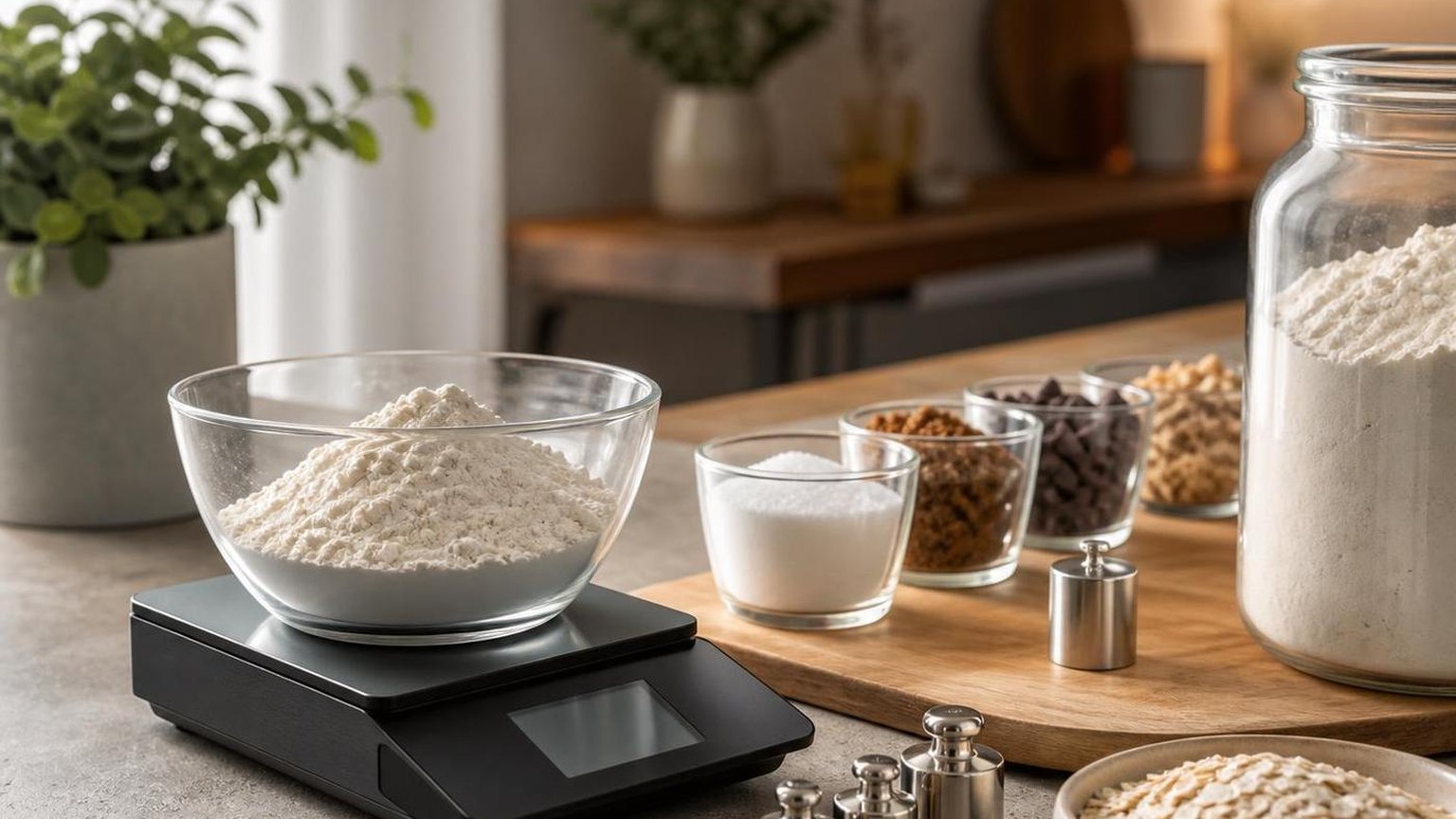
How do you convert kilograms to grams?
Multiply the number of kilograms by 1,000. For example, 2.5 kilograms equals 2,500 grams.
How do you convert grams to kilograms?
Divide the number of grams by 1,000. For example, 750 grams equals 0.75 kilograms.
Is 500 grams half a kilogram?
Yes, 500 grams is exactly half a kilogram. Since 1 kilogram equals 1,000 grams, half of 1,000 is 500.
What is the difference between a gram and a kilogram?
A kilogram is 1,000 times heavier than a gram. In everyday use, grams are often used for small amounts like food ingredients, while kilograms are used for larger weights such as produce, luggage, or body weight in metric countries.
Why does the metric system use kilograms instead of grams for larger weights?
The metric system scales by powers of 10, so a kilogram represents 1,000 grams and keeps larger measurements practical.
Scientists, food manufacturers, and retailers use kilograms because writing 2 kg is clearer than writing 2,000 g for many everyday and commercial quantities.
What items typically weigh about 1 kilogram?
One liter of water weighs about 1 kilogram at standard conditions, which makes it a common real-world reference point. A bag of sugar or flour is also often sold in 1-kilogram packages in many countries, helping shoppers visualize that weight quickly.
How is a kilogram defined today?
Since May 20, 2019, the kilogram has been defined by fixing the numerical value of the Planck constant at 6.62607015 × 10^-34 joule-second.
This replaced the older metal prototype standard and made the unit stable, universal, and independent of a physical object.
Related Reading
- How Many 8 Oz Water Bottles Are In A Gallon?
- How Many Ounces Is 30 Ml?
- How Much Does A Penny Weigh In Pounds?
- Who Makes Yellowstone Bourbon?
- How Many Shots Of Tequila To Get Drunk? Find Out Now
- What Alcohol Is In Mike’S Hard Lemonade?
- What Is A Wine Cooler? Benefits, Types & How to Choose (2026)
- All Blog Guides
- NIST Special Publication 330: The International System of Units (SI) (2019)
- NIST Guide for the Use of the International System of Units (SI), Special Publication 811 (2008)
- NIST Metric SI Prefixes (2024)
- BIPM The International System of Units (SI Brochure), 9th Edition (2019)
- BIPM SI Prefixes (2022)
- Encyclopaedia Britannica: Kilogram (2024)
- Merriam-Webster: Kilogram Definition (2024)