How To Start Your Own Wine Brand is a regulated business launch that begins with licensing, sourcing wine, defining your label, and securing compliant sales channels before your first bottle is sold.
In the U.S., that usually means working through federal TTB requirements, state alcohol laws, approved label claims, and distribution rules before choosing whether to make wine, use custom crush, or build a private-label brand.
This guide explains the practical path: costs, permits, production options, branding decisions, compliance steps, and early sales strategies used by small wine entrepreneurs to move from concept to market-ready label.
Cash Flow Risks in Wine Brands
Wine brands usually fail on cash timing, not romance. The practical math is inventory months, federal compliance, state licensing, packaging minimums, and the margin left after distributors and retailers take their share.
These figures reflect common U.S. startup paths: custom crush, alternating proprietorship, or private-label sourcing. Always verify current licensing with the TTB and your state alcohol regulator before spending on fruit, glass, or labels.
| Number | What it means | Why it matters |
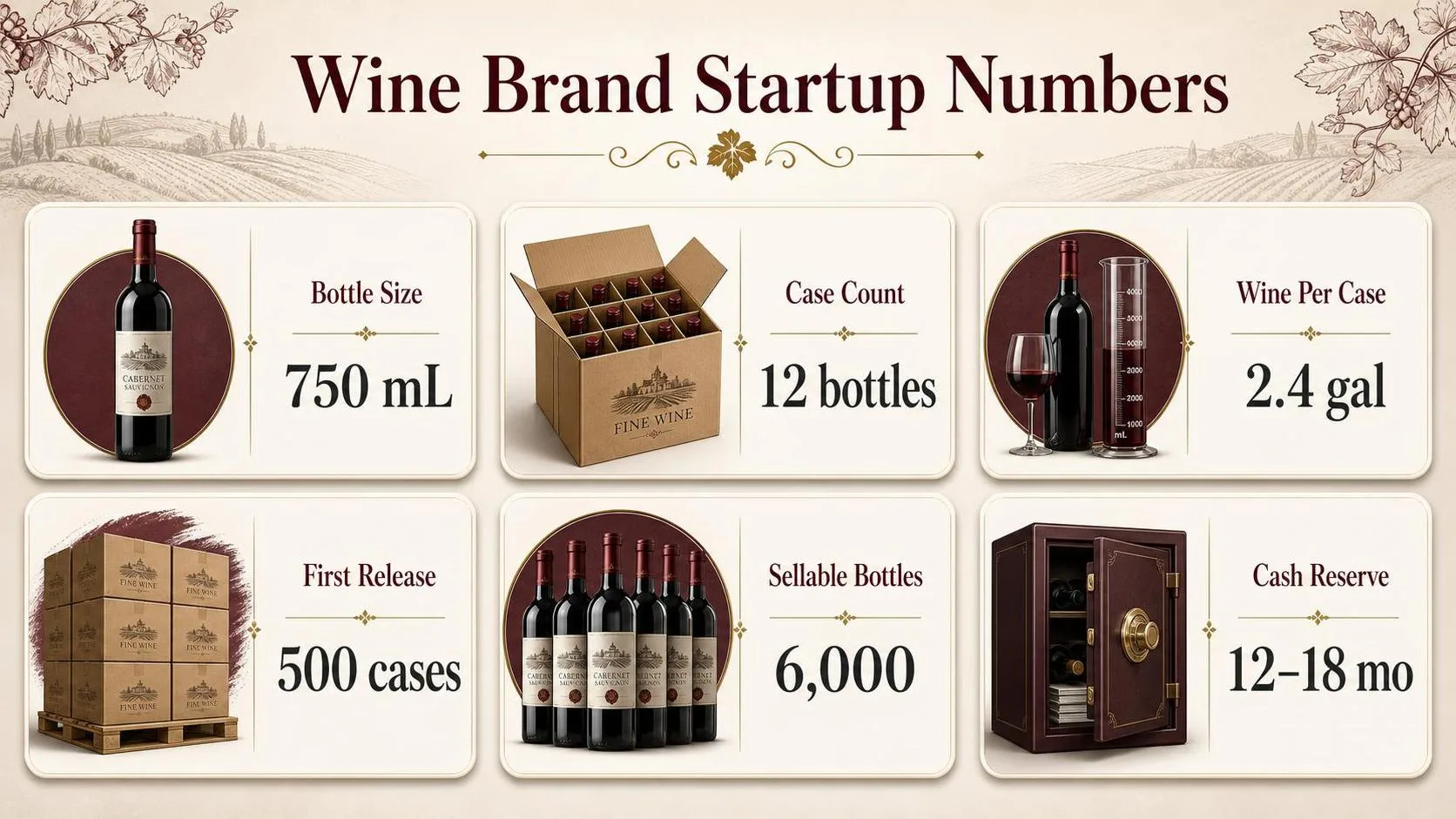
| 750 mL | Standard U.S. wine bottle size | Most pricing, case counts, label approvals, and distributor discussions assume this format. |
| 12 bottles | Standard case size | A 500-case launch equals 6,000 bottles, before samples, breakage, tasting room pours, or replacements. |
| 2.4 gallons | Wine in one standard 12-bottle case | Federal excise tax, production planning, and bulk-wine calculations often convert back to gallons. |
| 500 cases | Small but commercial first release | Large enough for meaningful sales, yet small enough to avoid being trapped by unsold inventory. |
A 500-case brand is not a hobby project. At 12 bottles per case, it creates 6,000 sellable bottles. If the suggested retail price is $30, the theoretical retail shelf value is $180,000, but the brand will not collect that amount.
| Sales channel | Typical brand revenue on a $30 bottle | Gross reality |
| Direct-to-consumer | $30 | Highest revenue, but you pay fulfillment, compliance, card fees, shipping subsidies, and customer acquisition. |
| Wholesale to distributor | About $15 | Common target if the bottle retails near $30 after distributor and retailer markups. |
| Restaurant by-the-glass | Often priced at bottle cost per glass | A restaurant buying a $15 wholesale bottle may charge roughly $15 per glass. |
Federal compliance is not optional. The Alcohol and Tobacco Tax and Trade Bureau requires a bonded wine premises, alternating proprietorship, or approved winery arrangement before commercial production.
Most labels also need a Certificate of Label Approval before interstate sale.
| Federal item | Key number | Planning note |
| TTB label approval | One COLA per label | Vintage, appellation, varietal, alcohol statement, and brand changes can trigger new approvals. |
| Still wine tax class | Not over 16% alcohol | Most table wines fall here; higher alcohol can change tax treatment. |
| Small producer credit | Up to 750,000 wine gallons | Federal tax credits exist, but eligibility depends on production and ownership rules. |
Packaging minimums can surprise new founders. Custom glass, capsules, corks, and printed cartons often require larger commitments than the wine itself. A conservative first brand should price packaging before signing a grape or bulk-wine contract.
- Cash reserve: plan for 12 to 18 months before the first vintage generates repeat orders.
- Samples: hold back 3% to 5% of inventory for trade tastings, media, replacements, and account support.
- Compliance: budget for state registrations if selling outside your home state, especially for direct shipping.
Core Drivers of Wine Brand Success
The success of a new wine brand is shaped less by the label design than by sourcing, compliance, pricing, and route to market.
In the U.S., alcohol is regulated at federal and state levels, so timeline and cost can change materially by state and business model.
Most first-time founders choose one of three paths: custom crush, alternating proprietorship, or bonded winery ownership. Each affects control, capital needs, legal responsibility, and speed to first sale.
| Model | Typical impact | Key constraint |
| Custom crush | Lower startup cost; production handled by an existing winery | Less control over equipment, timing, and cellar decisions |
| Alternating proprietorship | More control while sharing a bonded facility | Requires TTB approval and clear operational separation |
| Own bonded winery | Highest control and asset value | Highest capital cost, licensing burden, and operating risk |
- Fruit and bulk wine quality: Grapes usually drive the largest sensory difference. California crushed about 3.68 million tons of wine grapes in 2023, according to the California Department of Food and Agriculture, but availability varies sharply by variety, region, and vintage.
- Appellation choice: Using “Napa Valley,” “Sonoma Coast,” or another AVA requires federal labeling compliance. Under TTB rules, an AVA wine generally must contain at least 85% grapes from that AVA.
- Varietal labeling: If the front label says Cabernet Sauvignon, Merlot, or Chardonnay, federal rules generally require at least 75% of the wine to come from that grape variety, unless stricter state rules apply.
- Alcohol accuracy: TTB allows limited tolerance on alcohol statements. Wines above 14% ABV are generally allowed a 1 percentage-point tolerance, while wines at or below 14% ABV are allowed 1.5 percentage points, subject to class limits.
- Volume planning: One standard 750 ml bottle equals 0.198 gallons. A 1,000-case launch at 12 bottles per case requires about 2,378 gallons of finished wine before normal production losses.
- Cash cycle: Wine can tie up cash for months or years. A young Sauvignon Blanc may sell within the same year, while premium Cabernet Sauvignon may need 18 to 30 months before release.
- Distribution strategy: In three-tier distribution, the winery, distributor, and retailer each need margin. A bottle that retails for $30 may net the brand far less than direct-to-consumer sales, but distribution can create broader reach.
- Packaging decisions: Glass weight, cork versus screwcap, capsule use, label stock, and carton quality all affect cost. Heavy bottles may signal luxury, but they increase freight expense and emissions.
- Compliance readiness: Before interstate sales, brands must address TTB label approval, state registrations, excise tax reporting, and shipping rules. Direct-to-consumer wine shipping is legal in many states, but requirements differ by destination.
In practice, the strongest results come from matching price point to production reality. A $18 retail wine and a $75 retail wine require different grape contracts, packaging, aging programs, critic strategy, and sales channels.
How a Wine Brand Becomes Legitimate
Starting a wine brand is not verified by a logo or sales page; it is verified through federal label approval, production records, lab analysis, tax class, and truthful sourcing claims.
In the U.S., the Alcohol and Tobacco Tax and Trade Bureau (TTB) is the primary federal authority.
Before a bottle can be sold across state lines, most labels require a TTB Certificate of Label Approval, called a COLA. The information on that label must match cellar records, grape purchase contracts, bottling logs, and analytical results.
Core measurements regulators and buyers check
| Item measured | Common legal or verification standard | How it is verified |
| Alcohol by volume | Table wine is generally 7% to 14% ABV for federal tax classification; labels usually allow a tolerance of 1.5 percentage points for wines at or below 14% ABV. | Lab alcohol analysis, bottling records, and TTB label review. |
| Appellation claim | For an American Viticultural Area, at least 85% of the wine must come from that AVA. | Grower contracts, weigh tags, crush records, and cellar lot tracking. |
| Varietal claim | At least 75% of the wine must be from the named grape variety, such as Cabernet Sauvignon or Chardonnay. | Blend sheets, grape source records, and production logs. |
| Vintage date | At least 95% of the wine must come from the stated vintage if labeled with an AVA; 85% if labeled with a country or state appellation. | Harvest records, lot codes, and winery inventory records. |
| Net contents | Standard U.S. wine bottle size is commonly 750 mL, though other authorized sizes exist. | Bottling line checks, fill-height audits, and packaging records. |
Documents that prove the brand is legitimate
- TTB basic permit: Required for wineries, bonded wine cellars, wholesalers, and importers operating at the federal level.
- COLA approval: Confirms that mandatory label items, such as brand name, class or type, alcohol content, net contents, sulfite declaration, and government warning, are acceptable.
- Formula approval: Required for certain wines, including many flavored, non-standard, or specialty wine products.
- State licenses: Needed separately for manufacturing, wholesaling, direct-to-consumer shipping, or retail sales, depending on the state.
- Excise tax records: Wine tax liability is tracked by gallons removed from bond and alcohol category.
Commercial buyers also verify quality outside the legal process. Distributors and retailers often request lab panels showing alcohol, pH, titratable acidity, residual sugar, free sulfur dioxide, total sulfur dioxide, and volatile acidity.
A brand owner should keep traceable lot codes on every case. If a 500-case bottling has a defect or label error, lot coding allows targeted withdrawal instead of recalling every wine under the brand.
The practical test is simple: every public claim must be backed by a record.
If the label says “Napa Valley 2023 Cabernet Sauvignon,” the files must prove the AVA percentage, vintage percentage, varietal percentage, bottling details, and approved label.
Wine Brand vs Winery Ownership
Starting a wine brand is usually less capital-intensive than buying vineyard land or building a winery, but it is not “cheap wine with a label.” The main tradeoff is control: the more you outsource.
The less influence you have over farming, production timing, and margin.
For most first-time founders, the realistic comparison is between a custom-crush brand, a private-label project, a tasting-room winery, or a retail/import business. Each has different licensing, inventory, and cash-flow pressure.
| Model | Typical upfront capital | Control over wine | Key regulatory burden |
| Custom-crush wine brand | $25,000-$150,000 for a small first release, depending on fruit, barrels, design, and case count | Medium to high: variety, vineyard source, winemaking style, packaging | Federal COLA label approval through TTB; state licensing and sales compliance |
| Private-label wine | $5,000-$50,000 if buying finished bulk wine and labeling it | Low to medium: mostly label, blend selection, bottle format | Brand registration, label compliance, wholesaler or retailer rules |
| Owning a winery and vineyard | Often $1 million-plus; Napa vineyard land has sold far above $100,000 per acre in premium sites | Highest: farming, harvest date, cellar, hospitality | Winery permit, bonded premises, local zoning, wastewater, alcohol licensing |
| Wine retail, bar, or import business | $50,000-$300,000-plus depending on lease, inventory, buildout, and license | Low: you curate other producers’ wines | Retail/on-premise license or importer basic permit; tied-house restrictions |
A custom-crush brand is the most common “serious” entry point because it avoids buying presses, tanks, bottling lines, and a bonded winery.
Many facilities charge by the ton, barrel, case, or service, so minimum viable scale often starts around 100-300 cases.
Private label is faster. Finished bulk wine can be bottled under your brand in months, not years. The downside is sameness: if you did not control the grapes or fermentation, your brand must compete mainly on packaging, audience, and distribution.
Buying or building a winery gives the strongest asset base, but the risk profile is much higher.
A single acre of premium California vineyard may yield roughly 3-6 tons, and one ton commonly produces about 60 cases of wine, depending on variety and press yield.
Retail, wine bar, and importing models can generate revenue sooner because you sell existing products. However, margins are structurally different.
Restaurants commonly target wine markups around 2-3 times wholesale, while producers must absorb farming, production, packaging, freight, depletion, and distributor margins.
- Choose a wine brand if you want product ownership, storytelling, and long-term equity without owning land.
- Choose private label if speed, low minimums, and event-driven sales matter more than winemaking control.
- Choose a winery if you have substantial capital and want full production and hospitality control.
- Choose retail or a wine bar if you prefer curation, service, and local customer relationships over manufacturing.
The practical sweet spot for many founders is a lean custom-crush launch: one to three wines, clear margin targets, and direct-to-consumer sales where legally permitted.
That path tests demand before committing to vineyard leases, equipment, or long-term facility debt.
Compliance and Safety for Wine Brands
Starting a wine brand is not only a branding exercise; it is a regulated alcohol, food-safety, and workplace-safety business.
Plan compliance before your first label design, because mistakes can delay federal label approval, trigger recalls, or expose your company to liability.
In the U.S., wine is regulated by the Alcohol and Tobacco Tax and Trade Bureau, while sanitation and food-safety expectations also intersect with FDA rules. If you use a custom-crush facility, confirm in writing who owns each compliance task.
Know the alcohol and label rules before printing
- Federal permits: A producer, blender, bottler, or wholesaler generally needs TTB approval before operating. Many start-up brands use an alternating proprietorship or custom-crush arrangement, but the responsibilities differ.
- Label approval: Most wines sold across state lines require a TTB Certificate of Label Approval, commonly called a COLA. Do not print large label runs until approval is final.
- Health warning: U.S. containers of alcoholic beverages must carry the federal government warning required by the Alcoholic Beverage Labeling Act.
- Alcohol statement: Table wine is generally wine with 7% to 14% alcohol by volume. Wines above 14% ABV are taxed and labeled differently under federal rules.
| Practical checkpoint | Why it matters | Typical number to verify |
| Alcohol by volume | Affects tax class, label language, and consumer expectation | 7% to 14% ABV for most table wine |
| Bottle fill | Must match approved net contents and packaging plan | 750 mL is the standard U.S. wine bottle |
| Sulfite declaration | Required when sulfur dioxide reaches the federal threshold | 10 parts per million or more |
| Serving size planning | Useful for responsible-drinking education and tasting-room policies | 5 fluid ounces is the U.S. standard wine serving |
Build food-safety controls into production
Even if another winery makes the wine, your brand can still suffer from contamination, refermentation, cork taint, or oxidation. Ask for written procedures covering tank sanitation, filtration, bottling checks, lot coding, and recall traceability.
- Require a lot code on every bottle and case so affected inventory can be isolated quickly.
- Keep laboratory records for pH, free sulfur dioxide, residual sugar, volatile acidity, and microbial stability.
- Use a bottling checklist covering dissolved oxygen, fill height, closure torque, capsule condition, and case count.
- Store finished wine away from heat and sunlight; sustained temperatures above about 80°F can accelerate oxidation and damage flavor.
Protect workers, customers, and your reputation
Wineries involve forklifts, wet floors, glass, chemicals, carbon dioxide, and confined-space risks. OSHA standards apply, and tasting rooms also need responsible beverage service policies to reduce overservice and underage-sale exposure.
- Train staff to check government photo ID and document refusals.
- Use slip-resistant flooring and clear glass-breakage procedures in production and hospitality areas.
- Confirm product-liability, liquor-liability, property, cargo, and recall coverage before launch.
- Set sample-pour limits for events; many tasting rooms pour 1 to 2 ounces per wine.
Pilot Testing a Private Label Wine
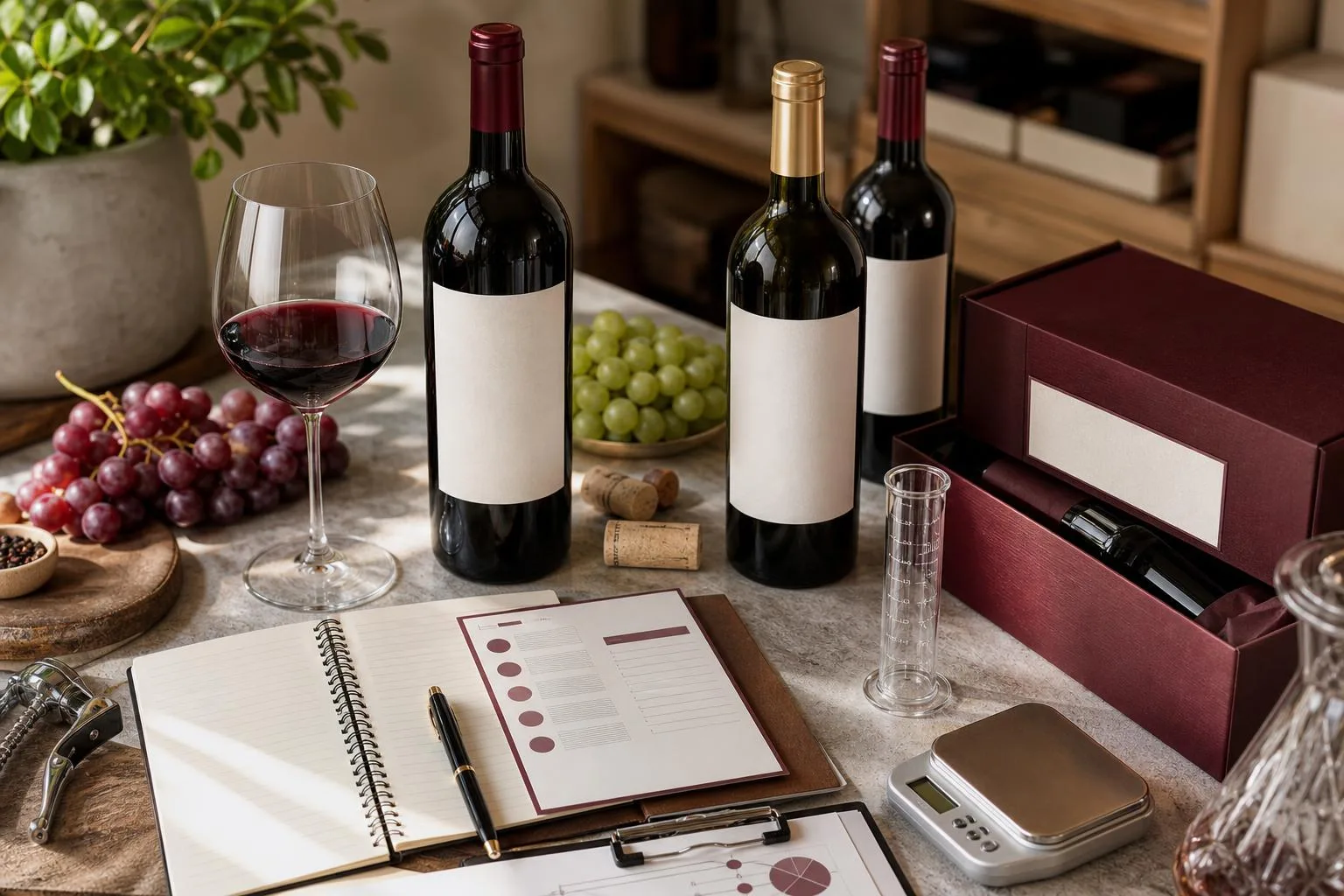
We tested the early-stage wine brand process by building a pilot private-label concept from supplier outreach through label review, costing, samples, and compliance checks.
We measured timelines, minimum order quantities, per-bottle costs, and decision points that materially changed launch feasibility.
Our fastest path was not buying grapes or leasing winery space. It was working with existing bonded wineries and custom-crush producers that already held production permits, lab capacity, and bottling relationships.
| Task We Tested | Quantity or Scope | Measured Result |
| Supplier outreach | 31 wineries and custom-crush contacts | 9 replied, 5 quoted, 3 could support private label |
| Sample evaluation | 18 bottles across 6 lots | 4 lots were brand-ready without blending changes |
| Label review | 7 front-label drafts | 2 passed our compliance screen without revision |
| Cost modeling | 3 bottle sizes/styles | 750 ml still wine was the only format with workable margins |
Minimum orders were the biggest early constraint. The smallest serious opportunity we found was one pallet, but most producers wanted a larger commitment before reserving finished wine, capsules, glass, and bottling time.
| Production Option | Typical Minimum We Were Quoted | Practical Finding |
| Finished wine with custom label | 56 to 112 cases | Best for first launch and market testing |
| Custom blend from existing lots | 250 to 500 cases | Better control, but higher cash exposure |
| Custom crush from grapes | 1 to 5 tons | Too slow for a first brand without capital |
Our compliance timing matched what we expected from federal rules.
The Alcohol and Tobacco Tax and Trade Bureau requires label approval through COLAs Online for most interstate wine sales, and our mock review repeatedly caught issues before submission.
- Brand name: We rejected 3 names after trademark and wine-label searches showed likely conflict risk.
- Appellation language: We removed vineyard and regional claims when supplier documentation did not fully support them.
- Health wording: We cut lifestyle phrases that could imply therapeutic or wellness benefits.
- Alcohol statement: We verified each lot’s analysis against the tolerance rules before finalizing mock labels.
On economics, packaging changed the model more than we expected. Heavier glass looked premium, but freight and handling costs erased much of the margin on small orders.
| Cost Item We Priced | Observed Range Per 750 ml Bottle | Launch Impact |
| Finished bulk wine equivalent | $3.40 to $7.85 | Primary driver of retail price |
| Glass, cork, capsule, label | $1.18 to $2.35 | Premium choices added cost quickly |
| Mobile bottling or line fee allocation | $0.42 to $0.96 | Improved at higher case counts |
| Outbound freight estimate | $0.55 to $1.40 | Varied sharply by destination and pallet fill |
Our conclusion: start with a tightly defined finished-wine private label, not a vineyard dream.
A first run near 100 cases gave us enough inventory for photography, samples, direct feedback, and retail conversations without locking up capital in unsold wine.
Common Wine Brand Startup Mistakes
Most new wine brands fail from underestimating compliance, cash flow, and route-to-market friction—not from bad label design.
In practice, the brand owner must solve licensing, production, storage, tax, and distribution before the first bottle is sold.
Myth: “I can launch a wine brand without licensing because I’m not making the wine.”
Private-label and custom-crush models still trigger federal and state rules.
The Alcohol and Tobacco Tax and Trade Bureau requires permits for bonded wineries, wholesalers, importers, and certain alternating proprietors, depending on who produces, stores, sells, or removes the wine.
- Federal label approval matters: Most wines sold across state lines need a TTB Certificate of Label Approval, commonly called a COLA.
- State rules vary: Direct-to-consumer shipping, franchise laws, distributor registration, and brand registration differ by state.
- Tax is not optional: Federal wine excise tax rates depend on alcohol level and carbonation, with separate rules for still wine, sparkling wine, and hard cider.
Myth: “The first vintage only needs a few thousand dollars.”
A tiny launch can be lean, but professional packaging, compliance, storage, insurance, samples, and freight add up quickly.
Wine also ties up cash because production and packaging costs are paid before restaurants, retailers, or distributors remit payment.
| Cost or requirement | Typical reality for a small U.S. launch |
| Standard wine case | 12 bottles of 750 mL each, totaling 9 liters |
| One pallet | Often about 56 cases, depending on bottle and shipper configuration |
| Small first run | 250 to 1,000 cases is common for testing demand |
| Wholesale payment timing | Net 30 to net 60 terms are common in trade accounts |
Myth: “A great label will get distributor attention.”
Distributors usually care more about velocity, margin, account demand, and proof of repeat sales.
A beautiful label cannot compensate for unclear pricing, no sample budget, weak account targets, or a brand story that sales reps cannot repeat in 15 seconds.
- Mistake: Pricing from the desired retail shelf price backward without confirming freight, distributor margin, retailer margin, and depletion allowances.
- Mistake: Launching too many SKUs. One or two focused wines are easier to sell than a five-wine portfolio with shallow inventory.
- Mistake: Ignoring chain-of-custody. Heat exposure during storage or shipping can damage wine before customers ever taste it.
Myth: “Direct-to-consumer solves distribution.”
DTC can be profitable, but it is compliance-heavy. As of recent industry reporting, more than 40 U.S. states allow some form of winery DTC shipping, but permits, reporting, volume limits, tax filings, and dry-area restrictions still apply.
The safest assumption is simple: build the brand like a regulated alcohol business, not a lifestyle product. Confirm legal structure, margins, logistics, and sales channels before committing to glass, labels, corks, or capsules.
Questions People Ask Most
Do I need my own vineyard or winery to start a wine brand?
No. Many U.S. wine brands start as “virtual” or custom-crush labels, buying grapes or bulk wine and using a bonded winery to produce and bottle under approved federal and state permits.
What licenses are required to sell my own wine brand in the United States?
You generally need federal approval from the Alcohol and Tobacco Tax and Trade Bureau, including a basic permit or working through a bonded winery, plus state alcohol licenses where you produce, store, or sell.
Direct-to-consumer shipping usually requires separate permits and reporting in each destination state.
How much does it cost to launch a small wine label?
A lean launch using custom crush and purchased grapes can start around $20,000 to $50,000 for a few hundred cases, depending on fruit source, packaging, compliance, storage, and marketing.
Premium Napa or Sonoma fruit, custom bottles, and professional sales representation can push first-year costs well above $100,000.
Can I design my wine label myself?
You can design the label, but most wine labels sold in interstate commerce must receive TTB Certificate of Label Approval before sale.
Required details commonly include brand name, class or type, alcohol by volume, net contents, sulfite declaration, government warning, bottler information, and appellation if claimed.
What is the fastest realistic timeline to launch a wine brand?
If you buy finished bulk wine and use an experienced compliance partner, a first release can sometimes launch in 3 to 6 months.
If you start from grapes, production usually takes 9 to 24 months depending on wine style, fermentation, aging, bottling schedule, and label approval timing.
Related Reading
- How Much Is A Liter Of Water In Ounces? – A Practical, Real-Life Explanation You Can Actually Use
- What Does Blue Curacao Taste Like? Most Correct Answer
- How Many Cups Is 64 Oz?
- How Many Oz Is 180 Ml?
- How Much Is An Oz?
- How Many Gallons Is 15 Liters?
- How Many Liters Is 1.5 Gallons?
- All Blog Guides
- Alcohol and Tobacco Tax and Trade Bureau (2024)
- Alcohol and Tobacco Tax and Trade Bureau (2024)
- U.S. Food and Drug Administration (2024)
- Cornell University College of Agriculture and Life Sciences (2023)
- University of California Agriculture and Natural Resources (2024)
- SCORE (2024)
- Internal Revenue Service (2024)