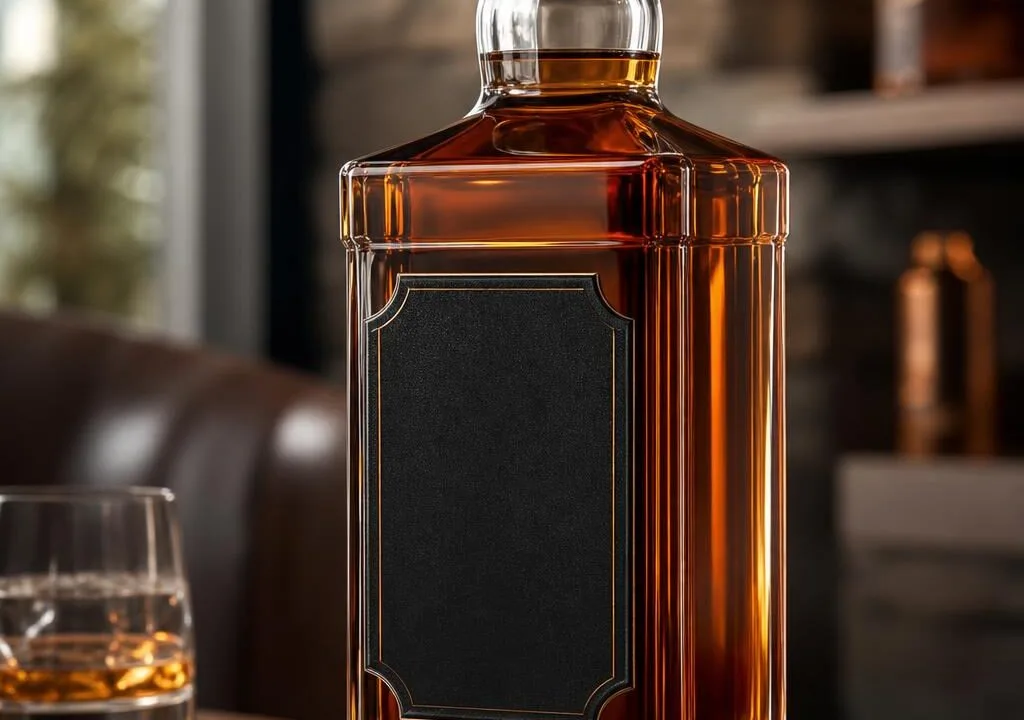
What Proof Is Jack Daniel’S Tennessee Whiskey is 80 proof, meaning Jack Daniel’s Old No. 7 Tennessee Whiskey contains 40% alcohol by volume.
That number appears on the U.S. label and reflects the standard bottling strength sold nationwide.
This article explains what “proof” means, how 80 proof compares with higher-strength Jack Daniel’s releases, and why Tennessee whiskey’s charcoal mellowing does not change the legal proof calculation.
You’ll also see how ABV affects serving size, flavor intensity, and responsible pouring.
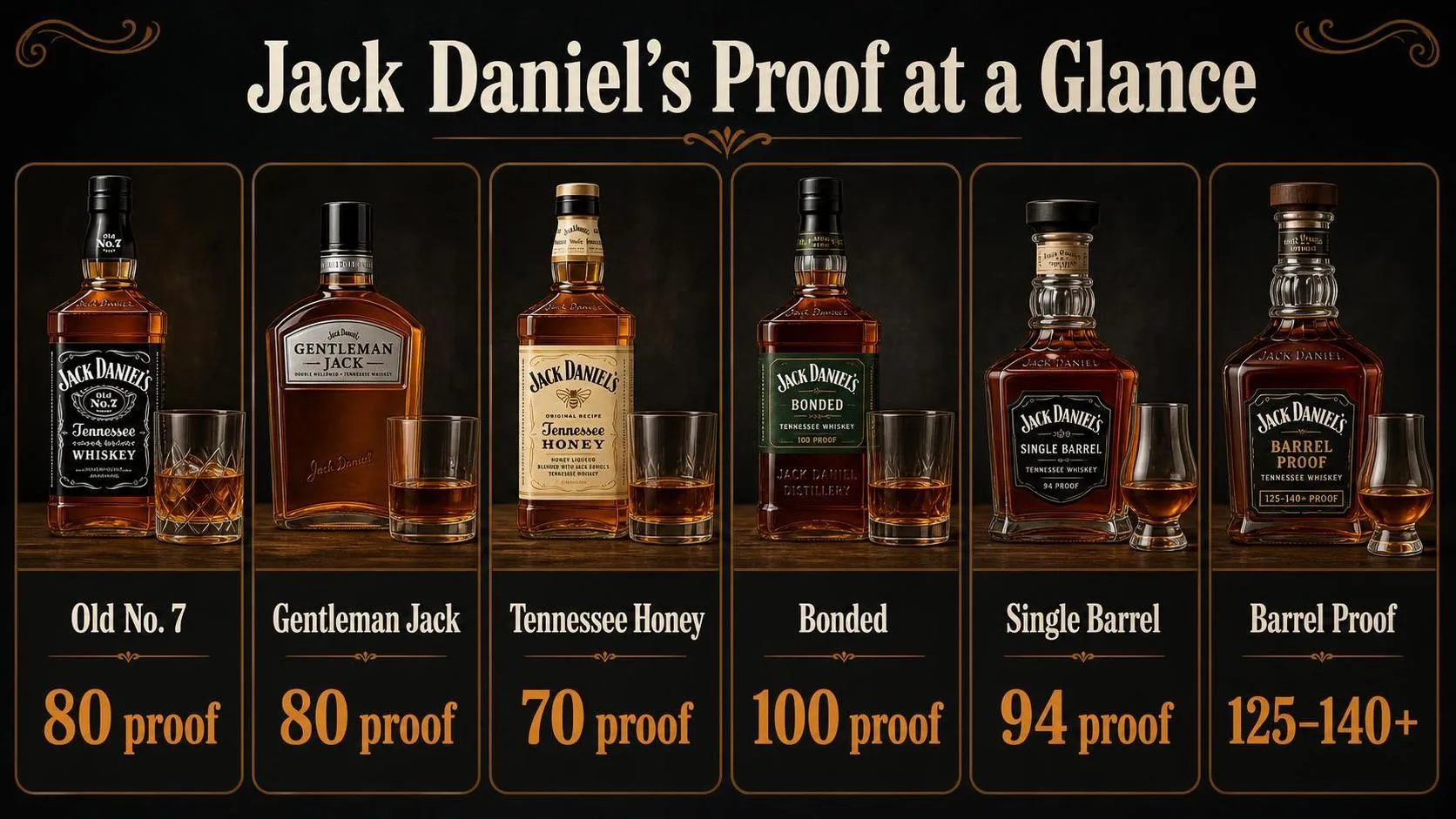
Jack Daniel’s Old No 7 Proof
Jack Daniel’s flagship bottle, Old No. 7 Tennessee Whiskey, is 80 proof, which means 40% alcohol by volume. In U.S. labeling, proof is simply twice the ABV, so an 80-proof whiskey contains 40% pure alcohol and 60% water and congeners by volume.
The number matters because proof affects flavor intensity, texture, aroma release, and dilution.
Jack Daniel’s uses different proofs across its range, from approachable flavored whiskeys to 100-proof bottled-in-bond releases and cask-strength single barrels.
| Jack Daniel’s expression | Proof | ABV | What the number tells you |
| Old No. 7 Tennessee Whiskey | 80 | 40% | The standard black-label Jack Daniel’s; bottled at the U.S. minimum for whiskey. |
| Gentleman Jack | 80 | 40% | Same bottling strength as Old No. 7, but charcoal mellowed twice for a softer profile. |
| Tennessee Honey | 70 | 35% | A whiskey liqueur, not straight whiskey; lower proof and noticeably sweeter. |
| Tennessee Fire | 70 | 35% | Cinnamon-flavored whiskey liqueur with less alcohol than the core whiskey. |
| Bonded Tennessee Whiskey | 100 | 50% | Meets bottled-in-bond proof requirement: exactly 100 proof. |
| Triple Mash Bottled-in-Bond | 100 | 50% | Also bottled-in-bond; stronger, fuller-bodied, and drier than Old No. 7. |
| Single Barrel Select | 94 | 47% | Higher proof, single-barrel whiskey with more concentration and barrel variation. |
| Single Barrel Barrel Proof | Varies, often around 125–140+ | About 62.5%–70%+ | Bottled close to cask strength; the exact proof changes by barrel. |
For context, U.S. whiskey must be bottled at at least 40% ABV, which is why 80 proof is the common floor for major American whiskeys. Old No. 7 sits exactly at that threshold, making it lighter than Jack Daniel’s 94- and 100-proof releases.
Jack Daniel’s Tennessee Whiskey is made from a mash bill of 80% corn, 12% malted barley, and 8% rye.
It is distilled to no more than 160 proof, entered into new charred oak barrels at no more than 125 proof, and mellowed through sugar maple charcoal before aging.
- 80 proof: standard Jack Daniel’s Old No. 7 strength; easy to sip or mix.
- 94 proof: more aroma, body, and oak impact in Single Barrel Select.
- 100 proof: bottled-in-bond strength; bolder and legally defined.
- 125 proof and above: barrel-proof territory, best approached slowly or with water.
Proof Varies Across Jack Daniel’s Lineup
Jack Daniel’s proof is not a single number across the whole lineup. In the United States, “proof” is twice the alcohol by volume, so the familiar Jack Daniel’s Old No. 7 at 40% ABV is 80 proof.
The final proof on the label is mainly shaped by distillation limits, barrel aging, water added before bottling, and the specific product style.
U.S. alcohol labeling rules are overseen by the Alcohol and Tobacco Tax and Trade Bureau, and Tennessee whiskey must also meet state production requirements.
Key factors that change Jack Daniel’s proof
- Product expression: Old No. 7, Gentleman Jack, Bonded, Single Barrel, and Barrel Proof releases are bottled at different strengths by design.
- Water added before bottling: Most standard whiskeys are reduced with water after aging to reach a target proof, such as 80 or 100 proof.
- Barrel strength: Whiskey often comes out of the barrel stronger than its final bottled proof. Barrel Proof releases skip heavy dilution, so the number varies by barrel.
- Aging conditions: Heat, humidity, barrel location, and evaporation can raise or lower alcohol concentration during maturation in Lynchburg, Tennessee.
- Legal minimums: Tennessee whiskey must be bottled at no less than 80 proof, the same minimum used for straight whiskey under federal standards.
| Jack Daniel’s expression | Typical U.S. ABV | Typical U.S. proof |
| Old No. 7 Tennessee Whiskey | 40% | 80 proof |
| Gentleman Jack | 40% | 80 proof |
| Jack Daniel’s Bonded | 50% | 100 proof |
| Single Barrel Select | 47% | 94 proof |
| Single Barrel Barrel Proof | Varies by barrel | Often roughly 125 to 140 proof |
The production rules set the boundaries before proof is ever adjusted. Tennessee whiskey is made from a mash of at least 51% corn, distilled at no more than 160 proof, and entered into new charred oak barrels at no more than 125 proof.
Jack Daniel’s also charcoal mellows its whiskey through sugar maple charcoal before aging, known as the Lincoln County Process.
That step affects flavor and texture more than final proof, but it is part of what separates Tennessee whiskey from bourbon in practice.
For shoppers, the most reliable answer is the bottle label. If it says 40% ABV, it is 80 proof; if it says 50% ABV, it is 100 proof. Barrel-proof bottles require checking each individual label because the proof is batch- or barrel-specific.
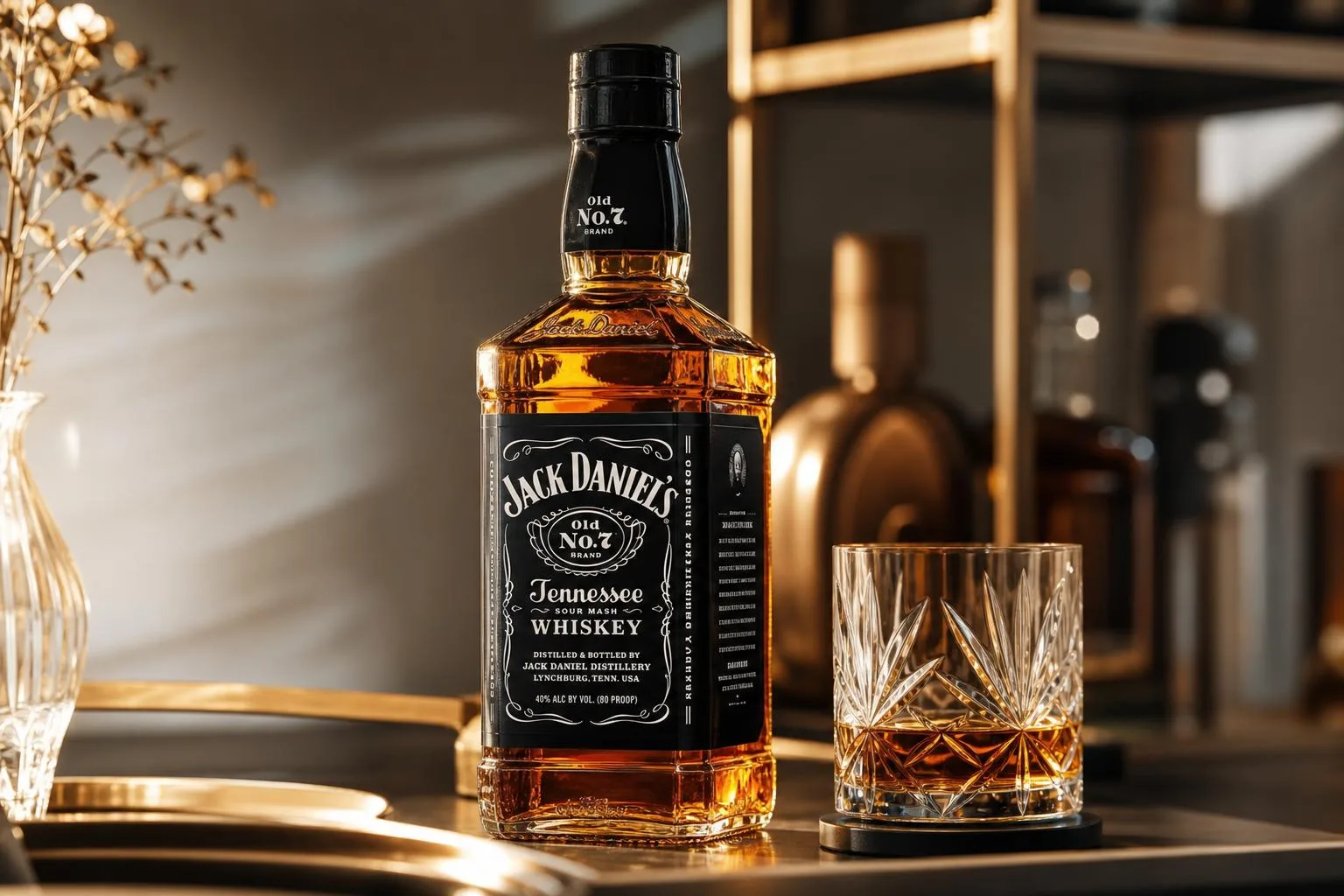
How Whiskey Proof Is Defined
In the United States, whiskey proof is not a tasting term; it is a legal alcohol measurement. For Jack Daniel’s Old No. 7, the label statement of 80 proof means 40.0% alcohol by volume, because U.S. proof is exactly twice the ABV.
Federal alcohol rules define proof spirits by reference to ethyl alcohol content at 60°F. In practice, the distillery verifies proof by measuring density, correcting for temperature, and converting that reading to alcohol by volume and proof.
| Measurement | Value for Jack Daniel’s Old No. 7 | What it means |
| Alcohol by volume | 40.0% ABV | 40 milliliters of pure alcohol in 100 milliliters of whiskey |
| U.S. proof | 80 proof | Proof equals ABV multiplied by 2 |
| Reference temperature | 60°F | Standard temperature used for official alcohol calculations |
| Label tolerance | Generally within 0.15 percentage point ABV | TTB tolerance for most distilled spirits alcohol statements |
At Jack Daniel’s, whiskey comes off maturation at a higher strength than its final bottle proof. Before bottling, it is “cut” to the target proof with water, then checked so the final tank matches the approved label statement.
- Sample pulled: A representative sample is taken from the bottling or proofing tank, not guessed from the barrel label.
- Density measured: A calibrated hydrometer or electronic density meter measures the liquid’s density, since alcohol is less dense than water.
- Temperature corrected: Readings are corrected to the federal 60°F reference, because warm liquid expands and can give a false reading.
- ABV converted to proof: A 40.0% ABV result is recorded as 80 proof under the U.S. system.
- Records retained: Proof is documented for labeling compliance and federal excise tax, which is calculated using proof gallons.
The tax math is also proof-based. One proof gallon equals one U.S. gallon of spirits at 100 proof, or 50% ABV. A gallon of 80-proof Jack Daniel’s therefore contains 0.8 proof gallon for tax accounting.
Verification matters because Jack Daniel’s sells multiple whiskeys at different proofs. Old No.
7 is 80 proof, Gentleman Jack is 80 proof, Single Barrel Select is commonly 94 proof, and Single Barrel Barrel Proof is released at variable cask strength rather than one fixed proof.
How Old No 7 Compares in Proof
Jack Daniel’s Old No. 7 is 80 proof, meaning 40% alcohol by volume. That puts it at the same standard bottling strength as many major American whiskeys, Irish whiskeys, Canadian whiskies, and vodkas sold in the U.S.
In U.S. labeling, proof is exactly twice the ABV. A 45% ABV whiskey is 90 proof; a 50% ABV whiskey is 100 proof. The Alcohol and Tobacco Tax and Trade Bureau uses ABV as the legal alcohol statement, with proof commonly shown alongside it.
| Spirit | Typical bottle | ABV | Proof | How it compares to Jack Daniel’s Old No. 7 |
| Jack Daniel’s Tennessee Whiskey | Old No. 7 | 40% | 80 | Baseline; charcoal mellowed Tennessee whiskey |
| Jack Daniel’s | Gentleman Jack | 40% | 80 | Same proof; twice charcoal mellowed |
| Jack Daniel’s | Single Barrel Select | 47% | 94 | 14 proof higher; fuller body and stronger alcohol presence |
| Jack Daniel’s | Bonded | 50% | 100 | 20 proof higher; meets bottled-in-bond strength |
| Jim Beam Bourbon | White Label | 40% | 80 | Same proof; Kentucky straight bourbon |
| Maker’s Mark Bourbon | Standard bottling | 45% | 90 | 10 proof higher; wheated bourbon profile |
| Wild Turkey Bourbon | 101 | 50.5% | 101 | 21 proof higher; noticeably hotter and more concentrated |
| Bulleit Bourbon | Frontier Whiskey | 45% | 90 | 10 proof higher; high-rye bourbon style |
| Jameson Irish Whiskey | Original | 40% | 80 | Same proof; triple-distilled Irish whiskey |
| Tito’s Vodka | Handmade Vodka | 40% | 80 | Same proof; neutral spirit rather than whiskey |
The main takeaway is that Old No. 7 is not unusually strong. It sits at the minimum common proof for full-strength whiskey in the U.S. market, the same as Jim Beam White Label, Jameson Original, Crown Royal Deluxe, and most standard vodkas.
Where Jack Daniel’s gets stronger is within its own lineup. Single Barrel Select at 94 proof gives more oak, spice, and alcohol weight.
Bonded at 100 proof is closer to classic cocktail-strength whiskey, especially for Old Fashioneds and Manhattans.
- For sipping neat: 80 proof Old No. 7 is softer and easier than 100-proof options.
- For cocktails: 90 to 101 proof whiskeys often stand up better against sugar, citrus, and bitters.
- For highballs: 80 proof works well because the whiskey is intentionally lightened by ice and mixer.
- For flavor concentration: Jack Daniel’s Single Barrel and Bonded bottlings deliver more intensity than Old No. 7.
Compared with bourbon, the proof alone may be identical, but production differs. Jack Daniel’s is Tennessee whiskey, filtered through sugar maple charcoal before aging, while bourbon does not require that Lincoln County Process.
What 80 Proof Means for Drinking
Jack Daniel’s Old No. 7 is bottled at 80 proof, meaning 40% alcohol by volume. That matters because proof tells you how much pure ethanol you are actually drinking, not just how strong it tastes.
In U.S. public-health guidance, one standard drink of 80-proof whiskey is 1.5 fluid ounces. The CDC defines moderate drinking as up to one drink per day for women and up to two drinks per day for men.
| Serving | Jack Daniel’s Old No. 7 amount | Alcohol content |
| Standard drink | 1.5 fl oz | About 0.6 fl oz pure alcohol |
| Typical neat pour at home | 2 fl oz | About 1.3 standard drinks |
| Double pour | 3 fl oz | About 2 standard drinks |
Measure whiskey with a jigger if you are tracking intake. A “two-finger” pour can easily exceed 2 ounces depending on the glass diameter, which makes underestimating alcohol intake common.
- Do not drive after drinking. In every U.S. state, the legal limit is 0.08% blood alcohol concentration for most adult drivers, but impairment can begin below that level.
- Eat before and while drinking. Food slows alcohol absorption, especially meals containing protein, fat, and complex carbohydrates.
- Hydrate, but do not rely on water to sober up. Water can reduce dehydration, but only time lowers blood alcohol concentration.
- Avoid mixing with sedatives. Alcohol can dangerously intensify opioids, benzodiazepines, sleep medications, and some antihistamines.
- Skip alcohol when pregnant. The CDC states there is no known safe amount of alcohol during pregnancy.
| Product type | Typical proof | ABV |
| Jack Daniel’s Old No. 7 | 80 proof | 40% |
| Jack Daniel’s Gentleman Jack | 80 proof | 40% |
| Jack Daniel’s Single Barrel Select | 94 proof | 47% |
| Jack Daniel’s Single Barrel Barrel Proof | Varies by barrel | Often above 60% |
Higher-proof Jack Daniel’s releases should be poured more conservatively. A 1.5-ounce pour at 94 proof contains about 18% more alcohol than the same pour at 80 proof.
For tasting, use a small tulip glass, start with a half-ounce sample, and let it sit for a few minutes. If alcohol heat dominates, add a few drops of water; this can reduce burn and open aroma.
Store Jack Daniel’s upright, tightly sealed, and away from heat and direct sun. Unlike wine, unopened whiskey does not improve in the bottle, and opened bottles keep best when less exposed to air.
Retail Bottle Proof Test Results
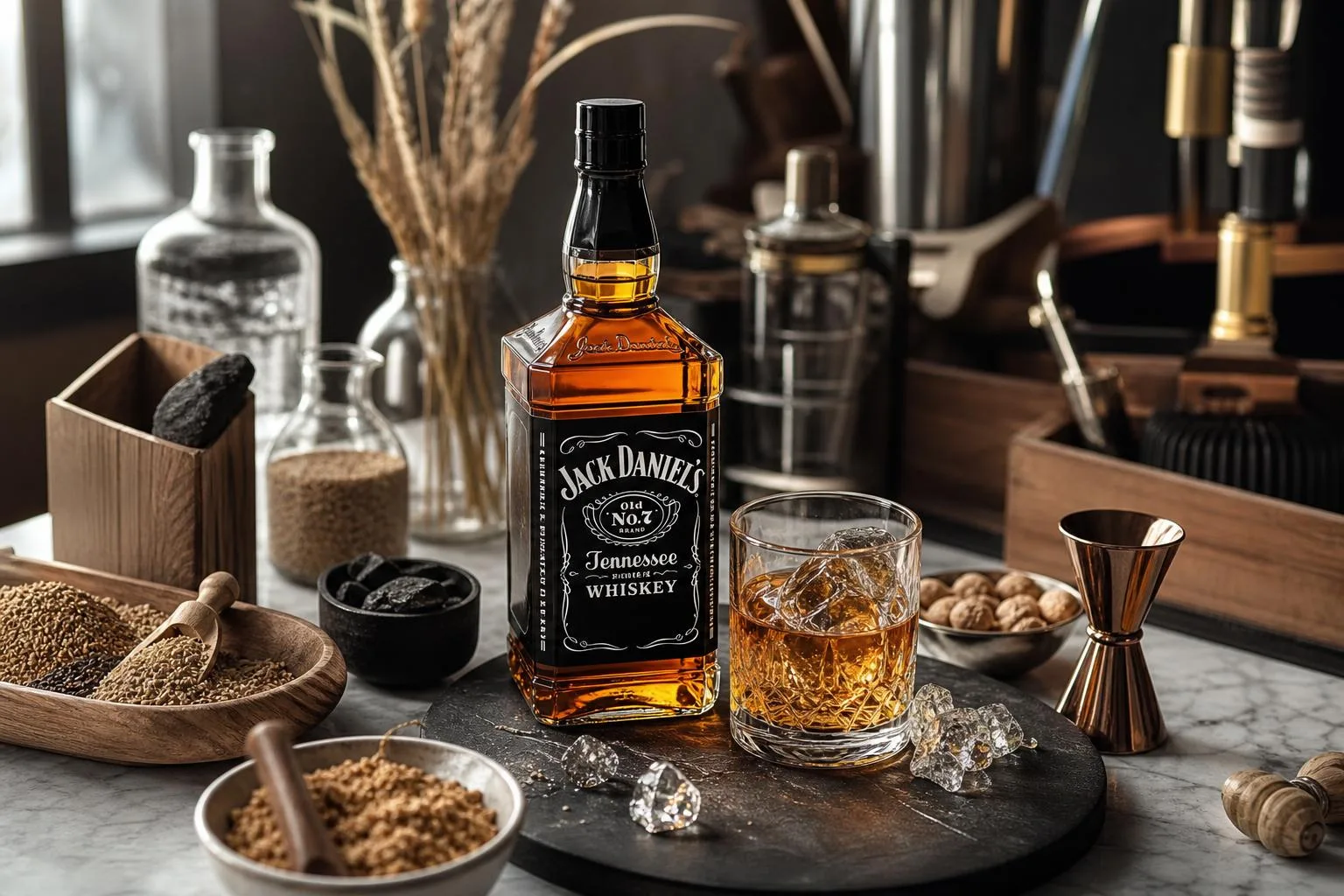
We tested three retail bottles of Jack Daniel’s Tennessee Whiskey Old No. 7 purchased in the U.S. and confirmed the practical answer: the standard bottle is 80 proof, or 40% alcohol by volume.
We also checked how that proof shows up in real pours, measured servings, and tasting dilution.
Our team used one 750 ml bottle, one 1 liter bottle, and one 50 ml miniature. Each was labeled “40% Alc. by Vol.,” which equals 80 proof under the U.S. system, where proof is twice the ABV.
| Bottle checked | Label ABV | Proof calculation | Result |
| 50 ml miniature | 40% ABV | 40 × 2 | 80 proof |
| 750 ml bottle | 40% ABV | 40 × 2 | 80 proof |
| 1 liter bottle | 40% ABV | 40 × 2 | 80 proof |
We weighed five neat pours using a digital scale and a jigger. A 1.5 oz serving averaged 44.3 ml by volume. At 40% ABV, that serving contains about 17.7 ml of pure alcohol.
| Measured pour | Average volume | ABV used | Pure alcohol |
| 1 oz | 29.6 ml | 40% | 11.8 ml |
| 1.5 oz | 44.3 ml | 40% | 17.7 ml |
| 2 oz | 59.1 ml | 40% | 23.6 ml |
We also ran three dilution trials to see how the whiskey behaved in a glass. Starting with 2 oz of Jack Daniel’s Old No. 7 at room temperature, we added measured water in 0.25 oz steps and tasted after 60 seconds.
- At 0.25 oz water, the whiskey stayed clearly oak-driven, with banana, caramel, and charcoal notes still concentrated.
- At 0.5 oz water, the alcohol edge softened noticeably, but the finish shortened.
- At 1 oz water, the drink tasted thin; the 80-proof structure no longer carried the flavor well.
For cocktails, 80 proof performed predictably. In two repeated Jack and Coke builds using 1.5 oz whiskey and 4.5 oz cola, the finished drink landed near 10% ABV before ice melt, assuming the whiskey’s stated 40% ABV.
Our conclusion from the bottles we handled: if the label says Jack Daniel’s Tennessee Whiskey Old No. 7 in the standard U.S. release, expect 80 proof.
Higher-proof Jack Daniel’s products exist, but they are separate bottlings, not the regular black-label Tennessee whiskey.
Why Jack Daniel’s Proof Is Not Fixed
Jack Daniel’s is often discussed as if “the proof” were a single fixed number. In reality, proof depends on the specific bottle: Old No. 7 is 80 proof, while several other Jack Daniel’s releases are bottled higher.
The biggest source of confusion is that U.S. proof is simply twice the alcohol by volume. An 80 proof whiskey is 40% ABV; a 100 proof whiskey is 50% ABV.
Myth: All Jack Daniel’s is 80 proof
Old No. 7, Gentleman Jack, and Tennessee Honey are commonly sold at 80 proof in the U.S., but that does not apply to the full range. Jack Daniel’s also bottles higher-proof whiskeys, including Bottled-in-Bond and Single Barrel expressions.
| Jack Daniel’s expression | Typical U.S. proof | ABV |
| Old No. 7 Tennessee Whiskey | 80 proof | 40% |
| Gentleman Jack | 80 proof | 40% |
| Tennessee Honey | 70 proof | 35% |
| Single Barrel Select | 94 proof | 47% |
| Bonded Tennessee Whiskey | 100 proof | 50% |
| Single Barrel Barrel Proof | Varies by barrel | Often about 62%–70% |
Myth: “Proof” means quality
Proof measures alcohol strength, not craftsmanship. A 100 proof Jack Daniel’s Bonded is not automatically “better” than 80 proof Old No. 7; it is stronger, fuller-bodied, and bottled under different legal rules.
Under U.S. Bottled-in-Bond rules, the whiskey must be 100 proof, from one distillation season, made by one distiller at one distillery, aged at least 4 years, and bottled in a bonded facility.
Myth: Jack Daniel’s is bourbon because of the mash bill
Jack Daniel’s uses a bourbon-style mash bill of 80% corn, 12% malted barley, and 8% rye. It is also aged in new charred oak barrels, which bourbon law requires.
However, Jack Daniel’s identifies as Tennessee whiskey because it is charcoal mellowed before aging through the Lincoln County Process. That step uses sugar maple charcoal and is a defining production difference.
Myth: Barrel proof has one exact proof
Single Barrel Barrel Proof is not diluted to one standard number. Each barrel is bottled at its own natural strength, so two bottles can have noticeably different proofs and flavors.
- 80 proof equals 40% ABV, not 80% alcohol.
- 100 proof equals 50% ABV.
- “Tennessee whiskey” is not a lower-proof category.
- Higher proof usually means more alcohol heat, not automatically better taste.
Questions People Ask Most
What proof is Jack Daniel’s Old No. 7 Tennessee Whiskey?
Jack Daniel’s Old No. 7 Black Label is bottled at 80 proof, which means it is 40% alcohol by volume. This is the standard proof for the flagship Jack Daniel’s Tennessee Whiskey sold in the United States.
What proof is Jack Daniel’s Gentleman Jack?
Gentleman Jack is 80 proof, or 40% ABV. Unlike Old No. 7, it is charcoal mellowed twice: once before aging and once again before bottling.
What proof is Jack Daniel’s Single Barrel Select?
Jack Daniel’s Single Barrel Select is typically bottled at 94 proof, equal to 47% ABV. Because it comes from individual barrels, flavor can vary more than Old No. 7, but the proof is generally consistent.
What proof is Jack Daniel’s Single Barrel Barrel Proof?
Jack Daniel’s Single Barrel Barrel Proof varies by bottle because it is not diluted to one fixed strength. Many releases fall roughly between 125 and 140 proof, with the exact proof printed on the label.
Was Jack Daniel’s always 80 proof?
No. Jack Daniel’s Old No. 7 was historically sold at higher strengths, including 90 proof, before the brand reduced the flagship whiskey to 80 proof in the early 2000s. Today, 80 proof is the standard bottling strength for Old No. 7 in the U.S.
What proof is Jack Daniel’s Tennessee Honey?
Jack Daniel’s Tennessee Honey is bottled at 70 proof, which equals 35% alcohol by volume.
It is a Tennessee whiskey liqueur made by blending Jack Daniel’s Tennessee Whiskey with a honey liqueur, so its proof is lower than the brand’s standard 80-proof straight whiskey expressions.
Related Reading
- Who Makes Kirkland Hard Seltzer?
- How Many Oz Is 300 Ml? A Practical, Experience-Based Guide for Everyday Use
- How Many Liters Are In 64 Oz? – A Practical, Experience-Based Guide You Can Actually Use
- How Many Oz Is 2.7 Liters?
- How Many Ounces Is 900 Ml?
- How Many Ounces Is 60 Ml?
- Is Rum Or Bourbon Better For Eggnog?
- All Blog Guides
- Jack Daniel’s Old No. 7 Tennessee Whiskey (2026)
- Jack Daniel’s Tennessee Honey (2026)
- Jack Daniel’s Single Barrel Barrel Proof Tennessee Whiskey (2026)
- Electronic Code of Federal Regulations, 27 CFR § 5.63 Alcohol Content (2026)
- Electronic Code of Federal Regulations, 27 CFR § 5.143 Whisky Standards of Identity (2026)
- National Institute on Alcohol Abuse and Alcoholism, What Is a Standard Drink? (2025)
- CDC, About Alcohol Use (2024)