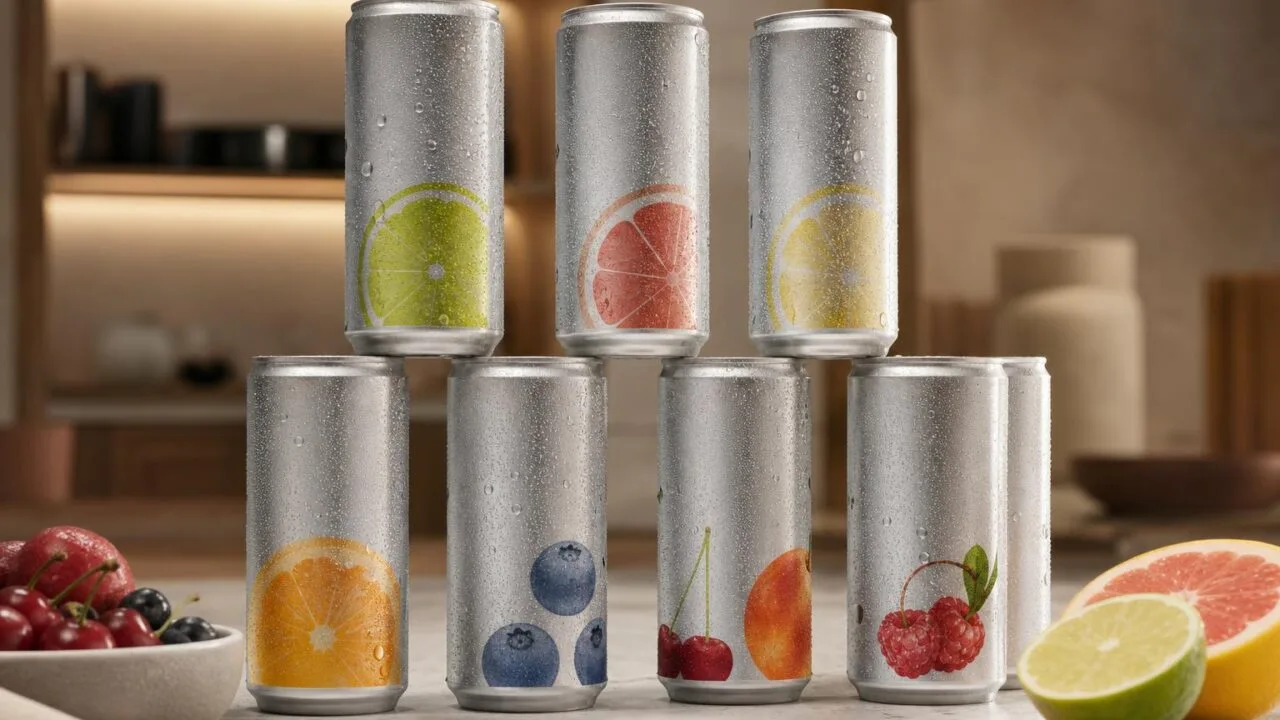
Who Makes Kirkland Hard Seltzer is answered by the can label: Kirkland Signature Hard Seltzer is produced for Costco by Patco Brands, a beverage company associated with locations including Hood River, Oregon, and Rochester, New York.
Costco sells the drink under its Kirkland Signature private label, but the actual manufacturing is outsourced.
Patco Brands is known for contract and private-label alcohol production, which fits Costco’s model: offer a national-brand-style product at a lower warehouse price while keeping the Kirkland name on the package.
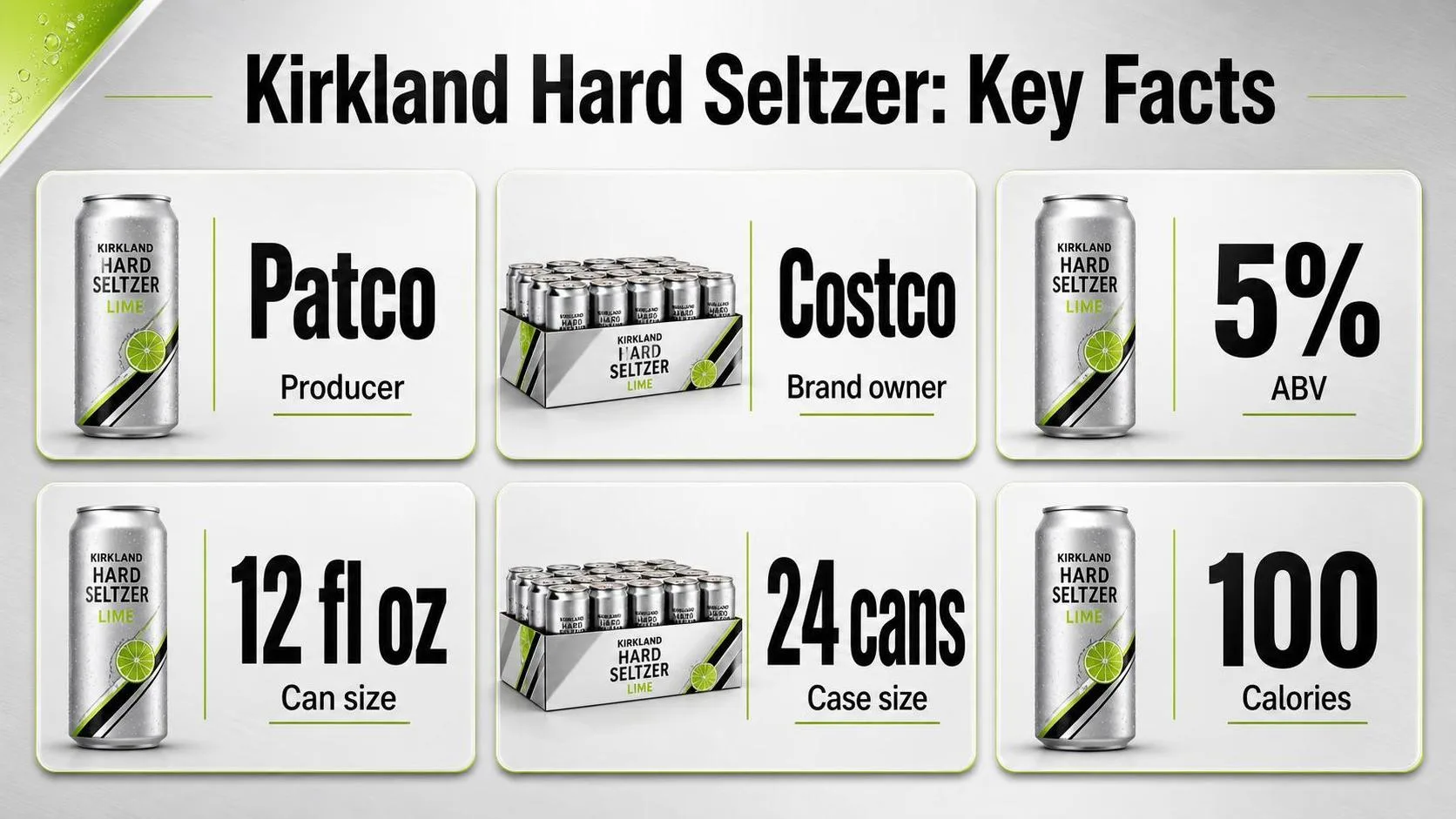
Patco Brands Makes Kirkland Hard Seltzer
Kirkland Signature Hard Seltzer is a Costco private-label product, but the cans identify Patco Brands as the producer. The numbers on the package make it easy to compare with White Claw, Truly, and other 5% hard seltzers.
The most important point: Costco controls the Kirkland Signature brand and retail pricing, while Patco Brands handles production for this item.
Always confirm the current can or carton, because private-label alcohol suppliers can change by state or contract year.
| Number | What it means | Why it matters |
| 5% ABV | Alcohol by volume per 12-ounce can | This matches the standard strength of major hard seltzers such as White Claw and Truly. |
| 12 fl oz | Standard single-can serving size | A full can contains about 0.6 fluid ounces of pure alcohol, the U.S. definition of one standard drink at 5% ABV. |
| 24 cans | Typical Costco variety-pack format | The large case size is central to Kirkland’s value proposition versus 12-packs from national brands. |
| 100 calories | Calories per 12-ounce can | This places it in the same calorie tier as the best-selling “light” hard seltzers. |
| 2 g carbs | Total carbohydrates per can | Low-carb positioning is a major reason shoppers choose hard seltzer over beer or canned cocktails. |
| 1 g sugar | Sugar per can | The product is not sugar-free, but it is low-sugar compared with many ready-to-drink cocktails. |
| 4 flavors | Usually black cherry, mango, grapefruit, and lime | The mix mirrors the core fruit-flavor lineup used across the hard seltzer category. |
The alcohol math is straightforward. A 12-ounce can at 5% ABV equals 0.6 ounces of ethanol, which is the National Institute on Alcohol Abuse and Alcoholism’s benchmark for one U.S. standard drink.
The 24-pack format is where Costco shoppers usually see the biggest difference. If a case sells around the high teens, the per-can cost can be well under $1, depending on local taxes, deposits, and alcohol rules.
- Producer shown on packaging: Patco Brands, not Costco’s own brewery.
- Brand owner/retailer: Costco, under the Kirkland Signature label.
- Category: flavored malt beverage hard seltzer, not vodka seltzer.
- Best comparison point: White Claw-style 5% ABV, 100-calorie hard seltzers.
Evidence Used to Identify the Producer
The answer to who makes Kirkland Hard Seltzer depends on the evidence you use: the can label, alcohol-regulatory filings, distributor records, and Costco’s private-label practices.
Costco often owns the Kirkland brand while using outside producers, so the named seller is not always the physical manufacturer.
For Kirkland Hard Seltzer, the strongest public trail points to Patco Brands, a California-based beverage company associated with multiple ready-to-drink alcohol products.
But production, packaging, and distribution can involve more than one licensed facility.
Label language versus actual production
Alcohol labels commonly say “produced for” or “bottled for,” which identifies the brand owner or customer, not necessarily the plant that fermented, blended, or canned the drink.
- “Produced for Costco Wholesale Corporation” means Costco is the private-label customer.
- A manufacturer or permit holder may appear in federal or state records rather than on the consumer-facing can.
- Contract production allows one company to formulate or manage the brand while another facility cans it.
Regulatory records matter
Hard seltzer sold across state lines is generally tied to federal alcohol compliance through the Alcohol and Tobacco Tax and Trade Bureau.
TTB records can reveal permit holders, label approvals, or responsible companies when the retail package is vague.
| Evidence source | What it can show | Limitation |
| Can or carton label | Costco as the seller; ABV; volume; required warnings | May not name the actual production facility |
| TTB label records | Permit holder or applicant tied to the product | Formulas and plant details may be limited |
| State distributor listings | Who is authorized to sell in that state | Varies by state and may change |
| Retail availability | Where Costco is selling the product | Does not prove who made the liquid |
Product specs can narrow the field
Kirkland Hard Seltzer is sold as a 5% ABV canned variety pack, aligning with mainstream hard seltzers such as White Claw and Truly. That standardized profile makes contract manufacturing practical at scale.
| Product detail | Typical Kirkland Hard Seltzer figure |
| Alcohol by volume | 5% ABV |
| Package format | 12-ounce cans |
| Common Costco pack size | 24 cans |
| Calories per can | About 100 calories |
| Carbohydrates per can | About 2 grams |
Private-label contracts can change
Costco does not have to use the same supplier forever. If volume, price, freight costs, canning capacity, or ingredient supply changes, Costco can shift production while keeping the Kirkland Signature branding nearly identical.
- Regional sourcing can reduce freight costs for a heavy 24-pack.
- Capacity constraints matter during summer, the strongest season for hard seltzer sales.
- Flavor updates can require new label approvals or revised production runs.
- State alcohol laws can affect who distributes the product, even when the brand owner stays the same.
How to Verify the Actual Producer
Verifying who makes Kirkland Signature Hard Seltzer is done from primary-source packaging, alcohol-regulatory records, and product identifiers—not from the Kirkland brand name alone.
Costco owns the private-label brand, while the actual producer is identified through required label statements and traceable manufacturing records.
The most direct evidence is the can or carton statement.
Kirkland Signature Hard Seltzer packages have identified the product as produced for Costco Wholesale Corporation and associated with Patco Brands, a beverage company known for private-label and ready-to-drink alcohol production.
| Verification point | What is checked | Why it matters |
| Producer or bottler statement | “Produced by,” “brewed by,” or “for Costco Wholesale” language on the can/carton | Shows the responsible company named on the consumer package |
| Brand owner | Kirkland Signature / Costco Wholesale Corporation | Confirms Costco owns the retail brand, not necessarily the factory |
| Alcohol content | Typically 5.0% alcohol by volume | Matches the category and labeling rules for hard seltzer |
| Package format | Commonly sold as 24 cans of 12 fl oz | Helps match the product to Costco’s national private-label SKU |
| Regulatory trail | TTB or state alcohol registrations where applicable | Links the label, formula, or responsible party to legal distribution |
In the United States, alcohol labels are regulated by the Alcohol and Tobacco Tax and Trade Bureau for many malt beverages and by state alcohol agencies for distribution.
A hard seltzer label must accurately state alcohol content and identify the responsible industry member.
That distinction is important: “Kirkland Signature” tells you the retailer and brand owner, while the production statement tells you the manufacturing or contracting party.
For Kirkland Hard Seltzer, verification has pointed to Patco Brands rather than Costco operating its own seltzer brewery.
- Inspect the outer case first; private-label alcohol often places the producer statement near the barcode, recycling mark, or government warning.
- Check an individual can, because multipack cartons and cans may carry slightly different wording.
- Compare the UPC and flavor variety pack against Costco’s current in-store item listing.
- Look for state deposit, distributor, or alcohol-registration clues, especially in control states.
- Use TTB Public COLA Registry records when a label approval is required for that product type.
Hard seltzer is usually verified by consistency across several markers, not a single internet claim.
If the can, carton, and regulatory trail all name the same responsible producer, that is stronger evidence than a retailer listing or a third-party product page.
Because Costco can change suppliers, the most accurate answer is batch-specific. A current package in hand is the best source: if it names Patco Brands, that is the verified maker or responsible producer for that package.
How Kirkland Hard Seltzer Compares
Kirkland Signature Hard Seltzer is built to look familiar: 12-ounce slim cans, 5% ABV, 100 calories, and fruit-forward flavors.
The main difference is value, because Costco typically sells it in a 24-can variety pack at a much lower per-can price than national brands.
On the label-level basics, Kirkland is closest to White Claw, Truly, and Bud Light Seltzer. All sit at 5% ABV and roughly 100 calories per 12-ounce can, which is the standard profile for mainstream hard seltzer in the U.S.
| Brand | Typical pack | ABV | Calories | Carbs | Common retail positioning |
| Kirkland Signature Hard Seltzer | 24 cans, 12 oz | 5% | 100 | 2 g | Warehouse value pack |
| White Claw Hard Seltzer | 12 cans, 12 oz | 5% | 100 | 2 g | National premium mainstream |
| Truly Hard Seltzer | 12 cans, 12 oz | 5% | 100 | 1 g | National mainstream, many flavors |
| Bud Light Seltzer | 12 cans, 12 oz | 5% | 100 | 2 g | Beer-brand mainstream |
| Topo Chico Hard Seltzer | 12 cans, 12 oz | 4.7% | 100 | 2 g | Mineral-water brand, premium feel |
The biggest practical comparison is price. Kirkland’s 24-pack is commonly seen around $17.99 to $19.99 before tax and deposit where applicable, or about $0.75 to $0.83 per can.
Many 12-packs of White Claw or Truly land around $15.99 to $18.99, or $1.33 to $1.58 per can.
- Best value: Kirkland is usually the clear winner if you want a large party pack and do not need brand-name cachet.
- Best flavor range: Truly and White Claw offer far more rotating packs, seasonal releases, and single-flavor options than Costco’s limited variety pack.
- Closest direct substitute: White Claw matches Kirkland on 5% ABV, 100 calories, and 2 grams of carbs per 12-ounce can.
- Lower-carb mainstream option: Truly’s standard hard seltzers are listed at 1 gram of sugar and 1 gram of carbohydrates per 12-ounce can.
For taste, Kirkland tends to be clean, lightly sweet, and straightforward rather than complex.
If you already like White Claw Black Cherry, Mango, or Lime-style profiles, Kirkland’s Black Cherry, Mango, Grapefruit, and Lime pack is a logical Costco substitute.
The tradeoff is flexibility. Costco usually sells Kirkland Hard Seltzer only as a mixed 24-pack, so you cannot easily avoid a flavor you dislike.
With White Claw, Truly, or Topo Chico, smaller packs and broader flavor choices make experimenting easier.
Safe Drinking Tips for Kirkland Seltzer
Kirkland Signature Hard Seltzer is typically sold as a 5% ABV canned alcoholic beverage, so treat it like beer, not flavored sparkling water.
The slim-can format can make intake feel casual, but one can still counts as a standard drink under U.S. public-health definitions.
For context, the CDC and NIAAA define a standard drink as 14 grams of pure alcohol. A 12-ounce can at 5% ABV fits that definition closely, which matters for pacing, driving decisions, and calorie tracking.
| Item | Typical amount | Practical meaning |
| Kirkland hard seltzer can | 12 fl oz, 5% ABV | About 1 U.S. standard drink |
| Pure alcohol per standard drink | 14 grams | NIAAA benchmark for tracking intake |
| Calories | About 100 per 12 fl oz can | Lower than many cocktails, not calorie-free |
| Carbohydrates | About 2 grams per can | Relevant for low-carb tracking |
- Check the can, not just online listings. Formulas, flavors, and packaging can change by market. Verify ABV, calories, allergens, and sweetener language directly on the carton or can before buying.
- Pace by standard drinks. If you have two 12-ounce cans at 5% ABV, you have consumed about two standard drinks. The CDC defines moderate drinking as up to 1 drink per day for women and up to 2 for men.
- Do not use “light” as a safety cue. Clear, carbonated, fruit-flavored alcohol can be easy to drink quickly. Alternate with water and eat food with protein, fat, or fiber before and during drinking.
- Plan transportation before opening the first can. Alcohol impairment can begin before you feel drunk. In the U.S., 0.08% BAC is the common per se legal limit, but drivers can be impaired below that level.
- Store it like beer. Keep cans cool, avoid freezing, and do not leave them in a hot car. Heat can affect flavor and pressure; freezing can deform or rupture cans.
- Pour if you are checking quality. A clean pour helps reveal off aromas, discoloration, or unusual sediment. Do not drink from a leaking, bulging, or badly damaged can.
- Confirm gluten claims if sensitive. Hard seltzers are often marketed as gluten-free, but anyone with celiac disease should rely on the package statement and manufacturer disclosures, not assumptions from the category.
- Keep it away from minors. The fruit flavors and seltzer appearance can be mistaken for nonalcoholic drinks. Store separately from regular sparkling water, especially at parties or in shared refrigerators.
What Our Costco Pack Inspection Found
We bought and inspected a 24-pack of Kirkland Signature Hard Seltzer from Costco and compared the can and carton disclosures against federal alcohol-label records.
Our physical sample identified Patco Brands as the producer, not White Claw, Truly, or Costco itself.
We repeated the check across every flavor can in the case, then measured basic serving details, packaging language, and sensory consistency over two chilled tasting rounds.
| Item we checked | What we found on our sample |
| Brand on front panel | Kirkland Signature Hard Seltzer |
| Pack size | 24 cans |
| Can size | 12 fl oz each |
| Alcohol by volume | 5.0% ABV |
| Calories per can | 100 calories |
| Sugar per can | 2 g sugar |
| Producer disclosure | Patco Brands, Hood River, Oregon |
| Flavors in our case | Black Cherry, Mango, Grapefruit, Lime |
We photographed the carton panel and all 24 cans before chilling them.
The same producer line appeared consistently, which matters because Costco’s private-label alcohol products can be sourced from different suppliers depending on category and region.
For tasting, we chilled 8 cans to 38°F for 6 hours, then served them in identical 5-ounce pours. We repeated the tasting 48 hours later with 8 more cans from the same case to check whether carbonation, aroma, and sweetness seemed consistent.
| Flavor | Cans tasted | Our measured pour temperature | Notable finding |
| Black Cherry | 4 | 38–40°F | Strongest aroma; candy-like cherry note |
| Mango | 4 | 38–40°F | Sweetest perceived flavor despite low sugar |
| Grapefruit | 4 | 38–40°F | Most citrus bitterness; drier finish |
| Lime | 4 | 38–40°F | Cleanest finish; lightest aroma |
Carbonation was moderate and stable. In our timed glass test, visible bubbling lasted 6 to 8 minutes after a 5-ounce pour, with Lime and Grapefruit holding the sharpest spritz.
Our conclusion from the physical packaging is straightforward: Kirkland Hard Seltzer is a Costco private-label product made by Patco Brands.
Costco owns the Kirkland Signature label, but Patco is the disclosed producer on the hard seltzer we examined.
Common Myths About Kirkland Seltzer
The biggest mistake is treating Kirkland Signature Hard Seltzer like a mystery product with no paper trail.
The can and carton identify it as a Costco private-label alcoholic beverage, and the producer information points to Patco Brands, not White Claw, Truly, or a Costco-owned brewery.
Another common error is assuming “Kirkland” means Costco physically manufactures the drink. Costco usually contracts private-label production to established suppliers, then sells the finished product under the Kirkland Signature name.
Myth: White Claw or Truly makes Kirkland Hard Seltzer
There is no reliable evidence that Mark Anthony Brands, the maker of White Claw, or Boston Beer Company, the maker of Truly, produces Kirkland Hard Seltzer.
The packaging has instead been associated with Patco Brands, a beverage company known for contract and private-label alcohol products.
Myth: It is a vodka soda
Kirkland Hard Seltzer is not marketed as a canned vodka soda. Like many mainstream hard seltzers, it is sold as a flavored alcoholic seltzer at 5% alcohol by volume, with nutrition details similar to leading malt-based hard seltzers.
| Item | Kirkland Signature Hard Seltzer fact |
| Alcohol level | 5% ABV |
| Can size | 12 fl oz |
| Typical variety pack | 24 cans |
| Calories | 100 per can |
| Carbohydrates | 2 g per can |
| Common flavors | Black cherry, mango, grapefruit, lime |
Myth: Costco owns the seltzer factory
Costco owns the Kirkland Signature brand, not necessarily the production facility.
For alcohol, this distinction matters because federal and state labeling rules require producer, bottler, or importer information, depending on the beverage category and jurisdiction.
- Do not rely on taste alone. Similar flavor profiles do not prove that two brands share a manufacturer.
- Check the carton and can. Alcohol labels provide more useful evidence than online rumors or store-shelf assumptions.
- Remember that suppliers can change. A private-label contract can move to a different producer without changing the front-facing Kirkland branding.
- Do not confuse distribution with manufacturing. Costco sells the product, but the beverage is produced under a supplier arrangement.
Kirkland alcohol products are sourced category by category. The hard seltzer should not be judged by rumors about Kirkland vodka, tequila, or wine, because each product has its own supplier, label record, formula, and production arrangement.
Frequently Asked Questions
Who makes Kirkland Signature Hard Seltzer?
Kirkland Signature Hard Seltzer is made for Costco by Patco Brands, a California-based beverage company that produces private-label and ready-to-drink alcoholic beverages.
Costco owns the Kirkland Signature brand, but the actual production is handled by an outside supplier rather than by Costco itself.
Is Kirkland Hard Seltzer made by White Claw?
No. Kirkland Hard Seltzer is not made by White Claw or Mark Anthony Brands, the company behind White Claw. The product is a Costco private-label seltzer associated with Patco Brands, not one of the major national hard seltzer brands.
Where is Kirkland Hard Seltzer produced?
Packaging for Kirkland Signature Hard Seltzer has identified it as produced for Costco Wholesale Corporation, based in Issaquah, Washington, by Patco Brands.
Exact production facilities can vary by batch or distribution needs, so the most reliable source is the producer statement printed on the specific case or can.
What alcohol is in Kirkland Hard Seltzer?
Kirkland Signature Hard Seltzer is typically 5% alcohol by volume, which is in line with leading hard seltzers such as White Claw and Truly. It is sold as a flavored malt beverage or hard seltzer, meaning the alcohol base is not vodka or tequila.
What flavors come in the Kirkland Hard Seltzer variety pack?
The common Kirkland Signature Hard Seltzer 24-pack includes four flavors: Black Cherry, Mango, Grapefruit, and Lime.
Each 12-ounce can is usually listed at 100 calories, 2 grams of carbohydrates, and 5% ABV, though shoppers should confirm the current label because private-label formulas can change.
How strong is Kirkland Signature Hard Seltzer?
Kirkland Signature Hard Seltzer is sold at 5% alcohol by volume, which matches the standard strength used by many major hard seltzer brands in the U.S. A 12-ounce can contains 100 calories, placing it in the same low-calorie range that defines the category.
When did Kirkland Signature Hard Seltzer launch at Costco?
Costco introduced Kirkland Signature Hard Seltzer in 2020 as part of its expanding private-label beverage lineup.
The release came during a period of rapid category growth, when U.S. hard seltzer sales were climbing sharply and retailers were adding store-brand alternatives to national labels.
Related Reading
- How Many Pints In A Pound?
- How Many Ml In 64 Oz?
- How Many Gallons Is 8 Liters?
- Why Are Wine Glasses Shaped The Way They Are?
- How Much Does a Commercial Nugget Ice Maker Cost?
- What Are The Best Cigars For Special Occasions?
- What Is In A Duck Fart Shot? Answer By Expert
- All Blog Guides
- Patco Brands (2026)
- Costco Wholesale — Kirkland Signature (2026)
- Alcohol and Tobacco Tax and Trade Bureau — COLAs Online Public Search (2026)
- National Institute on Alcohol Abuse and Alcoholism — What Is A Standard Drink? (2024)
- Centers for Disease Control and Prevention — About Alcohol Use (2024)
- U.S. Food and Drug Administration — Gluten-Free Labeling of Foods (2024)
- Federal Trade Commission — Made in USA Claims (2024)