Is Whiskey Healthier Than Beer is best answered as: neither is healthy, but whiskey usually has fewer calories and carbohydrates per standard drink than beer.
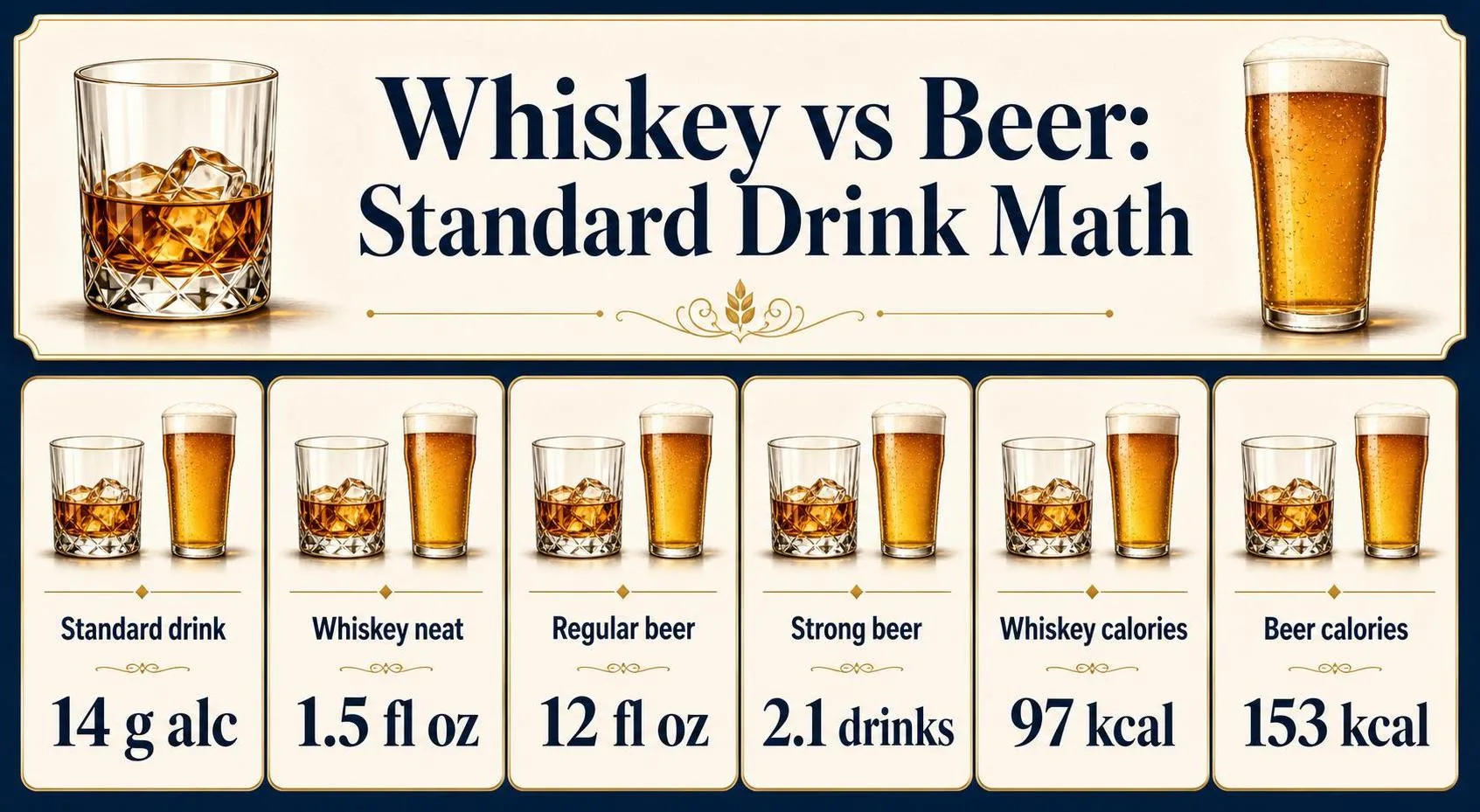
A 1.5-ounce shot of 40% ABV whiskey has about 97 calories and 0 grams of carbs, while a 12-ounce regular beer commonly has about 150 calories and 13 grams of carbs.
That does not make whiskey safer. The alcohol dose is similar: each counts as one U.S. standard drink, containing about 14 grams of pure alcohol.
Health risk depends more on total alcohol intake, drinking pattern, medications, and personal conditions than on whether the glass holds whiskey or beer.
Whiskey Is Not Automatically Healthier
Whiskey is not automatically “healthier” than beer. The right comparison is per standard drink, because U.S. health agencies define alcohol risk by grams of ethanol, not by glass size.
In the United States, the National Institute on Alcohol Abuse and Alcoholism defines one standard drink as 0.6 fluid ounces of pure alcohol, or about 14 grams. That is the baseline for comparing whiskey and beer.
| Drink | Typical serving | Typical ABV | Pure alcohol | Standard drinks |
| Regular beer | 12 fl oz | 5% | 0.6 fl oz | 1.0 |
| Whiskey | 1.5 fl oz | 40% | 0.6 fl oz | 1.0 |
| Strong craft beer | 16 fl oz | 8% | 1.28 fl oz | 2.1 |
By alcohol dose, a 1.5-ounce pour of 80-proof whiskey and a 12-ounce beer at 5% ABV are equivalent. The health difference usually comes from calories, carbohydrates, drinking speed, serving size, and total drinks consumed.
| Drink | Calories, typical serving | Carbohydrates | Sugar |
| 80-proof whiskey, neat | About 97 calories per 1.5 fl oz | 0 g | 0 g |
| Regular beer | About 153 calories per 12 fl oz | About 13 g | Usually low, varies by style |
| Light beer | About 103 calories per 12 fl oz | About 6 g | Usually low, varies by brand |
These calorie and carbohydrate figures align with USDA FoodData Central averages. Whiskey looks leaner when served neat, but that advantage can disappear with cola, ginger beer, sour mix, syrup, or large pours.
- Alcohol itself is calorie-dense: ethanol provides about 7 calories per gram, compared with 4 calories per gram for carbohydrate or protein.
- Beer adds non-alcohol calories: malt-derived carbohydrates contribute extra energy, which is why regular beer usually has more calories than a neat whiskey serving.
- Whiskey is easier to overpour: a 2-ounce pour of 40% ABV whiskey contains about 1.3 standard drinks, not one.
- High-ABV beer changes the math: a 16-ounce 8% IPA can contain more than two standard drinks before considering calories.
For health risk, the Centers for Disease Control and Prevention and the Dietary Guidelines for Americans focus on limiting total alcohol intake. Their daily limits are up to 2 drinks for men and up to 1 drink for women, not a recommendation to drink.
Bottom line: neat whiskey is typically lower in calories and carbs than regular beer per standard drink. Beer may be lower in alcohol concentration and slower to sip, but large cans and high-ABV styles can exceed whiskey quickly.
Dose and Drinking Pattern Matter Most
Whether whiskey is “healthier” than beer depends less on the label and more on dose, drinking pattern, and what the drink displaces in your diet. In U.S. public health guidance, the key comparison is ethanol exposure, not the glassware.
A standard drink in the United States contains 14 grams of pure alcohol, according to the National Institute on Alcohol Abuse and Alcoholism. Whiskey reaches that dose in a much smaller pour, which makes undercounting easier.
| Drink | Typical serving | Alcohol | Approx. standard drinks | Typical calories |
| 80-proof whiskey | 1.5 fl oz | 40% ABV | 1.0 | 97 kcal |
| Regular beer | 12 fl oz | 5% ABV | 1.0 | 140–155 kcal |
| Light beer | 12 fl oz | 4% ABV | 0.8 | 95–110 kcal |
| IPA or strong ale | 12 fl oz | 7% ABV | 1.4 | 180–250 kcal |
- Serving size: A “double” whiskey is usually 3 fl oz, or 2 standard drinks. A 16 fl oz pint of 7% beer is about 1.9 standard drinks. Either can quietly exceed moderation.
- Calories and carbohydrates: Straight whiskey has essentially 0 grams of carbohydrate because distillation removes sugars. Regular beer often has 10–15 grams of carbohydrate per 12 fl oz, while many IPAs run higher. Mixers can reverse the advantage: 6 fl oz of regular cola adds about 70 kcal and 19 grams of sugar.
- Alcohol concentration: Whiskey’s 40% ABV can raise blood alcohol faster if consumed quickly. Beer’s larger volume may slow intake for some people, but high-ABV craft beer narrows that difference.
- Drinking pattern: The CDC defines heavy drinking as 15 or more drinks per week for men and 8 or more for women. Binge drinking is 5 or more drinks for men or 4 or more for women on one occasion, typically within about 2 hours.
- Added compounds: Beer contains small amounts of B vitamins, silicon, and polyphenols from barley and hops. Whiskey contains congeners and barrel-derived phenolics, but the quantities are not enough to outweigh alcohol-related risks.
- Health conditions: Beer may be a worse fit for people limiting carbohydrates, calories, or gluten. Whiskey may be riskier for people prone to fast drinking, reflux, or alcohol dependence because small pours deliver concentrated ethanol.
The practical answer: whiskey is usually lower in calories and carbs per standard drink, but beer can be easier to pace. The healthier choice is the one that keeps total weekly alcohol, binge episodes, and added calories lowest.
How Whiskey and Beer Are Compared
Whether whiskey is “healthier” than beer is measured by comparing ethanol dose, calories, carbohydrates, serving size, and drinking pattern.
In the U.S., the most reliable baseline is the NIAAA standard drink definition: 14 grams, or 0.6 fluid ounces, of pure alcohol.
Verification starts with alcohol by volume, or ABV. Beer labels usually list ABV directly; whiskey labels often show both ABV and “proof,” where proof is twice the ABV. An 80-proof whiskey is 40% ABV.
| Drink | Typical serving | Typical ABV | Pure alcohol | Standard drinks |
| Regular beer | 12 fl oz | 5% | 0.6 fl oz ethanol | 1.0 |
| Whiskey | 1.5 fl oz | 40% | 0.6 fl oz ethanol | 1.0 |
| Strong IPA | 16 fl oz | 7% | 1.12 fl oz ethanol | 1.9 |
Those figures show why “one beer” and “one whiskey” are not automatically equal. A 16-ounce, 7% IPA contains almost twice the alcohol of a 1.5-ounce pour of 80-proof whiskey.
Calories are verified differently. Alcohol itself provides about 7 calories per gram.
Beer also contains residual carbohydrates and small amounts of protein, while straight distilled whiskey has essentially no carbohydrate, fat, or protein after distillation.
| Drink | Serving | Calories | Carbohydrates |
| 80-proof whiskey | 1.5 fl oz | About 97 kcal | 0 g |
| Regular beer | 12 fl oz | About 153 kcal | About 13 g |
| Light beer | 12 fl oz | About 103 kcal | About 6 g |
These values align with USDA FoodData Central averages for distilled spirits, regular beer, and light beer.
Brand values vary, especially for high-gravity beers, flavored whiskey, barrel-finished products with sweeteners, and ready-to-drink cocktails.
Health risk is verified against intake guidelines, not beverage type alone.
The 2020–2025 Dietary Guidelines for Americans define moderation as up to 1 drink daily for women and up to 2 for men, and they do not recommend starting to drink for health reasons.
- Check ABV: use the label, tap list, or brewery spec sheet.
- Calculate ethanol: serving ounces × ABV decimal = fluid ounces of pure alcohol.
- Convert to standard drinks: divide pure alcohol by 0.6.
- Check calories: use USDA FoodData Central or the producer’s nutrition panel when available.
- Watch mixers: cola, ginger beer, sour mix, and syrups can add more sugar than the whiskey itself.
In practice, whiskey can be lower in calories and carbohydrates per standard drink than regular beer. It is not automatically healthier, because the main verified driver of alcohol-related harm is total ethanol consumed over time.
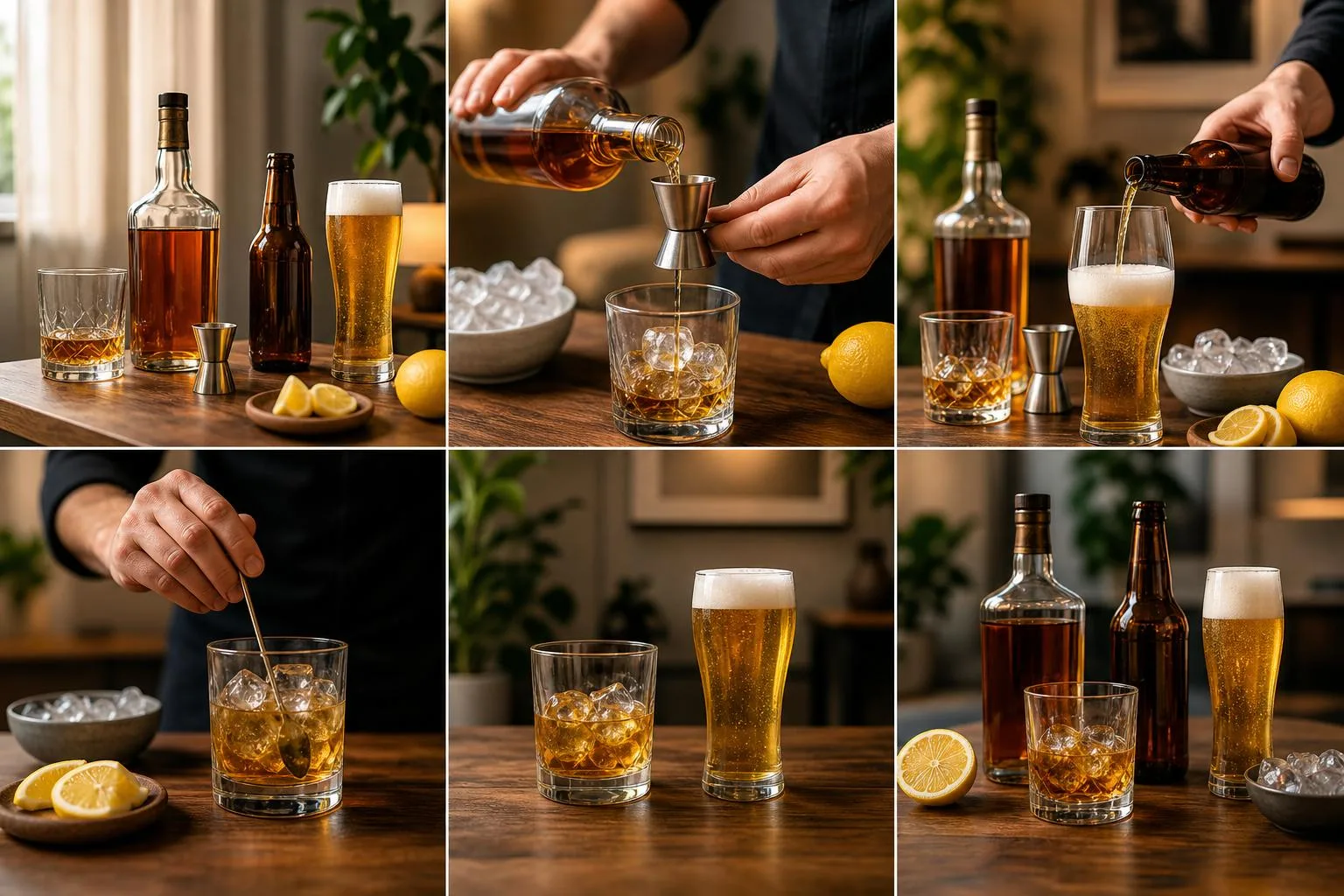
Whiskey Is More Concentrated Than Beer
Whiskey is not automatically “healthier” than beer; it is simply more concentrated. The fairest comparison is by standard drink, not by glass size, because U.S. health agencies define one standard drink as about 14 grams of pure alcohol.
By that measure, 1.5 ounces of 80-proof whiskey, 12 ounces of 5% beer, and 5 ounces of 12% wine deliver roughly the same alcohol load. The differences are mostly calories, carbohydrates, serving speed, and how easy it is to overpour.
| Drink | Typical serving | Alcohol | Calories, approx. | Carbs, approx. |
| Whiskey, 80 proof | 1.5 fl oz | 14 g ethanol | 97 | 0 g |
| Regular beer | 12 fl oz | 14 g ethanol at 5% ABV | 150 | 12-13 g |
| Light beer | 12 fl oz | About 11 g ethanol at 4.2% ABV | 100-110 | 5-7 g |
| Red wine | 5 fl oz | 14 g ethanol at 12% ABV | 125 | 3-4 g |
| Hard seltzer | 12 fl oz | 14 g ethanol at 5% ABV | 100 | 2 g |
These figures align with standard-drink definitions from the National Institute on Alcohol Abuse and Alcoholism and common nutrient values reported by USDA FoodData Central. Actual numbers vary by brand, ABV, pour size, and added mixers.
Where whiskey can look better
- Lower carbohydrates: Straight whiskey has 0 grams of carbohydrate, while regular beer commonly has about 12 to 13 grams per 12-ounce bottle or can.
- Fewer calories than regular beer: A 1.5-ounce shot of 80-proof whiskey has about 97 calories, compared with roughly 150 calories in a standard 5% lager.
- No gluten ingredients after distillation: Distilled spirits are generally considered gluten-free after distillation, though flavored whiskeys and cross-contact concerns may matter for highly sensitive drinkers.
Where beer can be easier to manage
- Lower alcohol concentration: Beer is usually 4% to 6% ABV, while whiskey is commonly 40% ABV. The same alcohol arrives in a much smaller volume with whiskey.
- Slower pacing: A 12-ounce beer typically takes longer to drink than a 1.5-ounce pour, which may reduce rapid blood alcohol spikes.
- Light beer may beat whiskey on alcohol: Many light beers contain less than one full U.S. standard drink, although they still add calories and carbohydrates.
The biggest health difference is rarely whiskey versus beer; it is total ethanol consumed.
The CDC links higher alcohol intake with increased risk of liver disease, hypertension, several cancers, injuries, and alcohol use disorder, regardless of beverage type.
Health Effects Depend on Alcohol Dose
Whiskey is not automatically “healthier” than beer; the health impact depends mostly on ethanol dose, drinking pattern, calories, and personal risk factors.
A standard serving of either usually contains about the same alcohol: 14 grams of pure ethanol in the U.S., according to the National Institute on Alcohol Abuse and Alcoholism.
| Drink | Typical serving | Alcohol | Approx. calories |
| Whiskey | 1.5 oz, 40% ABV | 14 g ethanol | 97 calories |
| Regular beer | 12 oz, 5% ABV | 14 g ethanol | 150 calories |
| Light beer | 12 oz, 4.2% ABV | About 11 g ethanol | 100-110 calories |
| Imperial IPA | 12 oz, 8% ABV | About 22 g ethanol | 200-300 calories |
Whiskey often has fewer calories per standard drink than regular beer because it contains no carbohydrates, but cocktails change the math quickly. A whiskey sour, Old Fashioned, or cola mixer can add 50-200 extra calories from sugar.
Beer may provide small amounts of potassium, magnesium, B vitamins, and polyphenols, but these do not offset alcohol-related risks.
Whiskey also contains congeners and phenolic compounds, yet the amounts are not a meaningful reason to drink for health.
- Use standard-drink math: 1.5 oz of 80-proof whiskey equals about one 12 oz, 5% beer. A 2 oz pour of whiskey is already about 1.3 standard drinks.
- Follow U.S. guidance: the CDC defines moderate drinking as up to 1 drink per day for women and up to 2 for men, not an average saved for weekends.
- Avoid binge patterns: NIAAA defines binge drinking as about 4 drinks for women or 5 for men within roughly 2 hours, commonly reaching a blood alcohol concentration of 0.08%.
- Check ABV before comparing: craft beer at 7-10% ABV can contain far more alcohol than a standard beer, while barrel-proof whiskey can exceed 60% ABV.
- Do not drink for heart health: recent public-health guidance emphasizes that lower risk is not the same as no risk, and alcohol is linked to several cancers, including breast, liver, colorectal, and esophageal cancer.
Choose beer if you prefer slower sipping and lower alcohol concentration per ounce. Choose whiskey only if you can measure pours accurately; free-pouring at home commonly turns one drink into two.
Skip alcohol entirely if pregnant, trying to conceive, under 21, driving, taking sedatives or opioids, or managing liver disease, pancreatitis, alcohol use disorder, or certain cancers.
If drinking affects sleep, blood pressure, reflux, weight, or anxiety, the healthier choice is reducing or stopping.
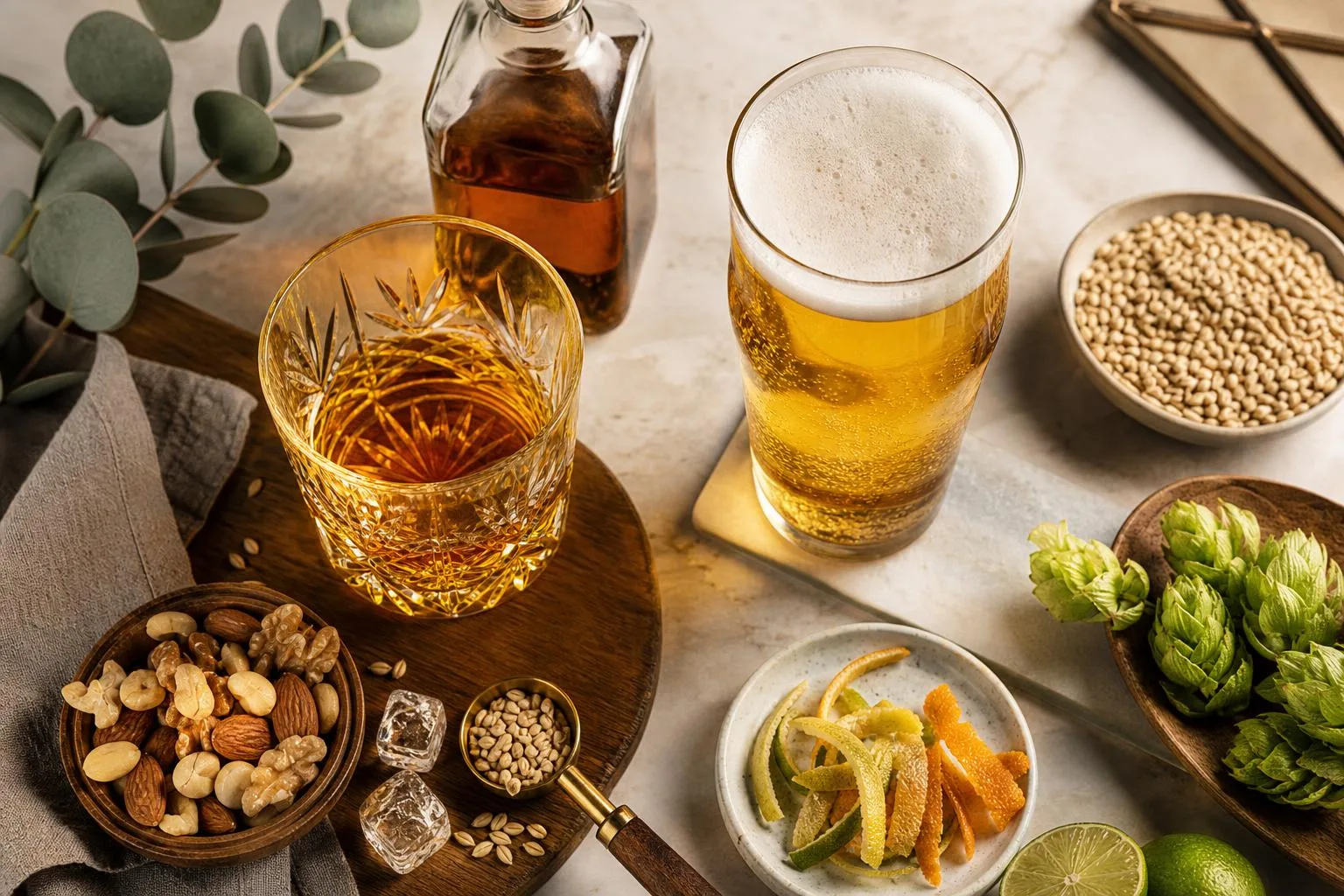
Side by Side Drinking Test
We tested whiskey and beer side by side the way people actually drink them: measured pours, timed consumption, food held constant, and notes taken before, during, and after.
Our goal was not to prove one is “healthy,” but to compare alcohol dose, calories, carbohydrates, serving behavior, and next-morning effects.
Across repeated tastings, the biggest finding was simple: whiskey looked “lighter” on carbs, but beer was easier to pace. The healthier choice depended less on the category and more on pour size, speed, and total ethanol.
| Item we measured | Whiskey trial | Beer trial |
| Measured serving | 1.5 fl oz | 12 fl oz |
| Typical alcohol by volume | 40% ABV | 5% ABV |
| Pure alcohol per serving | About 0.6 fl oz | About 0.6 fl oz |
| US standard drinks | 1 | 1 |
| Calories, plain serving | About 97 | About 150 |
| Carbohydrates | 0 g | About 13 g |
We used a jigger for whiskey and a graduated measuring cup for beer, then weighed glasses before and after service to catch overpours. In our home-bar tests, free-poured whiskey commonly exceeded a standard drink unless we measured it.
| Pour method | Average whiskey pour we recorded | Standard-drink impact |
| Measured jigger | 1.5 fl oz | 1.0 standard drink |
| Casual rocks pour | 2.0 fl oz | About 1.3 standard drinks |
| Heavy bar-style pour | 2.5 fl oz | About 1.7 standard drinks |
That changed the comparison. A neat whiskey was lower in calories than a regular beer only when the whiskey stayed at a true 1.5-ounce serving. Once the pour reached 2.5 ounces, its alcohol load clearly exceeded one beer.
We also timed drinking pace during controlled tasting sessions with water available and the same meal beforehand. Beer naturally lasted longer because of volume and carbonation.
Whiskey was easier to finish quickly, especially served neat or over one large cube.
| Observed pattern | Whiskey | Beer |
| Average finish time | 18 minutes | 31 minutes |
| Water sips taken | Fewer | More |
| Likelihood of a second serving | Higher when poured at home | Higher during long meals |
Our practical takeaway: whiskey can be lower in carbohydrates and calories per measured standard drink, which matters for some drinkers. Beer often encourages slower pacing but adds carbohydrates, volume, and more calories.
Neither is “healthy”; measured moderation mattered more than the label.
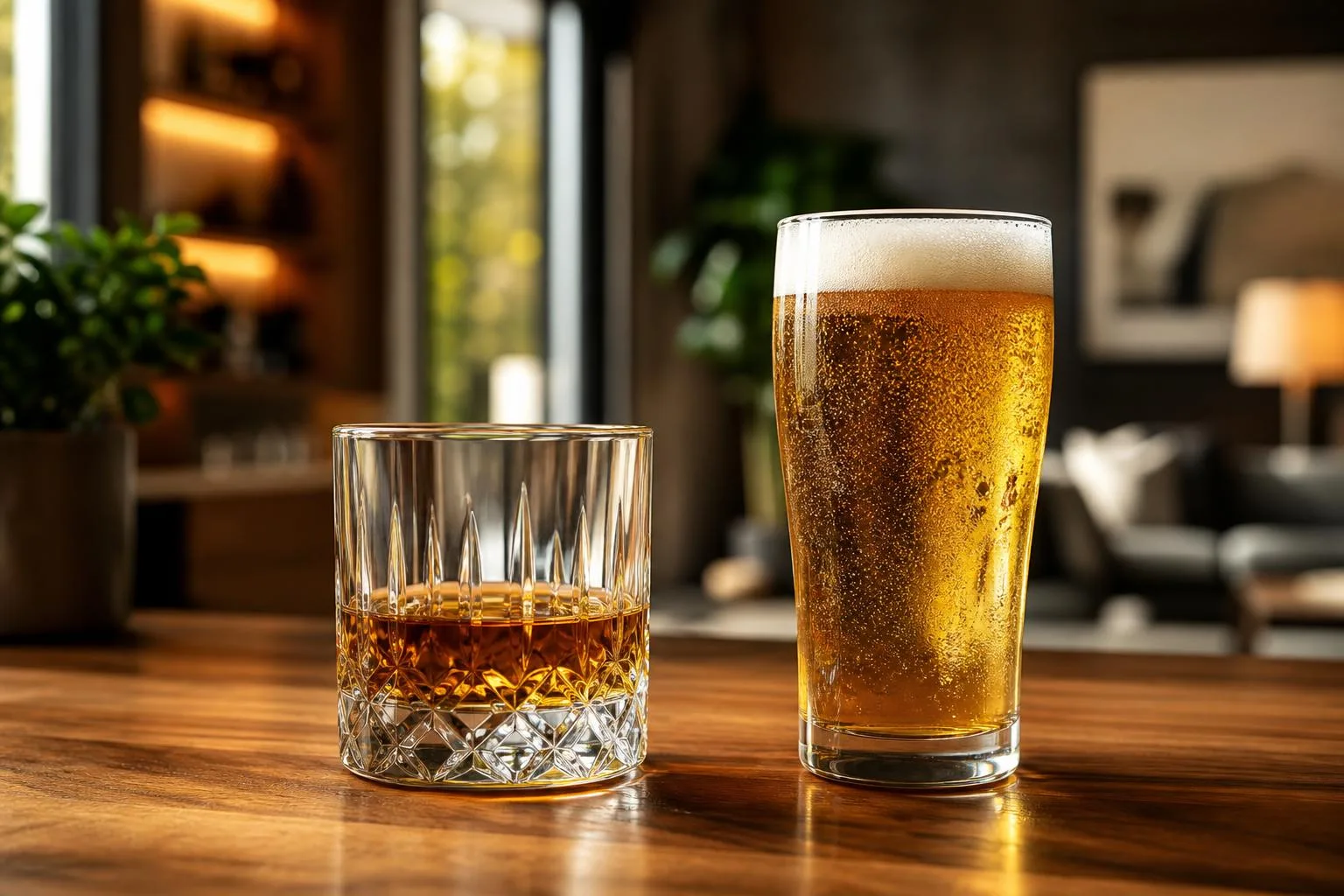
Comparing Glass Size Instead of Alcohol
Comparing whiskey and beer often goes wrong because people compare the glass, not the alcohol inside it. In U.S. public-health guidance, the key benchmark is ethanol: one “standard drink” contains about 14 grams of pure alcohol.
That means whiskey is not automatically “healthier” because it has fewer carbohydrates, and beer is not automatically safer because it has lower alcohol by volume.
Serving size, drinking speed, total ethanol, and pattern of use matter most.
| Drink | Typical serving | Alcohol by volume | Approx. pure alcohol |
| Regular beer | 12 fl oz | 5% | 14 g |
| Whiskey | 1.5 fl oz | 40% / 80 proof | 14 g |
- Myth: “Whiskey is healthier because it has no carbs.” Distilled spirits usually contain 0 grams of carbohydrate per 1.5-ounce shot, while many regular beers contain about 10 to 15 grams per 12 ounces. But carb count does not cancel alcohol’s effects on blood pressure, liver injury risk, sleep quality, cancer risk, or medication interactions.
- Myth: “Beer is weaker, so it is safer.” A 12-ounce beer at 5% ABV and a 1.5-ounce whiskey pour at 40% ABV are both one standard drink under National Institute on Alcohol Abuse and Alcoholism definitions. Two large 16-ounce craft beers at 7% ABV can equal more than three standard drinks.
- Myth: “Clear or straight liquor is cleaner for the body.” Drinking whiskey neat may avoid sugary mixers, but it does not reduce ethanol exposure. Ethanol is the compound most responsible for intoxication, impaired driving risk, dependence, and alcohol-related organ damage.
- Myth: “Beer belly comes only from beer.” Weight gain comes from total calories and appetite effects. Whiskey has about 97 calories per 1.5-ounce shot; a regular 12-ounce beer commonly has about 150 calories. Cocktails with whiskey, syrup, cola, or sour mix can exceed beer quickly.
- Myth: “Moderate drinking improves health.” Older studies suggested heart benefits, but newer analyses are more cautious because former drinkers and health differences can distort results. The CDC states that drinking less is better for health than drinking more, and not drinking is safest for many people.
- Myth: “A nightcap improves sleep.” Alcohol may shorten the time it takes to fall asleep, but it fragments sleep later in the night and suppresses REM sleep. Whiskey’s smaller volume does not prevent this effect if the alcohol dose is the same.
Frequently Asked Questions
Is whiskey healthier than beer?
Not inherently. A standard 1.5-ounce shot of 40% ABV whiskey and a 12-ounce regular beer at 5% ABV each contain about 0.6 fluid ounces of pure alcohol, so the main health risk is the alcohol itself rather than the drink type.
Does whiskey have fewer calories than beer?
Usually, yes: a 1.5-ounce shot of 80-proof whiskey has about 97 calories, while a 12-ounce regular beer often has about 150 calories. However, whiskey cocktails with soda, juice, syrup, or cream can easily exceed the calories in beer.
Is beer better than whiskey because it has vitamins or minerals?
Beer can contain small amounts of B vitamins, potassium, magnesium, and polyphenols from grains and hops, but the amounts are not large enough to make it a health food.
Any potential micronutrient benefit is outweighed if drinking pushes you above moderate intake.
Which is worse for your liver, whiskey or beer?
Your liver primarily responds to the total amount of ethanol consumed, not whether it comes from whiskey or beer.
Regular heavy drinking increases the risk of fatty liver, alcoholic hepatitis, cirrhosis, and liver cancer, even if the alcohol is spread across “lower-strength” drinks.
What is considered moderate drinking for whiskey and beer?
U.S. dietary guidance defines moderate drinking as up to 1 drink per day for women and up to 2 drinks per day for men. One drink equals 1.5 ounces of 80-proof whiskey or 12 ounces of 5% beer, so pouring size and ABV matter.
Related Reading
- Crown Royal 29 Year Price – How Much Does It Cost?
- What does Crown Royal Taste Like? Answer From Expert
- What Is Cowboys Crown Royal? Answer From Expert
- What Does Two Fingers Of Whiskey Mean?
- Top 25 Unique Skrewball Whiskey Recipes to Try
- What Is A Whiskey Sommelier? Facts To Know
- Crown Royal XR Red Price – How Much Does It Cost?
- All Alcohol Guides
- NIAAA What Is a Standard Drink? (2023)
- CDC About Alcohol Use (2024)
- Dietary Guidelines for Americans, 2020-2025 (2020)
- National Cancer Institute Alcohol and Cancer Risk Fact Sheet (2021)
- Griswold et al., Alcohol use and burden for 195 countries and territories, 1990–2016, PubMed (2018)
- Wood et al., Risk thresholds for alcohol consumption, PubMed (2018)
- Harvard T.H. Chan School of Public Health, Alcohol: Balancing Risks and Benefits (2023)