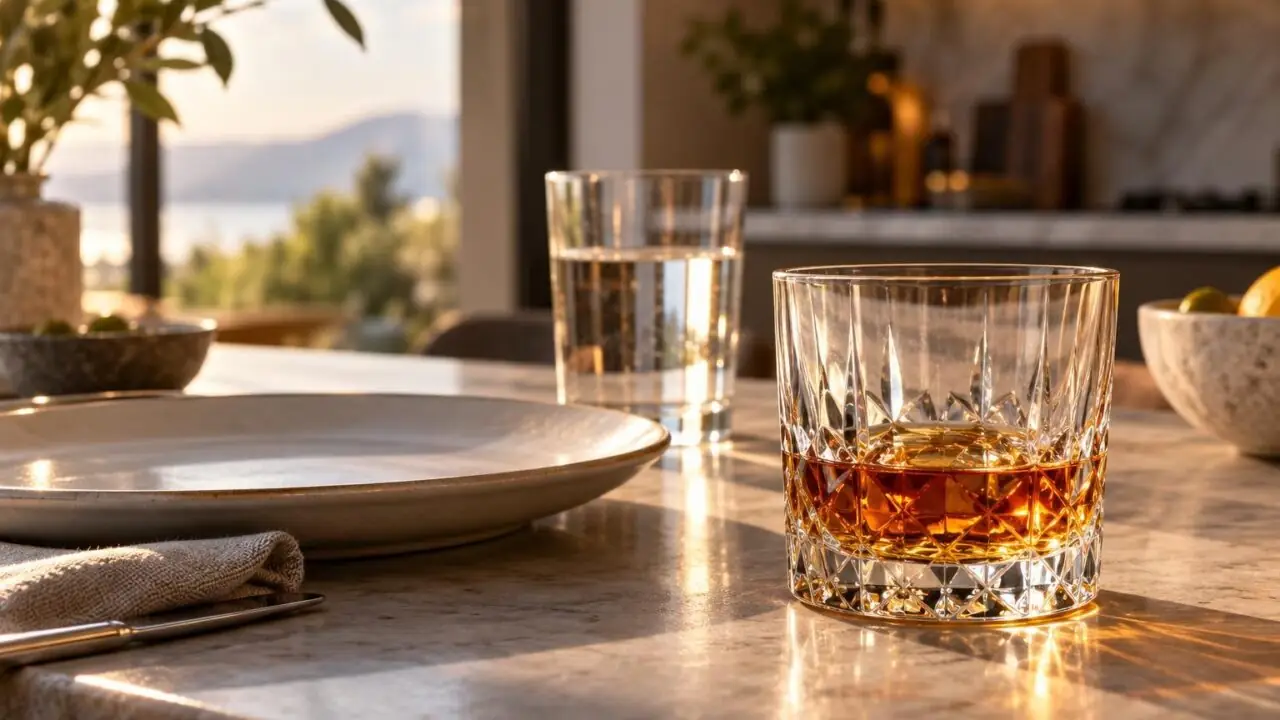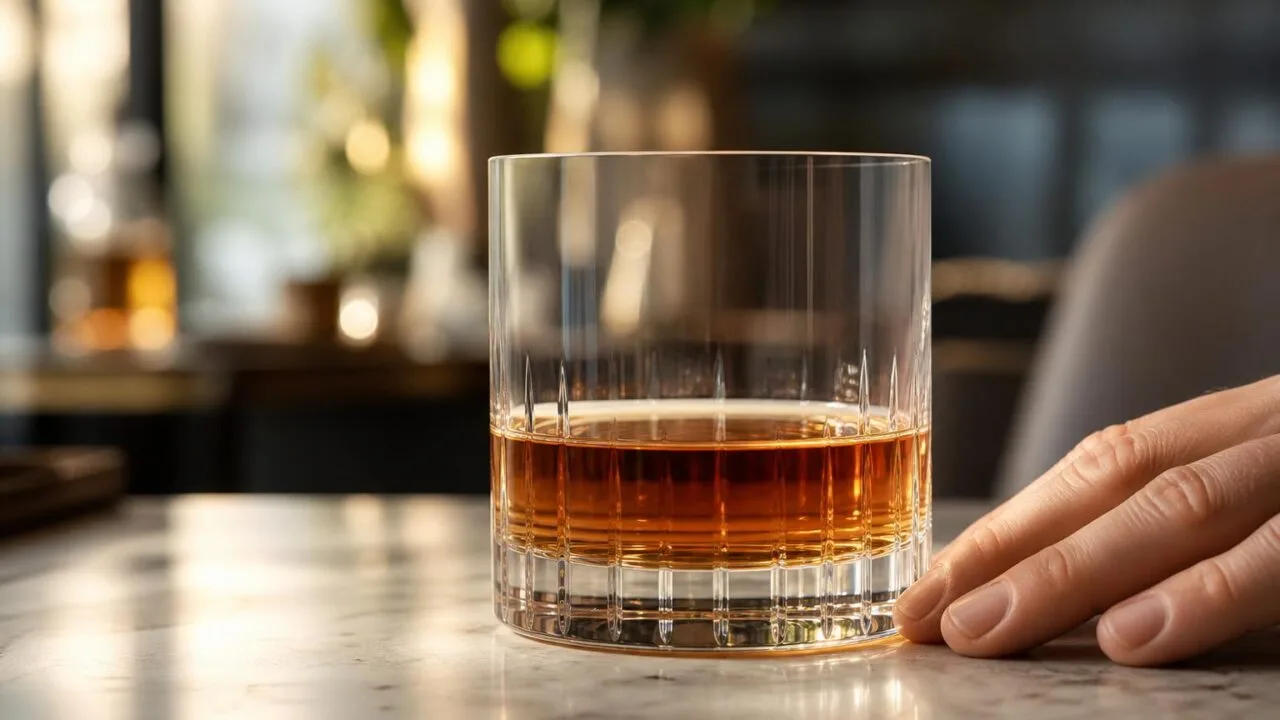
What Does Two Fingers Of Whiskey Mean is a bar pour measured by the height of two fingers held against the glass, not a fixed legal volume.
In practice, it usually lands around 2 to 3 ounces, depending on the glass diameter, the bartender’s hand, and how generously the pour is interpreted.
The phrase comes from an older visual measuring habit: place two fingers horizontally beside a tumbler, then fill whiskey to that level.
It remains common in casual whiskey service, but it is imprecise compared with a jigger-measured pour, which many U.S. bars standardize at 1.5 or 2 ounces.
What Two Fingers Usually Means
“Two fingers of whiskey” is an informal pour measured by the height of whiskey in the glass, not by a standardized bar jigger.
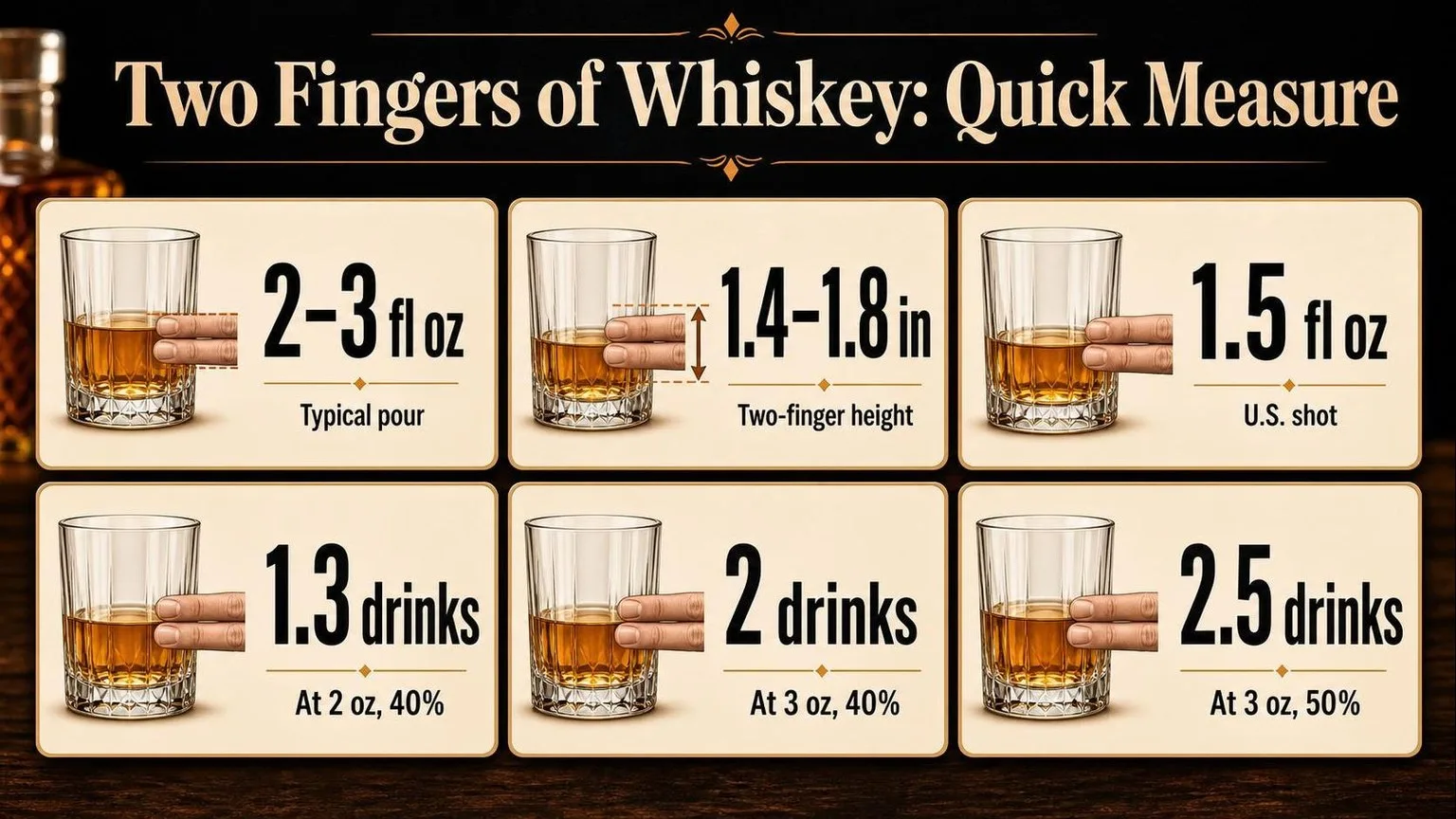
In practice, it usually lands around 2 to 3 fluid ounces, but the exact volume depends heavily on the glass diameter and the drinker’s finger width.
A typical adult finger is roughly 0.7 to 0.9 inches wide. So two fingers generally means about 1.4 to 1.8 inches of whiskey in the bottom of a straight-sided rocks glass.
| Measure | Approximate amount | What it means |
| 1 finger | About 0.75 to 1.5 fl oz | A small neat pour, depending on glass width |
| 2 fingers | About 2 to 3 fl oz | The common “two fingers” whiskey pour |
| Standard U.S. shot | 1.5 fl oz | The common bar reference pour |
| U.S. standard drink | 1.5 fl oz of 40% ABV whiskey | Contains about 0.6 fl oz pure alcohol, per U.S. dietary guidance |
The glass matters because volume rises with surface area. A wider tumbler holds more whiskey at the same “two-finger” height than a narrower tasting glass. That is why the phrase works casually at home but poorly for precise service.
| Glass inside diameter | Two-finger height used | Approximate volume |
| 2.5 inches | 1.5 inches | About 1.9 fl oz |
| 2.75 inches | 1.5 inches | About 2.4 fl oz |
| 3.0 inches | 1.5 inches | About 2.9 fl oz |
| 3.25 inches | 1.5 inches | About 3.4 fl oz |
For context, most whiskey is bottled at 40% ABV, though many bourbons, ryes, and single malts run 45% to 50% ABV or higher. A 2-ounce pour of 40% ABV whiskey contains about 0.8 fluid ounces of pure alcohol.
- At 1.5 fl oz: one U.S. standard drink when the whiskey is 40% ABV.
- At 2 fl oz: about 1.3 standard drinks at 40% ABV.
- At 3 fl oz: about 2 standard drinks at 40% ABV.
- At 3 fl oz and 50% ABV: about 2.5 standard drinks.
The practical takeaway: if you ask for two fingers, expect a generous neat pour, not a calibrated measurement. If alcohol content, pricing, or recipe balance matters, use ounces or milliliters instead.
Why Two Fingers Varies
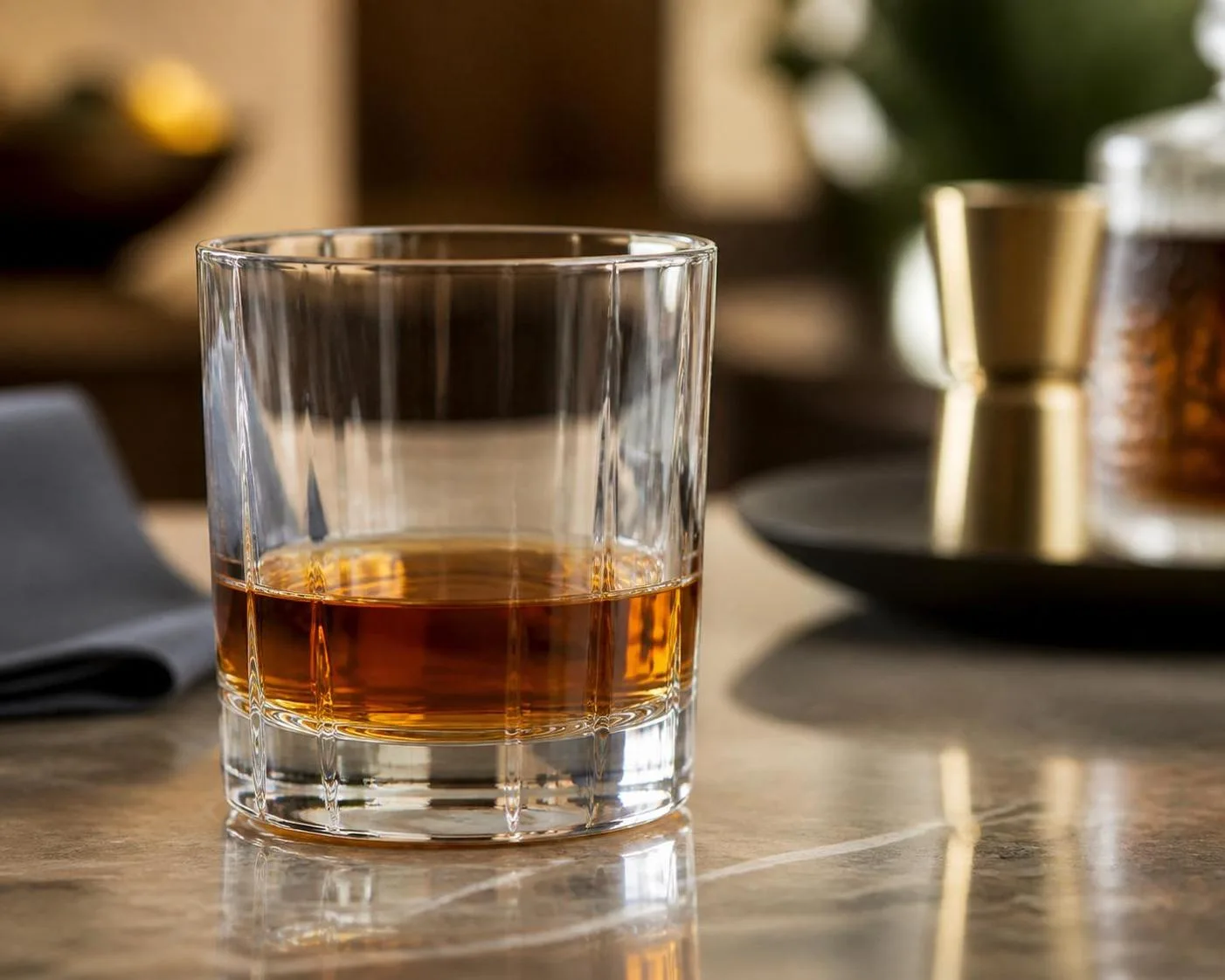
“Two fingers” is a visual pour, not a fixed legal measure. In practice, the volume changes with the glass, the person measuring, whether ice is present, and even how the whiskey is viewed against the rim.
In U.S. bars, a standard shot is commonly 1.5 fluid ounces, and federal dietary guidance defines one standard drink of 80-proof spirits as 1.5 fluid ounces. A two-finger pour often lands above that.
Glass Shape and Diameter
The biggest variable is the inside width of the glass. Two fingers measure height, but liquid volume is height multiplied by the glass’s internal area.
| Glass inside diameter | Approximate volume at 2 finger-widths, using 1.5 inches height |
| 2.5 inches | About 3.7 fluid ounces |
| 2.75 inches | About 4.5 fluid ounces |
| 3.0 inches | About 5.3 fluid ounces |
| 3.25 inches | About 6.2 fluid ounces |
That is why a rocks glass can make “two fingers” look modest while actually containing several standard drinks. A narrow tasting glass can hold far less at the same height.
Finger Width
Finger width varies by person. A bartender’s two fingers might measure about 1.25 inches; another person’s might be closer to 1.75 inches. That alone can change the pour by roughly 40 percent in the same glass.
Ice or No Ice
Ice displaces liquid. If someone measures two fingers after adding ice, the actual whiskey volume can be much lower than the same visible level in an empty glass.
| Scenario | What usually happens |
| Two fingers neat | Glass height mostly reflects whiskey volume |
| Two fingers over large cube | Part of the height is displaced by ice |
| Two fingers over several small cubes | Even more displacement and faster dilution |
Proof and Alcohol Content
Volume is only part of the result. A 2-ounce pour of 80-proof whiskey contains about 0.8 fluid ounce of pure alcohol. The same 2 ounces at 100 proof contains about 1.0 fluid ounce.
- 80 proof: 40% alcohol by volume.
- 90 proof: 45% alcohol by volume.
- 100 proof: 50% alcohol by volume.
- Cask strength: often 55% to 65% alcohol by volume.
Pouring Angle and Meniscus
Reading the line in a rounded glass is imprecise. The curved surface of the liquid, called the meniscus, can make the pour appear slightly higher or lower depending on eye level.
For consistency, use a jigger. If the goal is the old-school gesture, “two fingers” works conversationally; if the goal is responsible serving, ounces matter more than fingers.
How to Measure Two Fingers
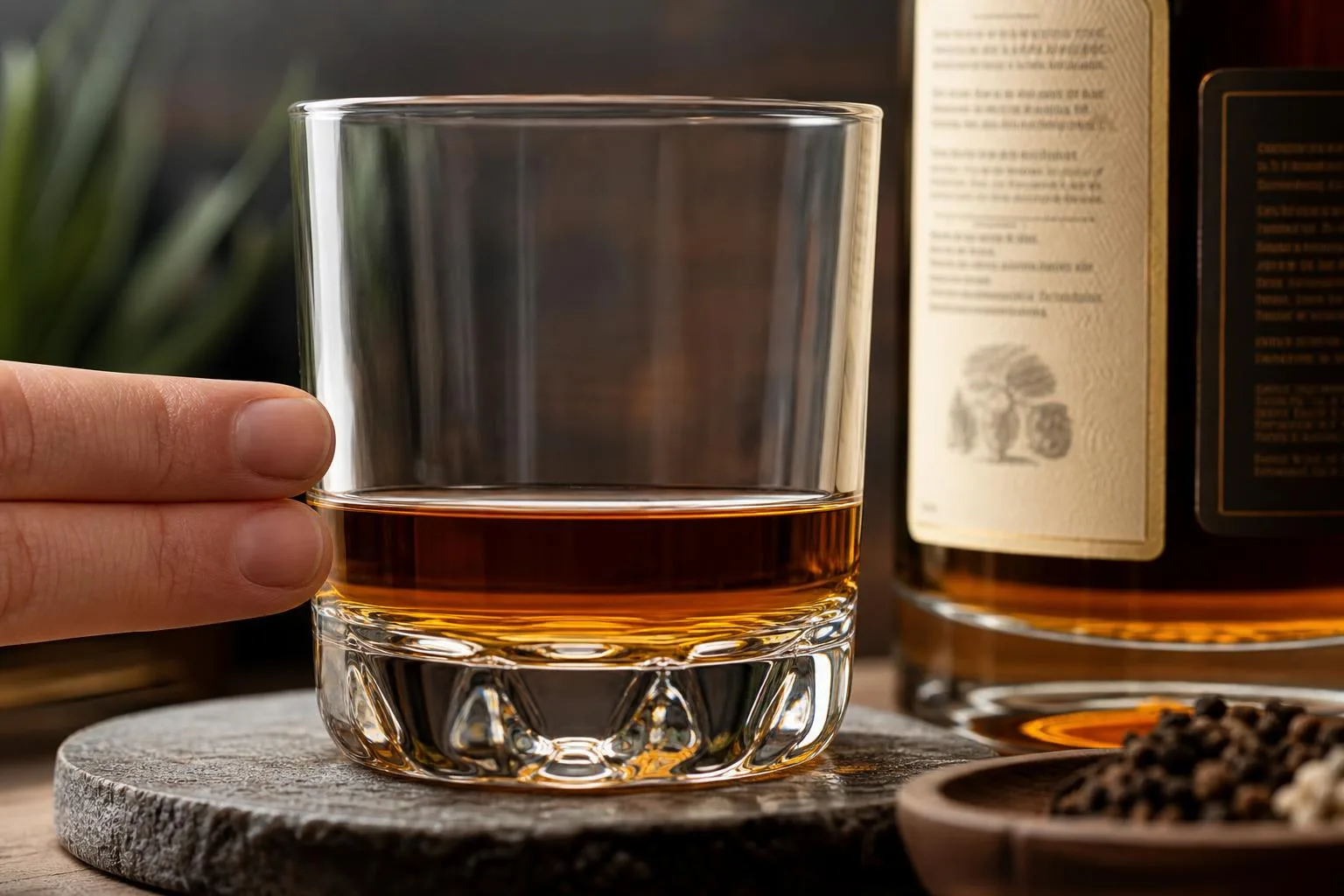
A “two fingers” pour is measured by holding two fingers horizontally against the side of the glass and filling whiskey to that height.
It is not a legal or standardized measure, so the actual volume depends on finger width and glass shape.
In practice, two fingers usually lands near 1.5 to 2.5 U.S. fluid ounces. A straight-sided rocks glass gives a more repeatable result than a tapered tumbler, because the same height can hold different volumes at different parts of the glass.
| Reference point | Typical volume | What it means |
| 1 U.S. fluid ounce | 29.57 mL | Common bar measuring unit |
| Standard neat pour | 1.5 to 2.0 fl oz | Common U.S. service range for whiskey |
| Two fingers | About 1.5 to 2.5 fl oz | Informal estimate, glass-dependent |
| U.S. standard drink at 40% ABV | 1.5 fl oz whiskey | Contains 0.6 fl oz pure alcohol, per NIAAA definition |
The most reliable way to verify a two-finger pour is to measure the actual glass. Fill it with water to the two-finger line, then pour that water into a jigger or graduated cylinder marked in ounces or milliliters.
- Use the same glass you plan to drink from; changing glassware changes the result.
- Keep your fingers level and placed at the widest consistent lower section of the glass.
- Repeat the water test three times and average the results for a practical house measure.
- Mark the level discreetly with removable tape if you want repeatable pours.
A kitchen scale can also verify the volume. Because 1 U.S. fluid ounce of water weighs about 29.57 grams, 2.0 fluid ounces of water weighs about 59.15 grams before subtracting the container weight.
| Water weight after taring glass | Approximate volume | Likely pour size |
| 44 g | 1.5 fl oz | One U.S. standard drink at 40% ABV |
| 59 g | 2.0 fl oz | Common generous neat pour |
| 74 g | 2.5 fl oz | Large two-finger pour |
For alcohol tracking, use the measured ounce amount, not the finger label. The calculation is simple: fluid ounces multiplied by ABV, then divided by 0.6. For example, 2.0 ounces of 40% whiskey equals about 1.33 U.S. standard drinks.
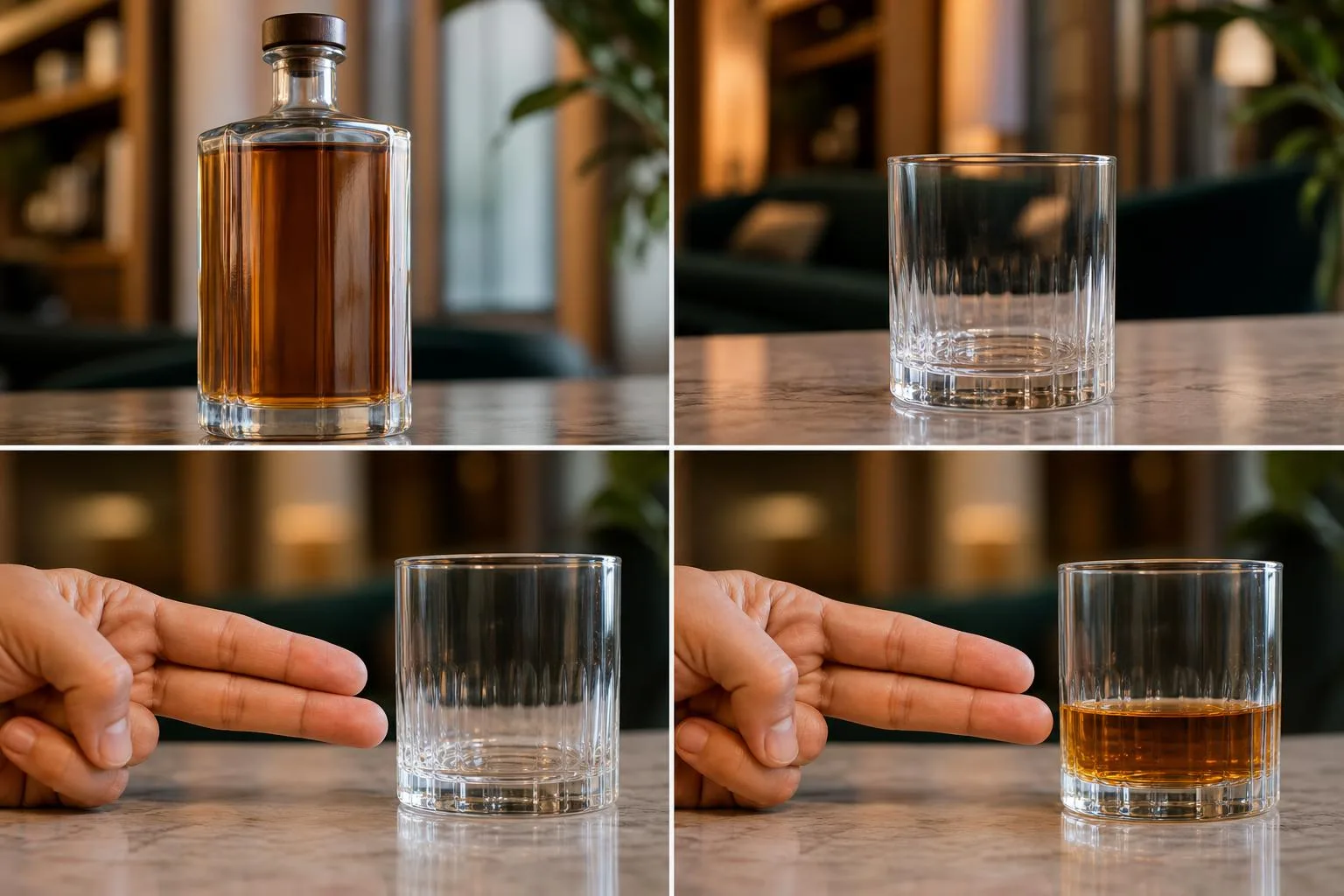
Two Fingers Versus Standard Pours
A “two fingers” pour is an informal measure, not a legal or standardized bar unit. In a typical rocks glass, it often lands around 2 to 3 fluid ounces, depending on glass diameter and the bartender’s actual fingers.
That makes it larger than a standard U.S. shot in many cases, and sometimes double a formal tasting pour.
For 80-proof whiskey, every 1.5 fluid ounces equals one U.S. standard drink, according to the National Institute on Alcohol Abuse and Alcoholism.
| Pour or Measure | Typical Volume | 80-Proof Whiskey Equivalent | How It Compares to Two Fingers |
| One finger | About 1 to 1.5 fl oz | 0.7 to 1 standard drink | Usually about half of two fingers |
| Two fingers | About 2 to 3 fl oz | 1.3 to 2 standard drinks | Informal, glass-dependent pour |
| U.S. standard shot | 1.5 fl oz | 1 standard drink | Often smaller than two fingers |
| Neat bar pour | Commonly 2 fl oz | 1.3 standard drinks | Often close to a modest two fingers |
| Whiskey tasting pour | 0.5 to 1 fl oz | 0.3 to 0.7 standard drink | Much smaller, designed for evaluation |
| Double shot | 3 fl oz | 2 standard drinks | Similar to a generous two fingers |
The closest modern equivalent is usually a neat pour. Many American whiskey bars use 2 ounces for a neat serving, especially when the whiskey is served in a rocks glass or Glencairn without ice.
A shot is more precise than “two fingers.” In the United States, a shot is commonly 1.5 ounces, though state law and house policy can vary. Utah, for example, defines a primary liquor pour as 1.5 ounces in many service contexts.
A double is the comparison that matters for alcohol intake. If your two-finger pour reaches 3 ounces of 40% ABV whiskey, it contains about the same alcohol as two standard drinks, not one.
- For ordering: say “2 ounces neat” if you want consistency across bars.
- For tasting: ask for a 1-ounce pour to compare several whiskeys responsibly.
- For cocktails: recipes usually specify ounces, not fingers, because balance depends on precision.
- For home pouring: use a jigger; visual finger measurements can shift by an ounce or more between glasses.
Ice also changes perception. Two fingers of whiskey over a large cube may look smaller after dilution and displacement, while the actual alcohol volume stays tied to the original measured pour.
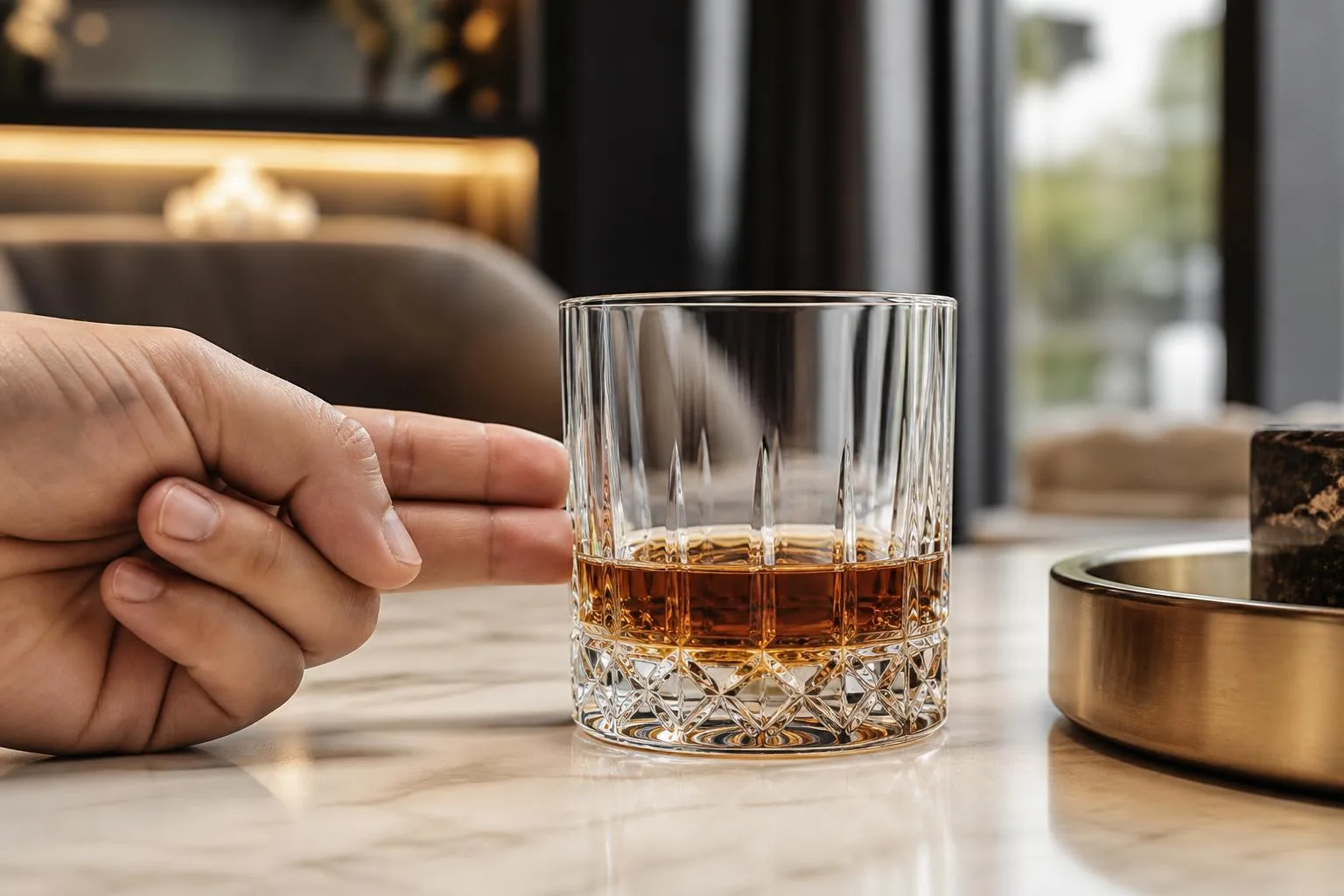
Practical Limits of Two Fingers
A “two fingers” pour is not a medical or legal measure; it depends on glass shape and finger width. In practice, it often lands near 2 to 3 fluid ounces, which can equal more than one U.S. standard drink.
| Measure | Typical Amount | Alcohol Impact at 40% ABV |
| U.S. standard drink of whiskey | 1.5 fl oz | 0.6 fl oz pure alcohol |
| Common “two fingers” pour | 2.0 fl oz | 0.8 fl oz pure alcohol |
| Large “two fingers” pour | 3.0 fl oz | 1.2 fl oz pure alcohol |
| Neat restaurant pour | 1.5 to 2.0 fl oz | 0.6 to 0.8 fl oz pure alcohol |
The National Institute on Alcohol Abuse and Alcoholism defines one standard drink as 1.5 fluid ounces of 80-proof spirits. That means a generous two-finger whiskey can count as two standard drinks, even if it looks modest in a rocks glass.
- Use a jigger when accuracy matters. A 1.5-ounce jigger gives a true standard pour; a 2-ounce jigger is common for neat whiskey but exceeds one standard drink.
- Account for proof. Whiskey at 50% ABV contains 25% more alcohol than 40% ABV whiskey in the same pour size.
- Do not use glass height alone. A wide tumbler can hold far more whiskey at “two fingers” than a narrow Glencairn-style glass.
- Measure once at home. Pour your normal two fingers, then transfer it to a measuring cup or jigger. Many people are surprised by the actual volume.
For safety, U.S. Dietary Guidelines recommend that adults who drink do so in moderation: up to 1 drink per day for women and up to 2 drinks per day for men. These limits refer to standard drinks, not bar pours.
Alcohol affects coordination, judgment, and reaction time before a person feels obviously drunk.
The CDC advises that no amount of alcohol is safe before driving; arrange transportation before pouring, especially when drinking cask-strength whiskey or multiple servings.
- Drink slowly. Sip over 30 to 60 minutes rather than treating neat whiskey like a shot.
- Eat first. Food slows alcohol absorption, especially meals containing protein, fat, or complex carbohydrates.
- Add water if desired. A few drops or a small splash can lower intensity and make sipping easier without implying a larger pour.
- Avoid mixing with sedatives. Alcohol combined with sleep medications, opioids, or benzodiazepines increases risk of dangerous respiratory depression.
When hosting, avoid asking guests if they want “one or two fingers” unless you know the glassware. Offer measured options instead: 1 ounce for a small taste, 1.5 ounces for a standard pour, or 2 ounces for a generous neat serving.
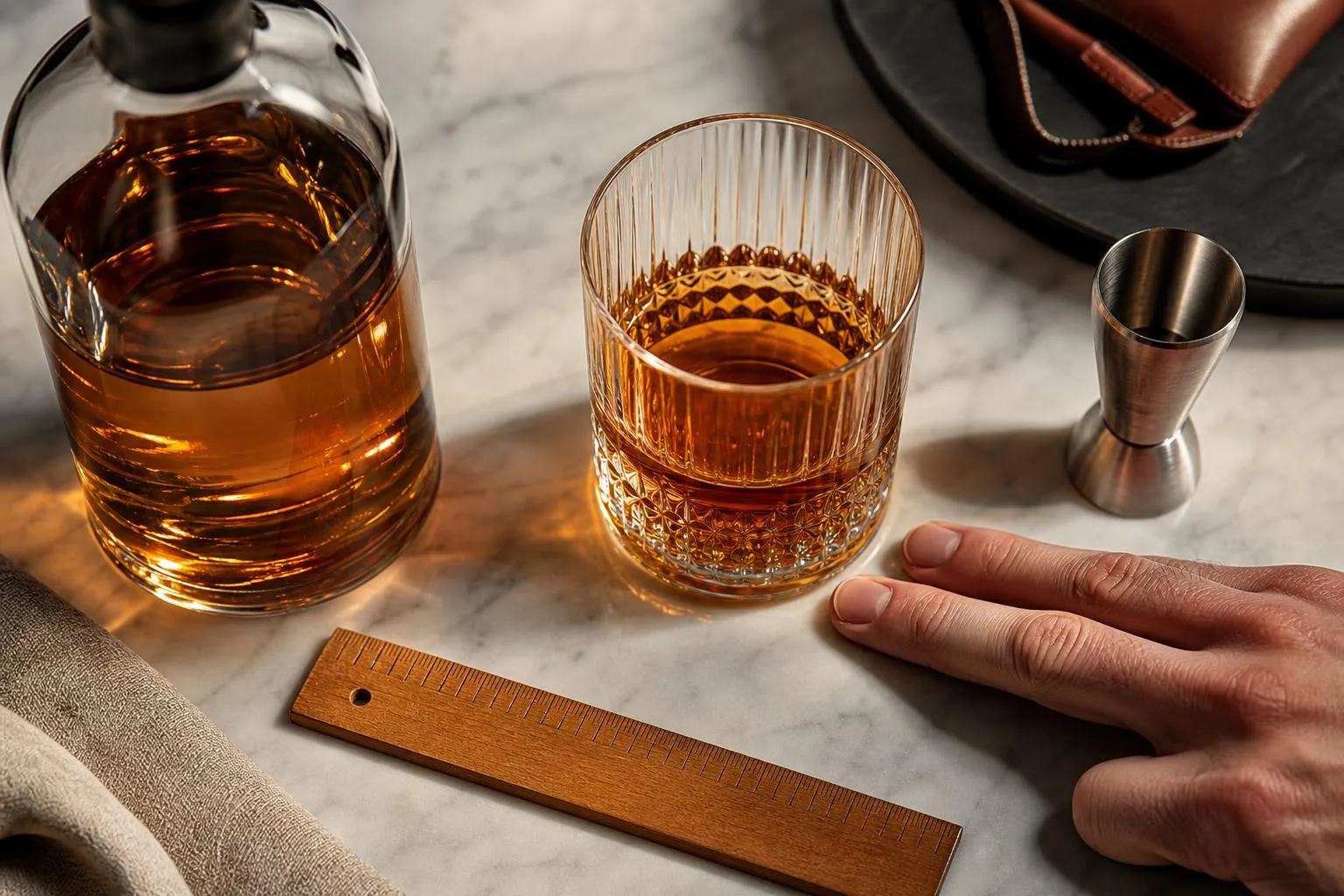
Testing a Real Two Finger Pour
We tested “two fingers of whiskey” as a real pour, not a folklore phrase. Across our trials, it was never a fixed measure; the result changed with glass shape, finger width, and whether ice was present.
We used 80-proof bourbon, room-temperature water for repeat measurements, a 100 ml graduated cylinder, and three common whiskey glasses. Each pour was filled to the top of two stacked fingers held against the outside wall of the glass.
| Glass tested | Measured capacity to two fingers | Average pour |
| 10 oz straight-sided rocks glass | 59 ml, 61 ml, 60 ml | 60 ml / 2.03 fl oz |
| 11 oz tapered rocks glass | 68 ml, 71 ml, 69 ml | 69.3 ml / 2.34 fl oz |
| Glencairn-style tasting glass | 43 ml, 45 ml, 44 ml | 44 ml / 1.49 fl oz |
The straight-sided rocks glass gave the most intuitive result: two fingers landed close to 2 fluid ounces. The tapered rocks glass poured larger because the bowl widens quickly above the base.
We also measured our own fingers. The two-finger height, using index and middle fingers stacked horizontally, ranged from 1.38 inches to 1.63 inches among three team members.
| Tester | Two-finger height | Pour in same rocks glass |
| Smallest hand | 1.38 in | 52 ml / 1.76 fl oz |
| Middle hand | 1.50 in | 60 ml / 2.03 fl oz |
| Largest hand | 1.63 in | 67 ml / 2.27 fl oz |
That spread matters. In the same glass, different hands changed the pour by 15 ml, roughly half an ounce. For an 80-proof whiskey, that difference equals about 0.2 fluid ounces of pure alcohol.
We then repeated the test with one large ice cube already in the glass. With a 2-inch cube, the visible “two fingers” line held less whiskey because the cube displaced volume.
| Condition | Average whiskey poured |
| No ice, straight rocks glass | 60 ml / 2.03 fl oz |
| One 2-inch cube in glass | 38 ml / 1.28 fl oz |
Our takeaway: if a bartender or host says “two fingers,” expect an approximate pour between 1.5 and 2.5 ounces, not a calibrated serving.
For precision, we would ask for ounces, because the U.S. standard drink reference is 1.5 ounces of 80-proof spirits.
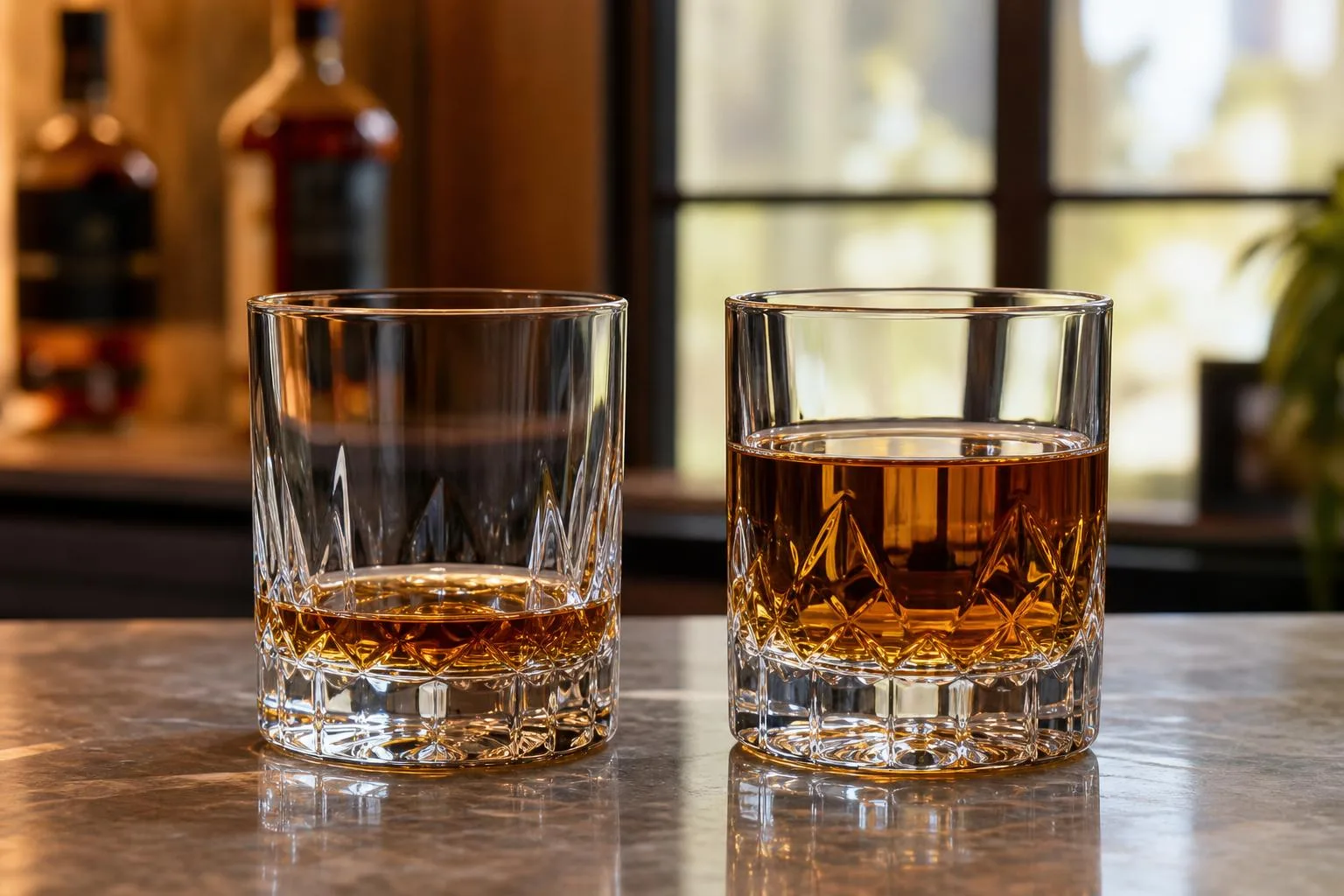
Myths About Two Fingers Precision
“Two fingers” sounds precise, but it is not a standardized pour. In real service, the amount changes with glass shape, finger width, ice, and the bartender’s house pour policy.
The biggest mistake is assuming two fingers always equals 2 ounces. The U.S. National Institute on Alcohol Abuse and Alcoholism defines one standard drink of 80-proof spirits as 1.5 fluid ounces, not two fingers.
| Measure | Typical amount | Why it matters |
| U.S. standard drink, 80-proof whiskey | 1.5 fl oz | Used by NIAAA for alcohol intake guidance |
| Common neat whiskey pour | 1.5 to 2 fl oz | Varies by bar, state rules, and pricing |
| “Two fingers” in a rocks glass | Often about 2 to 3 fl oz | Depends heavily on glass diameter and finger size |
| One jigger | Usually 1.5 fl oz in the U.S. | More reliable than visual finger measuring |
Myth: Two fingers is a legal or industry standard
There is no U.S. federal legal definition for a “finger” of whiskey.
Bars commonly train staff using jiggers, measured pour spouts, or POS-defined pours because “fingers” are too inconsistent for inventory and responsible service.
Myth: Finger width gives the same pour in every glass
A straight-sided rocks glass and a wide heavy-bottom tumbler can produce different volumes at the same visible height. A 2-inch liquid height in a wider glass can hold substantially more whiskey than the same height in a narrower tasting glass.
Myth: Ice does not affect the meaning
Ordering “two fingers on the rocks” is less clear than ordering “2 ounces over ice.” Ice raises the liquid line and displaces volume, so the visual height may look generous while the actual whiskey pour remains smaller.
Myth: It describes strength, not quantity
“Two fingers” describes an estimated volume, not proof. Two fingers of 80-proof bourbon and two fingers of barrel-proof whiskey may look identical, but the alcohol content can differ sharply.
- Ask for ounces when precision matters: Say “2 ounces neat” or “1.5 ounces over ice.”
- Expect house variation: Many U.S. bars treat a standard neat pour as 1.5 or 2 ounces.
- Do not use fingers for pacing: Track alcohol by standard drinks, especially with 100-proof or barrel-proof whiskey.
- Use a jigger at home: It gives repeatable pours for tastings and cocktails.
The practical takeaway: “two fingers” is bartender shorthand, not a calibrated measurement. For accuracy, especially in tasting, billing, or responsible drinking, ounces are the better language.
Questions People Ask Most
What does “two fingers of whiskey” mean?
“Two fingers of whiskey” means pouring whiskey to a height roughly equal to the width of two fingers held horizontally against the side of the glass.
In a typical rocks glass, that often lands around 2 to 3 fluid ounces, but it is not a standardized legal measure.
How many ounces are in two fingers of whiskey?
Two fingers of whiskey is commonly estimated at about 2 ounces, though the actual amount can vary by glass diameter and finger size. In a wide rocks glass, the same two-finger height can easily exceed 2.5 or 3 ounces.
Is two fingers the same as two shots?
Not always. In the United States, a standard shot is commonly 1.5 fluid ounces, so two shots would be about 3 ounces, while two fingers may be closer to 2 ounces depending on the glass.
Why do people measure whiskey with fingers?
The finger method comes from informal bar and saloon measuring, where bartenders could pour quickly without using a jigger.
It remains a casual shorthand today, but professional bars usually rely on measured pours for consistency, cost control, and alcohol service compliance.
Should you order “two fingers” at a bar?
You can, but it is better to ask for a specific amount, such as “2 ounces of whiskey neat” or “a double.” Because “two fingers” is subjective.
The bartender may interpret it differently based on house pour size, glassware, or local service rules.
Is a finger of whiskey the same in every glass?
No. A “finger” depends on the width of the tumbler, so the poured volume changes from one glass to another. In a wider rocks glass, two fingers can equal more liquid than in a narrow glass, which is why bars use jiggers for consistent 1.5-ounce pours.
Does ice change how “two fingers” of whiskey is served?
Yes. If whiskey is poured over ice, the visible liquid level can rise differently because the cubes displace volume in the glass.
That makes “two fingers” less precise than a measured neat pour, especially when using large cubes or multiple standard ice cubes.
Related Reading
- What To Mix With Jim Beam Apple?
- How Much Is A Dram Of Whiskey?
- What Do You Mix Baileys With?
- What Is Elijah Craig 18 Msrp? Answer From Expert
- What Does Whiskey Smell Like?
- Is Jack Daniel’S Whiskey Or Bourbon?
- How Long Does It Take To Make Whiskey?
- All Alcohol Guides
- National Institute on Alcohol Abuse and Alcoholism (2025)
- Centers for Disease Control and Prevention (2024)
- Electronic Code of Federal Regulations, 27 CFR § 5.203 Standards of Fill for Distilled Spirits (2024)
- Alcohol and Tobacco Tax and Trade Bureau, Distilled Spirits Beverage Alcohol Manual (2024)
- PubMed: White et al., “How Big Is a Self-Defined Drink? Implications for Drinking Guidelines” (2005)
- Merriam-Webster Dictionary, “Finger” (2025)
- Cambridge Dictionary, “Finger” (2025)