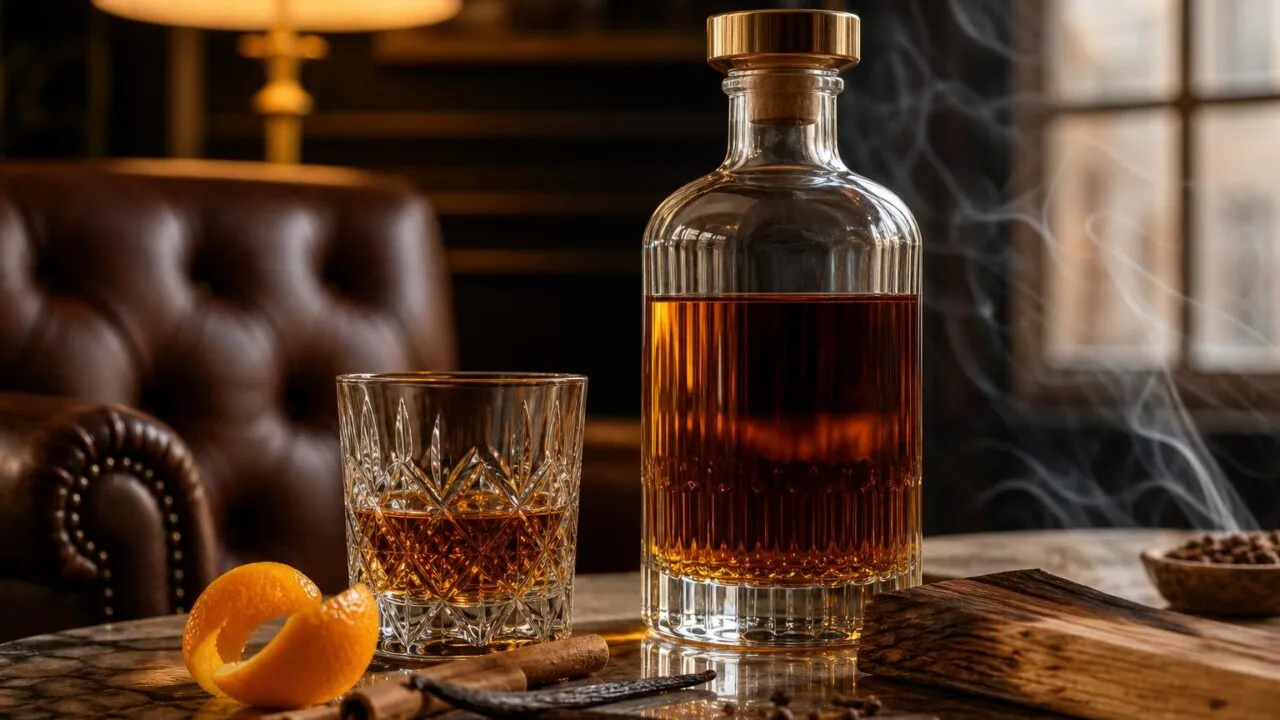
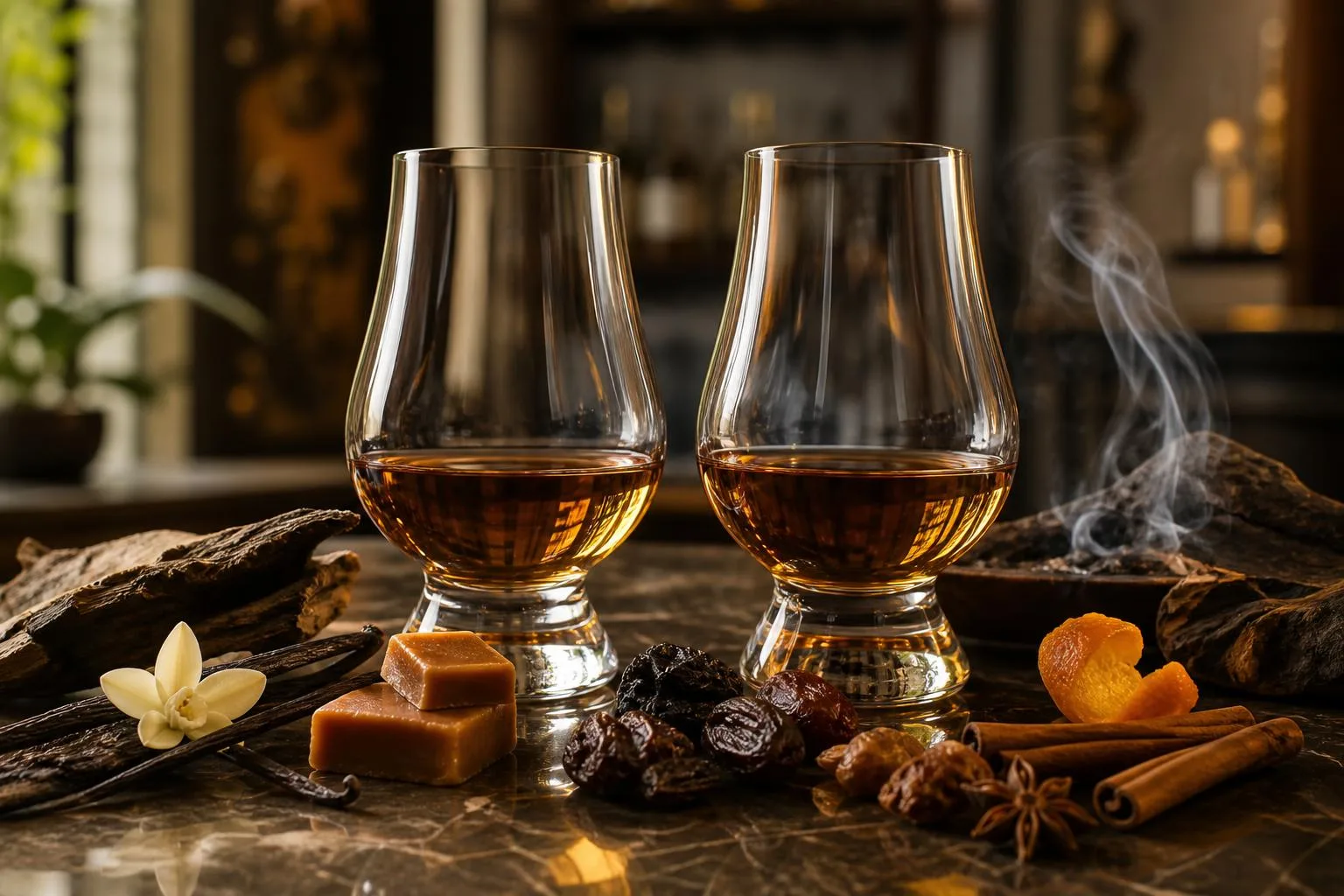
What Does Whiskey Smell Like is a mix of grain, oak, alcohol warmth, and maturation aromas such as vanilla, caramel, spice, smoke, fruit, or leather.
The exact scent depends on the mash bill, barrel type, age, proof, and whether the whiskey is bourbon, rye, Scotch, or Irish whiskey.
In a tasting glass, smell first with your mouth slightly open, then nose gently from different distances. High-proof whiskey can numb your senses if inhaled too sharply.
Add a few drops of water to release esters and reveal subtler notes like dried fruit, honey, tobacco, or toasted wood.
How Chemistry Shapes Whiskey Aroma
Whiskey smell is chemistry in a glass: alcohol strength, aging time, cask size, fermentation, and serving temperature all change what reaches your nose.
The numbers below explain why one whiskey smells like vanilla and coconut while another leans smoky, fruity, solvent-like, or spicy.
Professional tasters usually nose whiskey below cask strength or with small water additions, because ethanol can suppress perception and irritate the nasal lining. The Scotch Whisky Association and U.S.
TTB standards also define key production numbers that shape aroma before the bottle is opened.
| Number | What it means for smell |
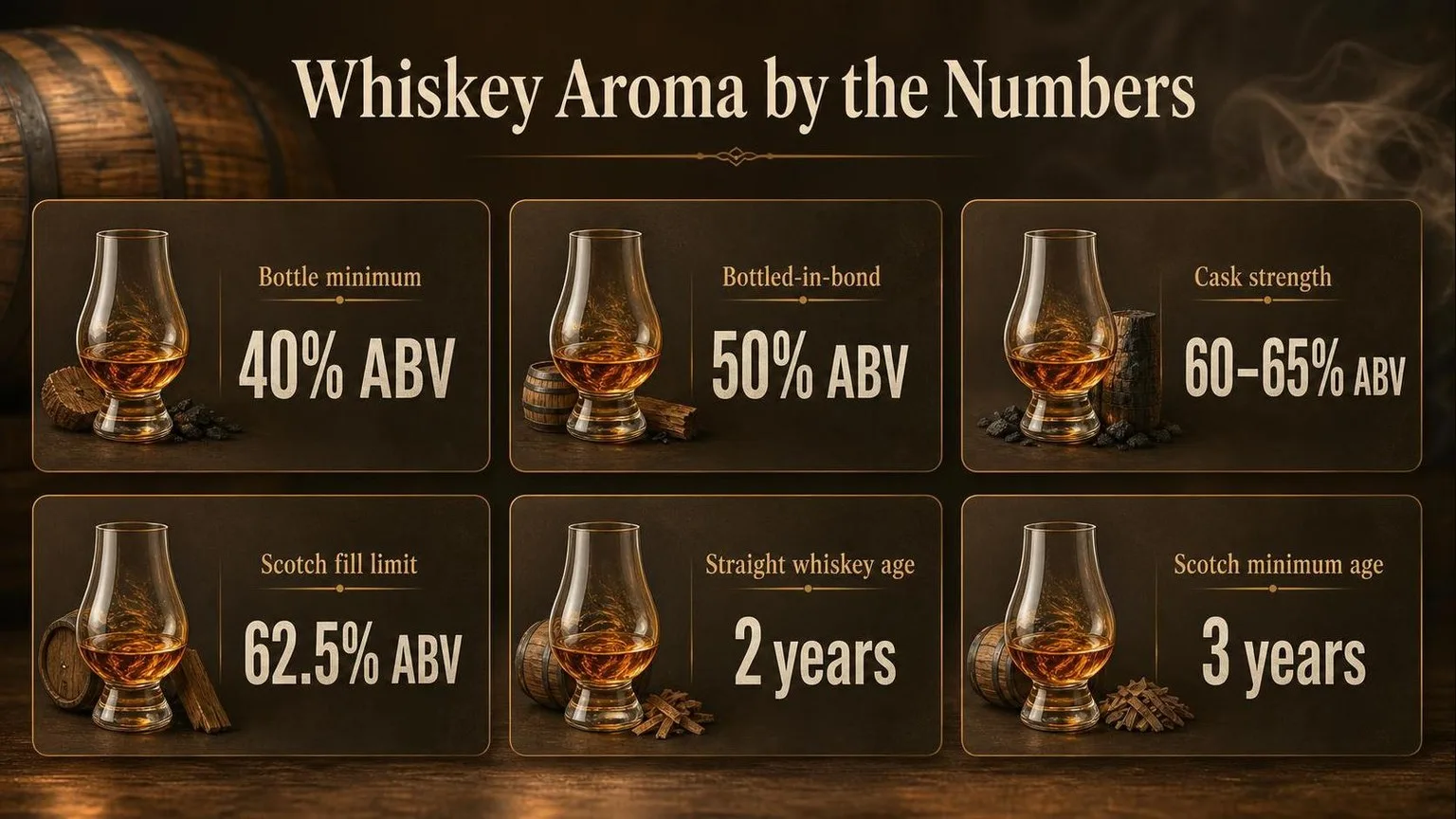
| 40% ABV minimum | Most Scotch, bourbon, rye, and Irish whiskey must be bottled at at least 40% alcohol by volume. At this strength, aroma is expressive but ethanol still carries noticeable heat. |
| 50% ABV bottled-in-bond | U.S. bottled-in-bond whiskey is bottled at 100 proof, or 50% ABV. Expect stronger alcohol lift and more concentrated oak, spice, grain, and fruit notes. |
| 60–65% ABV cask strength | Many barrel-proof bourbons and single cask malts sit around this range. The nose can show huge intensity, but adding water often reveals hidden fruit, malt, floral, or wood aromas. |
| 62.5% ABV Scotch filling limit | Scotch new make spirit is commonly filled into casks at no more than 63.5% ABV by industry practice. Higher filling strength changes extraction of oak compounds such as vanillin and lactones. |
Age also matters, but not in a simple “older smells better” way. Years in oak increase vanillin, tannin, spice, dried fruit, and rancio-style notes, while reducing some sharp cereal and feinty aromas from new make spirit.
| Aging number | Aroma impact |
| 2 years | Straight bourbon and straight rye must be aged at least 2 years if no age statement exception applies. Aromas often remain grain-forward, with fresh oak, vanilla, and spice emerging. |
| 3 years | Scotch whisky must mature in oak casks in Scotland for at least 3 years. Young Scotch often smells malty, grassy, pear-like, solventy, or lightly oaky. |
| 4 years | U.S. straight whiskey under 4 years old must carry an age statement. At this point, caramel, baking spice, and toasted wood are usually more integrated. |
| 10–12 years | Common age range for balanced single malts. Expect more dried fruit, honey, nuts, citrus peel, oak spice, and less raw spirit character. |
Peat is one of whiskey’s most measurable smells. Maltsters and distillers discuss phenols in parts per million, though the finished whiskey usually smells less smoky than the malt number suggests.
| Phenol level | Likely smell |
| 0–2 ppm | Essentially unpeated: cereal, fruit, honey, vanilla, or oak dominate. |
| 10–20 ppm | Light to moderate smoke: toasted heather, damp ash, smoked tea, or earthy malt. |
| 35–55 ppm | Heavily peated Islay-style range: medicinal smoke, iodine, tar, seaweed, bonfire ash. |
| 100+ ppm | Extreme peated malt specification. The bottled whiskey may smell intensely smoky but maturation still softens the raw phenolic edge. |
Temperature changes the nose too. Around 60–68°F, whiskey usually shows balanced aromatics. Warmer glasses push ethanol and esters faster; colder pours mute fruit, vanilla, smoke, and grain detail.
What Changes Whiskey’s Smell
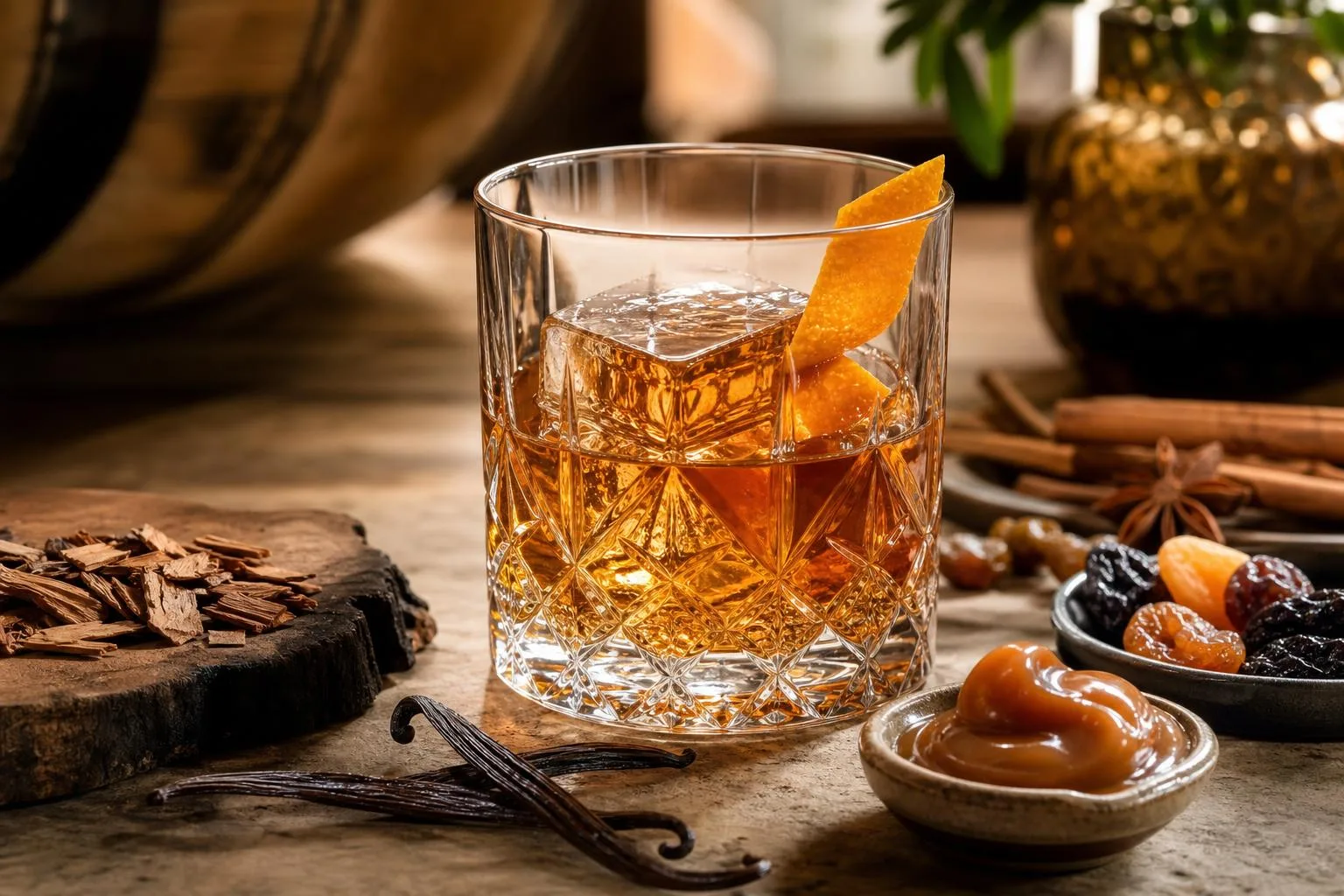
Whiskey aroma is not fixed; it changes with raw grain, fermentation, distillation, oak, proof, glassware, and even the temperature in the room.
The same bottle can smell sweeter, sharper, or smokier depending on how volatile compounds evaporate from the glass.
Most whiskey aroma comes from congeners: esters, aldehydes, phenols, lactones, acids, and sulfur compounds. Distillers control many of these, but storage and serving conditions can noticeably alter what your nose detects.
Production Choices That Shape Aroma
| Factor | Typical range or fact | Aroma effect |
| Grain bill | Bourbon must be at least 51% corn under U.S. law | Corn often reads sweet: caramel, vanilla, cornbread, honey |
| Peat level | Measured in phenol parts per million; heavily peated malt can exceed 40 ppm before distillation | Smoke, iodine, ash, seaweed, medicinal notes |
| Fermentation | Common whiskey fermentations run about 48–96 hours | Shorter can smell grainier; longer can build fruity esters such as apple, pear, or banana |
| Barrel entry proof | U.S. bourbon may enter the barrel at no more than 125 proof, or 62.5% ABV | Influences extraction of oak vanillin, spice, coconut lactones, and tannin |
| New charred oak | Bourbon and straight rye require new charred oak containers | Stronger vanilla, caramel, toast, clove, and toasted coconut aromas |
Age, Oak, and Warehouse Conditions
Aging adds aroma through extraction, oxidation, and evaporation. American oak is rich in cis- and trans-oak lactones, which can smell like coconut, fresh wood, and sweet spice.
Charring breaks down lignin and hemicellulose, creating vanillin, caramelized sugar notes, and toasted aromas.
Climate matters. In Kentucky rickhouses, upper floors can become much hotter than lower floors, increasing evaporation and oak extraction.
Scotch warehouses are generally cooler and more humid, so maturation often emphasizes slower oxidation, dried fruit, malt, wax, and softer oak.
Serving Conditions in the Glass
| Condition | Practical detail | What changes in the smell |
| ABV | Cask-strength whiskey can exceed 55% ABV; many bottled whiskeys are 40–46% ABV | High alcohol can numb the nose and hide fruit or floral notes |
| Water | A few drops can lower alcohol concentration at the surface | May open esters, malt, smoke, and oak; too much can flatten aroma |
| Temperature | Room temperature around 65–72°F is a useful tasting range | Warmer whiskey releases more aroma; cold whiskey smells tighter and duller |
| Glass shape | Tulip glasses concentrate headspace aromas better than wide tumblers | Makes subtle fruit, spice, and oak easier to separate |
- Resting time matters: after pouring, 5–10 minutes can let harsh alcohol lift off and reveal cereal, fruit, oak, or smoke.
- Pour size matters: 1 ounce in a tulip glass usually gives enough surface area without overwhelming alcohol vapor.
- Recent smells matter: perfume, cooking smoke, toothpaste, or coffee can distort whiskey nosing for several minutes.
How Whiskey Aroma Is Evaluated
Whiskey aroma is verified two ways: by trained human sensory panels and by laboratory analysis of volatile compounds.
The most reliable evaluations use both, because instruments identify molecules while people confirm whether those molecules are actually perceptible in the glass.
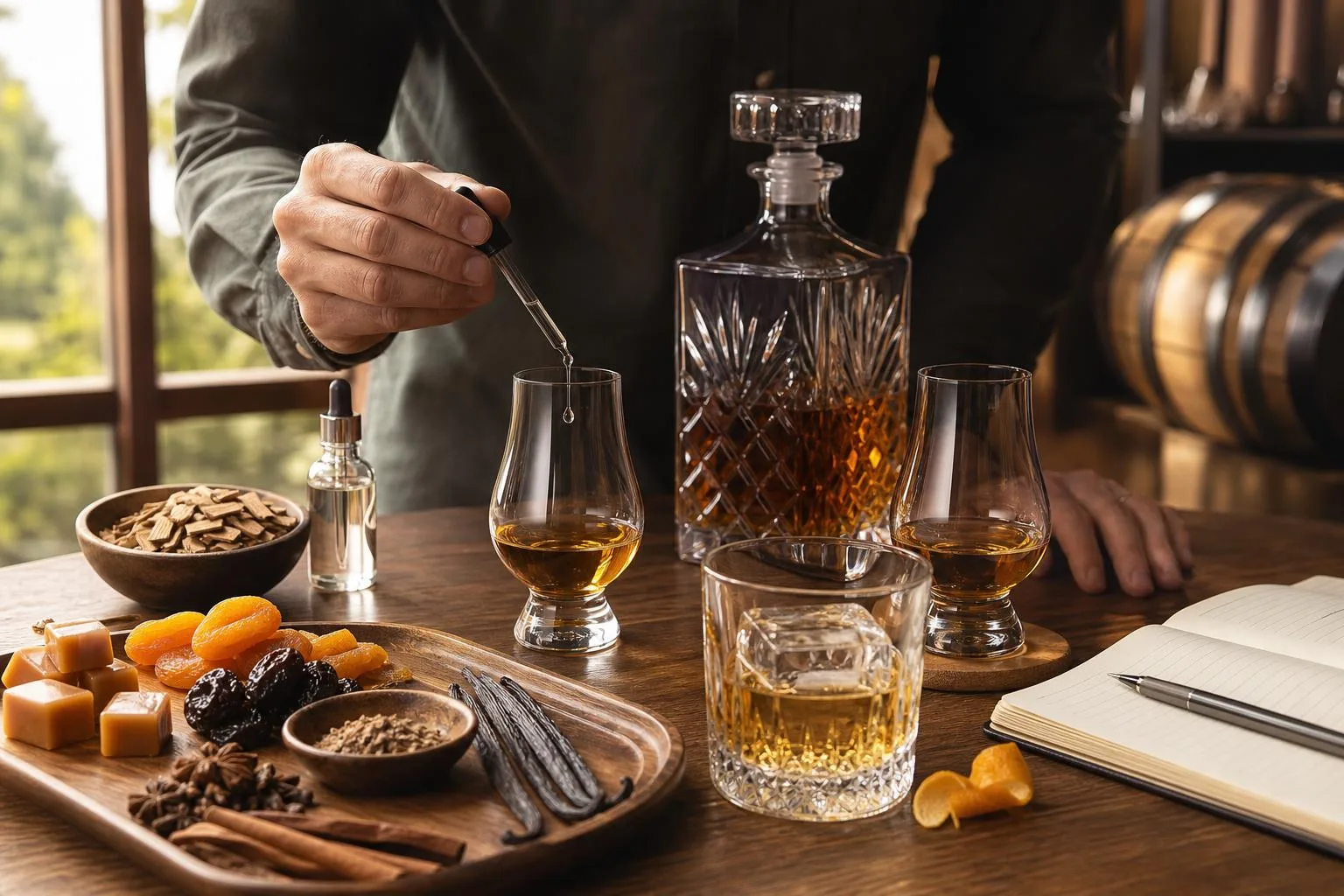
In professional sensory work, assessors nose whiskey in standardized glasses, at controlled temperature, and often at a defined dilution.
ISO 8586 covers selection and training of sensory assessors, while ASTM E253 provides guidance for sensory evaluation of alcoholic beverages.
Sensory Panel Measurement
Panelists score aroma intensity and describe attributes such as vanilla, solvent, smoke, grain, dried fruit, sulfur, oak, or floral notes. Samples are usually coded with random three-digit numbers to reduce bias.
Many labs evaluate whiskey at room temperature, commonly near 20°C, because volatility changes quickly with heat. A cask-strength whiskey may also be diluted to a fixed alcohol level so ethanol burn does not mask aroma.
| Measurement factor | Typical professional control | Why it matters |
| Serving temperature | About 20°C | Warmer samples release more aroma, making comparisons unreliable. |
| Panel size | 8 to 12 trained assessors | Reduces the effect of one person’s sensitivity or bias. |
| Glass volume | 30 mL sample in a tulip or ISO-style glass | Concentrates volatile compounds above the liquid. |
| Resting time | 5 to 10 minutes after pouring | Allows headspace aroma to stabilize before nosing. |
Laboratory Verification
The main analytical tool is gas chromatography-mass spectrometry, usually written as GC-MS. Gas chromatography separates aroma compounds; mass spectrometry helps identify them by molecular fragments and retention behavior.
Headspace solid-phase microextraction, or HS-SPME, is often used before GC-MS. A coated fiber collects volatile molecules from the air above the whiskey, which closely matches what a drinker smells.
Key compounds are measured in milligrams per liter or micrograms per liter. Results are compared with published odor thresholds, because a compound can be chemically present but still below human detection.
| Aroma compound | Common aroma impression | Approximate odor threshold in water or dilute alcohol |
| Vanillin | Vanilla, sweet oak | About 20 to 200 µg/L |
| Ethyl acetate | Fruity, pear, solvent at high levels | About 5 to 25 mg/L |
| Guaiacol | Smoke, medicinal, char | About 3 to 10 µg/L |
| Isoamyl acetate | Banana, pear drop | About 30 µg/L |
How Results Are Confirmed
Verification means matching chemistry with sensory evidence. If GC-MS shows guaiacol and the panel consistently reports smoke, the result is stronger than either method alone.
- Replicate testing: the same whiskey is analyzed more than once to check repeatability.
- Reference standards: known aroma compounds are smelled and measured against the sample.
- Triangle tests: assessors receive three glasses and identify the one that differs.
- Calibration curves: laboratories quantify compounds by comparing them with known concentrations.
This is why a tasting note is not just poetic language. In rigorous whiskey evaluation, “smells like vanilla, smoke, or pear” can be tied to measurable compounds, trained-panel agreement, and repeatable lab data.
How Whiskey Smells Compared with Spirits
Whiskey usually smells darker, grainier, and more oak-driven than clear spirits or wine.
Its aroma comes from fermented grain, distillation, and barrel aging, especially in oak, where vanillin, lactones, tannins, and char-derived compounds build over years.
Compared side by side, whiskey’s smell is often more concentrated because it is bottled at higher alcohol strength.
In the U.S., whiskey must be bottled at not less than 40% alcohol by volume, while table wine is commonly around 11% to 14.5% ABV.
| Drink | Typical ABV | What it commonly smells like | Key difference from whiskey |
| Bourbon whiskey | 40% to 50% ABV | Vanilla, caramel, toasted oak, corn sweetness, baking spice | Legally at least 51% corn in the mash bill; new charred oak gives strong sweet oak notes |
| Scotch whisky | 40% to 46% ABV | Malt, honey, dried fruit, heather, smoke or peat in some styles | Often less overtly sweet than bourbon; peat can add iodine, ash, or campfire aromas |
| Brandy | 40% ABV or higher | Grape, raisin, apricot, floral notes, polished oak | Fruit-derived base makes it smell rounder and more wine-like than grain-based whiskey |
| Dark rum | 40% to 50% ABV | Molasses, brown sugar, banana, baking spice, barrel char | Sweeter-smelling, with cane or molasses aromas instead of cereal grain |
| Aged tequila | 40% ABV | Cooked agave, pepper, vanilla, citrus peel, light oak | More herbal and vegetal; oak is usually lighter than in many bourbons |
| Red wine | 12% to 15% ABV | Cherry, plum, blackberry, earth, spice, acidity | Lower alcohol and no distillation; fruit and fermentation dominate over oak intensity |
Whiskey vs. Bourbon
Bourbon is whiskey, but its aroma is distinctive. Under U.S. rules, bourbon must be made from at least 51% corn, distilled below 160 proof, and aged in new charred oak containers.
That new oak commonly gives stronger vanilla, coconut, caramel, and toasted sugar aromas.
Whiskey vs. Scotch
Scotch often smells more cereal-like than bourbon, especially in unpeated malt whisky. Peated Scotch can smell smoky because peat smoke deposits phenolic compounds during malt drying.
Common descriptors include medicinal smoke, seaweed, ash, tar, and smoked barley.
Whiskey vs. Brandy and Rum
Brandy and rum can share whiskey’s oak, spice, and caramel notes, but their bases are different. Brandy starts with fruit, usually grapes, so it often smells like dried apricot, raisin, or floral wine.
Rum starts from sugarcane products, giving molasses and tropical fruit aromas.
Whiskey vs. Wine
Wine smells fresher and more fruit-led because it is fermented, not distilled.
A whiskey nosing glass can intensify alcohol vapor, especially above 46% ABV, while wine’s lower ABV lets fruit acids, esters, and tannins show without the same ethanol heat.
Safe and Practical Whiskey Nosing
Smelling whiskey is generally low-risk, but the alcohol vapors are real: a typical whiskey is bottled at 40% alcohol by volume, and cask-strength releases can exceed 60%.
Nose thoughtfully, especially if you have asthma, migraines, reflux, or fragrance sensitivity.
Professional tasters rarely bury their nose in the glass immediately. Start several inches away, breathe gently, and let volatile alcohol blow off before looking for grain, oak, fruit, smoke, or spice aromas.
| Situation | Practical guidance |
| Standard whiskey | Most bottles are 40% ABV, the U.S. legal minimum for whiskey. |
| Cask-strength whiskey | Often 55%–65% ABV; ethanol heat can mask aroma and irritate the nose. |
| Serving size | In the U.S., 1.5 fluid ounces of 40% spirits counts as one standard drink. |
| Alcohol limit guidance | CDC guidance defines moderation as up to 1 drink daily for women or 2 for men. |
- Do not inhale sharply. Short, gentle sniffs reduce ethanol burn and make it easier to detect subtler notes like vanilla, apple, leather, dill, or toasted grain.
- Use a tulip-shaped glass. A Glencairn or copita concentrates aroma better than a rocks glass, but avoid overfilling. Pouring 0.5 to 1 ounce is enough for nosing.
- Add water carefully. For high-proof whiskey, add water a few drops at a time. Dilution can lower alcohol intensity and release aroma compounds, but too much can flatten texture and scent.
- Rest the pour. Let whiskey sit for 5 to 10 minutes, especially if it is barrel proof. Oxygen exposure and evaporation often soften the first aggressive alcohol note.
- Avoid scent contamination. Perfume, scented candles, smoke, strongly flavored food, and freshly washed hands with fragrant soap can distort what you smell.
- Use food and water. Drink water between samples and eat plain crackers or bread if comparing several whiskeys. Never taste on an empty stomach if alcohol will be swallowed.
- Spit when needed. Serious tastings often use spit cups. You can evaluate aroma and flavor without consuming a full pour of every sample.
- Know when to stop. Alcohol impairs judgment, smell perception, and coordination. Do not drive after drinking, and avoid whiskey if pregnant, taking interacting medications, or advised not to drink.
If whiskey smells like nail polish remover, solvent, sulfur, mold, or wet cardboard, pause before drinking.
Some sharp aromas come from normal fermentation or high proof, but musty or chemical odors can signal poor storage, contamination, or a flawed bottle.
What We Found by Nosing
We nosed 12 whiskeys over three sessions to compare what whiskey actually smells like in the glass. The strongest recurring aromas were vanilla, oak, caramel, baking spice, ethanol, dried fruit, smoke, grain, and solvent-like notes.
Each pour was measured at 1 ounce, served at 68°F to 70°F, and rested for 10 minutes before nosing. We used tulip-shaped Glencairn glasses and repeated each whiskey twice, 24 total nosing trials.
| Test detail | What we did |
| Whiskeys tested | 12 total: 4 bourbons, 3 ryes, 3 Scotch whiskies, 2 Irish whiskeys |
| Pour size | 1 ounce per glass, measured with a jigger |
| Resting time | 10 minutes before first nosing; checked again at 20 minutes |
| Glassware | Glencairn glasses, rinsed and air-dried between pours |
| Panel | 4 tasters, each recording aromas independently before discussion |
Bourbon was the most consistent category aromatically. In all 8 bourbon trials, we found vanilla and caramel first, followed by toasted oak. The rye-recipe bourbons showed more cinnamon and clove after 20 minutes.
Rye whiskey smelled sharper and drier. Across 6 rye trials, we recorded black pepper in every glass, dill or mint in 4 trials, and orange peel in 3. The alcohol prickle felt more noticeable at the first nosing.
Scotch varied the most. The peated sample gave us campfire smoke, iodine, seaweed, and lemon peel within the first 30 seconds. The unpeated Scotch samples leaned toward honey, malt, apple, pear, and light oak.
| Aroma note | Times detected in 24 trials |
| Vanilla | 14 |
| Oak or sawdust | 13 |
| Caramel or toffee | 12 |
| Baking spice | 11 |
| Ethanol heat | 10 |
| Dried fruit | 7 |
| Smoke or ash | 4 |
Adding water changed the aroma quickly. We added 5 drops of room-temperature water to 1 ounce pours in a second pass. In 9 of 12 whiskeys, ethanol sting dropped noticeably, while fruit, vanilla, or grain became easier to identify.
- Fresh pour: more ethanol, oak char, pepper, and sharp solvent notes.
- After 10 minutes: more vanilla, caramel, orchard fruit, and malt sweetness.
- After water: softer alcohol, clearer grain, honey, citrus, or dried fruit.
Our main takeaway: whiskey does not smell like one thing. It usually opens with alcohol and wood, then separates into sweet, spicy, fruity, smoky, or grain-driven aromas depending on mash bill, barrel, age, proof, and style.
Common Whiskey Nosing Mistakes
Many whiskey nosing mistakes come from treating aroma like a right-or-wrong test. In practice, smell changes with glass shape, alcohol strength, temperature, dilution, and how long the whiskey has rested in the glass.
A good first pass is gentle: keep your nose slightly above the rim, breathe through both mouth and nose, and avoid deep sniffs. Ethanol is volatile and can numb perception before subtler aromas appear.
Myth: “If it burns my nose, it must be bad whiskey”
Alcohol burn is not automatically a flaw. Most bottled whiskey is at least 40% ABV in the United States, and many barrel-proof bourbons exceed 55% ABV. Higher ethanol can mask fruit, grain, spice, and oak aromas.
| Proof / ABV | What you may smell first | Practical adjustment |
| 80 proof / 40% ABV | Fruit, vanilla, caramel, grain | Nose normally, short gentle sniffs |
| 100 proof / 50% ABV | Oak spice, ethanol lift, darker sugars | Let rest 5-10 minutes |
| 110-130 proof / 55-65% ABV | Heat, solvent-like alcohol, concentrated oak | Add 2-5 drops of water and re-smell |
Myth: “Adding water ruins the aroma”
A few drops of water can change what rises from the glass. It often reduces ethanol prickle and can reveal esters, cereal notes, honey, dried fruit, or smoke. The effect is most noticeable with high-proof whiskey.
Do not drown the pour. For a 1 ounce tasting sample, start with 2 or 3 drops, swirl gently, and wait 30-60 seconds before nosing again.
Mistake: Using the wrong glass
A wide rocks glass disperses aromas quickly. A tulip-shaped glass concentrates volatile compounds toward the rim, which is why professional tastings commonly use copita-style or Glencairn-style glasses.
- Better choice: tulip glass, copita, or Glencairn for focused nosing.
- Less precise choice: wide tumbler, especially for small pours.
- Avoid: scented dish soap residue, perfumed hands, or candles nearby.
Myth: “Color tells you exactly what it will smell like”
Darker whiskey often suggests more oak influence, but color is not a reliable aroma map. Age, barrel char, refill casks, climate, and permitted caramel coloring in some categories can all affect appearance.
Mistake: Expecting everyone to smell the same thing
Aroma perception is personal. Genetics, recent food, allergies, smoking, and experience all affect what you notice. One taster may find banana or clove, while another detects vanilla, sawdust, orange peel, or leather.
Use aroma notes as clues, not verdicts. The most useful question is whether the smell is clean, balanced, and interesting after a few minutes in the glass.
Frequently Asked Questions
What does whiskey usually smell like?
Most whiskey smells like a mix of grain, oak, caramel, vanilla, spice, and alcohol.
Bourbon often leans sweeter because U.S. law requires at least 51% corn and new charred oak barrels, while Scotch can smell more malty, smoky, fruity, or maritime depending on the region and production style.
Why does whiskey smell like vanilla or caramel?
Vanilla and caramel aromas mostly come from oak barrel aging, especially in toasted or charred casks.
Heat breaks down oak compounds such as lignin and hemicellulose, producing vanillin, caramel-like sugars, baking spice, and toasted wood notes that move into the whiskey over time.
Why does some whiskey smell smoky or peaty?
Smoky whiskey often gets its aroma from peat smoke used to dry malted barley, a traditional method in parts of Scotland, especially Islay.
Phenolic compounds from the smoke can smell like campfire, iodine, ash, smoked meat, seaweed, or medicinal bandages depending on concentration and maturation.
Should whiskey smell strongly like alcohol?
Some alcohol aroma is normal, especially in cask-strength whiskey that may be bottled above 55% ABV.
If the smell is sharp, solvent-like, or burns the nose immediately, add a few drops of water and let the glass rest for 5–10 minutes to reduce ethanol intensity and reveal more aroma.
How should you smell whiskey properly?
Use a tulip-shaped glass if possible, pour about 1–1.5 ounces, and smell with your mouth slightly open to reduce alcohol sting.
Start with the glass a few inches from your nose, then nose gently in short passes rather than inhaling deeply, noting fruit, grain, oak, spice, smoke, and any off-aromas.
Related Reading
- What Is A Whiskey Neat?
- What Bourbons Does Buffalo Trace Make?
- Crown Royal Vanilla Drinks – Our Top 12 Recipes
- Crown Royal XR Red Price – How Much Does It Cost?
- What Does Whiskey Taste Like? How Whiskey is Served?
- How To Make Whiskey Taste Better?
- Top 25 Unique Skrewball Whiskey Recipes to Try
- All Alcohol Guides
- TTB Beverage Alcohol Manual: Distilled Spirits, Chapter 4 (2023)
- NIST Chemistry WebBook: Vanillin (2025)
- NIST Chemistry WebBook: Isoamyl acetate (2025)
- Poisson & Schieberle, “Characterization of the Most Odor-Active Compounds in an American Bourbon Whisky” (2008)
- Piggott, Conner, Paterson & Clyne, “Effects of distillate composition and maturation on Scotch malt whisky flavor” (1993)
- American Distilling Institute, “The Flavor Wheel” (2024)
- Scotch Whisky Association, “How Scotch Whisky is Made” (2024)