The Key Numbers, Explained
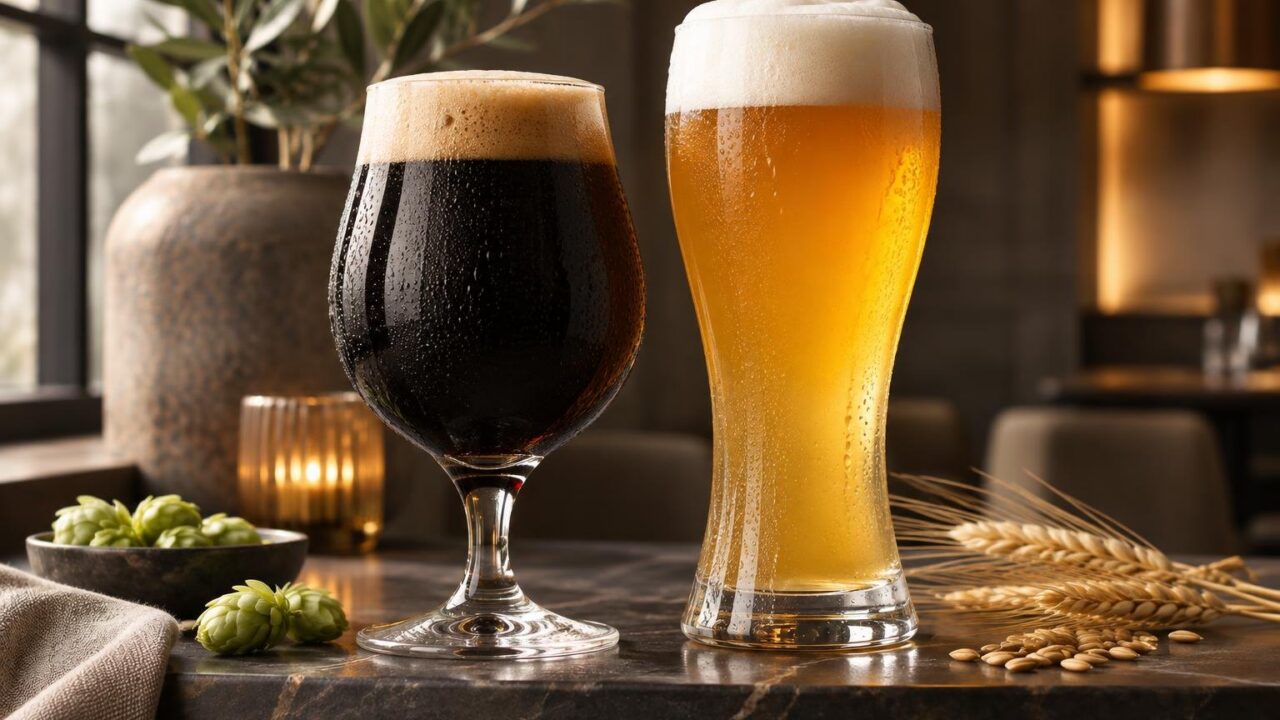
A black and white beer commonly pairs a pale wheat beer with a dark stout, often poured in layers. The name does not define a standardized recipe, so its strength and serving size depend on the beers and proportions your bartender uses.
Alcohol Strength: Calculate the Blend
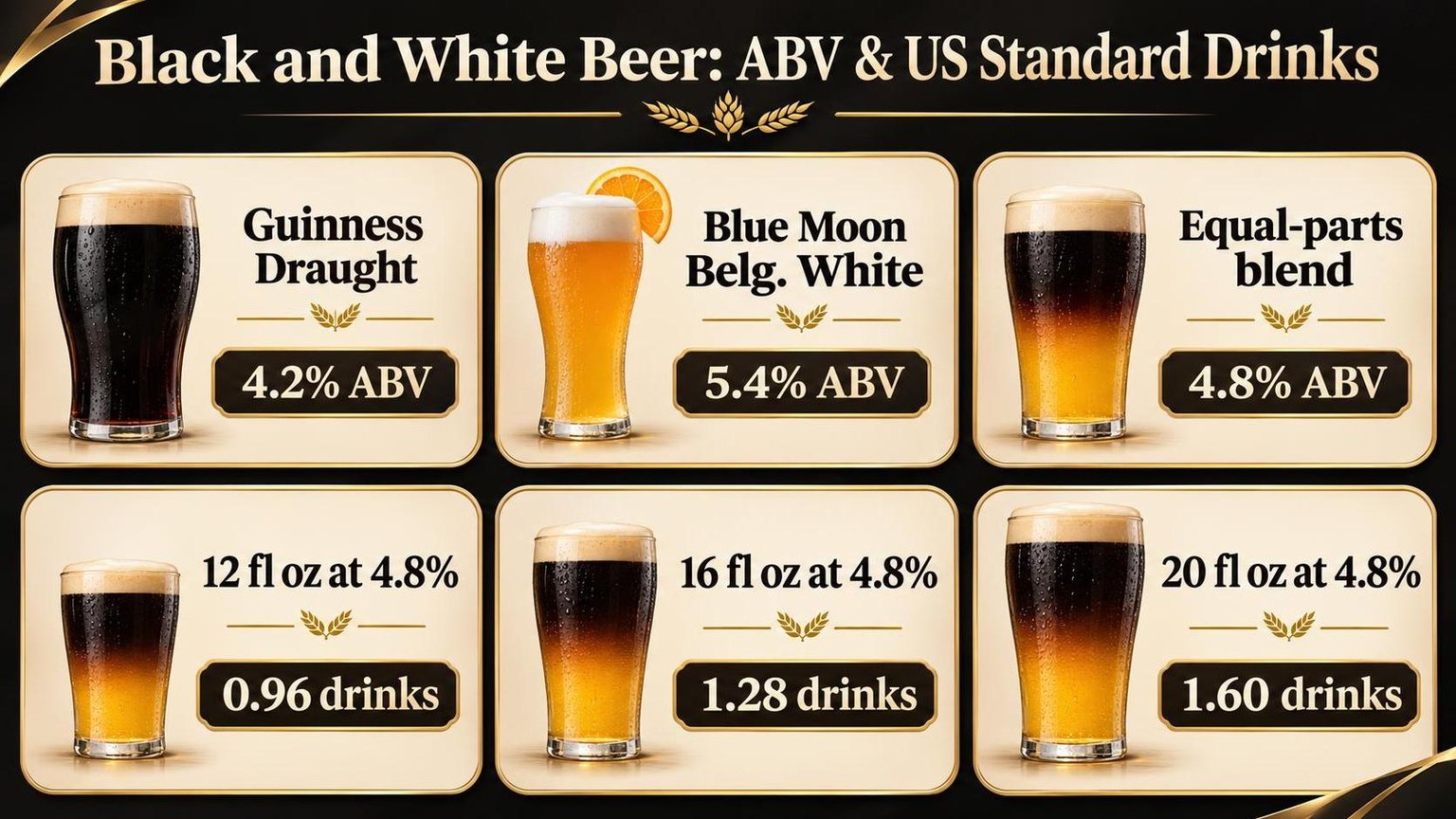
For a concrete example, use Guinness Draught and Blue Moon Belgian White.
Their published U.S. alcohol levels produce the following equal-parts blend; these figures do not apply automatically to other Guinness products, wheat beers, or regional formulations.
| Component | Pour volume | Alcohol by volume |
| Guinness Draught | 6 U.S. fl oz | 4.2% |
| Blue Moon Belgian White | 6 U.S. fl oz | 5.4% |
| Combined drink | 12 U.S. fl oz | 4.8% |
Calculate blended ABV by multiplying each beer’s volume by its ABV, adding those results, and dividing by total volume. Equal pours make the answer the arithmetic average.
Unequal pours require the full weighted calculation, even when the layers look evenly divided through the glass.
Sources: Guinness, “Guinness Draught,” https://www.guinness.com/en-us/beers/guinness-draught; Blue Moon Brewing Company, “Belgian White,” https://www.bluemoonbrewingcompany.com.
Check the package when buying, because product names and market-specific formulations matter.
Serving Size: One Glass Is Not One Standard Drink
The National Institute on Alcohol Abuse and Alcoholism defines a U.S. standard drink as containing 14 grams of pure alcohol, approximately 0.6 U.S. fluid ounces. Apply that definition to the finished blend, not separately to its visible layers.
| Finished serving at 4.8% ABV | Pure alcohol, U.S. fl oz | U.S. standard drinks, approximately |
| 12 U.S. fl oz | 0.576 | 0.96 |
| 16 U.S. fl oz | 0.768 | 1.28 |
| 20 U.S. fl oz | 0.960 | 1.60 |
These calculations assume the stated volume is liquid beer. Foam, headspace, and underfilled glassware change the actual amount served. Ask for the pour size rather than treating “a pint” as a reliable alcohol measure.
Source: NIAAA, “What Is a Standard Drink?” https://www.niaaa.nih.gov/alcohols-effects-health/overview-alcohol-consumption/what-standard-drink. Standard drinks measure alcohol exposure; they do not establish a safe driving threshold.
Layering: Color Does Not Measure Density
A stout does not float because it is dark. Layering depends on the beers’ relative densities and a gentle pour that limits mixing.
Dissolved extract and alcohol affect density, so ABV alone cannot reliably predict whether two particular beers will separate.
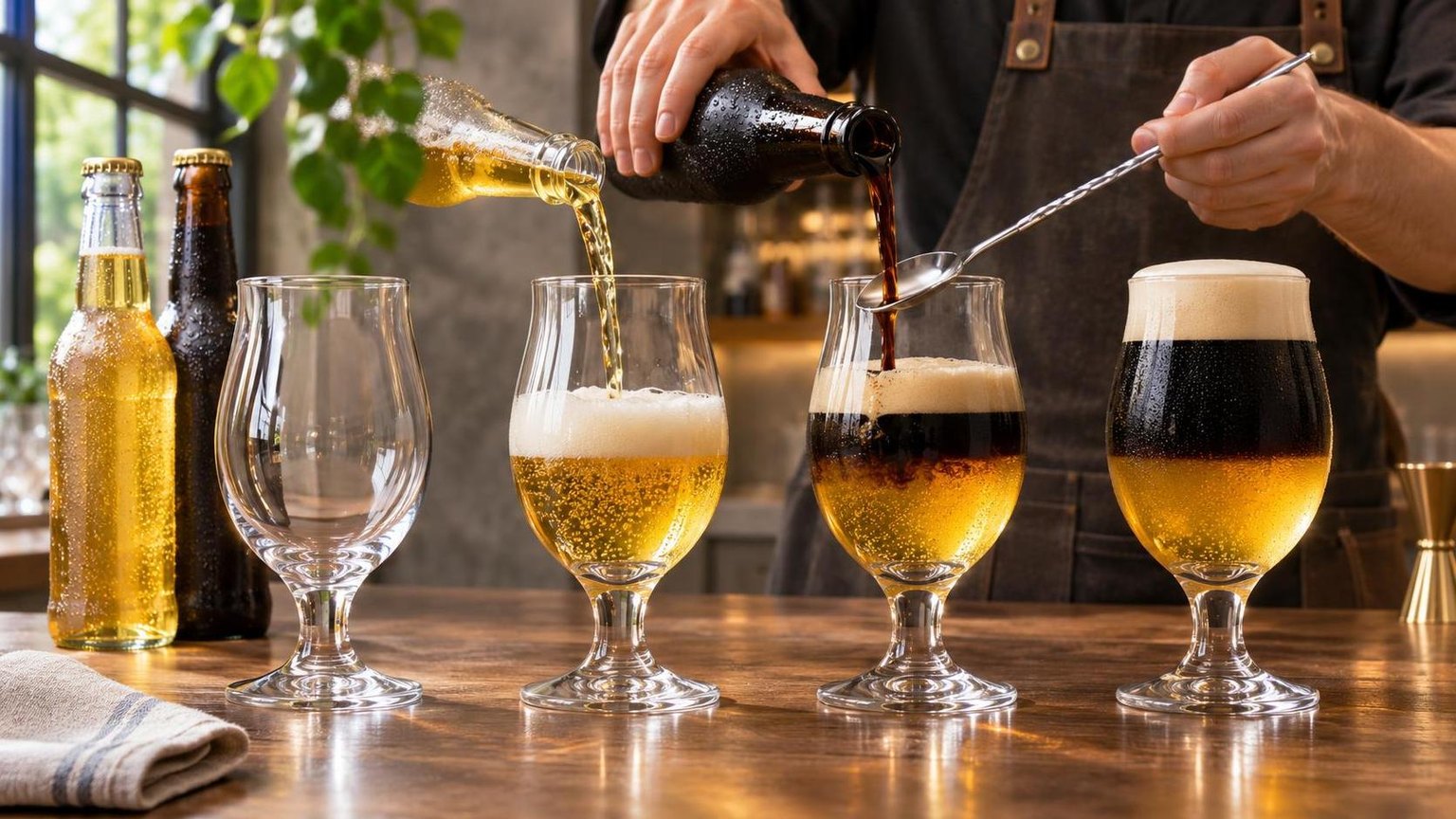
- Pour the wheat beer first, leaving room for the stout and its head.
- Add the stout slowly over the back of a spoon near the beer’s surface.
- Expect the boundary to blur during drinking. Mixing changes appearance, not the blend’s calculated alcohol content.
No universal density number guarantees a clean split across brands. Treat the recipe’s alcohol calculation as reproducible arithmetic and the layered presentation as a result that depends on the specific beers and pouring technique.
What Affects the Result
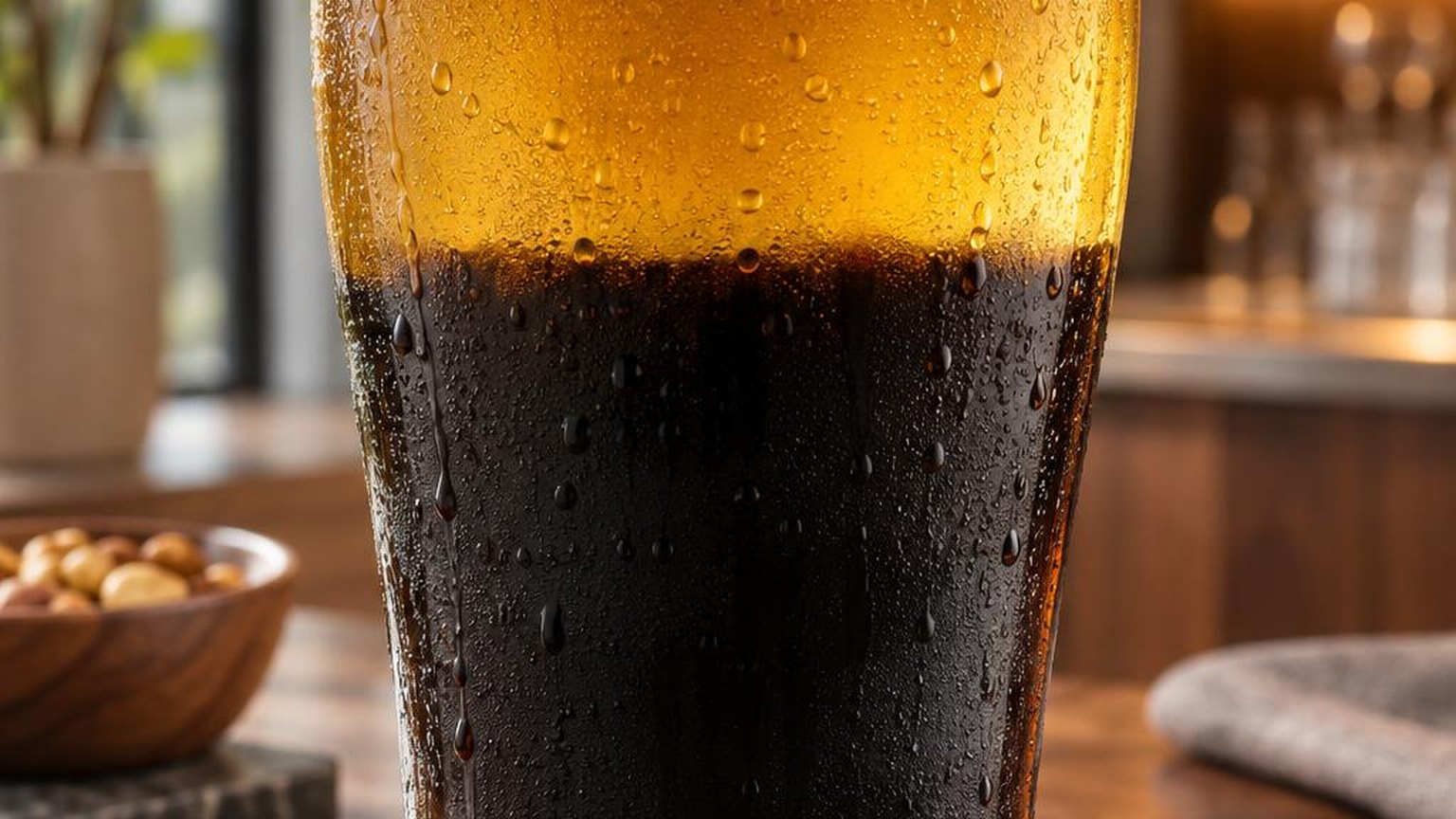
A black and white beer depends on the stout, the wheat beer underneath, and how gently they meet. Color creates the contrast, but liquid density and pouring turbulence determine whether you get distinct layers or a blended drink.
Density Matters More Than Color
Roasted malt makes stout dark; it does not automatically make it denser than pale beer. Finished-beer density reflects both dissolved extract, which raises density, and alcohol, which lowers it.
The denser beer belongs underneath if you want a stable boundary.
Alcohol percentage alone cannot predict the result. These commonly available examples illustrate why choosing by style or appearance is insufficient:
| Beer | Published alcohol by volume | Typical role |
| Guinness Draught | 4.2% | Dark upper pour |
| Hoegaarden White | 4.9% | Pale wheat-beer base |
Those figures describe alcohol content, not measured density. Guinness Draught can work as an upper layer, but no brand pairing guarantees a sharp division. Residual extract, temperature, and handling still matter.
Check your package because product specifications can vary by market.
Gas Changes Foam and Pour Behavior
Nitrogenated draught stout produces the fine-bubbled, creamy head associated with layered pub pours. Guinness Draught cans use a widget to help reproduce that presentation.
A conventionally carbonated bottled stout may produce a different head and mix more readily during an otherwise identical pour.
Nitrogen does not establish the density order of the underlying liquids. Its practical contribution is foam texture and dispensing behavior.
Do not substitute Guinness Extra Stout and assume it will behave exactly like Guinness Draught; they are different products.
Temperature, Glassware, and Technique
- Chill both beers together. Temperature changes density and gas release; using similarly chilled beers removes one avoidable source of variation.
- Use a beer-clean glass without grease or detergent residue. Contamination can damage foam, while scratches and particles provide sites for bubbles to form.
- Pour the wheat beer first, leaving room for the stout and its head. Let vigorous foaming settle before adding the upper beer.
- Hold an inverted spoon close to the surface and pour stout slowly across its back. The spoon spreads the stream and reduces the impact that drives mixing.
Haze and Time Affect Appearance
Witbier haze creates an opaque, pale base rather than a transparent golden one. Suspended yeast and protein contribute to that appearance.
Follow the wheat beer’s serving instructions, but avoid agitating the assembled drink if preserving the boundary is your priority.
Serve promptly. Movement, temperature gradients, and diffusion gradually soften the division. A blurred boundary does not indicate spoilage; it usually reflects mixing.
Sources: Manufacturer product information: https://www.guinness.com/en-us/beers/guinness-draught and https://hoegaarden.com/.
Brewing principles: Brewing: Science and Practice, Briggs, Boulton, Brookes, and Stevens, covers beer extract, alcohol, carbonation, and foam.
How It Is Measured and Verified
For a layered black and white beer, verification separates three questions: what each beer is, how its color is measured, and whether the finished liquids form distinct layers.
A dark appearance does not prove higher density, higher alcohol, or a particular beer style.
Measure Color, Not Perceived Strength
Brewers measure beer color using the Standard Reference Method, or SRM.
ASBC Methods of Analysis, Beer-10, describes spectrophotometric color measurement at 430 nanometers; for a clear sample in a 1-centimeter cell, SRM equals absorbance multiplied by 12.7, with dilution accounted for.
That measurement requires appropriate sample preparation. Suspended yeast and wheat proteins scatter light, so an untreated, cloudy witbier can produce a misleading absorbance reading.
Laboratory clarification helps isolate color, but it does not describe the haze drinkers see in the glass.
The BJCP’s 2021 Beer Style Guidelines provide useful reference ranges for two styles commonly used in this combination. These are style benchmarks, not certified measurements of any particular brand or poured serving.
| Measurement | Witbier, style 24A | Irish stout, style 15B |
| Color, SRM | 2–4 | 25–40 |
| Alcohol by volume | 4.5–5.5% | 4.0–4.5% |
| Final gravity | 1.008–1.012 | 1.007–1.011 |
The overlapping final-gravity ranges matter: style names alone cannot establish which beer will float. Roasted malt creates strong color without necessarily making the finished stout denser than the pale beer beneath it.
Check Finished Density and Alcohol Separately
For layering, compare the actual finished beers under consistent conditions. Degas separate samples, bring them to the instrument’s specified temperature, and measure with a calibrated hydrometer or density meter.
Carbonation bubbles adhering to a hydrometer can distort its reading.
- Record each product, batch identifier, sample temperature, and measured specific gravity.
- Use finished density rather than original gravity. Original gravity describes wort before fermentation changes its sugar and alcohol content.
- Do not read alcohol directly from a standard brewing hydrometer. Estimating alcohol requires additional information, commonly original and final gravity.
- Do not treat an uncorrected refractometer reading as final gravity after fermentation; alcohol changes the refractive index.
Verify the Pour Under Repeatable Conditions
Use the same glass, beer temperatures, serving volumes, and pouring technique for each trial. Place the denser finished beer underneath, then introduce the other gently over a spoon.
Pouring turbulence can destroy separation even when the density difference favors layering.
Photograph the boundary immediately and at predetermined intervals, recording the observation times. A visible boundary verifies temporary separation, not ingredient identity or laboratory color.
Dissolved components gradually diffuse, while handling and temperature-driven currents can accelerate mixing.
Sources: ASBC Methods of Analysis, Beer-10: Color; BJCP 2021 Beer Style Guidelines, 24A Witbier and 15B Irish Stout.
How It Compares to Common Alternatives
A black and white beer typically pairs dark stout with pale wheat beer, often Guinness Draught and Hoegaarden.
Unlike a standardized beer style, the name describes a mixed pour, so its flavor, strength, and appearance depend on the beers and proportions your bartender uses.
Strength and Ingredients
The table uses published U.S. alcohol levels and equal-volume blends. Calculated blend strengths assume the beers combine without a meaningful change in total volume; they are estimates, not laboratory measurements of a finished pub pour.
| Drink | Composition | ABV |
| Black and white | 50% Guinness Draught, 50% Hoegaarden | 4.55%, calculated |
| Stout-and-lager half and half | 50% Guinness Draught, 50% Harp Lager | 4.35%, calculated |
| Guinness Draught | Unmixed stout | 4.2% |
| Hoegaarden Original White Ale | Unmixed Belgian wheat beer | 4.9% |
| Harp Lager | Unmixed lager | 4.5% |
These figures show why dark color does not establish alcohol strength. Adding Guinness Draught to Hoegaarden lowers the wheat beer’s ABV in this recipe.
For alcohol intake, compare both the finished ABV and serving volume rather than judging the darkness of the glass.
Black and Tan: More Malt, Less Citrus
A black and tan generally combines stout with pale ale, although recipes vary. Compared with the Hoegaarden version, an ale-based pour usually emphasizes malt and hop character rather than wheat-beer spice.
The exact difference depends on whether the base ale is restrained or strongly hopped.
Hoegaarden identifies coriander and orange peel among its ingredients. Those additions give this black and white recipe a distinct citrus-and-spice component alongside Guinness’s roasted character.
Ask which base beer the bar uses; the drink’s name alone cannot establish its flavor.
Half and Half: A Cleaner Base
A Guinness-and-Harp half and half replaces spiced wheat beer with lager. Expect a cleaner base without Hoegaarden’s coriander-and-orange profile.
It suits drinkers who want stout character moderated by lager rather than combined with another expressive beer.
Terminology overlaps between pubs and countries. Order by ingredients if you want a particular combination.
In Ireland, “Black and Tans” also refers to a British police auxiliary force associated with the Irish War of Independence, making that name culturally sensitive.
Straight Stout or Wheat Beer: More Predictable
Choose straight Guinness for an uninterrupted roasted profile and nitrogenated texture. Choose Hoegaarden for its cloudy wheat-beer character and citrus-spice emphasis.
Mixing changes both experiences, and a visibly layered pour can taste different as you drink through it.
Layering depends on relative density and pouring technique, not simply color. A dark beer does not automatically float above a pale one.
If consistency matters more than presentation, an unmixed beer offers the clearest match between the label and the glass.
Sources: Manufacturer product information from Guinness and Harp at guinness.com and Hoegaarden at hoegaarden.com supports the listed beer strengths and ingredient descriptions.
Product formulations can differ by market; check the labels used for your pour.
Health, Safety, and Practical Tips
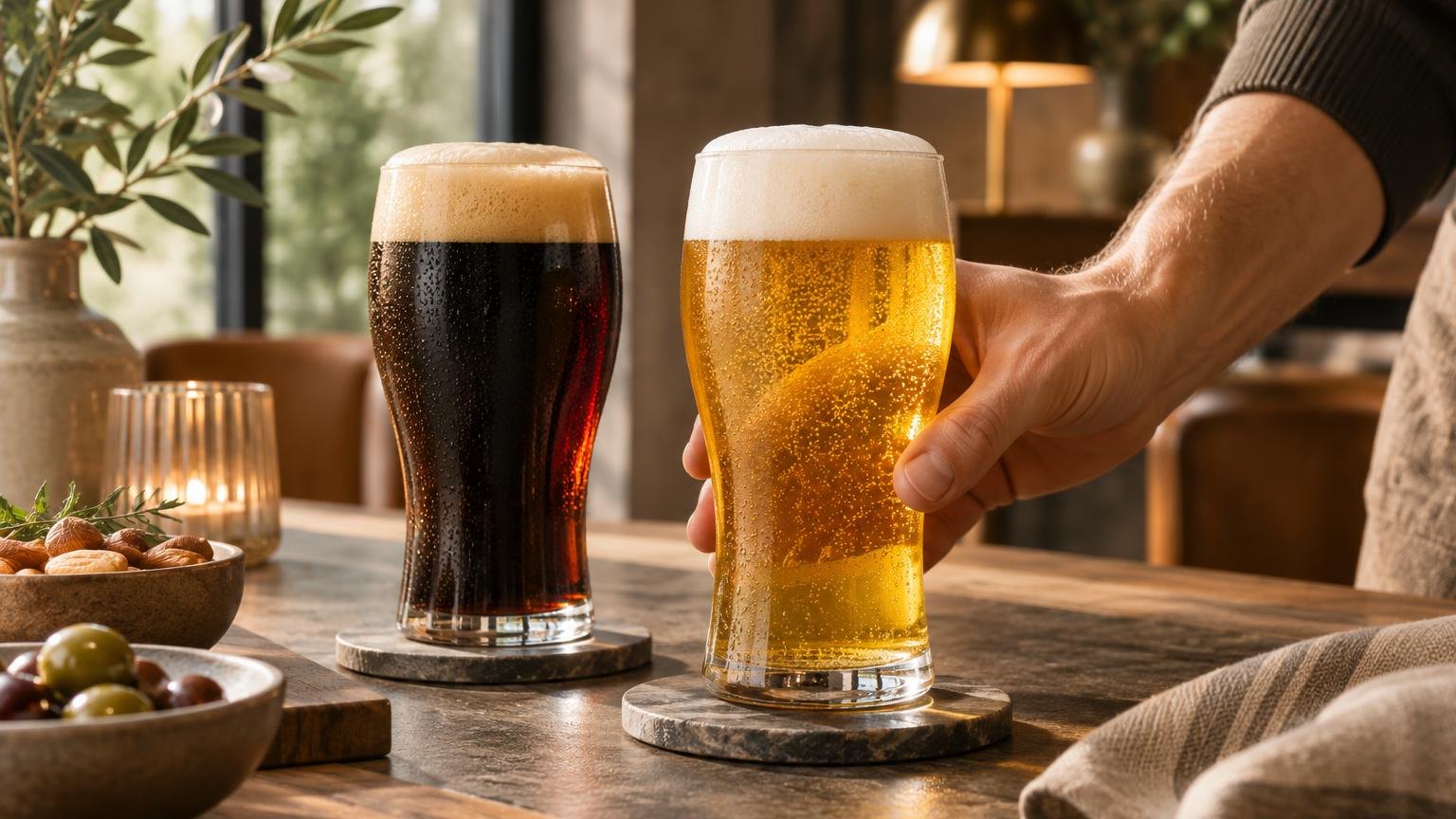
A black and white beer usually combines a dark beer with a pale or wheat beer, sometimes in distinct layers. Its health effects depend on the ingredients, alcohol concentration, and serving size—not the contrast between the beers.
Count Alcohol, Not Colors
Darkness does not reliably indicate strength, calories, or nutritional value. Roasted malt can make a relatively low-alcohol beer nearly black, while a pale beer can contain substantially more alcohol. Check both labels before mixing.
The National Institute on Alcohol Abuse and Alcoholism defines a US standard drink as 14 grams of pure alcohol. The examples below show why a full glass does not necessarily equal a single standard drink.
| Example serving | Volume | Alcohol by volume | US standard drinks |
| Reference regular beer | 12 fl oz | 5% | 1.00 |
| Hypothetical black-and-white blend | 12 fl oz | 4.6% | 0.92 |
| Same blend, larger glass | 16 fl oz | 4.6% | 1.23 |
Table values are rounded estimates. Calculate a blend’s ABV by multiplying each beer’s volume by its ABV, adding those results, and dividing by total volume. Layering changes presentation, not the amount of alcohol poured.
Check Ingredients and Personal Risks
- Gluten: Conventional barley stout and wheat beer contain gluten. People with celiac disease should choose products specifically labeled gluten-free rather than assume fermentation removes it. The FDA cautions that gluten testing in fermented products has important limitations.
- Milk and other allergens: Milk stout may contain lactose, which can cause symptoms in people with lactose intolerance. Milk allergy involves milk proteins, not lactose; check with the producer about milk-derived ingredients and cross-contact. Specialty beers may also contain nuts or other allergens.
- Medication interactions: Ask a pharmacist before combining alcohol with medicines, especially opioids, benzodiazepines, sleep aids, or sedating antihistamines. NIAAA warns that interactions can increase sedation and other serious risks.
- Pregnancy: CDC states that there is no known safe amount, safe time, or safe type of alcohol during pregnancy. Mixing beers or choosing a lighter-colored beer does not change that guidance.
Serve Carefully and Plan Ahead
Use a clean, intact glass and a clean spoon when layering. Pour slowly to control foam and avoid overflow. If the beers mix instead of separating, that is a presentation issue, not evidence that the drink is unsafe.
Eat before or while drinking, and alternate with water for hydration and pacing. Neither food nor water makes alcohol harmless or speeds its elimination. Coffee and cold showers do not sober someone up; arrange transportation before drinking.
Sources: NIAAA, “What Is a Standard Drink?” and “Harmful Interactions: Mixing Alcohol With Medicines”; CDC, “About Alcohol Use During Pregnancy”; FDA guidance on gluten-free labeling of fermented or hydrolyzed foods.
Questions People Ask Most
What is black and white beer?
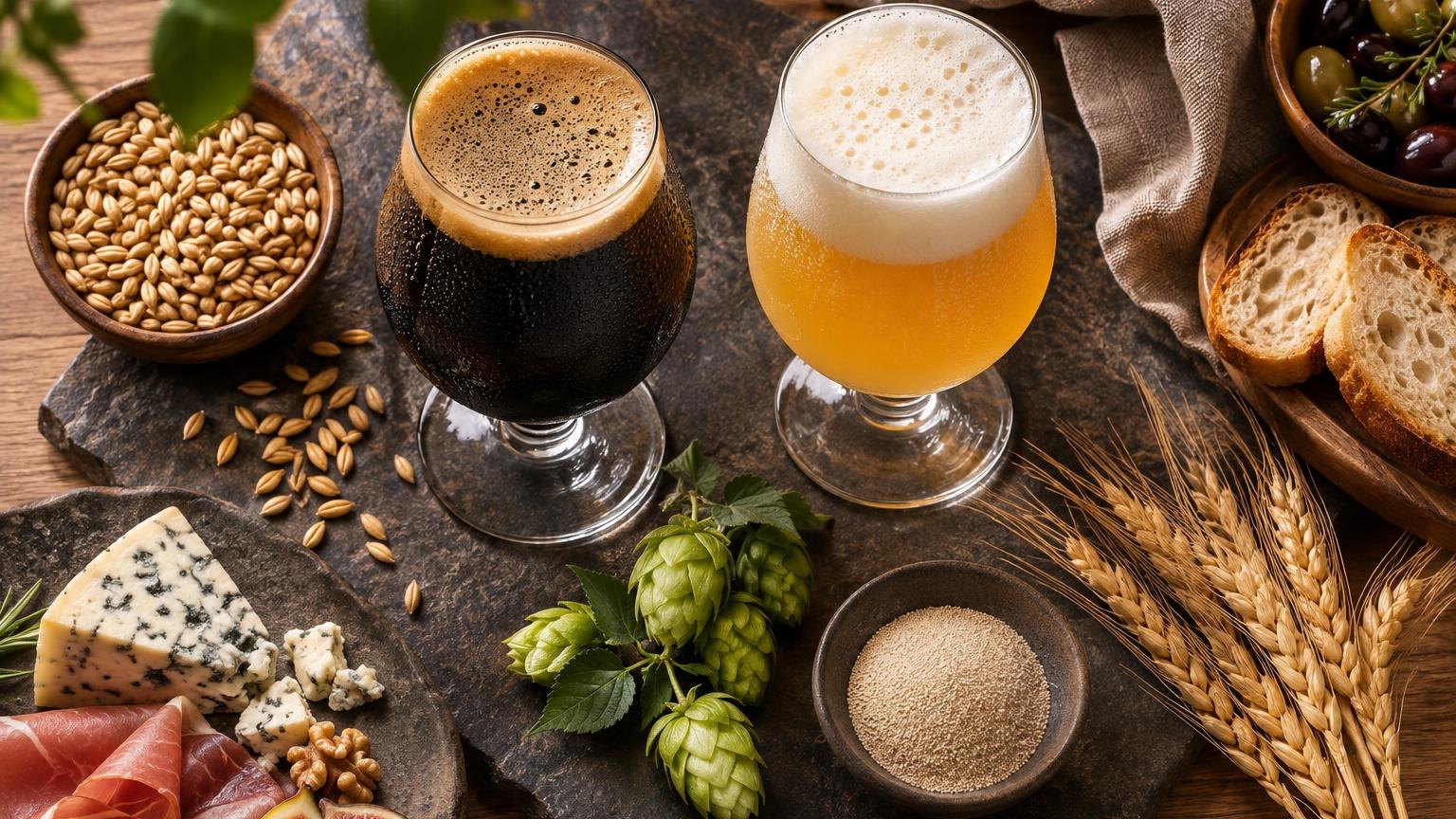
“Black and white beer” is not a standardized beer style; it can describe a dark beer layered over a pale wheat beer or a comparison of dark and white beers.
For a layered drink, ask which two beers the bar uses because the name does not specify a fixed recipe.
What makes white beer “white”?
Belgian witbier, also called bière blanche, gets its pale, cloudy appearance from suspended yeast and proteins in a wheat-rich grain bill.
The BJCP’s 2021 Beer Style Guidelines describe a typical recipe containing roughly 50% unmalted wheat, often seasoned with coriander and orange peel.
Is the black beer always a stout?
No: black beer can be stout, porter, or a dark lager such as German Schwarzbier.
The BJCP’s 2021 guidelines describe Schwarzbier as a 4.4–5.4% ABV lager with restrained roasted character, so black color does not automatically mean heavy body or intense bitterness.
Why can black beer float above white beer?
The upper beer must have a lower finished density than the beer beneath it; color does not determine which beer floats. Alcohol and dissolved extract affect density, while a gentle pour limits mixing enough to preserve the visible boundary.
How do you pour a layered black and white beer?
Fill a clean glass about halfway with chilled witbier, leaving room for its foam to settle.
Slowly pour a suitable lower-density stout over the back of a spoon held just above the surface; Guinness Draught is a common layering choice, but the result depends on the specific bottom beer.
How much alcohol does a black and white beer contain?
Calculate its approximate ABV by weighting each beer’s strength by its poured volume. Equal volumes of a 4.2% ABV stout and a 5.0% ABV witbier produce a 4.6% ABV blend—not 9.2%.
Is black and white beer gluten-free?
A conventional stout-and-witbier blend is not gluten-free: stout usually contains barley, and witbier contains wheat and usually barley.
FDA guidance distinguishes “gluten-free” claims from claims that a product was processed to remove gluten; people with celiac disease should not treat ordinary beer or a gluten-reduced blend as a gluten-free option.
- Beer Companies That Support LGBTQ Communities
- Modelo Especial Alcohol Content – Find Out Now
- Is Beer Carbonated? The Most Accurate Answer
- What Is Craft Cider? Basic Information You Must Know
- What Are Beers From Japan? The Answer You Must Know
- How Many Kegs In A Barrel?
- Coors Vs Coors Banquet: Which is Best?
- How Many Bottles Of Beer In A Keg? A Real-World, Experience-Driven Guide
- All Alcohol Guides
- Beer Judge Certification Program: Irish Stout (2021)
- Beer Judge Certification Program: Witbier (2021)
- Beer Judge Certification Program: American Stout (2021)
- Beer Judge Certification Program: Weissbier (2021)
- USDA and HHS: Dietary Guidelines for Americans, 2020–2025 (2020)
- U.S. Surgeon General: Alcohol and Cancer Risk Advisory (2025)
- CDC: Deaths from Excessive Alcohol Use—United States, 2016–2021 (2024)