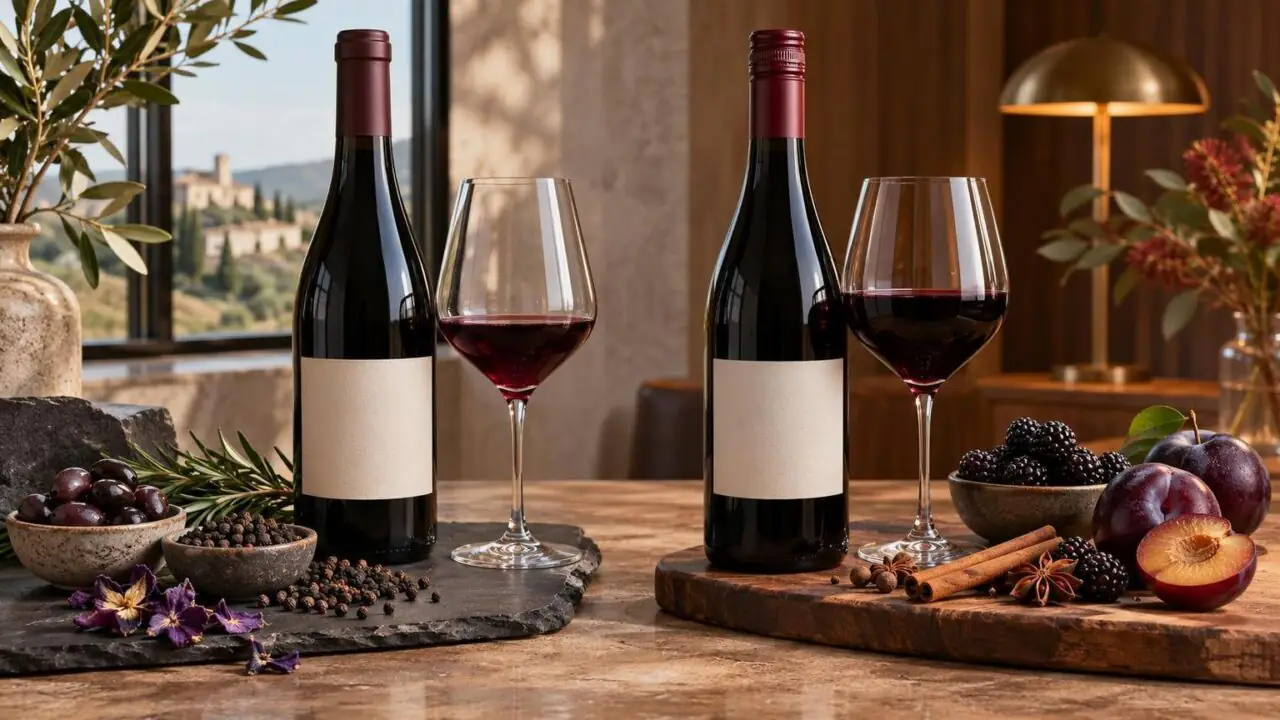
The difference between syrah and shiraz is mainly regional naming: Syrah is the usual name in France and many cooler-climate regions, while Shiraz is common in Australia and other warmer regions.
Both names refer to the same grape variety, not two distinct grapes.
The style can vary with climate and winemaking, so the label offers a clue rather than a guarantee. Syrah often suggests savory notes such as pepper, herbs, and olive; Shiraz is often associated with riper fruit and fuller body.
These are tendencies, not strict rules: producers in either region can make wines across a range of styles.
Understanding the names helps you interpret a bottle, but checking its region and producer gives a more reliable guide to what’s in the glass.
Syrah and Shiraz Are the Same Grape
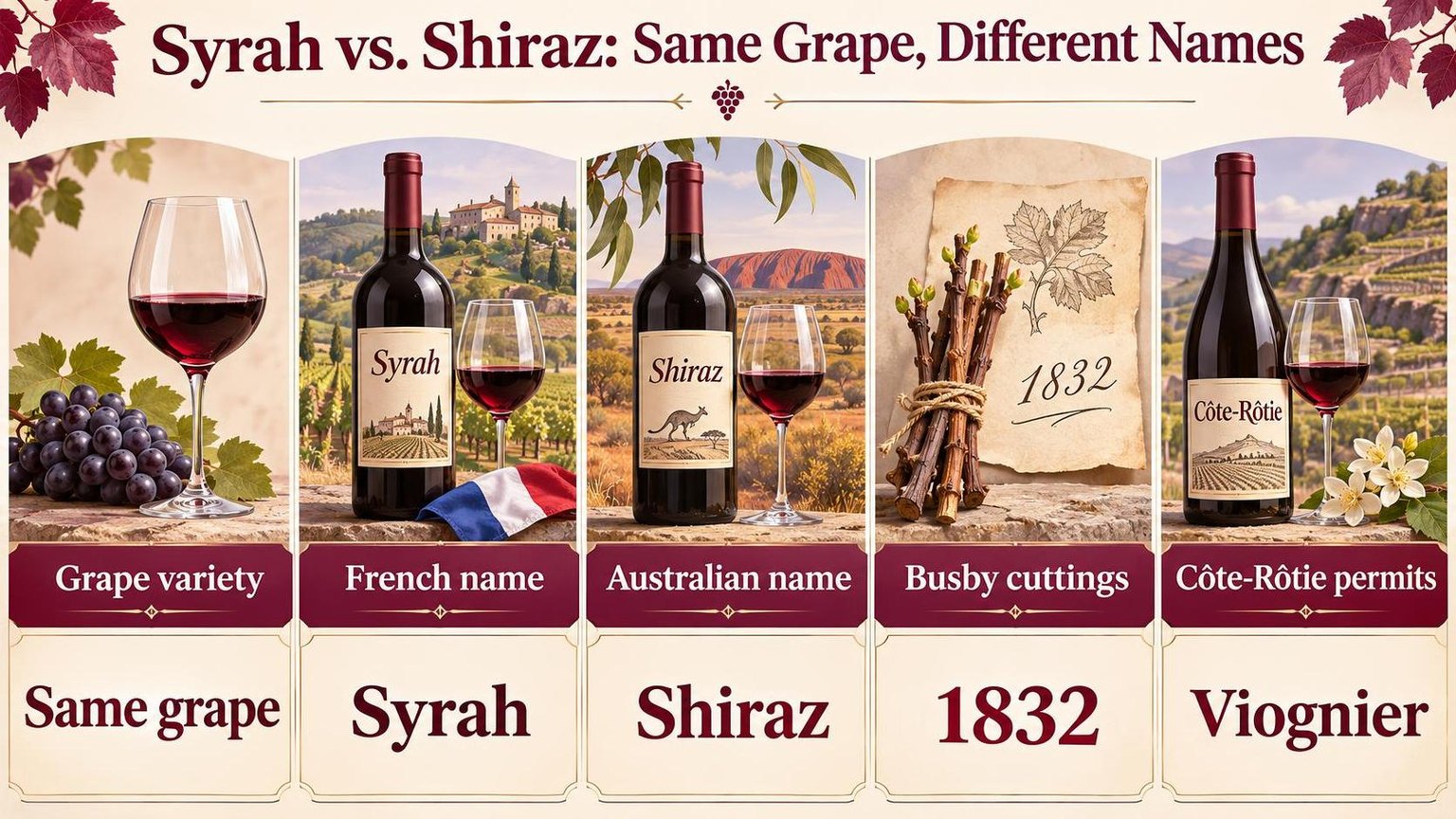
Syrah and Shiraz are two names for the same red grape variety, not separate grapes. A bottle labeled Shiraz is not automatically sweeter, stronger, or made from a different vine than one labeled Syrah.
The name usually signals where the wine was made or the style its producer wants to convey.
DNA research identified Syrah’s parents as the French varieties Dureza and Mondeuse Blanche (Meredith et al., American Journal of Enology and Viticulture, 1999).
That finding places the grape’s ancestry in southeastern France; it does not support the often-repeated claim that Syrah originated in the Iranian city of Shiraz.
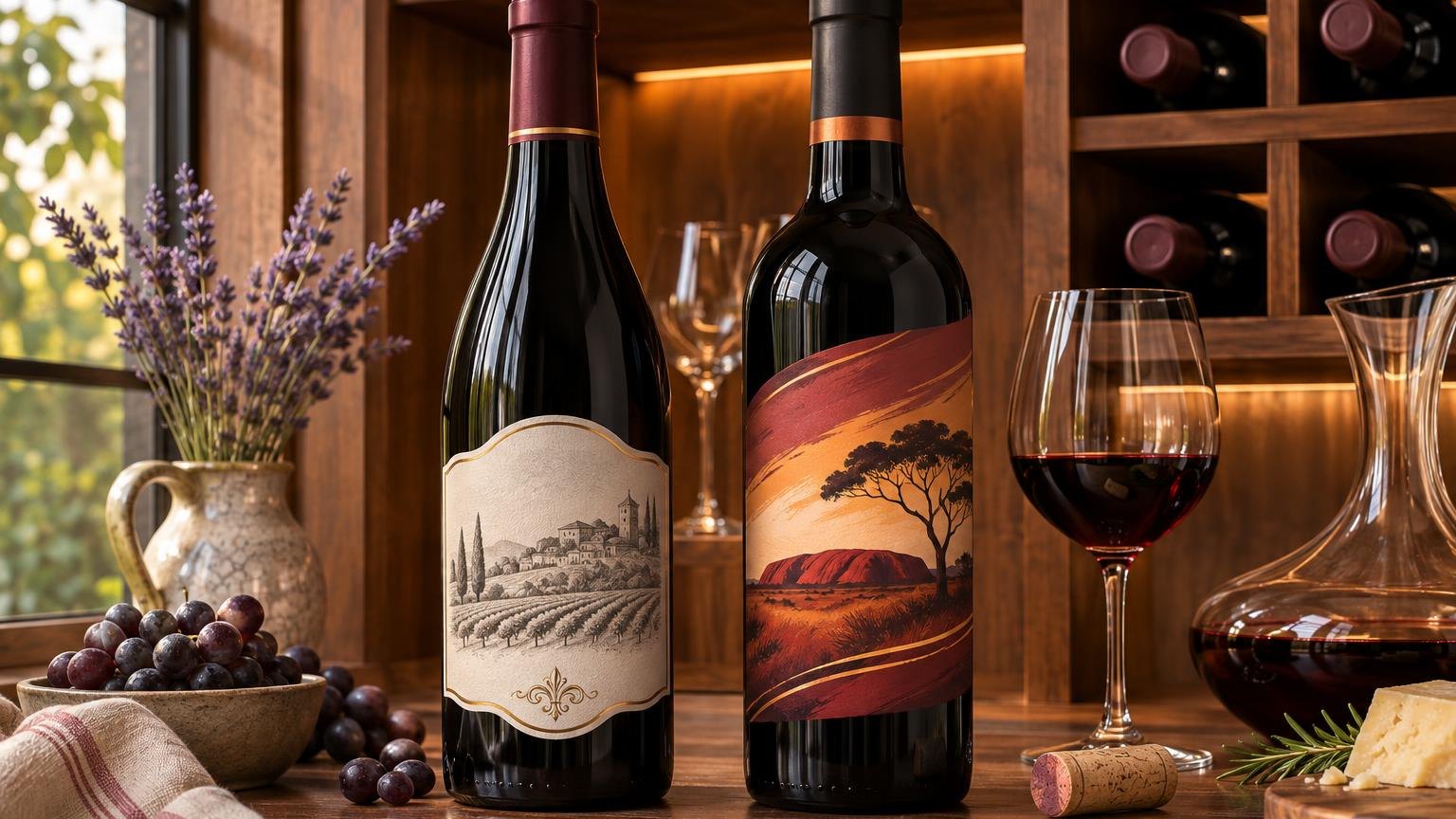
Australia adopted the name Shiraz. James Busby brought cuttings from France to Australia in 1832, helping establish the grape there (Wine Australia).
In France, producers generally call it Syrah, although wines from appellations such as Hermitage and Côte-Rôtie are usually labeled by place rather than by grape variety.
| Label name | Common association | What it guarantees |
| Syrah | France, or a producer aiming for a more savory, restrained style | The grape variety, if stated as a varietal label under applicable labeling rules—not a particular flavor |
| Shiraz | Australia, or a producer aiming for a riper, fruit-forward style | The same grape variety—not a particular level of sweetness or alcohol |
The style distinction is useful, but it is not a rule. A warm-climate Shiraz may taste of ripe blackberry and plum, while a cooler-site Syrah may show black pepper, violet, and firmer acidity.
Climate, harvest timing, winemaking, and oak use can all affect the result; the name alone cannot tell you which flavors will dominate.
Nor does a regional name ensure that the wine contains only Syrah. Côte-Rôtie, for example, permits producers to include Viognier, a white grape, alongside Syrah under its appellation rules (INAO, Côte-Rôtie product specification).
For a precise answer about any bottle, check its grape information and region rather than treating “Syrah” and “Shiraz” as opposing categories.
Why Winemakers Choose Each Name
Syrah and Shiraz name the same grape variety, but the choice of name can tell buyers something about a producer’s heritage or intended style.
It is a signal, not a guarantee: the spelling alone cannot establish where a wine was grown or how it will taste.
“Syrah” connects a wine to the grape’s French identity, especially the northern Rhône.
Côte-Rôtie and Hermitage are appellations closely associated with Syrah, although their labels generally emphasize the appellation name rather than the grape. Producers elsewhere may choose “Syrah” to evoke that tradition.
“Shiraz” reflects Australian usage. Wine Australia traces the grape’s arrival in Australia to James Busby’s collection of vine cuttings in 1832.
The name subsequently became closely associated with Australian wine, particularly the ripe, powerful reds for which regions such as the Barossa Valley are known.
| Name chosen | Common message to buyers |
| Syrah | A French or Rhône-inspired identity; sometimes a more restrained stylistic aim. |
| Shiraz | An Australian identity; sometimes a fuller-bodied stylistic aim. |
Those messages are conventions, not definitions. Wine Australia describes Australian Shiraz styles ranging from peppery, medium-bodied wines in cooler areas to richer wines from warmer regions.
An Australian bottle labeled “Shiraz” therefore need not be especially heavy, and a bottle labeled “Syrah” need not be lean.
Winemakers also use the name to set expectations within a range. A producer might label one bottling Syrah to emphasize savory character and another Shiraz to emphasize ripe fruit.
That decision communicates an intention; vineyard climate, harvest timing, fermentation and oak treatment determine far more about the finished wine.
Neither word certifies a different grape. Australia’s varietal-labeling rule requires at least 85% of a wine to come from a named variety, according to Wine Australia’s labeling guidance.
Because Syrah and Shiraz are names for the same variety, choosing one spelling over the other does not change that underlying varietal claim.
For a better prediction of flavor, read the region and producer alongside the grape name. “Barossa Valley Shiraz” supplies useful information about origin; “Syrah” by itself supplies no comparable climate or winemaking detail.
French Syrah From the Northern Rhône
In the northern Rhône, Syrah is the grape behind red wines from Côte-Rôtie, Hermitage, Saint-Joseph, Crozes-Hermitage, and Cornas. Syrah and Shiraz are the same grape variety; the name on the bottle does not indicate a different vine.
It often signals a different place and winemaking tradition.
The Rhône River runs through a narrow valley where vineyard exposure matters. Many prized parcels occupy steep, sun-facing slopes that help Syrah ripen in a relatively cool setting.
Granite is prominent in Cornas and parts of Hermitage, while other sites have different soils and exposures; there is no single northern Rhône terroir.
Appellation rules also shape what “Syrah” means on a label. The French national appellation authority, INAO, specifies the permitted grapes for each appellation in its published cahier des charges:
| Red-wine appellation | Grape rule |
| Cornas | 100% Syrah |
| Côte-Rôtie | Syrah, with up to 20% Viognier permitted |
Viognier is a white grape. Its permitted use in Côte-Rôtie is an appellation-specific tradition, not a requirement: a Côte-Rôtie can contain no Viognier at all.
Cornas, by contrast, offers a straightforward example of red wine made exclusively from Syrah under its appellation rules.
Northern Rhône Syrah commonly shows black pepper, violet, dark fruit, olive, or smoked-meat notes, but these are tasting descriptors, not guaranteed ingredients or flavors.
A cooler site or earlier harvest can emphasize freshness and pepper; warmer exposures and riper fruit can yield a fuller impression. Winemaking choices, including stem use and oak aging, add further variation.
That range makes “French Syrah” a useful starting point, not a promise that every bottle will taste lean or savory. Cornas can be dense and powerful, while Côte-Rôtie may feel fragrant and supple.
Producer and vintage matter as much as the regional shorthand when comparing either wine with an Australian Shiraz.
For an authoritative check on a bottle’s permitted grapes, consult INAO’s appellation specifications.
For an overview of each appellation’s geography and wines, Inter Rhône publishes individual profiles for Côte-Rôtie, Hermitage, and Cornas.
Australian Shiraz and Its Regional Styles
Shiraz is Australia’s name for the Syrah grape, but an Australian Shiraz is not one fixed style. Climate, site and winemaking shape wines that range from plush and fruit-rich to peppery, floral and savory.
These regional patterns are useful when choosing a bottle, not guarantees of its flavor.
Wine Australia’s regional profiles distinguish the warmer Barossa Valley from its higher-altitude neighbor, Eden Valley, and describe substantial variation within regions such as McLaren Vale.
| Region | Typical Shiraz expression |
| Barossa Valley, South Australia | Full-bodied wines with ripe blackberry or plum fruit, often joined by chocolate, spice and generous tannins. Warm sites help grapes reach substantial ripeness. |
| Eden Valley, South Australia | A cooler, higher-altitude Barossa subregion. Shiraz often shows red or dark fruit, pepper and firmer structure, with a more restrained impression than many Barossa Valley examples. |
| McLaren Vale, South Australia | Typically ripe and full-bodied, with dark fruit and spice. Coastal influence and differences among its sites mean the wines need not taste alike. |
| Heathcote, Victoria | Known for concentrated dark-fruit Shiraz with spice and firm tannins. Its celebrated Cambrian soils occur in parts of the region, not throughout every vineyard. |
| Grampians, Victoria | A cooler-climate expression commonly associated with pepper, red fruit and savory notes rather than the plushness of warmer regions. |
| Hunter Valley, New South Wales | Often medium-bodied and savory, with earthy notes that can become more pronounced with bottle age. |
“Old vine” is especially relevant in the Barossa, but it describes vine age—not a separate grape or a promised flavor. The Barossa Old Vine Charter sets the following minimum ages for its classifications:
| Charter classification | Minimum vine age |
| Old Vine | 35 years |
| Survivor Vine | 70 years |
| Centenarian Vine | 100 years |
| Ancestor Vine | 125 years |
Those thresholds help explain a label’s claim, but age alone does not establish quality.
For a practical comparison, taste a Barossa Valley Shiraz beside an Eden Valley or Grampians Shiraz: note the fruit’s ripeness, any pepper aroma, and how firmly the tannins grip.
Climate’s Effect on Flavor and Body
Syrah and Shiraz are the same grape, but growing temperature can make their wines taste strikingly different.
Cooler sites tend to preserve acidity and emphasize savory aromas; warmer sites generally produce riper fruit, more sugar at harvest, and fuller-bodied wines.
| Growing conditions | Typical fruit and savory notes | Typical structure |
| Cooler sites, such as parts of the northern Rhône | Blackberry, violet, olive, smoked meat, and black pepper | Fresher acidity, firmer tannins, and a leaner impression |
| Warmer sites, such as much of South Australia’s Barossa Valley | Ripe blackberry, plum, and sometimes chocolate or licorice | Higher potential alcohol, softer-tasting acidity, and a broader impression |
Sunlight and warmth help grapes accumulate sugar. During fermentation, yeast converts that sugar into alcohol, so fruit picked at higher sugar levels can yield a stronger wine.
Warmth also reduces malic acid in the berries, helping explain why a ripe Barossa Shiraz often feels rounder than a Syrah from a cooler northern Rhône site (WSET, Level 3 Award in Wines Specification).
Black pepper is not simply a winemaker’s tasting metaphor. Syrah contains rotundone, an aroma compound with a reported detection threshold of about 16 nanograms per liter in red wine.
Research found that roughly 20% of people tested could not perceive it, even at high concentrations (Wood et al., Journal of Agricultural and Food Chemistry, 2008).
Cool conditions often favor peppery expression, but climate does not act alone. Vineyard position, shade, harvest date, and vintage weather affect the fruit; fermentation choices and oak aging further change what reaches the glass.
A warm-region Shiraz can still taste peppery, while a cool-region Syrah can be rich and substantial.
Use the label as a clue, not a guarantee. Producers often choose “Shiraz” for a ripe, fruit-forward style and “Syrah” for a more restrained one, but neither name sets a legal climate or flavor standard.
For a useful comparison, taste a northern Rhône Syrah beside a Barossa Shiraz and check their stated alcohol levels as well as their aromas.
How Labels Signal Different Wine Styles
Syrah and Shiraz are two names for the same grape, not two legally defined styles.
A label can still offer a useful clue: producers often choose “Syrah” to suggest a more savory expression and “Shiraz” to suggest a fruit-forward one. Neither name guarantees what is in the glass.
Place names are often more informative than the grape name. In France’s northern Rhône, a bottle may say “Cornas” or “Crozes-Hermitage” rather than Syrah.
In Australia, the grape name is usually prominent, while a region such as Barossa Valley or Adelaide Hills adds context about where it grew.
| Label cue | Useful expectation | Important limit |
| Syrah | Often signals an emphasis on pepper, herbs, acidity, and restrained oak. | It can still be ripe, full-bodied, or heavily oaked. |
| Shiraz | Often signals generous dark fruit and a rounder impression. | It can also be peppery and structured, particularly from cooler sites. |
| French appellation name | Identifies a regulated origin; Cornas, for example, is a northern Rhône appellation for red wine made from Syrah. | The place name may not tell a new buyer which grape is inside. |
| Australian regional name | Helps narrow the likely growing conditions and producer style. | Climate, harvest decisions, and winemaking vary within every region. |
For a concrete contrast, compare bottles from producers rather than treating the names as opposing categories. A Barossa Shiraz may emphasize ripe blackberry and chocolate, while a northern Rhône Syrah may foreground black pepper and olive.
Those are common tasting profiles, not requirements imposed by the words on the label.
Grape-name rules also differ by country. Wine Australia’s Label Integrity Program requires a single-variety claim to reflect at least 85% of the wine.
In the United States, the Alcohol and Tobacco Tax and Trade Bureau generally requires at least 75% of the named grape for a varietal label under 27 CFR § 4.23.
When choosing a bottle, read the region, producer, and any tasting description alongside “Syrah” or “Shiraz.” If a retailer can identify the vintage and producer, compare those specific wines.
The same producer’s harvest choices and oak use can matter more than which synonym appears in larger type.
Pairing Syrah and Shiraz With Food
Pair by the wine’s weight and flavor, not just the name on the label. A peppery, savory Syrah can make herbs and grilled meat taste more vivid, while a ripe, fruit-forward Shiraz can stand up to sweeter glazes and bolder spices.
The distinction is stylistic, not botanical: Syrah and Shiraz are the same grape. Northern Rhône Syrah often emphasizes black pepper, olive and savory notes; warm-climate Australian Shiraz commonly shows riper dark fruit and a fuller body.
Producer and vintage still matter, so use the bottle’s tasting notes to refine your choice.
| Style | Try it with | Why it works |
| Peppery, savory Syrah | Grilled lamb with rosemary; mushroom ragù; pepper-crusted steak | Herbs, browned flavors and black pepper echo the wine’s savory character. |
| Ripe, fruit-forward Shiraz | Barbecue ribs; smoked brisket; burgers with caramelized onions | Dark fruit holds its own alongside smoke, richness and a moderately sweet glaze. |
Match the Sauce Before the Protein
The same chicken can call for different wines: roast chicken with mushrooms suits a lighter Syrah, while chicken coated in smoky barbecue sauce may suit Shiraz.
A noticeably sweet sauce can make a dry red seem more bitter and acidic, a food-and-wine interaction described in Wine & Spirit Education Trust (WSET) pairing guidance.
For either style, choose salt, herbs or gentle spice over intense chili heat.
WSET notes that chili heat can increase the perceived burning effect of alcohol; a powerful Shiraz is therefore a less forgiving match for a very hot curry than for a smoky, mildly spiced one.
Serve With the Meal in Mind
Serve full-bodied examples around 15–18°C (59–64°F), the range WSET recommends for full-bodied red wines. If a bottle has been sitting in a warm room, a short spell in the refrigerator can bring it closer to that range.
Cooler service can make a rich Shiraz feel fresher beside fatty barbecue.
If you are cooking for a group, pour both styles with grilled lamb or beef and compare them alongside the same bite. You may find the Syrah draws attention to pepper and herbs, while Shiraz brings the glaze or char into focus.
Taste first, then choose the pairing you enjoy.
Common Questions
Are Syrah and Shiraz the same grape?
Yes. DNA research identified Syrah and Shiraz as the same grape variety, descended from Mondeuse Blanche and Dureza; the two names do not indicate different grapes.
Why do some labels say Syrah and others say Shiraz?
“Syrah” is the traditional French name, while “Shiraz” became established in Australia.
Producers elsewhere may choose either name, sometimes to signal a style, so the label alone cannot reliably tell you how the wine will taste.
Does Syrah taste different from Shiraz?
Growing conditions matter more than the name: fruit from cooler sites often shows fresher acidity, firmer structure and savory notes, while fruit from warmer sites tends toward riper blackberry or plum flavors.
A warm-climate wine labeled Syrah can therefore resemble a warm-climate wine labeled Shiraz.
What causes the black-pepper note in some Syrah and Shiraz?
Aroma research has linked that distinctive pepper smell to rotundone, a compound found in grape skins. Its intensity varies by site and growing conditions, so not every Syrah or Shiraz smells peppery.
Is Shiraz always higher in alcohol than Syrah?
No. Riper grapes generally contain more sugar that fermentation can turn into alcohol, but neither grape name sets an alcohol level. Check the bottle’s stated alcohol by volume rather than assuming “Shiraz” means a stronger wine.
Does oak aging distinguish Syrah from Shiraz?
No. Oak use is a winemaking choice: barrels can add notes such as vanilla, toast or spice, while less oak influence leaves more emphasis on fruit and savory aromas. Either label can appear on a heavily oaked or minimally oaked wine.
Are Syrah and Shiraz used in the same blends?
Both names can appear on single-variety wines or blends. Syrah is a traditional component of southern Rhône blends with Grenache and Mourvèdre, while Australian producers also commonly blend Shiraz with Cabernet Sauvignon.
Should I pair Syrah and Shiraz with different foods?
Pair by the wine’s weight and flavor profile, not its name. A peppery, savory example works well with roast lamb or mushrooms; a fuller, riper example can stand up to grilled beef or barbecue.
Further Reading
- How Many Ounces In A Bottle Of Prosecco?
- How Many Calories In A Glass Of Prosecco? Get Answer Now
- How Many Fl Oz In A Bottle Of Wine?
- Does Wine Get You Drunk Fast?
- How Long Does Boxed Wine Last Unopened? 13 Things You Need To Know (2026 Guide)
- Gold Medal Wine Club Review – Information From Experts
- All Alcohol Guides
- Electronic Code of Federal Regulations, 27 CFR § 4.23, Varietal (2026)
- Electronic Code of Federal Regulations, 27 CFR § 4.25, Appellations of Origin (2026)
- Electronic Code of Federal Regulations, 27 CFR § 4.91, List of Approved Names (2026)
- Wine Folly, Syrah (n.d.)
- Jancis Robinson, Syrah (n.d.)
- MedlinePlus (NIH) – Caffeine
- PubChem (NIH) – Ethanol
- TTB – Distilled Spirits