Alcohol in orange juice is usually present only in trace amounts from natural fermentation, not as an ingredient in fresh, unopened juice.
Yeast can convert the juice’s sugars into ethanol, especially after the juice is opened or stored warm. The amount depends on freshness, temperature, storage time, and processing.
That does not mean ordinary orange juice is equivalent to an alcoholic drink: its alcohol content is generally very low, though spoiled or fermented juice may smell yeasty, taste fizzy, or show pressure in its container.
This article explains why alcohol can form, what affects its level, how to recognize fermentation, and when juice should be discarded rather than consumed.
How Much Alcohol Orange Juice Contains
Fresh orange juice is not made as an alcoholic drink, but “no alcohol added” does not guarantee zero ethanol.
Yeasts can ferment the juice’s natural sugars, producing small amounts of ethanol; the amount in a particular carton or glass cannot be determined from its appearance or label alone.
Gorgus, Hittinger, and Schrenk documented ethanol in foods and beverages not labeled as containing alcohol, including fruit juices, in the Journal of Analytical Toxicology (2016).
Their findings establish that incidental ethanol is possible; they do not provide a percentage that applies to every orange-juice brand, batch, or storage condition.
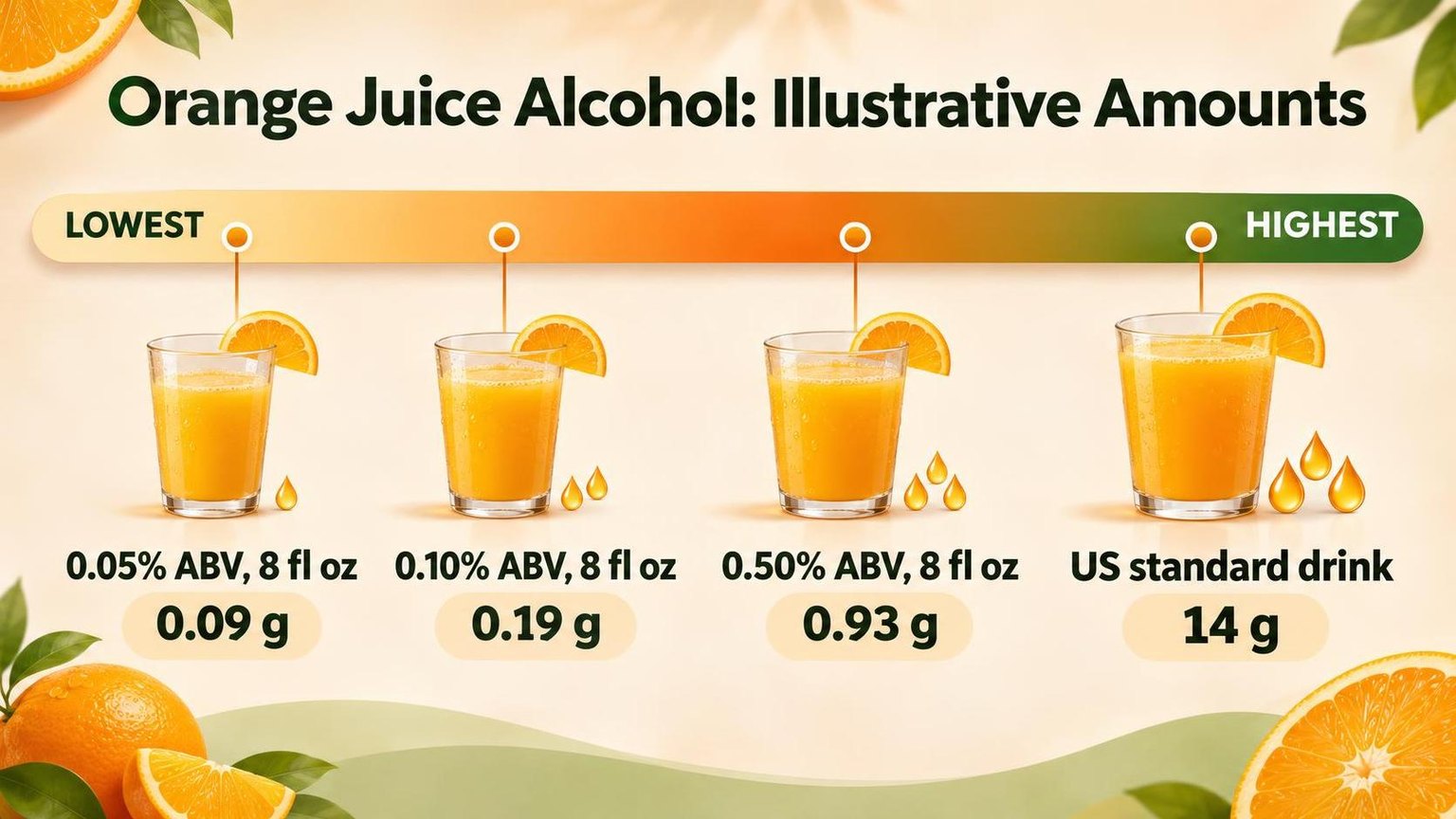
The table shows what specified alcohol-by-volume (ABV) readings would mean in a serving. These are calculations, not measurements of typical orange juice.
They use a serving of 8 US fluid ounces (about 237 milliliters) and ethanol’s density of approximately 0.789 grams per milliliter.
| Example ABV | Ethanol in 8 fl oz of juice | What the figure represents |
| 0.05% | About 0.09 gram | A low illustrative reading |
| 0.10% | About 0.19 gram | An illustrative reading, not a typical-content claim |
| 0.50% | About 0.93 gram | A substantially higher illustrative reading |
For context, the US National Institute on Alcohol Abuse and Alcoholism defines one standard drink as containing about 14 grams of pure alcohol.
That definition is useful for understanding scale, but it does not establish an acceptable ethanol limit for juice.
Storage matters because fermentation can continue if viable yeasts remain in juice. Refrigeration slows their activity; it does not reverse alcohol already produced.
Bubbling, pressure when opening a container, or a wine-like smell can signal spoilage, but the absence of those signs is not proof of zero ethanol.
If an exact amount matters—for example, because you must avoid ethanol altogether—request a product-specific test result rather than relying on a general estimate.
A laboratory can measure ethanol using a validated method such as gas chromatography. The label “100% orange juice” describes the juice ingredients, not a verified zero-ethanol reading.
Why Fresh Orange Juice Ferments
Fresh orange juice contains both fermentable sugar and microorganisms that can reach it during squeezing. If yeast grows in the juice, it can convert some of that sugar into ethanol and carbon dioxide.
The process does not require someone to add alcohol.
Oranges are not sterile on the outside. Cutting and squeezing can transfer yeast from the peel, equipment, hands, or containers into the juice.
Washing fruit and cleaning equipment reduce contamination, but they do not guarantee that freshly squeezed juice is free of microorganisms.
There is ample fuel for fermentation. USDA FoodData Central lists about 8.4 grams of total sugars per 100 grams of raw orange juice.
Yeast can use the juice’s glucose, fructose, and sucrose, producing ethanol and the gas that may cause persistent bubbling or pressure in a closed container.
Orange juice is acidic, but acidity is not sterilization. Some spoilage yeasts tolerate acidic foods and can grow when other microbes struggle.
Whether a particular bottle ferments depends on the organisms present, handling, temperature, and time; the sugar content alone cannot predict its alcohol concentration.
Warm storage gives surviving yeast more opportunity to multiply and ferment. Refrigeration slows that activity rather than stopping it completely.
The FDA advises keeping refrigerators at or below 40°F (4°C); freshly squeezed juice should be refrigerated promptly in a clean, covered container.
A sealed bottle can still ferment because yeast does not need oxygen to turn sugar into ethanol.
The carbon dioxide it produces may build pressure, so a swollen container or a forceful release of gas on opening is a reason to discard the juice, not to taste-test it.
Persistent fizz, an alcoholic or yeasty smell, and an unexpected change in flavor can signal fermentation.
None is a dependable measure of alcohol content: ethanol may be present before obvious changes appear, and bubbles introduced while squeezing or pouring do not by themselves establish that fermentation occurred.
Commercial pasteurization reduces microorganisms, while fresh-squeezed juice has not received that treatment. Fermentation also does not make questionable juice safe: harmful microbes may be present without an obvious smell or visible spoilage.
For juice intended to be nonalcoholic, prompt refrigeration and short storage are more reliable than judging it by appearance alone.
Alcohol in Store-Bought Orange Juice
Store-bought orange juice can contain trace ethanol even when no alcohol has been added. Yeasts can convert some of the juice’s natural sugars into ethanol during processing or storage, so the amount is not identical across brands or cartons.
In a published analysis of foods and beverages, Gorgus, Hittinger, and Schrenk reported ethanol concentrations of 0.16–0.73 grams per liter in the orange juices they tested.
That is approximately 0.02–0.09% alcohol by volume (ABV), calculated using ethanol’s density. These are measurements of the tested products, not a guaranteed range for every store-bought juice.
| Beverage | Alcohol concentration | Ethanol in a typical serving |
| Orange juice at the low end of the study’s measured range | 0.16 g/L; approximately 0.02% ABV | Approximately 0.04 g per 8 fl oz |
| Orange juice at the high end of the study’s measured range | 0.73 g/L; approximately 0.09% ABV | Approximately 0.17 g per 8 fl oz |
| Beer, for scale | 5% ABV | Approximately 14 g per 12 fl oz |
The beer row is an illustration calculated from its stated ABV, not a result from the orange-juice study.
The comparison also does not mean that every carton of juice contains the same amount of ethanol: yeast activity, packaging, temperature, and time can affect what develops after processing.
Pasteurization reduces microorganisms in juice, but it does not make opened juice sterile or stop new contamination.
Follow the package’s storage directions, refrigerate juice labeled “keep refrigerated,” and return an opened carton to the refrigerator promptly.
The FDA recommends keeping refrigerators at or below 40°F and not leaving perishable food at room temperature for more than two hours.
A swollen carton, unexpected fizz, a sharp fermented smell, or a markedly changed taste can signal spoilage; do not use taste alone to decide whether juice is safe.
If avoiding even trace ethanol is medically or personally necessary, do not assume “nonalcoholic” juice contains absolutely none. Ask the manufacturer about testing for the specific product and batch.
Sources: Gorgus, Hittinger, and Schrenk, “Ethanol Exposure in Children From Food and Beverages,” Journal of Analytical Toxicology (2016); U.S. Food and Drug Administration, “Are You Storing Food Safely?”.
How Storage Changes Alcohol Levels
Orange juice does not become alcoholic simply because it sits in the refrigerator. Alcohol rises when yeast ferments the juice’s sugars, and storage conditions determine how readily that can happen.
Temperature, contamination, and whether the container has been opened matter more than the date printed on the carton.
Cold storage slows fermentation
Refrigeration slows yeast growth and fermentation but does not sterilize juice. Pasteurization reduces the microorganisms present before a carton is opened; afterward, yeast can enter from cups, utensils, or the surrounding environment.
Fresh-squeezed and unpasteurized juices may start with more microorganisms than pasteurized products.
Keep juice that requires refrigeration cold, recap it promptly, and follow the label’s instructions after opening. The U.S.
Food and Drug Administration (FDA) recommends keeping the refrigerator at or below the temperature shown below and limiting the time perishable foods spend unrefrigerated.
| Storage condition | FDA food-safety guidance | Effect on fermentation risk |
| Refrigerator at or below 40°F (4°C) | Keep refrigerated foods cold. | Yeast activity slows; it does not necessarily stop. |
| Out of refrigeration | Do not leave perishable foods out for more than 2 hours. | Warmer juice offers yeast more opportunity to grow. |
| Ambient temperature above 90°F (32°C) | Limit unrefrigerated time to 1 hour. | Heat increases food-safety concerns; do not assume alcohol is the only change. |
Time alone cannot predict alcohol content
A sealed, commercially pasteurized carton stored as directed is different from an opened pitcher left warm.
Neither a storage date nor a sour smell can tell you the alcohol by volume: measuring it requires a suitable alcohol test, and other spoilage organisms can change the juice without producing much ethanol.
Fizzing, a swollen container, or an alcoholic odor can signal fermentation, but their absence does not establish safety. Discard juice with mold or clear signs of spoilage rather than tasting it.
If avoiding alcohol matters for medical, religious, or personal reasons, use fresh juice stored according to its label; do not rely on refrigeration to guarantee zero alcohol.
Sources: FDA, “Are You Storing Food Safely?” and “What You Need to Know About Juice Safety.” The FDA time and temperature limits are food-safety guidance, not thresholds at which orange juice reaches a particular alcohol level.
Fermentation Signs in Orange Juice
A hiss when you open the container, persistent bubbles in the glass, or a beer-like smell can signal that yeast is fermenting the sugars in orange juice.
These clues are most useful together: a few bubbles from pouring, by themselves, do not establish fermentation.
What to look for
- Pressure and fizz: A carton that bulges, a cap that releases gas, or juice that continues to foam after pouring suggests gas production. Yeast fermentation produces carbon dioxide as well as ethanol. Do not shake a swollen container or open it near your face.
- A changed aroma: Fresh orange juice smells citrusy. A distinctly yeasty, beer-like, wine-like, or vinegary odor points to microbial activity. Vinegar-like notes may reflect further changes beyond yeast fermentation; smell alone cannot identify the organism.
- Changed appearance: Look for unusual cloudiness, floating growth, or visible mold. Pulp settling is normal in many juices; fuzzy growth is not. The USDA Food Safety and Inspection Service advises discarding moldy high-moisture foods because contamination can extend below the visible surface.
- An unexpected taste: Fermentation can make juice seem less sweet, more acidic, or slightly fizzy. Do not taste juice to decide whether suspicious juice is safe.
What the signs cannot tell you
Neither fizz nor an alcoholic smell reveals the alcohol concentration. That requires a measurement; the amount depends on the yeast, available sugar, temperature, and time.
A fermented smell also does not make orange juice equivalent to a commercially produced alcoholic drink, which is made under controlled conditions.
Absence of these signs is not a safety guarantee. The U.S.
Food and Drug Administration (FDA) warns that harmful bacteria in untreated juice may cause illness, and its consumer food-safety guidance notes that food can make you sick without looking or smelling spoiled.
Do not rely on a sip test, especially with unpasteurized juice.
What to do
Discard juice with clear fermentation signs or visible mold rather than trying to rescue it by straining or chilling it. Keep juice that requires refrigeration at 40°F or below, the FDA’s recommended refrigerator temperature.
Refrigeration slows microbial growth; it does not reverse spoilage that has already occurred.
Can Orange Juice Make You Intoxicated
Ordinary orange juice will not make you intoxicated. It contains no added alcohol, although yeast can produce small amounts of ethanol from its sugars.
Orange juice mixed with spirits is different: its intoxicating effect comes from the added alcohol.
The table shows how alcohol content changes the dose in a glass of juice. These percentages are illustrations, not typical measurements of store-bought orange juice.
Calculations use ethanol’s density of approximately 0.789 grams per milliliter; figures are rounded.
| Drink or scenario | Serving | Alcohol by volume | Approximate ethanol |
| Juice with trace fermentation | 8 fl oz | 0.1% | 0.19 g |
| More noticeably fermented juice | 8 fl oz | 0.5% | 0.93 g |
| Heavily fermented juice, hypothetical | 8 fl oz | 5% | 9.3 g |
| Beer, for reference | 12 fl oz | 5% | 14 g |
The National Institute on Alcohol Abuse and Alcoholism defines a U.S. standard drink as containing about 14 grams of pure alcohol.
Trace fermentation in a glass of juice therefore provides too little ethanol to cause intoxication in a typical adult. Sensitivity and medical circumstances vary, however.
Freshly squeezed or opened juice can ferment if yeast gets in and the juice is stored improperly.
Bubbling, pressure in a container, an alcoholic smell, or an unexpectedly sour taste can signal fermentation, but they cannot tell you its alcohol concentration. Without testing, you cannot reliably calculate a dose.
Do not use an alcohol-like smell as proof that juice is safe to drink. Fermentation does not reliably eliminate harmful microbes. The U.S.
Food and Drug Administration warns that untreated juice can contain disease-causing bacteria, particularly concerning for children, older adults, pregnant people, and people with weakened immune systems.
Keep juice refrigerated according to its label and discard it if it appears spoiled or has been stored unsafely.
If avoiding alcohol entirely matters for pregnancy, medication, recovery, or religious reasons, choose properly stored juice rather than trying to judge a fermenting bottle by smell or taste.
Testing Alcohol in Orange Juice
A sweet smell or sour taste cannot establish whether orange juice contains ethanol.
If the result matters—for example, to assess a suspected fermentation problem—send a sealed sample to a food-testing laboratory and request an ethanol result reported as percent alcohol by volume (ABV).
Choosing a test
Gas chromatography with flame-ionization detection (GC-FID) separates ethanol from other volatile compounds and is a strong choice for confirming a low concentration.
An enzymatic ethanol assay is another laboratory option: alcohol dehydrogenase produces a measurable signal proportional to ethanol concentration.
Ask the laboratory for its reporting limit and whether its method has been validated for orange juice.
A brewing hydrometer does not directly measure ethanol. It measures density, which is also affected by the juice’s sugars and dissolved solids; estimating alcohol from gravity requires a reliable reading taken before fermentation.
A refractometer likewise cannot turn a single reading from finished juice into a trustworthy ABV. Consumer breathalyzers are designed for breath, not juice.
Collecting and interpreting a sample
Use a clean, tightly sealed container; record the brand, lot code, opening date, storage conditions, and sampling time. Refrigerate the sample promptly and follow the laboratory’s shipping instructions.
Delays or warm storage can allow fermentation to continue, so a later measurement may not represent the juice as it was when opened.
ABV expresses the volume of ethanol per volume of beverage. The figures below illustrate what reported concentrations mean in an eight-US-fluid-ounce serving; they are not typical values for orange juice.
Calculations use an ethanol density of approximately 0.789 grams per milliliter at 20°C.
| Reported ABV | Ethanol in 8 US fl oz (237 mL) | Approximate ethanol mass |
| 0.05% | 0.12 mL | 0.09 g |
| 0.5% | 1.18 mL | 0.93 g |
| 1.0% | 2.37 mL | 1.87 g |
A positive result establishes the sample’s ethanol concentration, not when fermentation occurred or whether the product remains safe to drink.
The FDA’s standard of identity describes orange juice as unfermented juice (21 CFR § 146.135). If a carton is swollen, leaks, or releases gas on opening, do not taste it to investigate; retain its packaging and contact the manufacturer.
Questions Readers Ask
Does plain orange juice contain alcohol?
Orange juice can contain trace ethanol produced naturally by yeasts on fruit or during processing, so “no alcohol added” does not necessarily mean exactly zero ethanol.
The amount varies by product and storage conditions; a standard nutrition label does not report it.
Can orange juice become alcoholic if it sits out?
Yeasts can ferment the sugars in orange juice and produce ethanol, especially if the juice is left warm or its container has been opened.
Fermentation is not a safe way to make a drink from spoiled juice: the FDA advises refrigerating perishable foods within 2 hours, or within 1 hour when temperatures exceed 90°F.
How much alcohol is in a mimosa made with orange juice?
A mimosa made with 4 fluid ounces of 12% ABV sparkling wine and 4 fluid ounces of orange juice is approximately 6% ABV before accounting for the juice’s negligible trace ethanol.
The wine contributes 0.48 fluid ounces of pure alcohol, or about 0.8 U.S. standard drinks using the National Institute on Alcohol Abuse and Alcoholism’s 0.6-fluid-ounce definition.
How much alcohol is in a screwdriver cocktail?
Mixing 1.5 fluid ounces of 40% ABV vodka with 6 fluid ounces of orange juice produces a drink that is approximately 8% ABV.
The vodka supplies 0.6 fluid ounces of pure alcohol—one U.S. standard drink—even though the finished cocktail is diluted with juice.
Does pasteurization make orange juice alcohol-free?
No. Pasteurization reduces harmful microorganisms, but it is not a guarantee that ethanol already present in the juice has been removed; if an exact zero-alcohol limit matters, ask the manufacturer for product-specific testing information.
Keep Exploring
- How To Make A Smoothie With Orange Juice? Simple Recipe
- How Much Caffeine Is In A Refresher? Find Out Now
- How Much Caffeine Is In A Starbucks Refresher? Find Out Now
- Does The Dragonfruit Refresher Have Caffeine? Answer By Expert
- Alcohol Drinks with Grape Juice Recipes to Try
- Can You Drink Lemon Water While Fasting? Find Out Now
- How Much Caffeine In Dunkin Refresher? (Shocking Facts, Real Experience & Complete Breakdown)
- All Non-Alcoholic Beverages Guides
- Electronic Code of Federal Regulations, “Juice HACCP” (2026)
- Electronic Code of Federal Regulations, “Fruit Juices and Beverages” (2026)
- USDA Food Safety and Inspection Service, “FoodKeeper App” (n.d.)
- National Institute on Alcohol Abuse and Alcoholism, “What Is a Standard Drink?” (n.d.)
- National Library of Medicine, “Ethanol” (n.d.)
- USDA Agricultural Research Service, “FoodData Central” (n.d.)
- NIAAA – Alcohol's Effects on the Body
- NIAAA – Alcohol Facts and Statistics