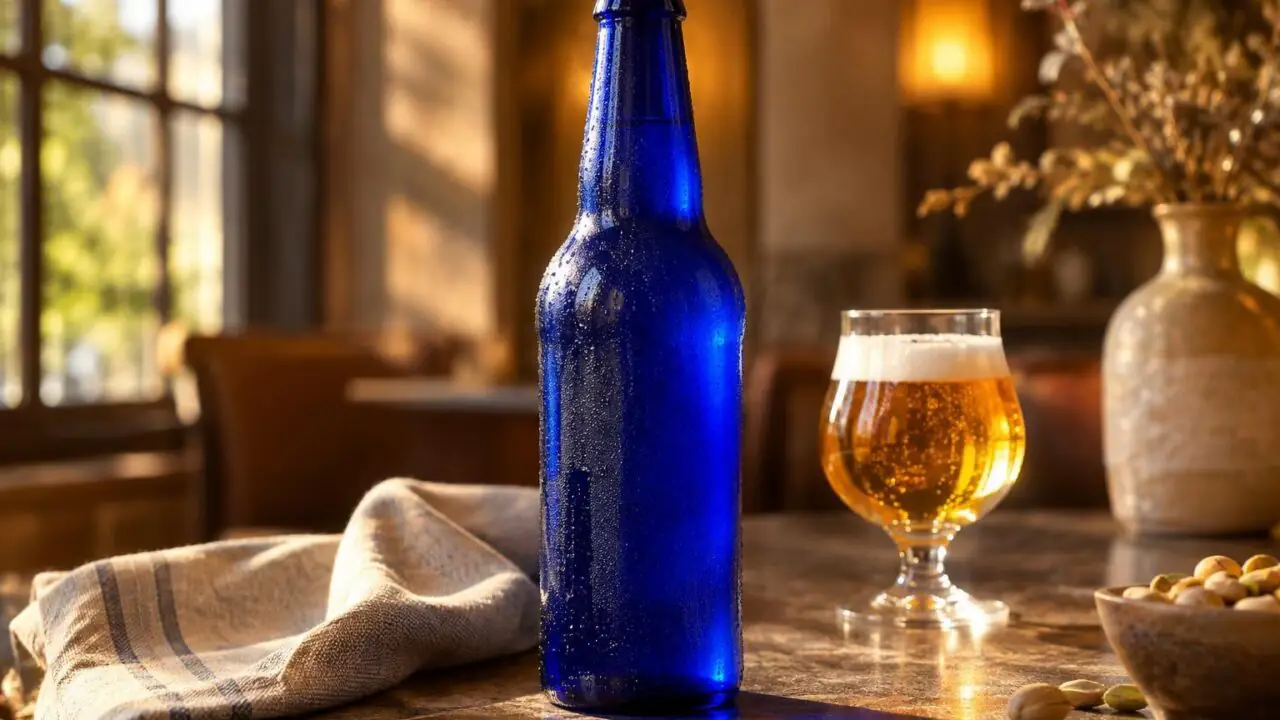
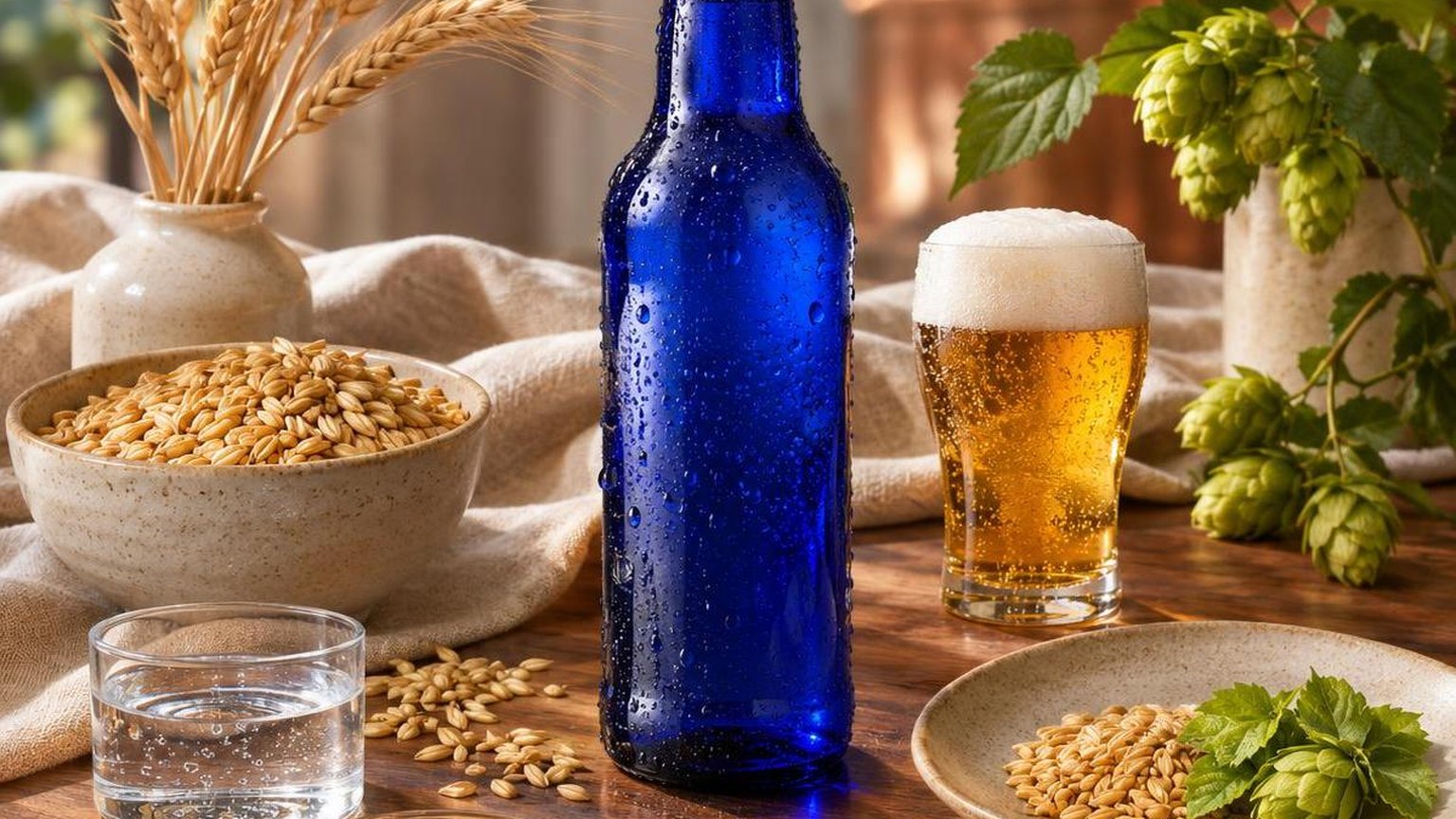
Beer in a blue bottle is commonly associated with Beck’s, a German pilsner sold in distinctive blue glass. The bottle’s color is a branding choice, not a sign that the beer has a different style or flavor.
Beck’s is a pale lager with a crisp, mildly bitter profile.
Blue glass offers less protection from light than brown glass. Light can react with hop compounds in beer and create a skunky aroma, so blue-bottled beer is best kept cool and away from sunlight and strong store lighting.
Packaging and freshness both matter when choosing a bottle.
The phrase “beer in a blue bottle” can also describe other brands or specialty packaging, so check the label rather than relying on color alone.
For Beck’s, the blue bottle is its familiar visual signature; it does not mean the beer is blue.
Why Some Beers Come in Blue Bottles
Blue bottles make a beer recognizable on a shelf, but the color does not identify a beer style or guarantee protection from light. Brands such as 1664 Blanc and Bud Light Platinum use blue packaging as part of their visual identity.
What matters to the beer inside is how much light the specific bottle lets through.
Branding Comes First
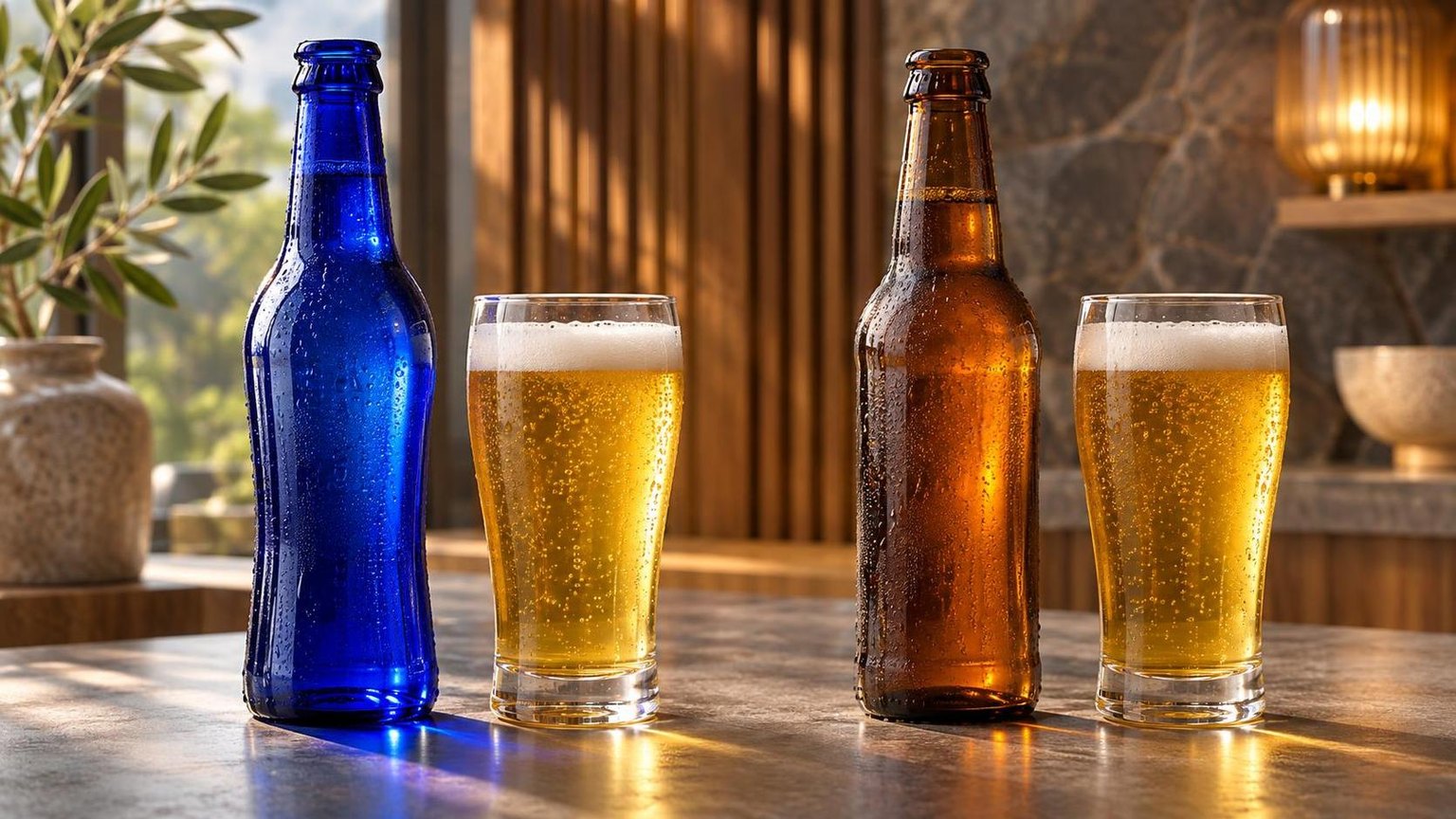
Most beer bottles are brown because brown glass generally limits the light that can damage beer. Blue gives a brand a different look: it can signal a particular product in a crowded cooler without changing the liquid’s ingredients.
Bud Light Platinum, for example, is sold in distinctive blue bottles; the package color is not a brewing category.
Glass gets its color from substances added during manufacture, but appearance alone is not a reliable measure of protection. A deep-blue bottle and a pale-blue bottle can transmit different amounts of light.
Wall thickness, coatings, and the wavelengths reaching the beer also matter. The only sound way to rank specific bottles is to measure their light transmission.
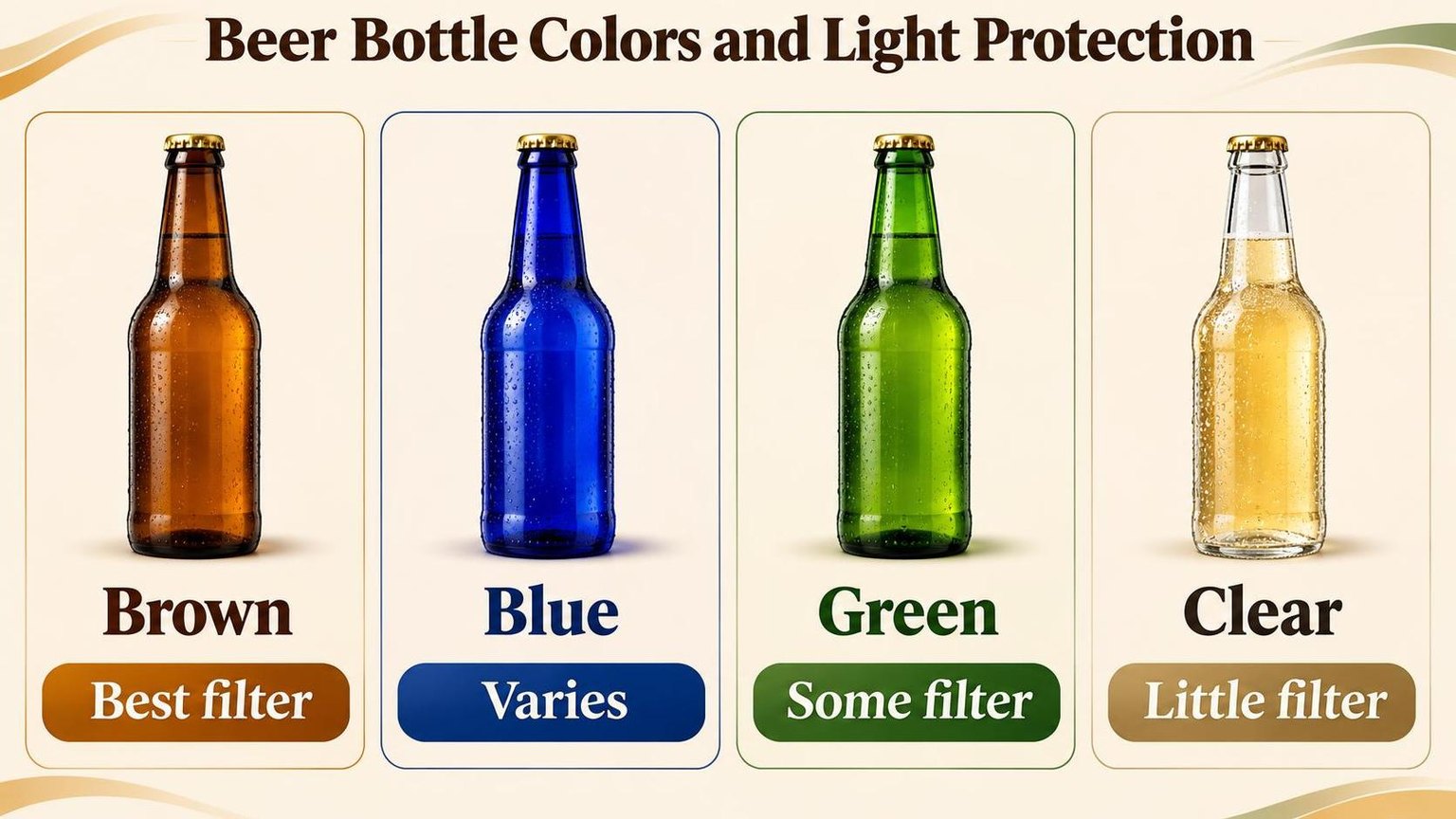
| Bottle color | What its appearance tells you |
| Brown | Generally the most protective conventional beer-bottle color against light exposure. |
| Blue | Visually distinctive; protection varies with the particular glass and any coating. |
| Green | Provides some filtering, but can still admit light that damages beer. |
| Clear | Offers little filtering unless other packaging or beer formulation addresses light exposure. |
Why Light Protection Matters
Lightstruck beer develops an aroma often described as skunky. In the underlying reaction, light acts on hop-derived bitter compounds, with riboflavin in beer helping drive the chemistry.
One resulting odorant is 3-methyl-2-butene-1-thiol, abbreviated MBT. The Oxford Companion to Beer describes this process in its entry on “lightstruck.”.
The problem is not limited to invisible ultraviolet light. Visible light can contribute, so a bottle that looks dark may still admit wavelengths relevant to flavor damage.
That is why “blue” should not be read as “UV-proof,” or treated as equivalent to brown glass. Refrigeration slows many changes in beer, but a cooler’s lights still expose displayed bottles.
Brewers can address the risk in more than one way. Brown glass, cans, cartons, and keeping bottles away from strong light reduce exposure. Some beers also use specially processed hop extracts that are less susceptible to lightstruck flavor.
Packaging choices therefore need to be considered alongside the beer’s formulation, not judged by color alone.
What to Do When Buying Blue-Bottled Beer
- Choose bottles stored inside a carton or away from a brightly lit display when possible.
- Keep them in a dark place at home rather than on a sunny counter or windowsill.
- Check the beer’s aroma after opening; a distinctly skunky smell can indicate light damage, not an intended trait of the brand.
A blue bottle is chiefly a packaging and branding decision. It may filter some light, but its color cannot tell you how well it protects a particular beer.
For the best chance of tasting the beer as intended, limit light exposure regardless of the bottle’s color.
Blue Glass Offers Less Light Protection
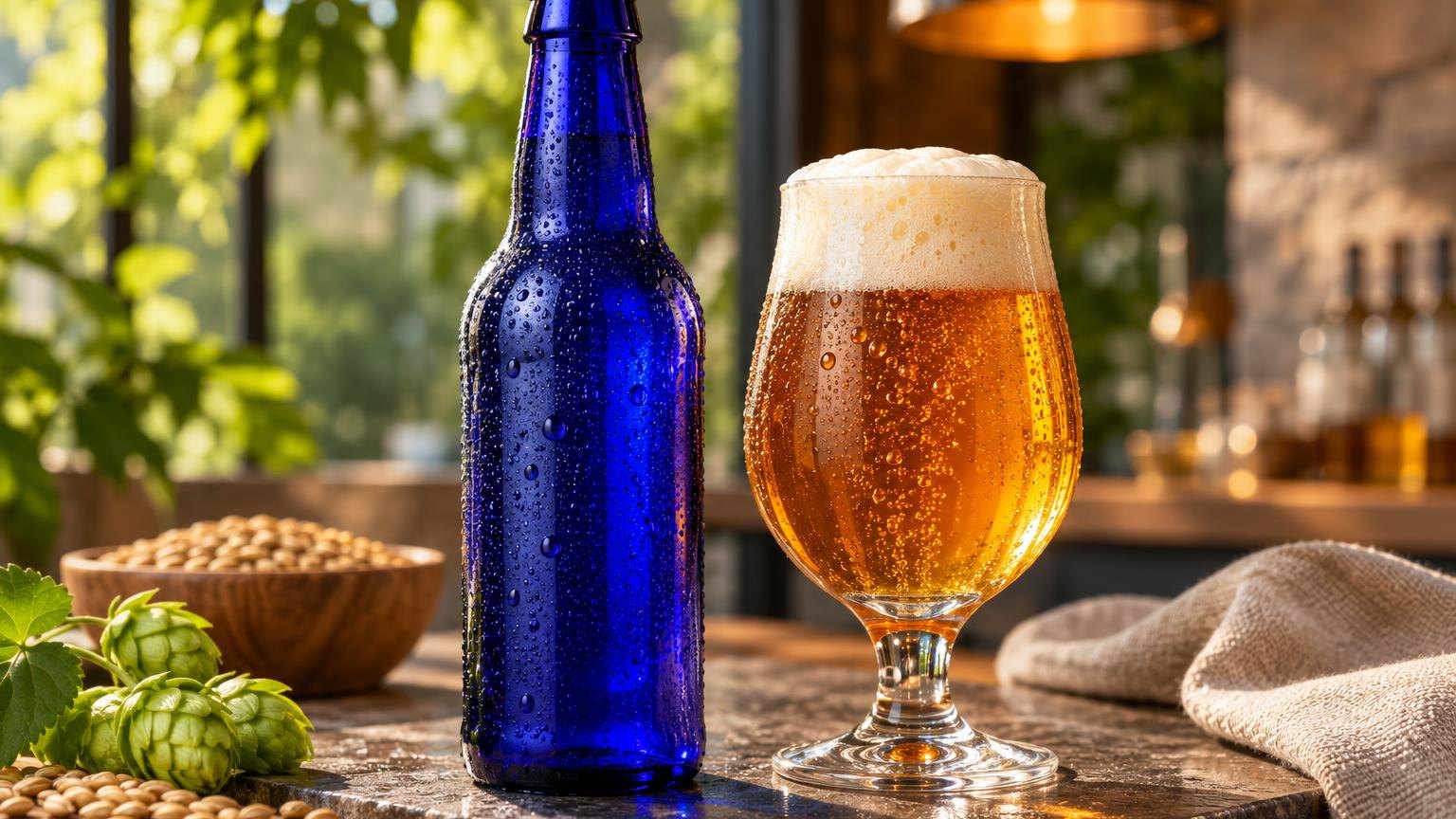
A blue beer bottle is visually distinctive, but its color is not a reliable shield against lightstruck flavor.
Compared with amber glass, blue glass can let more of the light that drives this off-flavor reach the beer; the exact protection depends on the bottle’s tint and thickness.
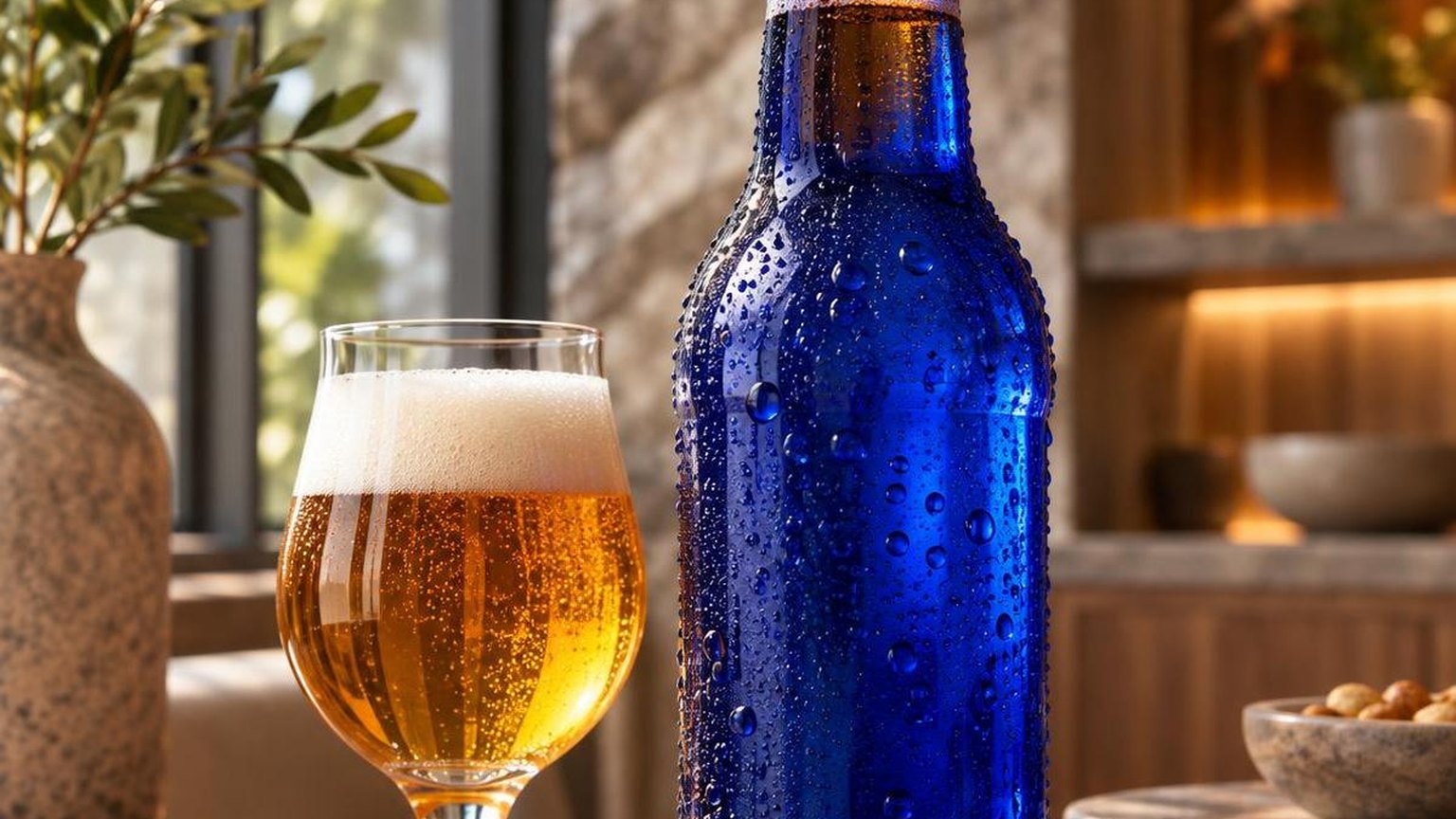
Lightstruck beer develops when light triggers reactions involving compounds from hops. The resulting sulfur compound, 3-methyl-2-butene-1-thiol, or MBT, produces the familiar skunky aroma.
Riboflavin in beer helps initiate the reaction by absorbing light, including wavelengths in the blue portion of the visible spectrum.
That makes bottle color more than a design choice. Amber glass is used widely because it filters much of the light relevant to this reaction.
Blue glass may look dark on a shelf while still transmitting blue light; apparent darkness alone does not establish how well a bottle protects beer.
| Package | Light-protection implication |
| Amber glass | Generally the strongest light protection among common beer-bottle colors because it substantially reduces transmission of relevant short-wavelength light. |
| Blue glass | Protection varies by formulation and thickness; its color does not guarantee effective filtering of blue light. |
| Clear glass | Provides little color-based protection from visible light. |
| Opaque can | Blocks light from reaching the beer while the can remains sealed. |
These are packaging tendencies, not measured transmission ratings for every bottle. A dark cobalt-blue bottle and a pale blue bottle need not perform alike.
To compare particular containers, a brewery would need their spectral-transmission measurements rather than a visual inspection.
Exposure conditions matter too. Direct sunlight can produce a noticeable lightstruck character quickly, while a brightly lit display can present a slower risk.
Temperature and time affect beer quality in other ways, but refrigeration does not turn a light-transmitting bottle into a light barrier.
- Choose a blue-bottled beer from a closed case or shaded shelf when possible, rather than a bottle displayed in direct sun.
- After purchase, keep the bottle in its carton or a dark refrigerator until serving.
- If a beer smells skunky on opening, consider light exposure as one possible cause; the bottle’s color alone cannot prove it.
Some beers use light-stable hop products specifically to reduce susceptibility to lightstruck flavor. Without information from the brewer, however, a blue bottle should not be taken as evidence that the recipe has that protection.
An opaque can or well-shielded amber bottle remains the more dependable choice for light-sensitive beer.
For the underlying chemistry, see Denis De Keukeleire’s “Fundamentals of Beer and Hop Chemistry” in Química Nova and the “Lightstruck” entry in The Oxford Companion to Beer.
How Light Exposure Affects Beer Flavor
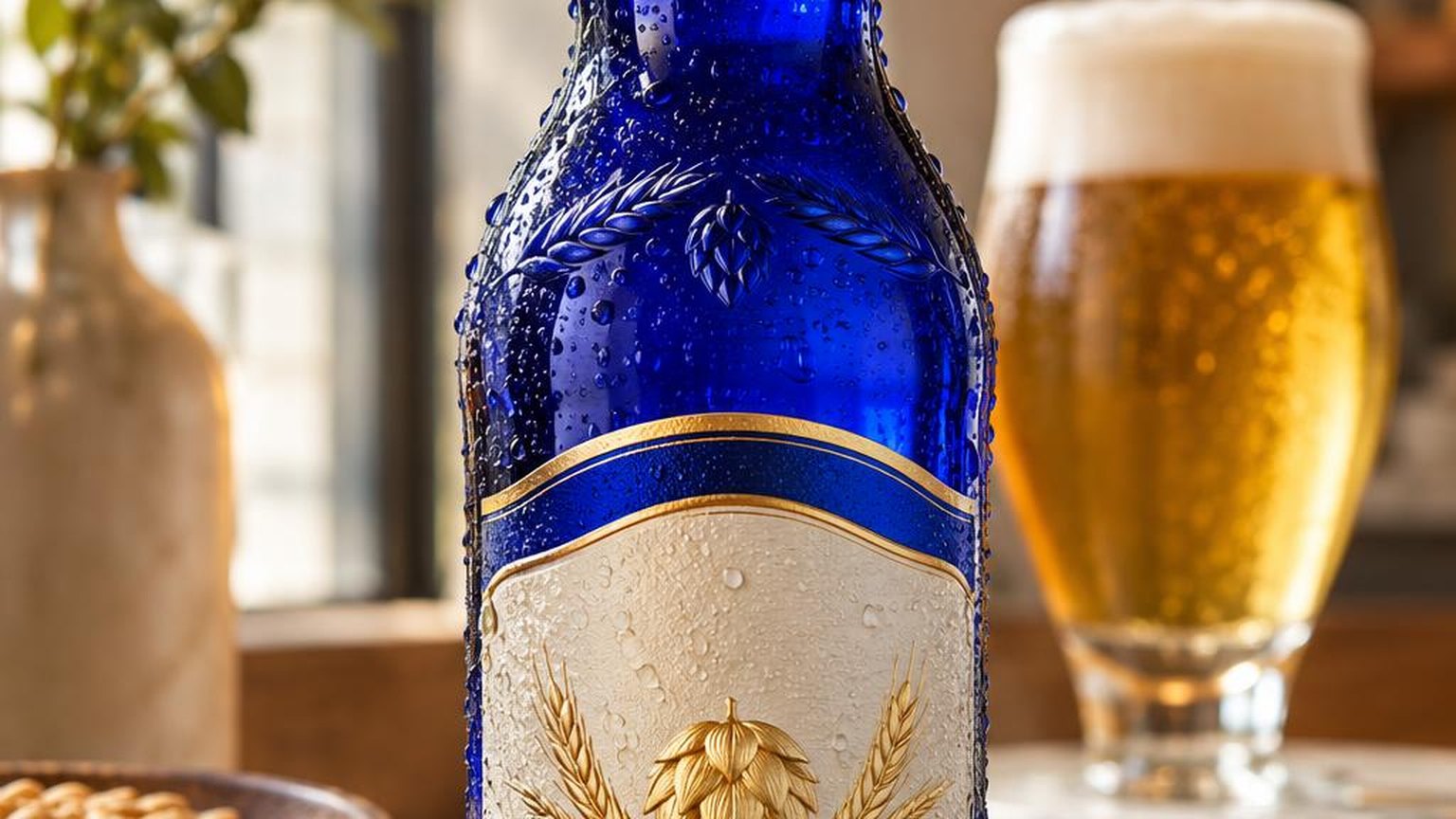
Beer in a blue bottle can look distinctive, but the color alone does not establish how well the package protects its contents.
Light can change beer’s aroma through a specific chemical reaction, producing the skunky smell brewers call “lightstruck.”.
The reaction begins when light reaches hop-derived iso-alpha acids in beer. Riboflavin, a compound naturally present in beer, helps drive a reaction that ultimately forms 3-methyl-2-butene-1-thiol, usually abbreviated 3-MBT.
The Oxford Companion to Beer describes this compound as the source of characteristic lightstruck aroma.
| Relevant measure | Figure | Significance |
| Light of concern | Approximately 350–500 nanometers | Includes ultraviolet and short-wavelength visible light capable of promoting the reaction. |
| Reported sensory threshold for 3-MBT | About 4 nanograms per liter | A very small concentration can produce a noticeable aroma; individual sensitivity and the beer’s flavor affect perception. |
That low threshold helps explain why a beer may smell skunky without appearing cloudy or otherwise damaged. Lightstruck character can develop during direct sun exposure or prolonged exposure to bright display lighting.
Refrigeration slows some forms of beer aging, but a cold, brightly lit display is not a substitute for light-protective packaging.
Bottle color matters because glass filters wavelengths differently. Brown glass generally offers the strongest light protection among common, uncoated beer-bottle colors. Green and clear glass allow more of the relevant light through.
A blue bottle cannot be judged reliably by color alone: shade, glass thickness, coatings, and any covering also affect transmission.
| Package | Practical light-exposure assessment |
| Brown glass | Generally the safer common glass choice for a brightly lit shelf. |
| Green or clear glass | Offers less protection from lightstruck flavor unless the beer or package has another safeguard. |
| Blue glass | Protection varies; the appearance does not verify that harmful wavelengths are blocked. |
| Opaque can | Prevents light from reaching the beer while the can remains sealed. |
Packaging is not the only variable. Some brewers use light-stable, reduced hop extracts to limit skunky flavor in beers sold in light-permeable bottles.
Ordinary hop-derived iso-alpha acids remain susceptible, so neither a blue bottle nor a lack of obvious skunk aroma proves that every beer uses the same recipe or protection.
To assess a blue-bottled beer, ask whether it was displayed under strong light and whether the bottle has a protective coating or sleeve. Keep it in its carton or a dark refrigerator until serving.
If it smells distinctly skunky on opening, moving it out of the light will not reverse the flavor change.
Brands Known for Blue Beer Bottles
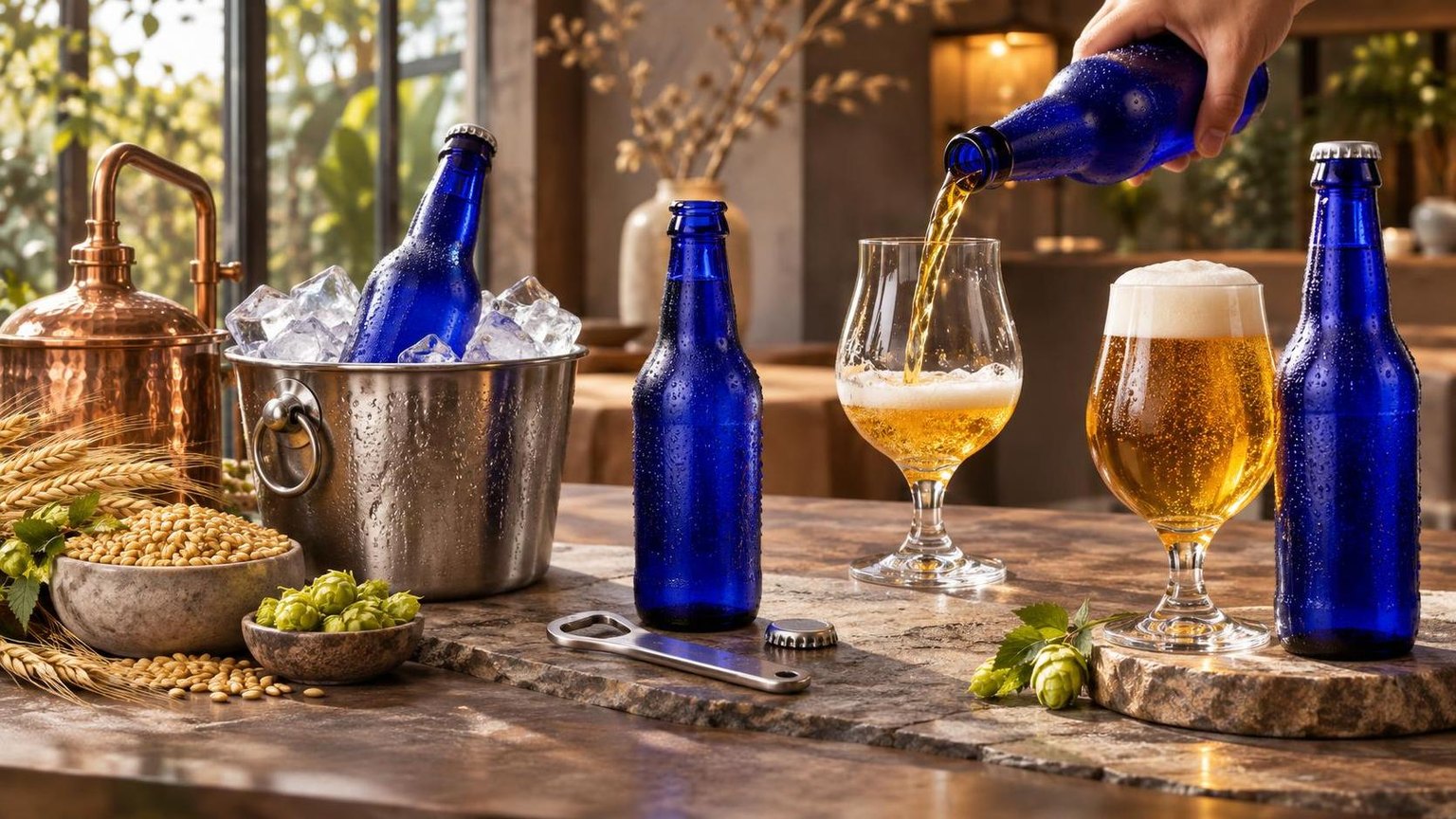
Two beers account for many searches for a “beer in a blue bottle”: Bud Light Platinum and 1664 Blanc. Both have used distinctive blue glass, but they are different beers from different producers.
Bottle color is a packaging clue, not a reliable way to identify a beer on its own.
| Beer | Producer | Listed alcohol by volume | Blue-bottle distinction |
| Bud Light Platinum | Anheuser-Busch | 6% ABV | Cobalt-blue glass bottle |
| 1664 Blanc | 1664, a Carlsberg brand | 5% ABV | Blue glass bottle associated with Blanc |
Bud Light Platinum
Introduced in 2012, Bud Light Platinum made its cobalt-blue bottle a prominent part of its presentation. Anheuser-Busch lists the beer at 6% alcohol by volume.
The name matters when shopping: a blue Bud Light Platinum bottle does not contain standard Bud Light.
Look for “Platinum” on the label rather than identifying it by color alone. Packaging can vary by retailer and market, and the beer is also sold in cans.
For the current strength and other product details, use the package label or Anheuser-Busch’s Bud Light Platinum product information.
1664 Blanc
1664 Blanc is a French-style wheat beer associated with a blue glass bottle and white branding. Its producer, Carlsberg, lists Blanc at 5% ABV and describes a citrus-forward profile.
The distinctive bottle is a useful visual cue, especially when several beers bearing the 1664 name share a shelf.
The word “Blanc” is the essential identifier. A bottle labeled simply “1664” may be a different beer, and 1664 Blanc may also appear in cans or other packaging.
Check the full product name and the ABV printed on the container, particularly when buying an import whose packaging differs by market.
Blue Labels Are Not Blue Bottles
Labatt Blue and Blue Moon Belgian White are easy names to misremember as blue-bottle beers. Their blue wording or branding does not, by itself, describe the glass.
Likewise, a blue neck label, sleeve, or light reflection can make an otherwise clear or brown bottle look blue in a photograph.
If you are trying to identify a beer you saw, note the bottle’s actual glass color where it has no label, then check the printed name. A blue bottle narrows the possibilities; a readable label identifies the product.
Neither Bud Light Platinum nor 1664 Blanc should be assumed to be in blue glass in every market or format.
Store blue-bottled beer away from direct sunlight. Brown glass generally offers better protection against the light that can cause a hop-related “skunky” aroma.
As explained in The Oxford Companion to Beer entry on lightstruck beer, packaging color affects light exposure; it does not tell you whether a beer has already developed that fault.
How to Store Blue-Bottled Beer
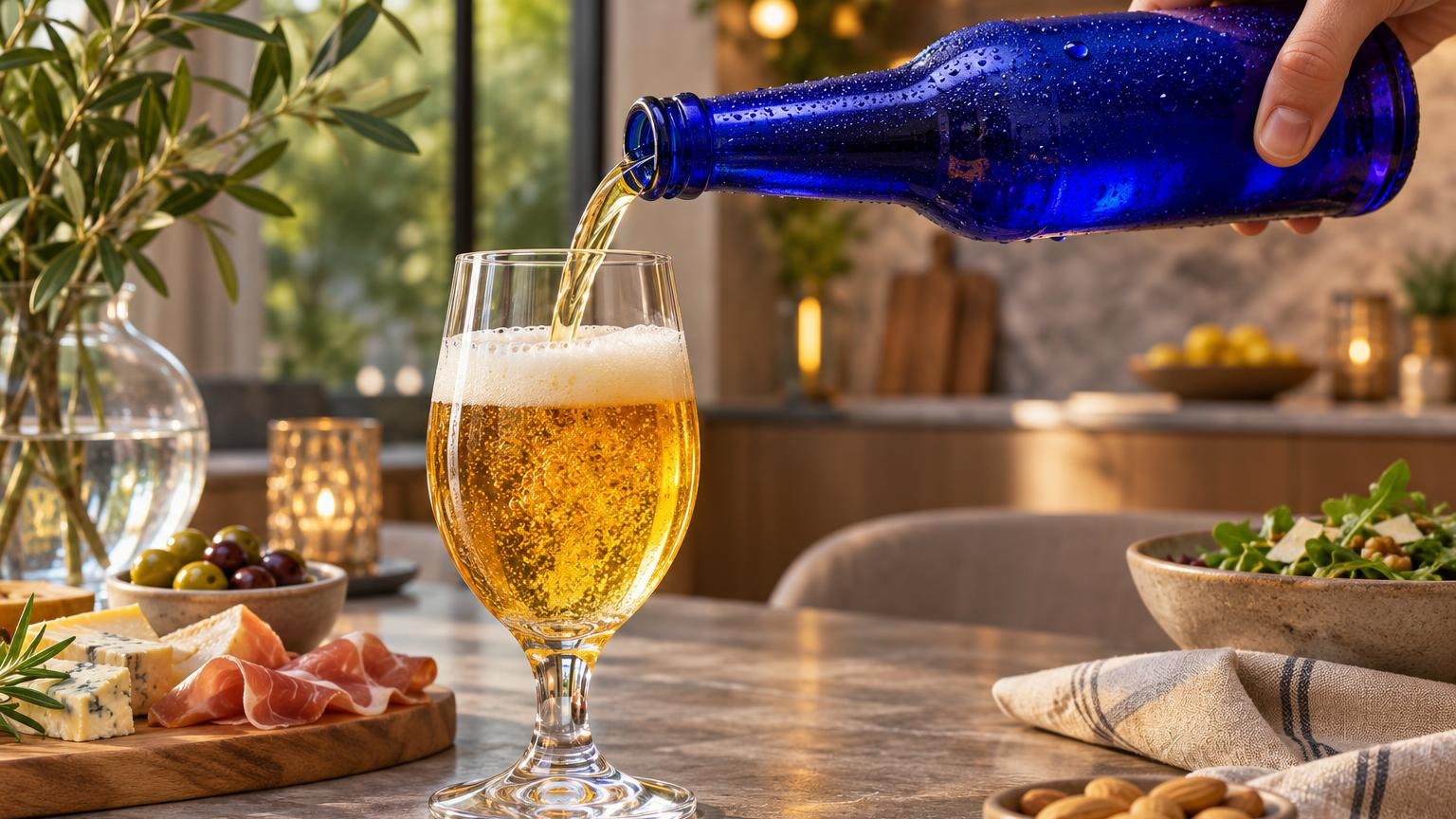
Keep blue-bottled beer cold, upright, and out of light. Blue glass is a packaging choice, not a reliable light shield: beer exposed through it can develop a skunky aroma even when the bottle remains sealed.
Light-struck flavor comes from a reaction involving hop-derived compounds. The resulting compound, 3-methyl-2-butene-1-thiol, has a distinctive skunk-like smell.
As The Oxford Companion to Beer explains in its entry on “lightstruck,” brown glass offers substantially better light protection than clear or colored glass.
Put blue bottles inside a closed refrigerator, carton, or opaque storage box rather than on a display shelf. Avoid sunny windows, bright retail-style lighting, and repeated trips between storage and the table.
A refrigerator door blocks light when closed, but a shelf inside offers steadier temperatures.
| Storage condition | Practical use |
| 35–40°F | A useful refrigerated range for most beers intended to be drunk fresh. |
| 45–55°F | Appropriate for some beers deliberately kept for aging, if the brewer recommends cellaring; keep bottles in complete darkness. |
| 32°F or below | Avoid: freezing becomes a risk, although the exact freezing point depends on the beer. |
Temperature matters even when light cannot reach the bottle. Warm storage accelerates flavor changes, including the loss of fresh hop aroma and the development of stale notes.
The Brewers Association’s Draught Beer Quality Manual likewise emphasizes cold, consistent storage to preserve beer quality.
Check the Bottle Before Storing It
- Read the packaging date or best-before date, if provided. For a beer sold as fresh and hop-forward, choose the freshest package available rather than assuming blue glass extends its shelf life.
- Inspect the cap and glass. A loose cap, leak, or damaged seal can allow carbonation to escape and oxygen to enter; storage conditions cannot repair a compromised package.
- Store bottles upright. This keeps sediment settled in bottle-conditioned beer and makes it easier to pour without disturbing the yeast. It also avoids prolonged contact between the beer and the cap liner.
Do not use a blue bottle’s appearance to judge whether its contents are protected. An opaque label or sleeve may cover part of the glass, but uncovered areas still admit light.
For outdoor serving, bring bottles out only when needed and return unopened ones to a cooler.
If a bottle has spent time in direct sun, chilling it afterward will not reverse light-struck flavor. Open it, smell it, and taste a small pour before serving guests.
A skunky smell points to a flavor fault, not necessarily a safety problem, but it is reason to choose another bottle.
Questions People Ask Most
What beer comes in a blue bottle?
Two examples are 1664 Blanc, sold in a distinctive blue bottle, and Bud Light Platinum, sold in cobalt-blue glass. Check the label rather than the bottle color: they are different beers from different producers.
What does 1664 Blanc taste like?
1664 Blanc is a wheat beer that its producer describes as having citrus notes and a hint of coriander. It is 5% alcohol by volume (ABV), according to Kronenbourg 1664’s product information.
How strong is Bud Light Platinum?
Bud Light Platinum is 6% ABV, according to Bud Light’s product information. Its blue bottle identifies the Platinum product; it does not indicate a blueberry flavor.
Does a blue bottle protect beer from sunlight?
Not as effectively as brown glass. Light can react with hop compounds to produce 3-methyl-2-butene-1-thiol, the source of a “skunky” aroma, so keep beer in blue bottles out of direct sunlight.
Is Blue Moon the beer in the blue bottle?
Usually not: Blue Moon Belgian White is commonly sold in brown bottles with blue-and-white labeling. If you remember blue glass rather than a blue label, 1664 Blanc or Bud Light Platinum is a more likely match.
Related Guides
- Does Beer Have Caffeine? Basic Information You Must Know
- What Time Can I Buy Beer In Tn?
- 12 Critical Facts About The Legal Drinking Age In Georgia
- What Are Beers From Japan? The Answer You Must Know
- Beers Not Owned by Anheuser-Busch to Try
- Where Is Pacifico Beer Brewed?
- All Alcohol Guides
- Blanc — Official Website (n.d.)
- Bud Light — Official Website (n.d.)
- Electronic Code of Federal Regulations — 27 CFR Part 7: Labeling and Advertising of Malt Beverages (2026)
- USDA — FoodData Central (n.d.)
- National Library of Medicine — PubChem: Riboflavin (n.d.)
- Harvard T.H. Chan School of Public Health – The Nutrition Source: Alcohol
- MedlinePlus (NIH) – Caffeine
- PubChem (NIH) – Ethanol
- TTB – Distilled Spirits