Calories in a bottle of chardonnay are typically about 600–650 calories in a standard 750-milliliter bottle.
The exact total depends mainly on the wine’s alcohol content and residual sugar, so the label’s alcohol by volume (ABV) can help explain differences between bottles.
A useful estimate starts with a five-ounce serving: many Chardonnays contain roughly 120–130 calories per serving.
A 750-milliliter bottle holds about 25.4 fluid ounces, or just over five such servings, putting the bottle near that 600–650-calorie range.
Pour size matters when tracking intake: a six-ounce glass contains about 20% more wine than a five-ounce serving.
This article explains how to estimate calories from bottle size and ABV, why Chardonnay calories vary, and how to compare a bottle with the amount you actually pour.
Calories in a 750 ml Chardonnay Bottle
A 750 ml bottle of Chardonnay typically contains about 500–650 calories, depending primarily on its alcohol content.
A dry bottle at 13.5% alcohol by volume (ABV) contains about 559 calories from alcohol alone; residual sugar and other wine components add to that total.
How alcohol content changes the total
Alcohol supplies about 7 calories per gram, according to the Dietary Guidelines for Americans. To estimate alcohol calories, multiply the bottle’s 750 ml by its ABV, by ethanol’s approximate density of 0.789 grams per ml, and then by 7.
| Chardonnay ABV | Alcohol calories per 750 ml bottle | Alcohol calories per 5 fl oz glass |
| 12% | 497 | 98 |
| 13.5% | 559 | 110 |
| 14.5% | 601 | 118 |
| 15% | 621 | 123 |
These are estimates of alcohol calories, not complete nutrition totals. Each row assumes a full 750 ml bottle and rounds to the nearest calorie.
A bottle holds about 25.4 US fluid ounces, or just over five 5-fl-oz glasses, so the glass figures represent roughly one-fifth of the bottle figures.
What adds calories beyond alcohol?
Residual sugar contributes about 4 calories per gram. For example, a dry Chardonnay containing 4 grams of residual sugar per liter has 3 grams in a 750 ml bottle, adding approximately 12 calories.
At 10 grams per liter, sugar adds about 30 calories per bottle.
Wine also contains small amounts of other compounds that can contribute energy, so adding alcohol and sugar provides an estimate rather than a laboratory-measured calorie count.
A higher-ABV Chardonnay can have more calories than a sweeter, lower-ABV one: the difference between 12% and 15% ABV is about 124 alcohol calories per bottle.
Oak aging or a buttery taste does not, by itself, mean cream or butter was added.
To make a useful comparison between two bottles, check their labeled ABVs first, then look for residual-sugar information from the producer if one tastes noticeably sweet.
Bottle shape and serving temperature do not change the calories in the wine.
Calories by Chardonnay Alcohol Content
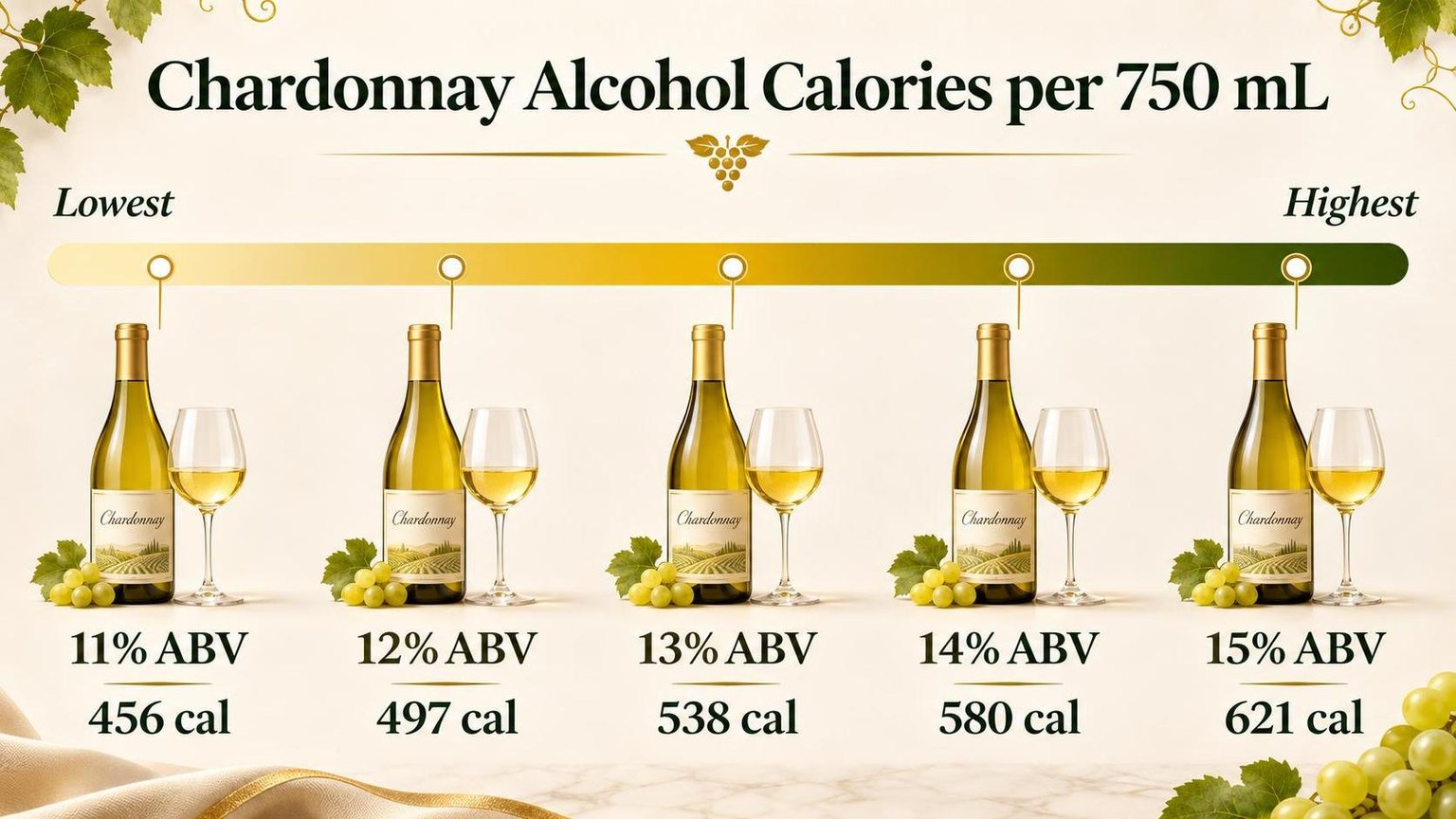
Alcohol content is the most useful starting point for estimating Chardonnay calories. In a standard 750 mL bottle, each percentage point of alcohol by volume (ABV) contributes about 41 calories from alcohol alone.
The wine’s residual sugar adds calories beyond these estimates.
The calculation uses 7 calories per gram of alcohol, as reported by the National Institute on Alcohol Abuse and Alcoholism, and an ethanol density of approximately 0.789 gram per milliliter at 20°C, as listed by PubChem.
Multiply the bottle volume by the ABV, then by ethanol’s density and calories per gram.
| Chardonnay ABV | Alcohol calories per 750 mL bottle | Alcohol calories per 5 fl oz pour |
| 11% | 456 | 90 |
| 12% | 497 | 98 |
| 13% | 538 | 106 |
| 14% | 580 | 114 |
| 15% | 621 | 123 |
These are alcohol-only estimates, rounded to whole calories. The serving column uses a 5-US-fluid-ounce pour, approximately 148 mL.
NIAAA uses that pour size for its standard-drink example of wine at 12% ABV; it does not mean every Chardonnay contains the same amount of alcohol.
Check the ABV on the bottle rather than assuming Chardonnay has a fixed calorie count. A wine’s ABV reflects, in large part, how much grape sugar fermented into alcohol.
Growing conditions, harvest ripeness and winemaking decisions can therefore change the result even when the grape variety is identical.
Residual sugar must be counted separately. Carbohydrate supplies approximately 4 calories per gram under U.S. food-labeling conventions.
A Chardonnay containing 4 grams of residual sugar per liter would have about 3 grams in a 750 mL bottle, adding roughly 12 calories to the alcohol estimate.
That example should not be treated as a universal sugar allowance: “dry” describes a range of wines, and perceived sweetness is not a reliable measurement.
Acidity, fruit aromas and oak-derived flavors can change how sweet a Chardonnay tastes without revealing its residual sugar. Producer technical sheets may provide a measured value.
For a quick bottle estimate, find the labeled ABV in the table and treat the figure as a starting point, not a total. Add calories from measured residual sugar if that information is available.
The calculation also assumes the bottle contains 750 mL; a different bottle size requires scaling the estimate accordingly.
How Bottle Calories Compare by Pour
A 750-milliliter bottle of Chardonnay contains about 25.4 US fluid ounces. Using roughly 120 calories for a 5-ounce pour of white table wine, that works out to about 610 calories per bottle.
The amount in your glass depends on the pour, not the shape of the glass.
The estimates below scale the 5-ounce figure proportionally. They are useful for comparing servings, but a particular Chardonnay’s alcohol content can move its actual calorie count above or below them.
The 120-calorie starting point is consistent with USDA FoodData Central’s data for white table wine.
| Pour | Estimated calories | Approximate pours per 750-mL bottle |
| 3 fl oz | 72 | 8.5 |
| 5 fl oz | 120 | 5.1 |
| 6 fl oz | 144 | 4.2 |
| 8 fl oz | 192 | 3.2 |
| Entire bottle | About 610 | 1 |
A 6-ounce pour is 20% larger than a 5-ounce pour, so its estimated calories rise by the same proportion: 144 rather than 120. An 8-ounce pour contains 60% more wine—and about 72 more calories—than the 5-ounce reference.
That difference is easy to miss in a large wineglass.
The National Institute on Alcohol Abuse and Alcoholism defines a US standard drink of wine as 5 ounces at 12% alcohol by volume (ABV). This is a measure of alcohol, not a promise that every 5-ounce glass has the same calories.
Check the bottle’s ABV when comparing Chardonnays.
Why the bottle total can vary
Alcohol supplies about 7 calories per gram. Using ethanol’s density of approximately 0.789 gram per milliliter, the alcohol alone in a 750-milliliter bottle contributes about 539 calories at 13% ABV, versus 621 at 15% ABV.
Any remaining sugar adds calories on top of those amounts.
Consequently, “610 calories per bottle” is a planning estimate, not a nutrition label for every Chardonnay. A higher-ABV bottle can exceed it before accounting for sugar; a lower-ABV bottle may come in below it.
For an accurate count at the table, measure the pour and use the specific wine’s nutrition information if the producer provides it.
Calories in Sweet and Dry Chardonnay
A sweet Chardonnay is not automatically higher in calories than a dry one. Sugar adds calories, but alcohol usually contributes far more; a higher-alcohol dry bottle can contain as many calories as a lower-alcohol sweet bottle.
Compare both alcohol by volume (ABV) and residual sugar.
Alcohol provides about 7 calories per gram, while sugar provides about 4 calories per gram, according to the calorie factors used in U.S. food labeling. In a 750 mL bottle at 13.5% ABV, alcohol alone contributes approximately 559 calories.
That estimate uses ethanol’s density of about 0.789 grams per milliliter.
Residual sugar is the sugar left after fermentation, measured in grams per liter (g/L). At 3 g/L, a 750 mL bottle contains 2.25 grams of residual sugar, adding approximately 9 calories.
At 30 g/L, it contains 22.5 grams, adding approximately 90 calories.
The table holds bottle size constant and combines estimated calories from alcohol and residual sugar. Its dry and sweet descriptions illustrate sugar levels; they are not promises about every wine bearing those words.
| Chardonnay example | ABV | Residual sugar | Estimated calories per 750 mL bottle |
| Dry, lower alcohol | 12.5% | 3 g/L | 527 |
| Dry, higher alcohol | 14.5% | 3 g/L | 610 |
| Sweet, lower alcohol | 12.5% | 30 g/L | 608 |
| Sweet, higher alcohol | 13.5% | 30 g/L | 649 |
At the same 12.5% ABV, increasing residual sugar from 3 to 30 g/L adds about 81 calories per bottle. Yet the 14.5% ABV dry example and the 12.5% ABV sweet example both land near 610 calories.
Alcohol strength can therefore offset a substantial difference in sweetness.
For context, the International Organisation of Vine and Wine classifies a still wine as dry at no more than 4 g/L residual sugar, with an allowance up to 9 g/L when specified acidity conditions are met.
A Chardonnay that tastes creamy or fruit-forward is not necessarily sweet: oak, ripe-fruit aromas and texture can shape that impression.
These figures are estimates, not laboratory measurements. Other wine components can contribute small amounts of energy, and actual residual sugar varies by bottle.
If a producer publishes a technical sheet, use its ABV and residual-sugar figures rather than assuming that every dry or sweet Chardonnay matches a table example.
Why Chardonnay Bottle Calories Vary
Alcohol content is the main reason two 750 mL bottles of Chardonnay can have different calorie counts. Residual sugar matters too, but a dry wine’s alcohol usually contributes far more calories than its sugar.
The bottle size and the accuracy of any published estimate also affect the number you see.
Alcohol content has the largest effect
Alcohol provides about 7 calories per gram, according to the National Institute on Alcohol Abuse and Alcoholism.
To estimate calories from alcohol in a 750 mL bottle, multiply the bottle volume by its alcohol by volume (ABV), then by ethanol’s density of approximately 0.789 grams per milliliter and 7 calories per gram.
| Chardonnay ABV | Estimated calories from alcohol per 750 mL bottle |
| 12% | 497 |
| 13.5% | 559 |
| 14.5% | 601 |
These are alcohol-only estimates, not exact totals for particular wines. Grapes picked with more sugar can produce a higher-ABV Chardonnay when yeast ferments that sugar into alcohol.
Growing conditions, harvest decisions, and winemaking choices therefore influence bottle calories even when two wines taste equally dry.
Residual sugar adds calories
Fermentation does not always consume every gram of grape sugar. Sugar supplies about 4 calories per gram; because residual sugar is commonly reported in grams per liter, multiply that figure by 0.75 to estimate grams in a standard bottle.
The table shows sugar’s contribution independently of alcohol.
| Residual sugar | Sugar in a 750 mL bottle | Estimated calories from sugar |
| 2 g/L | 1.5 g | 6 |
| 8 g/L | 6 g | 24 |
| 20 g/L | 15 g | 60 |
A Chardonnay can seem sweet because of ripe-fruit aromas without containing much residual sugar. Conversely, acidity can make a wine with some sugar taste less sweet.
Tasting impressions are useful for choosing wine, but they cannot establish its carbohydrate content or calorie count.
Oak aging and malolactic fermentation help explain buttery, vanilla, or creamy flavors; those flavors do not, by themselves, mean sugar or cream was added.
For a more reliable estimate, check the bottle’s ABV and use a producer’s nutrition information if available. A generic Chardonnay calorie figure cannot account for every bottle’s alcohol and residual sugar.
These calculations use the NIAAA’s approximate energy value for alcohol and the standard dietary energy value of 4 calories per gram of carbohydrate.
Other wine constituents can contribute small amounts of energy, so even an alcohol-plus-sugar calculation remains an estimate rather than a laboratory measurement.
Estimating Calories From the Label
For a standard 750-milliliter bottle of Chardonnay, the alcohol by volume (ABV) on the label is the most useful clue to its calories. It lets you estimate calories from alcohol, but it does not tell you how much sugar remains in the wine.
To calculate alcohol calories, multiply the bottle volume by the ABV as a decimal, then by ethanol’s density of approximately 0.789 grams per milliliter and 7 calories per gram.
The 7-calorie factor is the one used in U.S. nutrition-label calculations under 21 CFR §101.9(c)(1)(i).
| Label ABV | Approximate alcohol calories in 750 mL |
| 12% | 497 |
| 13.5% | 559 |
| 14.5% | 601 |
These figures are estimates for the entire bottle, not a glass, and exclude carbohydrates. To estimate calories per pour, divide the bottle estimate by the number of pours you actually serve. A 750-milliliter bottle yields five 150-milliliter pours.
Residual sugar adds roughly 4 calories per gram. If a producer reports residual sugar in grams per liter, multiply that figure by 0.75 to find grams in a 750-milliliter bottle, then multiply by 4.
For example, Chardonnay with 4 grams per liter of residual sugar adds about 12 calories per bottle.
Most bottles do not state residual sugar, so ABV usually supports a more reliable estimate than a precise total. “Dry” is a useful tasting description, but it is not a calorie count.
Acidity can make some residual sugar less noticeable, and an oak-rich texture does not itself establish sugar content.
Check that the number you use is ABV, not a vineyard designation, vintage, or suggested serving temperature. A winery’s technical sheet may supply residual sugar or nutrition information when the bottle does not.
If it gives calories per serving, check the stated serving volume before scaling that figure to the full bottle.
Finally, treat the calculation as an estimate rather than a laboratory measurement. U.S. wine-label rules permit specified tolerances between stated and actual alcohol content under 27 CFR §4.36.
Measuring an individual bottle’s total calories would require its actual alcohol and carbohydrate content, not just the printed ABV.
Frequently Asked Questions
How many calories are in a 750 mL bottle of Chardonnay?
A 750 mL bottle of dry Chardonnay typically contains about 575–650 calories, depending chiefly on its alcohol by volume (ABV). For the closest estimate, use the ABV printed on the bottle rather than a single calorie figure for all Chardonnays.
How many calories are in a 5-ounce glass of Chardonnay?
A 5-US-fluid-ounce pour (about 148 mL) typically contains 115–130 calories. A 750 mL bottle holds just over five pours of that size, so a larger restaurant pour will contain more calories.
How much does alcohol content change a bottle’s calorie count?
Alcohol provides about 7 calories per gram. In a 750 mL bottle, the alcohol alone contributes approximately 497 calories at 12% ABV versus 580 calories at 14% ABV—an 83-calorie difference before accounting for sugar and other components.
Does residual sugar add many calories to dry Chardonnay?
Usually not many: 4 grams of residual sugar per liter amounts to 3 grams in a 750 mL bottle, or about 12 calories. A sweeter Chardonnay with 10 grams per liter would get about 30 calories per bottle from sugar, using 4 calories per gram.
Does oaked Chardonnay have more calories than unoaked Chardonnay?
Oak aging does not, by itself, add a meaningful number of calories; it changes flavors and texture, not the wine’s caloric value directly.
Compare ABV and residual sugar instead: an oaked Chardonnay can be higher or lower in calories than an unoaked one.
How many calories are in a magnum of Chardonnay?
A 1.5-liter magnum contains twice as much wine as a standard 750 mL bottle. At the same ABV and sweetness, that means roughly 1,150–1,300 calories for a dry Chardonnay that would contain 575–650 calories per standard bottle.
Further Reading
- Good Wine with Pizza for Every Type of Slice
- What Is Sweet Wine Called?
- How to Make Homemade Wine from Grapes? (Beginner-Friendly Method, Real Fermentation Experience & Proven Tips)
- How Many Calories In A Glass Of Riesling?
- Does Cooking Wine Need to Be Refrigerated?
- All Alcohol Guides
- USDA FoodData Central (2026)
- National Institute on Alcohol Abuse and Alcoholism, What Is a Standard Drink? (2026)
- Centers for Disease Control and Prevention, About Alcohol Use (2026)
- NHS, Calories in Alcohol (2026)
- Harvard T.H. Chan School of Public Health, Alcohol: Balancing Risks and Benefits (2026)
- Wine Folly, Calories in Wine (2026)
- NIAAA – Alcohol's Effects on the Body