Does White Claw Have Gluten? White Claw Hard Seltzer is labeled gluten-free, and its alcohol base is made from fermented sugars rather than wheat, barley, or rye.
That ingredient distinction matters because gluten is a protein found in those grains, not in sugar.
White Claw says its products contain less than 20 parts per million of gluten, the U.S. Food and Drug Administration threshold for a “gluten-free” claim.
For most people avoiding gluten, that label indicates the drink meets the federal standard; it does not mean every flavor or product has identical ingredients.
Check the package and current product information if you have celiac disease, a wheat allergy, or another medical reason to avoid gluten.
Formulas and labeling can change, and a gluten-free claim addresses gluten—not other ingredients, alcohol-related risks, or possible individual reactions.
White Claw’s Gluten-Free Status
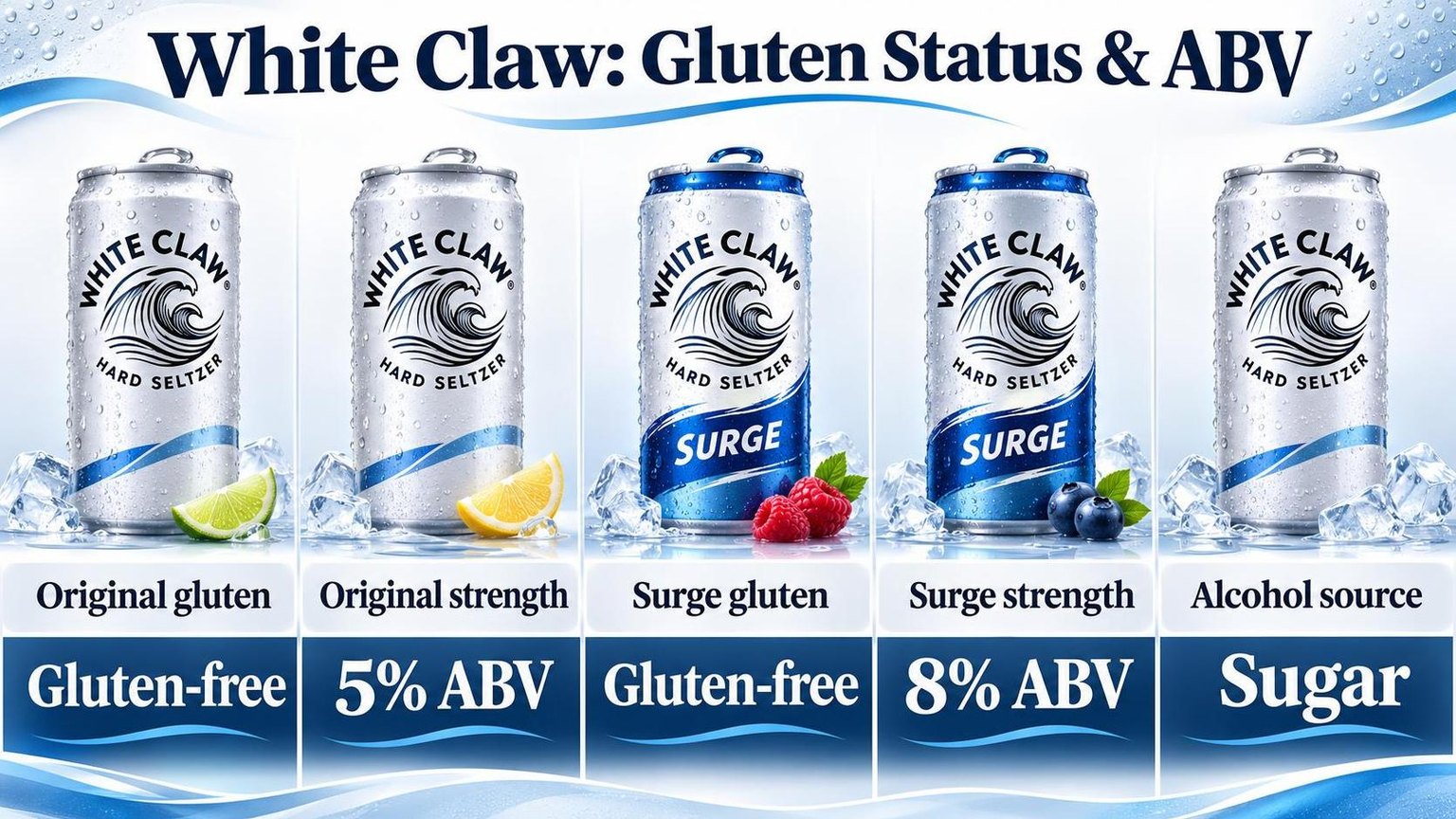
White Claw says its Hard Seltzer is gluten-free, including its Original and Surge products. That claim refers to gluten, not alcohol content: the two lines have different strengths, but neither is described by the company as containing gluten.
What the manufacturer says
White Claw describes its Hard Seltzer as a blend of seltzer water, a gluten-free alcohol base, and fruit flavor. Its product information identifies the Hard Seltzer line as gluten-free.
Check the package when buying a different White Claw product or a newly released variety rather than assuming the entire brand has the same formulation.
| U.S. product line | Typical alcohol by volume | Gluten status stated by White Claw |
| White Claw Hard Seltzer Original | 5% ABV | Gluten-free |
| White Claw Hard Seltzer Surge | 8% ABV | Gluten-free |
The ABV figures describe alcohol strength, not gluten content. Product labels are the best source for the specific can in hand, particularly when packaging, markets, or formulations change.
What “gluten-free” does—and does not—tell you
In the United States, the FDA’s gluten-free labeling standard for foods uses a limit of less than 20 parts per million of gluten, alongside ingredient and processing requirements.
Alcohol-beverage labeling can fall under different federal oversight, so that FDA threshold should not be treated as a published laboratory result for White Claw.
White Claw’s gluten-free statement is a manufacturer claim; it does not disclose a batch-by-batch gluten measurement on the can.
For someone with celiac disease, the useful distinction is between a product marketed as gluten-free and a drink merely assumed to be safe because it looks like seltzer.
If you have celiac disease, confirm that your chosen package still carries White Claw’s gluten-free designation.
If you have a wheat allergy, do not rely on “gluten-free” alone to answer every allergen question: contact White Claw for current ingredient and manufacturing information relevant to your allergy.
Sources: White Claw product information; U.S. Food and Drug Administration, “Gluten-Free” Labeling of Foods; Alcohol and Tobacco Tax and Trade Bureau, guidance on gluten labeling for alcoholic beverages.
What White Claw Is Made From
White Claw Hard Seltzer is a mixture of carbonated water, an alcohol base and flavoring. The key fact for anyone avoiding gluten is how that alcohol base is made: White Claw’s U.S.
FAQ says it comes from fermented sugar and describes the base as gluten-free.
Fermentation turns sugar into alcohol. For White Claw Hard Seltzer, the manufacturer identifies fermented sugar—not barley malt, wheat or rye—as the source of that alcohol.
This matters because barley, wheat and rye contain gluten proteins; “hard seltzer” alone does not tell you what supplied the alcohol.
White Claw’s FAQ summarizes its recipe as seltzer water, its gluten-free alcohol base and a hint of fruit flavor. Individual products can also contain ingredients such as natural flavors, citric acid, sodium citrate and cane sugar.
Check the package for the ingredient statement on the particular flavor you are buying.
The cane sugar listed in a finished drink is not necessarily the same sugar used to produce its alcohol. Sugar can be added during formulation for taste after the alcohol base has been fermented.
Likewise, “natural flavors” describes a flavoring category, not the grain or sugar source of the alcohol.
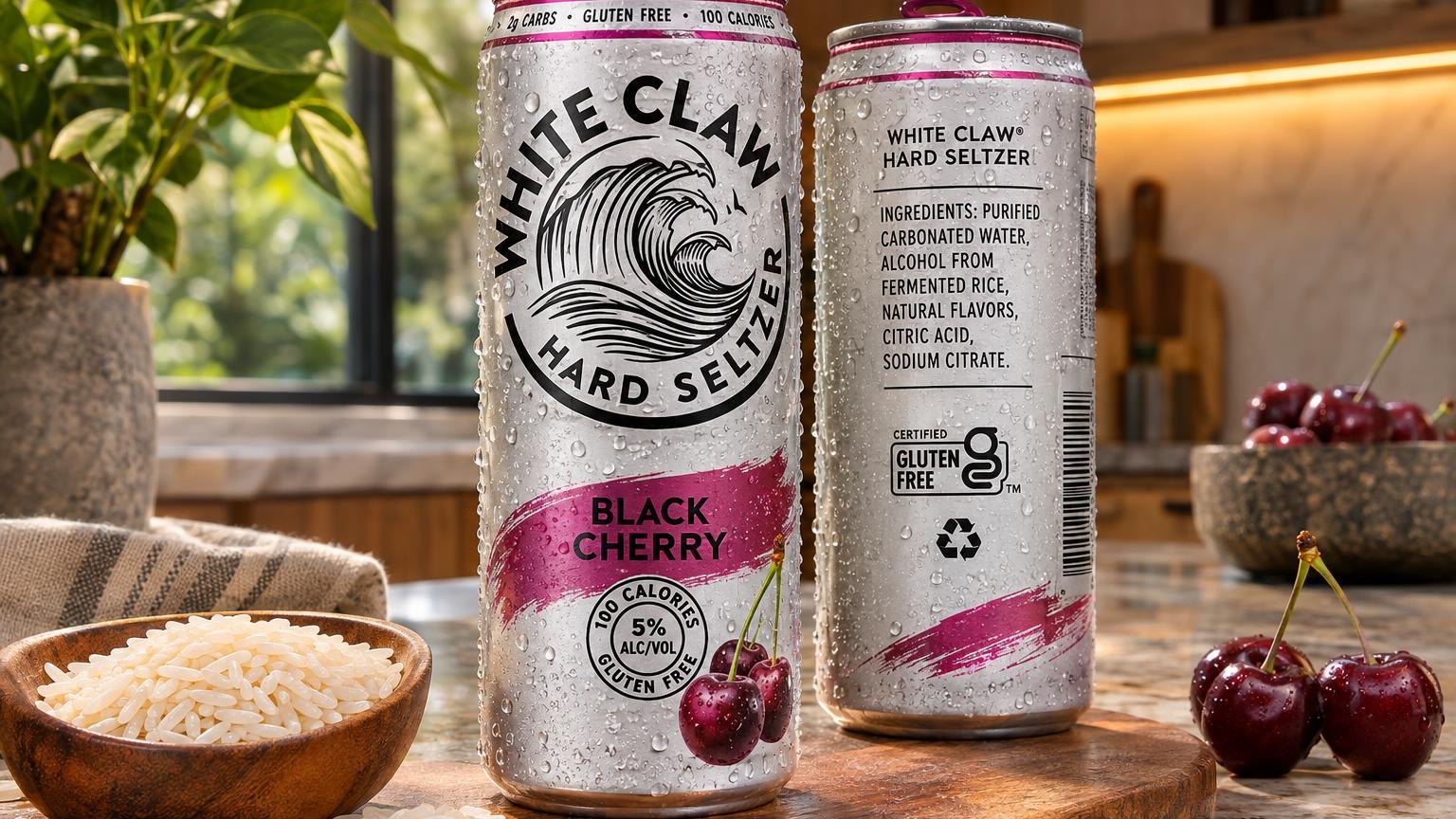
For a concrete example of the finished product, White Claw’s U.S. Black Cherry Hard Seltzer product information lists a 12-fluid-ounce can at 5% alcohol by volume, 100 calories, 2 grams of carbohydrates and 2 grams of sugar.
Those nutrition figures describe the beverage as sold; they do not identify every ingredient used during fermentation.
Do not infer that fermentation makes a gluten-containing grain safe. If a drink begins with barley malt, fermentation alone does not establish that its finished gluten content meets a gluten-free claim.
White Claw’s relevant distinction is its stated fermented-sugar alcohol base and the manufacturer’s gluten-free designation.
White Claw sells more than its original Hard Seltzer line, so avoid treating one recipe or nutrition panel as a specification for every can bearing the brand name.
For a different flavor or product line, use its current package and White Claw’s product-specific information to verify the alcohol base and gluten-free claim.
How White Claw Is Fermented
White Claw Hard Seltzer gets its alcohol from fermented sugar, not from distillation. White Claw describes the finished drink as a blend of seltzer water, a gluten-free alcohol base, and fruit flavor (White Claw, U.S. FAQ).
From sugar to alcohol
During fermentation, yeast consumes sugar and produces ethanol and carbon dioxide. That ethanol becomes the drink’s alcohol base.
White Claw identifies the ingredient it ferments as sugar; its public FAQ does not specify the sugar’s agricultural source or publish a complete production recipe.
The alcohol base is then used to make a flavored, carbonated hard seltzer. Carbonation gives the finished drink its bubbles, but it does not create the alcohol: fermentation does that.
Nor does the presence of alcohol tell you whether a beverage contains gluten; the ingredients used to make it matter.
White Claw states that its Hard Seltzer is gluten-free and that its alcohol base is gluten-free (White Claw, U.S. FAQ). That claim is more relevant to someone avoiding gluten than an assumption that all fermented drinks are safe.
Beer made with barley, for example, raises a different ingredient question.
Why fermentation alone is not a gluten test
Yeast converts sugars into alcohol; it does not reliably remove gluten proteins from a gluten-containing starting ingredient. Fermentation also differs from distillation, which separates alcohol from the fermented mixture.
White Claw’s gluten-free claim should therefore be understood as a claim about its ingredients and finished product, not as a benefit of fermentation itself.
In the United States, FDA rules generally require a food labeled “gluten-free” to contain less than 20 parts per million of gluten and to meet additional ingredient requirements (21 CFR § 101.91).
That threshold provides context for the label claim; it is not a published test result for a particular White Claw can.
If you have celiac disease, check the exact package you plan to drink rather than relying on the category “hard seltzer.” White Claw sells multiple products, and formulations or labeling can vary by product and market.
For its Hard Seltzer, the manufacturer’s stated process starts with fermented sugar and a gluten-free alcohol base.
Gluten Risks Across White Claw Varieties
For U.S. shoppers, White Claw Hard Seltzer’s gluten-free claim applies to more than its Original flavor.
The important distinction is the alcohol base: a drink can look like hard seltzer yet use different ingredients, so check the specific product rather than the brand name alone.
| U.S. variety | Alcohol content | Gluten consideration |
| White Claw Hard Seltzer, including Original and flavored cans | Typically 5% ABV | White Claw identifies its hard seltzer as gluten-free; its alcohol base is not brewed from barley. |
| White Claw Surge | 8% ABV | Higher alcohol content does not itself indicate gluten. Check the package for the current gluten-free statement. |
| White Claw Vodka + Soda | Varies by product | This is a vodka-based drink, not the same formulation as Hard Seltzer. Verify the label for the specific flavor. |
White Claw’s U.S. Hard Seltzer FAQ states that its hard seltzers are gluten-free.
That is more useful than judging by flavor names: “black cherry” or “mango” describes the flavor, not whether barley was used to make the alcohol.
A variety pack still warrants a quick check of each can’s product name.
Under the FDA’s gluten-free labeling rule, 21 CFR 101.91, a food bearing a gluten-free claim must contain less than 20 parts per million of gluten and meet the rule’s ingredient requirements.
The claim does not mean that a laboratory can prove an absolute absence of gluten.
- New releases and reformulations: Do not assume that every drink bearing the White Claw name has the original Hard Seltzer recipe. Read the current can or carton, particularly when buying a new line.
- Drinks made at a bar: A sealed can is different from a cocktail. Added syrups, garnishes, shared equipment, or a mistaken substitution can introduce ingredients that were not in the packaged drink.
- Products sold abroad: Packaging and formulations can differ by market. Use the gluten statement on the product you are actually buying, not a U.S. website description.
For someone with celiac disease, the practical choice is a sealed, clearly labeled gluten-free can whose product name matches the manufacturer’s current information. If the label is unclear, contact White Claw before drinking it.
White Claw and Celiac Disease
White Claw Hard Seltzer is labeled gluten-free and, according to White Claw, is made with a gluten-free alcohol base rather than a barley-malt base.
For people with celiac disease, that distinction matters: gluten from wheat, barley, and rye can trigger an immune reaction even when a drink looks clear.
What the gluten-free label means
White Claw’s U.S. product information identifies its hard seltzer as gluten-free. That is a statement about the finished product, not merely a claim that its fruit flavors contain no gluten.
It also distinguishes White Claw Hard Seltzer from malt-based alcoholic drinks, which should not be assumed safe for celiac disease.
Under the U.S. Food and Drug Administration’s gluten-free labeling rule, 21 CFR § 101.91, a food bearing that claim must meet requirements that include a gluten limit of less than 20 parts per million.
Federal oversight of alcoholic-beverage labels varies by product and regulator, so that FDA rule should not be treated as a White Claw batch-test result.
White Claw does not need to publish a test result for every can for its gluten-free claim to be useful. Still, a label cannot tell you the measured gluten concentration of the particular can in your hand.
If you need information about a specific flavor, package, or manufacturing practice, ask White Claw directly.
How to drink it more safely
- Check the exact can or package for a gluten-free claim, especially when trying a new White Claw product line. Do not assume every drink sold under the brand has the same ingredients as Hard Seltzer.
- At a bar, request an unopened can or a clean glass. Shared garnishes, mixing tools, and drink-preparation surfaces can introduce cross-contact even when the packaged drink itself is gluten-free.
- Do not judge safety by whether a drink causes immediate symptoms. The National Institute of Diabetes and Digestive and Kidney Diseases notes that celiac disease is an immune disorder; symptoms and their timing vary.
For most people managing celiac disease, a clearly labeled can of White Claw Hard Seltzer is a reasonable gluten-free choice.
If your clinician has advised additional precautions, or you react after drinking one, review the exact product and serving conditions rather than assuming the alcohol base was the cause.
Gluten-Free Labeling and Testing
White Claw says its Hard Seltzer is made with a gluten-free alcohol base and is gluten-free.
That claim is more useful than assuming all hard seltzers are safe: ingredients, production methods, and labeling rules can differ between brands and products.
What “gluten-free” means on a label
Under the U.S. Food and Drug Administration’s gluten-free labeling rule, a food bearing that claim must contain less than 20 parts per million of gluten.
The rule also restricts the use of wheat, rye, barley, and ingredients derived from those grains unless the ingredients have been processed to meet its requirements.
| FDA measure | Meaning |
| 20 parts per million | 20 milligrams of gluten per kilogram of product |
| “Gluten-free” | A regulated labeling claim, not a promise of absolutely zero gluten |
Alcohol labeling has an important complication. Depending on its ingredients and how it is made, a hard seltzer may fall under FDA labeling rules or under the Alcohol and Tobacco Tax and Trade Bureau’s rules for malt beverages.
A “gluten-free” claim should therefore be evaluated against the rules that apply to that particular drink.
Why a finished-drink test is not the whole answer
Testing can help verify a manufacturer’s controls, but the method matters. Fermentation can break gluten proteins into smaller fragments that some conventional tests do not reliably measure.
An undetectable result in a fermented drink is not, by itself, proof that gluten-containing grain was never used.
For FDA-regulated fermented or hydrolyzed foods, FDA rules require manufacturers making a gluten-free claim to keep records supporting the gluten-free status of ingredients before fermentation or hydrolysis.
Records must also show that the process adequately controls gluten cross-contact. This is why ingredient sourcing and production controls matter alongside laboratory results.
White Claw’s published gluten-free statement does not provide a batch-by-batch gluten result or a detection limit for every flavor.
If you have celiac disease, check the current label and White Claw’s product information for the exact variety you plan to drink, particularly for a new or limited-edition release.
Sources: White Claw Hard Seltzer FAQ; FDA, 21 CFR § 101.91 and “Gluten-Free Labeling of Fermented or Hydrolyzed Foods”; TTB Ruling 2020-2.
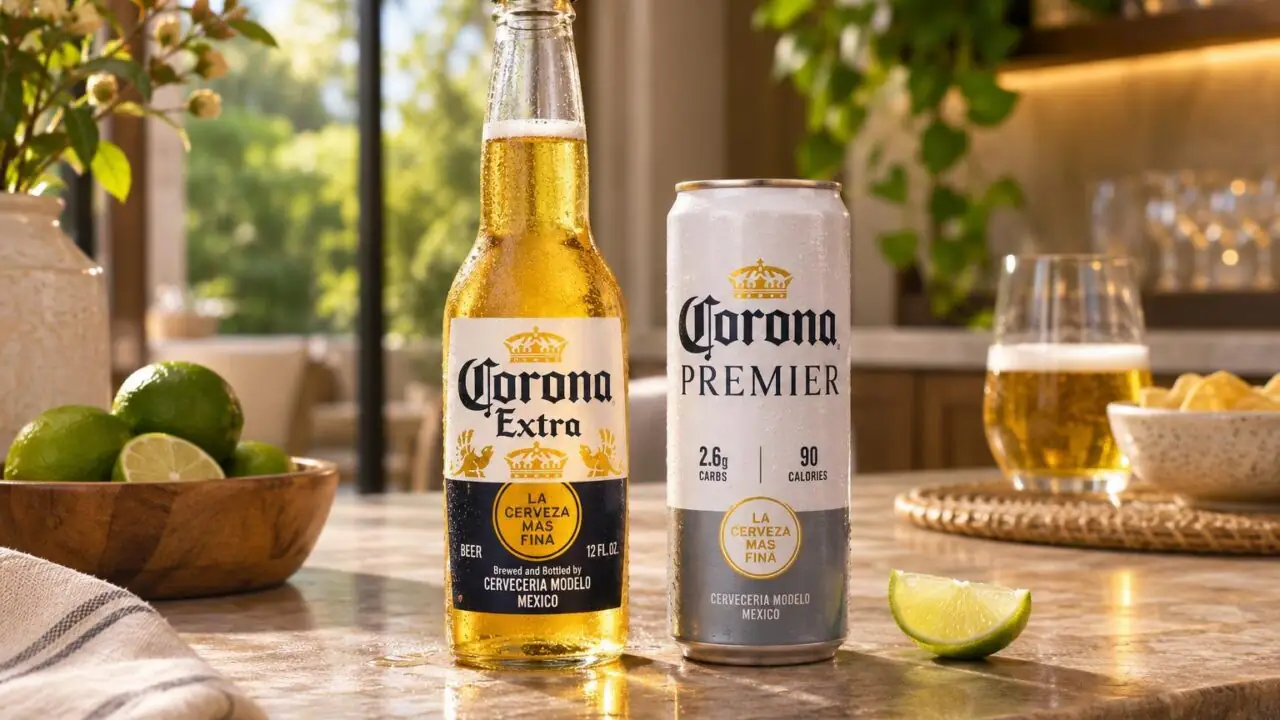
How White Claw Compares With Beer
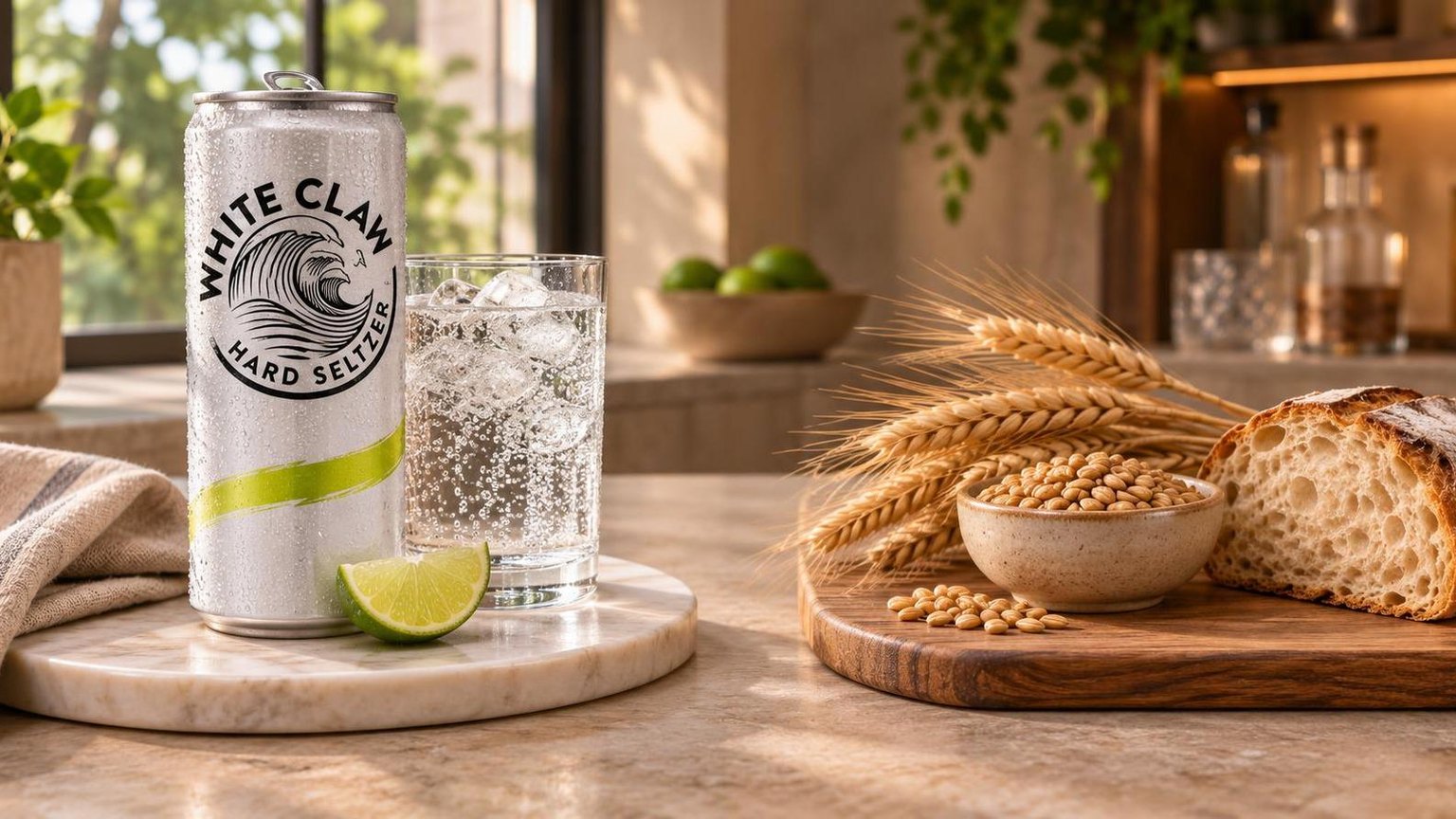
Original White Claw Hard Seltzer is labeled gluten-free; conventional beer generally is not.
The distinction comes from the ingredients used to make the alcohol: White Claw uses a gluten-free alcohol base, while most beer is brewed with barley, a gluten-containing grain.
| Per 12 fl oz | White Claw Black Cherry | Regular beer |
| Alcohol by volume | 5% | Varies by brand |
| Calories | 100 | 153, USDA reference value |
| Carbohydrates | 2 g | 12.6 g, USDA reference value |
| Gluten status | Labeled gluten-free | Generally contains gluten |
The White Claw figures come from its Black Cherry product information; the beer figures come from USDA FoodData Central’s entry for regular beer. The beer column is a reference value, not a promise about every brand.
Styles, recipes, and serving sizes change the nutritional comparison.
For someone avoiding gluten, the ingredient difference matters more than the calorie difference. Barley contains gluten, as does wheat, which is used in some beers.
Fermenting those grains does not automatically make the finished beer gluten-free. White Claw states that its Hard Seltzer alcohol base is gluten-free.
Beer can still be an option if it is specifically made and labeled gluten-free. Brewers can use ingredients such as sorghum, millet, or rice instead of barley and wheat.
Check the individual beer’s label rather than assuming that a light beer, a rice-containing lager, or a low-carbohydrate beer is gluten-free.
Be especially careful with beer advertised as “gluten-removed” or “crafted to remove gluten.” It starts with gluten-containing grain and is not the same as beer brewed without it. The U.S.
Alcohol and Tobacco Tax and Trade Bureau distinguishes these claims from a gluten-free claim, a meaningful difference for people with celiac disease.
The practical takeaway: White Claw’s gluten-free label makes it a clearer choice than ordinary barley-based beer for someone avoiding gluten.
It is not nutritionally identical to beer, either, but neither drink’s calorie count or carbohydrate count tells you whether it contains gluten. Check the current package whenever gluten avoidance is medically necessary.
Questions People Ask Most
Does White Claw Hard Seltzer contain gluten?
White Claw says its U.S. Hard Seltzer is made with gluten-free ingredients and is gluten-free. That is the manufacturer’s claim for the product, not a guarantee about every alcoholic drink sold under the White Claw name.
What is the alcohol in White Claw Hard Seltzer made from?
White Claw describes its Hard Seltzer as a blend of seltzer water, a gluten-free alcohol base, and fruit flavor. Its U.S. product information does not identify barley malt as the source of that alcohol base.
Can someone with celiac disease drink White Claw Hard Seltzer?
White Claw’s gluten-free claim makes its U.S. Hard Seltzer an option to consider, but people with celiac disease should check the current label for the exact product they plan to drink.
The Celiac Disease Foundation recommends choosing products labeled gluten-free rather than assuming all hard seltzers are alike.
Are all White Claw Hard Seltzer flavors gluten-free?
White Claw’s gluten-free statement applies to its Hard Seltzer line, rather than singling out one flavor. Check the package when buying a new flavor or variety pack, since formulations and product lines can change.
Why can White Claw be gluten-free if some alcoholic drinks contain gluten?
Gluten content depends on ingredients and production, not alcohol content. Conventional beer commonly uses barley malt, which contains gluten; White Claw says its Hard Seltzer uses a gluten-free alcohol base.
Are White Claw Vodka + Soda and other White Claw products automatically gluten-free?
No. A gluten-free statement for Hard Seltzer should not be treated as a blanket claim for every White Claw product, including Vodka + Soda or canned cocktails.
Check the specific product’s current label and White Claw’s product information before drinking it if you need to avoid gluten.
Related Guides
- Does White Claw Have Caffeine?
- Truly Pineapple – Information From Experts
- Do White Claws Expire? The Answer You Must Know
- Does White Claw Get You Drunk?
- What Alcohol Is in a Truly? Everything You Need to Know in 2026 (Full Guide)
- What Is Hard Seltzer? Brands, Ingredients & ABV Guide (2026)
- All Non-Alcoholic Beverages Guides
- White Claw, Frequently Asked Questions (n.d.)
- U.S. Food and Drug Administration, Gluten-Free Labeling of Foods (n.d.)
- U.S. Food and Drug Administration, Questions and Answers on the Gluten-Free Food Labeling Final Rule (n.d.)
- National Institute of Diabetes and Digestive and Kidney Diseases, Eating, Diet, & Nutrition for Celiac Disease (n.d.)
- National Institute of Diabetes and Digestive and Kidney Diseases, Definition & Facts for Celiac Disease (n.d.)
- Alcohol and Tobacco Tax and Trade Bureau, Ruling 2014-2 (2014)
- Celiac Disease Foundation, Alcohol (n.d.)
- Beyond Celiac, Is Alcohol Gluten-Free? (n.d.)