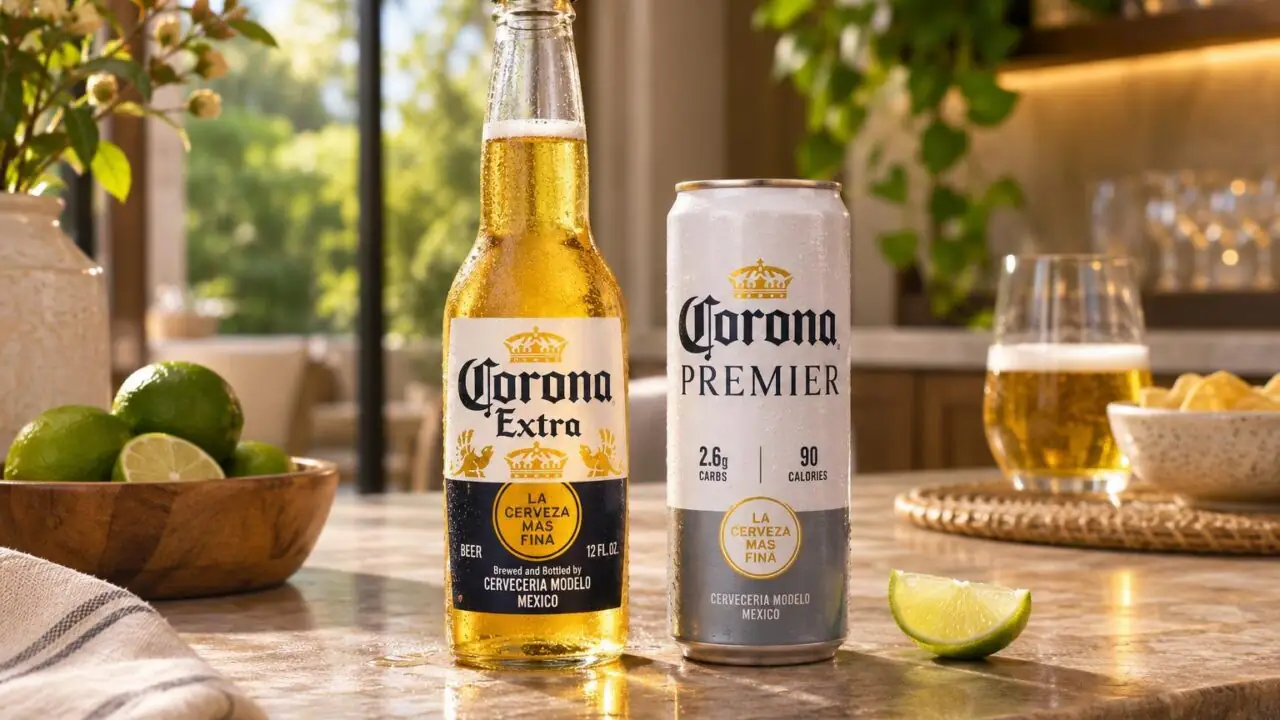
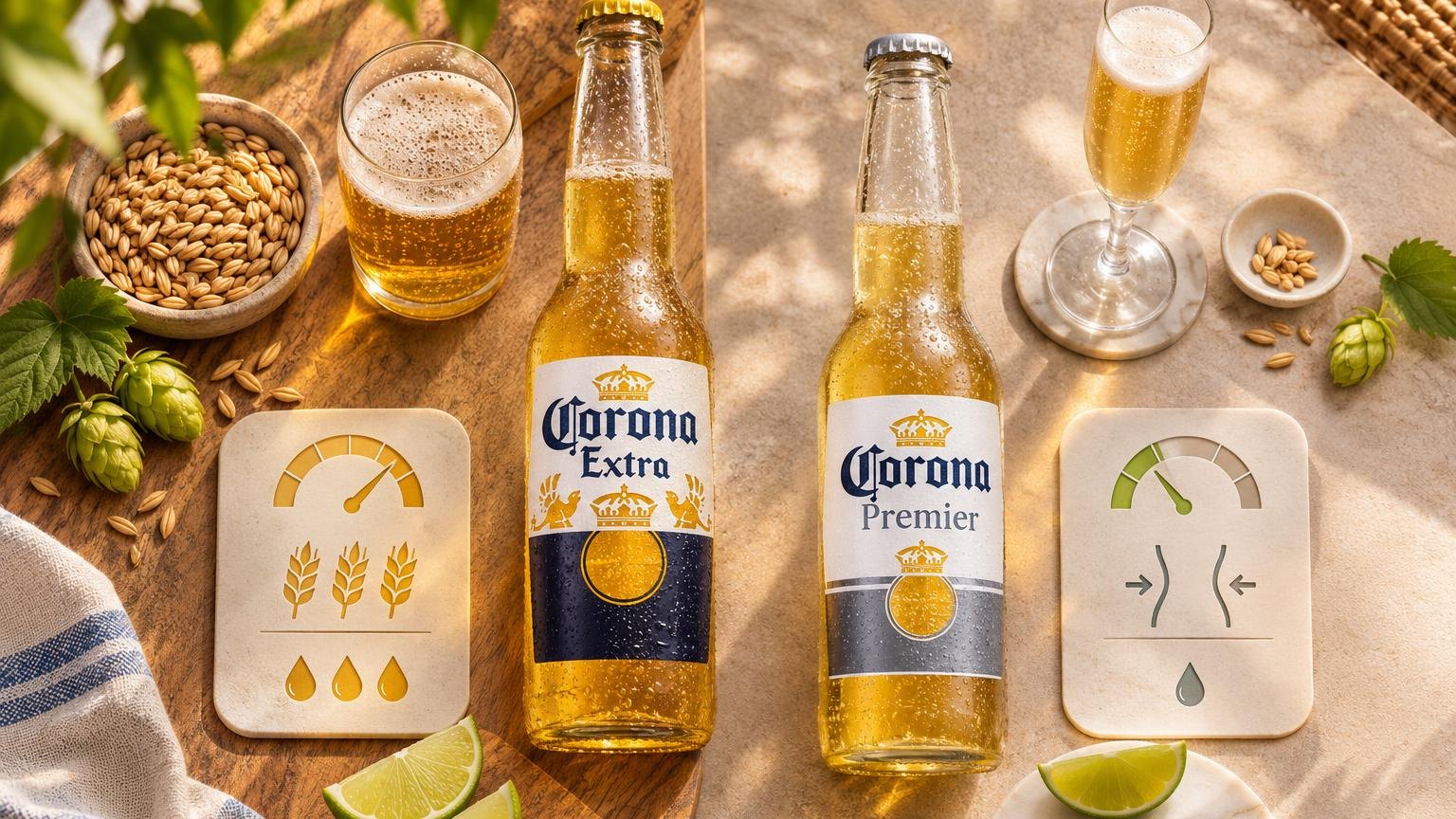
Difference between Corona Extra and Premier is that Extra is the fuller-bodied, slightly sweeter flagship lager, while Premier is a lighter-bodied, lower-calorie option.
Both are Mexican pale lagers brewed by Grupo Modelo, typically served in clear bottles, and have 4.0% alcohol by volume in the United States.
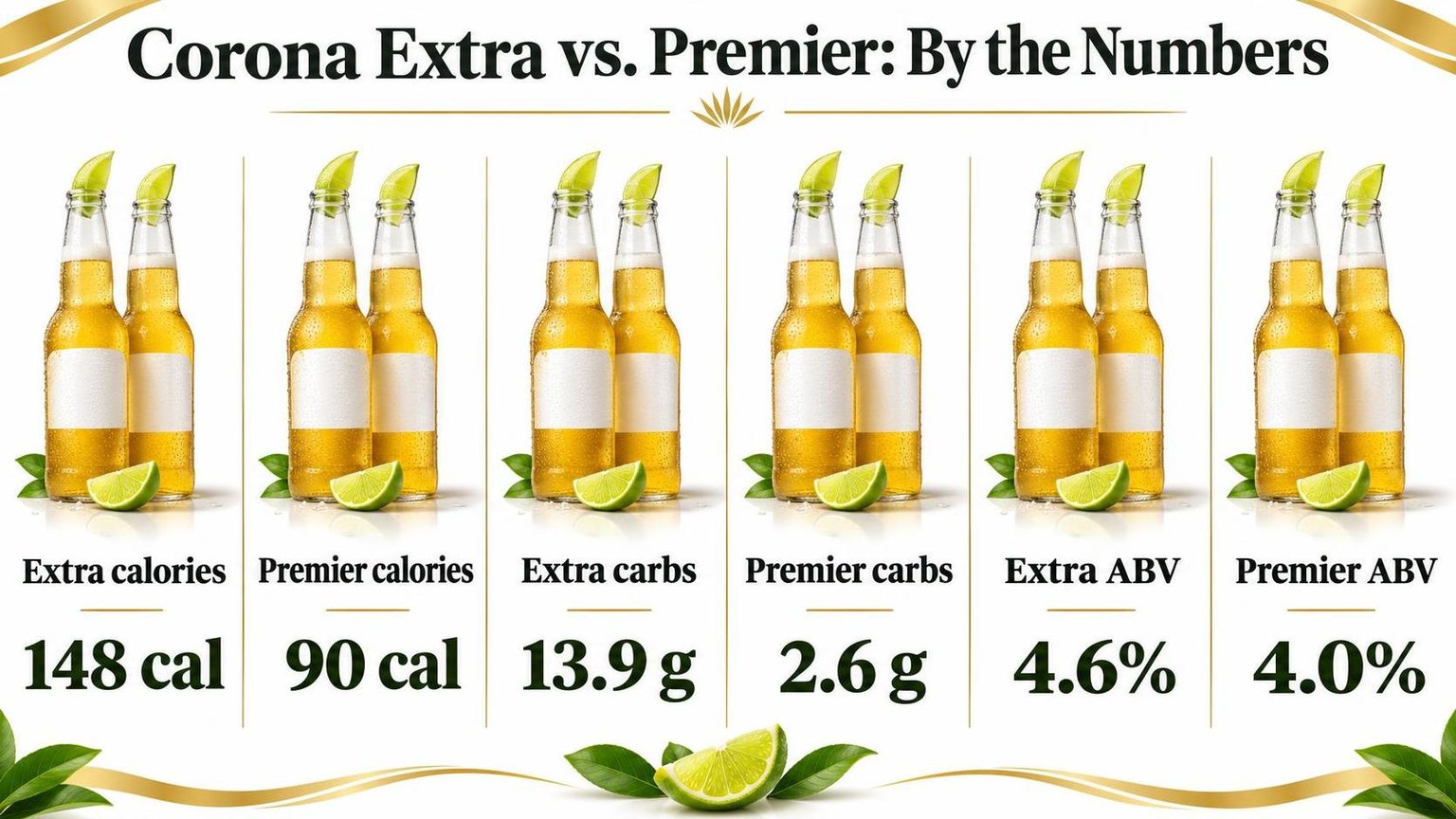
Corona Extra contains about 148 calories and 13.9 grams of carbohydrates per 12-ounce serving; Corona Premier has about 90 calories and 2.6 grams of carbohydrates per 12 ounces.
The practical difference is noticeable: Extra has a more pronounced malt flavor and a fuller finish, while Premier tastes lighter and crisper, with less sweetness.
Choose Extra for the classic, more substantial Corona profile; choose Premier if reducing calories and carbohydrates matters more. Nutrition values can vary slightly by serving size and product labeling, so check the package for current details.
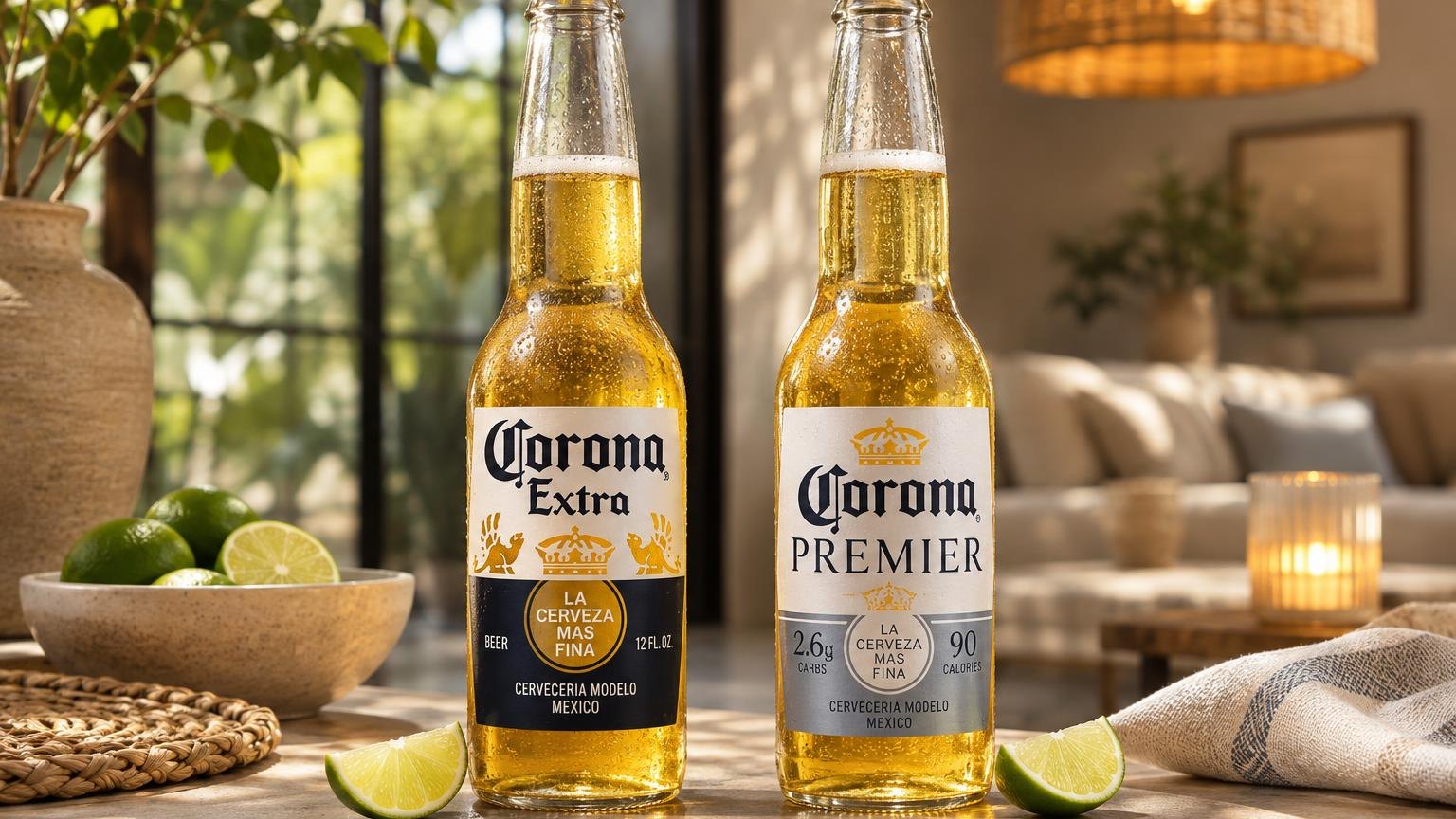
Corona Extra vs Corona Premier
Corona Extra is the fuller-flavored choice; Corona Premier is the lighter choice in calories, carbohydrates, and alcohol. Both are Mexican lagers, but Premier is designed for a crisper, leaner drinking experience.
The figures below come from Corona USA’s product information and apply to the same serving size.
| Per 12 fl oz | Corona Extra | Corona Premier |
| Calories | 148 | 90 |
| Carbohydrates | 13.9 g | 2.6 g |
| Alcohol by volume | 4.6% | 4.0% |
| Extra minus Premier | 58 calories; 11.3 g carbohydrates; 0.6 percentage points of alcohol | |
The calorie gap is substantial for beers served in identical bottles. Premier’s lower carbohydrate content accounts for much of it, while its lower alcohol content also matters: alcohol itself contributes calories.
Premier is not alcohol-free or calorie-free, and its nutrition advantage depends on comparing equal pours rather than differently sized servings.
Corona Extra has a more noticeable grain character and a somewhat rounder body. Premier tastes lighter and drier, with less of the bready, mildly sweet impression associated with Extra.
Neither is a hop-forward beer: expect restrained bitterness and a clean, refreshing finish rather than the pronounced hop aroma of an IPA.
That flavor distinction matters more than the label’s use of “light.” Premier can be appealing when you want a subtle beer that stays out of the way of food.
Extra is the better bet if you want the familiar Corona taste to remain noticeable alongside a meal, particularly one with salt, spice, or grilled flavors.
A lime wedge is optional for either beer. Citrus can make both seem brighter, but it also masks some of the difference in malt flavor and body.
If you are deciding between them for the first time, taste each cold without lime before adding it; that makes the contrast easier to judge.
Neither beer should be described as gluten-free. Beer made with barley presents a concern for people who must avoid gluten, regardless of how few carbohydrates the finished beer contains.
Likewise, “lower carb” is a nutrition comparison, not a promise that Premier fits every dietary or medical need.
Check the package when shopping: a tall can, draft pour, or other larger serving changes the total calories and carbohydrates you consume. The table describes a standard bottle or can serving, not every container in which Corona is sold.
It also does not account for mixers if the beer becomes part of a cocktail.
Choose Extra for more body and the brand’s classic flavor; choose Premier when lower calories and carbohydrates take priority and you prefer a lighter finish. Corona USA’s published product figures provide the objective distinction.
Flavor preference is personal, so the most useful test is a side-by-side taste at the same temperature.
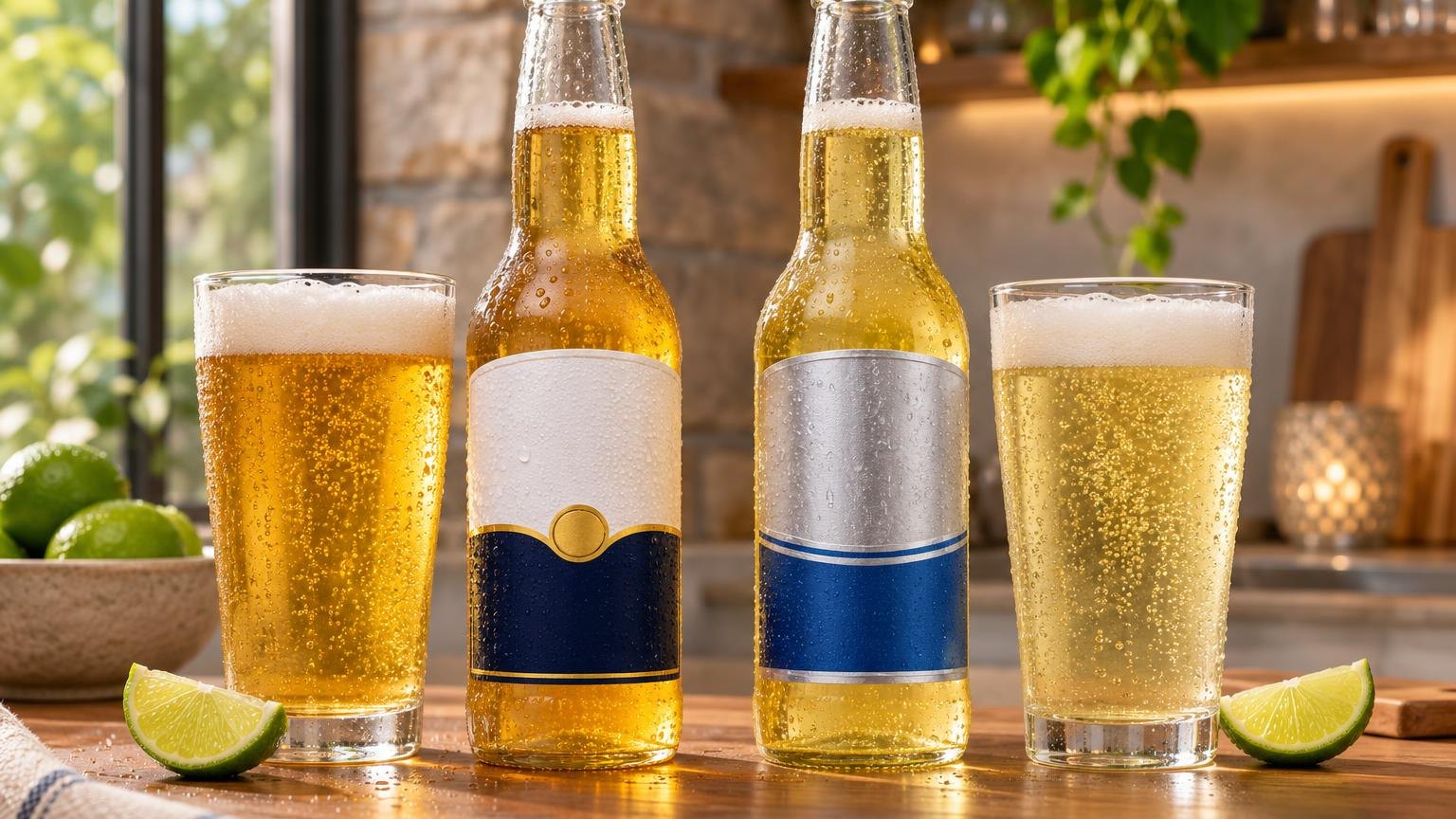
Alcohol Content and Calories Compared
Corona Premier has fewer calories and carbohydrates than Corona Extra, but the difference in alcohol content is smaller.
For a 12-fluid-ounce serving, Corona lists Premier at 90 calories and 4.0% alcohol by volume (ABV), versus 148 calories and 4.6% ABV for Extra.
| Per 12 fl oz | Corona Extra | Corona Premier |
| Alcohol by volume | 4.6% | 4.0% |
| Calories | 148 | 90 |
| Carbohydrates | 13.9 g | 2.6 g |
These figures come from Corona’s product information for Extra and Premier. Compare the same serving size: a larger can or bottle contains more alcohol and calories than the 12-ounce amounts shown here, even when its ABV stays the same.
Premier saves 58 calories per 12-ounce beer, approximately 39% of Extra’s calorie count. Its carbohydrate content is 11.3 grams lower, an approximately 81% reduction.
Those are meaningful differences for someone tracking calories or carbohydrates, though Premier is not calorie-free or carb-free.
The ABV gap is 0.6 percentage points—not 0.6% less alcohol overall. In a 12-ounce serving, Extra contains about 0.552 fluid ounces of pure alcohol, while Premier contains about 0.480.
That makes Premier’s alcohol content roughly 13% lower per equal-size serving.
For another reference point, the National Institute on Alcohol Abuse and Alcoholism defines one U.S. standard drink as containing 0.6 fluid ounces of pure alcohol.
On that basis, a 12-ounce Extra is about 0.92 standard drinks; a 12-ounce Premier is about 0.80. Neither should be treated as alcohol-free or as automatically safe for driving.
Alcohol itself supplies calories, so Premier’s lower ABV contributes to its lower total. The much larger difference in carbohydrates also matters: Extra has 13.9 grams per serving compared with Premier’s 2.6 grams.
The calorie gap therefore reflects more than the modest change in ABV.
Across two 12-ounce beers, the label figures add up to 296 calories for Extra or 180 for Premier—a difference of 116 calories. The corresponding carbohydrate totals are 27.8 grams and 5.2 grams.
These totals exclude anything eaten or added to the beer, such as a lime wedge.
If the goal is to reduce calories or carbohydrates while choosing between these two beers, Premier is the clear lower-number option.
If the goal is to limit alcohol intake, serving size and the number of beers matter alongside ABV: Premier still contains most of the alcohol found in an equal-size Extra.
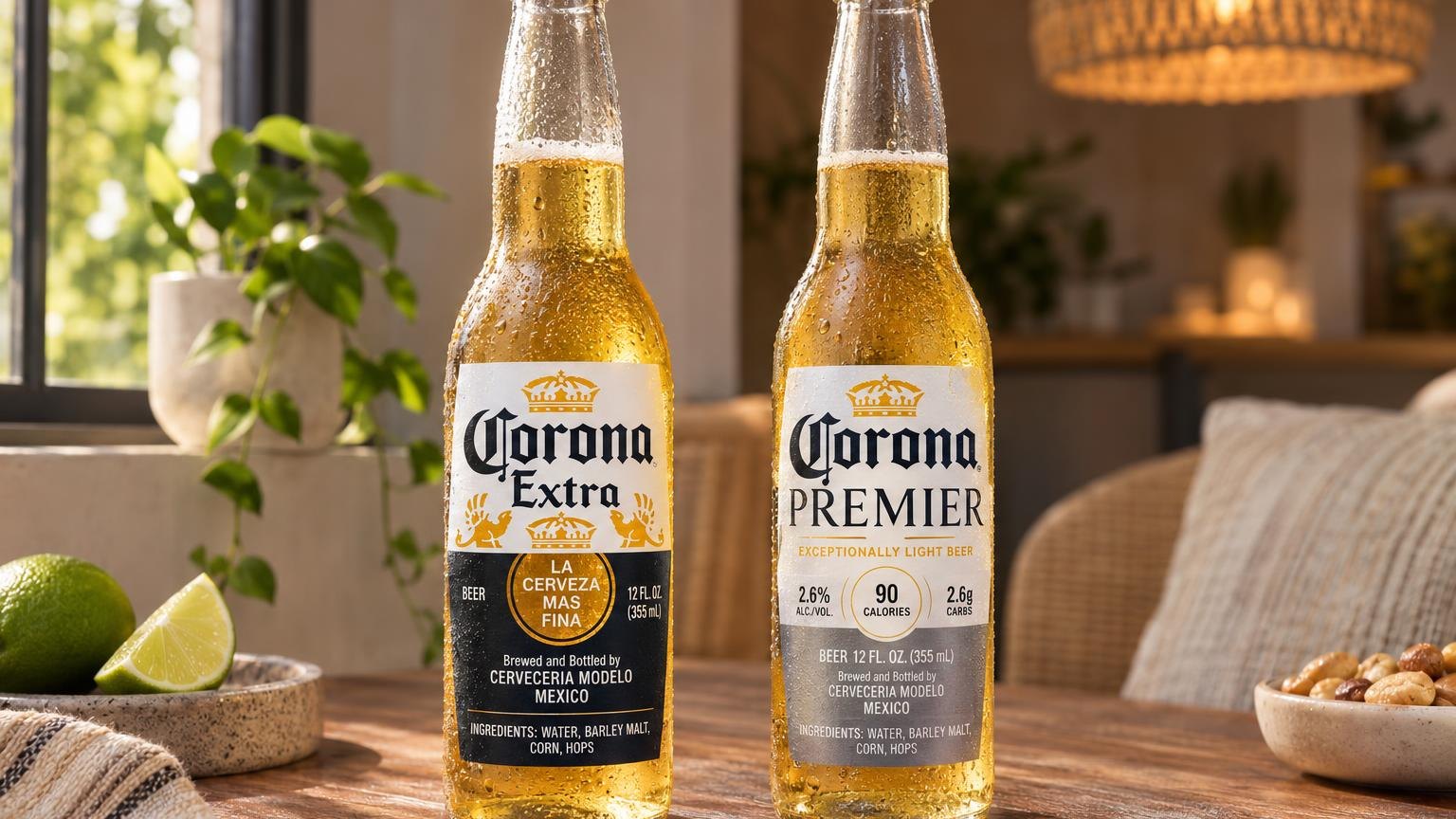
Taste Body and Bitterness Differences
Corona Extra has a fuller, slightly sweeter impression than Corona Premier, while Premier tastes lighter and finishes more quickly.
Neither is a strongly bitter beer; the difference is easier to notice in body and lingering grain flavor than in hop bite.
| U.S. product information | Corona Extra | Corona Premier |
| Serving size | 12 fl oz | 12 fl oz |
| Alcohol by volume | 4.6% | 4.0% |
| Calories | 148 | 90 |
| Carbohydrates | 13.9 g | 2.6 g |
These figures come from Corona’s U.S. product information. They help explain why Premier can feel leaner, but they are not a sweetness score.
Carbohydrate totals do not identify exactly which compounds remain in the finished beer, and aroma, carbonation, and serving temperature also affect perceived body.
Flavor and mouthfeel
Extra typically presents mild grain or corn-like notes, a faint sweetness, and a crisp finish. Its modest malt character gives the sip some weight without making it taste rich.
Premier keeps the clean, restrained lager profile but leaves less grain flavor on the palate.
“Body” describes how substantial a beer feels in the mouth, not how dark it looks. Premier’s leaner impression can make its carbonation seem more prominent.
Extra may feel a touch rounder, particularly when both beers are poured and tasted at the same temperature.
Neither beer should be expected to deliver the bread-crust depth of a malt-forward lager or the citrus-and-pine intensity of a hop-driven ale.
The practical choice is between a little more lingering flavor in Extra and a lighter, quicker finish in Premier.
Bitterness and the finish
Hop bitterness provides balance in both beers rather than leading the flavor. Extra can seem a little firmer at the end of a sip; Premier generally comes across as softer and more neutral.
Because sweetness can mask bitterness, a drier finish does not necessarily mean a beer contains more bitter hop compounds.
Do not treat an unsourced International Bitterness Units (IBU) figure as a reliable way to choose between them.
IBU measures bitter compounds under laboratory conditions, while perceived bitterness also depends on the beer’s sweetness, carbonation, and serving conditions. Taste is the more useful test here.
For a fair comparison, pour both into clean, identical glasses and taste them without lime first. Lime adds acidity and aroma that can obscure the beers’ subtle differences.
Compare the initial grain flavor, the weight across the tongue, and how much flavor remains after swallowing.
Light exposure matters, too. Beer in clear glass can develop a skunky aroma when hop compounds react to light; that fault is not either beer’s intended taste.
Compare fresh bottles stored away from bright light, or use cans, before deciding which profile you prefer.
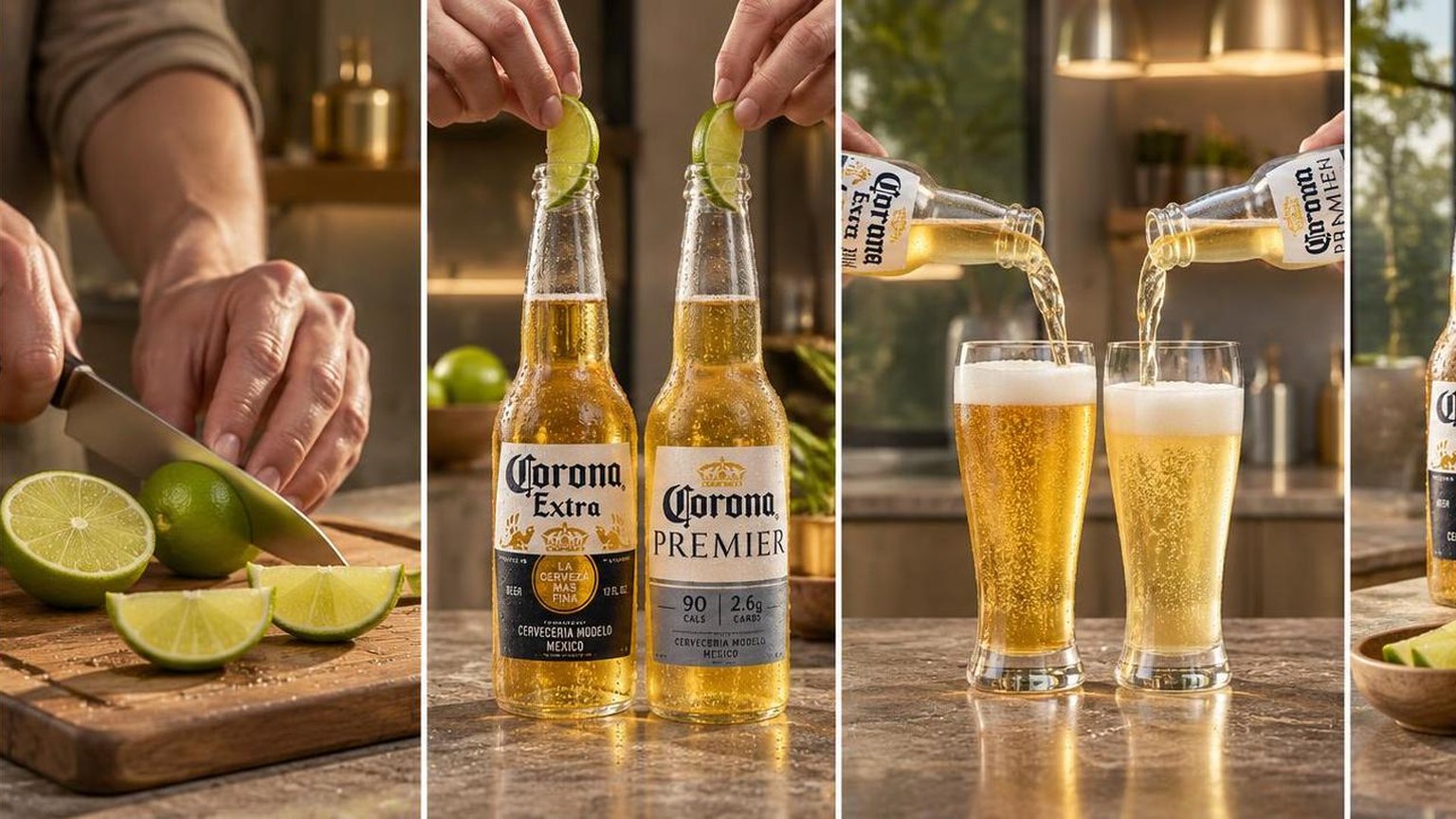
Ingredients and Brewing Differences
Corona Extra and Corona Premier use the same broad ingredient categories, but they are not nutritionally interchangeable.
Corona USA lists Premier at substantially fewer carbohydrates and calories per 12-ounce serving; the companies’ published ingredient information does not disclose a separate grain recipe or brewing schedule for either beer.
According to Corona USA’s product information, both beers contain water, barley malt, non-malted cereals, and hops.
Barley malt supplies fermentable sugars and contributes flavor, while non-malted cereals also affect the beer’s fermentable material and finished body.
The published ingredient categories do not identify the cereals or specify their proportions.
The clearest documented differences are in the finished beers. The figures below are Corona USA’s published values for a 12-fluid-ounce serving; they describe what is in the bottle, not precisely how each beer was brewed.
| Measure | Corona Extra | Corona Premier |
| Alcohol by volume | 4.6% | 4.0% |
| Calories | 148 | 90 |
| Carbohydrates | 13.9 g | 2.6 g |
| Published ingredient categories | Water, barley malt, non-malted cereals, hops | Water, barley malt, non-malted cereals, hops |
Premier therefore has 11.3 grams fewer carbohydrates and 58 fewer calories per serving. Its alcohol content is also 0.6 percentage points lower.
Those differences matter when comparing the beers, but the nutrition figures alone cannot establish whether Corona changed the grain proportions, fermentation, filtration, or some combination of brewing steps.
During brewing, enzymes convert grain starches into sugars. Yeast then turns some of those sugars into alcohol and carbon dioxide. Carbohydrates left in the finished beer depend partly on the sugars produced and how completely they ferment.
This explains how beers with similar listed ingredients can have different carbohydrate counts.
It does not mean Premier is simply Extra diluted with water. Dilution would lower alcohol and other dissolved components together; the published numbers do not identify Premier’s production method.
Corona USA does not provide a consumer-facing mash bill, fermentation endpoint, or filtration specification that would support a more exact account.
The lower carbohydrate content is relevant to flavor and texture, though it is not a complete tasting note. Residual carbohydrates can contribute to perceived body, while alcohol and other brewing compounds also shape the result.
A fair side-by-side comparison uses equally cold, equally fresh bottles without lime, which can mask differences.
Neither beer should be assumed gluten-free. Both list barley malt, which contains gluten; a lower carbohydrate count does not indicate gluten removal.
For someone avoiding gluten because of celiac disease, the shared barley ingredient is more consequential than Premier’s lower calorie or carbohydrate figure.
In short, Corona’s published specifications support a firm nutritional distinction, not a detailed claim about a secret recipe change.
Extra contains more carbohydrates and alcohol per serving; Premier delivers the lighter numbers while retaining the same publicly listed ingredient categories.
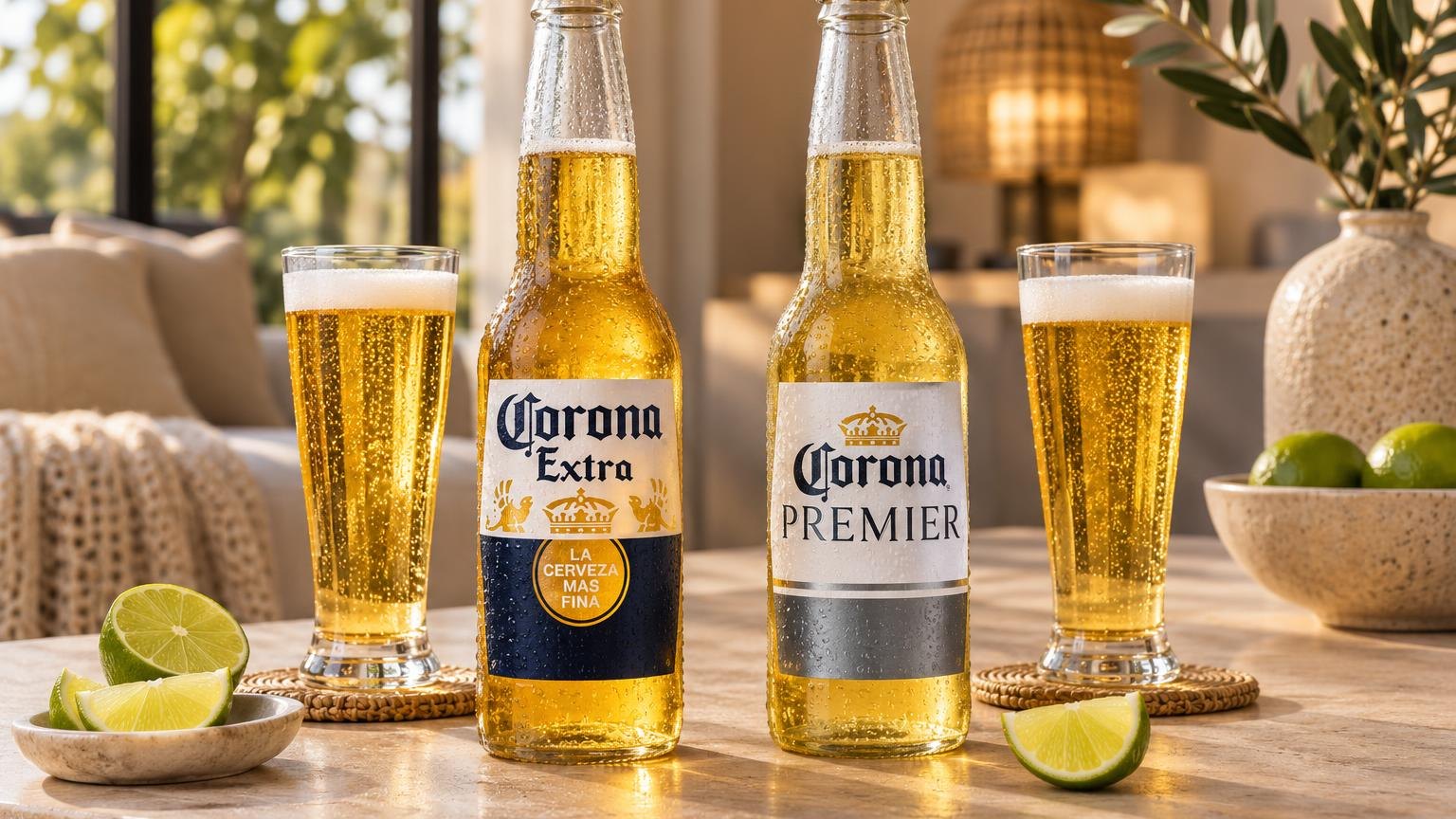
Which Corona Beer Should You Choose
Choose Corona Extra if you want a fuller-tasting lager; choose Corona Premier if lower calories and carbohydrates matter more.
Both are crisp, easy-drinking beers, but Premier’s lighter body is noticeable alongside food or in a side-by-side tasting.
Corona USA’s product information gives the following figures for the standard U.S. serving. Check your package if you are buying outside the United States, where serving sizes or product specifications may differ.
| Beer | Serving | Calories | Carbohydrates | Alcohol by volume |
| Corona Extra | 12 fl oz | 148 | 13.9 g | 4.6% |
| Corona Premier | 12 fl oz | 90 | 2.6 g | 4.0% |
Those figures make Premier the practical choice when carbohydrate intake is your main criterion. It is lower in carbs, not carbohydrate-free.
Its lower alcohol content also contributes to the calorie difference: alcohol itself supplies energy, so calorie counts cannot be judged from carbohydrates alone.
Pick Extra for more beer flavor
Extra has more body and a more apparent grain character while retaining the clean, refreshing finish associated with Corona. Pick it when the beer will be a prominent part of the meal rather than simply a cold drink alongside it.
For a useful comparison, taste both beers cold, without a lime wedge, before adding anything to the bottle. The lime can make the beers seem more alike by adding the same sharp citrus note to each.
Taste them again with lime if that is how you normally drink Corona.
Extra is a reasonable match for salty snacks, grilled food, or tacos when you want the lager to remain perceptible between bites. That is a preference, not a rule: neither beer needs a particular food pairing to work.
Pick Premier for a lighter option
Premier is the better fit if you like a lighter-bodied lager or want to keep the beer’s nutrition figures in view. Expect a leaner impression than Extra, rather than an identical-tasting beer with fewer calories.
Its crispness works well when you want the food to take center stage.
Do not treat “lower calorie” as a reason to ignore serving size. The figures above apply to a single standard serving, and drinking more beer changes the total.
Premier also contains alcohol; choosing it over Extra does not make a drinking occasion risk-free.
If you are buying for a group, offering both avoids guessing whether guests prioritize flavor or nutrition. For your own choice, start with the deciding factor: Extra for a more substantial lager, Premier for a lighter one.
Corona USA’s published product figures provide the clearest basis for that trade-off.
Questions Readers Ask
How do the calories and carbs compare?
Per 12-ounce serving, Corona Extra lists 148 calories and 13.9 grams of carbohydrates; Corona Premier lists 90 calories and 2.6 grams.
Those figures come from Corona’s US product information, so Premier saves 58 calories and 11.3 grams of carbs per bottle.
Which beer has more alcohol?
Corona Extra is 4.6% alcohol by volume (ABV), compared with 4.0% for Corona Premier, according to Corona’s US product information. In a 12-ounce serving, that works out to about 0.55 fluid ounces of pure alcohol in Extra versus 0.48 in Premier.
How do Corona Extra and Corona Premier taste different?
Corona Extra has a fuller malt presence, while Corona Premier is designed to taste lighter and crisper.
The difference is generally more noticeable when the beers are served without a lime, which can add acidity and mask some of their subtler flavors.
Is Corona Premier simply diluted Corona Extra?
No: Corona sells Premier as a separate light beer, not as a serving of Extra mixed with water. Its lower ABV, calorie count and carbohydrate count describe the finished beer; they do not establish that it is diluted Extra.
Are either Corona Extra or Corona Premier gluten-free?
No. Corona’s US ingredient information lists barley malt for both beers, and barley contains gluten; Premier’s lower carbohydrate count does not make it gluten-free.
People with celiac disease should not treat either beer as a gluten-free option.