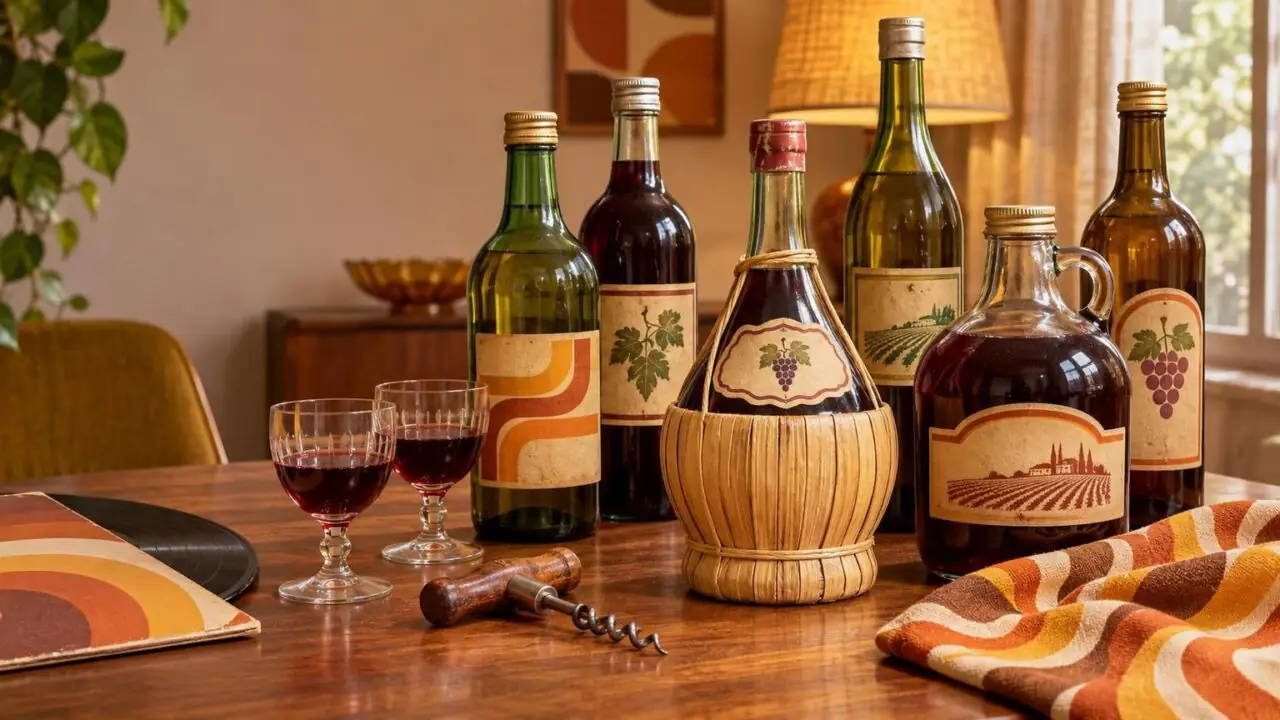
Cheap wines of the 60s and 70s were often inexpensive domestic jug wines, sweet wine drinks, and fortified wines sold for everyday occasions.
In the United States, brands such as Ripple and Boone’s Farm became familiar low-cost options, while larger containers of table wine offered value for households and parties.
Prices varied by year, state, brand, and package size, so there was no single national “cheap wine” price.
The category also reflected changing tastes: many popular choices were sweet or lightly flavored, unlike the drier wines that later gained prominence among American consumers.
Understanding what counted as cheap means looking beyond today’s bottle prices to the wine’s style, alcohol content, container, and local market.
This guide explains the best-known examples and the historical context behind their affordability, without treating every bottle from the era as interchangeable.
America's Cheap Wine in the 1960s
In 1960s America, “cheap wine” could mean a California jug wine, a sweet fortified wine, or an inexpensive import. The distinction matters: these wines differed substantially in sweetness, alcohol content, and how they were sold.
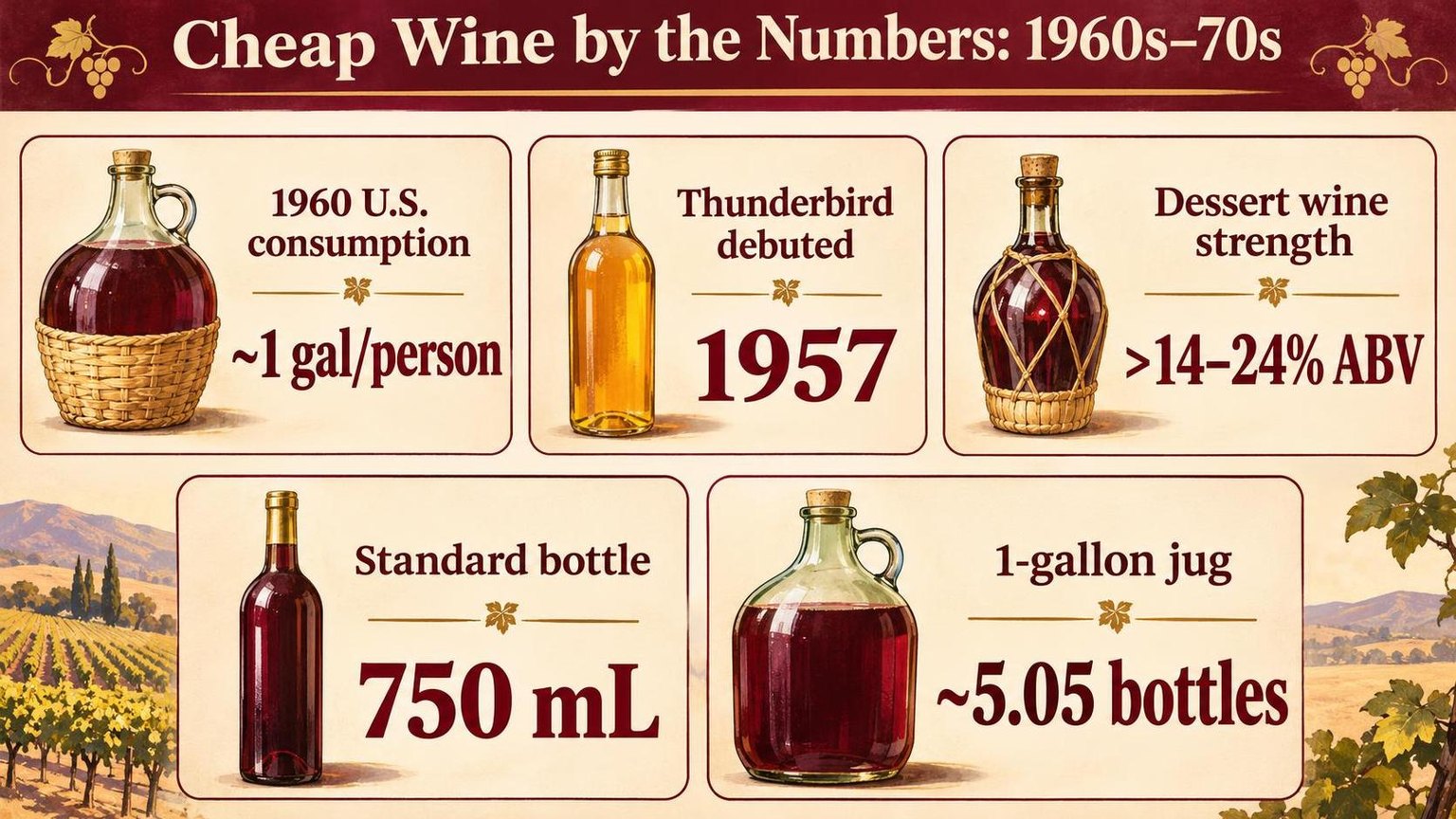
Wine was a relatively small part of American drinking culture. The Wine Institute’s historical consumption figures put U.S. wine consumption at roughly 1 gallon per resident in 1960.
For many buyers, an everyday wine was not identified by a grape variety; it was labeled with a familiar style name.
California producers sold inexpensive wines labeled “Burgundy,” “Chablis,” “Rhine,” and “Sauterne.” These were American wines using names associated with European regions or styles.
Not necessarily wines from those places.
A label saying “California Burgundy,” for example, did not tell the buyer which grapes were in the bottle.
The jug was central to this market. Large bottles made wine practical for family meals and parties, while familiar labels reduced the need to choose among unfamiliar grapes.
Red “Burgundy” and white “Chablis” were broad purchasing categories; neither guaranteed a close match to its French namesake.
Fortified wine was a different proposition. Federal wine-labeling regulations distinguish table wine from dessert wine, a category that includes wines above 14% alcohol by volume and up to 24%.
Adding distilled grape spirits could produce a stronger drink, often sold in sweet styles such as port, sherry, and muscatel.
Gallo’s Thunderbird, introduced in 1957, was already part of that landscape as the decade began. It should not be treated as interchangeable with a dry dinner wine simply because both were inexpensive.
Strength and sweetness are essential to understanding why different cheap wines appealed to different customers.
Imports complicated the picture. Portuguese rosés such as Mateus and Lancers offered a recognizable bottle and a slightly sweet, approachable taste.
They occupied a different place on the shelf from domestic jugs or fortified wines, even when shoppers encountered all of them as affordable choices.
To identify a surviving bottle accurately, start with its label rather than its reputation: look for the producer, place of origin, style name, alcohol statement, and bottle size.
The Wine Institute’s historical data establishes the period’s modest consumption; federal labeling rules help explain why “table wine” and “dessert wine” describe materially different drinks.
Jug Wine and Everyday Drinking
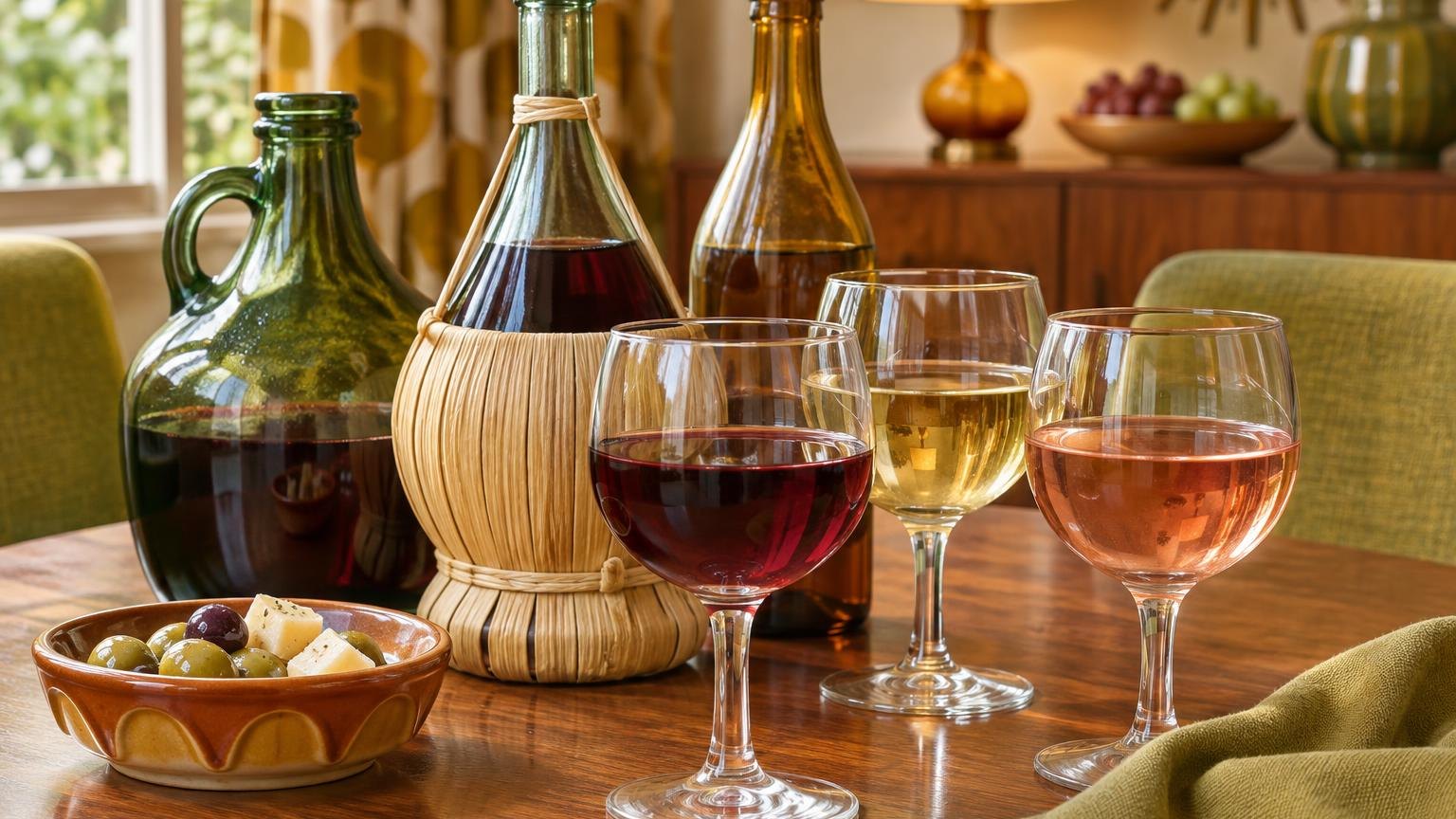
For many American households in the 1960s and 1970s, inexpensive wine meant a large glass jug on the dinner table, not a carefully selected bottle.
These wines were sold for everyday drinking: generous servings, familiar labels, and a container that could last through several meals.
California producers, including E. & J. Gallo and Almaden, sold widely distributed table wines under names such as Hearty Burgundy and Chablis.
In this context, “Burgundy” and “Chablis” were American style names, not assurances that the wine came from France or contained a particular grape (Thomas Pinney, A History of Wine in America, 2005; 27 CFR § 4.24).
The size of the jug was part of its appeal.
The table converts common U.S. jug sizes into the equivalent number of standard 750-milliliter bottles; the calculations use the U.S. gallon defined by the National Institute of Standards and Technology (NIST, Handbook 44, Appendix C).
| Container | Volume | 750-mL bottle equivalent |
| Half-gallon jug | About 1.89 liters | About 2.5 bottles |
| Gallon jug | About 3.79 liters | About 5 bottles |
| Standard bottle | 750 milliliters | 1 bottle |
That volume made the shelf price misleading if compared with a single bottle. A shopper looking for a bargain needed to compare the cost per ounce or per glass.
Buying one large container also suited households that poured a little wine with dinner rather than opening a new bottle for each occasion.
“Jug wine” described packaging and a market position, not one flavor. Reds, whites, and rosés ranged from fairly dry to noticeably sweet.
Familiar style names gave shoppers a quick guide, but they did not provide the grape, origin, and vintage detail a buyer might expect on a contemporary varietal label.
These were generally ordinary table wines, distinct from fortified wines such as Thunderbird. Fortified wine has added spirits; a large container or low price does not make a table wine fortified.
Keeping that distinction matters when recalling what Americans actually drank with meals rather than grouping every inexpensive wine of the era together.
Jug wine’s lasting association with the period reflects how accessible it made wine: a recognizable brand, a practical container, and enough to share.
The trade-off was less information about what was in the jug and, for households drinking slowly, the challenge of keeping opened wine fresh.
California Chablis Was Not French
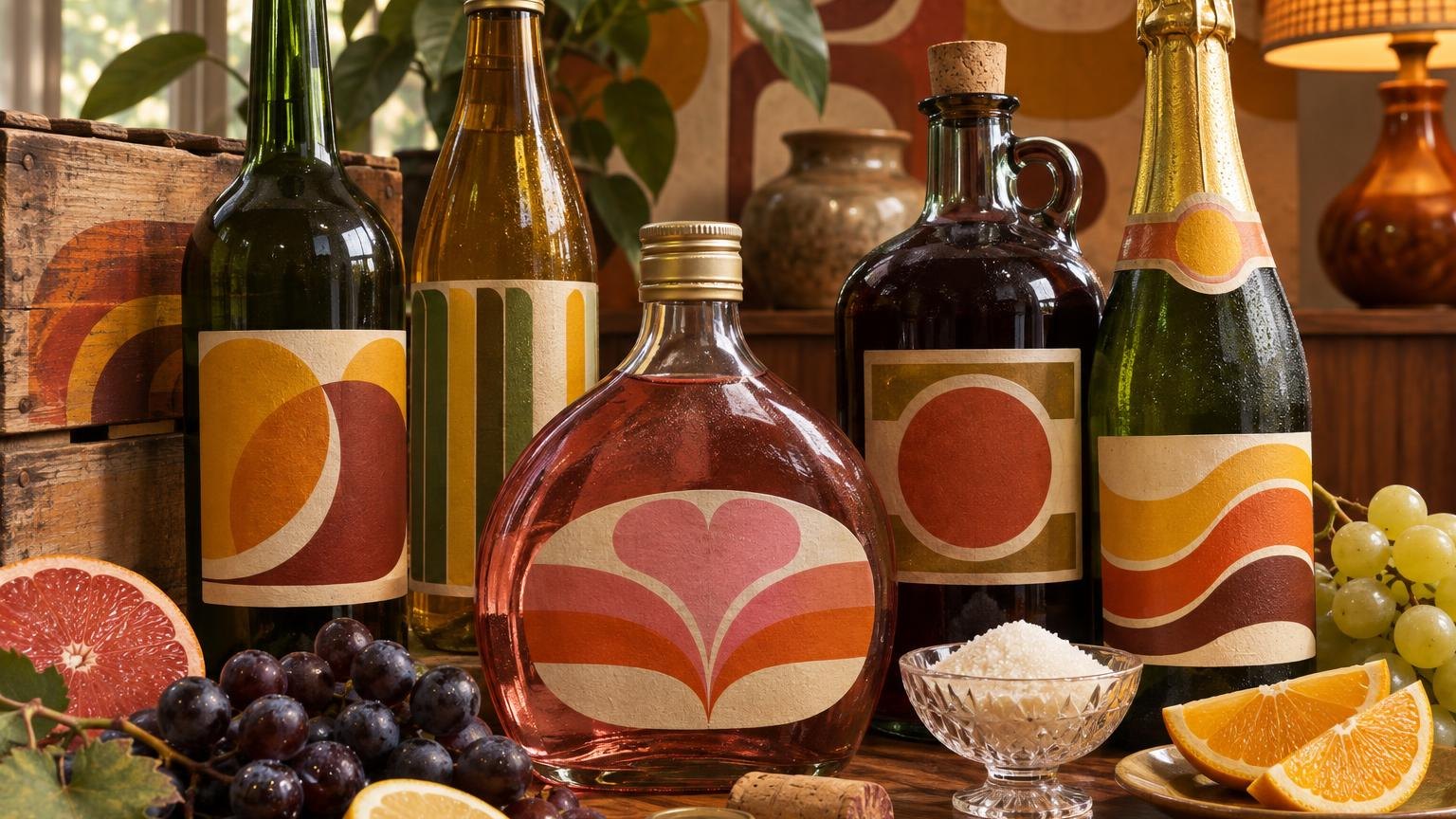
In the 1960s and 1970s, “California Chablis” meant an American white wine, not a bottle from France.
The geographic qualifier mattered: Chablis is a wine region in Burgundy, while California producers used the name for a domestic wine style.
French Chablis is an appellation-controlled wine made from Chardonnay grapes grown in a defined area around the town of Chablis. France recognized the Chablis appellation in 1938.
Its name identifies where the grapes came from, not merely how the finished wine tastes (Institut national de l’origine et de la qualité, Chablis appellation specification).
California Chablis carried no equivalent promise about Chardonnay. Producers could use other white grapes, including French Colombard or Chenin Blanc, and the resulting wines varied by brand.
A shopper could not determine the grape blend from the word “Chablis” alone.
The packaging helped make the distinction visible. Domestic Chablis appeared in large-format bottles and jugs intended for everyday drinking, as well as smaller bottles. A gallon jug offered substantially more wine than the familiar bottle size:
| Package | Volume |
| Standard wine bottle | 750 milliliters |
| U.S. gallon jug | Approximately 3.785 liters, or just over five standard bottles |
The names on those containers reflected U.S. labeling rules of the period.
Federal regulations classified “Chablis” as a semi-generic wine designation: an American producer could use it if the label also stated the wine’s true place of origin,.
As in “California Chablis” (Alcohol and Tobacco Tax and Trade Bureau, 27 CFR § 4.24).
That rule made the label lawful; it did not turn California wine into French Chablis. Nor did it establish one dependable flavor profile for every jug.
Depending on the producer, a domestic Chablis might be dry or show some sweetness, so the brand mattered more than the borrowed regional name.
The distinction remains useful when reading old advertisements or family recollections. “Chablis” on a 1970s grocery-store jug should not be interpreted as evidence that French appellation wine was an everyday American bargain.
Check the origin statement and, when available, the producer and grape information.
U.S. rules later tightened.
Following the 2006 U.S.–European Union wine agreement, new U.S. uses of protected semi-generic names such as Chablis were restricted, while qualifying previously approved labels could continue (Alcohol and Tobacco Tax and Trade Bureau, 27 CFR § 4.24).
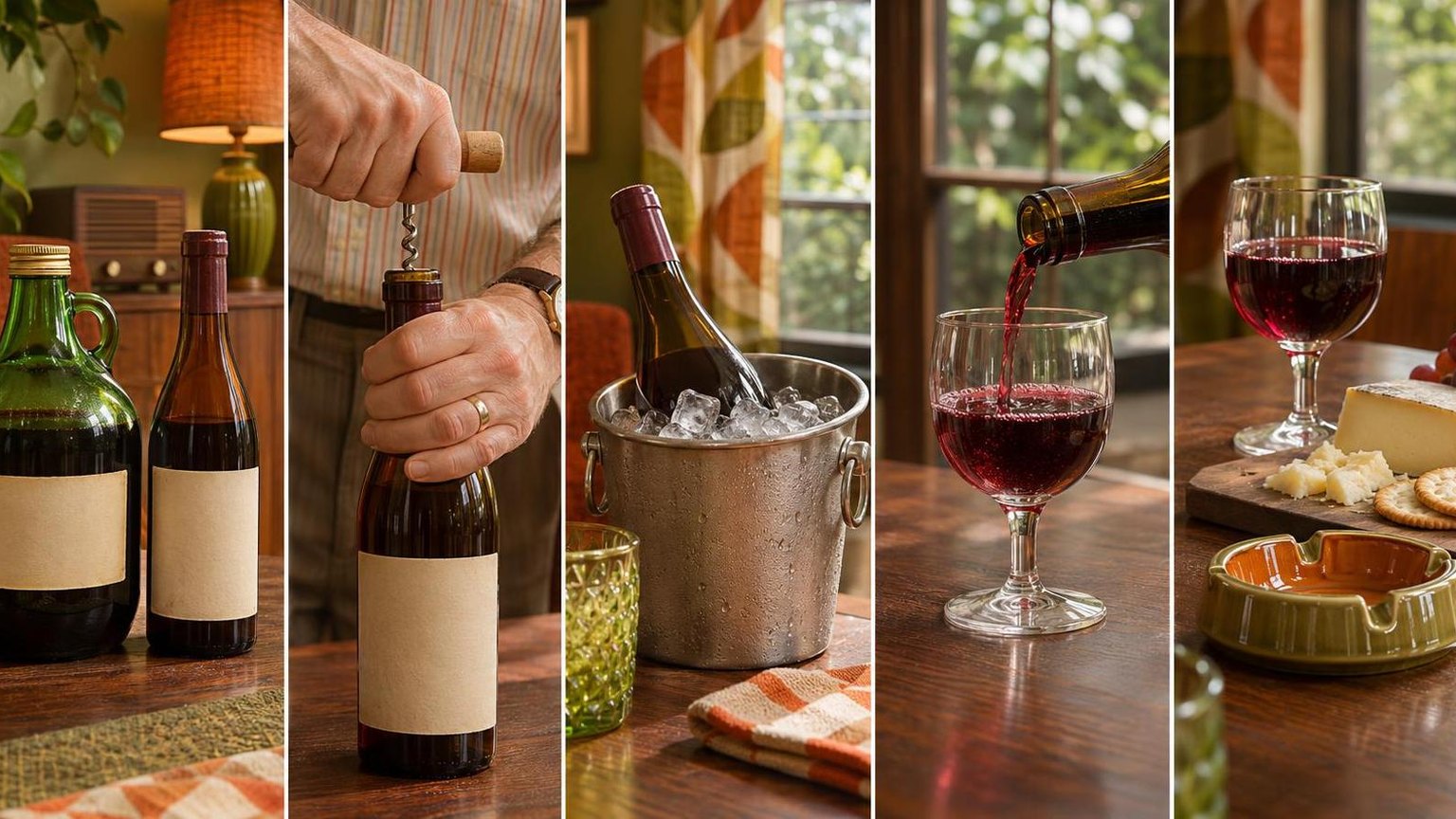
Mateus Rose and Lancers
Mateus Rosé and Lancers made Portuguese pink wine familiar to American shoppers in the 1960s and 1970s.
Their distinctive bottles helped them stand out on a shelf, while their approachable, fruit-forward styles suited drinkers who found many dry reds too stern.
| Wine | Producer | Introduced | Recognizable package |
| Mateus Rosé | Sogrape | 1942 | Squat glass bottle with Mateus Palace on the label |
| Lancers | José Maria da Fonseca | 1944 | Opaque, pottery-style bottle |
Sogrape dates Mateus to 1942 and credits its creation to founder Fernando van Zeller Guedes. The wine took its name from Mateus Palace in northern Portugal, whose image appeared on the label.
Its broad, flattened bottle was as recognizable as the wine itself.
José Maria da Fonseca dates Lancers to 1944. Its pottery-style bottle gave it a different shelf presence from Mateus, but the wines filled a similar role: easy-to-serve rosés for casual meals and parties.
Both names became familiar well beyond Portugal.
These were not simply inexpensive versions of the dry, pale rosés that dominate many wine lists today. Their appeal rested on soft fruit, noticeable sweetness and a gentle spritz.
Served chilled, they offered a straightforward alternative to tannic red wine without asking buyers to learn grape varieties or regions.
The bottles also mattered after purchase. Mateus’s rounded glass and Lancers’ opaque container looked decorative on a dinner table, reinforcing their usefulness as host gifts.
That packaging was part of their mass-market success, not evidence that the wines were rare or costly.
“Cheap” describes their place in many shoppers’ memories better than it identifies a fixed historical price. A shelf price would have depended on the year, retailer, location and local taxes.
The clearer distinction is that these were widely distributed, accessible imported wines rather than limited-production bottles bought for cellaring.
For a period-correct tasting, chill them and serve them with salty snacks, roast chicken or a buffet spread.
Compare their sweetness and light fizz with a modern dry rosé: the contrast explains why Mateus and Lancers could feel so inviting to a broad American audience.
Wine Prices in the 1970s
A 1970s wine price needs two pieces of context: the year and the bottle size.
Inflation rose sharply during the decade, and the traditional U.S. “fifth” held about 757 milliliters, slightly more than today’s standard 750-milliliter bottle.
The table shows what illustrative prices would equal in 2024 dollars. These are purchasing-power comparisons, not claims that every wine sold for those amounts. Calculations use the U.S.
Bureau of Labor Statistics’ annual-average Consumer Price Index for all urban consumers: 38.8 in 1970, 72.6 in 1979, and 313.7 in 2024.
| Illustrative bottle price | If paid in 1970, in 2024 dollars | If paid in 1979, in 2024 dollars |
| $1 | $8.09 | $4.32 |
| $2 | $16.17 | $8.64 |
| $5 | $40.43 | $21.60 |
That difference matters when someone remembers a “two-dollar wine” without recalling whether they bought it early or late in the decade.
A $2 purchase in 1970 represented nearly twice the 2024 purchasing power of a $2 purchase in 1979. Neither figure tells us the wine’s quality or its price relative to other bottles on the shelf.
Taxes were one component of the shelf price, but not its main explanation.
The federal excise tax on still wine containing no more than 14% alcohol was 17 cents per wine gallon during the 1970s, according to the Alcohol and Tobacco Tax and Trade Bureau’s historical tax-rate schedule.
That works out to about 3.4 cents per 750-milliliter bottle, before state taxes, shipping, retail margins, or other costs.
Package size also complicates memories of bargain wine. A one-gallon jug contains the equivalent of about five 750-milliliter bottles, so its sticker price should not be compared directly with a single bottle’s price.
To compare actual 1970s advertisements or receipts, divide the price by the volume, note the purchase year, and distinguish a jug or fortified wine from a standard bottle of table wine.
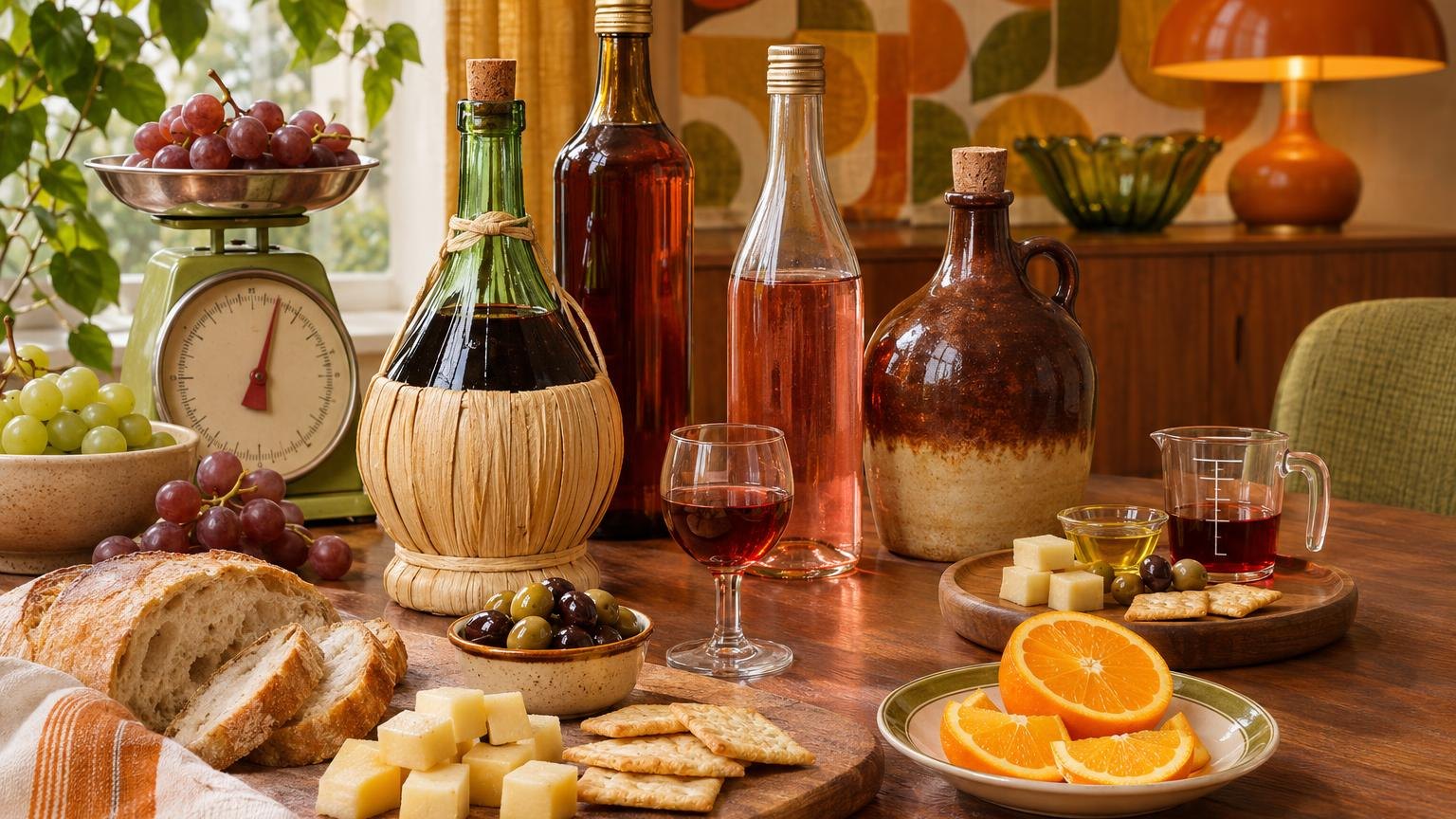
Imports Competing with Domestic Bottles
American shoppers looking for inexpensive wine in the 1960s and 1970s did not have to choose only among California bottles.
Portuguese rosé, German white wine and everyday Italian reds offered different flavors and packaging at prices intended for ordinary drinking, not collecting.
Two Portuguese brands made that competition especially visible. Sogrape dates Mateus Rosé to 1942; José Maria da Fonseca dates Lancers to 1944.
By the 1970s, their distinctive bottles helped shoppers recognize them without knowing a grape variety or wine region. Both offered a lightly sweet, approachable alternative to domestic white and rosé wines.
| Import on the shelf | What a shopper could expect | Domestic alternative |
| Mateus or Lancers rosé, Portugal | Recognizable packaging and a fruit-forward, easy-drinking style | California rosé or other lightly sweet table wine |
| Blue Nun Liebfraumilch, Germany | A branded, off-dry white rather than a dry white wine | California Rhine-style white wine |
| Chianti, Italy | A red identified with an Italian place and food tradition | California red table wine or California Burgundy |
Blue Nun was another brand-first choice. The Sichel family introduced it in 1921, long before its prominence on American shelves in the 1970s.
Its Liebfraumilch designation signaled a German white wine with sweetness, though individual bottles and vintages could differ. It was not a synonym for all German Riesling.
Italian Chianti competed differently: its regional name gave buyers a food-pairing cue, particularly for tomato-based dishes, that a generic California red might not.
The familiar straw-covered fiasco was a packaging style, not a quality guarantee. Neither an Italian name nor a decorative bottle established that a wine was a bargain; local retail price still mattered.
Domestic labels could be confusing in their own way. “California Chablis” and “California Burgundy” were American semi-generic names, not claims that the wine came from France.
Federal labeling rules later restricted those names while allowing certain established uses to continue (Alcohol and Tobacco Tax and Trade Bureau, 27 CFR § 4.24).
For a budget buyer, the useful comparison was the bottle’s actual origin, sweetness, size and shelf price—not a familiar-sounding place name alone.
The 1976 Judgment of Paris changed perceptions of California wine, but it concerned selected fine wines, not the inexpensive imports and domestic bottles that filled most everyday shopping baskets.
Its winners included California’s 1973 Château Montelena Chardonnay and 1973 Stag’s Leap Wine Cellars Cabernet Sauvignon (Smithsonian Institution).
Prestige at a tasting did not make ordinary California wine inherently better—or cheaper—than Mateus, Blue Nun or Chianti.
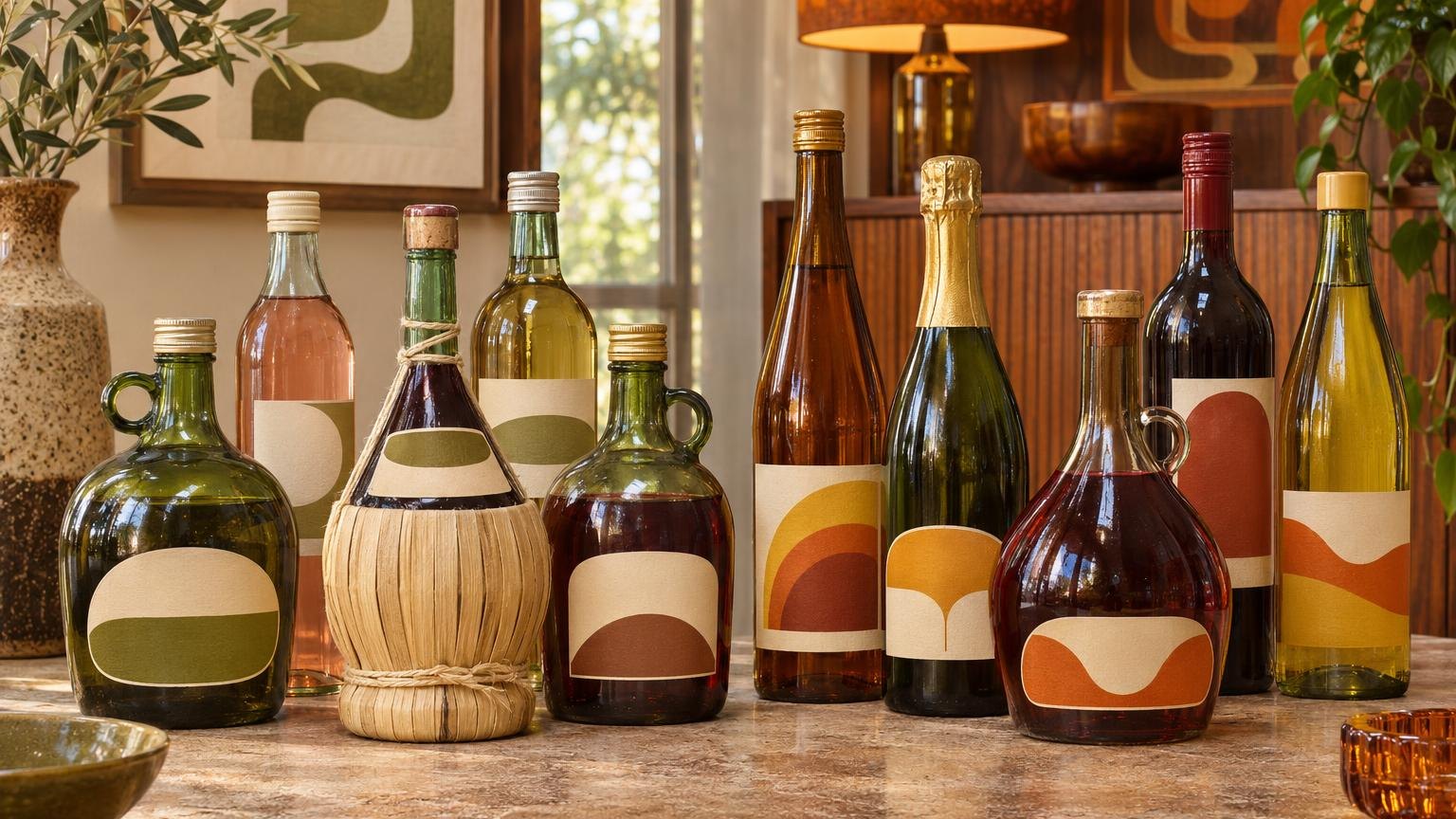
From Boone's Farm to Gallo
Cheap wine in the 1960s and 1970s was not one style. E. & J.
Gallo Winery, founded in Modesto, California, in 1933, sold drinks with different flavors, strengths, and reasons to buy them: a sweet fruit-flavored bottle for a party was not the same purchase as a jug for dinner.
The brands below show why “cheap wine” is a useful memory but an imprecise description of what people drank.
| Brand | What distinguished it | Typical appeal |
| Boone's Farm | Sweet, fruit-forward drinks; its early identity was apple wine. | Approachable flavors for drinkers who did not want a dry grape wine. |
| Ripple | Sweet, flavored grape wine. | An inexpensive, easy-drinking alternative to conventional table wine. |
| Thunderbird | Fortified wine, rather than an ordinary table wine. | A stronger drink sold in the same broad budget market. |
| Carlo Rossi | Grape table wine associated with large-format jugs. | Wine for pouring several servings at home. |
Boone's Farm and Ripple helped make sweetness a selling point. Fruit flavor could soften the tartness or tannin a new wine drinker might encounter in a dry red.
That does not make the brands interchangeable: Boone's Farm's apple-wine origins differ from Ripple's flavored-grape-wine identity.
Nor should an old Boone's Farm bottle be assumed to have the same legal classification as a product bearing that name today. Ingredients and formulations have changed.
For label terminology, the federal Alcohol and Tobacco Tax and Trade Bureau distinguishes grape wine and fruit wine under 27 CFR § 4.21; malt beverages fall under separate rules in 27 CFR Part 7.
Thunderbird makes another distinction clear. Fortification adds distilled spirits to wine, so calling it merely “sweet wine” misses a consequential difference from unfortified table wine.
Carlo Rossi jugs represented yet another buying decision: shoppers seeking wine for a meal or a gathering could favor a larger container over a fruit-flavored single bottle.
There was no universal shelf price for any of these brands. Package size, location, taxes, and year all matter, so a remembered price cannot establish what “cheap” meant nationwide.
What the brands shared was accessibility: Gallo offered recognizable names and straightforward styles across several kinds of budget-conscious drinking.
Frequently Asked Questions
What did “cheap wine” mean in the 1960s and 1970s?
It usually meant an inexpensive bottle or large-format jug sold for everyday drinking, rather than a formal category of wine.
Prices need historical context: using Bureau of Labor Statistics annual CPI-U averages, $1 in 1970 had roughly the purchasing power of $8.08 in 2024.
Was Thunderbird a wine of the 1960s and 1970s?
Yes. E. & J. Gallo introduced Thunderbird in 1957, and the fortified wine remained associated with low-cost drinking in the following decades; it should not be confused with the company’s ordinary table wines.
What was Ripple?
Ripple was a sweet, inexpensive wine sold by E. & J. Gallo and closely associated with the 1970s. It is also remembered through Fred Sanford’s references to it on Sanford and Son, which aired from 1972 to 1977.
Was Boone’s Farm actually wine?
Boone’s Farm became known for sweet, fruit-flavored drinks rather than conventional varietal wines.
Whether a particular bottle is labeled wine or a flavored malt beverage depends on the product and period, so a vintage label is better evidence than the brand name alone.
What did “jug wine” refer to?
Jug wine meant inexpensive wine sold in large glass containers, commonly by the half-gallon or gallon, rather than a particular grape or legal wine category.
The format lowered packaging cost per serving and was often used for blends sold under broad names such as Burgundy or Chablis.
What was Cold Duck?
Cold Duck was a sweet, sparkling red wine popular as an affordable celebration drink in the 1960s and 1970s. Its American versions varied by producer; the name did not identify a single grape variety or a regulated appellation.
Was MD 20/20 always 20% alcohol?
No. MD 20/20, also known as Mad Dog 20/20, is a brand name, not a dependable statement of alcohol content; strength has varied among products. For any specific bottle, the alcohol-by-volume figure on its label is the useful number.
Related Guides
- What Does Rose Taste Like? Answer By Expert
- Guinness Extra Stout Vs Draught: Which is Best?
- 10 Surprising Facts About What Do CBD Drinks Do (2026 Edition)
- What Is 1.5 Liters?
- What To Mix With Peach Crown?
- All Blog Guides
- Alcohol and Tobacco Tax and Trade Bureau, Wine Statistics (n.d.)
- U.S. Bureau of Labor Statistics, CPI Inflation Calculator (n.d.)
- Federal Reserve Bank of St. Louis, Consumer Price Index for All Urban Consumers (n.d.)
- USDA Economic Research Service, Food Availability Data (n.d.)
- National Institute on Alcohol Abuse and Alcoholism, Alcohol Facts and Statistics (n.d.)
- Wine Institute, Industry Statistics (n.d.)
- Encyclopaedia Britannica, Wine (n.d.)
- Encyclopaedia Britannica, History of Wine (n.d.)
- U.S. Bureau of Labor Statistics, Consumer Price Index Data (n.d.)
- Federal Reserve Bank of St. Louis, FRED Economic Data (n.d.)