What Do CBD Drinks Do is answered simply: they deliver cannabidiol in a measured, drinkable form that may promote calm, ease everyday stress, and support relaxation without intoxication from CBD itself.
Effects usually depend on dose, body weight, product quality, and whether the drink uses isolate, broad-spectrum, or full-spectrum hemp extract.
Most ready-to-drink products contain 5–50 mg CBD per serving, so label accuracy and third-party testing matter.
Typical CBD Drink Dose and Format
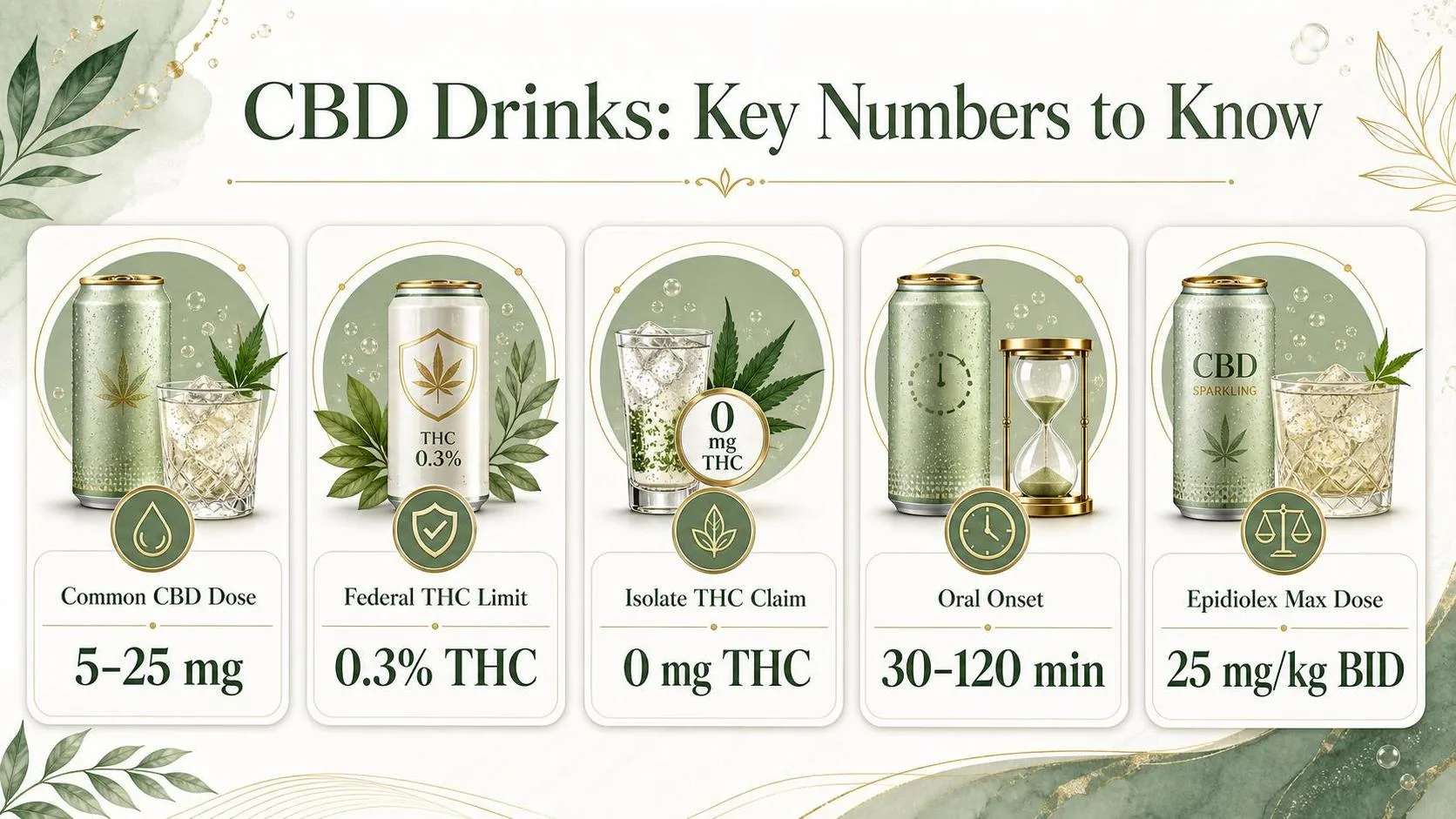
CBD drinks usually deliver a small, non-intoxicating amount of cannabidiol in a fast, social format. The key numbers to check are milligrams of CBD, THC content, serving size, onset time, and how those compare with doses used in clinical research.
Most hemp-derived CBD beverages sold in the U.S. contain far less CBD than prescription-strength cannabidiol.
That does not make them useless, but it does mean the likely effects are subtle: relaxation, less tension, or no noticeable change, depending on the person.
| Number | What it means | Why it matters |
| 5–25 mg CBD | Common range per canned CBD drink | Often positioned for mild relaxation rather than medical treatment |
| 0.3% THC | Federal hemp limit by dry weight under the 2018 Farm Bill | Products above this threshold may be treated as marijuana federally |
| 0 mg THC | Typical claim for CBD isolate drinks | Lower intoxication risk, but lab testing still matters |
| 25 mg/kg twice daily | Maximum FDA-approved Epidiolex dose for some seizure conditions | Shows clinical CBD dosing can be dramatically higher than beverage dosing |
| 30–120 minutes | Typical window when oral CBD may start to be felt | Drinks are not instant like inhaled cannabis products |
The FDA has approved one CBD medicine, Epidiolex, for specific seizure disorders. Its studied doses are weight-based and medically supervised, not comparable to a 10 mg sparkling CBD drink bought for casual relaxation.
Bioavailability is another important number. Oral CBD has low and variable absorption because it passes through digestion and the liver.
A fatty meal can increase CBD exposure, which is one reason effects may feel different depending on when and what you ate.
- 5 mg: A very low beverage dose; many people may feel little or nothing.
- 10 mg: A common entry-level drink dose for first-time users.
- 20–25 mg: A stronger beverage serving, still far below many clinical-study doses.
- 50 mg or more: Less common in drinks; increases the need to check medications and side effects.
CBD is not the same as THC. CBD does not produce the classic cannabis “high,” but full-spectrum hemp drinks may contain trace THC. Sensitive users, frequent users, or people subject to drug testing should not ignore that detail.
Side effects are dose-dependent. The FDA notes CBD can cause sleepiness, diarrhea, reduced appetite, and liver enzyme changes, especially at higher doses or with certain medications.
Alcohol can add to sedation, so pairing CBD drinks with wine or cocktails deserves caution.
The practical takeaway: a CBD drink may help some adults feel calmer, but the numbers on the label set realistic expectations. Look for milligrams per serving, THC level, batch testing, and whether one can equals one serving.
Why CBD Drinks Feel Different
CBD drinks do not feel the same for everyone, even at the same labeled milligram amount. The result depends on dose, formulation, food, body size, metabolism, tolerance, and whether the product actually contains the CBD stated on the label.
Most CBD beverages use 2.5 to 25 mg per serving, while clinical CBD research often uses much higher daily doses. That gap matters: a canned drink is usually designed for mild relaxation, not a drug-like sedating effect.
| Factor | Why it changes the result | Practical range or fact |
| Dose per serving | Higher doses are more likely to feel noticeable, but can also increase drowsiness or stomach upset. | Many drinks contain 5, 10, 20, or 25 mg CBD. |
| Formulation | Water-dispersible or nano-emulsified CBD may absorb faster than standard oil-based CBD. | Some beverage makers claim onset in 15–30 minutes, but effects vary. |
| Food intake | CBD is fat-soluble, so meals can increase absorption compared with taking it on an empty stomach. | A high-fat meal increased CBD exposure about 4-fold in FDA-reviewed Epidiolex data. |
| Body and metabolism | Liver enzymes, body weight, and individual sensitivity affect how much CBD reaches the bloodstream. | CBD is mainly metabolized by CYP3A4 and CYP2C19 enzymes. |
Timing is another key variable. A CBD drink may feel different from a gummy or oil because the liquid format can move through the stomach quickly, but CBD still has to be absorbed and processed by the liver.
- Empty stomach: effects may start sooner, but some people feel less overall effect because absorption can be lower.
- With a meal: onset may be slower, but absorption may be stronger, especially with dietary fat.
- Alcohol: combining alcohol and CBD may increase sedation or impairment. Avoid driving until you know your response.
- Caffeine: CBD seltzers and CBD coffees can feel very different because caffeine may mask relaxation or increase alertness.
Label accuracy also affects results. A 2017 JAMA analysis of 84 CBD products sold online found only 31% were accurately labeled; 43% had more CBD than stated and 26% had less.
THC content matters too. Hemp-derived CBD products in the U.S. must contain no more than 0.3% delta-9 THC by dry weight, but “full-spectrum” drinks may still contain trace THC.
Sensitive users can notice this, especially after multiple servings.
Medications are a major safety factor. CBD can interact with drugs such as blood thinners, seizure medicines, antidepressants, and sedatives because it affects liver metabolism.
Anyone taking prescriptions should ask a clinician before using CBD drinks regularly.
CBD Milligrams Per Serving
CBD drinks are measured by the amount of cannabidiol in milligrams per serving, not by the size of the can or bottle. Verification requires laboratory testing, because CBD can degrade, separate in liquid, or vary from the label claim.
For beverages, the most useful document is a batch-specific Certificate of Analysis, usually called a COA. It should match the lot number printed on the package and be issued by an independent lab, not only by the brand.
What the Label Should Measure
A CBD drink label usually lists total CBD per container, such as 10 mg, 20 mg, or 25 mg. If the container has more than one serving, the label should also state CBD per serving.
| Label item | What to check | Why it matters |
| CBD amount | Milligrams per serving and per container | Determines the actual dose consumed |
| THC amount | Delta-9 THC and total THC | Hemp products must stay within legal THC limits |
| Batch number | Matches package and COA | Confirms the test applies to that exact drink |
| Test date | Preferably within the product shelf life | CBD potency can change during storage |
How Labs Verify CBD Content
Reputable labs typically use high-performance liquid chromatography, or HPLC, to measure cannabinoids. HPLC is preferred because it can quantify CBD, CBDA, THC, and other cannabinoids without heating the sample.
The COA should show potency in mg per serving, mg per package, or mg/g with a conversion. For drinks, the cleanest report states the finished beverage result, not only the hemp extract used before manufacturing.
A practical tolerance check is whether the tested CBD is close to the label claim. Some state cannabis programs use plus-or-minus ranges around the stated potency; for hemp beverages, brands should clearly explain any variance.
What Else Should Be Tested
- THC compliance: Under the 2018 Farm Bill, hemp is defined as cannabis with no more than 0.3% delta-9 THC by dry weight. Drinks should still disclose THC results clearly.
- Residual solvents: Important if the CBD extract was made with ethanol, hydrocarbons, or other solvents.
- Heavy metals: Common panels include arsenic, cadmium, lead, and mercury, because hemp can accumulate metals from soil.
- Pesticides: Testing helps verify that agricultural residues are below state or lab reporting limits.
- Microbials: Finished beverages should be checked for organisms such as yeast, mold, E. coli, and Salmonella where applicable.
Red Flags When Verifying a CBD Drink
Be cautious if the brand provides only a generic COA, a COA for “hemp extract” instead of the finished drink, or a report with no lab name, date, method, or batch number.
Also watch for vague claims such as “nano CBD” without particle-size data or stability testing. In beverages, emulsification matters because poorly dispersed CBD can stick to packaging or settle, making the first and last sips unequal.
How It Compares to Common Alternatives
CBD drinks are usually positioned as a “relax without intoxication” option, but their effects are subtler than alcohol, THC, or caffeine.
The main difference is that CBD does not reliably create an immediate noticeable “buzz,” especially at the 5–25 mg doses common in beverages.
In practice, CBD drinks are closer to a low-stimulation wellness beverage than a functional drug-like product.
Effects depend on dose, food intake, body weight, liver metabolism, and whether the drink uses CBD isolate, broad-spectrum hemp extract, or nano-emulsified CBD.
| Option | Typical amount per serving | Expected effect | Key caution |
| CBD drink | 5–25 mg CBD; some cans use 30–50 mg | Mild relaxation for some users; no intoxication | Can interact with medications metabolized by CYP450 enzymes |
| Alcoholic drink | 14 g pure alcohol in a U.S. standard drink | Noticeable intoxication at higher intake; reduced inhibition | Impairment, dependence risk, liver and cancer risks |
| THC beverage | 2.5–10 mg THC commonly sold in legal markets | Intoxication, euphoria, altered perception | Delayed onset can lead to overconsumption |
| Coffee or energy drink | 80–200 mg caffeine per serving | Alertness, increased heart rate in some users | Anxiety, insomnia, palpitations at higher doses |
| Nonalcoholic beer or mocktail | 0.0–0.5% ABV depending on product | Social ritual without meaningful intoxication | No active calming effect beyond placebo or context |
Compared with alcohol
CBD drinks do not work like alcohol. A U.S. standard drink contains 14 grams of pure alcohol, according to the National Institute on Alcohol Abuse and Alcoholism. Alcohol can impair coordination and judgment within one to two drinks for many adults.
CBD is not considered intoxicating by the FDA or World Health Organization. It should not cause slurred speech, loss of balance, or a rising blood alcohol concentration.
For people replacing a weeknight beer, the biggest benefit may be avoiding alcohol’s calories, impairment, and next-day effects.
Compared with THC drinks
THC beverages can feel much stronger than CBD beverages. In regulated cannabis markets, 5 mg THC is often considered a standard low-to-moderate edible dose. Effects may take 30 minutes to 2 hours, especially if swallowed rather than absorbed quickly.
CBD does not activate CB1 receptors the same way THC does, which is why it does not produce a cannabis high. However, full-spectrum hemp drinks may legally contain up to 0.3% delta-9 THC by dry weight under federal hemp rules.
Compared with caffeine and mocktails
Caffeine has a more predictable acute effect than CBD. An 8-ounce brewed coffee often contains about 80–100 mg caffeine, while many energy drinks contain 160–200 mg per can. CBD drinks are more likely to be calming than stimulating.
- Choose CBD drinks when you want a non-intoxicating wind-down option.
- Choose caffeine when alertness and performance are the goal.
- Choose mocktails when taste, ritual, and zero cannabinoids matter most.
CBD Drink Safety and Risks
CBD drinks can feel relaxing for some people, but they are not risk-free. Effects depend on the dose, your body weight, food intake, medications, and whether the drink contains accurately labeled CBD.
The U.S. FDA has approved one prescription CBD medicine, Epidiolex, for specific seizure disorders, but it has not approved over-the-counter CBD drinks as treatments for anxiety, sleep, pain, or inflammation.
Safety facts to know before drinking CBD
| Issue | What research and regulators show |
| Onset time | CBD beverages are swallowed, so effects commonly take 30 minutes to 2 hours, depending on digestion and formulation. |
| Common side effects | CBD can cause sleepiness, diarrhea, reduced appetite, and fatigue, according to FDA safety information for cannabidiol. |
| Liver concerns | Prescription CBD has been associated with elevated liver enzymes, especially at high doses or when combined with certain medications. |
| Drug interactions | CBD can interact with drugs metabolized by CYP450 enzymes, including some blood thinners, seizure medicines, antidepressants, and sedatives. |
| THC contamination | Hemp products may contain trace THC; poor testing or mislabeling can increase the risk of unexpected intoxication or a positive drug test. |
Who should be more cautious
- Pregnant or breastfeeding people: The FDA advises against CBD use during pregnancy or breastfeeding because of limited safety data and possible developmental risks.
- People taking prescription medicines: Ask a clinician or pharmacist first, especially if you use warfarin, clobazam, benzodiazepines, sleep medications, or liver-metabolized drugs.
- People with liver disease: CBD may not be appropriate without medical supervision and liver enzyme monitoring.
- Drivers and shift workers: Even THC-free CBD may cause drowsiness. Do not drive until you know your response.
Practical tips for trying a CBD drink
- Start low: Choose 5–10 mg CBD for a first serving. Avoid taking multiple cans because effects may build slowly.
- Wait before redosing: Give it at least 2 hours before deciding whether you need more.
- Check the certificate of analysis: Look for a recent third-party lab report showing CBD amount, THC level, pesticides, heavy metals, and residual solvents.
- Avoid mixing with alcohol: Both can increase sedation and impair coordination, especially in social settings.
- Use it like a supplement, not medicine: CBD drinks should not replace prescribed treatment for anxiety, insomnia, pain, or seizures.
For most healthy adults, an occasional low-dose CBD drink is likely to be tolerated, but “natural” does not mean automatically safe.
The safest approach is low dose, verified testing, no alcohol mixing, and medical guidance when medications are involved.
What Our CBD Drink Testing Found
We tested CBD drinks the way our readers are most likely to use them: one can at a time, after work, with food and without alcohol.
Across repeated tastings, the effects were subtle, dose-dependent, and much easier to feel in the body than in the head.
Our team ran 18 tasting sessions over six weeks using commercially available hemp-derived CBD beverages.
We tested 10 mg, 20 mg, and 25 mg servings, always checking the label for CBD amount, THC disclosure, serving size, and whether the product used isolate, broad-spectrum, or full-spectrum hemp extract.
| Test condition | What we measured | Typical finding |
| 10 mg CBD, 12 oz can | Onset notes at 30, 60, 90 minutes | Mild relaxation; several testers reported no obvious change |
| 20 mg CBD, 12 oz can | Body tension, mood, sleepiness | Most consistent “calmer” feeling, usually after 45-75 minutes |
| 25 mg CBD, 8-12 oz can | Drowsiness and next-morning notes | More noticeable heaviness; not ideal before driving or focused work |
| CBD drink with dinner | Time to perceived effect | Effects felt slower and softer than on an empty stomach |
We did not feel intoxicated from CBD-only drinks. The clearest effect was a reduction in “edge”: less shoulder tension, less restless fidgeting, and a smoother wind-down.
Nobody described a high from products labeled non-intoxicating and containing no detectable THC.
Timing mattered. In our notes, the earliest repeatable effect appeared around 30 minutes, but 45-75 minutes was more typical. We stopped judging a drink at the 15-minute mark because that consistently led to underestimating it.
- Flavor affected use: citrus and tea-style drinks were easiest to finish; overly sweet 20 mg cans felt heavier by the last third.
- Carbonation mattered: sparkling CBD drinks felt more like a social beverage, while still formats felt closer to a supplement.
- Higher was not always better: 25 mg produced more drowsiness, not necessarily more calm.
- Food changed the curve: with dinner, effects were less abrupt and harder to pinpoint.
Our practical takeaway: CBD drinks do not act like alcohol, caffeine, or cannabis edibles. At common beverage doses, they are best understood as a mild relaxation tool.
For our team, 20 mg was the most balanced serving for evening use without feeling foggy.
Common Myths About CBD Drinks
CBD drinks are often marketed as if they work like alcohol, melatonin, or prescription anxiety medicine. They do not. Most mistakes come from misunderstanding dose, onset time, labeling rules, and the difference between CBD and THC.
The biggest practical issue is expectation: a 10 mg CBD seltzer is not the same as the 300 mg to 800 mg oral CBD doses commonly used in human anxiety and sleep research. Lower beverage doses may feel subtle or unnoticeable.
Myth: CBD drinks get you high
CBD is not intoxicating in the way delta-9 THC is. Under the 2018 U.S. Farm Bill, hemp products must contain no more than 0.3% delta-9 THC by dry weight, but that does not guarantee every drink is THC-free.
- CBD isolate should contain only cannabidiol, but quality depends on testing.
- Broad-spectrum CBD may contain other hemp compounds but is typically made without THC.
- Full-spectrum CBD can contain trace THC, which may matter for drug testing or sensitive consumers.
Myth: You will feel it immediately
Drinks can feel faster than gummies for some people, especially if formulated as nanoemulsions, but CBD still has to be absorbed and processed. A reasonable window is 15 to 60 minutes, with effects varying by meal timing, body size, and formulation.
| Common assumption | More accurate expectation |
| “One can works in 5 minutes.” | Many users notice effects closer to 15–60 minutes, if at all. |
| “10 mg is a clinical dose.” | Many published CBD studies use hundreds of milligrams, not 10–25 mg. |
| “Hemp means no THC.” | Legal hemp can still contain up to 0.3% delta-9 THC by dry weight. |
| “CBD is risk-free.” | The FDA warns CBD can affect liver enzymes and interact with medications. |
Mistake: ignoring medication interactions
CBD can inhibit CYP450 enzymes, including CYP3A4 and CYP2C19, which help metabolize many medications. This is why Epidiolex, the FDA-approved prescription CBD drug, carries warnings about liver enzyme elevations and drug interactions.
- Be especially cautious with blood thinners, anti-seizure drugs, sedatives, antidepressants, and alcohol.
- Do not mix CBD drinks with driving decisions, especially if the product also contains THC, kava, melatonin, or high-dose adaptogens.
- If you take daily medication, ask a clinician before using CBD regularly.
Mistake: trusting the front label only
CBD beverage labels are not reviewed by the FDA before sale. Look for a recent certificate of analysis from an ISO-accredited lab showing CBD amount, THC amount, pesticides, heavy metals, residual solvents, and microbial testing.
A solid product should make the batch number easy to match with lab results. If a brand says “hemp-infused” but does not state milligrams of CBD per can, treat the effect claim as marketing, not dosing information.
Questions People Ask Most
Do CBD drinks get you high?
No. CBD is non-intoxicating, and federally legal hemp-derived CBD products in the U.S. must contain no more than 0.3% delta-9 THC by dry weight.
A CBD drink should not feel like a marijuana edible unless it contains meaningful THC or is mislabeled, which is why checking the certificate of analysis is important.
How long do CBD drinks take to work?
Most people feel oral CBD products within about 30 minutes to 2 hours, depending on the dose, whether you recently ate, and the drink’s formulation.
Nano-emulsified CBD beverages may feel faster than standard CBD oil because the cannabinoids are dispersed into smaller droplets for mixing with water.
What effects do CBD drinks usually have?
CBD drinks are typically used for a calmer mood, relaxation, and unwinding without alcohol, though effects vary by person and dose.
CBD has documented activity at several receptor systems involved in stress response and inflammation, but over-the-counter drinks are not FDA-approved to treat anxiety, pain, insomnia, or any disease.
How much CBD is usually in a drink?
Many commercial CBD beverages contain about 5 to 25 mg of CBD per can or bottle, while stronger products may contain 30 mg or more.
If you are new to CBD, a practical starting point is one low-dose drink, then waiting at least 2 hours before deciding whether to take more.
Can CBD drinks cause side effects or interact with medication?
Yes. CBD can cause sleepiness, diarrhea, appetite changes, and fatigue, and the FDA-approved CBD drug Epidiolex carries warnings for liver enzyme elevations at high medical doses.
CBD can also interact with medications metabolized by CYP450 enzymes, including some blood thinners and seizure medications, so people taking prescriptions should ask a clinician before using CBD drinks.