What Is 1.5 Liters is answered simply: 1.5 liters equals 1,500 milliliters. In U.S. kitchen terms, that is about 50.7 fluid ounces, 6.34 cups, 3.17 pints, or 1.59 quarts, depending on the measuring tool you use.
For wine, 1.5 liters is the volume of a magnum, which holds the same amount as two standard 750-milliliter bottles. That makes it a practical size for shared tables, tastings, parties, and service planning when bottle count matters.
Because liters measure volume, not weight, 1.5 liters will weigh differently depending on the liquid. Water weighs about 1.5 kilograms, or 3.3 pounds, before container weight.
Liters in Common Units
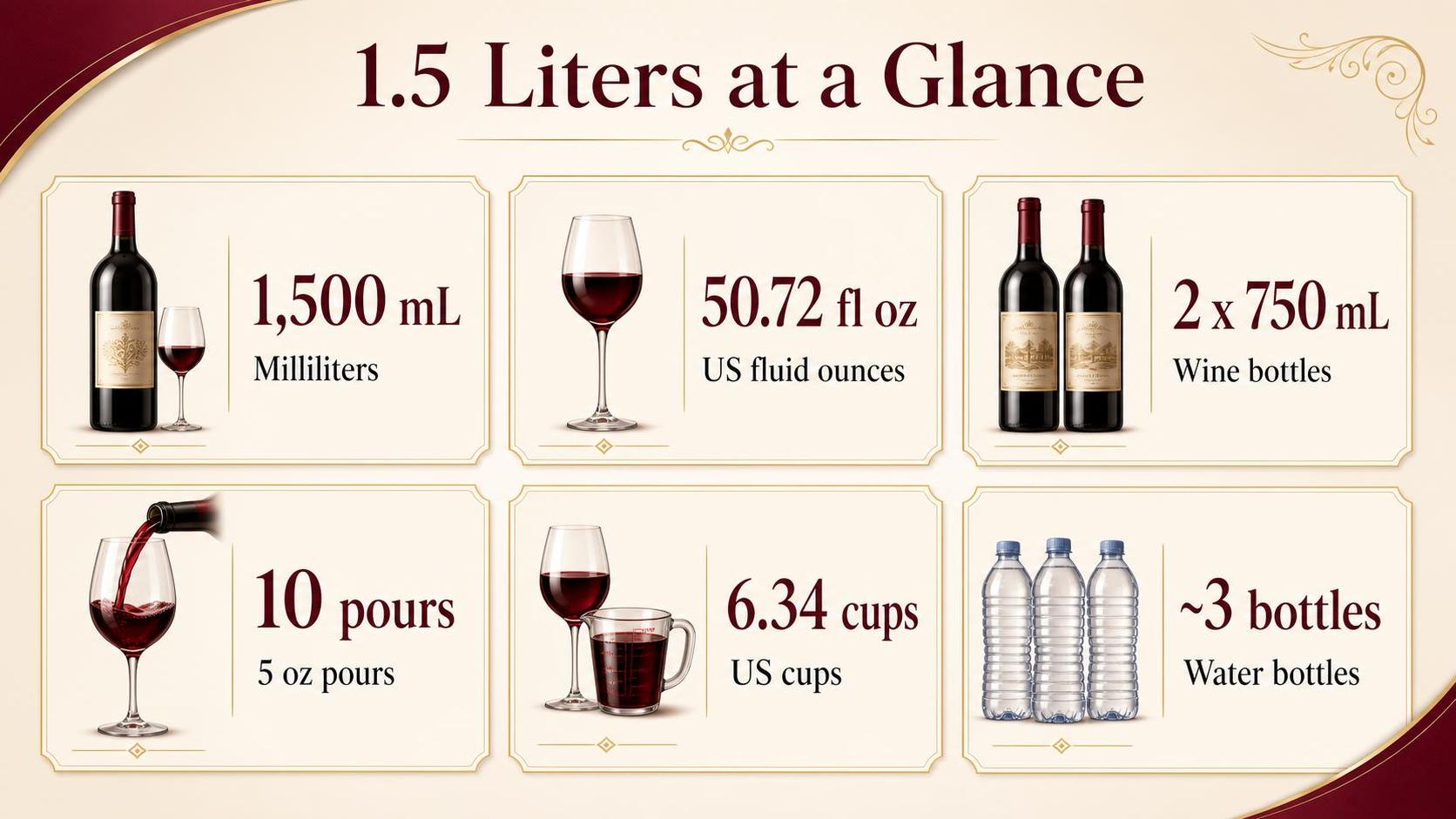
1.5 liters equals 1,500 milliliters, or just over 50 U.S. fluid ounces. In wine, that number is especially important because 1.5 liters is the standard size of a magnum bottle.
A magnum holds exactly twice as much wine as a standard 750 mL bottle. For serving, buying, or planning a tasting, the useful math starts with milliliters, ounces, bottles, and glasses.
| Measure | 1.5 liters equals |
| Milliliters | 1,500 mL |
| U.S. fluid ounces | 50.72 fl oz |
| Standard wine bottles | 2 bottles of 750 mL |
| Standard 5 oz wine pours | About 10 pours |
| Metric cups | 6 cups of 250 mL |
The ounce conversion uses the U.S. legal fluid ounce: 1 U.S. fl oz is about 29.5735 mL, as defined in U.S. measurement references such as NIST Handbook 44. That makes 1,500 mL equal to approximately 50.72 U.S. fl oz.
For wine service, the most practical number is 10. A standard U.S. restaurant wine pour is commonly 5 fl oz, so a 1.5-liter magnum contains just over ten 5-ounce servings.
| Pour size | Approximate servings from 1.5 L |
| 3 oz tasting pour | 16 to 17 pours |
| 4 oz lighter pour | 12 to 13 pours |
| 5 oz standard pour | 10 pours |
| 6 oz generous pour | 8 pours |
In U.S. alcohol labeling, wine containers are typically stated in milliliters or liters. The Alcohol and Tobacco Tax and Trade Bureau recognizes 750 mL as the common standard wine bottle size, making 1.5 L exactly two standard bottles.
- For a dinner table: one 1.5 L magnum usually serves 8 to 10 guests, depending on pour size.
- For cooking: 1.5 L equals about 6.34 U.S. liquid cups, since 1 U.S. cup is 236.588 mL.
- For water intake: 1.5 L is roughly three standard 16.9 fl oz disposable water bottles.
The key takeaway: 1.5 liters is not an abstract metric amount. It is two regular wine bottles, about 50.7 fluid ounces, or roughly ten standard glasses of wine.
Why 1.5 Liters Can Vary
1.5 liters is a fixed metric volume, but the practical answer changes depending on what you are measuring, how you convert it, and the container you use.
The biggest sources of variation are unit system, rounding, liquid density, temperature, and fill level.
| Measurement | Equivalent for 1.5 liters |
| Milliliters | 1,500 mL |
| US fluid ounces | 50.72 fl oz |
| US cups | 6.34 cups |
| US quarts | 1.59 qt |
| Imperial fluid ounces | 52.79 imp fl oz |
| Imperial pints | 2.64 imp pt |
Unit system matters. A US fluid ounce is 29.5735 mL, while an Imperial fluid ounce is 28.4131 mL. That is why 1.5 liters gives different ounce totals in US and UK-style measurements.
Rounding changes kitchen results. If you round 1.5 liters to 51 US fluid ounces, the difference is small for water, cocktails, or stock. If you round it to 6 cups, however, you are short by about 0.34 cup, which is roughly 80 mL.
| Common rounded value | Difference from 1.5 liters |
| 51 US fl oz | About 8 mL more |
| 50 US fl oz | About 21 mL less |
| 6 US cups | About 80 mL less |
| 1.6 US quarts | About 14 mL more |
Density affects weight, not volume. 1.5 liters of water weighs about 1.5 kilograms at normal kitchen conditions. The same volume of olive oil weighs less because olive oil is less dense, usually around 0.91 to 0.93 grams per milliliter.
| Liquid | Approximate weight for 1.5 liters |
| Water | 1.50 kg / 3.31 lb |
| Whole milk | About 1.54 kg / 3.40 lb |
| Olive oil | About 1.38 kg / 3.04 lb |
| Honey | About 2.13 kg / 4.70 lb |
Temperature can slightly change volume. Liquids expand when warmed and contract when cooled. For everyday pouring, the change is usually minor, but it matters in laboratory work, commercial bottling, and recipes measured by weight.
- Container shape: A 1.5-liter wine bottle, pitcher, and measuring jug can look very different even when they hold the same volume.
- Fill line accuracy: Meniscus reading, foam, carbonation, and tilted containers can all make the measured amount slightly off.
- Label meaning: Beverage labels usually state net contents, meaning the liquid volume inside, not the bottle’s outside capacity.
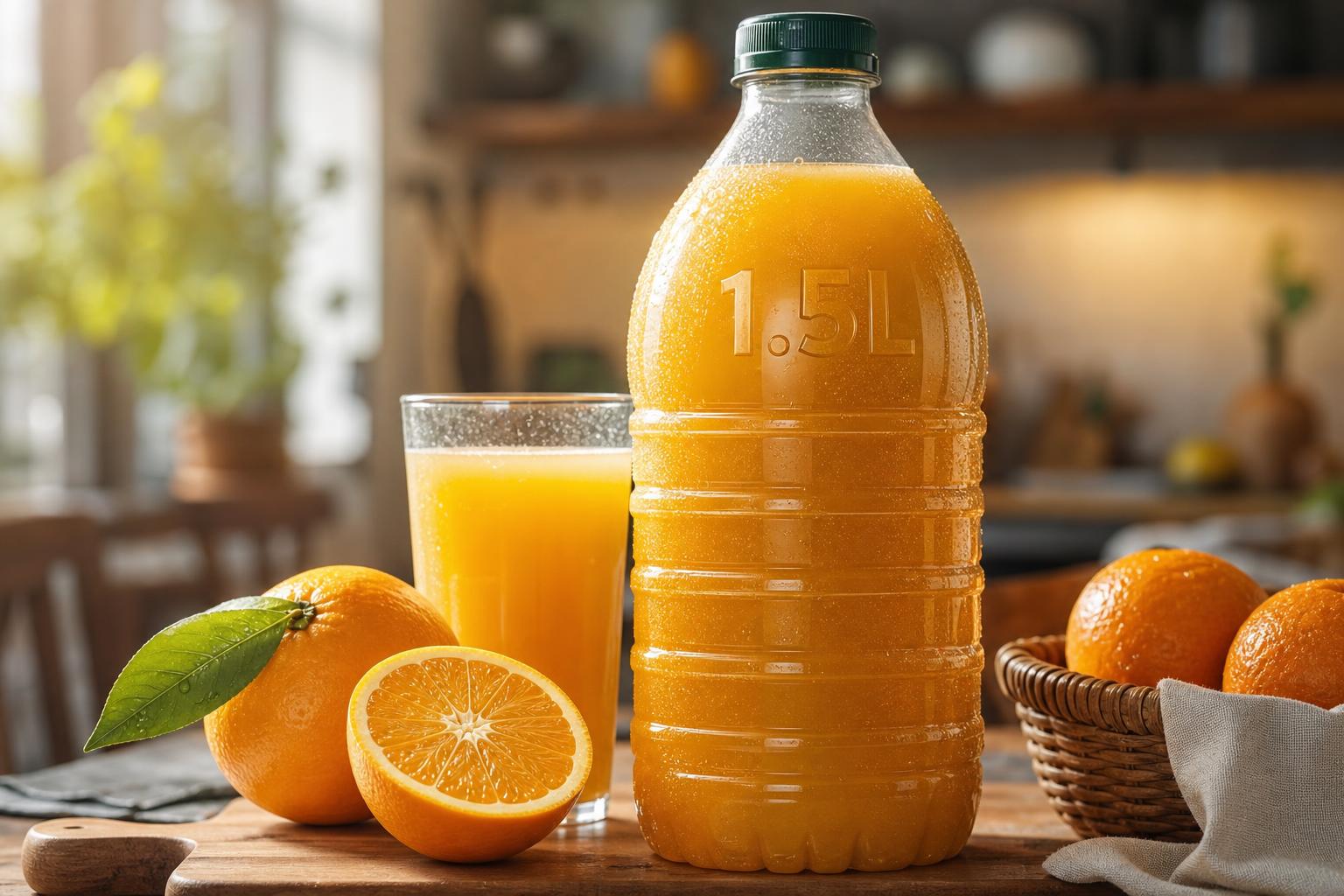
Measuring 1.5 Liters Accurately
1.5 liters is measured as a metric volume: exactly 1,500 milliliters, or about 50.72 U.S. fluid ounces. In wine service, that is the standard capacity of a magnum bottle, equal to two 750 mL bottles.
Verification depends on the context. A home cook may use a marked measuring jug, while a winery, bottler, or retailer relies on calibrated filling equipment, legal tolerances, and package-labeling rules.
Standard Volume Conversions
| Measure | Equivalent to 1.5 liters |
| Milliliters | 1,500 mL |
| U.S. fluid ounces | 50.72 fl oz |
| U.S. cups | 6.34 cups |
| U.S. pints | 3.17 pints |
| Wine bottles | 2 standard 750 mL bottles |
| Typical 5 oz wine pours | About 10 servings |
How the Measurement Is Checked
For liquids, volume is commonly verified using graduated glassware, calibrated tanks, flow meters, or fill-level checks.
The National Institute of Standards and Technology recognizes the liter as a unit accepted for use with the International System of Units.
In practical terms, 1.5 liters means the container should hold 1,500 cubic centimeters of liquid at the stated reference conditions.
Because liquids expand and contract with temperature, commercial measurements are usually controlled by calibrated equipment and consistent production temperatures.
- Kitchen verification: Use a metric measuring jug with 100 mL or 250 mL graduations. Filling to the 1,500 mL line verifies 1.5 liters directly.
- Wine bottle verification: A 1.5 L wine bottle should contain twice the volume of a 750 mL bottle. Two full 750 mL bottles poured into a suitable vessel equal one magnum.
- Commercial verification: Bottlers use calibrated fillers and sample bottles from the line to confirm fill volume. Underfilled containers can violate labeling and net-contents rules.
Labeling and Regulatory Checks
In the United States, wine container standards are regulated by the Alcohol and Tobacco Tax and Trade Bureau. TTB recognizes 1.5 liters as an authorized standard wine container size, commonly labeled “1.5 L.”.
For packaged goods generally, net quantity statements are checked under weights-and-measures principles published in NIST Handbook 133.
Inspectors may test samples from a production lot to determine whether the average contents match the labeled amount.
For consumers, the simplest reliable check is the metric label. If a bottle says 1.5 L, it should contain 1,500 mL, which is enough for approximately ten 5-ounce wine servings.
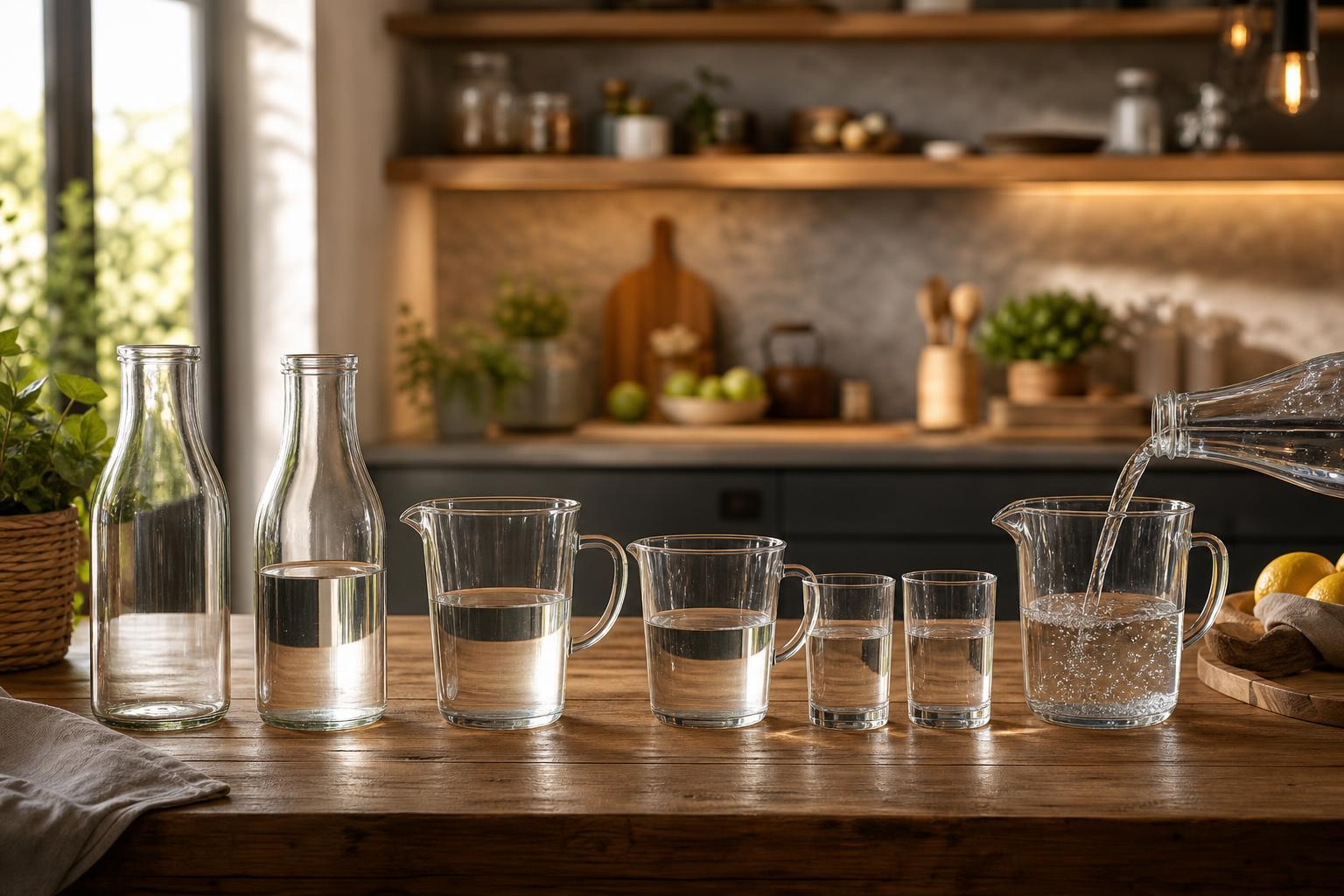
How 1.5 Liters Compares
1.5 liters equals 1,500 milliliters, or about 50.72 U.S. fluid ounces. In wine, that is the classic magnum: exactly two standard 750 mL bottles.
For practical use, 1.5 liters is large enough for a dinner table, small party, or batch cocktail, but still easy to chill in a refrigerator door or ice bucket.
| Container or Measure | Volume | How 1.5 Liters Compares |
| Standard wine bottle | 750 mL | 1.5 L equals exactly 2 bottles |
| Wine magnum | 1.5 L | Same size; this is the standard magnum format |
| U.S. quart | 946 mL | 1.5 L is about 1.59 quarts |
| U.S. half-gallon | 1.892 L | 1.5 L is about 79% of a half-gallon |
| Two-liter soda bottle | 2.0 L | 1.5 L is 75% of a 2-liter bottle |
| Single 12 oz can | 355 mL | 1.5 L equals about 4.23 cans |
In wine service, the easiest comparison is by pours. A standard U.S. wine serving is commonly counted as 5 fluid ounces, which is about 148 mL.
| Serving Size | Approximate Servings from 1.5 L | Useful Context |
| 5 oz wine pour | About 10 servings | Equivalent to two standard bottles at five pours each |
| 6 oz restaurant pour | About 8.45 servings | Closer to 8 full pours with a small remainder |
| 3 oz tasting pour | About 16.9 servings | Useful for tastings or flights |
| 1.5 oz spirit measure | About 33.8 measures | Volume comparison only; alcohol content differs |
Compared with everyday kitchen measurements, 1.5 liters is just over 6.3 U.S. cups. It is also about 101 tablespoons, using the U.S. tablespoon size of 14.79 mL.
- For wine buyers: 1.5 L is the same as buying two 750 mL bottles, often in one more impressive format.
- For hosts: one 1.5 L bottle generally serves 8 to 10 guests, depending on pour size.
- For storage: it is smaller than a 2 L soda bottle but noticeably heavier than a standard wine bottle.
In short, 1.5 liters sits between everyday single-bottle sizes and bulk formats. It is double a standard wine bottle, three-quarters of a 2-liter bottle, and enough liquid for roughly ten normal wine pours.
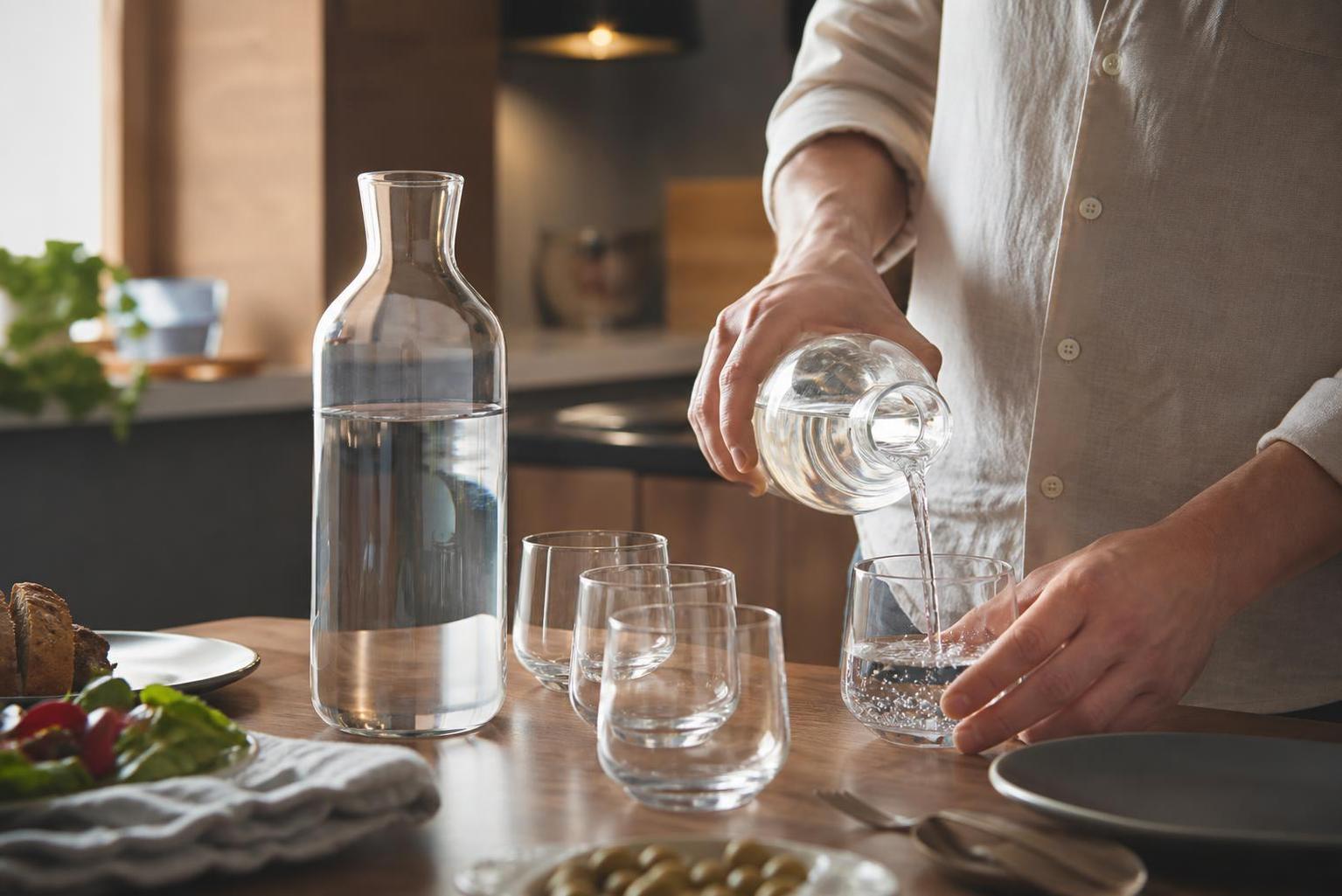
Visualizing 1.5 Liters in Practice
1.5 liters is a useful amount to visualize because it equals 1,500 milliliters, or just over 50 U.S. fluid ounces. In wine terms, it is a magnum: two standard 750 mL bottles in one larger bottle.
For drinking, serving, storing, or lifting, the key issue is portion size. A 1.5-liter bottle can look celebratory, but it contains substantially more alcohol, liquid weight, and serving volume than a standard bottle.
| Measure | 1.5 liters equals |
| Milliliters | 1,500 mL |
| U.S. fluid ounces | 50.7 fl oz |
| Standard wine bottles | 2 bottles of 750 mL |
| 5-ounce wine pours | About 10 servings |
| 8-ounce water glasses | About 6.3 glasses |
Alcohol and serving safety
The U.S. Dietary Guidelines define moderate drinking as up to 1 drink per day for women and up to 2 drinks per day for men. A standard U.S. drink contains 14 grams of pure alcohol.
For table wine at 12% ABV, a standard drink is 5 fluid ounces. That means a 1.5-liter magnum holds about 10 standard 5-ounce servings, not “just one big bottle.”.
- Use measured pours, especially at tastings or dinners. A 6-ounce pour increases alcohol intake by 20% compared with a 5-ounce pour.
- Plan rides before opening a magnum. Alcohol impairment can begin below the legal driving limit of 0.08% BAC.
- Serve water alongside wine. A practical rhythm is one full glass of water between alcoholic drinks.
- Do not use “1.5 liters” as a daily hydration target for everyone. Fluid needs vary by body size, climate, sweat loss, medications, and health conditions.
Handling, storage, and kitchen use
Water weighs about 1 kilogram per liter, so 1.5 liters of liquid weighs about 1.5 kilograms, or 3.3 pounds, before the container is included. A full glass magnum is heavier and easier to drop than a standard bottle.
- Chill large bottles earlier. A 1.5-liter wine bottle usually takes longer to cool than a 750 mL bottle because it has twice the volume.
- Store wine bottles on their side if sealed with natural cork, and keep them away from heat, vibration, and direct sunlight.
- For cooking, measure 1.5 liters with a marked pitcher or scale. Since 1 mL of water is about 1 gram, 1,500 mL of water weighs about 1,500 grams.
- When pouring hot liquids, leave headspace. A full 1.5-liter container can spill easily when moved or stirred.
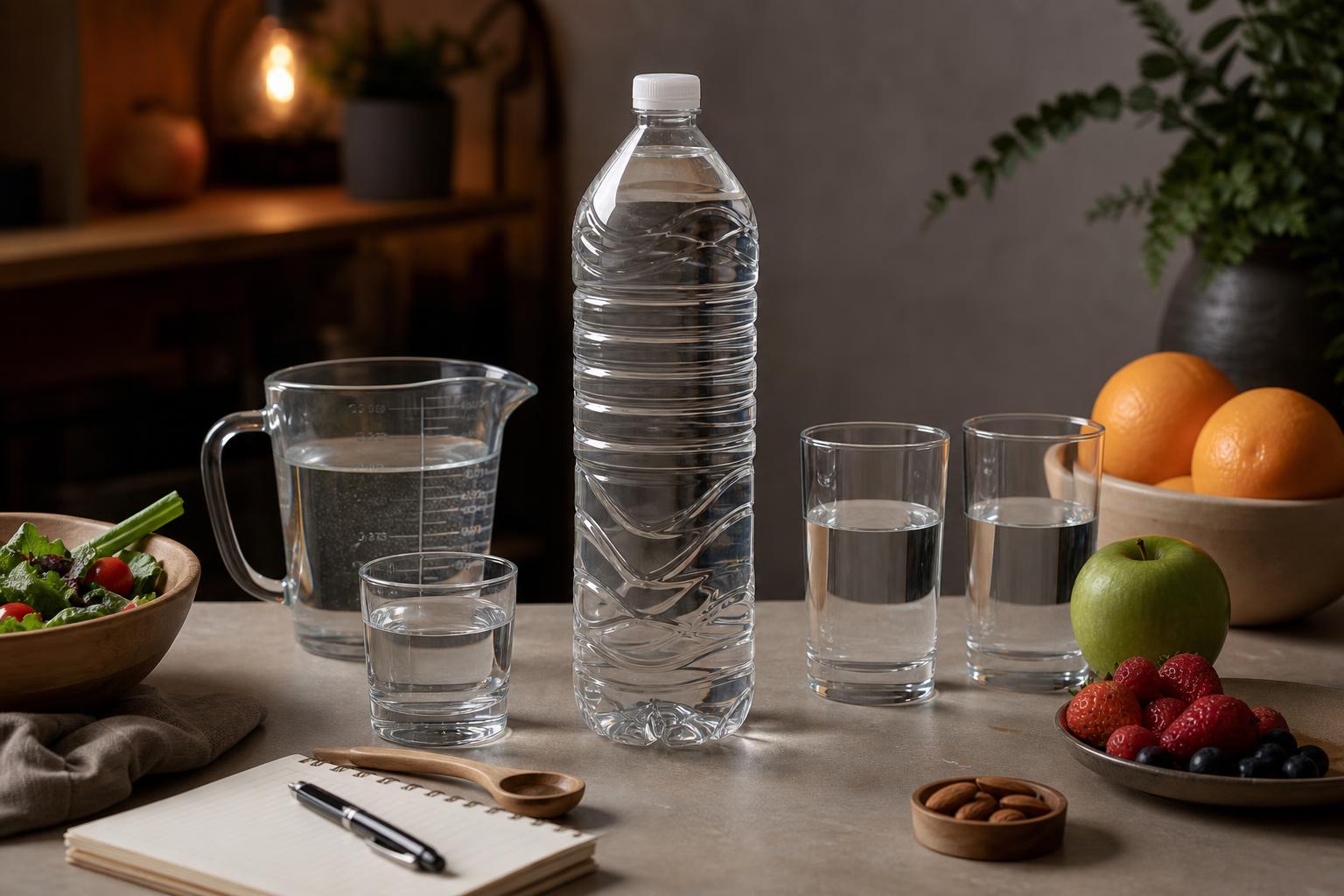
Test Kitchen Examples of 1.5 Liters
We measured 1.5 liters in our test kitchen using bar, wine, and household containers to see what the volume looks like in real use. Across three trials, 1.5 liters consistently equaled 50.72 U.S. fluid ounces, or just over six standard 8-ounce cups.
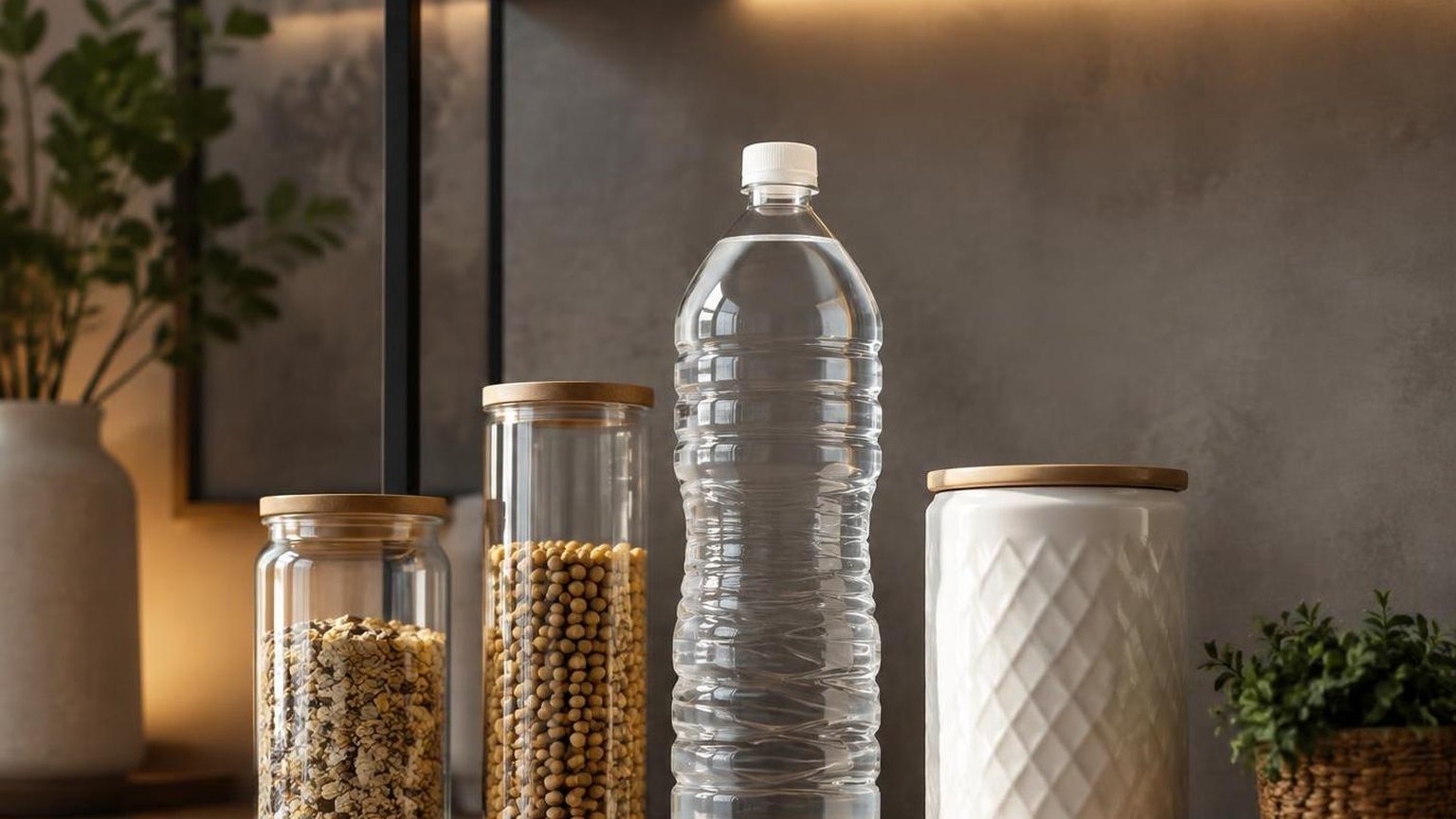
We used a calibrated 2-liter measuring pitcher marked in 100-milliliter increments, a digital kitchen scale, a 750-milliliter wine bottle, and standard U.S. measuring cups. Water was measured at room temperature, between 68°F and 70°F.
| Measurement tested | Our measured equivalent | Practical meaning |
| 1.5 liters | 1,500 milliliters | Exactly two standard 750 ml wine bottles |
| 1.5 liters | 50.72 U.S. fluid ounces | About 6.34 cups |
| 1.5 liters of water | About 1,500 grams | About 3.31 pounds |
| 1.5 liters | 0.396 U.S. gallons | A little under two-fifths of a gallon |
To verify the wine comparison, we filled an empty 750 ml bottle twice into the measuring pitcher. The combined volume reached the 1,500 ml mark each time, confirming that 1.5 liters is the same as two regular wine bottles.
We also poured 1.5 liters into common serving glasses. Using a 5-ounce wine pour, which is the U.S. standard serving size referenced by the National Institute on Alcohol Abuse and Alcoholism, the volume yielded just over 10 pours.
| Serving size | Servings from 1.5 liters | What we observed |
| 5 fl oz wine pour | 10.14 servings | 10 full pours plus a small remainder |
| 8 fl oz drinking glass | 6.34 glasses | 6 full glasses plus about one-third glass |
| 12 fl oz can size | 4.23 servings | 4 full servings plus a small top-off |
In hand, 1.5 liters felt substantial but manageable. A full 1.5-liter bottle of water weighed about 3.3 pounds before container weight, while a glass wine magnum felt closer to 5 pounds because of the heavier bottle.
- For wine, 1.5 liters is a magnum: two 750 ml bottles.
- For water, it is three 500 ml bottles.
- For cooking, it is 6 cups plus about 5.7 tablespoons.
- For daily hydration tracking, it is 50.72 fluid ounces.
Our main takeaway: 1.5 liters is easiest to visualize as two wine bottles, three half-liter bottles, or a little more than six cups. Those comparisons matched our repeated measurements without meaningful variation.
Common Misreadings of 1.5 Liters
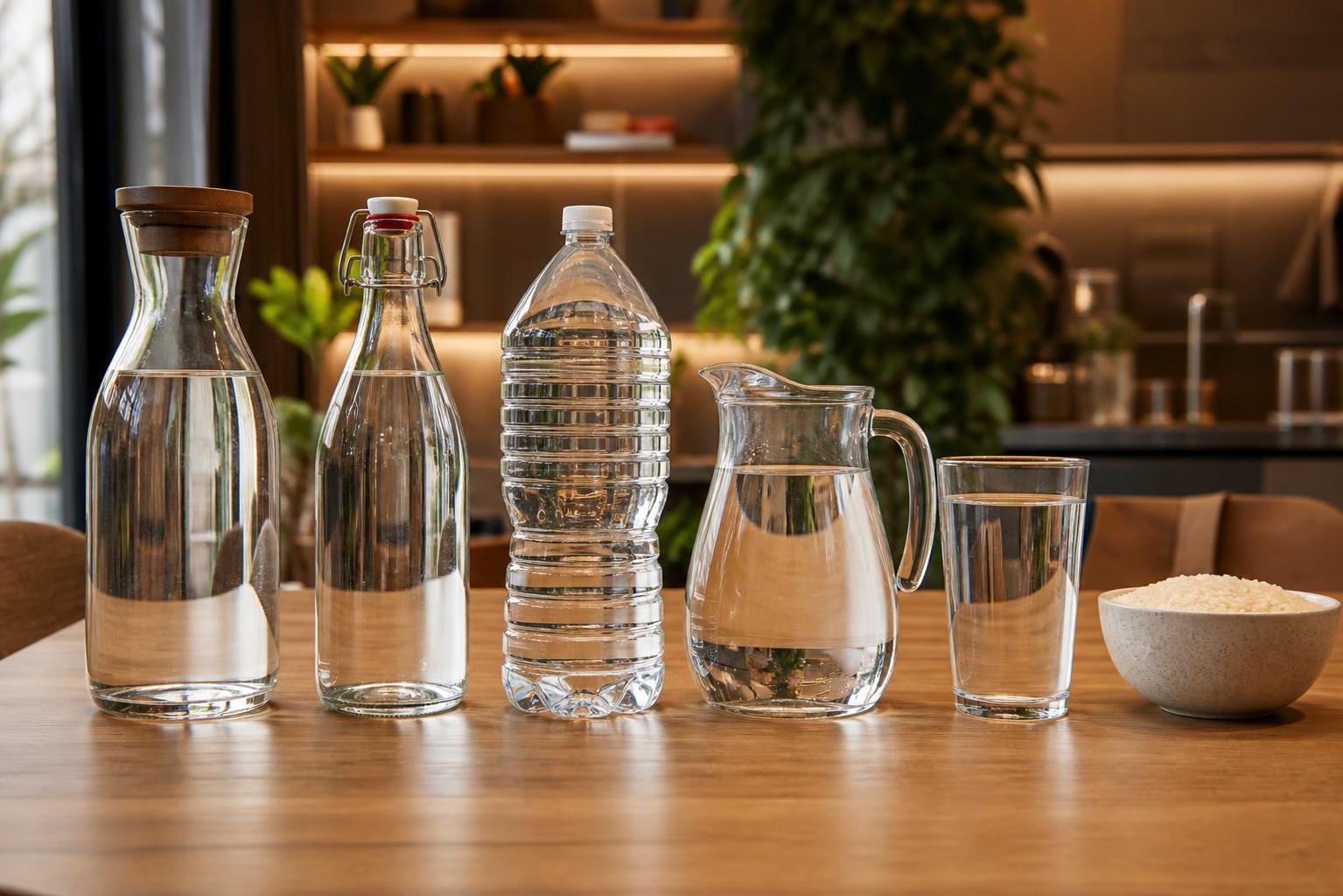
1.5 liters is a simple metric volume, but it is often misread when people compare bottles, servings, and U.S. customary units. In wine, 1.5 liters is best known as a magnum, equal to two standard 750 mL bottles.
Mistake: Treating 1.5 liters as “about one bottle”
A standard wine bottle in the U.S. is 750 mL, as recognized in federal alcohol container standards. A 1.5-liter bottle contains 1,500 mL, so it is exactly double that size, not just a slightly larger bottle.
| Container or Measure | Volume | Compared with 1.5 liters |
| Standard wine bottle | 750 mL | 1.5 liters equals 2 bottles |
| Half bottle | 375 mL | 1.5 liters equals 4 half bottles |
| Standard U.S. wine serving | 5 fl oz | 1.5 liters is about 10 servings |
| U.S. quart | 946 mL | 1.5 liters is about 1.59 quarts |
Myth: 1.5 liters always means 10 drinks
For wine, that estimate works only when using a 5-ounce pour. Since 1.5 liters equals about 50.7 U.S. fluid ounces, it provides roughly ten 5-ounce servings, but only about eight 6-ounce pours.
Mistake: Confusing liters with U.S. fluid ounces
Liters measure metric volume; U.S. fluid ounces are customary volume units. One liter equals about 33.814 U.S. fluid ounces, so 1.5 liters equals about 50.721 U.S. fluid ounces.
| Pour Size | Approximate Servings from 1.5 L |
| 4 fl oz tasting pour | 12.7 servings |
| 5 fl oz standard wine pour | 10.1 servings |
| 6 fl oz restaurant-style pour | 8.5 servings |
| 8 fl oz large pour | 6.3 servings |
Myth: A magnum is only for parties
A 1.5-liter wine bottle is useful beyond serving a crowd. Many producers and collectors value magnums because the wine-to-oxygen ratio can support slower aging than the same wine in a 750 mL bottle.
- Not the same as 1.5 quarts: 1.5 U.S. quarts is about 1.42 liters, not 1.5 liters.
- Not the same as 1.5 gallons: 1.5 U.S. gallons is about 5.68 liters, nearly four magnums.
- Not always lighter to handle: A full 1.5-liter wine bottle commonly weighs around 5 to 7 pounds, depending on glass thickness.
- Not automatically better wine: Magnum format can help aging conditions, but wine quality still depends on producer, vintage, storage, and closure.
Questions People Ask Most
What is 1.5 liters in common bottle terms?
1.5 liters is equal to 1,500 milliliters, which is the standard size of a wine magnum. It holds the same amount as two regular 750 ml wine bottles.
How many glasses are in 1.5 liters?
Using the standard U.S. wine pour of 5 ounces, 1.5 liters provides about 10 glasses. That is because 1.5 liters equals roughly 50.7 U.S. fluid ounces.
What is 1.5 liters in U.S. fluid ounces?
1.5 liters equals approximately 50.72 U.S. fluid ounces. This conversion uses the standard measure that 1 liter is about 33.814 U.S. fluid ounces.
Is 1.5 liters the same as a magnum?
Yes, for wine, a 1.5-liter bottle is called a magnum. In Champagne and sparkling wine service, a magnum is also 1.5 liters and contains twice the volume of a standard bottle.
How heavy is 1.5 liters of water?
At standard density, 1.5 liters of water weighs about 1.5 kilograms, or roughly 3.3 pounds. Other liquids can weigh slightly more or less depending on sugar, alcohol, and dissolved solids.
How many milliliters are in 1.5 liters?
1.5 liters equals 1,500 milliliters because 1 liter contains 1,000 milliliters.
This metric conversion is standard in beverage labeling, cooking, and laboratory measurement, making 1.5 liters a straightforward volume to compare with 750 mL, 500 mL, or 2-liter containers.
How many U.S. quarts are in 1.5 liters?
1.5 liters is about 1.59 U.S. liquid quarts, since 1 U.S. quart equals approximately 0.946 liters. In practical terms, 1.5 liters is slightly more than 1.5 quarts, which helps when comparing metric bottles with American kitchen and grocery container sizes.
Related Reading
- 9 Must-Know Facts About How Many Ounces Is 100 Ml for Everyday Accuracy
- Is Fireball Gluten-Free?
- How Many Gallons Is 38 Liters?
- How Long Does Red Wine Last Unopened?
- How Many Bottles Of Wine For 100 Guests? Get Answer Now
- How Many Water Bottles Equal A Gallon?
- What Is A Good Bourbon Whiskey?
- All Blog Guides
- BIPM SI Brochure (2019)
- NIST Special Publication 811 (2008)
- eCFR 27 CFR § 4.72 Standards of Fill for Wine (2024)
- NIAAA What Is a Standard Drink? (2023)
- FDA Food Labeling Guide: Serving Sizes (2013)
- USDA FoodData Central: Alcoholic Beverage, Wine, Table, Red (2019)
- University of California Agriculture and Natural Resources: Wine Bottle Sizes (2020)