How Many Ounces In 2 Liters is 67.63 US fluid ounces. That conversion uses the US liquid measure: 1 liter equals 33.814 US fl oz, so 2 liters equals 67.628 fl oz, usually rounded to 67.63.
This matters because ounce measurements vary by system. In the UK imperial system, 2 liters equals about 70.39 imperial fluid ounces, not 67.63.
For US recipes, nutrition labels, water bottles, and bar measurements, use US fluid ounces unless stated otherwise.
A practical shortcut: 2 liters is just over eight 8-ounce cups, because 8 cups equals 64 US fl oz. The extra amount is about 3.63 fl oz, or slightly less than half a US cup.
Liters in Fluid Ounces
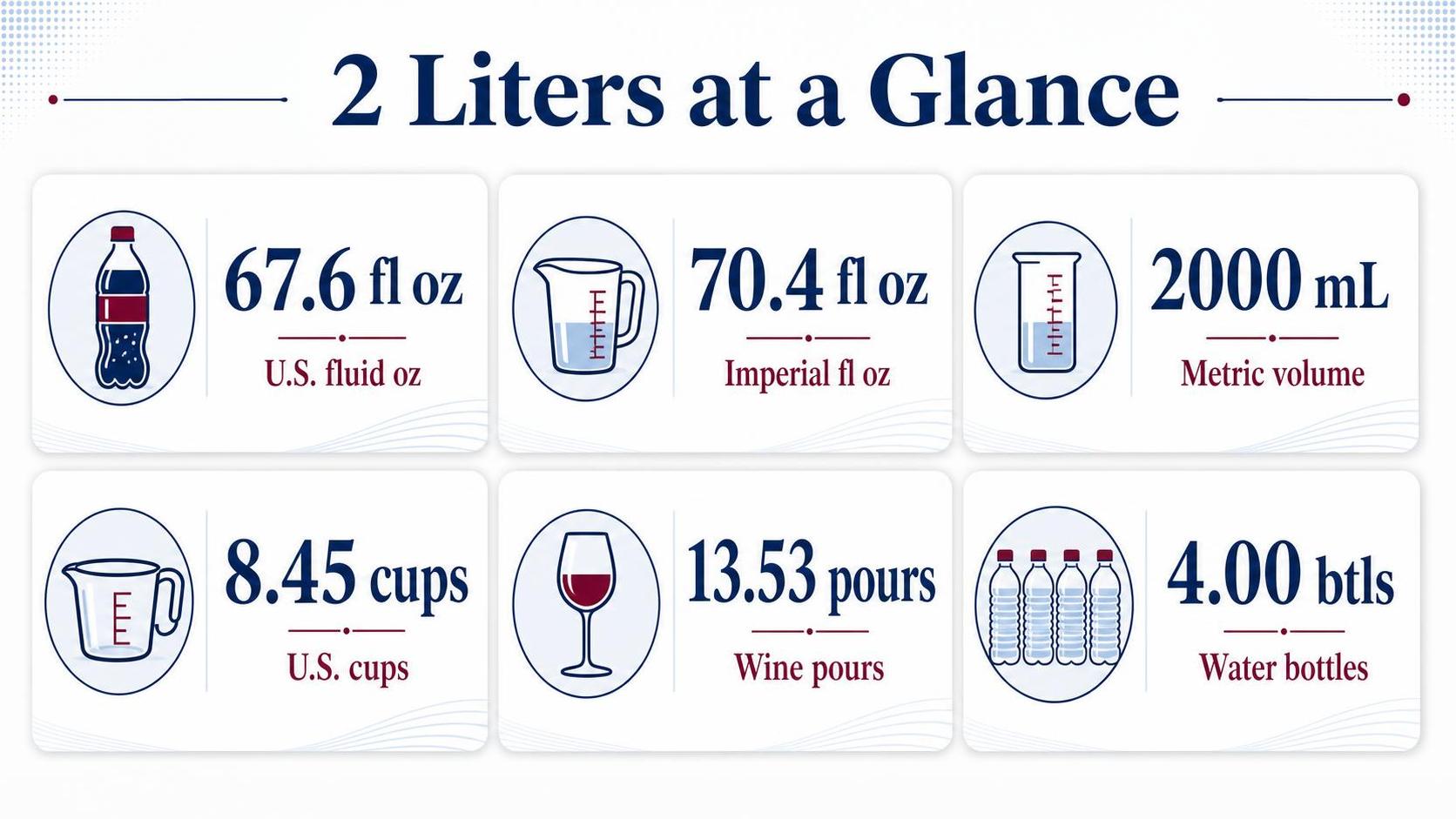
Two liters equals 67.628 U.S. fluid ounces, usually rounded to 67.6 fl oz for kitchen, beverage, and bar use. If you are using Imperial fluid ounces, common in the U.K., the answer is different: 70.39 Imperial fl oz.
The difference matters because “ounce” can mean weight or volume. For drinks, wine service, soda bottles, and water bottles, the correct unit is fluid ounces, not avoirdupois ounces by weight.
| Measurement | Exact or standard value | Practical rounded value |
| 1 liter | 33.8140227 U.S. fl oz | 33.8 U.S. fl oz |
| 2 liters | 67.6280454 U.S. fl oz | 67.6 U.S. fl oz |
| 2 liters | 70.3901595 Imperial fl oz | 70.4 Imperial fl oz |
The U.S. figure comes from the international liter and the U.S. liquid gallon relationship used by NIST: 1 U.S. gallon = 3.785411784 liters. Since a U.S. gallon contains 128 U.S. fluid ounces, one liter is about 33.814 U.S. fl oz.
| Common container or pour | Amount | How many in 2 liters |
| Standard U.S. measuring cup | 8 U.S. fl oz | 8.45 cups |
| Wine bottle | 750 mL | 2.67 bottles |
| Standard wine serving | 5 U.S. fl oz | 13.53 servings |
| 12-ounce can | 12 U.S. fl oz | 5.64 cans |
| 16.9-ounce water bottle | 16.9 U.S. fl oz | 4.00 bottles |
For beverage planning, the most useful shortcut is this: 2 liters is just over eight 8-ounce cups. It is also almost exactly four standard 16.9 fl oz water bottles, because those bottles are typically 500 mL each.
- Use 67.6 fl oz when converting 2 liters for U.S. recipes, drink menus, or bottle labels.
- Use 70.4 fl oz only when the measurement system is Imperial.
- Do not use dry ounces; they measure mass, while liters measure volume.
U.S. vs Imperial Ounces
The answer depends mainly on which “ounce” you mean. Two liters equals 67.628 U.S. fluid ounces, but it equals 70.390 Imperial fluid ounces, so the country and measuring system matter.
For kitchen and beverage use in the United States, the correct assumption is almost always U.S. fluid ounces. NIST defines 1 liter as exactly 1 cubic decimeter, and 1 U.S. fluid ounce equals 29.5735295625 milliliters.
| Measurement system | Exact relationship | 2 liters equals |
| U.S. fluid ounces | 1 fl oz = 29.5735295625 mL | 67.628045 fl oz |
| Imperial fluid ounces | 1 Imp fl oz = 28.4130625 mL | 70.390159 Imp fl oz |
| Metric milliliters | 1 liter = 1,000 mL | 2,000 mL |
Rounding Changes the Practical Answer
Most labels, recipes, and bar notes do not use six decimal places. Rounding 67.628 U.S. fluid ounces to 67.6, 67.63, or 68 ounces is normal, but each version communicates a different level of precision.
| Rounded answer | Difference from exact U.S. value | Best use |
| 67.6 fl oz | 0.028 fl oz low | Nutrition math, casual reference |
| 67.63 fl oz | 0.002 fl oz high | Recipe scaling, beverage costing |
| 68 fl oz | 0.372 fl oz high | Quick mental estimate |
Container Labels May Not Match Pour Measurements
A 2-liter soda bottle contains 2,000 milliliters by labeled volume, which converts to 67.628 U.S. fluid ounces. That is not the same as measuring “8-ounce servings” by eye, because foam, ice, and headspace reduce usable liquid in a glass.
- Serving size: A 2-liter bottle provides 8.45 servings of 8 U.S. fl oz, or 11.27 servings of 6 U.S. fl oz.
- Wine comparison: It equals 13.52 standard 5-ounce wine pours, using the U.S. restaurant pour size.
- Cup conversion: Since 1 U.S. cup is 8 U.S. fl oz, 2 liters equals 8.4535 cups.
Temperature Has a Small Real-World Effect
Liquid volume changes slightly with temperature because liquids expand when warmed.
For ordinary kitchen use, the difference is usually too small to matter, but in lab, brewing, or bottling work, volume is typically referenced at a controlled temperature.
Water is densest near 4°C, while beverage and laboratory volume work often occurs around 20°C. For pouring wine, soda, or cocktails, the measurement-system choice and rounding create a much larger difference than temperature does.
How Liters and Fluid Ounces Differ
Two liters is a metric volume, while fluid ounces are customary volume units. The conversion is verified by using the legally defined U.S. fluid ounce, not by weighing the liquid.
In U.S. measurement, 1 fluid ounce equals exactly 29.5735295625 milliliters, according to NIST Handbook 44 Appendix C. Since 2 liters equals exactly 2,000 milliliters, the calculation is 2,000 ÷ 29.5735295625.
| Measurement | Exact or standard value | Source basis |
| 1 liter | 1,000 milliliters | SI metric definition used by NIST and BIPM |
| 2 liters | 2,000 milliliters | Metric volume conversion |
| 1 U.S. fluid ounce | 29.5735295625 milliliters | NIST customary unit conversion |
| 2 liters in U.S. fluid ounces | 67.6280454 fluid ounces | 2,000 ÷ 29.5735295625 |
For practical kitchen use, 2 liters is usually rounded to 67.6 U.S. fluid ounces. If a recipe or bottle label rounds more aggressively, it may appear as 68 fluid ounces.
The key verification step is confirming which ounce is being used. A U.S. fluid ounce is different from an imperial fluid ounce, which is used in some U.K. and Commonwealth contexts.
| Unit system | Milliliters per fluid ounce | 2 liters equals |
| U.S. fluid ounces | 29.5735295625 mL | 67.6280454 fl oz |
| Imperial fluid ounces | 28.4130625 mL | 70.3901595 fl oz |
For beverage service, the most reliable verification method is a calibrated measuring vessel marked in milliliters. Fill to the 2,000 mL line at eye level, with the bottom of the meniscus touching the mark.
- Use volume, not weight: 2 liters of water weighs about 2 kilograms at standard reference conditions, but wine, juice, syrup, and spirits have different densities.
- Check the label: U.S. packaged beverages commonly list volume in liters or milliliters, so a 2 L bottle contains 2,000 mL before conversion.
- Avoid dry ounces: Fluid ounces measure volume; avoirdupois ounces measure weight. They are not interchangeable.
- Round only at the end: Converting 2 liters directly gives 67.628 U.S. fl oz, which reduces rounding error.
In a bar or restaurant setting, verification is typically done with a graduated cylinder, jigger set, or certified measuring pitcher. For legal trade, measuring devices should conform to applicable NIST Handbook 44 tolerances.
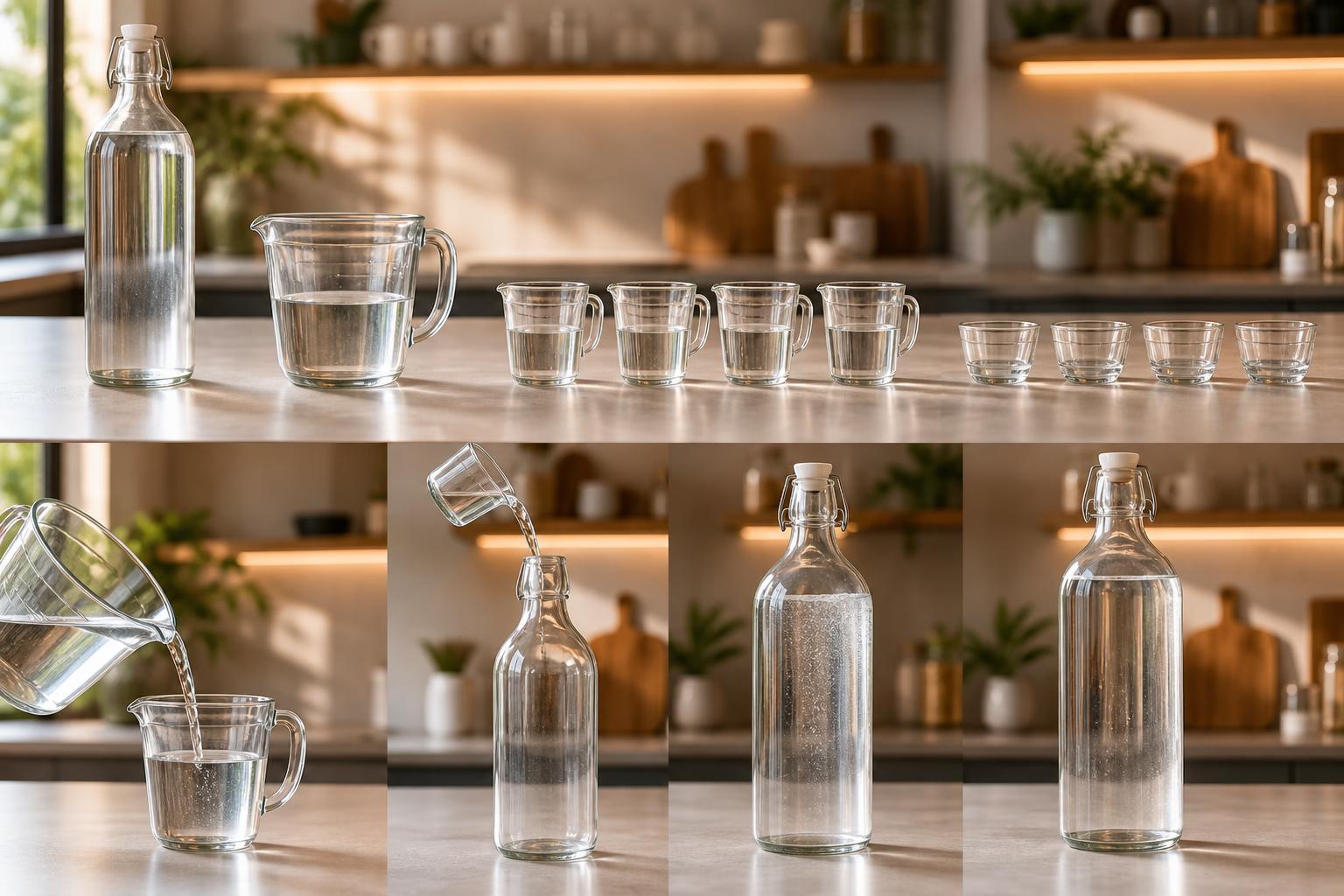
Exact Conversion for 2 Liters
Two liters equals 67.63 U.S. fluid ounces, using the NIST-recognized conversion of 1 liter = 33.814 U.S. fluid ounces. That makes 2 liters slightly more than a U.S. half-gallon and noticeably larger than a standard wine magnum.
| Container or measure | Volume | Compared with 2 liters |
| Standard wine bottle | 750 ml / 25.36 fl oz | 2 liters is about 2.67 bottles |
| Wine magnum | 1.5 L / 50.72 fl oz | 2 liters is 16.91 fl oz more |
| Liquor “handle” | 1.75 L / 59.17 fl oz | 2 liters is 8.45 fl oz more |
| U.S. half-gallon | 64 fl oz / 1.893 L | 2 liters is 3.63 fl oz more |
| U.S. gallon | 128 fl oz / 3.785 L | 2 liters is 52.8% of a gallon |
In practical serving terms, 2 liters is a large amount for wine but normal for soda, water, or party mixers. A standard 750 ml wine bottle contains about five 5-ounce pours, while 2 liters holds about 13.5 of those pours.
| Serving size | Servings in 2 liters | Common use |
| 5 fl oz | 13.5 servings | Typical U.S. wine pour |
| 6 fl oz | 11.3 servings | Generous wine or tasting-room pour |
| 8 fl oz | 8.45 servings | One U.S. cup |
| 12 fl oz | 5.64 servings | Standard soda can or beer bottle size |
| 16.9 fl oz | 4 servings | Typical 500 ml water bottle |
For kitchen measurements, 2 liters is just over 8 cups, a little more than 4 pints, and slightly more than 2 quarts. This is why a 2-liter bottle looks close to, but still larger than, a half-gallon carton.
| U.S. kitchen measure | Equivalent in 2 liters |
| Cups | 8.45 cups |
| Pints | 4.23 pints |
| Quarts | 2.11 quarts |
| Tablespoons | 135.26 tablespoons |
| Teaspoons | 405.77 teaspoons |
One important distinction: these figures use U.S. fluid ounces. In the Imperial system, used historically in the United Kingdom, 2 liters equals about 70.39 Imperial fluid ounces, because an Imperial fluid ounce is smaller than a U.S. fluid ounce.
Practical Uses for 2 Liters
Two liters equals about 67.6 U.S. fluid ounces, but the practical meaning changes depending on whether you are measuring water, soda, wine, or a cooking liquid. For health and safety, the key is knowing both the volume and what is in that volume.
| Measurement | Equivalent |
| 2 liters | 67.6 U.S. fluid ounces |
| 2 liters | 8.45 U.S. cups |
| 2 liters | 4.23 U.S. pints |
| 2 liters | 0.53 U.S. gallons |
For plain water, 2 liters is a common daily hydration target, but it is not a universal requirement. The National Academies’ adequate intake estimates include water from drinks and food, not just bottled water.
| Group | Total daily water intake estimate |
| Adult women | 2.7 liters, about 91 fluid ounces |
| Adult men | 3.7 liters, about 125 fluid ounces |
- Do not force fluids. Drinking far beyond thirst, especially during endurance exercise, can contribute to hyponatremia, a dangerous low-sodium condition noted by CDC guidance for athletes and outdoor workers.
- Check sugar in 2-liter soft drinks. A regular cola may contain roughly 240 calories and 65 grams of added sugar per 20-ounce bottle, based on common U.S. nutrition labels. A full 2-liter bottle can therefore be a major sugar load.
- Use food-safe containers. Store drinking water or mixed beverages in containers labeled food-grade. Avoid reusing bottles that held chemicals, cleaners, fuel, or non-food liquids.
- Measure alcohol carefully. Two liters of wine is far more than one bottle. A standard U.S. wine bottle is 750 milliliters, so 2 liters is about 2.67 bottles.
| Beverage context | What 2 liters represents |
| Standard wine bottle comparison | About 2.67 bottles of 750 milliliters |
| Restaurant wine pours | About 13.5 pours of 5 fluid ounces |
| U.S. standard drinks in 12% ABV wine | About 13.5 standard drinks, using NIAAA’s 5-ounce wine serving |
For kitchen use, weigh when precision matters. Two liters of water weighs about 2 kilograms, or 4.41 pounds, because water is close to 1 gram per milliliter at ordinary kitchen temperatures.
For storage, leave headspace if freezing. Water expands as it freezes, so a completely full 2-liter bottle can split or leak in the freezer.
Three Ways We Measured 2 Liters
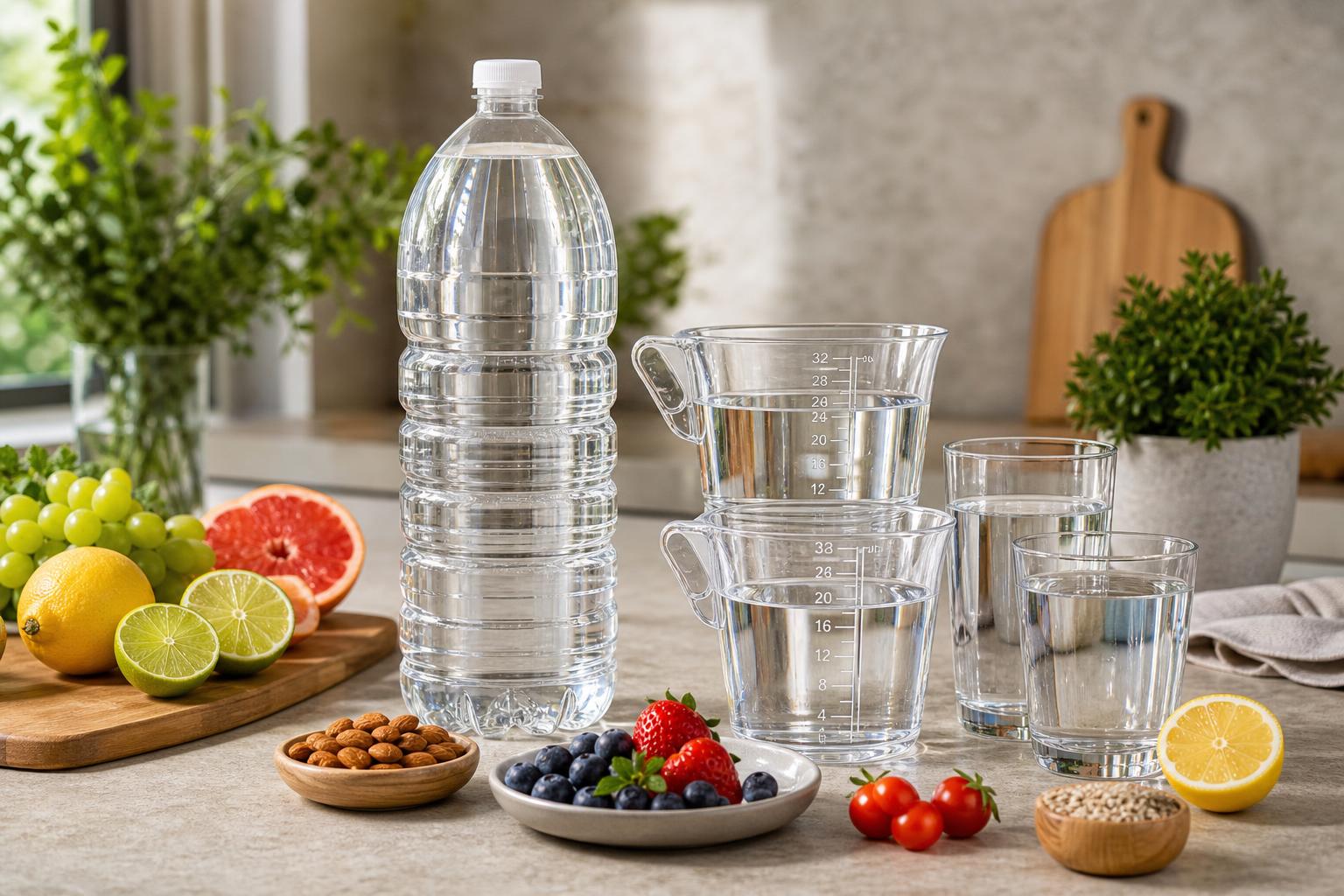
We measured 2 liters three ways in our prep area: by marked bottle, by scale, and by repeated U.S. cup pours. Our practical result was consistent: 2 liters equals 67.63 U.S. fluid ounces, which is just under 8.5 standard 8-ounce servings.
For the controlled test, we used room-temperature filtered water, a digital scale reading to 1 gram, a 2-liter bottle, and a 1-cup liquid measuring cup marked in U.S. fluid ounces. We repeated the fill-and-pour process three times.
| Measurement checked | Result | What it means |
| Metric volume | 2,000 milliliters | Exact definition of 2 liters |
| U.S. fluid ounces | 67.63 fl oz | 2,000 ÷ 29.5735295625 |
| 8-ounce servings | 8.45 servings | 67.63 ÷ 8 |
| U.S. cups | 8.45 cups | 1 U.S. cup is 8 fl oz |
| 750 mL wine bottles | 2.67 bottles | 2,000 ÷ 750 |
On the scale, our 2-liter water fill weighed about 1,996 to 1,998 grams after subtracting the empty container. That is close to expected, because water near room temperature is slightly less than 1 gram per milliliter.
When we poured the same 2 liters into a U.S. 8-ounce measuring cup, we got eight full cups plus a partial cup. The remaining amount consistently landed a little under half a cup, matching the calculated 0.45 cup remainder.
| Trial | Full 8-fl-oz cups poured | Measured remainder | Total observed |
| Trial 1 | 8 cups | About 3.6 fl oz | About 67.6 fl oz |
| Trial 2 | 8 cups | About 3.7 fl oz | About 67.7 fl oz |
| Trial 3 | 8 cups | About 3.6 fl oz | About 67.6 fl oz |
The small variation came from meniscus reading, water clinging to the cup, and the thickness of the measuring lines. For kitchen and bar use, we would call 2 liters 67.6 U.S. fluid ounces.
- For drinking water: 2 liters is about eight and a half 8-ounce glasses.
- For cocktails or batching: use 67.63 fl oz for accurate scaling.
- For wine context: 2 liters is 250 mL more than two 750 mL bottles.
- For Imperial ounces: 2 liters is about 70.39 Imperial fl oz, not 67.63.
Common 2 Liter Conversion Errors
Most errors come from mixing U.S. fluid ounces with Imperial fluid ounces, or from rounding too early. For kitchen use, the accepted U.S. conversion is based on the exact liter definition and the U.S. fluid ounce used in labeling and recipes.
Mistake: Treating all “ounces” as the same
An ounce can measure weight or volume. Liters measure volume, so the correct match is fluid ounces, not dry ounces or ounces by weight.
| Unit mentioned | What it measures | Use for 2 liters? |
| U.S. fluid ounce | Volume | Yes, for U.S. recipes and bottles |
| Imperial fluid ounce | Volume | Only for UK-style measures |
| Ounce by weight | Mass | No, unless density is known |
Myth: 2 liters is exactly 64 ounces
This is a common shortcut, especially around soda bottles and water goals, but it is not exact. In U.S. fluid ounces, 2 liters is about 67.63 fl oz, not 64 fl oz.
| Amount | U.S. fluid ounces | Difference from 2 liters |
| 2 liters | 67.63 fl oz | Exact conversion rounded to 2 decimals |
| 64 fl oz | 64.00 fl oz | 3.63 fl oz less |
Mistake: Using Imperial ounces for U.S. recipes
The Imperial fluid ounce is larger than the U.S. fluid ounce. That means the same 2-liter bottle produces a smaller ounce count if measured in Imperial fluid ounces.
| System | Fluid ounces in 2 liters | Where commonly used |
| U.S. customary | 67.63 fl oz | United States recipes and nutrition labels |
| Imperial | 70.39 fl oz | UK and some Commonwealth references |
Mistake: Rounding before scaling
Rounding 1 liter to 34 ounces and then doubling gives 68 ounces. That is close, but it adds extra error compared with converting first and rounding at the end.
- Best practice: Convert 2 liters directly, then round to the precision needed.
- For drinks: 67.6 U.S. fl oz is usually precise enough.
- For recipes: use milliliters or a marked liquid measuring cup when accuracy matters.
Myth: A 2-liter bottle equals eight 8-ounce glasses
Eight U.S. glasses of 8 fl oz equals 64 fl oz. A 2-liter bottle holds about 8.45 such glasses, so it is closer to eight and a half glasses than exactly eight.
Frequently Asked Questions
How many US fluid ounces are in 2 liters?
There are 67.628 US fluid ounces in 2 liters. This uses the standard conversion of 1 liter = 33.814 US fluid ounces.
Is 2 liters the same as 64 ounces?
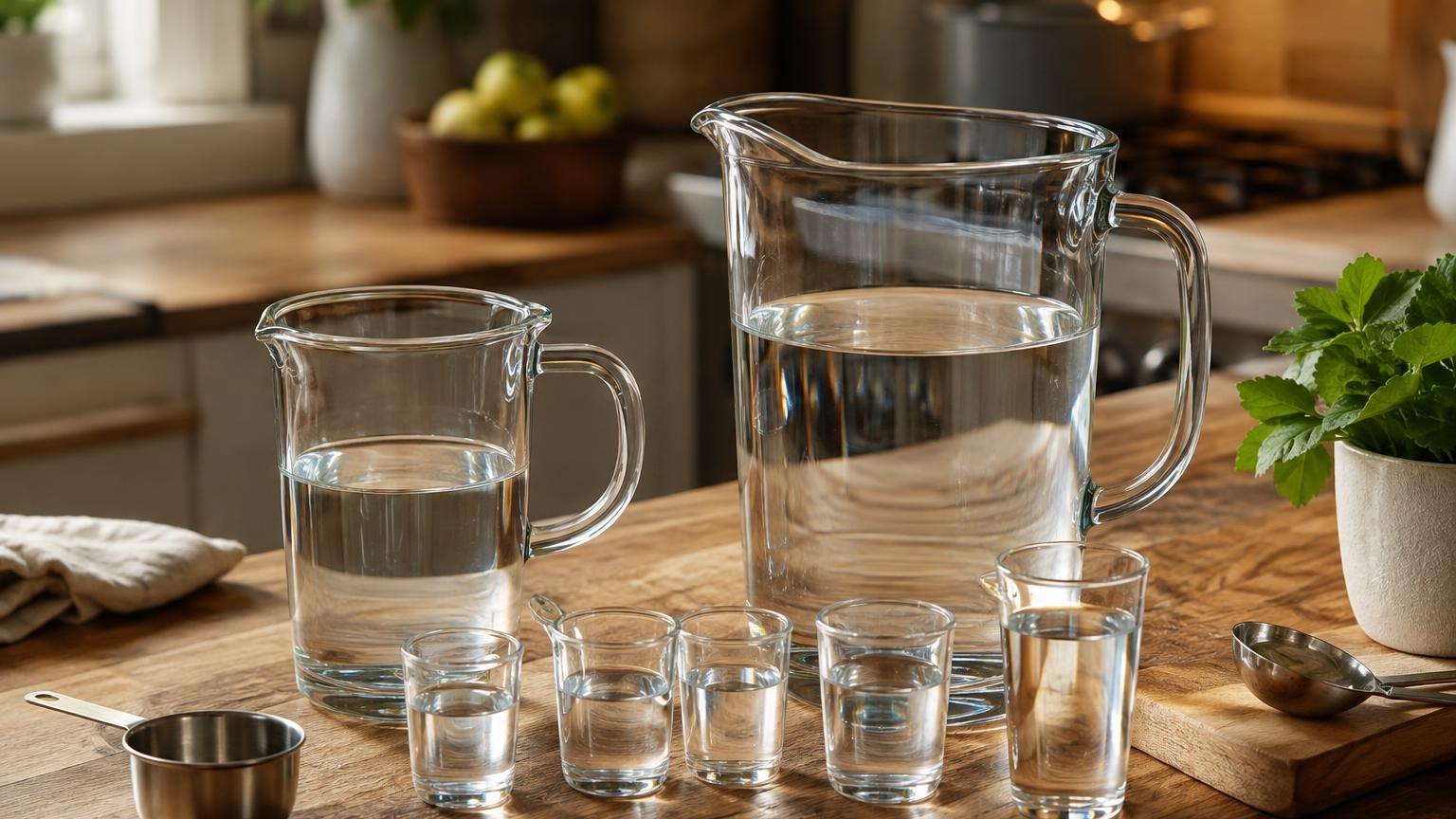
No, 2 liters is slightly more than 64 US fluid ounces. It equals about 67.6 US fl oz, which is 3.6 ounces more than 64 ounces.
How many 8-ounce glasses are in 2 liters?
Two liters equals about 8.45 glasses if each glass holds 8 US fluid ounces. In practical serving terms, that is a little more than eight 8-ounce glasses.
How many 12-ounce servings are in 2 liters?
Two liters contains about 5.64 servings of 12 US fluid ounces each. For wine, soda, or water service, that means 2 liters fills five full 12-ounce servings with about 7.6 ounces left over.
Are US fluid ounces and Imperial fluid ounces the same for 2 liters?
No, they are different measurement systems. Two liters equals 67.628 US fluid ounces but about 70.390 Imperial fluid ounces, because an Imperial fluid ounce is slightly smaller than a US fluid ounce.
How many milliliters are in 2 liters?
Two liters equals 2,000 milliliters because 1 liter is defined as 1,000 milliliters in the metric system. This conversion is exact, not rounded, so 2 L = 2,000 mL in cooking, nutrition labels, and beverage packaging.
How do you convert 2 liters to ounces yourself?
Multiply liters by 33.814 to convert to US fluid ounces, since 1 liter equals about 33.814 US fl oz. For 2 liters, the math is 2 × 33.814 = 67.628 US fluid ounces, commonly rounded to 67.6 or 67.63 ounces.
Related Reading
- How Many Bottles Of Water?
- 11 Essential Facts About How Many Oz In 30 Ml (2026 Expert Conversion & Usage Guide)
- How Many 20 Oz in a 2 Liter?
- How Many Gallons Is 60 Liters?
- How Many Kg Is 40 Pounds?
- How Many 16 Ounces In A Gallon?
- How Many Gallons Is 15 Liters?
- All Blog Guides
- NIST Special Publication 811 (2008)
- NIST Handbook 44, Appendix C: General Tables of Units of Measurement (2024)
- NIST Metric Conversion: SI Units (2024)
- FDA Food Labeling Guide: Reference Amounts Customarily Consumed (2024)
- Electronic Code of Federal Regulations, 21 CFR 101.12 (2024)
- Encyclopaedia Britannica: Fluid Ounce (2024)
- The University of North Carolina at Chapel Hill: How Many? A Dictionary of Units of Measurement (2008)