A black owned winery in georgia is a Georgia winery whose ownership is held by Black individuals or families.
To identify one, check the winery’s own account of its ownership rather than relying on a directory label; ownership and business status can change.
- Georgia’s wine industry includes vineyards and wineries, but a tasting room, wine shop, or winery operating in the state is not necessarily Black-owned.
Before visiting, confirm the winery’s address, tasting availability, and hours through its official website or social media. If ownership is not clearly stated, contact the business directly.
This helps distinguish a verified Black-owned winery from a retailer or event venue that simply features wines from Black producers. Also check whether tastings require reservations, since schedules and access vary by location and season.
Black-Owned Wineries in Georgia
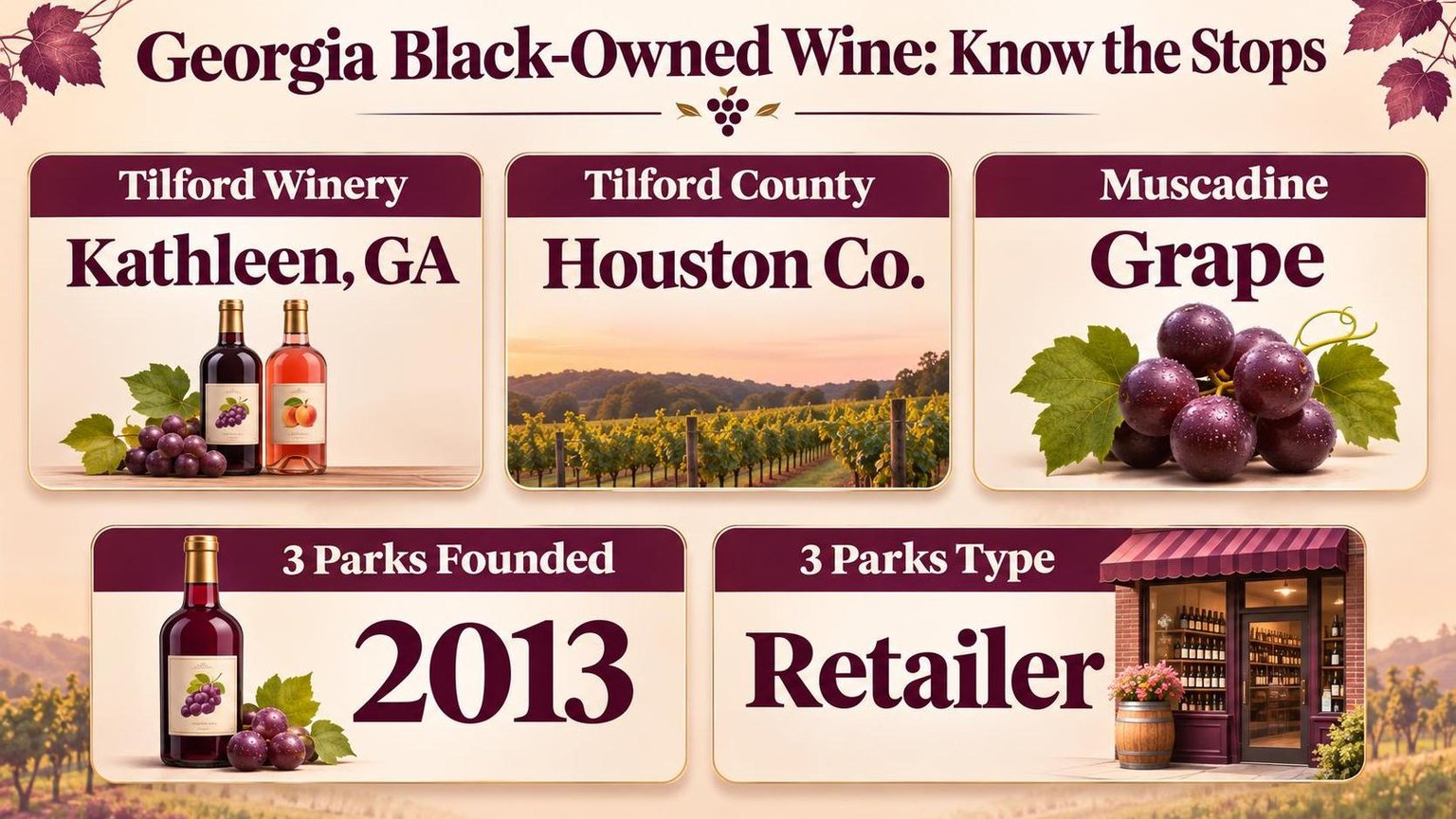
Tilford Winery in Kathleen is a Black-owned Georgia winery worth knowing if you want to explore wines made from muscadines and other fruit.
It is in Houston County, near Warner Robins—not in the North Georgia mountain region where many visitors first look for wineries.
Tilford Winery: Start With the Fruit
Tilford is associated with muscadine wine and wines made from fruits such as peach, blueberry, and strawberry.
Its location makes it a different kind of Georgia wine stop from a mountain vineyard tour: ask what is currently available to taste, and confirm visiting arrangements directly before making the drive.
Muscadines are grapes, despite their distinctive flavor and thick skins. University of Georgia Cooperative Extension identifies them as grapes native to the southeastern United States.
That matters when reading a tasting list: muscadine wine is grape wine, while a wine fermented from peaches or blueberries is fruit wine.
If you usually drink dry Cabernet Sauvignon or Chardonnay, ask about sweetness before ordering a flight or bottle. Do not assume that “muscadine” always means sweet, or that every fruit wine tastes like juice.
The useful questions are whether a wine is dry, off-dry, or sweet and which fruit was fermented.
How to Check a Black-Owned Winery Listing
Ownership, production, and retailing are separate facts. A Black-owned wine brand may buy grapes, use another facility to make its wine, or sell bottles through a tasting room.
None of those arrangements makes the business less Black-owned, but they do change what you can expect from a winery visit.
For Tilford—or any winery on a travel list—check the business’s current website or social account for tasting hours, reservations, and the address. Then check the bottle label for the producer or bottler statement. The U.S.
Alcohol and Tobacco Tax and Trade Bureau’s public label registry can help confirm label details, but it does not certify who owns a business.
- For a tasting: Ask which wines are available that day, whether tastings require an appointment, and whether bottles can be purchased on-site.
- For a specific style: Ask for the fruit used and the wine’s sweetness level rather than relying on its name.
- For an ownership claim: Look for the owner’s own identification or a current, attributable interview. A state business registration alone does not establish an owner’s race.
Georgia Grown and winery directories can help you find producers, but a directory listing is not an ownership certification.
If supporting a Black-owned business is the purpose of your trip, confirm that claim and the visitor experience separately before you go.
Georgia’s Black-Owned Wine Businesses
Georgia’s Black-owned wine businesses include retailers as well as wine producers, but those are different things.
Atlanta’s 3 Parks Wine Shop is a documented example of Black-owned wine retail; finding a Black-owned winery that grows grapes or makes wine in Georgia requires a separate check of ownership, production location, and licensing.
A documented Atlanta wine shop
Sarah Pierre founded 3 Parks Wine Shop in 2013. The shop identifies itself as a woman-owned, Black-owned business in Atlanta’s Glenwood Park neighborhood.
It sells wines from multiple producers, so a bottle purchased there is not necessarily a Georgia wine—or a wine made by a Black-owned winery. Sources: 3 Parks Wine Shop’s About page and shop information.
That distinction matters when searching for a “black owned winery in georgia.” Supporting 3 Parks supports a Georgia Black-owned wine retailer.
To support a Black-owned producer, ask the shop which bottles come from Black-owned wine companies and where those wines are made. A producer’s headquarters, grape source, and bottling location can all be different.
How to check a winery claim
Start with the business’s own account of its owners and operations, then check its address and products. A Georgia tasting room may pour wine made elsewhere.
A Georgia-based brand may contract with another winery to make and bottle its wine. Neither arrangement is inherently misleading, but neither establishes that the business operates a Georgia winery.
- Confirm ownership: Look for named owners on the business website or in credible reporting. A directory listing alone may be outdated or may group wine bars, retailers, and producers together.
- Confirm production: Read the bottle’s name-and-address statement. Federal wine-label rules, including 27 CFR § 4.35, govern identification of the bottler, producer, or other responsible business. The address is a useful lead, not proof of vineyard ownership.
- Confirm geography: Ask whether the business grows grapes, makes wine, bottles wine, or only hosts tastings in Georgia. For a planned visit, verify current hours and whether tastings require reservations.
- Confirm licensing where relevant: Georgia’s Department of Revenue administers alcohol licensing, while the federal Alcohol and Tobacco Tax and Trade Bureau regulates wine production and labeling. A retail license and a winery operation are not interchangeable.
For Georgia-grown wine, the label’s origin claim is more informative than a shop’s location.
Federal appellation rules in 27 CFR § 4.25 set conditions for using a state or American Viticultural Area name; an Atlanta mailing address does not establish where the grapes grew.
The practical approach is to choose which purchase you intend to make: a bottle from a Black-owned producer, wine at a Black-owned Georgia shop, or a tasting at a Black-owned Georgia winery.
Ask that specific question before traveling or ordering. It avoids treating a retailer, a wine brand, and a production facility as the same business.
Where to Find Black-Owned Georgia Wineries
Start by distinguishing a Georgia winery from a Georgia wine shop or a wine brand sold in Georgia.
A business can be Black-owned and wine-focused without growing grapes or making wine in the state; confirm the production address before planning a winery visit.
Verify a winery before making the trip
Georgia’s Department of Revenue licenses alcohol manufacturers, while the federal Alcohol and Tobacco Tax and Trade Bureau (TTB) issues winery permits.
Check a producer’s website for its ownership, production location, tasting-room address, hours, and reservation policy. A mailing address or Atlanta-area event listing is not evidence of an operating winery.
The Association of African American Vintners’ member directory is a useful starting point for discovering Black wine professionals and businesses. It is not a directory of Georgia tasting rooms.
Cross-check any promising listing against the producer’s own site and Georgia licensing information, particularly if a third-party article describes a brand as a “Georgia winery.”.
Find Black-owned wine businesses in Atlanta
For an in-person stop, 3 Parks Wine Shop is a Black-owned retailer at 880 Glenwood Avenue SE in Atlanta’s Glenwood Park neighborhood. Founder Sarah Pierre has discussed her ownership in interviews with wine-industry publications.
It is a shop, not a winery, so call before visiting if you want a particular Black-owned producer’s bottle.
Retailers can be a practical route to wines that have no Georgia tasting room. Ask whether the wine is in stock, whether it can be ordered, and where it was produced.
For example, McBride Sisters Wine Company is Black-owned, but its wines are associated with California and New Zealand—not a Georgia winery visit.
| Where to look | What to confirm |
| Winery or vineyard website | Georgia production site, current visitor hours, and whether tastings require reservations |
| 3 Parks Wine Shop, Atlanta | Current selection of Black-owned producers; this is retail, not on-site winemaking |
| Association of African American Vintners directory | Producer identity and location; membership alone does not establish Georgia production |
Plan around the production site, not the label
“Black-owned,” “Georgia-based,” and “made with Georgia-grown grapes” answer different questions. A Georgia-based owner may contract with an out-of-state winery; a Georgia winery may use grapes grown elsewhere.
If local agriculture matters to you, ask which grapes went into the specific wine you intend to taste.
Before driving to a rural address, request the tasting-room location and confirm that the public is welcome that day. Some producers sell through shops or events rather than operating regular walk-in hours.
This verification prevents a common mistake: arriving at an office, private vineyard, or production facility expecting a tasting bar.
Georgia Wine Regions and Black Ownership
Georgia’s federally recognized wine regions are in the northern mountains, but a Black-owned winery need not be inside either one.
Stoney J’s Farm Winery in Cumming illustrates the distinction: ownership, winery location, and the origin of the grapes are separate facts.
The Alcohol and Tobacco Tax and Trade Bureau (TTB) recognizes two American Viticultural Areas (AVAs) that include Georgia land.
An AVA identifies a grape-growing area with distinctive geographic features; it does not certify a winery’s ownership, guarantee that every bottle uses local grapes, or serve as a ranking of wine quality.
| AVA | Established | Georgia geography |
| Upper Hiwassee Highlands | 2014 | North Georgia mountain counties; the AVA also extends into North Carolina |
| Dahlonega Plateau | 2018 | A 133-square-mile area in Lumpkin and White counties |
Those designations come from TTB’s Federal Register rules establishing the Upper Hiwassee Highlands and Dahlonega Plateau AVAs. Dahlonega Plateau lies wholly in Georgia, while Upper Hiwassee Highlands crosses the state line.
Neither boundary should be treated as a directory of Black-owned businesses.
Stoney J’s Farm Winery describes itself as Forsyth County’s first Black-owned winery. Its Cumming location is in the northern Atlanta metropolitan area, not the Dahlonega Plateau AVA.
That makes it a useful reminder to search beyond Dahlonega when looking for Black-owned Georgia wineries. Check the winery’s current website before visiting for hours, reservations, and available wines.
Georgia’s growing conditions also complicate assumptions about what “local wine” means.
The cooler north Georgia mountains support vineyards growing European grapes and hybrids, while muscadines are an important grape in the warmer, humid Southeast.
A winery’s address alone cannot establish which grapes went into a particular bottle.
The most direct evidence is the bottle label or the producer’s description of that wine. Under TTB appellation rules, a wine labeled with an AVA must derive at least 85% of its grapes from that AVA and meet other production requirements.
A Georgia winery may therefore be locally owned without selling only AVA-labeled or Georgia-grown wine.
When researching a Black-owned winery, confirm ownership through the business’s own account or reliable reporting, then check its address separately from each wine’s stated grape origin.
Those checks answer different questions: whom your purchase supports, where you can visit, and where the fruit was grown.

Visiting Black-Owned Wineries in Georgia
Stoney J’s Farm & Winery in Cumming is a place to start planning a visit to a Black-owned Georgia winery.
Check the winery’s own website or social channels before leaving: tasting hours, reservation requirements, and available wines can change.
Plan the tasting, not just the drive
Confirm the winery’s current address, opening hours, and whether it accepts walk-ins. Ask if tastings take place outdoors, whether seating is reserved, and what happens during bad weather.
Those details matter when a winery is also a farm or event venue.
Before booking, ask what a tasting includes and whether the fee covers a guided flight, a fixed pour selection, or a credit toward a bottle. Check the cancellation policy if you are reserving for a group.
Do not assume a winery serves meals; verify its food policy before bringing a picnic.
Bring a valid government-issued photo ID. Georgia requires purchasers of alcoholic beverages to be at least 21, and a tasting room may check identification even when guests are accompanied by older adults.
Arrange a designated driver or another sober ride before tasting; rural and suburban winery visits are not always convenient for rideshare pickups.
Know what you are tasting
Ask which wines are made from grapes grown on the property, which use fruit grown elsewhere in Georgia, and which use out-of-state fruit. A tasting room’s location does not establish where every grape was grown.
The bottle label and a conversation with staff are better guides than the scenery.
If you see muscadine on a tasting menu, ask about the grape variety and sweetness level rather than assuming all muscadine wines taste alike.
The University of Georgia Cooperative Extension identifies muscadines as grapes well adapted to the Southeast; winemaking choices still shape a wine’s aroma, sweetness, and texture.
You may also encounter wines made from other grapes or fruit. Ask whether a wine is dry, off-dry, or sweet, and whether it was made on-site.
These questions make it easier to choose a flight that suits your preferences and to understand what you are buying to take home.
Verify ownership and support the business
“Black-owned” describes ownership, not a wine style or grape source. For a current answer, look for the owners’ own account on the winery’s website or ask the tasting-room team.
Directory listings and older articles can be useful leads, but ownership and operating arrangements can change.
If you want to support the winery beyond a tasting, ask about bottle purchases, wine-club membership, or upcoming events directly through its official channels.
Check shipping availability before purchasing a gift for someone outside Georgia: wine shipment rules depend on the destination and the seller’s permissions.
For label questions, the Alcohol and Tobacco Tax and Trade Bureau’s guidance on American Viticultural Areas explains what an AVA designation means.
It is a statement about grape origin under federal labeling rules, not a certification of who owns the winery. Keep those distinctions in mind when comparing Georgia tasting experiences.
Questions People Ask Most
Where can I find a Black-owned winery in Georgia?
Start with Georgia winery directories and the winery’s own website, then confirm who owns and operates the business before traveling.
A Black-owned wine shop is not necessarily a winery: Atlanta’s 3 Parks Wine Shop, founded by Sarah Pierre, is a retailer rather than a wine producer.
How can I verify that a Georgia winery is Black-owned?
Look for an owner biography, a winery statement, or an interview that identifies the owners by name.
Also check whether the business makes wine, contracts with another producer to make it, or only sells finished bottles; those are different types of wine businesses.
Is McBride Sisters a Georgia winery?
No. McBride Sisters is a Black-owned wine company associated with California and New Zealand, not a Georgia winery; its Black Girl Magic wines may still be available through Georgia retailers.
What Georgia-grown wines should I look for during a tasting?
Ask which wines use Georgia-grown fruit, because a tasting room’s wines do not necessarily come entirely from its own vineyard.
Muscadine, a grape native to the southeastern United States, is one option; some Georgia producers also work with wine-grape varieties suited to the state’s climate.
Does Georgia have an official wine-growing region?
Yes. The Dahlonega Plateau became a federally recognized American Viticultural Area in 2018, according to the Alcohol and Tobacco Tax and Trade Bureau.
An AVA identifies a grape-growing area; it does not certify a winery’s ownership or guarantee that every wine poured there uses local grapes.
Should I book a tasting before visiting a Georgia winery?
Check the winery’s current booking page or call before making the trip. Some tastings are walk-in, while guided flights, group visits, and vineyard tours may require reservations and may not be offered every day.
Can I buy wine from a Black-owned producer at a Georgia wine shop without visiting a winery?
Yes, if the shop carries that producer’s bottles. Ask the retailer for the producer’s name and the wine’s place of production so you can distinguish a Black-owned brand from a wine that was actually made in Georgia.
Can a Georgia winery ship wine to my home?
Shipping depends on the winery’s licenses and the rules in the destination state, so confirm eligibility at checkout rather than assuming a bottle can be mailed.
Direct-to-consumer wine shipments require an adult recipient who is at least 21 to sign for delivery.
Related Reading
- How Much Is 5 Stone In Pounds?
- How Many Pounds Is 12 Stone?
- What To Mix With Scotch?
- Where Can I Find Black-Owned Wineries Near Me?
- How Many Cups Of Flour In A 2 Pound Bag?
- How Many Quarts In 64 Ounces?
- What Does Rye Whiskey Taste Like?
- All Blog Guides
- USDA National Agricultural Statistics Service, 2022 Census of Agriculture: Georgia (2024)
- Alcohol and Tobacco Tax and Trade Bureau, Wine (2026)
- Electronic Code of Federal Regulations, Wine Regulations (2026)
- Explore Georgia, Wineries and Vineyards (2026)
- Association of African American Vintners (2026)
- Georgia Wine Producers (2026)
- Parks Wine Shop (2026)