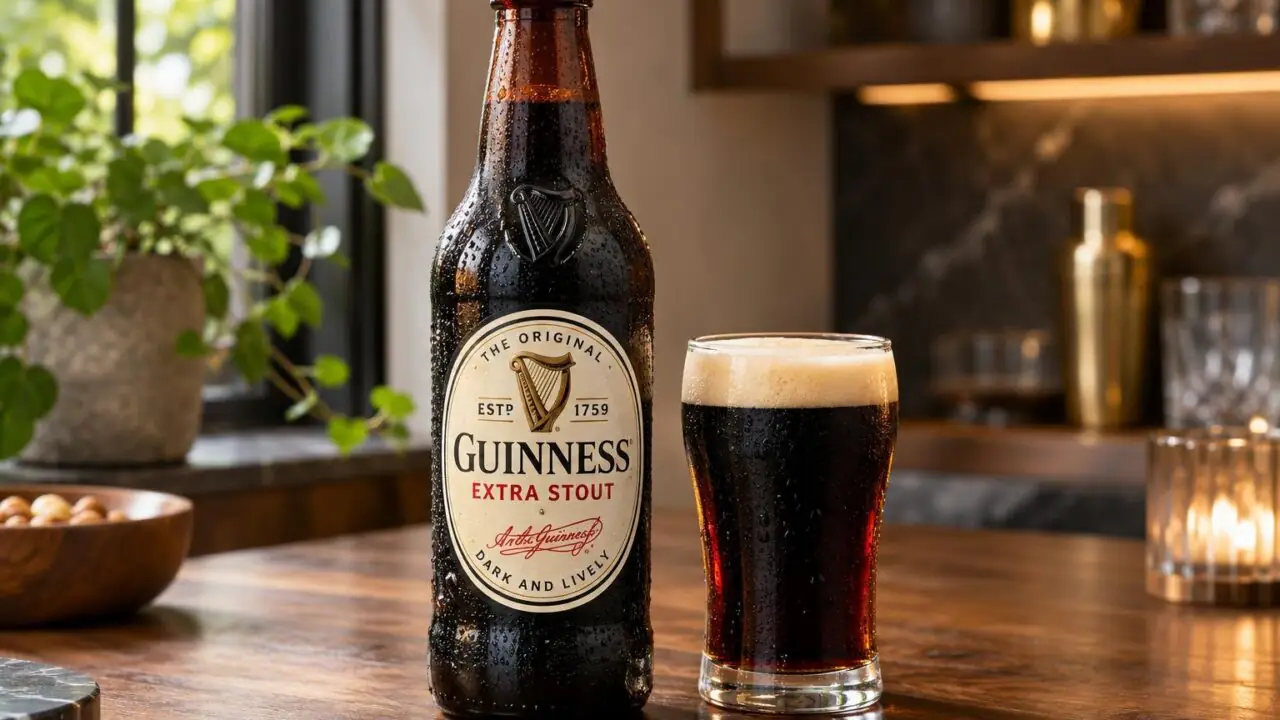
Calories Guinness Extra Stout contains 176 calories per 12-fluid-ounce serving, according to Guinness’s U.S. product nutrition information.
That figure applies to the standard serving size; a larger pour contains proportionally more calories, so a 16-ounce pint has about 235.
Guinness Extra Stout is 5.6% alcohol by volume in the United States, and its calories come from both alcohol and carbohydrates. The number is not the same for every Guinness beer: Draught and other varieties have different nutrition profiles.
For a useful estimate, check the serving size and beer name on the label or Guinness product page. Bar pours may also exceed 12 ounces, making their calorie total higher than the listed serving. ગણ.
Calories in a 12-Ounce Guinness Extra Stout
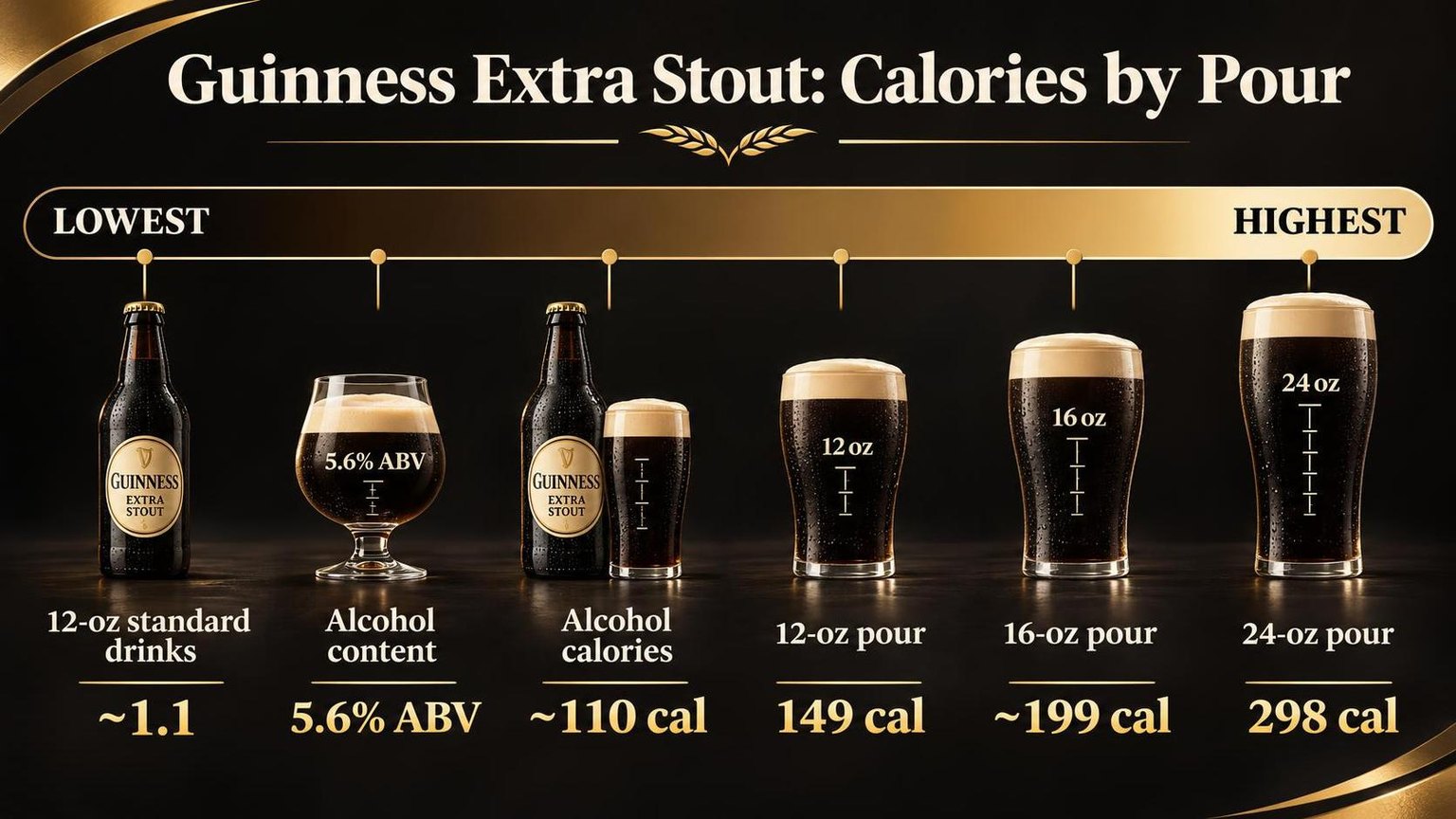
A 12-ounce serving of Guinness Extra Stout contains 149 calories, according to Guinness’s U.S. product information. That figure applies to Extra Stout—not Guinness Draught or Foreign Extra Stout, which are different beers.
Check the label if your bottle was purchased outside the United States.
Guinness Extra Stout is 5.6% alcohol by volume (ABV) in the U.S. Alcohol accounts for a substantial share of its calories; the rest comes primarily from carbohydrates remaining after fermentation.
The beer’s dark color does not, by itself, indicate how many calories it contains.
Calories by serving size
The published calorie figure is for a 12-fluid-ounce serving. For a larger pour of the same beer, calories increase in proportion to the amount poured.
The estimates below assume the beer has the same composition throughout and are rounded to whole calories.
| Amount of Guinness Extra Stout | Calories | Basis |
| 12 fl oz | 149 | Guinness’s published serving figure |
| 16 fl oz | About 199 | Calculated from the published figure |
| 24 fl oz | 298 | Calculated from the published figure |
If you pour a bottle into a glass, measure the beer rather than judging by the glass’s capacity. Foam, an incomplete pour, or a glass that holds more than its nominal size can make a visual estimate unreliable.
The calories consumed depend on the liquid you actually drink.
Where the calories come from
At 5.6% ABV, 12 fluid ounces of Extra Stout contain approximately 0.67 fluid ounces of pure alcohol. That works out to about 15.7 grams of ethanol.
Using the standard estimate of 7 calories per gram of alcohol, ethanol contributes roughly 110 calories.
The alcohol calculation is an estimate, not a separate nutrition claim from Guinness. Carbohydrates and small amounts of other nutrients supply the remaining energy.
Do not estimate a beer’s total calories from its ABV alone: fermentation, recipe, and residual carbohydrate content also matter.
Alcohol content also matters when tracking intake. The National Institute on Alcohol Abuse and Alcoholism defines a U.S. standard drink as containing 0.6 fluid ounces of pure alcohol.
On that basis, a 12-ounce Extra Stout contains approximately 1.1 standard drinks, even though it is one bottle.
For the most reliable count, use the serving size on the container and the nutrition information for the specific Guinness product you bought.
Guinness Draught, Extra Stout, and Foreign Extra Stout should not be treated as interchangeable entries in a calorie-tracking app. A generic “stout” entry may also reflect a different recipe.
Sources: Guinness, U.S. Guinness Extra Stout product information; National Institute on Alcohol Abuse and Alcoholism, “What Is a Standard Drink?”.
How Alcohol Content Affects Calories
Guinness Extra Stout’s alcohol content is a major reason it has more calories than Guinness Draught.
Alcohol supplies about seven calories per gram, compared with about four calories per gram from carbohydrate, so a change in alcohol by volume (ABV) matters even when the serving size stays the same.
In the U.S., Guinness Extra Stout is 5.6% ABV, while Guinness Draught is 4.2% ABV, according to Guinness’s product information.
For a 12-fluid-ounce serving, those percentages translate to approximately 15.7 grams and 11.8 grams of alcohol, respectively. The alcohol alone therefore contributes about 110 calories in Extra Stout versus 82 in Draught.
| 12-fl-oz beer | ABV | Approximate alcohol | Approximate calories from alcohol |
| Guinness Draught | 4.2% | 11.8 g | 82 |
| Beer at the U.S. standard-drink reference strength | 5.0% | 14.0 g | 98 |
| Guinness Extra Stout | 5.6% | 15.7 g | 110 |
These are calculated alcohol calories, not total beer calories. The calculation uses the National Institute on Alcohol Abuse and Alcoholism’s standard-drink reference: 12 fluid ounces of 5% beer contains about 14 grams of pure alcohol.
Multiplying the alcohol grams by seven gives an estimate; rounding and laboratory measurements can produce small differences.
Commonly reported U.S. figures put a 12-ounce Guinness Extra Stout at about 149 total calories and a same-size Guinness Draught at about 125. On those figures, Extra Stout has roughly 24 more calories per serving.
Its calculated alcohol contribution is about 28 calories higher, showing why ABV explains much of the difference.
It does not explain every calorie. Beer also contains residual carbohydrates and small amounts of protein left after brewing.
Their amounts depend on ingredients and fermentation, so two beers with the same ABV need not have the same total calories.
Dark color alone is not a reliable calorie measure: roasted grain can make a beer look rich without establishing its alcohol or carbohydrate content.
Serving size changes the calculation just as directly.
At 5.6% ABV, a 16-fluid-ounce pour of Extra Stout contains about one-third more alcohol than a 12-ounce bottle and would supply about 147 calories from alcohol alone, before counting carbohydrates or protein.
Check both the container volume and ABV before comparing servings.
Finally, use the label for the specific Guinness beer sold in your market. “Extra Stout,” “Draught,” and “Foreign Extra Stout” are distinct products, and ABV can vary by country.
Substituting another Guinness product’s calorie figure—or comparing a pint with a 12-ounce bottle—can make an otherwise sound comparison misleading.
Carbohydrates and Calories per Serving
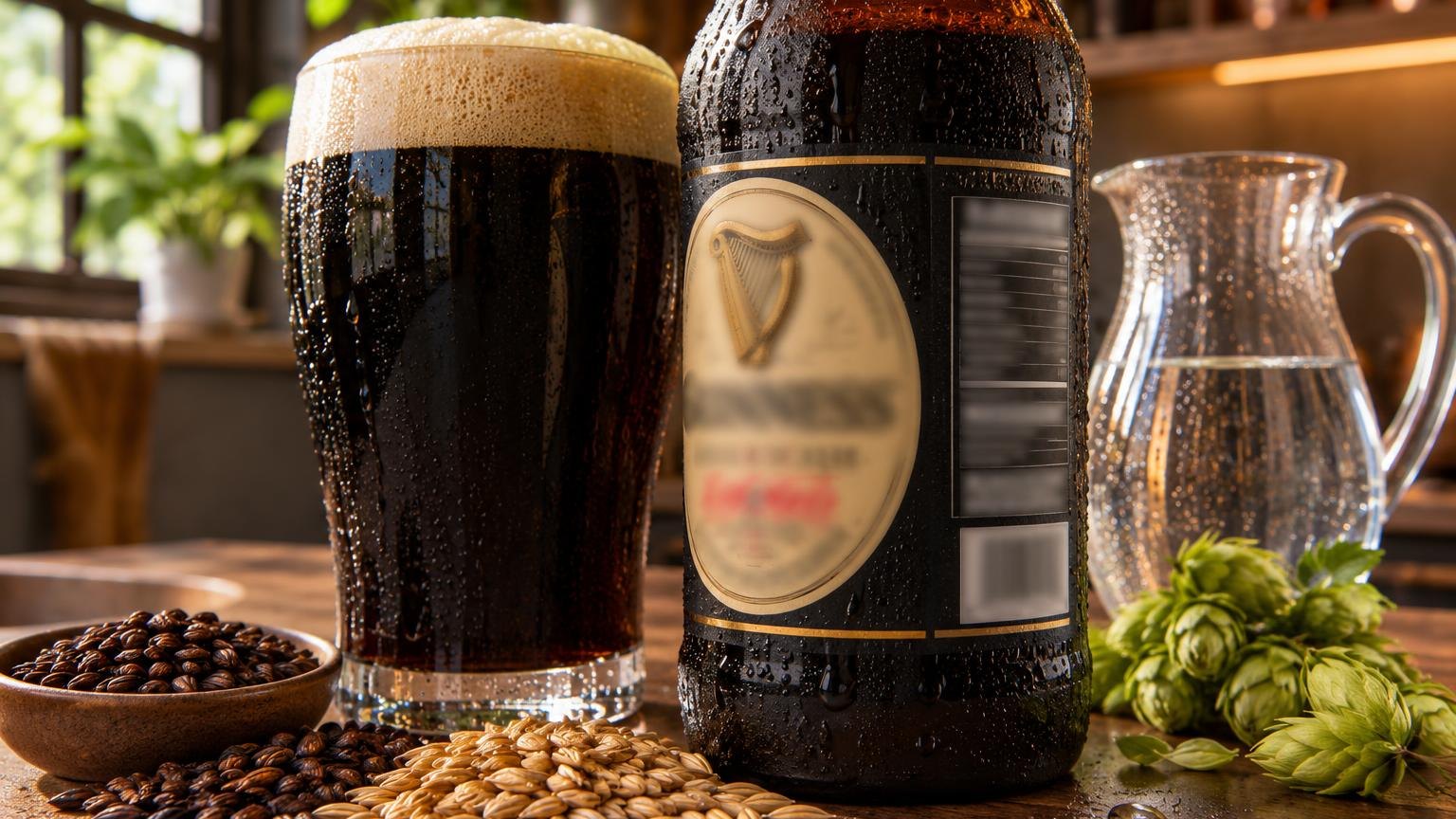
A 12-fluid-ounce serving of Guinness Extra Stout contains approximately 176 calories and 14 grams of carbohydrate.
Serving size matters: a 16-ounce pour contains one-third more beer than a 12-ounce bottle, so its calories and carbohydrates rise by the same proportion.
The figures below use a 12-ounce serving as the baseline. Values for larger pours are calculated from that baseline, not taken from a separate nutrition label.
| Beer and serving | Calories | Carbohydrates |
| Guinness Extra Stout, 12 fl oz | Approximately 176 | Approximately 14 g |
| Guinness Extra Stout, 16 fl oz | Approximately 235 | Approximately 18.7 g |
| Guinness Extra Stout, two 12-fl-oz bottles | Approximately 352 | Approximately 28 g |
Carbohydrate comes primarily from grain-derived sugars and starches that remain after fermentation. Beer can contain carbohydrates even when it tastes dry rather than sweet.
Alcohol also contributes calories, but it is not included in the carbohydrate total; that distinction matters when reading beer nutrition figures.
Guinness lists its U.S. Extra Stout at 5.6% alcohol by volume (ABV). At that strength, a 12-ounce serving contains about 0.67 fluid ounce of pure alcohol.
Using the standard nutrition estimate of 7 calories per gram of alcohol, alcohol accounts for a substantial share of the beer’s energy.
The approximately 14 grams of carbohydrate account for a further roughly 56 calories when estimated at 4 calories per gram.
These conversions explain where calories come from; they should not be treated as a way to reproduce a beer’s labeled calorie figure exactly. Published nutrition values and calculated estimates can differ.
Check the package and the pour
For an accurate personal tally, check the volume printed on the bottle and count how many you drink. Two 12-ounce bottles are 24 ounces, not a single serving.
Likewise, a full 16-ounce glass contains about 33% more Extra Stout than the 12-ounce baseline used above.
Do not apply these numbers automatically to Guinness Draught, Foreign Extra Stout, or a different market’s Extra Stout.
They are distinct beers, and alcohol strength and nutrition information can vary by product and country. “Guinness” on its own is not specific enough for a reliable calorie entry.
The most useful sources are Guinness’s product information for the beer sold in your market and the nutrition details on the package, where provided.
If an app gives a different result, first compare its beer name and serving volume with the bottle in your hand.
Calories by Bottle and Can Size
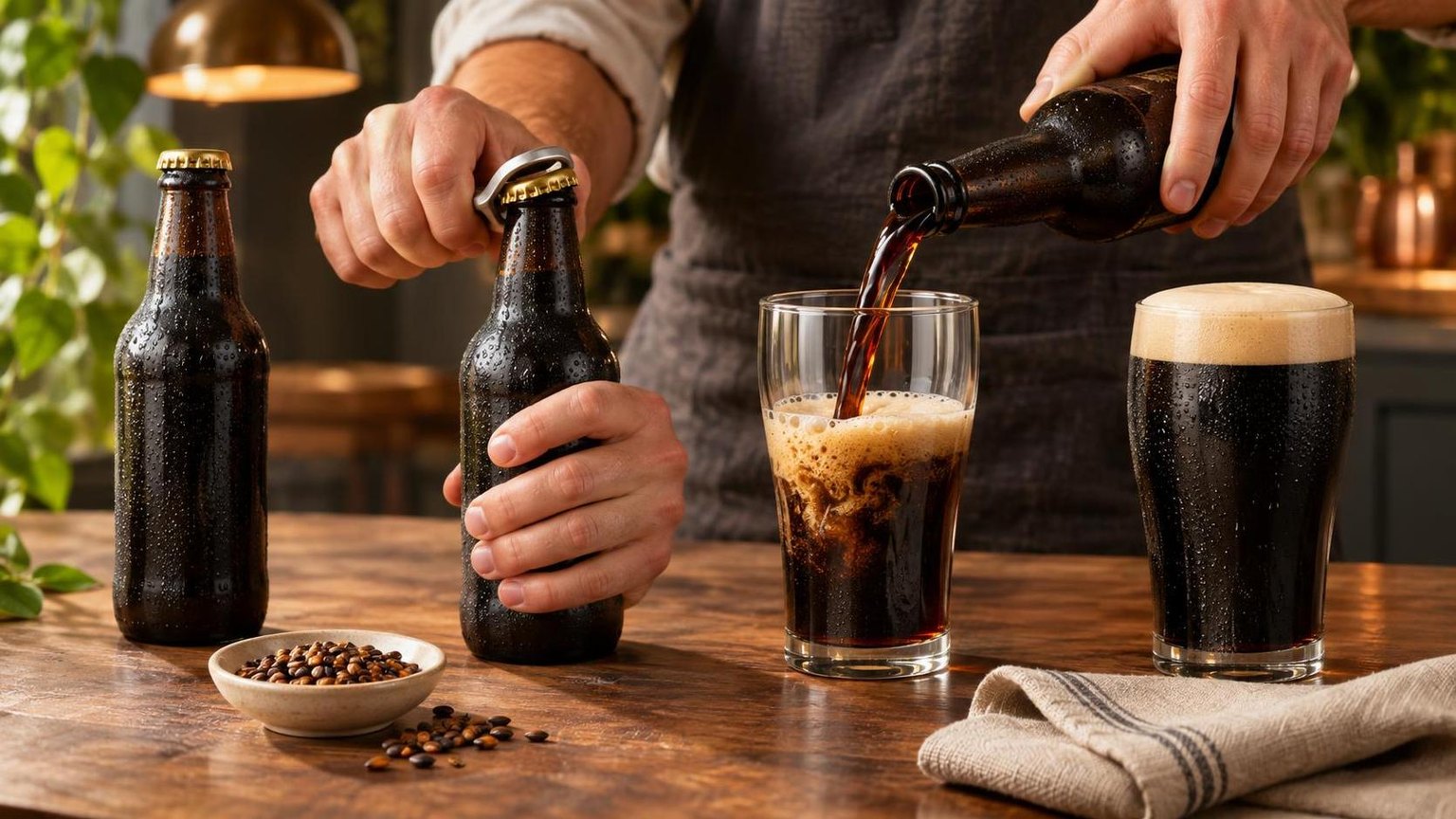
A 12-fl-oz serving of U.S. Guinness Extra Stout is commonly listed at about 149 calories. Bottle or can size changes the total calories you drink, but the container alone does not change the beer’s calories per ounce.
Check the label before using these figures for a differently named Guinness beer.
The table scales the 149-calorie, 12-fl-oz reference by volume. It includes common package and serving sizes for comparison; a listed size does not mean Guinness Extra Stout is sold in that package in every U.S. market.
| Beer consumed | Calculation | Approximate calories |
| 8 fl oz, partial bottle or can | 149 × 8 ÷ 12 | 99 |
| 11.2 fl oz bottle or can | 149 × 11.2 ÷ 12 | 139 |
| 12 fl oz bottle or can | Reference serving | 149 |
| 16 fl oz can or pour | 149 × 16 ÷ 12 | 199 |
| 22 fl oz bottle, if labeled Extra Stout | 149 × 22 ÷ 12 | 273 |
These are estimates rounded to the nearest calorie, not separate nutrition-label claims for each container. For example, drinking half of a 12-fl-oz bottle is about 75 calories; finishing it is about 149.
A 16-fl-oz pour contains one-third more beer than a 12-fl-oz serving, so its estimated calories are one-third higher.
Check the beer name before comparing packages
“Guinness” is not one calorie specification. Guinness Draught, Guinness Extra Stout, and Guinness Foreign Extra Stout are distinct beers.
A can with a widget is often Guinness Draught, not Extra Stout; applying Extra Stout’s 149-calorie reference to it would be a product mix-up.
Read the full product name and net contents on the bottle or can. Imported packaging may state volume in milliliters rather than U.S. fluid ounces.
A 330-mL package is approximately 11.2 fl oz, so the table’s 11.2-fl-oz estimate is more appropriate than automatically counting it as a 12-fl-oz bottle.
Why serving volume matters
Alcohol accounts for a substantial share of beer’s energy. Guinness lists U.S. Extra Stout at 5.6% alcohol by volume (ABV). At that strength, 12 fl oz contains roughly 16 grams of alcohol.
Using the USDA’s energy value of approximately 7 calories per gram of alcohol gives about 110 calories from alcohol alone.
The remaining calories come primarily from the beer’s other components, including residual carbohydrates.
ABV therefore cannot establish an exact calorie count by itself: beers with the same alcohol strength can differ in residual sugar and other constituents.
For tracking intake, use the specific product’s published nutrition information when available, then multiply by the amount actually poured or consumed.
Guinness Extra Stout Compared with Other Beers
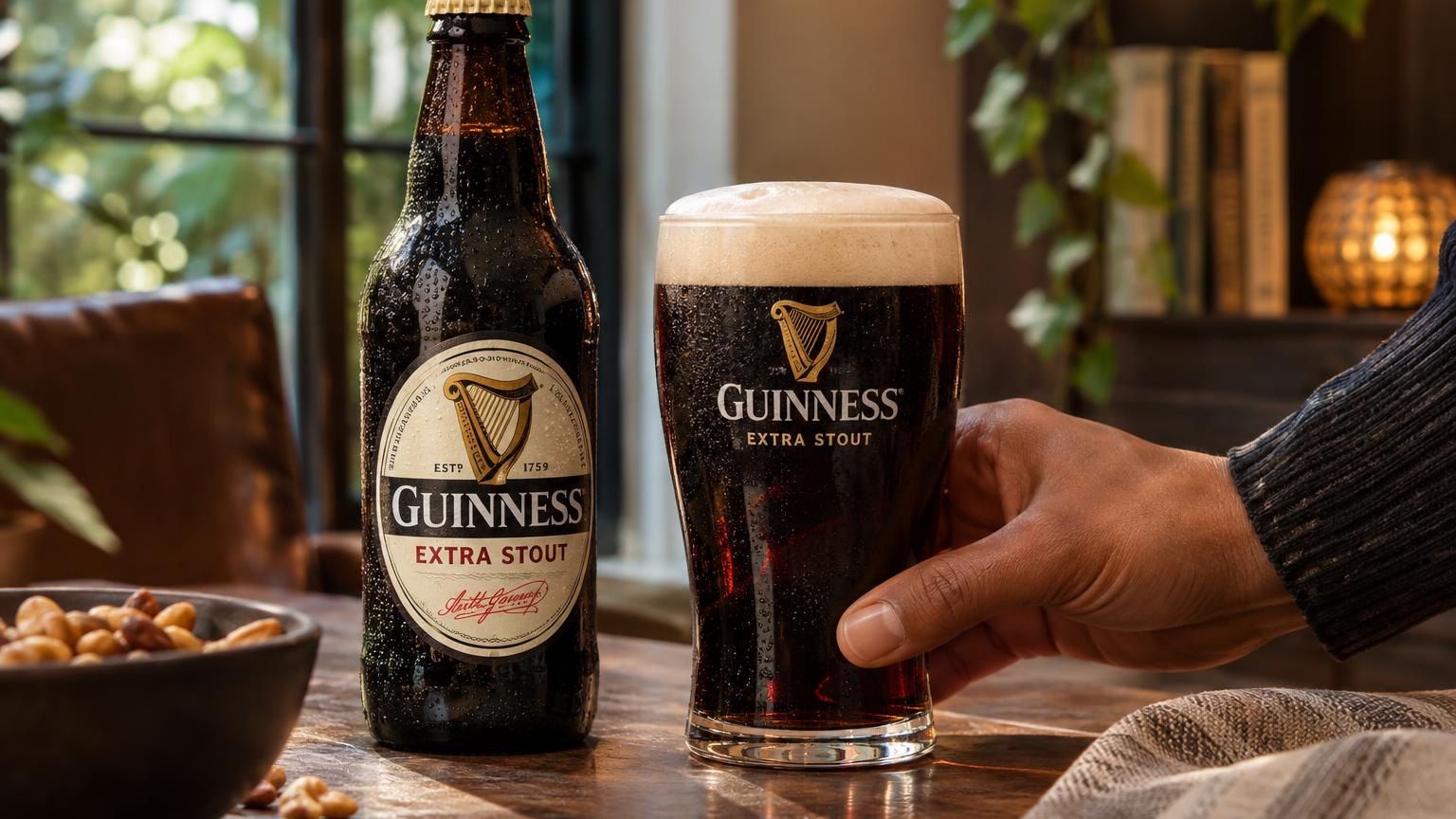
A 12-ounce bottle of Guinness Extra Stout contains 176 calories, more than a 12-ounce Guinness Draught at 125 calories. The difference matters when comparing stouts: their dark color does not tell you how many calories they contain.
Serving size and alcohol content are more useful starting points.
The table uses published U.S. product figures for standard 12-fluid-ounce servings. Guinness lists Extra Stout at 5.6% alcohol by volume (ABV), versus 4.2% for Draught.
Calories and ABV for the other beers come from their respective brands’ U.S. product information.
| Beer | Calories per 12 fl oz | ABV |
| Michelob Ultra | 95 | 4.2% |
| Bud Light | 110 | 4.2% |
| Guinness Draught | 125 | 4.2% |
| Budweiser | 145 | 5.0% |
| Sierra Nevada Pale Ale | 175 | 5.6% |
| Guinness Extra Stout | 176 | 5.6% |
Extra Stout has 51 more calories per 12 ounces than Guinness Draught. That does not mean all stouts exceed all lagers: the comparison depends on the particular beer.
Extra Stout is also close to Sierra Nevada Pale Ale, which has a similar ABV and 175 calories in the same serving size.
Alcohol helps explain the pattern. Ethanol supplies about seven calories per gram, according to USDA food-energy calculations. At 5.6% ABV, Extra Stout contains more alcohol per ounce than a 4.2% beer.
Carbohydrates and other residual ingredients also contribute calories, so ABV alone cannot predict an exact total.
Against common U.S. lagers, Extra Stout adds 31 calories relative to Budweiser and 66 relative to Bud Light per 12 ounces. Michelob Ultra is lower still, at 95 calories.
Those differences reflect specific products, not a rule that lager is inherently lower in calories than stout.
Check the container before applying the table. A 12-ounce bottle of Extra Stout matches its listed serving, but a pint is 16 fluid ounces.
At the same calorie density, 16 ounces would provide about 235 calories; that figure is a serving-size calculation, not a separate Guinness nutrition listing.
The same caution applies when comparing bar pours. Guinness Draught may be served in a larger glass than bottled Extra Stout, making a pint-to-bottle comparison misleading. Compare equal volumes first, then account for what you actually drank.
A larger serving can outweigh a lower per-ounce calorie count.
Finally, read the full beer name. Guinness Draught, Extra Stout, and Foreign Extra Stout are distinct products; their nutrition figures are not interchangeable.
For a reliable comparison, match the U.S. product, package size, and stated serving volume to the label or manufacturer information.
Questions Readers Ask
How many calories are in a 12-ounce Guinness Extra Stout?
A 12-fl-oz serving of Guinness Extra Stout contains about 149 calories, according to Guinness’s U.S. nutrition information. Check the bottle size before logging a serving; calorie totals change with the amount poured.
How many calories are in a 16-ounce pour of Guinness Extra Stout?
A 16-fl-oz pour contains approximately 199 calories, calculated from 149 calories per 12 fl oz. That estimate assumes the same beer and a full 16-ounce pour.
Does Guinness Extra Stout have more calories than Guinness Draught?
Yes. Guinness lists approximately 149 calories per 12 fl oz for Extra Stout, compared with 125 calories for Guinness Draught—a difference of about 24 calories at the same serving size.
Where do the calories in Guinness Extra Stout come from?
They come from alcohol and carbohydrates, not just sugar.
At 5.6% alcohol by volume, the alcohol alone accounts for roughly 110 calories in 12 fl oz, calculated using about 7 calories per gram of alcohol; the remaining calories come primarily from carbohydrates.
How many calories are in two bottles of Guinness Extra Stout?
Two 12-fl-oz bottles total about 298 calories, based on 149 calories per bottle. If your bottles are a different size, use the volume on the label rather than assuming that total applies.
Is Guinness Extra Stout the same as Guinness Foreign Extra Stout for calorie tracking?
No. They are distinct Guinness beers, so a calorie figure for Extra Stout should not automatically be used for Foreign Extra Stout.
Confirm the full product name and serving size on the packaging or in Guinness’s nutrition information before recording either one.
Keep Exploring
- How To Shotgun A Beer? The Ultimate No-Nonsense Guide From Real Experience
- Modelo Especial Alcohol Content – Find Out Now
- Does Beer Have Caffeine? Basic Information You Must Know
- How Many Gallons In A Half Keg?
- Guinness Draught Vs Stout: What Are The Differences?
- All Alcohol Guides
- Guinness, Guinness Extra Stout (n.d.)
- Guinness, Guinness Draught (n.d.)
- USDA, FoodData Central (n.d.)
- National Institute on Alcohol Abuse and Alcoholism, What Is a Standard Drink? (n.d.)
- National Institute on Alcohol Abuse and Alcoholism, Alcohol’s Effects on the Body (n.d.)
- CDC, About Alcohol Use (n.d.)
- MedlinePlus, Alcohol (n.d.)
- Dietary Guidelines for Americans 2020-2025 (USDA/HHS)
- NIAAA – Alcohol Facts and Statistics
- Harvard T.H. Chan School of Public Health – The Nutrition Source: Alcohol