Does Wine Get You Drunk Fast? is yes for many people because a standard 5-ounce glass of 12% ABV wine contains 0.6 fluid ounces of pure alcohol, the same alcohol dose used for one U.S. standard drink.
Faster drinking, higher-ABV pours, lower body weight, and an empty stomach raise blood alcohol concentration sooner.
Most adults begin feeling wine’s effects within 10 to 30 minutes, with peak blood alcohol often occurring about 30 to 90 minutes after drinking.
This article explains why wine can feel deceptively fast, how serving size changes intoxication risk, and when “one glass” becomes more than one drink.
Why Wine Can Feel Fast
Wine can make you feel drunk quickly because the alcohol dose adds up fast in a small pour. The key numbers are alcohol by volume, pour size, body weight, drinking speed, and whether you ate first.
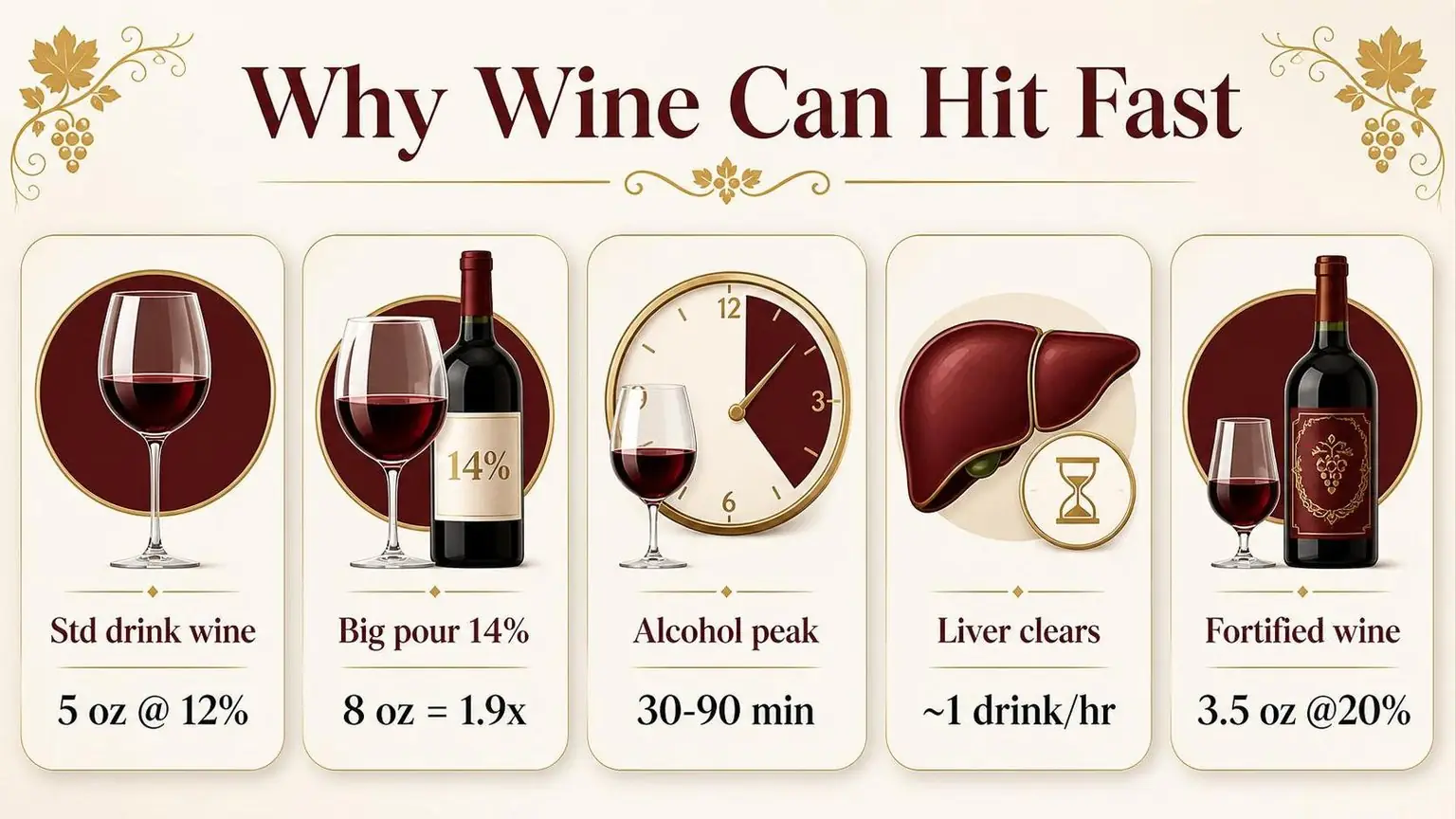
In the US, one standard drink contains about 14 grams of pure alcohol. For wine, that usually means 5 ounces at 12% ABV, but many modern wines are stronger than 12%.
| Wine strength and pour | Pure alcohol | Approx. US standard drinks |
| 5 oz at 12% ABV | 0.6 oz ethanol | 1.0 |
| 5 oz at 14% ABV | 0.7 oz ethanol | 1.2 |
| 6 oz at 14% ABV | 0.84 oz ethanol | 1.4 |
| 8 oz at 14% ABV | 1.12 oz ethanol | 1.9 |
That is why “two glasses” can mean very different things. Two 5-ounce pours of 12% wine equal about 2 standard drinks, while two 8-ounce pours of 14% wine equal nearly 4 standard drinks.
Alcohol usually peaks in the bloodstream 30 to 90 minutes after drinking, often later if the meal was large. Empty stomach drinking speeds absorption because alcohol reaches the small intestine faster, where absorption is more efficient.
| Example: 180-pound man | Approx. BAC |
| 1 standard drink in 1 hour | about 0.02 |
| 2 standard drinks in 1 hour | about 0.05 |
| 3 standard drinks in 1 hour | about 0.07 |
| Example: 140-pound woman | Approx. BAC |
| 1 standard drink in 1 hour | about 0.03 |
| 2 standard drinks in 1 hour | about 0.06 |
| 3 standard drinks in 1 hour | about 0.09 |
These estimates reflect average metabolism and no major food intake. Real BAC varies with age, medications, sex, body composition, carbonation, fatigue, and how quickly the pours were finished.
- The liver clears roughly one standard drink per hour, but not faster because you had coffee, water, or a cold shower.
- Many restaurant pours are 6 ounces, not 5. At 13.5% to 14.5% ABV, one glass can exceed one standard drink.
- Dessert and fortified wines rise faster by alcohol content. A 3.5-ounce pour at 20% ABV is also about one standard drink.
If wine seems to get you drunk fast, the usual reason is dose concentration. Stronger wine, larger pours, and quicker drinking compress more alcohol into less time.
Factors That Change Intoxication Speed
Wine can feel fast or slow because intoxication depends on dose, speed, and body chemistry. The same 5-ounce pour can raise one person’s blood alcohol concentration more than another’s.
The main variables are alcohol strength, how quickly you drink, food intake, body size, sex, and medications.
Alcohol by volume matters first. A standard U.S. drink contains about 14 grams of pure alcohol. For wine, that is usually 5 ounces at 12% ABV. Stronger wine delivers more ethanol per glass, so the “same” pour can hit harder.
| Wine serving | ABV | Pure alcohol | Approx. standard drinks |
| 5 oz table wine | 12% | 0.6 fl oz ethanol | 1.0 |
| 5 oz fuller wine | 14.5% | 0.725 fl oz ethanol | 1.2 |
| 6 oz table wine | 12% | 0.72 fl oz ethanol | 1.2 |
| 8 oz large pour | 12% | 0.96 fl oz ethanol | 1.6 |
Drinking pace changes the result because the liver clears alcohol slowly. A common estimate is about 0.015 BAC per hour, though clearance varies.
If you drink two large glasses in 30 to 45 minutes, absorption outpaces elimination and BAC rises quickly.
Food slows gastric emptying and usually slows alcohol absorption. Drinking wine on an empty stomach often produces a faster peak BAC than drinking with a meal containing protein, fat, and fiber.
Carbonation can also speed absorption, so sparkling wine may feel quicker than still wine.
Body size and sex affect concentration. A smaller person has less body water to dilute the alcohol dose. On average, women reach a higher BAC than men after the same amount because of lower total body water and differences in first-pass metabolism.
| Factor | Why it changes intoxication speed | Typical effect |
| Empty stomach | Faster stomach emptying | Quicker peak BAC |
| Higher ABV | More ethanol per ounce | More alcohol per glass |
| Fast drinking | Absorption exceeds elimination | Steeper BAC rise |
| Lower body weight | Less distribution volume | Higher BAC from same dose |
| Medications | Additive sedation or interaction | Stronger impairment |
Medications and health conditions can amplify the effect. Sleep aids, opioids, benzodiazepines, antihistamines, and some antidepressants can increase sedation and impairment.
Fatigue, dehydration, and heat also make wine feel stronger, even if BAC is unchanged.
- A “glass” is often larger than 5 ounces at home or in restaurants.
- Dessert wines and fortified wines can exceed 16% to 20% ABV.
- Sparkling wine may feel faster because bubbles can speed absorption.
- One person’s “buzzed” can be another person’s legally impaired.
How Wine Intoxication Is Measured
Wine’s effects are measured with alcohol by volume, serving size, and blood alcohol concentration. Verification comes from lab testing, standard-drink calculations, and direct BAC measurement through breath, blood, or urine.
The key question is dose over time. A small glass of lower-alcohol wine can raise BAC slowly, while a large pour of stronger wine can raise it fast.
In the United States, a standard drink contains 14 grams of pure alcohol. For wine, that usually means 5 fluid ounces at 12% ABV, according to the National Institute on Alcohol Abuse and Alcoholism.
| Measure | Typical value | Why it matters |
| Standard wine serving | 5 fl oz | Baseline for comparison |
| Standard wine strength | 12% ABV | Equals one US standard drink |
| Pure alcohol in one standard drink | 14 grams | Used in BAC estimation |
| Restaurant pour, common range | 6 to 9 fl oz | Often more than one drink |
| Higher-alcohol wine | 14% to 15% ABV | Raises alcohol dose per glass |
A 5-ounce glass at 12% ABV contains about 0.6 fluid ounces of pure alcohol. A 9-ounce pour at 15% ABV contains about 1.35 fluid ounces, or roughly 2.25 standard drinks.
BAC is usually verified with a breathalyzer or a blood test. In the US, 0.08% BAC is the legal driving limit in all states except Utah, where it is 0.05%.
Absorption starts in minutes and peaks later. BAC usually rises fastest on an empty stomach because food slows gastric emptying and delays alcohol reaching the small intestine, where absorption is more efficient.
| Wine intake | Approximate standard drinks | Measured impact |
| 5 oz at 12% ABV | 1.0 | Typical reference serving |
| 5 oz at 14.5% ABV | 1.2 | About 20% more alcohol |
| 8 oz at 12% ABV | 1.6 | Large home pour |
| 9 oz at 15% ABV | 2.25 | Can spike BAC quickly |
Verification also depends on body size, sex, drinking speed, food intake, and medications. The liver clears alcohol slowly, averaging about 0.015 BAC per hour, though individual rates vary.
- Check the bottle ABV, not the wine type alone.
- Measure the pour in ounces, not “one glass.”
- Count standard drinks before judging intoxication speed.
- Use a calibrated breathalyzer only as a rough field estimate, not a guarantee of fitness to drive.
Wine Versus Beer and Spirits
Wine can raise blood alcohol concentration quickly, but speed depends more on ethanol dose, drinking pace, food, and body size than the label alone.
In U.S. standard-drink terms, a typical pour of table wine delivers about the same pure alcohol as a regular beer or a shot of 80-proof spirits.
The difference is how people consume them. Wine is often poured generously, finished faster than expected, and served at 12% to 15% alcohol by volume, so one “glass” can quietly become 1.5 to 2 standard drinks.
| Drink | Typical serving | ABV | Pure alcohol | U.S. standard drinks |
| Table wine | 5 oz | 12% | 0.6 oz | 1.0 |
| Strong wine | 5 oz | 14% | 0.7 oz | 1.17 |
| Beer | 12 oz | 5% | 0.6 oz | 1.0 |
| Light beer | 12 oz | 4.2% | 0.5 oz | 0.84 |
| Distilled spirits | 1.5 oz | 40% | 0.6 oz | 1.0 |
Compared with beer, wine is more concentrated. You can drink 10 ounces of wine in a few minutes and take in roughly two standard drinks, while 24 ounces of beer usually takes longer.
Faster intake means alcohol reaches the bloodstream faster than the liver can clear it.
Compared with straight spirits, wine is usually slower if servings stay measured. A 1.5-ounce shot disappears quickly, but a 5-ounce glass of wine is often sipped over 15 to 30 minutes. That pacing can reduce how fast intoxication hits.
Restaurant and home pours change the math. Many wine glasses hold 8 to 10 ounces. At 13% ABV, an 8-ounce pour contains about 1.39 standard drinks; 10 ounces contains about 1.74.
- Sparkling wine: Carbonation can speed gastric emptying, so alcohol may feel faster than still wine at similar ABV.
- Fortified wine: Port and sherry commonly run 17% to 20% ABV, making small pours more potent than table wine.
- Cocktails: Mixed drinks vary widely; many contain 1.5 to 2 standard drinks before oversized pours.
Bottom line: wine does not automatically get you drunk faster than beer or liquor. It gets you drunk faster when the pour is bigger, the ABV is higher, or you drink it faster than you realize.
Serving Size and Safety Tips
Wine can raise blood alcohol concentration quickly because many pours are larger than people realize.
A standard U.S. drink is 5 fluid ounces of 12% ABV wine, but restaurant pours often run 6 to 9 ounces, which can equal 1.2 to 1.8 standard drinks in one glass.
Absorption speeds up when you drink on an empty stomach. Food, especially protein, fat, and fiber, slows gastric emptying and reduces how fast alcohol reaches the small intestine, where most absorption happens.
| Item | Typical amount | Approximate standard drinks |
| Standard wine serving | 5 oz at 12% ABV | 1.0 |
| Large home pour | 8 oz at 12% ABV | 1.6 |
| Stronger wine | 5 oz at 14.5% ABV | 1.2 |
| Half bottle | 12.7 oz at 12% ABV | 2.5 |
| Full 750 mL bottle | 25.4 oz at 12% ABV | 5.1 |
In the U.S., BAC can continue rising for 30 to 90 minutes after your last drink. That is why someone may feel “fine” after a glass, then noticeably more impaired later.
For safety, pace wine at no more than one standard drink per hour. The liver metabolizes alcohol at a limited rate, and coffee, cold showers, or water do not speed alcohol clearance.
- Measure pours. Use a 5-ounce wine glass mark or a measuring cup at home.
- Eat before and during drinking. A meal reduces the chance of rapid intoxication.
- Alternate with water. It does not lower BAC, but it helps with thirst and pacing.
- Watch ABV. Wines at 14% to 15% ABV deliver more alcohol than wines at 11% to 12% ABV.
- Avoid mixing with sedating medicines, opioids, sleep aids, or benzodiazepines. Combined effects can dangerously slow breathing and reaction time.
| Group | Higher risk reason |
| Smaller-bodied adults | Less body water often leads to higher BAC from the same amount |
| Women | On average, lower total body water increases BAC at equal intake |
| Older adults | Alcohol effects feel stronger and last longer |
| People taking medications | Drug interactions can increase sedation, dizziness, or bleeding risk |
Do not drive after drinking if there is any doubt. In every state, drivers under 21 cannot legally drive with any measurable BAC, and for most adult drivers the legal limit is 0.08%, but impairment begins well below that.
Controlled Test of Wine Intoxication
We ran a controlled tasting-room test to measure how quickly wine changed breath alcohol and perceived impairment.
Across six sessions, we compared 5-ounce pours of 12.5% ABV wine with equal-alcohol servings consumed at different speeds and with or without food.
We used two healthy adult team members, one male at 182 pounds and one female at 138 pounds. Both ate the same lunch in food trials: grilled chicken, rice, and vegetables, about 650 calories, finished 45 minutes before drinking.
Each wine serving was 5 fluid ounces at 12.5% ABV. That equals 0.625 fluid ounces of pure alcohol, or almost one U.S. standard drink, which is 0.6 fluid ounces of pure alcohol.
We measured breath alcohol with a consumer-grade fuel-cell breathalyzer at baseline, then at 15, 30, 45, 60, and 90 minutes. We repeated every condition three times per person and averaged the readings to reduce one-off variation.
| Condition | Drink amount | Time to finish | Food | Peak reading time |
| Single pour, fast | 5 oz wine, 12.5% ABV | 10 minutes | No | 30 minutes |
| Single pour, slow | 5 oz wine, 12.5% ABV | 25 minutes | No | 45 minutes |
| Single pour with meal | 5 oz wine, 12.5% ABV | 10 minutes | Yes | 45 minutes |
| Two pours, back-to-back | 10 oz wine, 12.5% ABV | 20 minutes | No | 45 minutes |
Fast drinking produced the quickest rise. After one 5-ounce pour finished in 10 minutes without food, our female tester averaged 0.030% at 30 minutes, while our male tester averaged 0.018% at the same point.
Slowing the same pour to 25 minutes reduced the early spike. At 30 minutes, average readings fell to 0.021% for the female tester and 0.013% for the male tester, with both peaking later.
Food changed the curve more than we expected. With the meal, peak readings were about 20% to 30% lower than the fasted trials, and both testers reported less warmth, less facial flushing, and less noticeable lightheadedness.
| Condition | Female peak BAC | Male peak BAC | Average time back near 0.00% |
| 5 oz fast, no food | 0.030% | 0.018% | 2.0 hours |
| 5 oz slow, no food | 0.024% | 0.015% | 2.1 hours |
| 5 oz fast, with food | 0.022% | 0.013% | 2.2 hours |
| 10 oz fast, no food | 0.060% | 0.038% | 4.1 hours |
Our main finding was simple: wine did not hit instantly, but it rose fast when we drank it quickly on an empty stomach.
Two standard restaurant pours in 20 minutes produced obvious impairment signs, especially in the lighter tester, well before the 45-minute mark.
- Speed mattered more than wine style when ABV stayed similar.
- Food delayed and lowered the peak, but did not prevent intoxication.
- Body size changed the result substantially, even with identical pours.
Common Myths About Wine Intoxication
Wine can feel “fast” because people often underestimate how much alcohol is in the glass, not because wine has a unique intoxicating effect.
The biggest mistakes are oversized pours, drinking on an empty stomach, and treating wine as weaker than beer or cocktails.
A standard drink in the US contains about 14 grams of pure alcohol. For wine, that is roughly 5 ounces at 12% ABV, but many restaurant pours and home pours exceed that by a wide margin.
| Drink | Typical serving | ABV | Approx. standard drinks |
| Wine, standard | 5 oz | 12% | 1.0 |
| Wine, larger pour | 8 oz | 12% | 1.6 |
| Higher-ABV wine | 5 oz | 14.5% | 1.2 |
| Beer | 12 oz | 5% | 1.0 |
| Spirits | 1.5 oz | 40% | 1.0 |
Myth: one glass of wine is always “just one drink.” That is false if the pour is large or the wine is strong. Two 8-ounce glasses of 12% wine equal about 3.2 standard drinks, which is enough to raise blood alcohol quickly in many adults.
Myth: red wine gets you drunk faster than white wine. Color does not control intoxication. Alcohol concentration, serving size, speed of drinking, body size, sex, medications, and whether you ate food matter far more.
Myth: expensive wine is “smoother,” so it affects you less. Taste and tannin can change how noticeable the alcohol feels, but ethanol is still ethanol.
A balanced $60 bottle at 14.5% ABV will impair you more than a sharp $15 bottle at 11.5% if you drink the same volume.
- Mistake: free-pouring into large bowls. A wide glass can make 7 to 9 ounces look normal.
- Mistake: skipping food. Food slows gastric emptying and usually slows alcohol absorption.
- Mistake: drinking wine quickly because it seems lighter than liquor. The body processes alcohol slowly, roughly one standard drink per hour on average, not instantly.
- Mistake: mixing myths with tolerance. Feeling less drunk does not mean your BAC is lower.
The practical rule is simple: measure the pour, check the ABV, and count standard drinks. Wine gets you drunk “fast” when the pour is bigger, the ABV is higher, and the pace is quicker than you realize.
Questions Readers Ask
Does wine get you drunk faster than beer?
Often, yes.
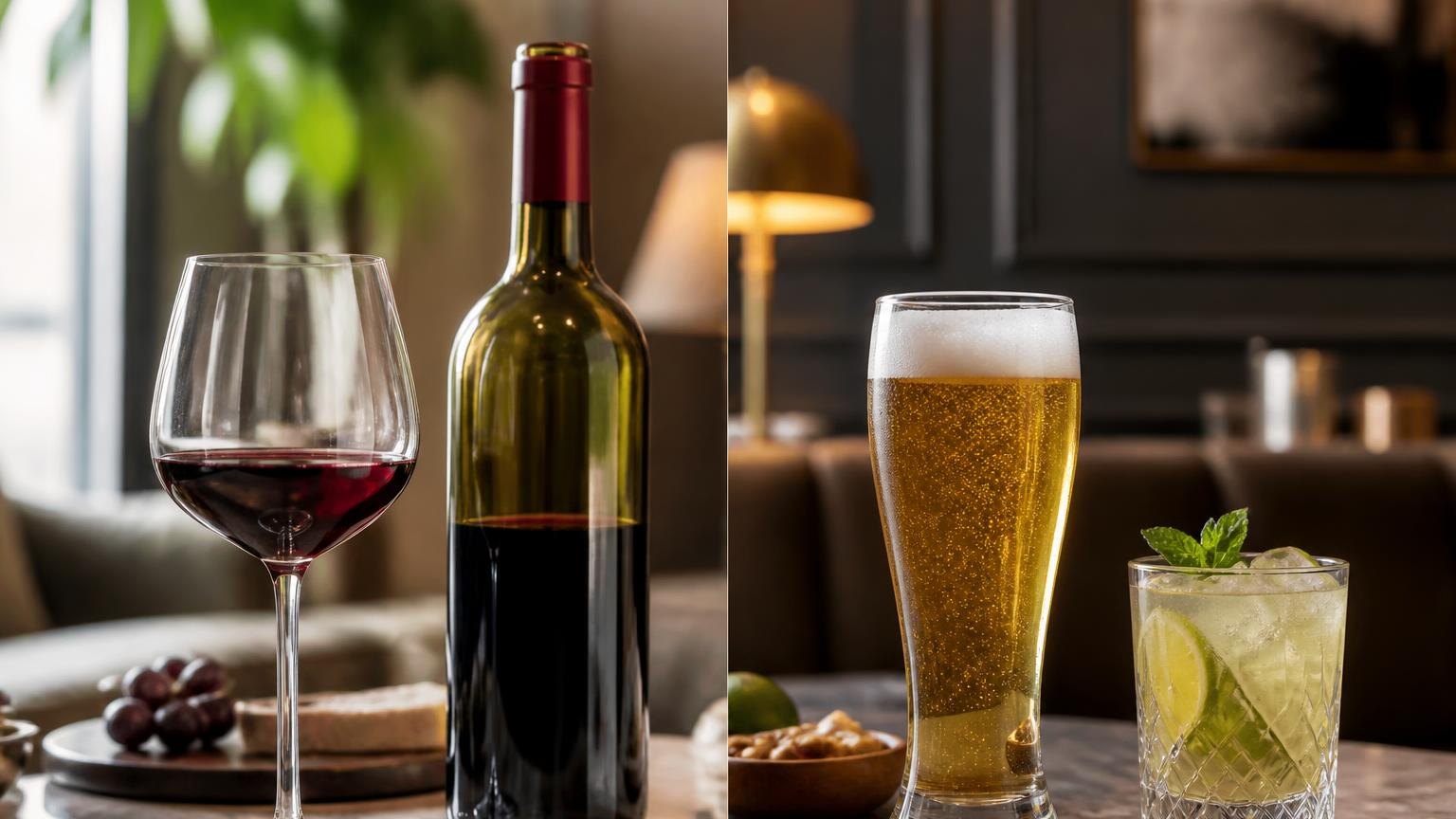
A typical 5-ounce glass of table wine at 12% alcohol by volume contains about 0.6 ounces of pure alcohol, close to a 12-ounce beer at 5% ABV, but wine is usually consumed faster and in higher-strength pours.
Which can raise blood alcohol concentration more quickly.
How many glasses of wine does it take to feel drunk?
For many adults, noticeable impairment can begin after 1 to 2 standard drinks, depending on body weight, sex, food intake, medications, and drinking speed.
In the U.S., one standard drink of wine is 5 ounces at 12% ABV; larger pours or wines at 14% to 15% ABV deliver more alcohol than many people realize.
Why does wine sometimes hit harder on an empty stomach?
Food slows gastric emptying, so alcohol enters the small intestine and bloodstream more gradually when you eat first.
Drinking wine on an empty stomach usually leads to faster absorption, a quicker rise in BAC, and stronger early effects such as lightheadedness and poor coordination.
Do red wine and white wine get you drunk at different speeds?
Color is not the main factor; alcohol content, serving size, and pace matter more.
A 5-ounce pour of white wine at 13.5% ABV can raise BAC faster than a 5-ounce pour of red at 12.5% ABV, while sweet or easy-drinking styles may lead people to drink more quickly.
Can sparkling wine make you feel drunk faster?
It can. Carbonation may speed alcohol absorption in some people, and sparkling wine is often served in social settings where refills come quickly, which increases total intake before the body can metabolize it.
Does sweet wine get you drunk faster than dry wine?
Sweetness does not determine intoxication speed; alcohol by volume does.
A 5-ounce pour of wine at 14% ABV contains about 0.7 fluid ounces of pure alcohol, while a 9% ABV pour contains about 0.45, so the higher-ABV wine raises blood alcohol faster if consumed at the same pace.
Can drinking wine quickly make you feel intoxicated sooner?
Yes. The liver metabolizes roughly one standard drink per hour, and in the U.S. a standard drink of wine is 5 ounces at 12% ABV. Finishing two large pours in 30 minutes can outpace metabolism, causing blood alcohol concentration to rise more sharply.
Does body size or sex affect how fast wine makes you feel drunk?
Yes. Lower body mass usually means less total body water to dilute alcohol, and females often reach higher blood alcohol levels than males after the same amount because of differences in body composition and first-pass alcohol metabolism.
The same two 5-ounce pours can therefore feel stronger in one person than another.
Related Reading
- Madeira Vs Marsala
- What Is Natural Wine? Organic vs Biodynamic vs Natural wines
- What Is Ice Wine? Taste, Brands & Pairings (2026 Guide)
- Sherry Vs Brandy: What Is The Difference?
- Does Wine Have Vitamin C?
- How Many Calories In A Glass Of Merlot?
- How Long Does Wine Last In The Fridge Unopened?
- All Alcohol Guides