Beginner-Friendly Wines Under 20 Dollars
Good wines for beginners make sweetness, acidity, and tannin easy to recognize without an expensive commitment.
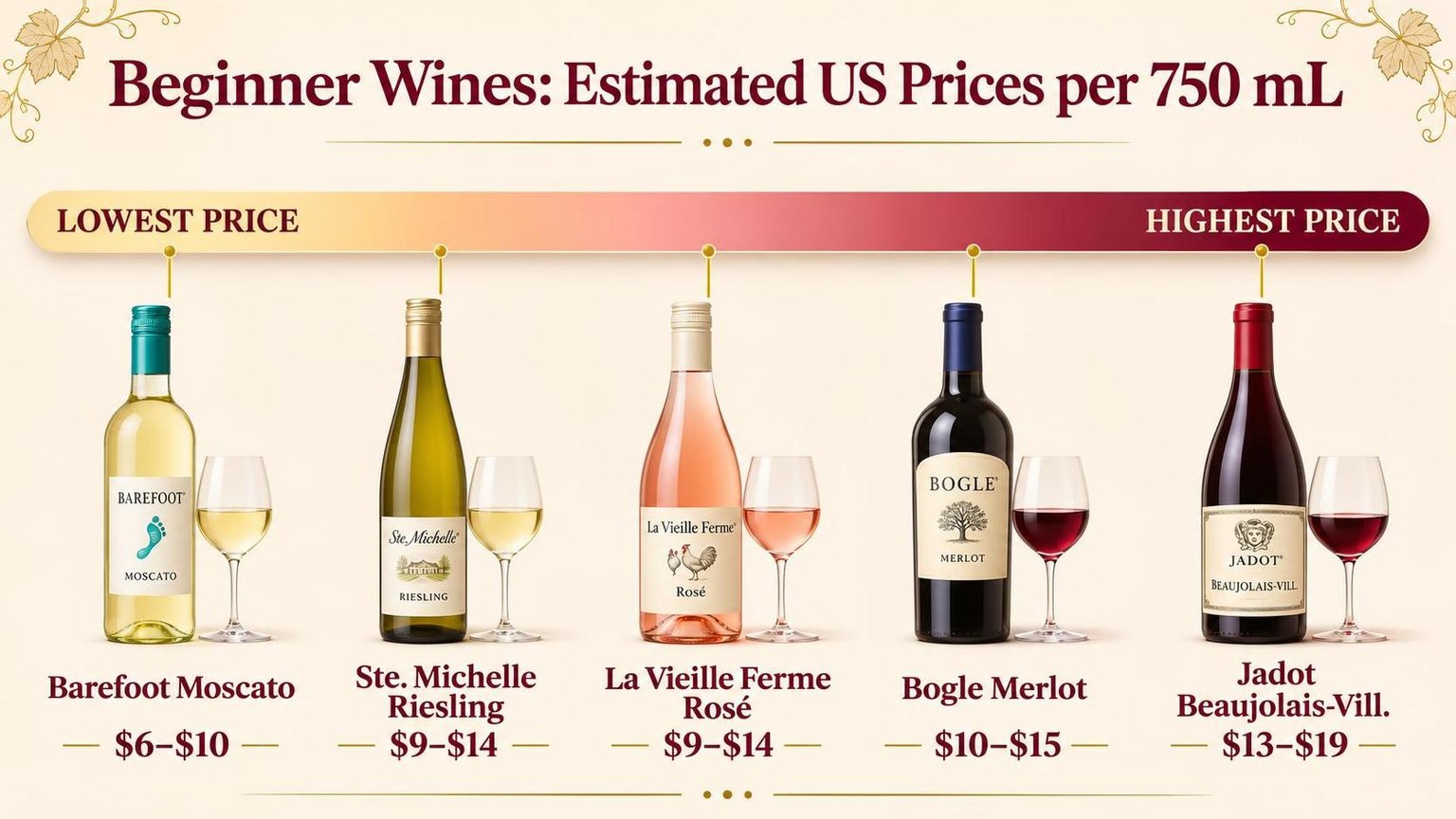
These widely distributed bottles offer contrasting styles; the estimated US retail ranges below apply to standard 750 mL bottles before tax, not verified live offers.
| Wine | Estimated price | Style and flavors |
| Barefoot Moscato, California | $6–$10 | Sweet white; peach, apricot, and citrus |
| Chateau Ste. Michelle Columbia Valley Riesling, Washington | $9–$14 | Off-dry white; apple, peach, and balancing acidity |
| La Vieille Ferme Rosé, France | $9–$14 | Dry rosé; red fruit and citrus |
| Louis Jadot Beaujolais-Villages, France | $13–$19 | Dry, lighter-bodied red; cherry and raspberry |
| Bogle Merlot, California | $10–$15 | Dry, fuller red; plum, dark fruit, and oak spice |
Choose by Sweetness, Not Color
Start with Barefoot Moscato if you prefer distinctly sweet drinks. The producer describes peach and apricot flavors with a sweet finish. Serve it chilled with fruit or mildly spicy food.
Its sweetness makes it approachable, but it does not represent how most dry white wines taste.
Choose Chateau Ste. Michelle Columbia Valley Riesling for a middle ground. The winery describes this bottling as medium-dry; “off-dry” conveys its noticeable but restrained sweetness.
Check the label carefully: the producer also sells a separate Dry Riesling, which offers a different starting point.
Try La Vieille Ferme Rosé when you want fruit without obvious sweetness. Its pink color does not indicate sugar content. The producer identifies Cinsault, Grenache, and Syrah in the blend.
Pair it with roast chicken, a sandwich, or grilled vegetables to explore a versatile dry style.
Make Your First Red a Deliberate Choice
Pick Louis Jadot Beaujolais-Villages if drying tannins put you off. Made from Gamay, it provides a lighter-bodied introduction to red wine than many Cabernet Sauvignons. Cherry-like fruit can smell sweet even when the wine tastes dry.
Serve slightly cool rather than warm.
Pick Bogle Merlot if you enjoy richer flavors. Plum-like fruit and oak influence offer a fuller impression, while tannin supplies the drying sensation on your gums.
Try it with burgers or mushroom dishes. “Smooth” describes texture here, not a guarantee of sweetness.
Buy for Learning, Not Scores
- Choose contrasting styles rather than several similar bottles. A sweet Moscato and dry rosé teach more about your preferences than matching labels.
- Taste before and during a meal. Record sweetness, mouthwatering acidity, drying tannin, and whether you want another sip.
- Check local shelf prices and the exact bottling. Promotions, state taxes, and vintage changes affect value and availability.
Sources: Producer product descriptions from Barefoot Wine, Chateau Ste. Michelle, La Vieille Ferme, Louis Jadot through US importer Kobrand, and Bogle Family Vineyards support the style and grape information.
Flavor descriptions are reference points, not guaranteed sensations; price ranges are shopping estimates.
Sweet Versus Dry Wines Explained for New Drinkers
Sweet wine contains enough residual sugar to taste sweet; dry wine contains little residual sugar.
For beginners, the important distinction is that fruity aromas do not necessarily mean sweetness: a dry wine can smell like ripe peaches, strawberries, or pineapple.
What Makes Wine Sweet or Dry?
During fermentation, yeast converts grape sugar into alcohol and carbon dioxide. Winemakers can retain sweetness by stopping fermentation before all the sugar is consumed.
Some wines are sweetened afterward using permitted grape-derived products, depending on local production rules.
Residual sugar is measured in grams per liter. These European Union labeling thresholds apply to still wines; they are useful reference points, not universal rules for every bottle sold in the United States.
| Still-wine designation | EU residual-sugar threshold | Important qualification |
| Dry | Up to 4 g/L | May reach 9 g/L when residual sugar exceeds total acidity, expressed as tartaric acid, by no more than 2 g/L. |
| Sweet | At least 45 g/L | Acidity can make the sweetness feel less pronounced. |
Source: Commission Delegated Regulation (EU) 2019/33, Annex III, Part B.
Wines between these categories may carry medium-dry or medium-sweet descriptions; “off-dry” commonly signals slight sweetness, but its interpretation varies across markets.
Why Fruity, Acidic, and Tannic Feel Different
Sweetness is a taste; fruitiness largely comes from aroma. Acidity creates tartness and encourages salivation. Tannins create an astringent, drying sensation on your gums.
A red wine can therefore feel drying because of tannin while “dry” technically describes its low sugar content.
Acidity also changes perceived sweetness. A sweet Riesling with lively acidity may taste refreshing rather than syrupy.
Alcohol, serving temperature, and individual sensitivity influence the overall impression, so a sugar figure cannot predict your preference by itself.
Choose a Style, Not a Grape Alone
- For noticeable sweetness: Try Moscato d’Asti. It is typically sweet, lightly sparkling, and aromatic, with peach and floral notes.
- For gentle sweetness: Look for an explicitly off-dry Riesling or Chenin Blanc. Both grapes also produce dry wines, so check the producer’s description.
- For dry, fruit-forward wine: Try a Pinot Grigio or a young, unoaked Chardonnay labeled dry. Ripe-fruit aromas can make these approachable without substantial sugar.
- For a softer dry red: Consider Gamay or Pinot Noir. Their generally lighter tannins can help separate astringency from actual sweetness.
Check Before You Buy
Ask the retailer for the producer’s technical sheet and look for residual sugar rather than relying on “smooth” or “fruity.” Treat sparkling-wine terminology separately.
“extra dry” is sweeter than “brut,” despite the wording.
Source for sparkling terminology: Commission Delegated Regulation (EU) 2019/33, Annex III, Part A. Compare wines at similar serving temperatures, and note whether you enjoy sugar, fruit aroma, or softer tannins.
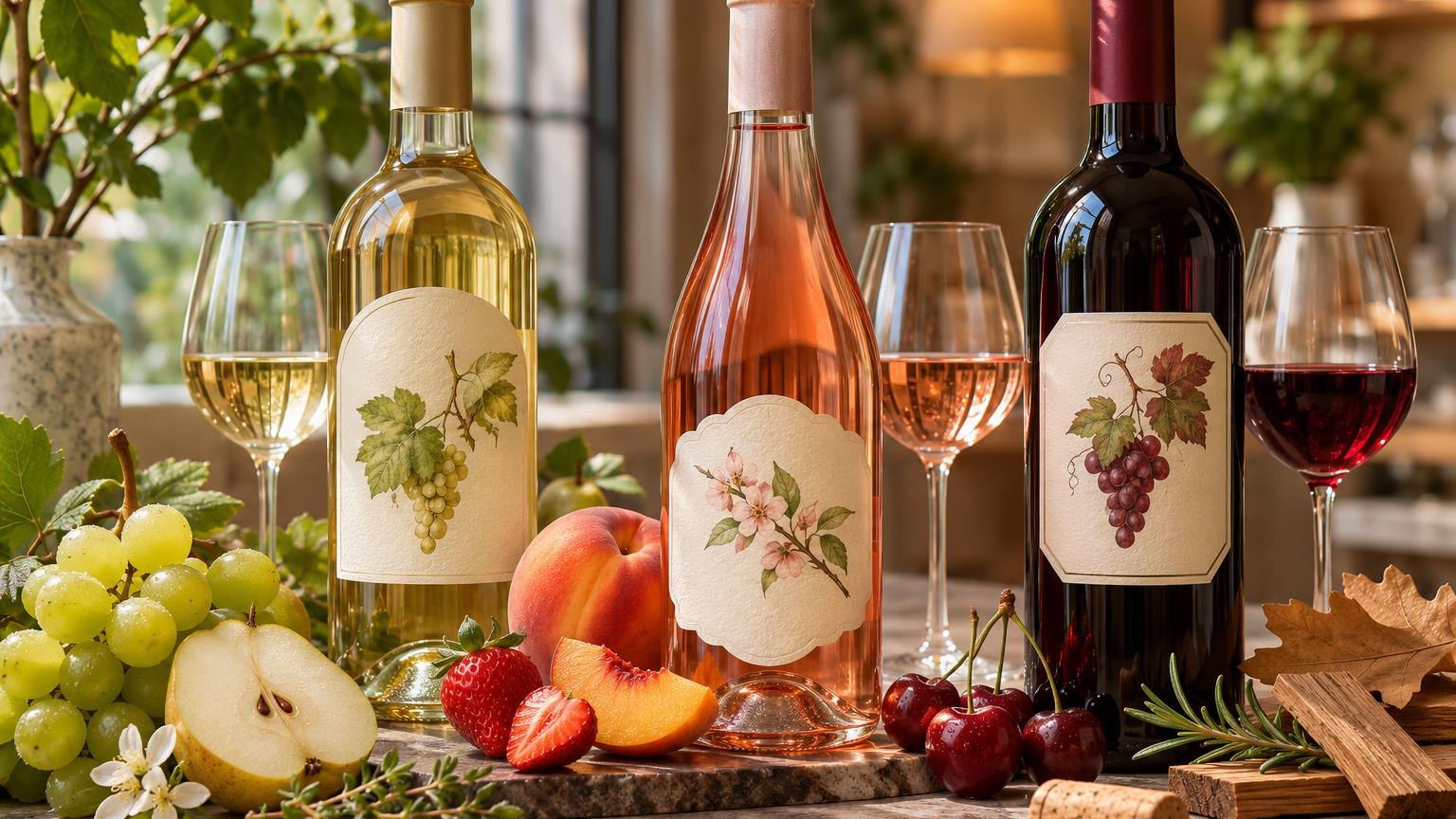
Best Red Grapes to
Pinot Noir, Gamay, Merlot, and Grenache offer approachable starting points for red wine, but they suit different tastes. Choose by texture and acidity rather than color alone: a pale red can taste brisk, while a darker wine can feel soft and rounded.
Pinot Noir: Light Texture, Fresh Fruit
Pinot Noir typically combines relatively low tannin with noticeable acidity and cherry or raspberry aromas. Tannin creates the drying sensation on your gums; acidity makes your mouth water.
This distinction explains why a silky Pinot can still taste tart.
Start with a regional California or New Zealand bottling if you prefer prominent fruit. Burgundy can introduce earthier, more savory expressions, although producer and vintage matter.
Pair Pinot with roast chicken, mushrooms, or salmon; avoid assuming that every expensive bottle will be easier to enjoy.
Gamay: Juicy and Easy to Explore
Gamay, the principal red grape of Beaujolais, commonly delivers red-berry fruit, lively acidity, and modest tannin. Some producers use carbonic or semicarbonic maceration, techniques associated with particularly fruity styles.
Not every Gamay undergoes the same winemaking process.
Look for Beaujolais or Beaujolais-Villages before exploring the region’s 10 crus. Fleurie often offers a fragrant introduction, while Morgon can be more structured. These are useful regional tendencies, not guarantees.
Try Gamay with charcuterie, roast turkey, or a simple mushroom pizza.
Merlot: Rounder, With More Weight
Merlot generally offers more body than Pinot Noir, with plum, cherry, and sometimes chocolate-like notes.
Its tannins can feel rounded, but Merlot is not automatically low-tannin: concentrated examples and oak-aged Bordeaux blends may be firm, powerful wines.
For an accessible introduction, consider a fruit-forward Chilean or California Merlot. Check the label because wines sold by grape name can contain other varieties.
Serve it with burgers, lentil stew, or roast pork rather than judging its structure entirely on an empty palate.
Grenache: Ripe Fruit Without Guaranteed Sweetness
Grenache, called Garnacha in Spain, often shows strawberry, raspberry, and spice, with relatively restrained tannin. Warm growing conditions can produce substantial alcohol, however.
That warmth may feel more challenging than tannin, so compare the labeled alcohol levels when choosing bottles.
Try Spanish Garnacha or a Grenache-led Côtes du Rhône blend with grilled vegetables or herb-roasted chicken. Ripe fruit aromas do not establish sweetness; these wines are usually dry.
| Wine style | Starting serving temperature |
| Light-bodied Pinot Noir or Gamay | 55°F / 13°C |
| Medium- or full-bodied Merlot or Grenache | 59–64°F / 15–18°C |
These temperatures follow WSET’s service guidance by body, not rigid grape rules. Let a chilled glass warm gradually if its aromas seem muted.
Grape and regional descriptions align with The Oxford Companion to Wine, fifth edition (2023); individual bottles vary with climate, ripeness, and winemaking.
The Key Numbers, Explained
For beginners, alcohol by volume, residual sugar, and serving size explain more than a bottle’s price.
These numbers help you choose lighter wines, understand sweetness, and compare pours without assuming that every glass contains the same amount of alcohol.
Alcohol: Read the ABV First
ABV means alcohol by volume. A higher percentage means more alcohol in an equal pour, although sweetness, acidity, and serving temperature also influence how strong a wine tastes.
| Label ABV | Pour size | Approximate US standard drinks |
| 9% | 5 US fluid ounces | 0.75 |
| 12% | 5 US fluid ounces | 1.00 |
| 15% | 5 US fluid ounces | 1.25 |
The National Institute on Alcohol Abuse and Alcoholism defines one US standard drink as 14 grams of pure alcohol, approximately the amount in a 5-ounce glass of 12% wine.
These are rounded alcohol-equivalence calculations, not recommended consumption levels.
For a gentler introduction, check lower-ABV bottles of Riesling or Moscato rather than relying on grape names alone. Riesling can be dry or sweet, and Moscato styles vary substantially.
Lower alcohol does not automatically mean lower sugar or fewer calories.
Source: NIAAA, “What Is a Standard Drink?” https://www.niaaa.nih.gov/alcohols-effects-health/overview-alcohol-consumption/what-standard-drink.
Residual Sugar: Convert Concentration Into Your Glass
Residual sugar, usually reported in grams per liter, describes sugar remaining in the finished wine. Producer technical sheets often provide this figure when the bottle does not.
The calculations below use a 150-milliliter serving, slightly larger than 5 US fluid ounces.
| Residual sugar | Sugar per 150-milliliter glass |
| 4 grams per liter | 0.6 grams |
| 12 grams per liter | 1.8 grams |
| 45 grams per liter | 6.75 grams |
These are concentration examples, not universal sweetness categories. Acidity can make a sugary wine taste refreshing rather than syrupy.
Fruit aromas also suggest sweetness without proving that much sugar remains: a wine smelling of ripe peaches can still be dry.
For EU-regulated still wines, “dry” generally permits up to 4 grams per liter, or up to 9 when residual sugar exceeds total acidity, expressed as tartaric acid, by no more than 2 grams per liter.
Sparkling wines use different labeling categories.
Source: Commission Delegated Regulation (EU) 2019/33, Annex III. https://eur-lex.europa.eu/eli/reg_del/2019/33/oj.
Bottle Size: Plan the Pour
A standard wine bottle holds 750 milliliters, enough for five measured 150-milliliter servings. A large wineglass can hold considerably more than one serving, so its bowl size is not a reliable guide.
- Check ABV before comparing bottles.
- Ask for residual sugar when sweetness matters.
- Measure your first pour to learn what a serving looks like.
Choose by the combination: alcohol for strength, residual sugar for sweetness context, and serving size for the amount actually consumed. No single number guarantees that you will enjoy a wine.
What Affects the Result
A beginner-friendly wine depends on sweetness, acidity, tannin, alcohol, and serving conditions—not grape variety alone.
The same bottle can taste refreshing with dinner but sharp without food, or balanced when cool but noticeably alcoholic when warm.
Sweetness and Fruit Flavor
Fruit aromas do not prove that a wine contains much sugar. A dry Sauvignon Blanc can smell intensely of passion fruit, while a dry red can suggest ripe cherries without tasting sweet.
- For noticeable sweetness: Look for explicitly sweet or off-dry styles. Moscato d’Asti usually offers sweetness, gentle bubbles, and relatively low alcohol.
- For fruit without much sweetness: Try Pinot Grigio or an unoaked Chardonnay, but check the producer’s description rather than relying on the grape name.
- For Riesling: Verify the sweetness level. Producers make it in styles ranging from dry to intensely sweet; “Riesling” alone does not identify which style you are buying.
Acidity, Tannin, and Alcohol
Acidity creates tartness and encourages salivation. Tannin creates a drying, grippy sensation, particularly along the gums.
Beginners sometimes confuse these sensations, but they call for different adjustments: lower acidity for less tartness, lower tannin for less grip.
Pinot Noir generally has less tannin than Cabernet Sauvignon, although extraction and aging affect individual bottles. Higher alcohol can contribute body and warmth.
Check the label’s alcohol percentage if that warming sensation makes a wine unpleasant.
Sweetness can soften the impression of acidity, which explains why an off-dry Riesling may feel more approachable than a dry, sharply acidic white. Neither sweetness nor smoothness, however, establishes a wine’s quality.
Serving Temperature
Overchilling suppresses aromas and can make red wine feel more astringent. Excessive warmth makes alcohol more noticeable. These WSET service ranges provide practical starting points; Fahrenheit equivalents are rounded.
| Wine style | Serving temperature |
| Light- to medium-bodied white wine | 45–50°F / 7–10°C |
| Light-bodied red wine | 55°F / 13°C |
| Medium- to full-bodied red wine | 59–64°F / 15–18°C |
Let a refrigerator-cold white warm slightly in the glass. Briefly chill a red that tastes hot or heavy. “Room temperature” is unreliable because a warm kitchen can exceed suitable serving temperatures.
Food and Tasting Context
- Sweet food: It can make wine seem drier, more bitter, and more acidic. Avoid judging a dry wine immediately after dessert.
- Salty food: It can reduce perceived bitterness and make a tannic red easier to enjoy.
- Chili heat: Alcohol can intensify the burning sensation. A lower-alcohol, off-dry wine is often a more comfortable starting point.
Source: WSET, Understanding Wines: Explaining Style and Quality, covers service temperatures, structural components, and food interactions. Use these principles to identify what you enjoy, rather than treating beginner recommendations as fixed rules.
Questions Readers Ask
What are good wines for beginners who do not know their preferences?
Start with Pinot Grigio for a light, crisp white, off-dry Riesling for gentle sweetness, or Pinot Noir for a lighter red with less drying tannin than Cabernet Sauvignon.
Try a 2-ounce pour of each and compare sweetness, acidity, and the drying sensation on your gums before buying a bottle.
Which beginner-friendly wines are sweet rather than dry?
Moscato d’Asti is typically sweet, lightly sparkling, and around 5–6% alcohol by volume; off-dry Riesling offers less sweetness and brighter acidity.
Riesling also comes in dry styles, so check the producer’s sweetness description rather than assuming the grape guarantees sweetness.
As WSET explains in its wine education materials, fruity aromas do not necessarily mean a wine contains noticeable residual sugar.
How much should beginners spend on a bottle of wine?
Use $10–$20 per 750-milliliter bottle as a practical starting budget, not a quality guarantee.
Compare two contrasting styles at similar prices rather than buying one expensive bottle: that makes it easier to identify whether you prefer crispness, sweetness, or softer tannins.
What temperature should beginners serve wine at?
WSET’s service guidelines recommend approximately 45–50°F for light-bodied white wines and rosés, and 59–64°F for medium- to full-bodied reds.
Use a thermometer when learning: excessive chilling can mute aromas, while an overly warm red can make alcohol seem more prominent.
What easy food pairings work with beginner-friendly wines?
Try off-dry Riesling with moderately spicy takeout, Pinot Noir with roast chicken or mushrooms, and sparkling wine with salty fried foods.
WSET’s food-pairing guidance notes that chili heat can increase the perception of alcohol and bitterness, making a lower-alcohol, slightly sweet wine a useful starting choice.
Related Guides
- Was Mountain Dew Made For Whiskey?
- How Much Is A Kilogram In Grams?
- What Does Bitters Taste Like? The Complete Flavor Guide for 2026
- How Much Does 4 Quarters Weigh?
- 11 Essential Facts About How Many Tons Is A Semi Truck (2026 Expert Weight & Logistics Guide)
- Scotch Vs Bourbon: What Are The Differences?
- What Does Bruising Mean in Bartending? 17 Things Every Bartender Should Know (2026 Guide)
- All Blog Guides
- National Institute on Alcohol Abuse and Alcoholism — What Is a Standard Drink? (n.d.)
- USDA and HHS — Dietary Guidelines for Americans, 2020–2025 (2020)
- U.S. Surgeon General — Alcohol and Cancer Risk Advisory (2025)
- University of California, Davis — Department of Viticulture and Enology (n.d.)
- Wine & Spirit Education Trust — Level 1 Award in Wines (n.d.)
- Wine Folly — Wine Basics (n.d.)
- Wine Enthusiast — Basics (n.d.)
- Decanter — Learn About Wine (n.d.)