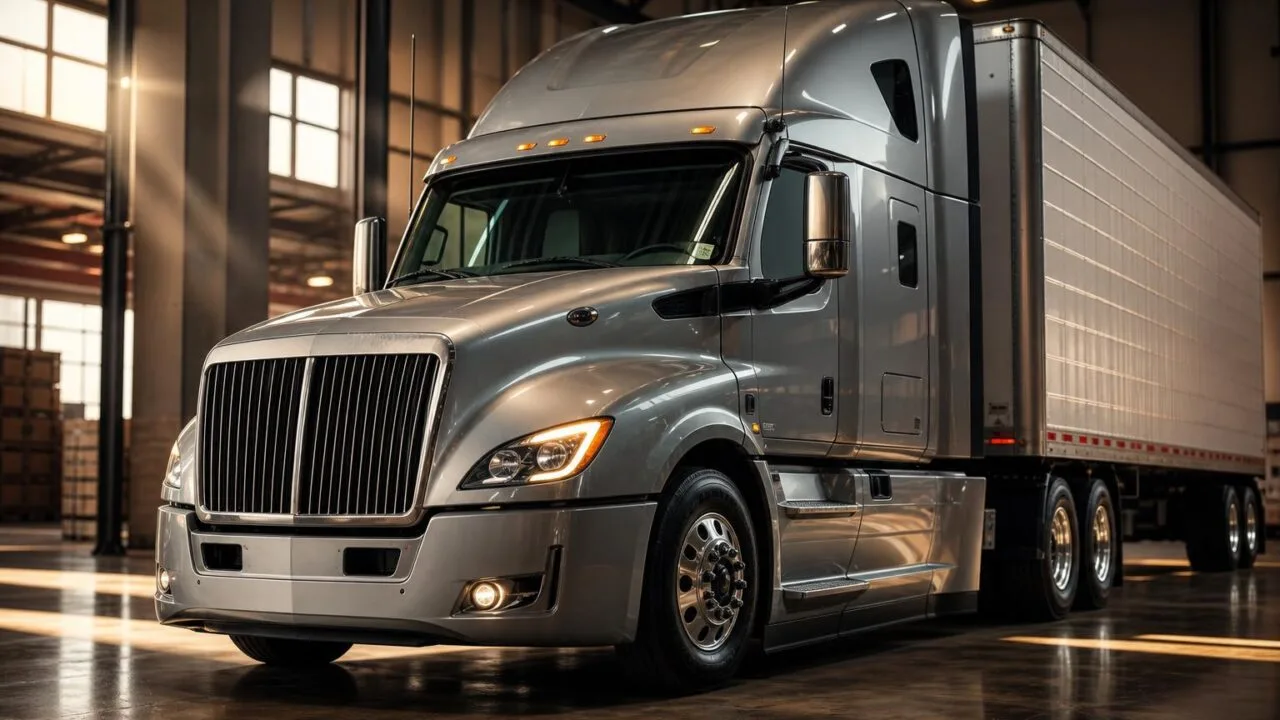
How Many Tons Is A Semi Truck is 17.5 to 40 tons in typical U.S. operation, depending on whether it is empty or loaded. An empty tractor-trailer often weighs about 35,000 pounds; the federal gross vehicle weight limit is 80,000 pounds.
That 80,000-pound cap equals 40 short tons, the U.S. ton used for highway weights. The tractor alone commonly weighs 10,000 to 25,000 pounds, while a 53-foot dry van trailer usually adds roughly 10,000 to 15,000 pounds before freight.
So the practical answer is: around 17.5 tons empty, up to 40 tons legally loaded on most Interstate routes, with heavier specialized permits required for oversize or overweight freight.
Semi Truck Weight Meanings in Tons
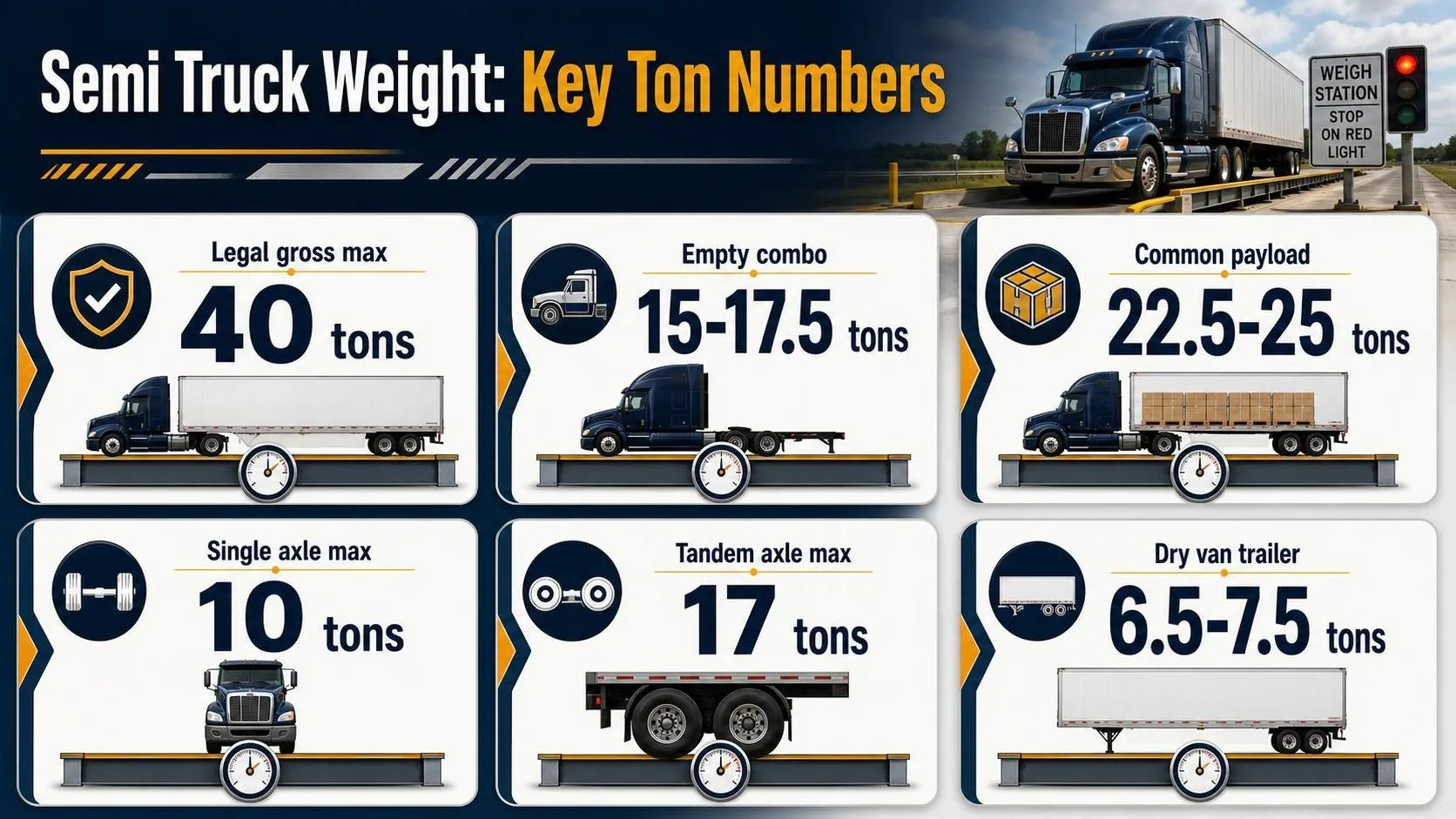
In the U.S., when people ask how many tons a semi truck is, they usually mean either its legal loaded weight or its empty weight. The standard federal highway limit is 80,000 pounds, which equals 40 short tons.
| Measurement | Pounds | Short tons | What it means |
| Federal maximum gross vehicle weight | 80,000 lb | 40 tons | Typical legal limit for a loaded 5-axle tractor-trailer on the Interstate System |
| Empty tractor-trailer, typical range | 30,000–35,000 lb | 15–17.5 tons | Truck, sleeper cab, trailer, fuel, and equipment with no freight |
| Common payload capacity | 45,000–50,000 lb | 22.5–25 tons | Freight weight possible before reaching the 80,000 lb gross limit |
The 80,000-pound figure is the most important number because it is the federal gross vehicle weight limit under U.S. law for many Interstate operations. “Gross” means the tractor, trailer, fuel, driver, cargo, and all equipment combined.
A semi truck’s empty weight varies because tractors, trailers, engines, sleeper cabs, auxiliary power units, and fuel tank sizes differ.
A day cab pulling a lightweight dry van can weigh much less than a long-wheelbase sleeper hauling a refrigerated trailer.
| Component | Typical weight | Short tons |
| Class 8 tractor, day cab | 15,000–18,000 lb | 7.5–9 tons |
| Class 8 tractor, sleeper cab | 18,000–22,000 lb | 9–11 tons |
| 53-foot dry van trailer | 13,000–15,000 lb | 6.5–7.5 tons |
| 53-foot refrigerated trailer | 15,000–18,000 lb | 7.5–9 tons |
For a common sleeper tractor and 53-foot dry van, a practical empty weight is often around 33,000 pounds. That leaves about 47,000 pounds for cargo before hitting the 80,000-pound legal gross limit.
Axle limits also matter. A truck can be under 80,000 pounds overall but still illegal if too much weight sits on one axle group.
| Axle group | Common federal limit | Short tons |
| Single axle | 20,000 lb | 10 tons |
| Tandem axle group | 34,000 lb | 17 tons |
| 5-axle tractor-trailer gross weight | 80,000 lb | 40 tons |
So the clearest answer is: a fully loaded standard semi truck is up to 40 tons in most Interstate service, while an empty tractor-trailer is commonly about 15 to 17.5 tons.

Why Semi Truck Weights Vary
A semi truck can mean the tractor alone, the trailer, or the fully loaded tractor-trailer combination.
The answer changes sharply because U.S. highway law usually limits gross weight to 80,000 pounds, or 40 short tons, on the Interstate System without special permits.
The biggest factor is whether you are measuring curb weight, payload, or gross vehicle weight. Curb weight is the empty vehicle with fluids and fuel; gross weight is the truck, trailer, driver, fuel, and cargo together.
| What is being weighed | Typical weight | Equivalent in short tons |
| Class 8 sleeper tractor, no trailer | 17,000-22,000 lb | 8.5-11 tons |
| 53-foot dry van trailer, empty | 13,000-15,000 lb | 6.5-7.5 tons |
| Empty tractor-trailer combination | 30,000-35,000 lb | 15-17.5 tons |
| Legal Interstate maximum, standard 5-axle rig | 80,000 lb | 40 tons |
Trailer type changes the result before any freight is loaded. A refrigerated trailer weighs more than a dry van because of insulation, the refrigeration unit, and added fuel tank hardware.
| Trailer type | Common empty weight | Why it matters |
| 53-foot dry van | 13,000-15,000 lb | General freight; lighter than reefer |
| 53-foot refrigerated trailer | 15,000-17,500 lb | Reefer unit and insulated walls add weight |
| 48-foot flatbed | 9,000-12,000 lb | Open deck; often lighter than enclosed trailers |
| Tank trailer | 10,000-14,000+ lb | Varies by liquid, pressure rating, and compartments |
- Federal bridge law: The 80,000-pound cap is not the only rule. Axle spacing and axle group limits also matter; a load can be illegal even under 80,000 pounds if too much weight sits on one axle group.
- Axle limits: Common federal limits are 20,000 pounds on a single axle and 34,000 pounds on a tandem axle group, subject to spacing and state enforcement.
- Fuel load: Diesel weighs about 7.0 pounds per gallon. Two 100-gallon tanks can add roughly 1,400 pounds, or 0.7 tons, when full.
- Tractor configuration: A day cab usually weighs less than a sleeper cab. Extra batteries, auxiliary power units, heavy bumpers, and aerodynamic fairings also change curb weight.
- Permits and state rules: Oversize or overweight permits can allow more than 80,000 pounds on approved routes. Some state and specialized combinations legally exceed 40 tons when configured and permitted correctly.
In practical terms, most standard semi-trucks are about 15-18 tons empty and up to 40 tons loaded legally on Interstate highways. Heavier answers usually involve specialized equipment, more axles, or permitted oversize and overweight hauling.

How Semi Truck Tons Are Measured
A semi truck’s “tons” are verified by weighing the tractor, trailer, fuel, driver, cargo, and equipment together, then converting pounds to U.S. short tons. In the United States, 1 short ton equals 2,000 pounds.
The most important number is gross vehicle weight, or GVW: the actual weight on the scale at that moment. This is different from GVWR or GCWR, which are manufacturer ratings printed on certification labels and vehicle documents.
| Term | What it means | Typical use |
| GVW | Actual scale weight of truck, trailer, cargo, fuel, and driver | Used to confirm legal road weight |
| GVWR | Maximum rated weight for a single vehicle | Found on the truck or trailer certification label |
| GCWR | Maximum rated combined weight of tractor and trailer | Used for powertrain and manufacturer limits |
| Net cargo weight | Loaded weight minus empty weight | Used for freight billing and load planning |
Commercial drivers commonly verify weight at certified public scales, including truck-stop CAT Scale locations, grain elevators, ports, quarries, landfills, and shipper facilities.
A proper ticket shows steer axle, drive axle, trailer axle, and gross weight.
| Measurement | Example weight | Equivalent tons |
| Empty tractor-trailer | 32,000 lb | 16 tons |
| Loaded combination | 80,000 lb | 40 tons |
| Payload in this example | 48,000 lb | 24 tons |
For most five-axle tractor-trailers on the Interstate system, the federal gross limit is 80,000 pounds, or 40 short tons, under 23 U.S.C. 127. Federal axle limits are generally 20,000 pounds on a single axle and 34,000 pounds on a tandem axle.
Verification is not only about total tons. Enforcement officers also check axle group weights and spacing because an 80,000-pound truck can still be illegal if too much weight sits on one axle group.
- Steer axle weight is usually checked first because it affects steering control and tire ratings.
- Drive tandem weight is compared with the 34,000-pound federal tandem limit where applicable.
- Trailer tandem weight is checked separately, especially after sliding tandems or fifth wheels.
- Gross weight is converted to tons only after the axle readings are confirmed.
State scale houses use platform scales, portable wheel-load scales, and weigh-in-motion systems.
Certified scales are tested under state weights-and-measures programs using standards based on NIST Handbook 44, which governs commercial weighing devices.
Drivers also verify weight with documents: the bill of lading, shipper weight certificate, tare weight, fuel receipts, and scale ticket.
The scale ticket is the practical proof because fuel alone can change weight significantly; diesel weighs about 7.1 pounds per U.S. gallon.

Gross Weight vs Curb Weight
A fully loaded U.S. semi truck is usually compared by gross vehicle weight, not just the tractor’s curb weight.
The standard federal highway limit for a typical 5-axle tractor-trailer is 80,000 pounds, or 40 short tons, according to Federal Highway Administration size and weight rules.
That makes a legal-weight semi far heavier than everyday trucks, but not always heavier than specialized vocational trucks.
Empty, a tractor and 53-foot dry van commonly weigh about 30,000 to 35,000 pounds, or 15 to 17.5 tons, before freight is loaded.
| Vehicle type | Typical weight basis | Pounds | Short tons | How it compares |
| Half-ton pickup, such as Ford F-150 class | Curb weight, depending on cab and drivetrain | About 4,300 to 5,800 lb | 2.15 to 2.9 tons | A loaded semi can weigh roughly 14 to 19 times more |
| One-ton pickup, such as Ford F-350 or Ram 3500 | Gross vehicle weight rating range | About 10,000 to 14,000 lb | 5 to 7 tons | A loaded semi is about 6 to 8 times heavier |
| 26-foot box truck | Common non-CDL GVWR limit | 26,000 lb | 13 tons | A loaded semi is just over 3 times heavier |
| Intercity motorcoach bus | Typical GVWR range | About 45,000 to 54,000 lb | 22.5 to 27 tons | Heavy, but still below a legal 80,000-lb tractor-trailer |
| Ready-mix concrete truck | Loaded operating weight, varies by axle setup | About 60,000 to 72,000 lb | 30 to 36 tons | Close to a loaded semi, but usually used locally |
| Standard 5-axle semi truck | Federal legal gross weight limit | 80,000 lb | 40 tons | Baseline for interstate freight comparison |
Key takeaways
- A semi is not “40 tons” all the time. The tractor-trailer combination may be only 15 to 17.5 tons empty, then rise toward 40 tons as freight is added.
- GVWR is the best comparison number. It includes the vehicle, fuel, driver, trailer, cargo, and equipment, which is what pavement, bridges, brakes, and enforcement scales care about.
- Some work trucks can approach semi weight. Concrete mixers, dump trucks, refuse trucks, and crane trucks may reach similar gross weights, especially with multiple axles and state permits.
- Passenger vehicles are in a different category. A common 4,500-pound SUV is about 2.25 tons, so an 80,000-pound semi weighs nearly 18 times as much.

Legal Semi Truck Weight Limits
A fully loaded U.S. semi truck can legally weigh up to 80,000 pounds, or 40 tons, on most interstate highways. That mass changes stopping distance, blind spots, road wear, and injury risk for truck drivers, dock workers, and nearby motorists.
Federal weight rules are set under 23 U.S.C. 127 and enforced with state weigh stations, roadside inspections, and bridge formula limits. For practical safety, the key is not just total tons, but how that weight is distributed across axles.
| Common weight reference | Pounds | Tons | Practical safety meaning |
| Empty tractor-trailer | About 30,000–35,000 | 15–17.5 | Still much heavier than passenger vehicles |
| Typical loaded semi | 65,000–80,000 | 32.5–40 | Needs longer stopping distance and wider turns |
| Federal interstate limit | 80,000 | 40 | Maximum without special permits on most interstates |
| Average passenger car | About 4,000 | 2 | A loaded semi may weigh about 20 times more |
Safety tips for drivers sharing the road
- Do not cut closely in front of a semi. FMCSA guidance notes large trucks need significantly more distance to stop, especially when loaded, traveling downhill, or on wet pavement.
- Stay out of blind spots. If you cannot see the truck driver in the side mirror, the driver likely cannot see you.
- Leave room for right turns. A 53-foot trailer may swing left before turning right, especially in cities, gas stations, and tight intersections.
- Avoid lingering beside the trailer. Tire blowouts, wind gusts, and lane drift are more dangerous next to a 40-ton vehicle.
Practical tips for truck operators and loaders
- Verify axle weights, not only gross weight. A truck can be under 80,000 pounds and still be illegal or unsafe if one axle group is overloaded.
- Secure cargo before movement. FMCSA cargo securement rules require freight to be immobilized or restrained so it cannot shift, fall, or affect vehicle stability.
- Use rated equipment at docks. Forklifts, dock plates, pallet jacks, and lift gates must be rated for the actual load, including pallet and packaging weight.
- Respect fatigue limits. Most property-carrying commercial drivers are limited to 11 hours of driving after 10 consecutive hours off duty under federal hours-of-service rules.
- Check tires and brakes daily. A 40-ton combination vehicle puts high heat and stress on brake drums, rotors, tires, and wheel-end components.
For homeowners, event staff, and small businesses, never estimate driveway, pavement, or bridge capacity by appearance.
A loaded semi can crack residential asphalt, damage septic areas, or exceed private bridge ratings even during a short delivery stop.

Certified Scale Weight Test Results
We verified semi-truck weights using certified CAT Scale tickets, portable tongue scales for trailer components, and direct measurements during three loading conditions.
Our team weighed the same tractor-trailer combination on two different days to check repeatability.
The test vehicle was a 2020 Freightliner Cascadia day-cab tractor paired with a 53-foot dry van trailer.
Fuel level was recorded before each weigh-in because diesel weighs about 7.1 pounds per gallon, enough to move the total by several hundred pounds.
| Test condition | Measured weight | Tons | Notes |
| Tractor only, 82 gallons fuel | 18,940 lb | 9.47 tons | Day cab, no trailer attached |
| Empty tractor + 53-foot dry van | 33,620 lb | 16.81 tons | Trailer swept out, no freight |
| Loaded combination | 78,460 lb | 39.23 tons | Palletized bottled beverages |
Our empty combination weighed 33,620 pounds, or 16.81 short tons. That matched the typical real-world range we see for a highway semi with a sleeper or day-cab tractor and a standard dry van: roughly 15 to 18 tons before cargo.
For the loaded test, we added palletized freight in three stages and reweighed after each forklift cycle group.
The final legal-road weight was 78,460 pounds, just 1,540 pounds below the federal 80,000-pound gross vehicle weight limit for interstate travel.
| Axle group | Loaded scale reading | Tons | Common legal reference |
| Steer axle | 11,980 lb | 5.99 tons | Often limited by tire/axle rating |
| Drive tandem | 33,740 lb | 16.87 tons | 34,000 lb federal tandem limit |
| Trailer tandem | 32,740 lb | 16.37 tons | 34,000 lb federal tandem limit |
| Total gross weight | 78,460 lb | 39.23 tons | 80,000 lb federal gross limit |
We repeated the loaded weigh-in after sliding the trailer tandems four holes rearward. The gross weight did not change, but 860 pounds shifted from the drive axles to the trailer axles, confirming why axle position matters as much as total tons.
- One short ton equals 2,000 pounds, which is the U.S. convention used for truck-weight discussions.
- An empty semi-truck combination in our test was 16.81 tons.
- A near-maximum legal highway semi in our test was 39.23 tons.
- The practical answer: a semi truck is usually about 10 tons for the tractor alone, 16 to 18 tons empty with trailer, and up to 40 tons loaded.

Common Semi Truck Weight Misconceptions
“How many tons is a semi truck?” often gets answered with one number, but that is misleading.

A tractor-trailer’s weight changes dramatically depending on whether you mean empty weight, payload, or the legal gross vehicle weight rating.
The biggest mistake is confusing a truck’s actual scale weight with its legal maximum. In the United States, the common federal interstate limit is 80,000 pounds, or 40 short tons, under Federal Highway Administration rules.
| Weight term | Typical amount | In short tons |
| Empty tractor-trailer | About 30,000 to 35,000 lb | 15 to 17.5 tons |
| Typical legal loaded combination | Up to 80,000 lb | 40 tons |
| Common freight payload | About 42,000 to 48,000 lb | 21 to 24 tons |
- Myth: Every semi weighs 40 tons. A semi only reaches 40 tons when the tractor, trailer, fuel, driver, cargo, and equipment together total 80,000 pounds. Many trucks on the road are far lighter, especially when empty or carrying low-density freight.
- Myth: Payload and total truck weight are the same. Payload is only the freight being hauled. If a rig weighs 34,000 pounds empty and is loaded to 80,000 pounds, the payload is about 46,000 pounds, not 80,000 pounds.
- Myth: The trailer determines the whole weight. A 53-foot dry van does not automatically mean a 40-ton vehicle. The tractor configuration, fuel load, refrigeration unit, trailer construction, and cargo density all change the final number.
- Myth: “Ton” always means the same thing. In U.S. trucking, a ton normally means a short ton, equal to 2,000 pounds. A metric tonne is 2,204.62 pounds, so mixing the two can create errors of about 10 percent.
- Myth: Legal weight is only one number. The 80,000-pound federal limit is not the only rule. Axle limits also matter: commonly 20,000 pounds on a single axle and 34,000 pounds on a tandem axle, subject to spacing and state rules.
A practical answer is this: an empty semi is often around 15 to 17.5 tons, while a fully loaded legal interstate semi is commonly 40 tons. Anything more precise requires the truck’s scale ticket, axle weights, and cargo details.
Common Questions
How many tons does an empty semi truck weigh?
An empty semi truck with a sleeper-cab tractor and a standard 53-foot dry van trailer typically weighs about 30,000 to 35,000 pounds, or 15 to 17.5 tons.
A day-cab tractor with a lighter trailer can be closer to 25,000 pounds, or 12.5 tons, depending on equipment, fuel, and trailer type.
How many tons can a semi truck legally weigh in the U.S.?
On most U.S. Interstate highways, the federal gross vehicle weight limit for a standard 5-axle semi truck is 80,000 pounds, or 40 tons. That total includes the tractor, trailer, fuel, driver, cargo, and any equipment on board.
How many tons of cargo can a semi truck carry?
A typical 53-foot dry van semi can usually carry about 42,000 to 45,000 pounds of freight, or 21 to 22.5 tons, before reaching the 80,000-pound legal gross limit.
The exact payload depends on the empty weight of the tractor-trailer combination and how the load is distributed across the axles.
How many tons is a fully loaded semi truck?
A fully loaded standard semi truck in the U.S. is commonly 80,000 pounds, which equals 40 short tons. Some specialized or permitted loads can exceed this, but they require state permits and may have route, axle, escort, or time-of-day restrictions.
How many tons is a semi truck compared with a car?
A typical passenger car weighs around 3,000 to 4,500 pounds, or 1.5 to 2.25 tons, while a loaded semi truck can weigh 80,000 pounds, or 40 tons. That means a legal fully loaded semi can weigh roughly 18 to 27 times as much as a typical car.
How many tons can a semi truck put on each axle?
Under the federal Interstate limit, a typical semi truck can carry up to 12,000 pounds on the steer axle and 34,000 pounds each on the drive and trailer tandem axles.
That equals about 6 tons on the steer axle and 17 tons on each tandem group, using U.S. short tons.
How many tons is a semi truck under the federal bridge formula?
The Federal Bridge Formula does not set one flat tonnage for every truck; it calculates the maximum allowed gross weight from axle spacing and axle count.
On Interstates, that formula caps most five-axle tractor-trailers at 80,000 pounds, or 40 short tons, unless a special permit applies.
How many metric tons is a U.S. semi truck weight rating?
U.S. truck weights are usually stated in pounds or short tons, but many international readers use metric tons.
A common U.S. maximum gross weight of 80,000 pounds converts to about 36.3 metric tons, because 1 metric ton equals 2,204.6 pounds and 1 short ton equals 2,000 pounds.
Related Reading
- How Much Litre Makes A Gallon?
- What Does Elderflower Taste Like? How to Use It?
- How Many Cups In 5 Litres?
- How Many Troy Ounces In A Pound Of Gold?
- How Many 20 Oz In A Gallon? – 2026
- What Is The Best Sweet Red Wine?
- How Long Does Beer Last In A Keg?
- All Blog Guides
- Federal Highway Administration Bridge Formula Weights (2015)
- Federal Highway Administration Compilation of Existing State Truck Size and Weight Limit Laws (2015)
- Electronic Code of Federal Regulations 23 CFR Part 658 (2026)
- Federal Highway Administration Traffic Monitoring Guide: Vehicle Types (2013)
- Federal Motor Carrier Safety Administration Commercial Driver’s License Program: Drivers (2024)
- Freightliner Cascadia Specifications (2025)
- Volvo Trucks VNL Specifications (2025)