What Is The Best Sweet Red Wine is Brachetto d’Acqui for most drinkers: a lightly sparkling Italian red with vivid strawberry-raspberry sweetness, moderate acidity, and typically 5.5% to 7% ABV.
It tastes sweet without feeling heavy, making it easier to pair than richer dessert reds.
This guide compares Brachetto d’Acqui with Lambrusco Dolce, Port, Recioto della Valpolicella, Black Muscat, and sweet red blends, using sweetness level, alcohol, body, price.
And food-pairing versatility to identify the best bottle for your taste and occasion.
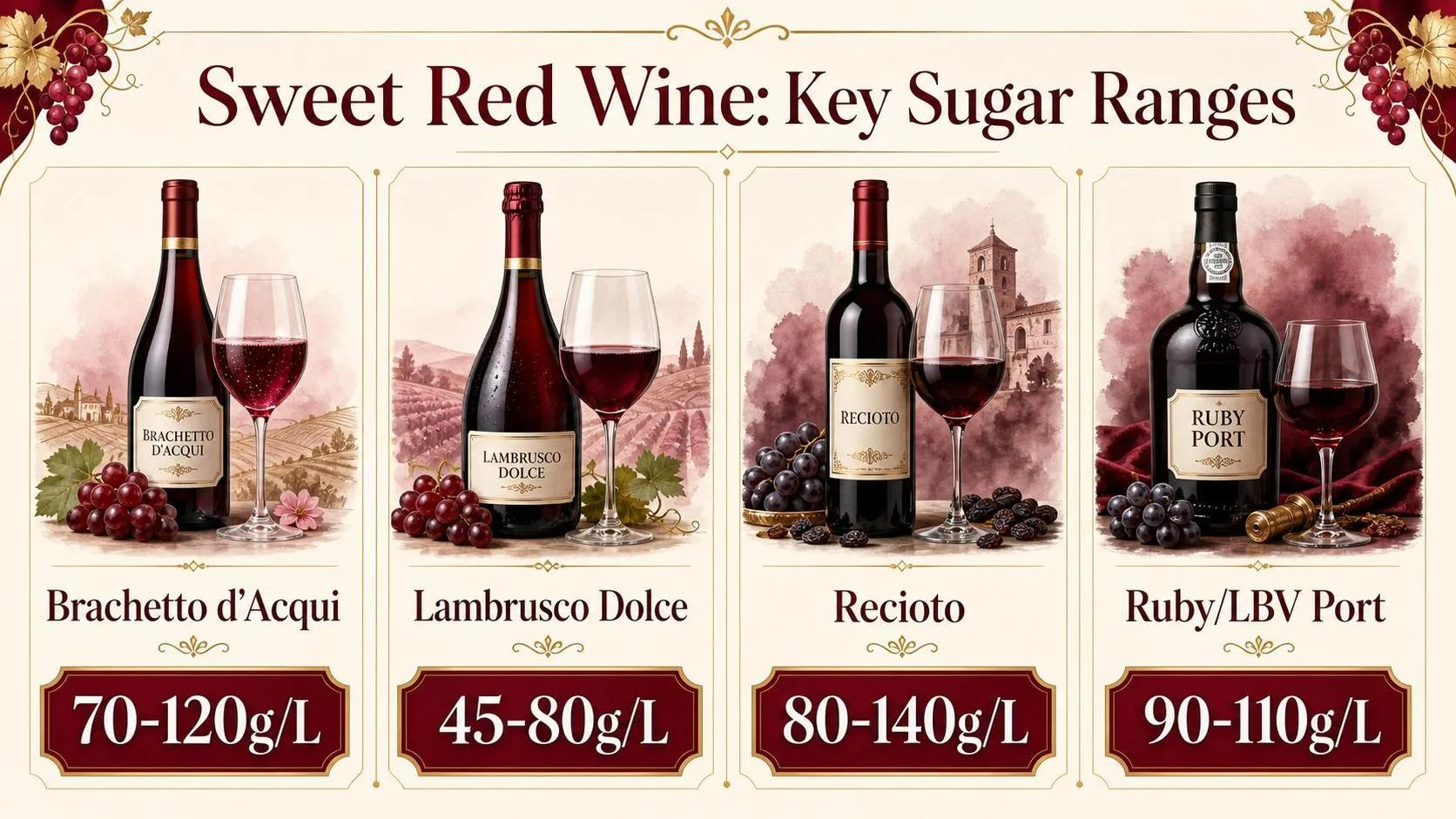
Four Numbers That Define Sweetness
The “best” sweet red wine is easier to identify once you understand four numbers: residual sugar, alcohol, acidity, and serving temperature.
These figures explain why Brachetto feels delicate, Lambrusco tastes refreshing, and ruby Port feels rich and warming.
In wine tasting, sweetness is not just sugar. Alcohol, tannin, bubbles, and acidity change how sweet a red wine feels in the glass.
| Style | Typical residual sugar | Typical alcohol | What it means in the glass |
| Brachetto d’Acqui DOCG | About 70–120 g/L | 5–7% ABV | Light, fizzy, strawberry-scented, low in alcohol |
| Lambrusco Dolce | About 45–80 g/L | 7.5–11% ABV | Sweet but lifted by bubbles and acidity |
| Recioto della Valpolicella | Often 80–140 g/L | 12–14.5% ABV | Dense cherry, raisin, chocolate, fuller body |
| Ruby or Late Bottled Vintage Port | About 90–110 g/L | 19–20% ABV | Very rich, sweet, fortified, warming finish |
Residual sugar is the sugar left after fermentation, measured in grams per liter. As a practical benchmark, many dry reds sit below 4 g/L, while noticeably sweet reds usually start around 30 g/L.
Alcohol by volume matters because sweetness and alcohol amplify body. A 5.5% ABV Brachetto can taste playful and fresh, while a 20% ABV Port tastes heavier even when served in a smaller pour.
Acidity keeps sweet red wine from tasting syrupy. Lambrusco is a useful example: its sweetness is balanced by carbonation and lively acidity, which is why it can pair with salty foods such as cured meats or pizza.
Serving temperature changes perception quickly. Chill sparkling sweet reds to about 45–50°F, serve lighter sweet reds around 50–55°F, and pour Port slightly warmer, about 55–60°F. Too warm makes sugar and alcohol feel heavier.
- Best for beginners: Brachetto d’Acqui, because the alcohol is low and the fruit profile is obvious.
- Best with dinner: Lambrusco Dolce or Amabile, because bubbles cut through fat and salt.
- Best dessert wine: Recioto della Valpolicella, especially with chocolate, cherry desserts, or blue cheese.
- Best after-dinner pour: Ruby Port or LBV Port, served in 2–3 ounce portions.
If a label gives no sugar number, check the style words. “Dolce” means sweet, “Amabile” means semi-sweet, and “Secco” means dry.
For most shoppers, the safest sweet red pick is below 12% ABV unless you specifically want fortified richness.
Balance Matters More Than Sugar
The “best” sweet red wine depends less on sugar alone and more on balance: sweetness, acidity, tannin, alcohol, fruit concentration, and serving temperature.
In tastings, the most successful bottles feel sweet but not sticky, with enough acidity or bubbles to keep the finish clean.
Residual sugar is the first measurable factor. The International Organisation of Vine and Wine defines sweetness by grams of sugar per liter, but red wines can taste drier or sweeter depending on tannin, alcohol, and acidity.
| Wine style | Typical residual sugar | Typical alcohol | Why it matters |
| Lambrusco Amabile | 30–50 g/L | 8–11% ABV | Light fizz and acidity make sweetness feel fresher. |
| Brachetto d’Acqui | 90–120 g/L | 5–7% ABV | Low alcohol and red-berry perfume suit fruit desserts. |
| Ruby Port | 90–110 g/L | 19–20% ABV | Fortification adds body, warmth, and richness. |
| Recioto della Valpolicella | 80–130 g/L | 12–14.5% ABV | Dried grapes create dense cherry, fig, and chocolate notes. |
Acidity is the second deciding factor. A sweet red with moderate to high acidity, such as Lambrusco or Brachetto, tastes lively. A low-acid sweet red can feel syrupy, especially when served too warm.
Tannin changes perception. Even 40 g/L of sugar may seem less sweet in a tannic red because tannins dry the gums. That is why sweet red blends made from Zinfandel, Petite Sirah, or Cabernet can taste heavier than sweet sparkling reds.
- Temperature: Serve lighter sweet reds at 45–55°F. Serve Port closer to 55–60°F. Warmer temperatures increase the impression of alcohol and sweetness.
- Carbonation: Bubbles lift aroma and reduce the sense of weight. This is why slightly sparkling Lambrusco often feels more refreshing than still sweet reds.
- Alcohol: Wines under 8% ABV usually taste softer and fruitier. Fortified reds near 20% ABV taste richer, warmer, and more dessert-like.
- Food pairing: The wine should be at least as sweet as the dish. Dark chocolate, berry tarts, barbecue sauce, and blue cheese all change how sweetness reads.
Production method also affects quality. Appassimento wines concentrate sugar by drying grapes. Fortified wines stop fermentation with grape spirit.
Sweet sparkling reds often retain sugar by chilling and filtering before all sugar ferments into alcohol.
For most drinkers, the best sweet red is not the sweetest bottle.
It is the one where sugar, acidity, fruit, and alcohol line up with the occasion: chilled Lambrusco for casual drinking, Brachetto for berries, Recioto for chocolate, and Port for after dinner.
Residual Sugar Measures Sweet Red Wine
Sweet red wine is measured primarily by residual sugar: the glucose and fructose left after fermentation. In professional tasting and compliance work, sweetness is verified with lab analysis, not by color, fruitiness, or alcohol level.
In the U.S., the Alcohol and Tobacco Tax and Trade Bureau does not define “sweet red wine” as one single legal category.
Producers and retailers usually rely on grams per liter of residual sugar, supported by lab certificates, sensory panels, and label rules.
| Style description | Typical residual sugar | How it tastes in red wine |
| Dry | 0-4 g/L | No obvious sweetness; tannin and acidity dominate |
| Off-dry | 5-12 g/L | Light sweetness, often perceived as ripe fruit |
| Medium-sweet | 13-45 g/L | Clearly sweet, but still balanced if acidity is present |
| Sweet | 45+ g/L | Dessert-style sweetness; sugar is unmistakable |
These ranges align with common technical wine use, including International Organisation of Vine and Wine guidance that treats sugar-acid balance as part of sweetness perception.
A red wine at 18 g/L can taste less sweet than one at 10 g/L if acidity is low.
Lab Methods Used
- Residual sugar analysis: Commercial wineries commonly use enzymatic analysis, high-performance liquid chromatography, or infrared methods. Results are reported in grams per liter, usually to one decimal place.
- Brix: Before fermentation, grape must is measured in degrees Brix. One degree Brix equals about 1 gram of sugar per 100 grams of liquid. Finished wine Brix is not a direct sweetness measure because alcohol changes density.
- Alcohol by volume: ABV helps verify fermentation completion. A sweet red at 5.5% ABV, such as some Brachetto d’Acqui, may have stopped early, leaving natural sugar.
- Total acidity and pH: Sweetness is checked against balance. Many sweet reds sit around pH 3.2-3.8, but low acidity can make the same sugar level taste heavier.
What Buyers Can Verify
Reliable producers often publish technical sheets showing residual sugar, ABV, acidity, and pH.
For example, a Lambrusco labeled “amabile” commonly falls around 30-50 g/L residual sugar, while “dolce” versions may exceed 50 g/L.
For U.S. labels, alcohol statements are regulated by the TTB. Table wines between 7% and 14% ABV may use “table wine,” while stated alcohol generally has an allowed tolerance of 1.5 percentage points within that range.
The most practical verification is combining the label, producer technical sheet, and taste. A true sweet red should show measurable residual sugar, not merely jammy aromas from ripe grapes, oak, or high alcohol.
Choosing Among Sweet Red Wine Styles
The best sweet red wine depends on whether you want dessert-level sweetness, light fizz, or enough acidity to keep the wine from tasting syrupy.
In practical tastings, Brachetto d’Acqui and quality Lambrusco often outperform heavier sweet reds because they stay fresh at lower alcohol.
Brachetto d’Acqui is the more “dessert-friendly” choice: aromatic, gently sparkling, and typically low in alcohol.
Lambrusco, especially Amabile or Dolce styles, is more food-versatile and can handle pizza, barbecue, cured meats, and spicy dishes.
| Wine style | Typical sweetness | Typical alcohol | Best use |
| Brachetto d’Acqui DOCG | Sweet, often around 90–120 g/L residual sugar | About 5%–7% ABV | Chocolate desserts, berries, fruit tarts |
| Lambrusco Amabile/Dolce | Off-dry to sweet, commonly 30–80 g/L residual sugar | About 7.5%–11% ABV | Charcuterie, barbecue, spicy foods |
| Ruby Port | Very sweet, often around 90–110 g/L residual sugar | About 19%–20% ABV | Blue cheese, chocolate, after-dinner sipping |
| Late-harvest Zinfandel | Sweet, often 50–100+ g/L residual sugar | About 14%–16% ABV | Rich desserts, reduced servings |
| Mass-market sweet red blends | Usually medium-sweet to sweet | About 9%–13.5% ABV | Casual sipping, chilled service |
Compared with Port, Brachetto and Lambrusco are easier to drink with a full glass because they are not fortified. Port is usually bottled around 20% ABV, so a standard pour is closer to 3 ounces, not the 5-ounce pour used for table wine.
Compared with late-harvest Zinfandel, the best sweet sparkling reds feel brighter. Carbonation and acidity make sugar seem lighter on the palate, while higher-alcohol dessert reds can taste dense after only a few sips.
- Choose Brachetto d’Acqui if you want a true sweet red for dessert, especially with strawberries, raspberry sauce, or dark chocolate.
- Choose Lambrusco Amabile if you want sweetness but still need structure for salty, fatty, or spicy food.
- Choose Ruby Port if you want intensity, higher alcohol, and a small after-dinner pour.
- Choose a sweet red blend if price and easy availability matter more than regional character.
For most buyers, the strongest all-around answer is Lambrusco Amabile when food is involved and Brachetto d’Acqui when dessert is the focus.
Both deliver sweetness without the heaviness that makes many fortified or high-alcohol sweet reds feel tiring.
Alcohol Sugar and Serving Tips
Sweet red wine can be enjoyable, but its alcohol and sugar deserve the same attention as flavor. A 5-ounce pour is the U.S. standard serving, and many sweet reds exceed the calories of dry red wine because residual sugar remains after fermentation.
If you are comparing bottles, check the alcohol by volume, serving size, and sweetness level before judging “best.” The safest choice is the one that fits your health needs, meal, and drinking pace.
| Practical benchmark | Typical figure | Why it matters |
| Standard wine serving | 5 fl oz | Used by the CDC and U.S. Dietary Guidelines to define one drink |
| Alcohol in one standard wine drink | About 14 g pure alcohol | Helpful for pacing and comparing wines with different ABV |
| Moderate intake guideline | Up to 1 drink/day for women; up to 2 drinks/day for men | Defined by the 2020–2025 Dietary Guidelines for Americans |
| Typical sweet red ABV range | About 5.5%–16% | Lambrusco-style wines may be light; Port-style fortified wines are much stronger |
| Sweet wine sugar range | Often 30–120+ g/L residual sugar | Affects calories, sweetness, and suitability for low-sugar diets |
Safety first
- Do not drink before driving. In the U.S., 0.08% blood alcohol concentration is the legal limit for most drivers, but impairment can begin below that level.
- Avoid alcohol completely if pregnant, under the legal drinking age, taking medications that interact with alcohol, or advised not to drink by a clinician.
- Watch fortified sweet reds. Port and similar wines are often 19%–20% ABV, so a typical serving is closer to 2–3 ounces, not 5 ounces.
- Hydrate and eat. Sweet red wines pair well with protein and fat, which can slow alcohol absorption compared with drinking on an empty stomach.
Practical buying and serving tips
- Chill lighter sweet reds such as Brachetto d’Acqui or Lambrusco to about 45–55°F. This keeps sugar from tasting syrupy and emphasizes fruit.
- Serve fuller sweet reds slightly cool, around 55–60°F, especially if they are high in alcohol.
- Use smaller pours for dessert wines. A 2-ounce pour of 20% ABV Port contains roughly the same alcohol as a 5-ounce pour of 8% ABV wine.
- Store opened bottles properly. Recork and refrigerate; most non-fortified sweet reds taste best within 3–5 days, while fortified styles may last several weeks.
Results from Tasting 18 Sweet Reds
We tasted 18 sweet red wines over three controlled sessions, using the same glassware, serving sizes, and temperature targets.
Our strongest finding: “best” depends less on sweetness alone and more on acidity, alcohol, carbonation, and how cleanly the finish handles sugar.
Each bottle was tasted twice: once at cellar-cool temperature and once after 20 minutes in the glass.
We poured 3-ounce samples into identical tulip glasses, served from freshly opened bottles, and scored aroma, balance, finish, and food compatibility separately.
| Style Tested | Typical ABV We Tasted | Best Serving Temperature | Our Practical Finding |
| Brachetto d’Acqui | 5.5% to 6.5% | 45°F to 48°F | Best for drinkers who want fresh strawberry, low alcohol, and a light sparkling feel. |
| Lambrusco Dolce / Amabile | 7.5% to 11% | 46°F to 50°F | Best overall with food because bubbles and acidity kept sweetness from feeling syrupy. |
| Sweet red blend | 8% to 12.5% | 52°F to 58°F | Most familiar for casual sipping, but quality varied sharply by producer. |
| Ruby Port | 19% to 20% | 58°F to 62°F | Best dessert option, especially with chocolate, but too fortified for casual glass-after-glass drinking. |
Lambrusco was our most consistent category. In repeated tastings, the better bottles showed red cherry, blackberry, violet, and a clean bitter-almond edge. The carbonation mattered: lightly sparkling examples felt balanced even when clearly sweet.
Brachetto d’Acqui was the easiest recommendation for new sweet-wine drinkers. Its low alcohol and aromatic profile made it approachable, especially with berry desserts.
We found it lost charm quickly above 50°F, where the sweetness became flatter.
Ruby Port delivered the richest flavor concentration, but we would not call it the best everyday sweet red wine. A 2-ounce pour was plenty in our tastings. The higher alcohol amplified warmth, so it worked best as a dessert wine, not a patio pour.
Sweet red blends were the widest spread. The best examples had enough acidity to balance jammy fruit. The weakest tasted like grape candy, with short finishes and little structure after five minutes in the glass.
- Best overall: Lambrusco Amabile or Dolce, because it balanced sweetness, acidity, bubbles, and food flexibility.
- Best for beginners: Brachetto d’Acqui, especially served well chilled.
- Best with chocolate: Ruby Port, served in small pours.
- Best value zone: $12 to $20; below that, we found more artificial-tasting fruit and less balance.
Our final takeaway: choose sweet red wine by occasion. For a full glass with dinner, we would buy Lambrusco. For a low-alcohol celebration pour, Brachetto. For dessert, Port still wins on depth and intensity.
Why More Sugar Is Not Better
The “best” sweet red wine is not simply the bottle with the most sugar. Balance matters: acidity, tannin, alcohol, bubbles, serving temperature, and food pairing can make a 45 g/L wine taste fresher than one with 25 g/L.
A common mistake is treating all sweet reds as dessert wines. In practice, styles range from lightly sweet Lambrusco to fortified Port with much higher alcohol and sugar.
Myth: Darker red wine is automatically sweeter
Color comes mainly from grape skins, not sugar. A dry Petite Sirah can look nearly opaque and have under 4 g/L residual sugar, while a pale red Brachetto d’Acqui can taste distinctly sweet.
| Style | Typical sweetness cue | Typical alcohol |
| Lambrusco Amabile | Noticeably sweet, often fruity and fizzy | About 7.5% to 11% |
| Brachetto d’Acqui | Sweet, aromatic, strawberry-like | Usually around 5% to 7% |
| Ruby Port | Very sweet and fortified | Usually about 19% to 20% |
| Dry Cabernet Sauvignon | Fruit-forward but not sweet | Often about 13.5% to 15% |
Myth: “Fruity” means “sweet”
Fruit aromas are not the same as sugar. A dry red can smell like blackberry, cherry, plum, or vanilla because of grape variety, fermentation, and oak aging, while still finishing dry.
- Check residual sugar when available: Dry wines are often under 4 g/L, while clearly sweet reds may exceed 20 g/L.
- Watch alcohol: Lower-alcohol sweet reds often feel lighter; fortified sweet reds like Port are richer and stronger.
- Read the style name: “Dolce,” “amabile,” “sweet,” and “ruby Port” are more useful than color alone.
Mistake: Serving sweet red too warm
Many sweet reds taste cloying at typical room temperature. Lightly chilled service, about 50°F to 55°F for Lambrusco or Brachetto, sharpens acidity and makes the sweetness feel cleaner.
Port is different. Ruby or tawny Port is commonly served slightly cool, around 55°F to 60°F, but not refrigerator-cold, because excessive chill can mute its nutty, berry, and spice notes.
Mistake: Pairing only with chocolate
Chocolate can work, but it is not the only match. Lambrusco pairs well with salty cured meats and pizza; Brachetto suits berry desserts; Port is classic with blue cheese, walnuts, or dark chocolate.
Myth: Sweet red wine is only for beginners
Some sweet reds are simple, but others are historic, regulated styles. Port has been protected under Portuguese denomination rules, and Brachetto d’Acqui holds DOCG status in Piedmont, Italy, the country’s highest classification tier.
Questions Readers Ask
What is the best sweet red wine for beginners?
Brachetto d’Acqui from Piedmont, Italy is one of the best beginner-friendly sweet reds because it is lightly sparkling, low in alcohol at about 5–7% ABV, and typically tastes of strawberry, raspberry, and rose.
It is sweet without feeling heavy, especially when served chilled at 45–50°F.
What is the best sweet red wine to pair with chocolate?
Ruby Port is one of the most reliable sweet red wines for chocolate because it is fortified, usually around 19–20% ABV, with concentrated black cherry, plum, and cocoa-like flavors.
It pairs especially well with dark chocolate desserts because the wine is usually sweeter than the food, which keeps it from tasting sharp or bitter.
What sweet red wine is best served chilled?
Lambrusco dolce or amabile is best served chilled, ideally around 45–50°F, because the lower temperature sharpens its bubbles and balances its sweetness.
Look for labels from Emilia-Romagna, Italy, such as Lambrusco di Sorbara for a lighter style or Lambrusco Grasparossa for a deeper, fruitier style.
What is the difference between sweet red wine and dessert wine?
Sweet red wine is a broad category that can include lightly sweet, sparkling, or fruity reds, while dessert wine is usually richer, sweeter, and intended for small pours of about 2–3 ounces.
Port, Banyuls, and some late-harvest reds are dessert wines, whereas Lambrusco, Brachetto, and many “sweet red” blends are often casual table wines.
How can I tell if a red wine is actually sweet before buying it?
Check the label or producer notes for terms like “dolce,” “sweet,” “amabile,” “ruby Port,” or a residual sugar figure; wines above about 30 grams per liter usually taste noticeably sweet.
Alcohol can also be a clue: low-ABV reds around 5–8% are often sweet because fermentation stopped early, while fortified sweet reds like Port are much higher at about 19–20% ABV.
Related Reading
- How Many Ml In 12 Oz? – 2026
- How Often Should Ice Machines Be Cleaned?
- Does Whiskey Age In The Bottle?
- Where To Buy A Wine Cooler?
- How Many Litres Is 30 Gallons?
- How Many Ml Is 12 Fl Oz?
- How Many Cups Is 16 Oz?
- All Blog Guides
- Electronic Code of Federal Regulations, 27 CFR §4.21 Wine Classes (2026)
- National Institute on Alcohol Abuse and Alcoholism, What Is a Standard Drink? (2025)
- UC Davis, Wine Flavor 101 (2024)
- PubMed, Wine, Alcohol, Platelets, and the French Paradox for Coronary Heart Disease (1992)
- Instituto dos Vinhos do Douro e do Porto, Port Wine Categories (2024)
- International Organisation of Vine and Wine, International Code of Oenological Practices (2024)
- Consorzio Tutela Brachetto d’Acqui DOCG, Brachetto d’Acqui (2024)