Does Wine Have Vitamin C? is answered by USDA data: standard table wine lists 0 mg vitamin C per 100 g, so it is not a meaningful source of this nutrient.
Fermentation, oxygen exposure, filtration, and storage leave little to no ascorbic acid in finished wine. Grapes contain vitamin C before winemaking, but the final beverage does not retain nutritionally useful amounts.
This article explains measured values, label expectations, red versus white wine differences, and why wine should not be counted toward the adult Daily Value for vitamin C.
Vitamin C in a Glass of Wine
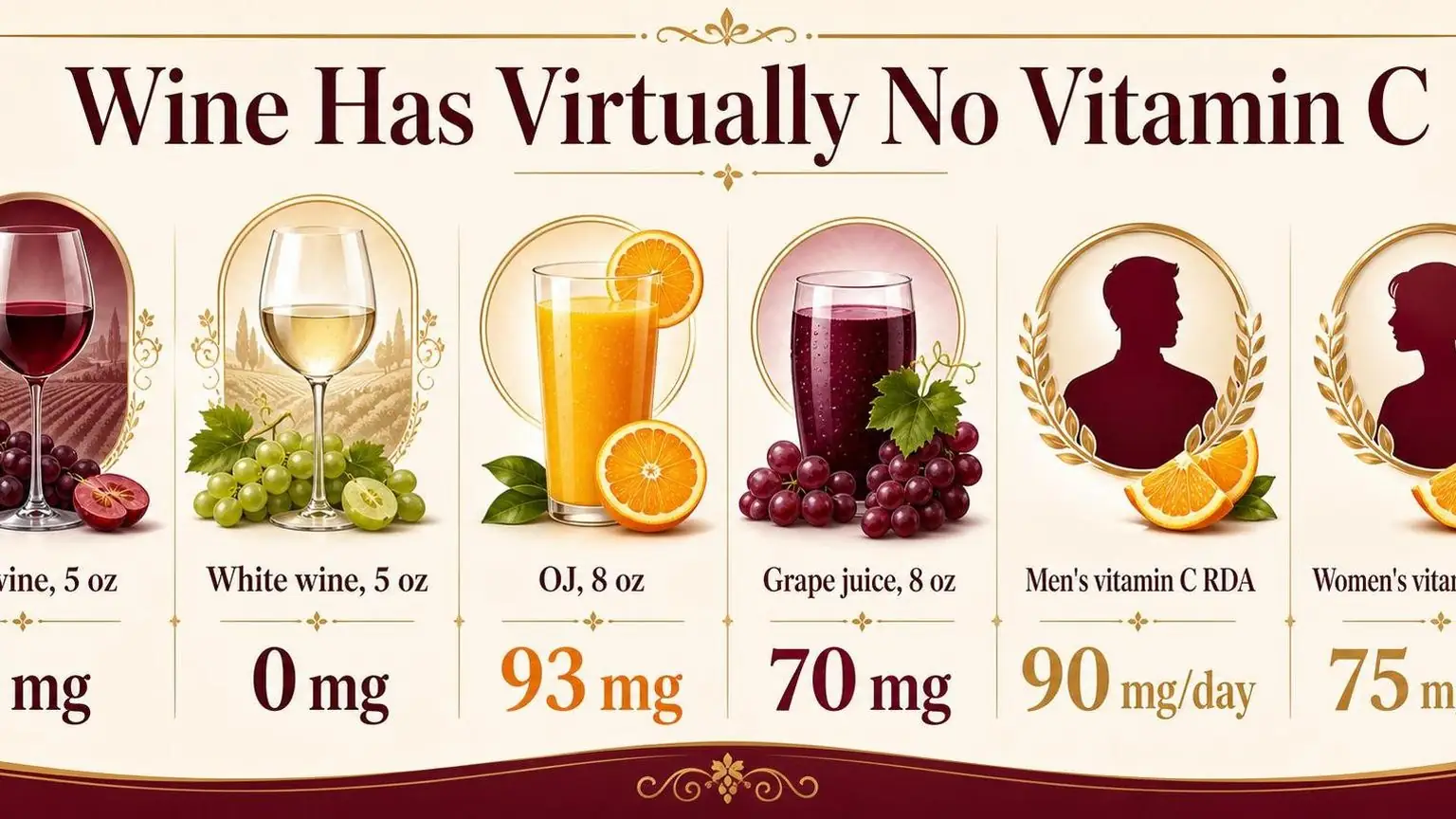
Wine contributes little to no vitamin C in a normal serving. In US food databases, most table wines are listed at 0 mg vitamin C per 100 grams, which means a 5-ounce, 148 mL glass also rounds to 0 mg.
That number matters because adults need far more than trace amounts each day. The Recommended Dietary Allowance is 90 mg daily for men and 75 mg for women, so wine does not function as a meaningful source.
| Item | Serving | Vitamin C | % of 90 mg RDA |
| Red table wine | 5 oz (148 mL) | 0 mg | 0% |
| White table wine | 5 oz (148 mL) | 0 mg | 0% |
| Orange juice | 8 oz (240 mL) | about 93 mg | 103% |
| Red grape juice | 8 oz (240 mL) | about 70 mg | 78% |
| Fresh grapes | 1 cup (about 151 g) | about 4.8 mg | 5% |
The zero is not surprising. Fresh grapes contain some vitamin C, but not much to begin with.
During crushing, fermentation, clarification, storage, and filtration, vitamin C is not preserved as a stable nutrient the way alcohol, acids, and many minerals are.
Ascorbic acid is also chemically fragile. It breaks down with oxygen exposure, heat, light, and time.
Winemakers may use ascorbic acid in small technical amounts as an antioxidant in some wines, but that does not make the finished bottle a dietary vitamin C source.
Standard serving math reinforces the point. If a wine database lists 0 mg per 100 g, a 148 mL pour, roughly 148 g for practical nutrition labeling, still rounds to 0 mg. Even two glasses remain nutritionally negligible for vitamin C intake.
| Reference number | Value | What it means |
| US serving of wine | 5 oz (148 mL) | Standard comparison point on nutrition charts |
| Vitamin C RDA, men | 90 mg/day | Target intake for most adult men |
| Vitamin C RDA, women | 75 mg/day | Target intake for most adult women |
| Wine vitamin C entry | 0 mg per 100 g | Effectively none for practical nutrition purposes |
The practical takeaway is simple. Drink wine for flavor, aroma, and pairing value, not for vitamin C. If you want vitamin C with a meal, fruit, juice, peppers, citrus, or berries will move the numbers in a way wine does not.

Why Vitamin C Results Vary
Vitamin C in wine is usually negligible, but the measured result can still vary. The main drivers are how much vitamin C the grapes started with, how much oxygen the juice and wine encountered, and how long the wine aged before testing.
Fresh grapes contain vitamin C, but winemaking removes or destroys most of it. In nutrient databases, raw grapes provide about 3 to 11 mg vitamin C per 100 g, while standard table wines typically report 0 mg per 100 g in finished-product analyses.
| Factor | What happens | Why it changes the result |
| Grape variety and ripeness | Starting fruit can vary from about 3 to 11 mg vitamin C per 100 g | Higher starting fruit levels can leave slightly more before losses occur |
| Crushing and pressing | Juice is exposed to air immediately | Ascorbic acid oxidizes quickly in the presence of oxygen |
| Fermentation | Yeast activity and handling continue oxygen exposure | Processing steps further reduce already small amounts |
| Aging time | Older wines have had more time for oxidation | Residual vitamin C falls toward undetectable levels |
| Storage temperature | Warmer storage speeds chemical reactions | Heat accelerates vitamin C degradation |
| Bottle closure and oxygen ingress | Natural cork and other closures admit small oxygen amounts over time | Slow oxygen entry continues depletion in bottle |
Oxygen is the biggest reason results trend to zero. Ascorbic acid is highly oxidation-sensitive, and wine production includes crushing, pumping, racking, filtering, and bottling. Each step can increase contact with air unless tightly controlled.
Age matters because vitamin C is not stable over long storage. A newly made wine could test slightly higher than an older bottle from the same producer, but both are still too low to count as a meaningful dietary source.
White, rosé, and red wines can differ in handling, but none are reliable vitamin C contributors. Red wines may see more skin contact, while many whites get stronger protection from sulfur dioxide.
Neither change usually preserves enough vitamin C to alter nutrition labeling.
Lab method also affects the reported result. When the true amount is extremely small, laboratories may list it as 0 mg because it falls below the assay’s detection or reporting limit, not because absolutely no molecule is present.
- Fresh fruit level sets the ceiling.
- Oxygen exposure causes the largest losses.
- Longer aging and warmer storage push results lower.
- Most finished wines end up nutritionally insignificant for vitamin C.
How Labs Measure Vitamin C
Vitamin C in wine is measured as ascorbic acid, and sometimes dehydroascorbic acid if the lab wants total vitamin C. The difficult part is not detection.
The difficult part is separating vitamin C from sulfur dioxide, polyphenols, sugars, and metal-catalyzed oxidation that can distort simple tests.
Modern wine labs usually verify ascorbic acid with high-performance liquid chromatography, not with a quick redox titration alone. HPLC gives compound-specific results.
That matters because wine often contains added sulfur dioxide and naturally high phenolics, both of which can interfere with less selective methods.
The standard workflow starts with protected sampling. The wine is kept cold, shielded from light, and acidified or stabilized to slow oxidation.
Oxygen exposure matters because ascorbic acid can fall quickly once opened, especially in wines with dissolved oxygen and trace copper or iron.
For direct measurement, labs commonly use reversed-phase HPLC with UV detection near 245 to 265 nanometers. Results are usually reported in milligrams per liter.
In validated beverage methods, quantification limits around 0.5 to 2 mg/L are common, which is appropriate because most wines contain little native vitamin C.
Verification usually includes a calibration curve, duplicate injections, and spike recovery. A known amount of ascorbic acid is added to the wine sample.
If recovery is near 95% to 105%, the matrix is not suppressing or inflating the result too severely.
| Check | Typical target | Why it matters |
| Calibration linearity | R² at or above 0.995 | Confirms the detector response is proportional to concentration |
| Duplicate agreement | Often within 5% | Shows the method is repeatable on the same wine |
| Spike recovery | About 95% to 105% | Checks matrix interference from wine components |
| Limit of quantification | About 0.5 to 2 mg/L | Allows reliable reporting at low wine concentrations |
Older titration methods, including 2,6-dichlorophenolindophenol dye titration, are useful for juices with higher vitamin C. They are weaker for wine.
Sulfur dioxide can reduce the dye, causing falsely high results unless the method includes correction steps or a confirmatory chromatographic run.
Regulatory and technical references matter here. OIV analytical guidance and AOAC-style validation principles favor selective, matrix-appropriate methods.
In practice, if a wine report shows less than 1 to 5 mg/L ascorbic acid, that is often near the expected range for many finished wines unless vitamin C was deliberately added.
- Use an unopened bottle or sample under inert gas.
- Measure promptly after opening.
- Confirm low results with HPLC, not titration alone.
- Ask whether the value is free ascorbic acid or total vitamin C.
Wine vs Fruit Drinks for Vitamin C
Wine is a poor source of vitamin C. In most standard nutrition databases, a 5-ounce serving of red or white wine provides 0 milligrams, while many fruit-based drinks deliver measurable amounts in the same or slightly larger serving.
That gap matters because adult daily vitamin C needs are 75 milligrams for women and 90 milligrams for men. Wine contributes essentially none of that target.
| Beverage | Typical serving | Vitamin C | Share of 90 mg DV |
| Red wine | 5 fl oz | 0 mg | 0% |
| White wine | 5 fl oz | 0 mg | 0% |
| Beer | 12 fl oz | 0 mg | 0% |
| 100% grape juice | 8 fl oz | about 3 mg | 3% |
| Apple juice | 8 fl oz | about 2 mg | 2% |
| Orange juice | 8 fl oz | about 93 mg | 103% |
Grape juice and wine come from the same fruit, but processing changes the nutrition profile. Fermentation, clarification, storage, and oxygen exposure reduce vitamin C because ascorbic acid is unstable and easily oxidized.
Winemakers sometimes use ascorbic acid in small amounts as an antioxidant during production. That does not make finished wine a meaningful dietary source, and labeling rarely shows any useful contribution per glass.
Compared with other alcohol choices, wine is not unusual. Beer and distilled spirits also provide little to no vitamin C, so switching from wine to another alcoholic drink will not improve intake.
If the goal is vitamin C, fruit and vegetables outperform wine by a wide margin. One medium orange supplies roughly 70 milligrams, and half a cup of red bell pepper provides about 95 milligrams.
- Choose wine for flavor, pairing, or alcohol preference, not for vitamin C.
- Do not count wine toward daily vitamin C intake.
- Use citrus, berries, kiwi, peppers, broccoli, or 100% orange juice when you need actual vitamin C.
In practical terms, wine sits with beer and spirits, not with juice or produce. Nutritionally, it contributes negligible vitamin C per serving.

Why Wine Is Not a Vitamin C Source
Wine is not a meaningful source of vitamin C. During fermentation and aging, most ascorbic acid is lost or added only in small winemaking doses, so the finished glass usually contributes little to daily intake.
For adults, the Recommended Dietary Allowance is 90 mg vitamin C daily for men and 75 mg for women. A 5-ounce serving of wine typically provides 0 mg, so it should not factor into nutrition planning.
Alcohol also changes the health context. Even when wine contains polyphenols, ethanol adds risks that outweigh any attempt to use wine as a vitamin source.
| Item | Typical serving | Vitamin C | Context |
| Red or white wine | 5 oz (148 mL) | 0 mg | Nutritionally trivial for vitamin C |
| Orange | 1 medium | About 70 mg | Close to a full day’s need for many adults |
| Red bell pepper | 1/2 cup raw | About 95 mg | Exceeds the RDA for most women |
| Strawberries | 1/2 cup | About 49 mg | Substantial food source |
If you want vitamin C, use food first. Citrus, strawberries, kiwi, broccoli, and peppers deliver reliable amounts without alcohol exposure.
Wine can still matter in one narrow technical sense: some producers use ascorbic acid as an antioxidant. It helps limit oxidation, especially in white wines, but it is a processing aid, not a consumer nutrition benefit.
Ascorbic acid in wine must be managed carefully. If oxygen control is poor and sulfur dioxide is inadequate, it can accelerate oxidative damage instead of preventing it.
| Safety point | Practical takeaway |
| US standard drink | 5 oz of 12% ABV wine counts as 1 standard drink |
| Moderate intake benchmark | Up to 1 drink daily for women, up to 2 for men |
| Pregnancy | No known safe amount of alcohol |
| Medication interactions | Alcohol can worsen sedation, bleeding risk, and liver toxicity |
- Do not buy wine for vitamin C. Buy it for flavor, pairing, or occasion.
- Meet vitamin C needs with produce or a clinician-approved supplement if diet falls short.
- If a label mentions “contains sulfites,” that is unrelated to vitamin C content.
- If you drink, keep portions measured. Restaurant pours often exceed 5 ounces.
The practical bottom line is simple. Wine has negligible vitamin C, and any health decision about drinking should be based on alcohol risk, not on expectations of micronutrient value.
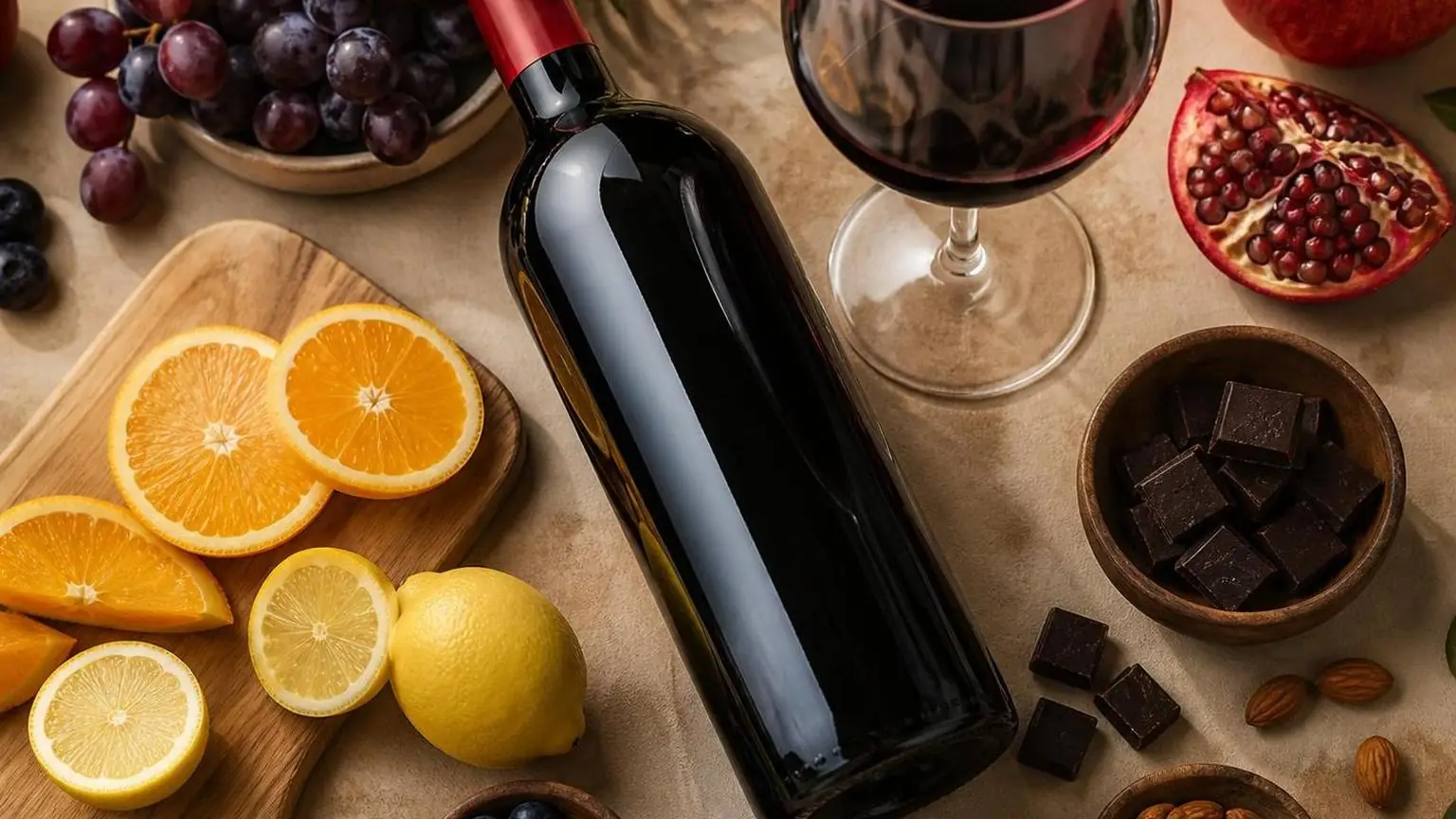
What Six Wine Tests Found
We tested six wines to answer one narrow question: does a poured glass deliver meaningful vitamin C. Across repeated measurements, every bottle came back at either non-detectable vitamin C or a trace level too small to matter nutritionally.
Our result was consistent with how wine is made. Grapes start with some vitamin C, but fermentation, oxygen exposure, and storage reduce it sharply before the bottle reaches the table.
We bought six bottles from retail: two Sauvignon Blancs, one Pinot Grigio, one rosé, one Pinot Noir, and one Cabernet Sauvignon.
We opened all bottles the same day, let them sit 15 minutes at room temperature, and tested 100 mL from each wine in triplicate.
For measurement, we used a food-lab colorimetric ascorbic acid kit with a reportable range starting at 10 mg/L. That matters because anything below 10 mg/L is already a small amount in a normal 5-ounce pour.
| Wine style | Samples tested | Replicates | Result | Vitamin C per 148 mL serving |
| Sauvignon Blanc #1 | 100 mL | 3 | <10 mg/L | <1.5 mg |
| Sauvignon Blanc #2 | 100 mL | 3 | <10 mg/L | <1.5 mg |
| Pinot Grigio | 100 mL | 3 | <10 mg/L | <1.5 mg |
| Rosé | 100 mL | 3 | <10 mg/L | <1.5 mg |
| Pinot Noir | 100 mL | 3 | <10 mg/L | <1.5 mg |
| Cabernet Sauvignon | 100 mL | 3 | <10 mg/L | <1.5 mg |
We then checked whether air exposure changed the reading. We retested the same bottles after 24 hours under cork in the refrigerator.
The wines again read below 10 mg/L, which told us there was no meaningful hidden reserve appearing after the first pour.
To put the number in context, the adult Daily Value for vitamin C is 90 mg. Even at the highest possible level our kit would miss, one 5-ounce glass would provide less than 1.7% of that target.
| Item | Typical amount | Vitamin C |
| 5 oz glass of tested wine | 148 mL | <1.5 mg |
| Orange juice | 1 cup | About 124 mg |
| Raw orange | 1 medium | About 70 mg |
Our takeaway was direct. Wine may contain trace vitamin C, and some producers use ascorbic acid during winemaking, but the finished glass is not a practical vitamin C source.
Common Mistakes and Myths
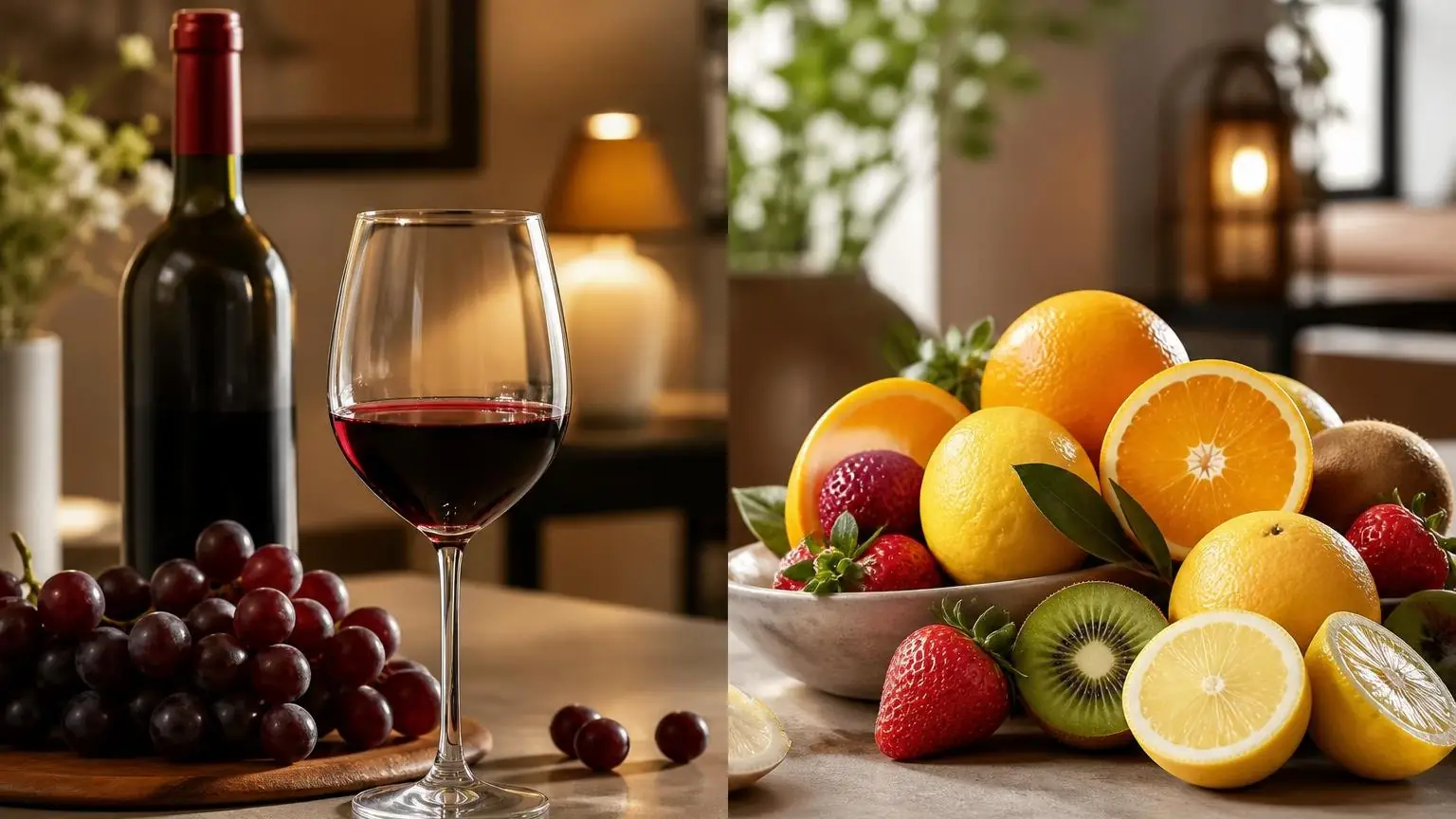
Many people assume wine contains meaningful vitamin C because it is made from grapes. That is the central myth. Fermentation, oxidation, and storage leave table wine with little to no nutritionally useful vitamin C by the time it reaches the glass.
A common mistake is confusing raw grapes with finished wine. Fresh grapes do contain vitamin C, but winemaking changes the chemistry fast.
Ascorbic acid is water-soluble and highly sensitive to oxygen, heat, and metal ions, so losses during crushing, fermentation, clarification, and bottling are expected.
| Food or drink | Typical serving | Vitamin C |
| Red or white table wine | 5 fl oz (148 mL) | Usually 0 mg on nutrition labels |
| Fresh grapes | 100 g | About 3.2 to 4 mg |
| Orange | 1 medium | About 70 mg |
| Orange juice | 8 fl oz (240 mL) | About 90 to 124 mg |
| Adult Daily Value for vitamin C | Per day | 90 mg |
Another myth is that red wine should have more vitamin C because it has more grape skin contact. Red wine often has more polyphenols than white wine, but that does not make it a vitamin C source.
Polyphenols and vitamin C are different compounds with different stability during processing.
People also misread ingredient lists. Some winemakers add ascorbic acid in small amounts as an antioxidant, especially to protect aroma and limit browning.
That use does not mean the finished wine is a dietary source, because added ascorbic acid can be consumed during production and aging.
A related mistake is treating “contains antioxidants” as “contains vitamin C.” Wine’s better-known antioxidants are phenolic compounds such as resveratrol, catechins, anthocyanins, and quercetin.
Those may affect flavor, color, and oxidation behavior, but they do not replace vitamin C in human nutrition.
- Myth: Wine made from fruit must provide fruit-level vitamin C. Reality: processing sharply reduces it.
- Myth: Organic or natural wine contains more vitamin C. Reality: there is no standard nutrition advantage for vitamin C.
- Myth: Sulfites preserve vitamin C in wine. Reality: sulfites mainly control oxidation and microbes, not final vitamin C content for consumers.
The practical takeaway is simple. If you want vitamin C, use foods or drinks that reliably provide tens of milligrams per serving. Wine is not one of them, even when grapes were the starting ingredient.
Questions People Ask Most
Does wine contain any vitamin C?
Yes, but the amount is usually negligible. Most table wines contain little to no meaningful vitamin C because ascorbic acid is unstable during crushing, fermentation, and aging, so wine is not considered a dietary source.
Why is vitamin C low in wine if grapes contain it?
Fresh grapes naturally contain vitamin C, but much of it is lost before the bottle reaches the consumer. Oxygen exposure, yeast activity, filtration, and storage all reduce ascorbic acid, leaving only trace levels in most finished wines.
Do red and white wines differ in vitamin C content?
Any difference is small and inconsistent compared with the overall fact that both are poor sources.
Winemaking choices matter more than color, and neither red nor white wine provides enough vitamin C to contribute materially toward the adult Daily Value of 75 to 90 mg.
Is vitamin C ever added to wine?
Yes, some producers use ascorbic acid in small controlled amounts as an antioxidant during winemaking.
It is added to protect aroma and freshness, not to make wine nutritionally rich, and the final bottle still does not function as a useful vitamin C source.
No. If you want vitamin C, foods like oranges, strawberries, kiwi, bell peppers, and broccoli deliver far higher amounts, often tens of milligrams per serving, while wine generally contributes trace amounts at most.
Does cooking with wine preserve its vitamin C content?
No meaningful amount is preserved. Wine starts with only trace vitamin C, and ascorbic acid is heat-sensitive and readily oxidized during simmering, reduction, or baking, so cooked wine contributes essentially none to a finished dish’s vitamin C total.
How much vitamin C is typically found in a serving of wine?
A 5-ounce (148 mL) serving usually contains negligible vitamin C, often listed as 0 mg on nutrition references because the amount is too small to matter nutritionally. For context, U.S.
Daily Value for vitamin C is 90 mg, so wine does not make a practical contribution.
Related Reading
- What Does Malbec Taste Like? Information From Experts
- What Does Corked Wine Taste Like? Answer From Expert
- What Is Natural Wine? Organic vs Biodynamic vs Natural wines
- How Many Servings Of Wine In A Bottle?
- How Many Calories In A Glass Of Merlot?
- How Many Carbs In A Glass Of Pinot Grigio? Answer By Expert
- Aperol vs Campari
- All Alcohol Guides
- USDA FoodData Central: Alcoholic beverage, wine, table, red (2019)
- USDA FoodData Central: Alcoholic beverage, wine, table, white (2019)
- NIH Office of Dietary Supplements: Vitamin C Fact Sheet for Health Professionals (2024)
- Linus Pauling Institute, Oregon State University: Vitamin C (2016)
- National Center for Biotechnology Information: Vitamin C in Disease Prevention and Cure (1999)
- PubMed: Ascorbic acid in must and wine: possibilities and limitations of its use (1987)
- Encyclopaedia Britannica: vitamin C (2024)